
 KES

Search
- Page Path
- HOME > Search
Original Articles
- Miscellaneous
- AM1638, a GPR40-Full Agonist, Inhibited Palmitate- Induced ROS Production and Endoplasmic Reticulum Stress, Enhancing HUVEC Viability in an NRF2-Dependent Manner
- Hwan-Jin Hwang, Joo Won Kim, SukHwan Yun, Min Jeong Park, Eyun Song, Sooyeon Jang, Ahreum Jang, Kyung Mook Choi, Sei Hyun Baik, Hye Jin Yoo
- Endocrinol Metab. 2023;38(6):760-769. Published online November 2, 2023
- DOI: https://doi.org/10.3803/EnM.2023.1774
- 7,509 View
- 137 Download
- 7 Web of Science
- 8 Crossref
-
 Abstract
 PDF
 PubReader
 ePub
- Background
G protein-coupled receptor 40 (GPR40) is a key molecule in diabetes and fatty liver, but its role in endothelial dysfunction remains unclear. Our objective in this study was to determine whether GPR40 agonists protect endothelial cells against palmitatemediated oxidative stress.
Methods
Human umbilical vein endothelial cells (HUVECs) were used to investigate effects of various GPR40 agonists on vascular endothelium.
Results
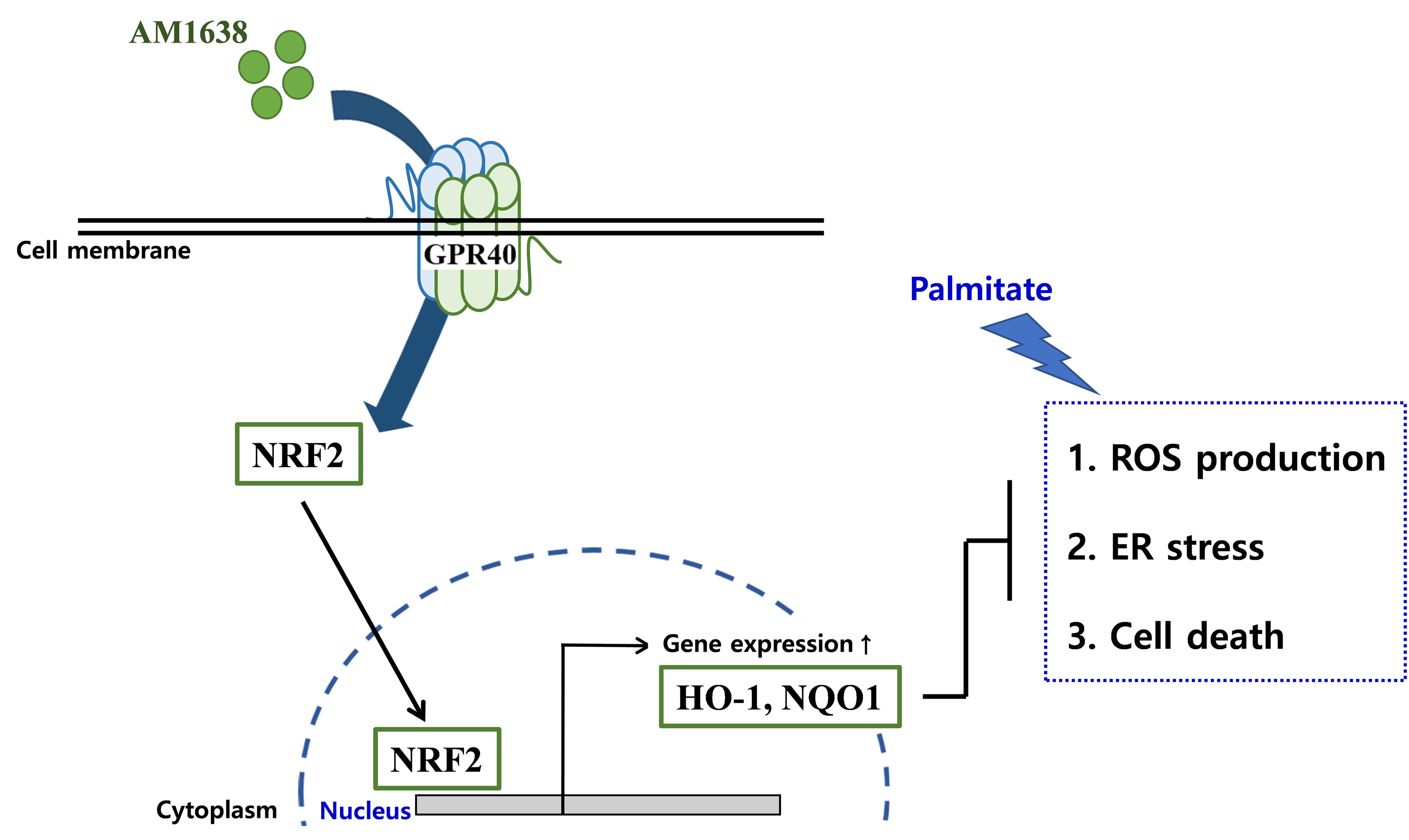
In HUVECs, AM1638, a GPR40-full agonist, enhanced nuclear factor erythroid 2–related factor 2 (NRF2) translocation to the nucleus and heme oxygenase-1 (HO-1) expression, which blocked palmitate-induced superoxide production. Those antioxidant effects were not detected after treatment with LY2922470 or TAK875, GPR40-partial agonists, suggesting that GPR40 regulates reactive oxygen species (ROS) removal in a ligand-dependent manner. We also found that palmitate-induced CCAAT/enhancer‐binding protein homologous protein expression; X-box binding protein-1 splicing, nuclear condensation, and fragmentation; and caspase-3 cleavage were all blocked in an NRF2-dependent manner after AM1638 treatment. Both LY2922470 and TAK875 also improved cell viability independent of the NRF2/ROS pathway by reducing palmitate-mediated endoplasmic reticulum stress and nuclear damage. GPR40 agonists thus have beneficial effects against palmitate in HUVECs. In particular, AM1638 reduced palmitate-induced superoxide production and cytotoxicity in an NRF2/HO-1 dependent manner.
Conclusion
GPR40 could be developed as a good therapeutic target to prevent or treat cardiovascular diseases such as atherosclerosis. -
Citations
Citations to this article as recorded by
- From oxidative stress to metabolic dysfunction: The role of TRPM2
Ying-Shuang Li, Hua-Cheng Ren, Hui Li, Man Xing, Jian-Hua Cao
International Journal of Biological Macromolecules.2025; 284: 138081. CrossRef - Discovery of potent free fatty acid receptor 1 full agonists with a novel scaffold bearing conjugated double bond linker
Ziwei Yang, Jun Sun, Tifei Xu, Yu Wang, Jiahui Fang, Kai Wang, Shimeng Guo, Xin Xie, Jianhua Shen
Bioorganic & Medicinal Chemistry.2025; 123: 118158. CrossRef - GPR40-full agonist AM1638 alleviates palmitate-induced oxidative damage in H9c2 cells via an AMPK-dependent pathway
SukHwan Yun, Joo Won Kim, Min Jeong Park, Eyun Song, Soo Yeon Jang, Ahreum Jang, Kyung Mook Choi, Sei Hyun Baik, Hwan-Jin Hwang, Hye Jin Yoo
BMB Reports.2025; 58(3): 133. CrossRef - HD6277 Suppresses Muscle Atrophy by Promoting Myogenic Factors and Inhibiting Proteolysis in Aged Mice
Joo Won Kim, SukHwan Yun, Min Jeong Park, Eyun Song, Sooyeon Jang, Ahreum Jang, Kyung Mook Choi, Sei Hyun Baik, Hwan‐Jin Hwang, Hye Jin Yoo
Journal of Cachexia, Sarcopenia and Muscle.2025;[Epub] CrossRef - Sarcopenic obesity: prospects of mitochondrial transplantation to combat metabolic deterioration in aging
Md Ariful Islam, Wenyi Gu, Yijie Song, Yu Xu, Hongxi Xu
Acta Materia Medica.2025;[Epub] CrossRef - Molecular mechanisms of aberrant fatty acids metabolism in driving cardiovascular diseases: key regulatory targets and dietary interventions
Rui Yang, Jiao Pang, Xue Zhong, Shuyang Pang, Xuefeng Hu, Chenfei Wei, Weiqi Yan, Xueting Chen, Rui Zhao, Baojun Xu, Zhipeng Cao
Food & Function.2025; 16(15): 5961. CrossRef - Hypoglycemic and Analgesic Effects of Benzyloxyphenylpropanoic Derivatives of Isobornylamine as FFAR‐1 Agonists
Mariya A. Elkina, Mikhail V. Khvostov, Sergey O. Kuranov, Olga A. Luzina, Natalia A. Zhukova, Yulia V. Meshkova, Tatiana G. Tolstikova, Nariman F. Salakhutdinov
Archiv der Pharmazie.2025;[Epub] CrossRef - Free Fatty Acids and Free Fatty Acid Receptors: Role in Regulating Arterial Function
Fengzhi Yu, Boyi Zong, Lili Ji, Peng Sun, Dandan Jia, Ru Wang
International Journal of Molecular Sciences.2024; 25(14): 7853. CrossRef
- From oxidative stress to metabolic dysfunction: The role of TRPM2

- Thyroid
- Immunoglobulin G4-Related Thyroid Disease: A Single-Center Experience and Literature Review
- Meihua Jin, Bictdeun Kim, Ahreum Jang, Min Ji Jeon, Young Jun Choi, Yu-Mi Lee, Dong Eun Song, Won Gu Kim
- Endocrinol Metab. 2022;37(2):312-322. Published online April 25, 2022
- DOI: https://doi.org/10.3803/EnM.2021.1318
- 15,614 View
- 306 Download
- 6 Web of Science
- 7 Crossref
-
Abstract
PDFPubReader ePub
- Background
Immunoglobulin G4 (IgG4)-related disease is an entity that can involve the thyroid gland. The spectrum of IgG4-related thyroid disease (IgG4-RTD) includes Hashimoto thyroiditis (HT) and its fibrotic variant, Riedel thyroiditis, as well as Graves’ disease. The early diagnosis of IgG4-RTD is important because it is a medically treatable disease, and a delay in the diagnosis might result in unnecessary surgery. We present a case series of IgG4-RTD with a review of the literature.
Methods
We retrospectively reviewed the clinical presentation and the radiological and pathological findings of patients diagnosed with IgG4-RTD between 2017 and 2021 at a tertiary medical center in Korea. We also conducted a literature review of IgG4-RTD.
Results
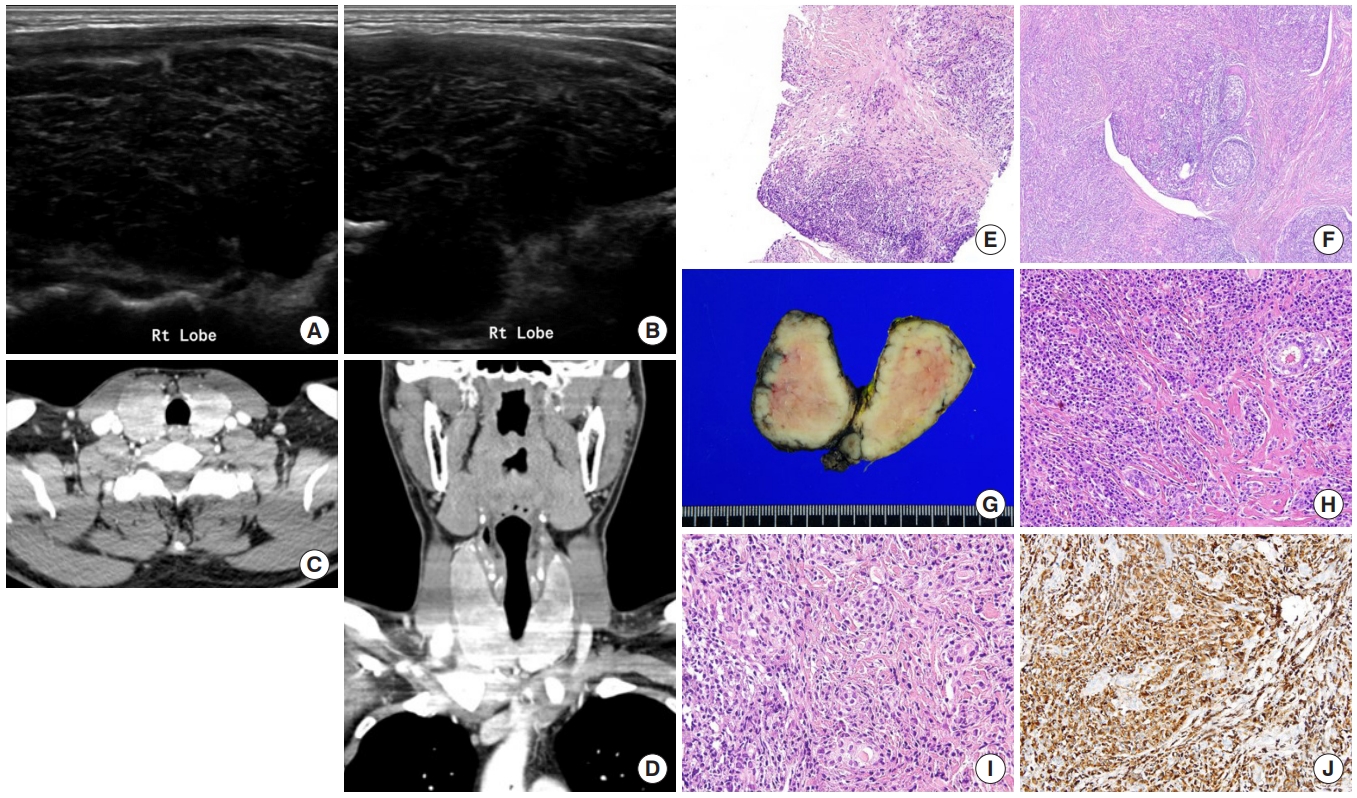
Five patients were diagnosed with IgG4-RTD during the study period. The patients’ age ranged from 31 to 76 years, and three patients were men. Most patients visited the clinic for a neck mass, and hypoechogenic nodular lesions were observed on neck ultrasonography. Three patients had IgG4 HT, and two patients had IgG4 Riedel thyroiditis. All patients developed hypothyroidism that necessitated L-thyroxine replacement. The diagnosis of IgG4-RTD was confirmed after a pathological examination of the surgical specimen in the first two cases. However, the early diagnosis was possible after a core needle biopsy in three clinically suspected patients.
Conclusion
The diagnosis of IgG4-RTD requires clinical suspicion combined with serology and histological analyses using IgG4 immunostaining. The early diagnosis of IgG4-RTD is difficult; thus, biopsy with IgG4 immunostaining and serum IgG4 measurements will help diagnose patients suspected of having IgG4-RTD. -
Citations
Citations to this article as recorded by- Usefulness of core needle biopsy of thyroid for the diagnosis of IgG4 Hashimoto's thyroiditis
Chenxu Zhao, Yang Yu, Jumei Liu, Yang Zhang, Lei Chen, Guizhi Lu, Ying Gao
Journal of Translational Internal Medicine.2026; 14(2): 306. CrossRef - Clinical Significance of Serum IgG-4 Levels in Autoimmune Hypothyroidism and their Relationship to Thyroid Function Parameters
Mina AkbariRad, AmirAli Moodi Ghalibaf, Mitra Ahadi, Ali Tajik, Milad Beizaei, Mohammad Reza Rouhbakhsh Zahmatkesh, Abdollah Firoozi, Zahra Mazloum Khorasani
SN Comprehensive Clinical Medicine.2026;[Epub] CrossRef - IgG4-Related Disease: Current and Future Insights into Pathological Diagnosis
Marlon Arias-Intriago, Tamar Gomolin, Flor Jaramillo, Adriana C. Cruz-Enríquez, Angie L. Lara-Arteaga, Andrea Tello-De-la-Torre, Esteban Ortiz-Prado, Juan S. Izquierdo-Condoy
International Journal of Molecular Sciences.2025; 26(11): 5325. CrossRef - IgG4-Mediated Sclerosing Riedel Thyroiditis: A Multidisciplinary Case Study and Literature Review
Dumitru Ioachim, Mihai Alin Publik, Dana Terzea, Carmen Adina Cristea, Adina Mariana Ghemigian, Anda Dumitrascu, Eugenia Petrova, Alexandra Voinea, Romeo Smarandache, Mihail Ceausu
International Journal of Molecular Sciences.2025; 26(16): 7786. CrossRef - Are sonographic characteristics of Hashimoto’s thyroiditis related with immunologic parameters? A cross-sectional study
K. Kenarlı, A. B. Bahçecioğlu, Ö. B. Aksu, S. Güllü
Journal of Endocrinological Investigation.2024; 47(7): 1701. CrossRef - A machine learning-based diagnosis modeling of IgG4 Hashimoto’s thyroiditis
Chenxu Zhao, Zhiming Sun, Yang Yu, Yiwei Lou, Liyuan Liu, Ge Li, Jumei Liu, Lei Chen, Sainan Zhu, Yu Huang, Yang Zhang, Ying Gao
Endocrine.2024; 86(2): 672. CrossRef - Reshaping the Concept of Riedel’s Thyroiditis into the Larger Frame of IgG4-Related Disease (Spectrum of IgG4-Related Thyroid Disease)
Mara Carsote, Claudiu Nistor
Biomedicines.2023; 11(6): 1691. CrossRef
- Usefulness of core needle biopsy of thyroid for the diagnosis of IgG4 Hashimoto's thyroiditis
 First
 Prev


