
 KES

Search
- Page Path
- HOME > Search
Review Article
- Diabetes, Obesity and Metabolism
- Overcoming Therapeutic Inertia as the Achilles’ Heel for Improving Suboptimal Diabetes Care: An Integrative Review
- Boon-How Chew, Barakatun-Nisak Mohd-Yusof, Pauline Siew Mei Lai, Kamlesh Khunti
- Endocrinol Metab. 2023;38(1):34-42. Published online February 16, 2023
- DOI: https://doi.org/10.3803/EnM.2022.1649
- 12,831 View
- 395 Download
- 16 Web of Science
- 18 Crossref
-
 Abstract
 PDF
 PubReader
 ePub
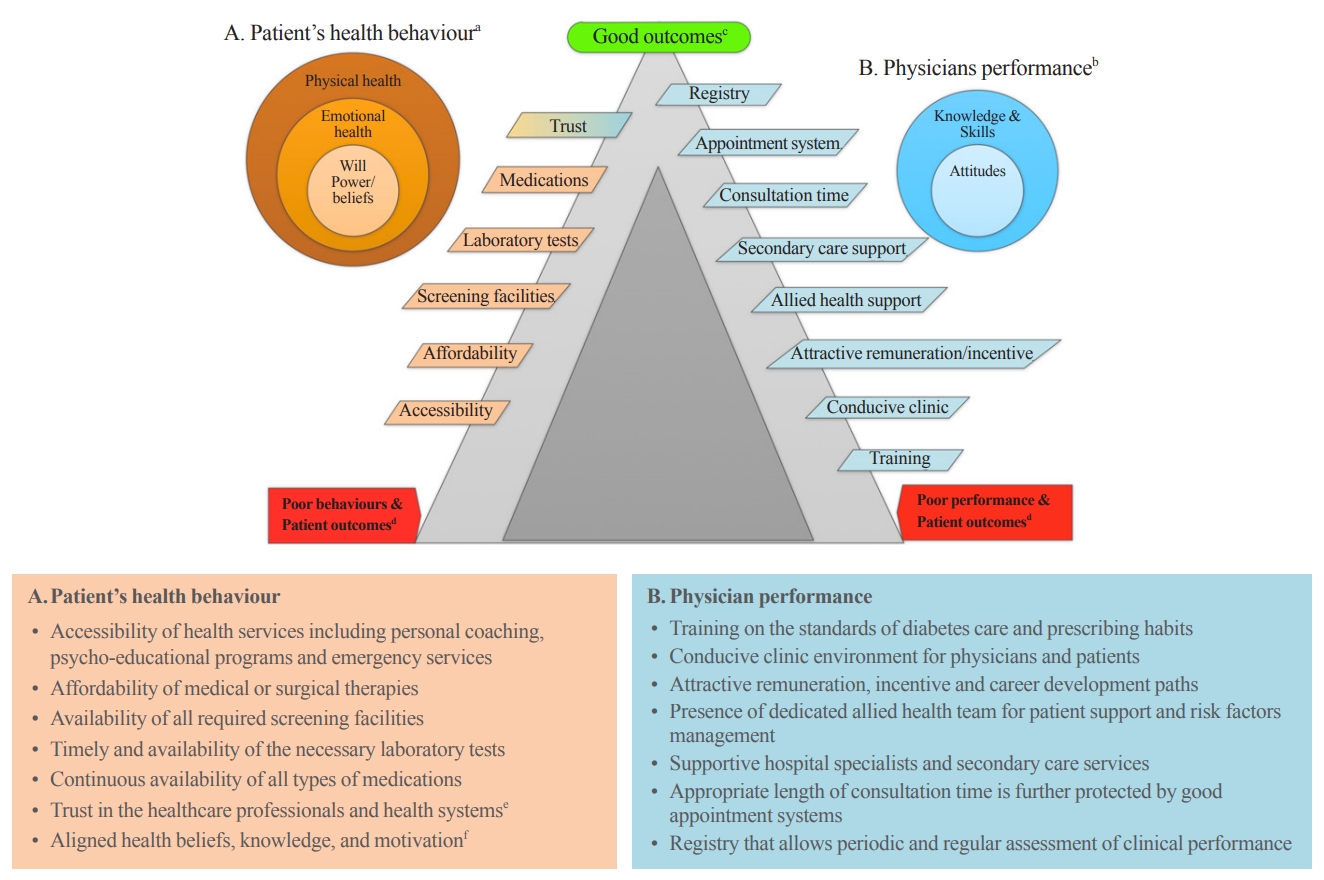
- The ultimate purpose of diabetes care is achieving the outcomes that patients regard as important throughout the life course. Despite advances in pharmaceuticals, nutraceuticals, psychoeducational programs, information technologies, and digital health, the levels of treatment target achievement in people with diabetes mellitus (DM) have remained suboptimal. This clinical care of people with DM is highly challenging, complex, costly, and confounded for patients, physicians, and healthcare systems. One key underlying problem is clinical inertia in general and therapeutic inertia (TI) in particular. TI refers to healthcare providers’ failure to modify therapy appropriately when treatment goals are not met. TI therefore relates to the prescribing decisions made by healthcare professionals, such as doctors, nurses, and pharmacists. The known causes of TI include factors at the level of the physician (50%), patient (30%), and health system (20%). Although TI is often multifactorial, the literature suggests that 28% of strategies are targeted at multiple levels of causes, 38% at the patient level, 26% at the healthcare professional level, and only 8% at the healthcare system level. The most effective interventions against TI are shorter intervals until revisit appointments and empowering nurses, diabetes educators, and pharmacists to review treatments and modify prescriptions.
-
Citations
Citations to this article as recorded by
- Neurologists’ decision-making in the management of generalised myasthenia gravis: Therapeutic inertia and treatment choices
Gerardo Gutiérrez-Gutiérrez, Rocío Gómez-Ballesteros, Adrián Ares, Ramón Villaverde, Virginia Reyes, Thaís Armangué, Paola Díaz-Abós, Pablo Rebollo, Neus Canal, Luis Querol, Jorge Maurino, Elena Cortés-Vicente
Journal of Neuromuscular Diseases.2026; 13(5): 1039. CrossRef - Identifying Provider Prescribing Practices for GLP‐1RAs and SGLT‐2is in Patients With Type 2 Diabetes to Address Pharmacoinequity
Parnnate Wongsirisakul, Vincent L. Chen, Ponni V. Perumalswami, Piaopiao Li
Journal of Diabetes Research.2026;[Epub] CrossRef - Assessing Clinical Inertia on Implementing Clinical Guideline Recommendations in Patients with Type 2 Diabetes: A Clinician Survey Study
Judith Stephenson, Nancy Witkowski, Joseph Smith, Anny Wong, Lindsay Bengtson, Vincent Willey
Diabetes, Metabolic Syndrome and Obesity.2026; Volume 19: 1. CrossRef - A Real-World Evaluation of Therapeutic Inertia in Patients with Severe Uncontrolled Chronic Obstructive Pulmonary Disease
Myriam Calle Rubio, Juan José Soler-Cataluña, Pere Almagro, Arturo Huerta, Diego González-Segura, Borja Cosío
International Journal of Chronic Obstructive Pulmonary Disease.2026; Volume 21: 1. CrossRef - Implementing SGLT2 Inhibitor Therapy in Line with the New NICE Guidelines for Type 2 Diabetes Management
Philip Newland-Jones, Partha Kar, Beth Kelly, Rahul Mohan, Sarah Davies, Jane Diggle, Marc Evans, Kevin Fernando, Debbie Hicks, Naresh Kanumilli, Nicola Milne, Dipesh Patel, Samuel Seidu, Adie Viljoen, David C. Wheeler, John P. H. Wilding
Diabetes Therapy.2026; 17(8): 1095. CrossRef - Initial conceptual development of a pilot questionnaire for patient-perceived clinical inertia in chronic disease management: an exploratory study with a predominantly Peruvian sample
Jorge Isaac Necochea-Chamorro, Monica Elisa Meneses-La-Riva
Frontiers in Health Services.2026;[Epub] CrossRef - Medication adherence: an overlooked critical determinant of pharmacological effectiveness
Michel Burnier, Michel Azizi, Pankaj Gupta, Przemyslaw Kardas, Marie-Paule Schneider, Bernard Vrijens
Pharmacological Reviews.2026; : 100161. CrossRef - Efficient and Effective Diabetes Care in the Era of Digitalization and Hypercompetitive Research Culture: A Focused Review in the Western Pacific Region with Malaysia as a Case Study
Boon-How Chew, Pauline Siew Mei Lai, Dhashani A/P Sivaratnam, Nurul Iftida Basri, Geeta Appannah, Barakatun Nisak Mohd Yusof, Subashini C. Thambiah, Zubaidah Nor Hanipah, Ping-Foo Wong, Li-Cheng Chang
Health Systems & Reform.2025;[Epub] CrossRef - Clinical control in COPD and therapeutic implications: The EPOCONSUL audit
Myriam Calle Rubio, Marc Miravitlles, Juan José Soler Cataluña, José Luis López-Campos, Bernardino Alcázar Navarrete, Manuel E. Fuentes Ferrer, Juan Luis Rodríguez Hermosa, Stelios Loukides
PLOS ONE.2025; 20(1): e0314299. CrossRef - Association between sex, age, temporal trends, and glycemic control of 221,769 adults with type 2 diabetes in a multi-ethnic middle-income Asian country
Swee Hung Ang, Lee-Ling Lim, Feisul Idzwan Mustapha, Eliana Ahmad, Sanjay Rampal
Diabetes Research and Clinical Practice.2025; 220: 111976. CrossRef - 3. Blood glucose-lowering therapies – Non-insulin options for type 2 diabetes
Stephen Colagiuri, Antonio Ceriello
Diabetes Research and Clinical Practice.2025; 222: 112147. CrossRef - Therapeutic inertia in statin therapy for secondary prevention after percutaneous coronary intervention: a nationwide population-based cohort study
Young-Hoon Seo, Jee-Young Hong, Yong-Kyun Kim, Ki-Hong Kim, Taek-Geun Kwon, Jang-Ho Bae
BMC Cardiovascular Disorders.2025;[Epub] CrossRef - Current Status of Delay in Injectable Therapy among Type 2 Diabetes Mellitus Patients in South Korea: Multicenter Retrospective Study (2015–2021)
Jong Han Choi, Min Kyong Moon, Hae Jin Kim, Kyung Ae Lee, Hyun Jin Kim, Jung Hae Ko, Jae-Seung Yun, Seung-Hyun Ko, Suk Chon, Nam Hoon Kim
Endocrinology and Metabolism.2025; 40(5): 727. CrossRef - Patient Perspectives of the Operationalization of Adult Patient–centred Care at the Primary Care Diabetes Support Program, London, Ontario: A Qualitative Descriptive Study
Gillian Young, Anika Garg, Dana Ryan, Leslie Meredith, Stewart Harris, Sonja M. Reichert, Lindsay Hedden, Maria Mathews
Canadian Journal of Diabetes.2025; 49(7): 381. CrossRef - Exploring the Evidence for Personalized Pharmacotherapy in Type 2 Diabetes—A Systematic Review
Velimir Altabas, Jelena Marinković Radošević
Journal of Personalized Medicine.2025; 15(11): 539. CrossRef - Obesity management from the perspectives of people living with obesity in Canada: A mixed‐methods study
David C. W. Lau, Ian Patton, Reena Lavji, Adel Belloum, Ginnie Ng, Renuca Modi
Diabetes, Obesity and Metabolism.2024; 26(4): 1529. CrossRef - Using continuous glucose monitoring to measure and improve quality metrics: Updates on the Healthcare Effectiveness Data and Information Set 2024 Glucose Management Indicator measure
Marissa Morris-Murray, Marie Frazzitta
Journal of Managed Care & Specialty Pharmacy.2024; 30(10-b Suppl): S30. CrossRef - Bridging the gap in cardiovascular care in diabetic patients: are cardioprotective antihyperglycemic agents underutilized?
André J Scheen
Expert Review of Clinical Pharmacology.2023; 16(11): 1053. CrossRef
- Neurologists’ decision-making in the management of generalised myasthenia gravis: Therapeutic inertia and treatment choices

 First
 Prev


