
 KES

Search
- Page Path
- HOME > Search
Original Articles
- Thyroid
- Clinical Outcomes of Repeated Radioactive Iodine Therapy for Graves’ Disease
- Min Joo Kim, Sun Wook Cho, Ye An Kim, Hoon Sung Choi, Young Joo Park, Do Joon Park, Bo Youn Cho
- Endocrinol Metab. 2022;37(3):524-532. Published online June 16, 2022
- DOI: https://doi.org/10.3803/EnM.2022.1418
- 16,591 View
- 319 Download
- 7 Web of Science
- 9 Crossref
-
 Abstract
 PDF
 Supplementary Material
 PubReader
 ePub
- Background
Radioactive iodine (RAI) therapy is a successful therapeutic modality for Graves’ disease. However, RAI therapy can fail, and RAI therapy after antithyroid drugs (ATDs) has a lower remission rate. Therefore, many patients require repeated RAI therapy. This study investigated the clinical outcomes of repeated RAI therapy for Graves’ disease.
Methods
Patients who underwent RAI therapy as second-line therapy after failure of ATD treatment between 2001 and 2015 were reviewed. Remission was defined as hypothyroid or euthyroid status without ATD, and with or without levothyroxine at 12 months after RAI therapy.
Results
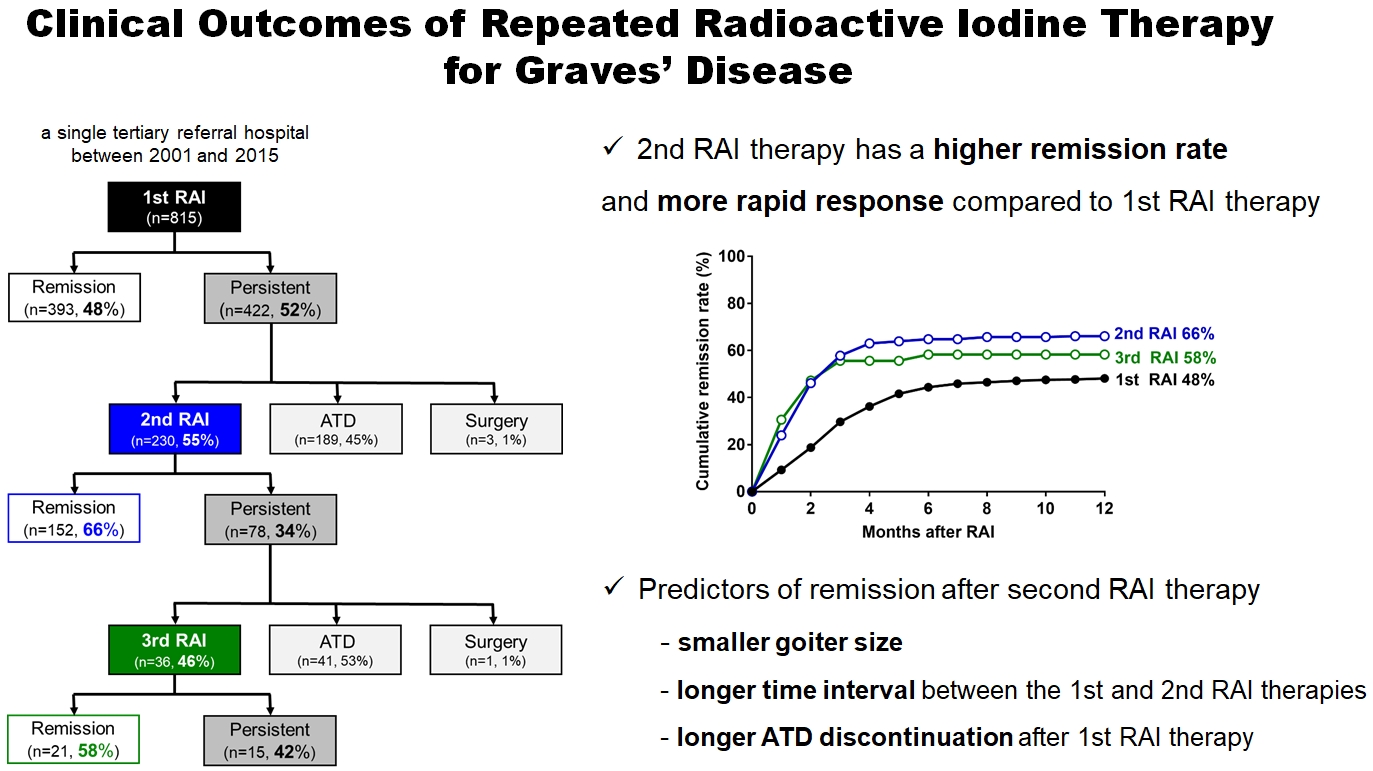
The 1-year remission rate after 2nd RAI therapy (66%, 152/230) is significantly higher than that after 1st RAI therapy (48%, 393/815) or long-term ATD treatment after 1st RAI therapy failure (42%). The clinical response to 2nd RAI therapy was more rapid. The median time intervals from the 2nd RAI therapy to ATD discontinuation (1.3 months) and to the start of levothyroxine replacement (2.5 months) were significantly shorter than those for the 1st RAI therapy. A smaller goiter size, a longer time interval between the 1st and 2nd RAI therapies, and a longer ATD discontinuation period predicted remission after the 2nd RAI therapy. Finally, in 78 patients who failed the 2nd RAI therapy, the mean ATD dosage significantly reduced 5.1 mg over 12 months.
Conclusion
Repeated RAI therapy can be a good therapeutic option, especially in patients with smaller goiters and those who are more responsive to the 1st RAI therapy. -
Citations
Citations to this article as recorded by
- Outcome of MRI-Guided Single-Dose Iodine-131 for Graves’ Hyperthyroidism with Large Goiter
Shangcheng Yan, Xiansheng Chen, Bing Yan, Xin Li, Zhen Cao, Pan Zhang, Yajun Wang, Wenmei Guo, Ziwen Liu
Annals of Nuclear Medicine.2026; 40(6): 624. CrossRef - Radioactive Iodine Therapy for Graves’ Disease: Treatment Outcomes and Predictors of Therapeutic Failure – A Retrospective Analysis in Qatar
Elabbass A. Abdelmahmuod, Shahd I. Ibrahim, Maab F. Elhaj, Ahmed Elmudathir Osman, Hisham Elhiday, Ahmed A. Alsayed, Mahmoud Osman, Abdalla Fadul, Elmustafa Abdalla, Mohamed Y. Ali, Ghulam Syed, Mahmoud Zirie, Zaina Rohani, Tania Jaber, Dabia Al- Mohanadi
Endocrinology Insights.2026; : 1. CrossRef - Outcomes of Fixed-Dose Radioactive Iodine Therapy in Hyperthyroidism and Optimization of Follow-Up After Treatment Failure With Low-Dose Antithyroid Medication
Panita Kantikool, Naphat Buraphanawibun
Cureus.2025;[Epub] CrossRef - Tingkat Keberhasilan Terapi Radioiodin Pertama pada Pasien Graves’ Disease
Aliya Khadijah Kemaleratu, Yuliana Rahmah Retnaningrum, Yudanti Riastiti
Jurnal Sains dan Kesehatan.2025; 6(1): 1. CrossRef - Association of high‐dose radioactive iodine therapy with PPM1D‐mutated clonal hematopoiesis in older individuals
Jaeryuk Kim, Sungwoo Bae, Jaeyong Choi, Sun‐Wha Im, Bukyoung Cha, Gyeongseo Jung, Sun Wook Cho, Eul‐Ju Seo, Young Ah Lee, Jin Chul Paeng, Young Joo Park, Jong‐Il Kim
Molecular Oncology.2025; 19(11): 3079. CrossRef - Characteristics of Japanese patients with Graves’ disease who fail first radioiodine therapy
Yuki Yamamoto, Hiroshi Fukazawa, Jun Ito, Kei Ito, Masanao Fujii, Aiko Hosoda, Yoshinori Osaki, Hiroaki Yagyu
Thyroid Science.2025; 2(4): 100028. CrossRef - Prospective study to evaluate radioactive iodine of 20 mCi vs 10–15 mCi in Graves’ disease
Wasit Kanokwongnuwat, Nawarat Penpong
BMC Endocrine Disorders.2024;[Epub] CrossRef - The Early Changes in Thyroid-Stimulating Immunoglobulin Bioassay over Anti-Thyroid Drug Treatment Could Predict Prognosis of Graves’ Disease
Jin Yu, Han-Sang Baek, Chaiho Jeong, Kwanhoon Jo, Jeongmin Lee, Jeonghoon Ha, Min Hee Kim, Jungmin Lee, Dong-Jun Lim
Endocrinology and Metabolism.2023; 38(3): 338. CrossRef - Effect of liver dysfunction on outcome of radioactive iodine therapy for Graves’ disease
Yuyang Ze, Fei Shao, Xuefeng Feng, Shanmei Shen, Yan Bi, Dalong Zhu, Xiaowen Zhang
BMC Endocrine Disorders.2022;[Epub] CrossRef
- Outcome of MRI-Guided Single-Dose Iodine-131 for Graves’ Hyperthyroidism with Large Goiter

- Miscellaneous
- Clinical Value of Serum Mitochondria-Inhibiting Substances in Assessing Renal Hazards: A Community-Based Prospective Study in Korea
- Hoon Sung Choi, Jin Taek Kim, Hong Kyu Lee, Wook Ha Park, Youngmi Kim Pak, Sung Woo Lee
- Endocrinol Metab. 2021;36(6):1298-1306. Published online November 26, 2021
- DOI: https://doi.org/10.3803/EnM.2021.1226

- 7,619 View
- 106 Download
- 1 Web of Science
- 1 Crossref
-
Abstract
PDFPubReader ePub
- Background
Mitochondrial dysfunction is strongly associated with several kidney diseases. However, no studies have evaluated the potential renal hazards of serum mitochondria-inhibiting substance (MIS) and aryl hydrocarbon receptor ligand (AhRL) levels.
Methods
We used serum level of MIS and AhRL and clinical renal outcomes from 1,511 participants of a prospective community-based cohort in Ansung. MIS was evaluated based on intracellular adenosine triphosphate (MIS-ATP) or reactive oxygen species (MIS-ROS) generation measured using cell-based assays.
Results
During a mean 6.9-year follow-up, 84 participants (5.6%) developed a rapid decline in kidney function. In the lowest quartile group of MIS-ATP, patients were older and had metabolically deleterious parameters. In multivariate logistic regression analysis, higher MIS-ATP was associated with decreased odds for rapid decline: the odds ratio (OR) of 1% increase was 0.977 (95% confidence interval [CI], 0.957 to 0.998; P=0.031), while higher MIS-ROS was marginally associated with increased odds for rapid decline (OR, 1.014; 95% CI, 0.999 to 1.028; P=0.055). However, serum AhRL was not associated with the rapid decline in kidney function. In subgroup analysis, the renal hazard of MIS was particularly evident in people with hypertension and low baseline kidney function.
Conclusion
Serum MIS was independently associated with a rapid decline in kidney function, while serum AhRL was not. The clinical implication of renal hazard on serum MIS requires further evaluation in future studies. -
Citations
Citations to this article as recorded by- An Interactive Online App for Predicting Diabetes via Machine Learning from Environment-Polluting Chemical Exposure Data
Rosy Oh, Hong Kyu Lee, Youngmi Kim Pak, Man-Suk Oh
International Journal of Environmental Research and Public Health.2022; 19(10): 5800. CrossRef
- An Interactive Online App for Predicting Diabetes via Machine Learning from Environment-Polluting Chemical Exposure Data
- Thyroid
- Comparison of Korean vs. American Thyroid Imaging Reporting and Data System in Malignancy Risk Assessment of Indeterminate Thyroid Nodules
- Sunyoung Kang, Seul Ki Kwon, Hoon Sung Choi, Min Joo Kim, Young Joo Park, Do Joon Park, Sun Wook Cho
- Endocrinol Metab. 2021;36(5):1111-1120. Published online October 21, 2021
- DOI: https://doi.org/10.3803/EnM.2021.1208

- 9,674 View
- 162 Download
- 12 Web of Science
- 13 Crossref
-
Abstract
PDFSupplementary MaterialPubReader ePub
- Background
The management of cytologically indeterminate thyroid nodules is challenging for clinicians. This study aimed to compare the diagnostic performance of the Korean Thyroid Imaging Reporting and Data Systems (K-TIRADS) with that of the American College of Radiology (ACR)-TIRADS for predicting the malignancy risk of indeterminate thyroid nodules.
Methods
Thyroid nodules diagnosed by fine-needle aspiration (FNA) followed by surgery or core needle biopsy at a single referral hospital were enrolled.
Results
Among 200 thyroid nodules, 78 (39.0%) nodules were classified as indeterminate by FNA (Bethesda category III, IV, and V), and 114 (57.0%) nodules were finally diagnosed as malignancy by surgery or core needle biopsy. The area under the curve (AUC) was higher for FNA than for either TIRADS system in all nodules, while all three methods showed similar AUCs for indeterminate nodules. However, for Bethesda category III nodules, applying K-TIRADS 5 significantly increased the risk of malignancy compared to a cytological examination alone (50.0% vs. 26.5%, P=0.028), whereas applying ACR-TIRADS did not lead to a change.
Conclusion
K-TIRADS and ACR-TIRADS showed similar diagnostic performance in assessing indeterminate thyroid nodules, and K-TIRADS had beneficial effects for malignancy prediction in Bethesda category III nodules. -
Citations
Citations to this article as recorded by- Ultrasound characteristics of medullary thyroid carcinoma and prognostic significance
Li Wang, Yuzhe Wang, Xueqing Wei, Xi Wei
Ultrasound.2026;[Epub] CrossRef - Artificial intelligence-assisted risk stratification of thyroid nodules with atypia of undetermined significance
Jinyoung Kim, Jeongmin Lee, Jeonghoon Ha, Ohjoon Kwon, Ki-Hyun Baek, Chang Myeon Song, Hyeon A Lee, Hyemi Kwon, Inyoung Youn, Mi-ri Kwon, Dong-Jun Lim
European Thyroid Journal.2026;[Epub] CrossRef - Integrating Digital Ki-67 Labeling Index and K-TIRADS for Malignancy Risk Stratification in Thyroid Core Needle Biopsies
Yujin Cha, Sue Youn Kim, Chankyung Kim, Ja Seong Bae, Dong-Jun Lim, So-Lyung Jung, Chan Kwon Jung
Cancers.2026; 18(14): 2260. CrossRef - Artificial Intelligence-Assisted ACR TI-RADS Assessment of Thyroid Nodules: Potential for Reducing Unnecessary Biopsies in a Prospective Single-Center Study
Rojda Kotan, Bahri Evren
Tomography.2026; 12(10): 144. CrossRef - Is the nodule location a predictive risk factor for cancer in AUS/FLUS thyroid nodules? A retrospective cohort study
Saad M. Alqahtani, Bassam A. Altalhi, Yousef S. Alalawi, Saif S. Al-Sobhi
Asian Journal of Surgery.2024; 47(6): 2574. CrossRef - Correlation between Ultrasound TI-RADS and Bethesda FNAC Scoring in Thyroid Lesions: A Retrospective Analysis
Smriti Mathur, Amit Chail, Amit K. Das, Seerat Pal, Ranjit S. Lahel
Medical Journal of Dr. D.Y. Patil Vidyapeeth.2024; 17(3): 533. CrossRef - Diagnostic Performance of Various Ultrasound Risk Stratification Systems for Benign and Malignant Thyroid Nodules: A Meta-Analysis
Ji-Sun Kim, Byung Guk Kim, Gulnaz Stybayeva, Se Hwan Hwang
Cancers.2023; 15(2): 424. CrossRef - The impact of thyroid imaging reporting and data system on the management of Bethesda III thyroid nodules
Saad M. Alqahtani, Saif S. Al-Sobhi, Mohammed A. Alturiqy, Riyadh I. Alsalloum, Hindi N. Al-Hindi
Journal of Taibah University Medical Sciences.2023; 18(3): 506. CrossRef - Diagnostic Performance of Six Ultrasound Risk Stratification Systems for Thyroid Nodules: A Systematic Review and Network Meta-Analysis
Do Hyun Kim, Sung Won Kim, Mohammed Abdullah Basurrah, Jueun Lee, Se Hwan Hwang
American Journal of Roentgenology.2023; 220(6): 791. CrossRef - Diagnostic efficiency among Eu-/C-/ACR-TIRADS and S-Detect for thyroid nodules: a systematic review and network meta-analysis
Longtao Yang, Cong Li, Zhe Chen, Shaqi He, Zhiyuan Wang, Jun Liu
Frontiers in Endocrinology.2023;[Epub] CrossRef - Comparison of diagnostic performance of two ultrasound risk stratification systems for thyroid nodules: a systematic review and meta-analysis
Yun Jin Kang, Hee Sun Ahn, Gulnaz Stybayeva, Ju Eun Lee, Se Hwan Hwang
La radiologia medica.2023; 128(11): 1407. CrossRef - Diagnostic Performance of ACR and Kwak TI-RADS for Benign and Malignant Thyroid Nodules: An Update Systematic Review and Meta-Analysis
Yun Jin Kang, Gulnaz Stybayeya, Ju Eun Lee, Se Hwan Hwang
Cancers.2022; 14(23): 5961. CrossRef - Comparison of Thyroid Imaging Reporting and Data Systems in Malignancy Risk Stratification of Indeterminate Thyroid Nodules
Bo Hyun Kim
Endocrinology and Metabolism.2021; 36(5): 974. CrossRef
- Ultrasound characteristics of medullary thyroid carcinoma and prognostic significance
- Clinical Study
- High Serum-Induced AhRL Is Associated with Prevalent Metabolic Syndrome and Future Impairment of Glucose Tolerance in the Elderly
- Youngmi Kim Pak, Hoon Sung Choi, Wook Ha Park, Suyeol Im, P. Monica Lind, Lars Lind, Hong Kyu Lee
- Endocrinol Metab. 2021;36(2):436-446. Published online April 19, 2021
- DOI: https://doi.org/10.3803/EnM.2020.883
- 8,249 View
- 122 Download
- 6 Web of Science
- 6 Crossref
-
Abstract
PDFSupplementary MaterialPubReader ePub
- Background
High circulating levels of dioxins and dioxin-like chemicals, acting via the aryl hydrocarbon receptor (AhR), have previously been linked to diabetes. We now investigated whether the serum AhR ligands (AhRL) were higher in subjects with metabolic syndrome (MetS) and in subjects who had developed a worsened glucose tolerance over time.
Methods
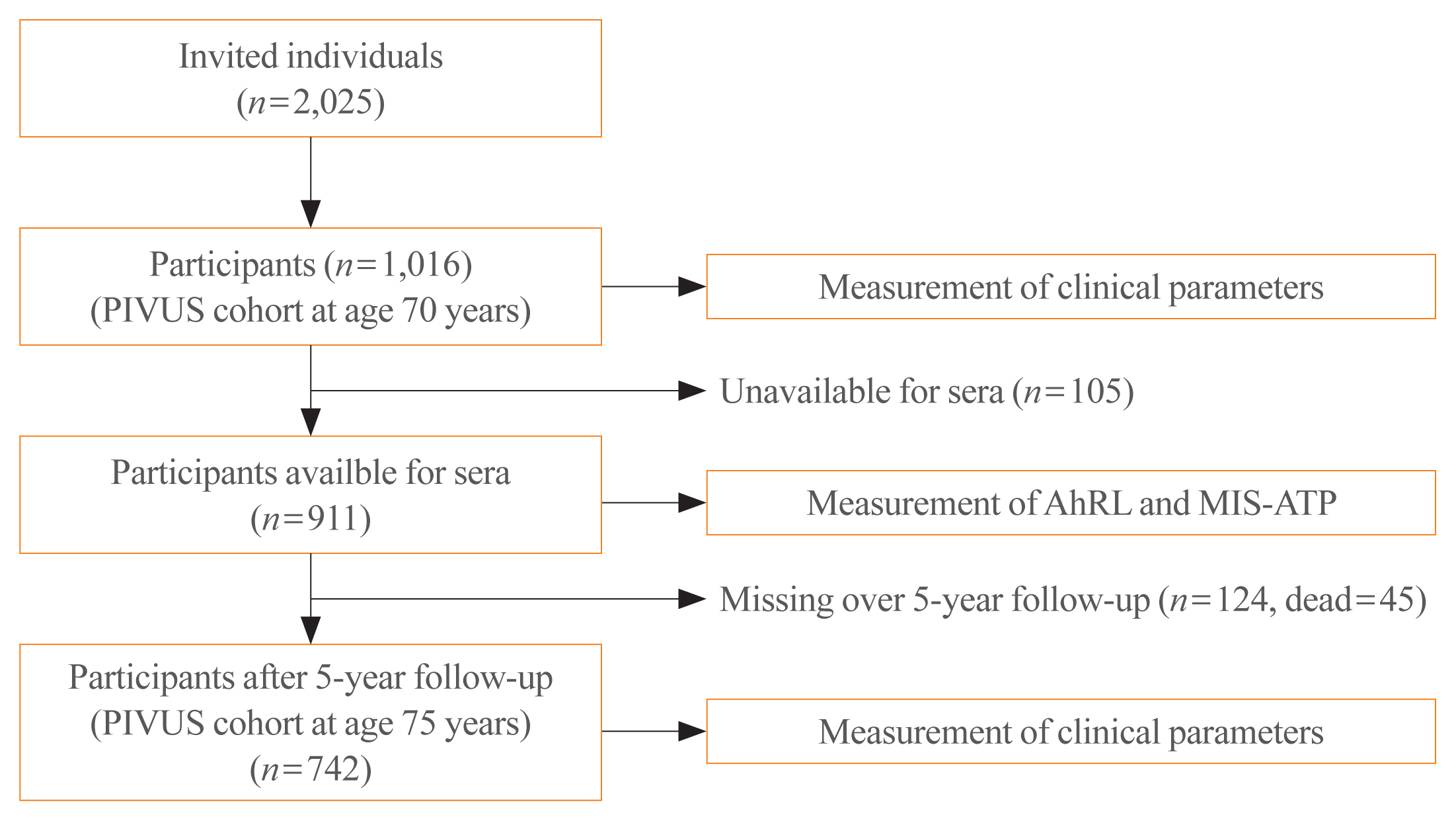
Serum AhRL at baseline was measured by a cell-based AhRL activity assay in 70-year-old subjects (n=911) in the Prospective Investigation of the Vasculature in Uppsala Seniors (PIVUS) study. The main outcome measures were prevalent MetS and worsening of glucose tolerance over 5 years of follow-up.
Results
AhRL was significantly elevated in subjects with prevalent MetS as compared to those without MetS, following adjustment for sex, smoking, exercise habits, alcohol intake and educational level (P=0.009). AhRL at baseline was higher in subjects who developed impaired fasting glucose or diabetes at age 75 years than in those who remained normoglycemic (P=0.0081). The odds ratio (OR) of AhRL for worsening glucose tolerance over 5 years was 1.43 (95% confidence interval [CI], 1.13 to 1.81; P=0.003, continuous variables) and 2.81 (95% CI, 1.31 to 6.02; P=0.008, in the highest quartile) adjusted for sex, life style factors, body mass index, and glucose.
Conclusion
These findings support a large body of epidemiologic evidence that exposure to AhR transactivating substances, such as dioxins and dioxin-like chemicals, might be involved in the pathogenesis of MetS and diabetes development. Measurement of serum AhRL in humans can be a useful tool in predicting the onset of metabolic disorders. -
Citations
Citations to this article as recorded by- Correlation between environmental pollutant exposure and cardiopulmonary health by serum biomarker analysis in the Swedish elderly population
Youngmi Kim Pak, Suyeol Im, Hoon Sung Choi, Lars Lind, Monica Lind, Hong Kyu Lee
International Journal of Environmental Health Research.2025; 35(5): 1156. CrossRef - Hepatic AhR Activation by TCDD Induces Obesity and Steatosis via Hepatic Plasminogen Activator Inhibitor-1 (PAI-1)
Seung Jun Oh, Suyeol Im, Sora Kang, Aden Geonhee Lee, Byung Cheol Lee, Youngmi Kim Pak
International Journal of Molecular Sciences.2025; 26(17): 8452. CrossRef - Association between polychlorinated biphenyl (PCB) and dioxin with metabolic syndrome (METS): a systematic review and meta-analysis
Mohd Danial Mohd Efendy Goon, Sarah Zulkifli, Siti Suhana Abdullah Soheimi, Sharaniza Ab. Rahim, Normala Abd Latip, Norbaya Hashim, Nirmala Devi Kerisnan, Nasehir Khan E. M. Yahaya, Alias Mohamed, Siti Hamimah Sheikh Abdul Kadir
Scientific Reports.2024;[Epub] CrossRef - Relationships among Dioxin-like Mitochondria Inhibitor Substances (MIS)-Mediated Mitochondria Dysfunction, Obesity, and Lung Function in a Korean Cohort
Hoonsung Choi, Kyungho Ha, Jin Taek Kim, Min Kyong Moon, Hyojee Joung, Hong Kyu Lee, Youngmi Kim Pak
Toxics.2024; 12(10): 735. CrossRef - An Interactive Online App for Predicting Diabetes via Machine Learning from Environment-Polluting Chemical Exposure Data
Rosy Oh, Hong Kyu Lee, Youngmi Kim Pak, Man-Suk Oh
International Journal of Environmental Research and Public Health.2022; 19(10): 5800. CrossRef - A Novel Aryl Hydrocarbon Receptor Antagonist HBU651 Ameliorates Peripheral and Hypothalamic Inflammation in High-Fat Diet-Induced Obese Mice
Sora Kang, Aden Geonhee Lee, Suyeol Im, Seung Jun Oh, Hye Ji Yoon, Jeong Ho Park, Youngmi Kim Pak
International Journal of Molecular Sciences.2022; 23(23): 14871. CrossRef
- Correlation between environmental pollutant exposure and cardiopulmonary health by serum biomarker analysis in the Swedish elderly population
Corrigendum
- Diabetes, Obesity and Metabolism
- Corrigendum: Correction of Table. Identification of Maturity-Onset Diabetes of the Young Caused by Glucokinase Mutations Detected Using Whole-Exome Sequencing
- Eun-Hee Cho, Jae Woong Min, Sun Shim Choi, Hoon Sung Choi, Sang-Wook Kim
- Endocrinol Metab. 2021;36(2):468. Published online March 24, 2021
- DOI: https://doi.org/10.3803/EnM.2021.202
- Corrects: Endocrinol Metab 2017;32(2):296

- 5,020 View
- 89 Download
Original Article
- Clinical Study
- Association of Vitamin D Deficiency with Diabetic Nephropathy
- So-hyeon Hong, Young Bin Kim, Hoon Sung Choi, Tae-Dong Jeong, Jin Taek Kim, Yeon Ah Sung
- Endocrinol Metab. 2021;36(1):106-113. Published online February 24, 2021
- DOI: https://doi.org/10.3803/EnM.2020.826
- 14,904 View
- 280 Download
- 43 Web of Science
- 50 Crossref
-
Abstract
PDFSupplementary MaterialPubReader ePub
- Background
Low 25-hydroxyvitamin D (25OHD) levels are associated with the incidence of type 2 diabetes mellitus (T2DM). However, the association between 25OHD and metabolic health status or diabetic complications is inconclusive. We evaluated this relationship between vitamin D status and metabolic parameters and complications of T2DM.
Methods
This study included 1,392 patients with T2DM who visited Eulji and Ewha Diabetes Center between January 2011 and August 2016. Anthropometric parameters and laboratory tests including glycated hemoglobin (HbA1c), lipid profile, liver and kidney function, and urinary albumin-to-creatinine ratio (UACR) were evaluated. Diabetic macro- and microvascular complications were determined through a medical record review. Serum 25OHD concentrations were measured by chemiluminescent immunoassay.
Results
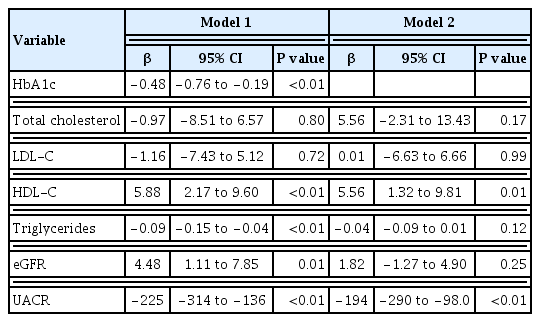
The mean 25OHD level was 16.8±9.6 ng/mL. Vitamin D deficiency (<20 ng/mL) and severe deficiency (<10 ng/mL) were observed in 990 (71.1%) and 351 (25.2%) participants, respectively. 25OHD level was positively correlated with age and highdensity lipoprotein cholesterol (HDL-C) level and negatively correlated with HbA1c, triglyceride level, and UACR. HDL-C and UACR were significantly associated with 25OHD after adjusting for other variables. Vitamin D deficiency was independently related to nephropathy after adjusting for confounding variables.
Conclusion
Vitamin D deficiency was common among Korean T2DM patients; it was independently associated with microalbuminuria and HDL level, and positively related to diabetic nephropathy. -
Citations
Citations to this article as recorded by- Impact of Vitamin D deficiency and VDR FokI polymorphism on diabetic nephropathy risk in type 2 diabetes
Addisu Melake, Misganaw Asmamaw Mengstie
Journal of the National Medical Association.2026; 118(1): 83. CrossRef - Association between triglyceride-glucose index and diabetic kidney disease in adults with type 1 diabetes
Jie Xiang, Wei Gao, Yao Yao, Chan Lu
BMC Endocrine Disorders.2026;[Epub] CrossRef - Prevalence of Hypovitaminosis D Among Patients With Type 2 Diabetes Mellitus: Evidence From a Diabetes Clinic in Durgapur, West Bengal
Sutanuka Saha, Piush Pandey, Indradeep Ganguly, Rakesh Kumar, Soumit Roy, Raghunath Misra, Sayanti Bandyopadhyay, Ankita Banerjee, Anirban Mondal, Subarna Sinha Mahapatra
Cureus.2026;[Epub] CrossRef - Association of 25(OH)D status with calcium metabolism, inflammation, and thyroid autoimmunity in patients with type 2 diabetes mellitus
Nannan Lv, Jianjian Xiang, Jinsong Kuang, Fei Liu, Lan Cheng, Shanyu Yin
Frontiers in Endocrinology.2026;[Epub] CrossRef - Endolymphatic hydrops and its association with Magnetic Resonance Imaging and serum vitamin D levels
Tao Lin, Xiaoting Wang, Luguang Zhang, Jing Li, Ling Ding
Brazilian Journal of Otorhinolaryngology.2026; 92(5): 101858. CrossRef - Vitamin D deficiency and metabolic disorders increase albuminuria risk in type 2 diabetes (ACR 0.1–300 mg/g): a nomogram-based stratification
Yanmei Lin, Chenru Zhao, Kang Du, Jianqing Tian
Frontiers in Endocrinology.2026;[Epub] CrossRef - Construction and validation of a risk prediction model for vitamin D deficiency in patients with type 2 diabetes mellitus
Ying Zhao, Jieru Chen, Fan Feng, Lixing Yang, Peng Zhang, Xia Cui
Frontiers in Nutrition.2026;[Epub] CrossRef - Association of vitamin D deficiency and chronic kidney disease in comorbid patients with type 2 diabetes mellitus
V. A. Dugusheva, Yu. A. Kotova
Meditsinskiy sovet = Medical Council.2026; (13): 179. CrossRef - Pathophysiological mechanisms, potential biomarkers, and therapeutic interventions in diabetic nephropathy
Kuldip Vyas, Abu Sufiyan Chhipa, Ayush chauhan, Snehal S. Patel
Discover Molecules.2026;[Epub] CrossRef - Role of vitamin D3 in lipid metabolism and chronic pain in advanced diabetic kidney disease and its rehabilitation
Ning-Ning Zhuang, Hao-Jun You
Healthcare and Rehabilitation.2025; 1(1): 100005. CrossRef - Role of platelet indices and vitamin D in forecasting deterioration of glycemic control and vascular complications in type 2 diabetes
Maryam Ahmed Obaid Al Ali, Khalid Abdelsamea Mohamedahmed, Asaad Ma Babker
Italian Journal of Medicine.2025;[Epub] CrossRef - Vitamin D Status and Its Association With Sun Exposure in Patients With Type 2 Diabetes Mellitus in Southern Malaysia
Norizzati Amsah, Zaleha Md Isa, Norfazilah Ahmad, Zaid Kassim, Siti Nor Athirah Mohamad
Cureus.2025;[Epub] CrossRef - Impact of dioxins and polychlorinated biphenyls on kidney parameters: The modulatory role of vitamin D
Dongdong Zhang, Xixi Qiao, Juan Peng, Jingjing Quan, Zhijun Huang, Bin Yi
Ecotoxicology and Environmental Safety.2025; 294: 118062. CrossRef - Vitamin D deficiency and VDR TaqI polymorphism on diabetic nephropathy risk among type 2 diabetes patients
Addisu Melake, Misganaw Asmamaw Mengstie
Frontiers in Endocrinology.2025;[Epub] CrossRef - Role of vitamin D in the development and progression of diabetic kidney disease: an overview of meta-analyses
Ashna Chackochan, Muhammed Rashid, Swetha R. Reghunath, Pooja Gopal Poojari, Girish Thunga, Shivashankara Kaniyoor Nagri, Vasudeva Guddattu, Revathi P. Shenoy, Vishnu Prasad Shenoy, Leelavathi D. Acharya
Therapeutic Advances in Endocrinology and Metabolism.2025;[Epub] CrossRef - Association Between Vitamin D Receptor Gene Polymorphism and Diabetic Nephropathy in Patients with Type 2 Diabetes Mellitus
Nardin S. Soliman, Dina Adam El-Shahat, Hala Mohammed Nagy, Gihan Farouk Attia, Amal Abd Elmoniem Selim
Indian Journal of Clinical Biochemistry.2025;[Epub] CrossRef - 25-(OH)D Deficiency and the Risk of Minor Amputation in Patients with Diabetes Foot Ulcers: A Chinese Cohort Study
Zhikai Qian, Yongyang Sun, Jinyu Bai, Bo Jiang, Jiaju Zhao
International Journal of General Medicine.2025; Volume 18: 3837. CrossRef - Associations between serum JAML, nesfatin-1, and 25(OH)D and the risk of diabetic kidney disease in patients with type 2 diabetes
Qizhuo Hou, Kangkang Huang, Yunlai Liang, Wenze Yu, Lu Long, Kun Wang, Bin Yi
Scientific Reports.2025;[Epub] CrossRef - Vitamin D Deficiency Is Associated with an Increased Risk of Macroalbuminuria in Chinese Patients with Type 2 Diabetes
Xiulin WANG, Wenjin XIAO
Journal of Nutritional Science and Vitaminology.2025; 71(4): 283. CrossRef - Association of Vitamin D Deficiency with Diabetic Nephropathy in Type 2 Diabetes: A Hospital-Based Cross-Sectional Study
Shafia Bashir, Geer Mohammad Ishaq, Insha Mushtaq, Mohammad Ashraf Ganie, Imtiyaz Wani, Muteb Alanazi, Ibrahim Asiri, Arshad Hussain, Kashif Ullah Khan, Sirajudheen Anwar
Diseases.2025; 13(12): 405. CrossRef - Association Between Vitamin D and Diabetic Kidney Disease
Feride Pınar Altay, Özlem Turhan İyidir, Sevim Güllü
Journal of Clinical Medicine.2025; 15(1): 153. CrossRef - Evaluation the Levels of Pentosidine and Vitamin D3 in Diabetic Nephropathy
Maryam Hiyder Kadum, Khawla A. Shemran, Yasameen AL Saffar
Medical Journal of Babylon.2025; 22(4): 995. CrossRef - Deficiency of 25-Hydroxy Vitamin D in Type 2 Diabetic Patients in Parakou in 2023: Prevalence and Associated Factors
Moutawakilou Gomina, Adébayo Alassani, Diane Naissem Guidimbaye, Sékossounon Sanni, Romaric Basson, Jean-Baptiste Aidjinou, Lassane Zoungrana, Abdou-Badiou Djibril, Jules Gninkoun
Open Journal of Endocrine and Metabolic Diseases.2025; 15(10): 217. CrossRef - ED-71 ameliorates bone regeneration in type 2 diabetes by reducing ferroptosis in osteoblasts via the HIF1α pathway
Maoshan Wang, Yingxue Liu, Houda Gui, Gaoqiang Ma, Binyang Li, Zhanwei Zhang, Gyeonghwi Yu, Ailin Wu, Xin Xu, Dongjiao Zhang
European Journal of Pharmacology.2024; 969: 176303. CrossRef - Vitamin D metabolism in diabetic nephropathy
Z. V. Abilov, R. Kh. Salimkhanov, A. A. Povaliaeva, A. Yu. Zhukov, E. A. Pigarova, L. K. Dzeranova, L. Ya. Rozhinskaya
Obesity and metabolism.2024; 20(4): 283. CrossRef - Telmisartan ameliorates nephropathy and restores the hippo pathway in rats with metabolic syndrome
Badria Mohamed, Salah A. Ghareib, Amira Ebrahim Alsemeh, Shaimaa S. El-Sayed
European Journal of Pharmacology.2024; 973: 176605. CrossRef - The impact of vitamin D on the etiopathogenesis and the progression of type 1 and type 2 diabetes in children and adults
Candong Li, Jiaowen Fu, Yipeng Ye, Junsen Li, Yangli He, Tuanyu Fang
Frontiers in Endocrinology.2024;[Epub] CrossRef - 25(OH)D level and vascular lesion scores in kidney histopathology as risk-stratification tool for predicting renal progression in people with type 2 diabetes
Suyan Duan, Fang Lu, Rui Sun, Chen Chen, Si Chen, Luhan Geng, Li Qian, Ying Pan, Chengning Zhang, Ming Zeng, Bin Sun, Huijuan Mao, Bo Zhang, Changying Xing, Yanggang Yuan
Diabetes & Metabolic Syndrome: Clinical Research & Reviews.2024; 18(5): 103037. CrossRef - Relationship between bone turnover markers and renal disease in elderly patients with type 2 diabetes: a cross-sectional study
Shuwu Wei, Xinyu Pan, Junping Wei
BMC Endocrine Disorders.2024;[Epub] CrossRef - COVID-19 infection and metabolic comorbidities: Mitigating role of nutritional sufficiency and drug – nutraceutical combinations of vitamin D
Sumit Kumar Mandal, Meghana Tare, P.R. Deepa
Human Nutrition & Metabolism.2023; 31: 200179. CrossRef - Effects of Vitamin D Supplementation in Diabetic Kidney Disease: A Systematic Review
Thais de Oliveira e Silva Ullmann, Beatrys Juliani Ramalho, Lucas Fornari Laurindo, Ricardo José Tofano, Claudio José Rubira, Elen Landgraf Guiguer, Sandra Maria Barbalho, Uri Adrian Prync Flato, Katia Portero Sloan, Adriano Cressoni Araujo
Journal of Renal Nutrition.2023; 33(5): 618. CrossRef - Diabetic Nephropathy: Significance of Determining Oxidative Stress and Opportunities for Antioxidant Therapies
Marina Darenskaya, Sergey Kolesnikov, Natalya Semenova, Lyubov Kolesnikova
International Journal of Molecular Sciences.2023; 24(15): 12378. CrossRef - Association between serum 25- hydroxyvitamin D and albuminuiria in middle-aged and older Chinese patients with type 2 diabetes
Luyan Zhang, Qian Guo, Yanjia Xu, Wenzhen Wei, Yu Wang
BMC Endocrine Disorders.2023;[Epub] CrossRef - Vitamin D deficiency and its associated factors among patients with type 2 diabetes mellitus: a systematic review and meta-analysis
Mitku Mammo Taderegew, Gashaw Garedew Woldeamanuel, Alemayehu Wondie, Atsede Getawey, Abera Nesiru Abegaz, Fentahun Adane
BMJ Open.2023; 13(10): e075607. CrossRef - Progression of diabetic nephropathy and vitamin D serum levels: A pooled analysis of 7722 patients
Yomna E. Dean, Sameh Samir Elawady, Wangpan Shi, Ahmed A. Salem, Arinnan Chotwatanapong, Haya Ashraf, Tharun Reddi, Prashant Obed Reddy Dundi, Waleed Yasser Habash, Mohamed Yasser Habash, Safaa Ahmed, Hana M. Samir, Ahmed Elsayed, Aryan Arora, Abhinav Aro
Endocrinology, Diabetes & Metabolism.2023;[Epub] CrossRef - Incidence of Vitamin D Deficiency and Its Association With Microalbuminuria in Patients With Type 2 Diabetes Mellitus
Muhammad Hamza Riaz, Ammar Jamil, Hira Yousaf, Muhammad Hassan, Muhammad Ahmer Sohaib, Sharjeel Babar, Muhammad Hassan Ahmad, Ibtesam Allahi, Muhammad Zeshan Mehmood, Tayyab Mumtaz Khan
Cureus.2023;[Epub] CrossRef - The Role of Vitamin D in Diabetic Nephropathy: A Translational Approach
Charlotte Delrue, Reinhart Speeckaert, Joris R. Delanghe, Marijn M. Speeckaert
International Journal of Molecular Sciences.2022; 23(2): 807. CrossRef - Associations of serum amyloid A and 25‐hydroxyvitamin D with diabetic nephropathy: A cross‐sectional study
Qian Liu, Jin Sun, Tongdao Xu, Guangrong Bian, Fumeng Yang
Journal of Clinical Laboratory Analysis.2022;[Epub] CrossRef - Formulation Strategies for Improving the Stability and Bioavailability of Vitamin D-Fortified Beverages: A Review
Elsa F. Vieira, Suene Souza
Foods.2022; 11(6): 847. CrossRef - Association between Vitamin D Status and Mortality among Adults with Diabetic Kidney Disease
Feng Xu, Hongyu Lu, Tianwen Lai, Ling Lin, Yongsong Chen, Pratibha V. Nerurkar
Journal of Diabetes Research.2022; 2022: 1. CrossRef - Assessment of the relationship between 25-hydroxyvitamin D and albuminuria in type 2 diabetes mellitus
Seyed Alireza Zomorodian, Maryam Shafiee, Zeinab Karimi, Fatemeh Masjedi, Amirhossein Roshanshad
BMC Endocrine Disorders.2022;[Epub] CrossRef - Association of Serum 25 (OH) Vitamin D With Chronic Kidney Disease Progression in Type 2 Diabetes
Suyan Duan, Fang Lu, Buyun Wu, Chengning Zhang, Guangyan Nie, Lianqin Sun, Zhimin Huang, Honglei Guo, Bo Zhang, Changying Xing, Yanggang Yuan
Frontiers in Endocrinology.2022;[Epub] CrossRef - The Influence of Dietary Supplementations on Neuropathic Pain
Francesco D’Egidio, Giorgia Lombardozzi, Housem E. Kacem Ben Haj M’Barek, Giada Mastroiacovo, Margherita Alfonsetti, Annamaria Cimini
Life.2022; 12(8): 1125. CrossRef - Emergence of Ectopic Adrenal Tissues-What are the Probable Mechanisms?
Gürkan Tarçın, Oya Ercan
Journal of Clinical Research in Pediatric Endocrinology.2022; 14(3): 258. CrossRef - Anti-proteinuria effect of active vitamin D in patients with type 2 diabetic nephropathy
Asieh Aref, Mina Khodhal, Homeira Rashidi, Zahra Farhangiyan, Saeid Bitaraf
Journal of Family Medicine and Primary Care.2022; 11(12): 7735. CrossRef - Nutritional Supplements for the Treatment of Neuropathic Pain
Khaled M. Abdelrahman, Kevin V. Hackshaw
Biomedicines.2021; 9(6): 674. CrossRef - Vitamin D Deficiency as a Predictor of a High Prevalence of Coronary Artery Disease in Pancreas Transplant Candidates With Type 1 Diabetes
Małgorzata Buksińska-Lisik, Przemysław J. Kwasiborski, Robert Ryczek, Wojciech Lisik, Artur Mamcarz
Frontiers in Endocrinology.2021;[Epub] CrossRef - Serum 25-hydroxyvitamin D and Metabolic Parameters in Healthy Korean Adults: Korean National Health and Nutrition Examination Survey VI
Jeonghoon Ha, Hansang Baek, Chaiho Jeong, Hyunsam Kim, Ki-Hyun Baek, Moo Il Kang, Dong-Jun Lim
International Journal of General Medicine.2021; Volume 14: 5233. CrossRef - Association Between 25(OH)Vitamin D, HbA1c and Albuminuria in Diabetes Mellitus: Data From a Population-Based Study (VIDAMAZON)
João Soares Felício, Hana Andrade de Rider Britto, Pedro Celeira Cortez, Fabrício de Souza Resende, Manuela Nascimento de Lemos, Lorena Vilhena de Moraes, Vitória Teixeira de Aquino, Fernanda de Souza Parente, Natércia Neves Marques de Queiroz, João Felíc
Frontiers in Endocrinology.2021;[Epub] CrossRef - Vitamin D Analogs Can Retard the Onset or Progression of Diabetic Kidney Disease: A Systematic Review
Samuel N. Uwaezuoke
Frontiers in Clinical Diabetes and Healthcare.2021;[Epub] CrossRef
- Impact of Vitamin D deficiency and VDR FokI polymorphism on diabetic nephropathy risk in type 2 diabetes
Special Article
- Miscellaneous
- Diagnosis and Treatment of Growth Hormone Deficiency: A Position Statement from Korean Endocrine Society and Korean Society of Pediatric Endocrinology
- Jung Hee Kim, Hyun Wook Chae, Sang Ouk Chin, Cheol Ryong Ku, Kyeong Hye Park, Dong Jun Lim, Kwang Joon Kim, Jung Soo Lim, Gyuri Kim, Yun Mi Choi, Seong Hee Ahn, Min Ji Jeon, Yul Hwangbo, Ju Hee Lee, Bu Kyung Kim, Yong Jun Choi, Kyung Ae Lee, Seong-Su Moon, Hwa Young Ahn, Hoon Sung Choi, Sang Mo Hong, Dong Yeob Shin, Ji A Seo, Se Hwa Kim, Seungjoon Oh, Sung Hoon Yu, Byung Joon Kim, Choong Ho Shin, Sung-Woon Kim, Chong Hwa Kim, Eun Jig Lee
- Endocrinol Metab. 2020;35(2):272-287. Published online June 24, 2020
- DOI: https://doi.org/10.3803/EnM.2020.35.2.272
- 52,590 View
- 905 Download
- 34 Web of Science
- 39 Crossref
-
Abstract
PDFPubReader ePub
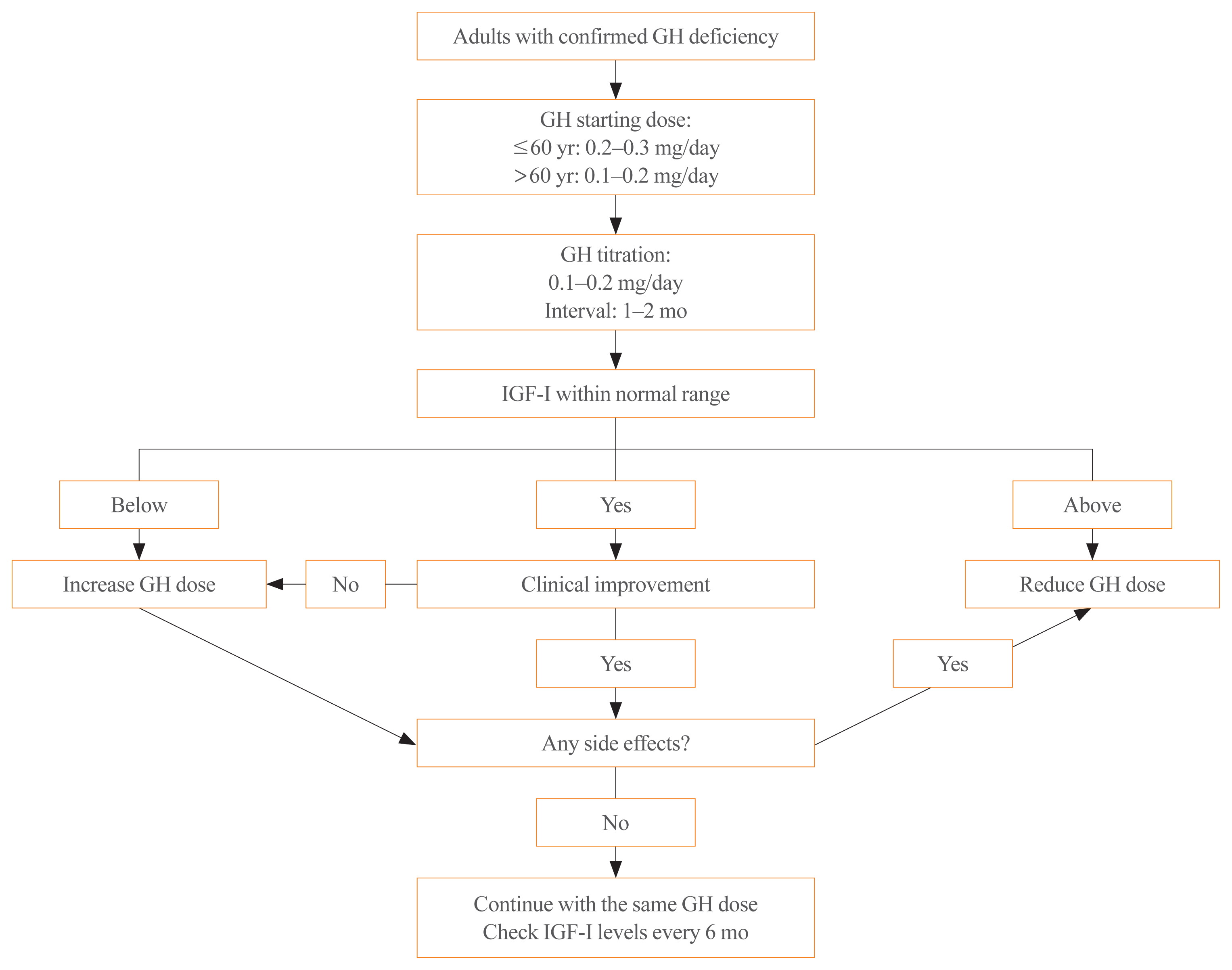
- Growth hormone (GH) deficiency is caused by congenital or acquired causes and occurs in childhood or adulthood. GH replacement therapy brings benefits to body composition, exercise capacity, skeletal health, cardiovascular outcomes, and quality of life. Before initiating GH replacement, GH deficiency should be confirmed through proper stimulation tests, and in cases with proven genetic causes or structural lesions, repeated GH stimulation testing is not necessary. The dosing regimen of GH replacement therapy should be individualized, with the goal of minimizing side effects and maximizing clinical improvements. The Korean Endocrine Society and the Korean Society of Pediatric Endocrinology have developed a position statement on the diagnosis and treatment of GH deficiency. This position statement is based on a systematic review of evidence and expert opinions.
-
Citations
Citations to this article as recorded by- Growth Outcomes and Relapse Risk in Pediatric Medulloblastoma Survivors with and Without Growth Hormone Therapy: A 23-Year Single-Center Cohort Study
Gerdi Tuli, Jessica Munarin, Paola Ragazzi, Eleonora Biasin, Francesco Felicetti, Anna Mussano, Stefano Gabriele Vallero, Daniele Bertin, Paola Peretta, Giovanni Morana, Franca Fagioli, Luisa De Sanctis
Journal of Clinical Medicine.2026; 15(9): 3472. CrossRef - Once-weekly somapacitan vs. daily norditropin in GHD: a systematic review and meta-analysis of efficacy and safety in children and adults
Sarah Azhar, Mohammad Daniyal, Roshni Riaz Memon, Hamza Sajid, Nad e Ali Yousfani, Hamza Yousuf Ibrahim, Syeda Umme Farwa, Shaharyar Ahmed, Mohsin Ali, Rimsha Abbas, Syed Muhammad Abbas, Ahmed Ali Khan, Haider Imran
Endocrine.2026;[Epub] CrossRef -
De novo ARID1A Coffin-Siris syndrome with hypothyroidism and dyslipidemia: A case report and literature review
Michael N Fragos, Ilektra Toulia, Maria G Grammatikopoulou, Parthena Savvidou, Ioannis Taiganidis, Panagiota Zissiadis, Charalampos Antachopoulos, Dimitrios G Goulis, Kyriaki Tsiroukidou
World Journal of Clinical Cases.2026;[Epub] CrossRef - Long‐Acting Growth Hormone Versus Daily Growth Hormone for Growth Hormone Deficiency Patients: A Network Meta‐Analysis of Clinical Trials
Amir Abadi, Usra Ghanem, Hamid Ghanem, Ahmed Jalal Sawafta, Ayah Abulehia, Mohammed Ataya, Rahma Nairat, Alhammam Mohammad Sammour, Hazem Ayesh
Endocrinology, Diabetes & Metabolism.2026;[Epub] CrossRef - Long-acting growth hormone: an updated Growth Hormone Research Society consensus statement
Katharina Schilbach, Peter Clayton, Nidhi Agrawal, Mai C Arlien-Søborg, Philippe F Backeljauw, Beverly M K Biller, Cesar L Boguszewski, Margaret C S Boguszewski, Philippe Chanson, Pierre Chatelain, Stefano Cianfarani, Maria Fleseriu, Judith Gebauer, Adda
European Journal of Endocrinology.2026; 195(3): R73. CrossRef - Gut microbiota profiles in Korean children with growth hormone deficiency: a case-control study
So Yoon Choi, Seom Gim Kong, Gyu Min Yeon, Yoo Rha Hong, Minyoung Jung, Jung Hyun Lee
Clinical and Experimental Pediatrics.2026; 69(10): 797. CrossRef - Investigation of overnight growth hormone secretion patterns in the clinical diagnosis of growth hormone neurosecretory dysfunction
Nurgul Atas, Mehmet Ali Kopan, Fatoş Çirkin Melik, Mehmet Keskin, Murat Karaoğlan
Growth Hormone & IGF Research.2026; 85: 101726. CrossRef - Growth Hormone Deficiency and Systemic Metabolic Remodeling: Insights from Metabolomics and Lipidomics
Sarmed Al-Samerria, Sally Radovick
Metabolites.2026; 16(10): 744. CrossRef - Influencing factors on selection of initial treatment dose in children diagnosed with isolated growth hormone deficiency
İbrahim Mert Erbaş, Nilüfer Uyar, Özlem Nalbantoğlu, Behzat Özkan
Trends in Pediatrics.2026; 7(3): 193. CrossRef - GHRH in diabetes and metabolism
Charlotte Steenblock, Stefan R. Bornstein
Reviews in Endocrine and Metabolic Disorders.2025; 26(3): 413. CrossRef - Biomarkers of GH deficiency identified in untreated and GH-treated Pit-1 mutant mice
Sarmed Al-Samerria, Huiting Xu, M. Elena Diaz-Rubio, Joseph Phelan, Chi Su, Keer Ma, Anna Newen, Kiana Li, Sayaka Yamada, Ariel L. Negron, Fredric Wondisford, Sally Radovick
Frontiers in Endocrinology.2025;[Epub] CrossRef - The TUITEK® patient support program improved caregiver-related behaviors on growth hormone treatment adherence
Ekaterina Koledova, Pen-Hua Su, Yen-Ju Chen, Aria Assefi, Matias Debicki, Debbie Cooke, Amrit Jheeta, Alexander B. Jones, Jung Eun Moon
Frontiers in Endocrinology.2025;[Epub] CrossRef - Otolaryngological Problems Among Patients with Growth Hormone Deficiency—A Systematic Review
Gazala Abdulaziz-Opiela, Paweł Witkowski, Yasmina Późniak, Julia Bajdor, Joanna Bautembach, Małgorzata Myśliwiec, Bogusław Mikaszewski
Journal of Clinical Medicine.2025; 14(9): 3064. CrossRef - Serum levels of leucine-rich α–2 glycoprotein 1 (LRG1), pro-neurotensin (PNT), fatty acid-binding protein 4 (FABP4) and furin in pediatric growth hormone deficiency before and after 1-year growth hormone replacement therapy
Zhibo Zhou, Yuxin Sun, Zeyan Zheng, Xiaoyuan Guo, Hongbo Yang, Shi Chen, Hui Pan, Huijuan Zhu
Cytokine.2025; 195: 157022. CrossRef - Growth hormone in disease and treatment (Review)
Saikat Fakir, Md Matiur Rahman Sarker, Madan Sigdel, Nektarios Barabutis
Medicine International.2025; 5(6): 1. CrossRef - Once-Weekly Somapacitan as an Alternative Management of Growth Hormone Deficiency in Prepubertal Children: A Systematic Review and Meta-Analysis of Randomized Controlled Trial
Ghina Tsurayya, Cut Alifiya Nazhifah, Muhammad Rahmat Pirwanja, Putri Oktaviani Zulfa, Muhammad Raihan Ramadhan Tatroman, Fajar Fakri, Muhammad Iqhrammullah
Children.2024; 11(2): 227. CrossRef - Efficacy, safety, and patient satisfaction of norditropin and sogroya in patients with growth hormone deficiency: a systematic review and meta-analysis of randomized controlled trials
Obieda Altobaishat, Mohamed Abouzid, Mostafa Hossam El Din Moawad, Abdulrahman Sharaf, Yazan Al-Ajlouni, Tungki Pratama Umar, Abdallah Bani-salameh, Mohammad Tanashat, Omar Abdullah Bataineh, Abdulqadir J. Nashwan
Endocrine.2024; 85(2): 545. CrossRef - Growth Hormone Deficiency and Growth Hormone Stimulation Test
胜彬 孙
Advances in Clinical Medicine.2024; 14(06): 1587. CrossRef - Clinical Management of Postoperative Growth Hormone Deficiency in Hypothalamic-Pituitary Tumors
Pedro Iglesias
Journal of Clinical Medicine.2024; 13(15): 4307. CrossRef - Isolated Growth Hormone Deficiency
Anastasia Ibba, Chiara Guzzetti, Lavinia Sanfilippo, Sandro Loche
Endocrines.2024; 5(3): 341. CrossRef - L‐DOPA Test in the Diagnosis of Childhood Short Stature: Evaluation of Growth Hormone Peaks Over Time
Barbara Castelli, Rita De Santis, Simona Carrera, Marco Andrea Malanima, Salvatore De Masi, Stefano Stagi
Endocrinology, Diabetes & Metabolism.2024;[Epub] CrossRef - Hsa_circ_0002473 inhibits GH3 cell proliferation and GH secretion as a competitive endogenous RNA for has-miR-4645-3p
Kaiyu Pan, Xiaoguang Jiang, Xiaohong Hu, Jianhua Zhan, Chengyue Zhang
Journal of Pediatric Endocrinology and Metabolism.2024; 37(12): 1054. CrossRef - Baseline Clinical Factors Associated with Cessation of Growth Hormone Therapy in Patients with Severe Growth Hormone Deficiency - Real World Evidence
Nageswary Nadarajah, Emmanuel Ssemmondo, Shani Brooks, Remi Akinyombo, Kazeem Adeleke, Harshal Deshmukh, Thozhukat Sathyapalan
International Journal of Endocrinology and Metabolism.2024;[Epub] CrossRef - Cohort profile: Multicenter Networks for Ideal Outcomes of Rare Pediatric Endocrine and Metabolic Diseases in Korea (OUTSPREAD study)
Yun Jeong Lee, Chong Kun Cheon, Junghwan Suh, Jung-Eun Moon, Moon Bae Ahn, Seong Hwan Chang, Jieun Lee, Jin Ho Choi, Minsun Kim, Han Hyuk Lim, Jaehyun Kim, Shin-Hye Kim, Hae Sang Lee, Yena Lee, Eungu Kang, Se Young Kim, Yong Hee Hong, Seung Yang, Heon-Seo
Annals of Pediatric Endocrinology & Metabolism.2024; 29(6): 349. CrossRef - Pituitary abnormalities in patients with pediatric growth hormone deficiency in a single tertiary center
Hyeon Jun Jung, Jeong Rye Kim, Jeesuk Yu
Annals of Pediatric Endocrinology & Metabolism.2024; 29(6): 365. CrossRef - Evaluation of Adult Height in Patients with Non-Permanent Idiopathic GH Deficiency
Agnese Murianni, Anna Lussu, Chiara Guzzetti, Anastasia Ibba, Letizia Casula, Mariacarolina Salerno, Marco Cappa, Sandro Loche
Endocrines.2023; 4(1): 169. CrossRef - The effect of hypothalamic involvement and growth hormone treatment on cardiovascular risk factors during the transition period in patients with childhood-onset craniopharyngioma
Sang Hee Park, Yun Jeong Lee, Jung-Eun Cheon, Choong Ho Shin, Hae Woon Jung, Young Ah Lee
Annals of Pediatric Endocrinology & Metabolism.2023; 28(2): 107. CrossRef - Continuous Glucose Monitoring: A Possible Aid for Detecting Hypoglycemic Events during Insulin Tolerance Tests
Soo Yeun Sim, Moon Bae Ahn
Sensors.2023; 23(15): 6892. CrossRef - The risk patients with AGHD have of developing CVD
Eisha Javed, Maha Zehra, Naz Elahi
International Journal of Cardiology Cardiovascular Risk and Prevention.2023; 19: 200221. CrossRef - Diagnosis of GH Deficiency Without GH Stimulation Tests
Anastasia Ibba, Sandro Loche
Frontiers in Endocrinology.2022;[Epub] CrossRef - Metabolic Impacts of Discontinuation and Resumption of Recombinant Human Growth Hormone Treatment during the Transition Period in Patients with Childhood-Onset Growth Hormone Deficiency
Yun Jeong Lee, Yunha Choi, Han-Wook Yoo, Young Ah Lee, Choong Ho Shin, Han Saem Choi, Ho-Seong Kim, Jae Hyun Kim, Jung Eun Moon, Cheol Woo Ko, Moon Bae Ahn, Byung-Kyu Suh, Jin-Ho Choi
Endocrinology and Metabolism.2022; 37(2): 359. CrossRef - A Radiomics-Based Model with the Potential to Differentiate Growth Hormone Deficiency and Idiopathic Short Stature on Sella MRI
Taeyoun Lee, Kyungchul Song, Beomseok Sohn, Jihwan Eom, Sung Soo Ahn, Ho-Seong Kim, Seung-Koo Lee
Yonsei Medical Journal.2022; 63(9): 856. CrossRef - Phenotypic spectrum of patients with mutations in CHD7: clinical implications of endocrinological findings
Ja Hye Kim, Yunha Choi, Soojin Hwang, Gu-Hwan Kim, Han-Wook Yoo, Jin-Ho Choi
Endocrine Connections.2022;[Epub] CrossRef - Immune Checkpoint Inhibitors and Endocrine Disorders: A Position Statement from the Korean Endocrine Society
Hyemi Kwon, Eun Roh, Chang Ho Ahn, Hee Kyung Kim, Cheol Ryong Ku, Kyong Yeun Jung, Ju Hee Lee, Eun Heui Kim, Sunghwan Suh, Sangmo Hong, Jeonghoon Ha, Jun Sung Moon, Jin Hwa Kim, Mi-kyung Kim
Endocrinology and Metabolism.2022; 37(6): 839. CrossRef - Laron syndrome: clinic, diagnostics (а clinical case)
P.M. Lіashuk, R.P. Lіashuk, N.I. Stankova, M.B. Kudina
INTERNATIONAL JOURNAL OF ENDOCRINOLOGY (Ukraine).2022; 18(3): 193. CrossRef - Diagnosis for Pheochromocytoma and Paraganglioma: A Joint Position Statement of the Korean Pheochromocytoma and Paraganglioma Task Force
Eu Jeong Ku, Kyoung Jin Kim, Jung Hee Kim, Mi Kyung Kim, Chang Ho Ahn, Kyung Ae Lee, Seung Hun Lee, You-Bin Lee, Kyeong Hye Park, Yun Mi Choi, Namki Hong, A Ram Hong, Sang-Wook Kang, Byung Kwan Park, Moon-Woo Seong, Myungshin Kim, Kyeong Cheon Jung, Chan
Endocrinology and Metabolism.2021; 36(2): 322. CrossRef - Asian Conference on Tumor Ablation Guidelines for Adrenal Tumor Ablation
Byung Kwan Park, Masashi Fujimori, Shu-Huei Shen, Uei Pua
Endocrinology and Metabolism.2021; 36(3): 553. CrossRef - Asian Conference on Tumor Ablation guidelines for renal cell carcinoma
Byung Kwan Park, Shu-Huei Shen, Masashi Fujimori, Yi Wang
Investigative and Clinical Urology.2021; 62(4): 378. CrossRef - Diagnosis and Treatment of Adult Growth Hormone Deficiency
Jung Hee Kim
The Korean Journal of Medicine.2021; 96(5): 400. CrossRef
- Growth Outcomes and Relapse Risk in Pediatric Medulloblastoma Survivors with and Without Growth Hormone Therapy: A 23-Year Single-Center Cohort Study
Original Article
- Clinical Study
- Postoperative Thyroid-Stimulating Hormone Levels Did Not Affect Recurrence after Thyroid Lobectomy in Patients with Papillary Thyroid Cancer
- Myung-Chul Lee, Min Joo Kim, Hoon Sung Choi, Sun Wook Cho, Guk Haeng Lee, Young Joo Park, Do Joon Park
- Endocrinol Metab. 2019;34(2):150-157. Published online May 10, 2019
- DOI: https://doi.org/10.3803/EnM.2019.34.2.150
- 20,270 View
- 200 Download
- 41 Web of Science
- 46 Crossref
-
Abstract
PDFSupplementary MaterialPubReader ePub
Background Thyroid-stimulating hormone (TSH) suppression is recommended for patients who undergo thyroidectomy for differentiated thyroid cancer (DTC). However, the impact of TSH suppression on clinical outcomes in low-risk DTC remains uncertain. Therefore, we investigated the effects of postoperative TSH levels on recurrence in patients with low-risk DTC after thyroid lobectomy.
Methods Patients (
n =1,528) who underwent thyroid lobectomy for papillary thyroid carcinoma between 2000 and 2012 were included in this study. According to the mean and dominant TSH values during the entire follow-up period or 5 years, patients were divided into four groups (<0.5, 0.5 to 1.9, 2.0 to 4.4, and ≥4.5 mIU/L). Recurrence-free survival was compared among the groups.Results During the 5.6 years of follow-up, 21 patients (1.4%) experienced recurrence. Mean TSH levels were within the recommended low-normal range (0.5 to 1.9 mIU/L) during the total follow-up period or 5 years in 38.1% or 36.0% of patients. The mean and dominant TSH values did not affect recurrence-free survival. Adjustment for other risk factors did not alter the results.
Conclusion Serum TSH levels did not affect short-term recurrence in patients with low-risk DTC after thyroid lobectomy. TSH suppression should be conducted more selectively.
-
Citations
Citations to this article as recorded by- On-demand l-thyroxine replacement therapy in post-lobectomy papillary thyroid cancer: a prospective nonrandomized controlled study
Siyuan Xu, Lida Liao, Keyao Xian, Kai Wang, Chengwei Xing, Ruiying Liu, Zongmin Zhang, Haixia Guan, Jie Liu
International Journal of Surgery.2026; 112(2): 3467. CrossRef - Korean Thyroid Association Guidelines on the Management of Differentiated Thyroid Cancers; Part II. Follow-up Surveillance after Initial Treatment 2026
Eun Kyung Lee, Seung Heon Kang, Bon Seok Koo, Mijin Kim, Min Joo Kim, Bo Hyun Kim, Ji Won Kim, Dong Gyu Na, Sohyun Park, Ji-In Bang, Kyorim Back, Youngduk Seo, Young-Ik Son, Young Shin Song, Dong Yeob Shin, Jong-Hyuk Ahn, Hwa Young Ahn, So Won Oh, Ho-Ryun
International Journal of Thyroidology.2026; 19(1): 1. CrossRef - Choosing Wisely With the Korean Association of Endocrine Surgeons: Reducing Overuse in Thyroid Nodule and Cancer Care
Jin Hyang Jung, Hyeong Won Yu, Young Jae Ryu, Hyungju Kwon, Ha Kyoung Park, Kyorim Back, Haiyoung Son, Young San Jeon, Jung Eun Choi
Journal of Endocrine Surgery.2026; 26(2): 41. CrossRef - Korean Thyroid Association Guidelines on the Management of Differentiated Thyroid Cancers, Part II: Follow-up Surveillance after Initial Treatment 2026
Eun Kyung Lee, Seung Heon Kang, Bon Seok Koo, Mijin Kim, Min Joo Kim, Bo Hyun Kim, Ji Won Kim, Dong Gyu Na, Sohyun Park, Ji-In Bang, Kyorim Back, Youngduk Seo, Young-Ik Son, Young Shin Song, Dong Yeob Shin, Jong-hyuk Ahn, Hwa Young Ahn, So Won Oh, Ho-Ryun
Endocrinology and Metabolism.2026; 41(4): 493. CrossRef - Effects of 131I and TSH suppression therapy on METTL3, METTL14 levels and recurrence in thyroid cancer
Li-Guo Yang
American Journal of Cancer Research.2025; 15(1): 42. CrossRef - Tailoring TSH suppression in differentiated thyroid carcinoma: evidence, controversies, and future directions
Xinxin Song, Xin Zhi, Linxue Qian
Endocrine.2025; 89(1): 1. CrossRef - The 2024 revised clinical guidelines on the management of thyroid tumors by the Japan Association of Endocrine Surgery
Iwao Sugitani, Naomi Kiyota, Yasuhiro Ito, Naoyoshi Onoda, Tomo Hiromasa, Kiyomi Horiuchi, Seigo Kinuya, Tetsuo Kondo, Sueyoshi Moritani, Kiminori Sugino, Hisato Hara
Endocrine Journal.2025; 72(5): 545. CrossRef - 2025 American Thyroid Association Management Guidelines for Adult Patients with Differentiated Thyroid Cancer
Matthew D. Ringel, Julie Ann Sosa, Zubair Baloch, Lindsay Bischoff, Gary Bloom, Gregory A. Brent, Pamela L. Brock, Roger Chou, Robert R. Flavell, Whitney Goldner, Elizabeth G. Grubbs, Megan Haymart, Steven M. Larson, Angela M. Leung, Joseph R. Osborne, Jo
Thyroid®.2025; 35(8): 841. CrossRef - 2025 ATA Thyroid Cancer Guidelines: How Low Should TSH Suppression Go?
Jennifer S. Mammen, Gabriela Brenta, Kaniksha Desai
Clinical Thyroidology®.2025; 37(12): 420. CrossRef - Characterization of a novel four-miRNA signature in papillary thyroid carcinoma: Integrating molecular profiling, hormonal regulation, and diagnostic implications in populations with rising PTC incidence
Afshan Afzal, Nafeesa Kainat, Aayesha Riaz, Afia Malik, Azhar Ejaz, Yasmeen Sher, Zaineb Tariq, Kainat Abbasi, Rashida Khan, Ruqia Mehmood Baig
Cancer Biomarkers.2025;[Epub] CrossRef - Prevalence of endogenous normal thyroid function 3 years after hemithyroidectomy for differentiated thyroid cancer
Tina Toft Kristensen, Christina Caroline Plaschke, Anne Fog Lomholt, Christoffer Holst Hahn, Irene Wessel, Mads Aage Toft Kristensen, Jens Bentzen, Christina Ellervik
European Thyroid Journal.2025;[Epub] CrossRef - Dynamic risk assessment in patients with differentiated thyroid cancer
Erika Abelleira, Fernando Jerkovich
Reviews in Endocrine and Metabolic Disorders.2024; 25(1): 79. CrossRef - Stimulating thyroglobulin to TSH ratio predict long-term efficacy of 131I therapy in patients with differentiated thyroid cancer after total thyroidectomy: a retrospective study
Xue Yin, Chao Lu, Danyang Sun, Yanhui Ji, Yan Wang, Hongyuan Zheng, Ziyu Ma, Qiang Jia, Jian Tan, Wei Zheng
Endocrine.2024; 84(3): 1064. CrossRef - Effect of thyroid-stimulating hormone suppression on quality of life in thyroid lobectomy patients: interim analysis of a multicenter, randomized controlled trial in low- to intermediate-risk thyroid cancer patients (MASTER study)
Ja Kyung Lee, Eu Jeong Ku, Su-jin Kim, Woochul Kim, Jae Won Cho, Kyong Yeun Jung, Hyeong Won Yu, Yea Eun Kang, Mijin Kim, Hee Kyung Kim, Junsun Ryu, June Young Choi
Annals of Surgical Treatment and Research.2024; 106(1): 19. CrossRef - Impact of a mobile health intervention based on multi-theory model of health behavior change on self-management in patients with differentiated thyroid cancer: protocol for a randomized controlled trial
Yang Jiang, Xiangju Sun, Maomin Jiang, Hewei Min, Jing Wang, Xinghua Fu, Jiale Qi, Zhenjie Yu, Xiaomei Zhu, Yibo Wu
Frontiers in Public Health.2024;[Epub] CrossRef - Risk of Subsequent Primary Cancers in Thyroid Cancer Survivors according to the Dose of Levothyroxine: A Nationwide Cohort Study
Min-Su Kim, Jang Won Lee, Min Kyung Hyun, Young Shin Song
Endocrinology and Metabolism.2024; 39(2): 288. CrossRef - Korean Thyroid Association Guidelines on the Management of Differentiated Thyroid Cancers; Part II. Follow-up Surveillance after Initial Treatment 2024
Mijin Kim, Ji-In Bang, Ho-Cheol Kang, Sun Wook Kim, Dong Gyu Na, Young Joo Park, Youngduk Seo, Young Shin Song, So Won Oh, Sang-Woo Lee, Eun Kyung Lee, Ji Ye Lee, Dong-Jun Lim, Ari Chong, Yun Jae Chung, Chae Moon Hong, Min Kyoung Lee, Bo Hyun Kim
International Journal of Thyroidology.2024; 17(1): 115. CrossRef - An age-and sex-matched postoperative therapy should be required in thyroid papillary carcinoma
Caigu Yan, Jinjin Sun, Xianghui He, Lanning Jia
Frontiers in Endocrinology.2024;[Epub] CrossRef - Prognostic Implications of Maintaining the Target Thyroid-Stimulating Hormone Status Based on the 2015 American Thyroid Association Guidelines in Patients with Low-Risk Papillary Thyroid Carcinoma after Lobectomy: A 5-Year Landmark Analysis
Ye Won Jeon, Young Jin Suh, Seung Taek Lim
Cancers.2024; 16(19): 3253. CrossRef - The necessity of thyroid-stimulating hormone suppression therapy for low-risk differentiated thyroid carcinoma following hemithyroidectomy: A systematic review and meta-analysis
Xinyu Wang, Yuqian Ye, Mizaniya Amdulla, Chenglong Ren, Yunhe Liu, Song Ni
Heliyon.2024; 10(23): e40574. CrossRef - Outcomes and Trends of Treatments in High‐Risk Differentiated Thyroid Cancer
Arash Abiri, Khodayar Goshtasbi, Sina J. Torabi, Edward C. Kuan, William B. Armstrong, Tjoson Tjoa, Yarah M. Haidar
Otolaryngology–Head and Neck Surgery.2023; 168(4): 745. CrossRef - Outcomes of Patients with an Intermediate‐Risk Group According to the Japanese Risk Classification of Papillary Thyroid Carcinoma
Kiyomi Horiuchi, Mikiko Fujimoto, Kamio Hidenori, Yusaku Yoshida, Eiichiro Noguchi, Yoko Omi, Takahiro Okamoto
World Journal of Surgery.2023; 47(10): 2464. CrossRef - Effects of Isthmus Preservation on Postoperative Hypothyroidism after Lobectomy
Yeong San Jeon, Wan Wook Kim
International Journal of Thyroidology.2023; 16(1): 120. CrossRef - Physical activity and reduced risk of fracture in thyroid cancer patients after thyroidectomy — a nationwide cohort study
Jinyoung Kim, Kyungdo Han, Jin-Hyung Jung, Jeonghoon Ha, Chaiho Jeong, Jun-Young Heu, Se-Won Lee, Jeongmin Lee, Yejee Lim, Mee Kyoung Kim, Hyuk-Sang Kwon, Ki-Ho Song, Ki-Hyun Baek
Frontiers in Endocrinology.2023;[Epub] CrossRef - Association between thyroid stimulating hormone levels and papillary thyroid cancer risk: A meta-analysis
Bin Xu, Shu-Yan Gu, Ning-Ming Zhou, Jun-Jie Jiang
Open Life Sciences.2023;[Epub] CrossRef - The Relationship between Thyrotropin Serum Concentrations and Thyroid Carcinoma
Xueqi Zhang, Lijun Tian, Di Teng, Weiping Teng
Cancers.2023; 15(20): 5017. CrossRef - Differentiated thyroid cancer: a focus on post-operative thyroid hormone replacement and thyrotropin suppression therapy
Benjamin J. Gigliotti, Sina Jasim
Endocrine.2023; 83(2): 251. CrossRef - Optimal Serum Thyrotropin Level for Patients with Papillary Thyroid Carcinoma After Lobectomy
Siyuan Xu, Ying Huang, Hui Huang, Xiaohang Zhang, Jiaxin Qian, Xiaolei Wang, Zhengang Xu, Shaoyan Liu, Jie Liu
Thyroid®.2022; 32(2): 138. CrossRef - Optimal Thyrotropin Following Lobectomy for Papillary Thyroid Cancer: Does It Exist?
Lindsay Bischoff, Megan R. Haymart
Thyroid®.2022; 32(2): 117. CrossRef - Evaluation of ITGA3 as a Biomarker of Progression and Recurrence in Papillary Thyroid Carcinoma
Guoliang Zhang, Bing Li, Yuanmei Lin
Frontiers in Oncology.2022;[Epub] CrossRef - The Question of an Optimal TSH Goal After Lobectomy for Papillary Thyroid Cancer
Bernadette Biondi
Clinical Thyroidology.2022; 34(2): 67. CrossRef - Is Maintaining Thyroid-Stimulating Hormone Effective in Patients Undergoing Thyroid Lobectomy for Low-Risk Differentiated Thyroid Cancer? A Systematic Review and Meta-Analysis
Ho-Ryun Won, Eonju Jeon, Jae Won Chang, Yea Eun Kang, Kunho Song, Sun Wook Kim, Dong Mee Lim, Tae Kwun Ha, Ki-Wook Chung, Hyo-Jeong Kim, Young Joo Park, Bon Seok Koo
Cancers.2022; 14(6): 1470. CrossRef - Research Review of Thermal Ablation in the Treatment of Papillary Thyroid Carcinoma
Di Ou, Chen Chen, Tian Jiang, Dong Xu
Frontiers in Oncology.2022;[Epub] CrossRef - CACA guidelines for holistic integrative management of thyroid cancer
Minghua Ge, Ming Gao, Ruochuan Cheng, Xiaohong Chen, Haixia Guan, Yansong Lin, Shaoyan Liu, Yu Wang, Chuanming Zheng, Xiangqian Zheng
Holistic Integrative Oncology.2022;[Epub] CrossRef - Value of thyroglobulin post hemithyroidectomy for cancer: a literature review
Saam S. Tourani, Bill Fleming, Justin Gundara
ANZ Journal of Surgery.2021; 91(4): 724. CrossRef - Pros and cons of hemi‐thyroidectomy for low‐risk differentiated thyroid cancer
Alexander J. Papachristos, Anthony Glover, Mark S. Sywak, Stan B. Sidhu
ANZ Journal of Surgery.2021; 91(9): 1704. CrossRef - Management and follow-up of differentiated thyroid cancer not submitted to radioiodine treatment: a systematic review
Carla GAMBALE, Rossella ELISEI, Antonio MATRONE
Minerva Endocrinologica.2021;[Epub] CrossRef - The Recovery of Thyroid Function in Low-Risk Papillary Thyroid Cancer After Lobectomy: A 3-Year Follow-Up Study
Yi Dou, Yingji Chen, Daixing Hu, Xinliang Su
Frontiers in Endocrinology.2021;[Epub] CrossRef - Controversy: For or against thyroid lobectomy in > 1 cm differentiated thyroid cancer?
Fabrice Menegaux, Jean-Christophe Lifante
Annales d'Endocrinologie.2021; 82(2): 78. CrossRef - Thyroid cancer, recent advances in diagnosis and therapy
Fadi Nabhan, Priya H. Dedhia, Matthew D. Ringel
International Journal of Cancer.2021; 149(5): 984. CrossRef - A Multicenter, Randomized, Controlled Trial for Assessing the Usefulness of Suppressing Thyroid Stimulating Hormone Target Levels after Thyroid Lobectomy in Low to Intermediate Risk Thyroid Cancer Patients (MASTER): A Study Protocol
Eun Kyung Lee, Yea Eun Kang, Young Joo Park, Bon Seok Koo, Ki-Wook Chung, Eu Jeong Ku, Ho-Ryun Won, Won Sang Yoo, Eonju Jeon, Se Hyun Paek, Yong Sang Lee, Dong Mee Lim, Yong Joon Suh, Ha Kyoung Park, Hyo-Jeong Kim, Bo Hyun Kim, Mijin Kim, Sun Wook Kim, Ka
Endocrinology and Metabolism.2021; 36(3): 574. CrossRef - Long-term follow-up results of PTMC treated by ultrasound-guided radiofrequency ablation: a retrospective study
Yalin Zhu, Ying Che, Shuhang Gao, Shuangsong Ren, Mengying Tong, Lina Wang, Fang Yang
International Journal of Hyperthermia.2021; 38(1): 1225. CrossRef - Thyroid Hormone Supplementation Therapy for Differentiated Thyroid Cancer After Lobectomy: 5 Years of Follow-Up
Soo Young Kim, Hee Jun Kim, Seok-Mo Kim, Hojin Chang, Yong Sang Lee, Hang-Seok Chang, Cheong Soo Park
Frontiers in Endocrinology.2020;[Epub] CrossRef - Thyroid Lobectomy for Low to Intermediate Risk Differentiated Thyroid Cancer
Dana M. Hartl, Joanne Guerlain, Ingrid Breuskin, Julien Hadoux, Eric Baudin, Abir Al Ghuzlan, Marie Terroir-Cassou-Mounat, Livia Lamartina, Sophie Leboulleux
Cancers.2020; 12(11): 3282. CrossRef - Annual Neck Ultrasonography Surveillance between 3 to 12 Years after Thyroid Lobectomy for Papillary Thyroid Microcarcinoma
Jin Gu Kang, Jung Eun Choi, Soo Jung Lee, Su Hwan Kang
International Journal of Thyroidology.2020; 13(2): 142. CrossRef - Thyroid hormone therapy in differentiated thyroid cancer
Giorgio Grani, Valeria Ramundo, Antonella Verrienti, Marialuisa Sponziello, Cosimo Durante
Endocrine.2019; 66(1): 43. CrossRef
- On-demand l-thyroxine replacement therapy in post-lobectomy papillary thyroid cancer: a prospective nonrandomized controlled study
Corrigendum
- Miscellaneous
- Corrigendum: Correction of Acknowledgments. Association between Serum Fibroblast Growth Factor 21 Levels and Bone Mineral Density in Postmenopausal Women
- Hoon Sung Choi, Hyang Ah Lee, Sang-Wook Kim, Eun-Hee Cho
- Endocrinol Metab. 2018;33(3):428. Published online August 14, 2018
- DOI: https://doi.org/10.3803/EnM.2018.33.3.428
- 5,447 View
- 41 Download
- 1 Crossref
Original Articles
- Mineral, Bone & Muscle
- Association between Serum Fibroblast Growth Factor 21 Levels and Bone Mineral Density in Postmenopausal Women
- Hoon Sung Choi, Hyang Ah Lee, Sang-Wook Kim, Eun-Hee Cho
- Endocrinol Metab. 2018;33(2):273-277. Published online June 21, 2018
- DOI: https://doi.org/10.3803/EnM.2018.33.2.273
- 8,332 View
- 60 Download
- 11 Web of Science
- 9 Crossref
-
Abstract
PDFPubReader ePub
Background Despite the beneficial effect of fibroblast growth factor 21 (FGF21) on metabolic disease, there are concerns about adverse effects on bone metabolism, supported by animal studies. However, a recent human study showed the positive association between serum FGF21 level and bone mineral density (BMD) in healthy premenopausal women. We undertook this study to examine the association between FGF21 level and BMD in healthy postmenopausal Korean women who are susceptible to osteoporosis.
Methods We used data of 115 participants from a cohort of healthy postmenopausal women (>50 years old) to examine the association between serum FGF21 level and BMD. The clinical characteristics were obtained from the participants, and blood testing and serum FGF21 testing were undertaken. BMD of the lumbar spine, femoral neck and total hip area, and bone markers were used in the analyses.
Results The mean age of the participants was 60.2±7.2 years. Serum FGF21 levels showed negative correlation with BMD and T-scores in all three areas, but there were no statistically significant differences. Multivariate analyses with adjustment for age and body mass index also did not show significant association between serum FGF21 level and BMD. In addition, serum FGF21 level also showed no correlation with osteocalcin and C-telopeptide levels.
Conclusion In our study, serum FGF21 level showed no significant correlation with BMD and T-scores.
-
Citations
Citations to this article as recorded by- Enhanced bone structural strength and osteogenesis induced by osteocytic Fgf21 deletion via activation of the Wnt pathway
Zemin Liu, Bin Chen, Wei Han, Liben Cheng, Xiaoli Li, Yutao Zhang, Dong Wang, Yan Li, Yu Wang, Xinxin Wang, Yonghong Zhang
Materials & Design.2026; 265: 115991. CrossRef - FGF-based drug discovery: advances and challenges
Gaozhi Chen, Lingfeng Chen, Xiaokun Li, Moosa Mohammadi
Nature Reviews Drug Discovery.2025; 24(5): 335. CrossRef - Effect of Fibroblast Growth Factor (FGF) 19 and 21 on Hip Geometry and Strength in Post-menopausal Osteoporosis (PMO)
EunJi Kim, Amelia. E. Moore, Dwight Dulnoan, Geeta Hampson
Calcified Tissue International.2024; 115(5): 562. CrossRef - Fibroblast growth factor 21 and bone homeostasis
Yan Tang, Mei Zhang
Biomedical Journal.2023; 46(4): 100548. CrossRef - FGF21 negatively affects long-term female fertility in mice
Beat Moeckli, Thuy-Vy Pham, Florence Slits, Samuel Latrille, Andrea Peloso, Vaihere Delaune, Graziano Oldani, Stéphanie Lacotte, Christian Toso
Heliyon.2022; 8(11): e11490. CrossRef - Potential role of fibroblast growth factor 21 in the deterioration of bone quality in impaired glucose tolerance
D. T. W. Lui, C. H. Lee, V. W. K. Chau, C. H. Y. Fong, K. M. Y. Yeung, J. K. Y. Lam, A. C. H. Lee, W. S. Chow, K. C. B. Tan, Y. C. Woo, K. S. L. Lam
Journal of Endocrinological Investigation.2021; 44(3): 523. CrossRef - Skeletal Muscle and Bone – Emerging Targets of Fibroblast Growth Factor-21
Hui Sun, Matthew Sherrier, Hongshuai Li
Frontiers in Physiology.2021;[Epub] CrossRef - Age‐related bone loss is associated with FGF21 but not IGFBP1 in healthy adults
Shuen Yee Lee, Kai Deng Fam, Kar Ling Chia, Margaret M. C. Yap, Jorming Goh, Kwee Poo Yeo, Eric P. H. Yap, Sanjay H. Chotirmall, Chin Leong Lim
Experimental Physiology.2020; 105(4): 622. CrossRef - Chronic Kidney Disease Is Associated with Increased Plasma Levels of Fibroblast Growth Factors 19 and 21
Małgorzata Marchelek-Myśliwiec, Violetta Dziedziejko, Monika Nowosiad-Magda, Katarzyna Dołęgowska, Barbara Dołęgowska, Andrzej Pawlik, Krzysztof Safranow, Magda Wiśniewska, Joanna Stępniewska, Maciej Domański, Kazimierz Ciechanowski
Kidney and Blood Pressure Research.2019; 44(5): 1207. CrossRef
- Enhanced bone structural strength and osteogenesis induced by osteocytic Fgf21 deletion via activation of the Wnt pathway
- Free Thyroxine, Anti-Thyroid Stimulating Hormone Receptor Antibody Titers, and Absence of Goiter Were Associated with Responsiveness to Methimazole in Patients with New Onset Graves' Disease
- Hoon Sung Choi, Won Sang Yoo
- Endocrinol Metab. 2017;32(2):281-287. Published online June 23, 2017
- DOI: https://doi.org/10.3803/EnM.2017.32.2.281
- 8,429 View
- 53 Download
- 5 Web of Science
- 5 Crossref
-
Abstract
PDFPubReader
Background Anti-thyroid drug therapy is considered a treatment of choice for Graves' disease; however, treatment response varies among individuals. Although several studies have reported risk factors for relapse after initial treatment, few have assessed responsiveness during the early treatment period. Our study aimed to identify the clinical characteristics for responsiveness to methimazole.
Methods We included 99 patients diagnosed with Graves' disease for the first time. Drug responsiveness was defined as the correlation coefficients between decreasing rates of free thyroxine level per month and methimazole exposure dose. According to their responsiveness to treatment, the patients were classified into rapid or slow responder groups, and age, sex, free thyroxine level, and thyrotropin binding inhibiting immunoglobulin (TBII) titers were compared between groups.
Results The mean patient age was 44.0±13.5 years and 40 patients were male (40%). The mean TBII titer was 36.6±74.4 IU/L, and the mean free thyroxine concentration was 48.9±21.9 pmol/L. The rapid responder group showed higher TBII titer and free thyroxine level at diagnosis, while age, sex, smoking, and presence of goiter did not differ between the two groups. Logistic regression analyses revealed that high level of serum thyroxine, high titer of TBII, and absence of goiter were significantly associated with a rapid response, while age, sex, and smoking were not significant factors for the prediction of responsiveness.
Conclusion In patients with new onset Graves' disease, high level of free thyroxine, high titer of TBII, and absence of goiter were associated with rapid responsiveness to methimazole treatment.
-
Citations
Citations to this article as recorded by- Enhanced predictive validity of integrative models for refractory hyperthyroidism considering baseline and early therapy characteristics: a prospective cohort study
Xinpan Wang, Tiantian Li, Yue Li, Qiuyi Wang, Yun Cai, Zhixiao Wang, Yun Shi, Tao Yang, Xuqin Zheng
Journal of Translational Medicine.2024;[Epub] CrossRef - Analysis of Related Factors in Refractory Graves’ Disease
鑫 王
Advances in Clinical Medicine.2023; 13(08): 13439. CrossRef - Clinical efficacy of thyroid-stimulating immunoglobulin detection for diagnosing Graves’ disease and predictors of responsiveness to methimazole
KunY Liu, Yu Fu, TianT Li, SunQ Liu, DouD Chen, ChengC Zhao, Yun Shi, Yun Cai, Tao Yang, XuQ Zheng
Clinical Biochemistry.2021; 97: 34. CrossRef - Changes in Thyroid Peroxidase and Thyroglobulin Antibodies Might Be Associated with Graves' Disease Relapse after Antithyroid Drug Therapy
Yun Mi Choi, Mi Kyung Kwak, Sang Mo Hong, Eun-Gyoung Hong
Endocrinology and Metabolism.2019; 34(3): 268. CrossRef - When should antithyroid drug therapy to reduce the relapse rate of hyperthyroidism in Graves’ disease be discontinued?
Suyeon Park, Eyun Song, Hye-Seon Oh, Mijin Kim, Min Ji Jeon, Won Gu Kim, Tae Yong Kim, Young Kee Shong, Doo Man Kim, Won Bae Kim
Endocrine.2019; 65(2): 348. CrossRef
- Enhanced predictive validity of integrative models for refractory hyperthyroidism considering baseline and early therapy characteristics: a prospective cohort study
Brief Report
- Identification of Maturity-Onset Diabetes of the Young Caused by Glucokinase Mutations Detected Using Whole-Exome Sequencing
- Eun-Hee Cho, Jae Woong Min, Sun Shim Choi, Hoon Sung Choi, Sang-Wook Kim
- Endocrinol Metab. 2017;32(2):296-301. Published online May 29, 2017
- DOI: https://doi.org/10.3803/EnM.2017.32.2.296
- Correction in: Endocrinol Metab 2021;36(2):468
- 11,186 View
- 88 Download
- 14 Web of Science
- 12 Crossref
-
Abstract
PDFPubReader
Glucokinase maturity-onset diabetes of the young (GCK-MODY) represents a distinct subgroup of MODY that does not require hyperglycemia-lowering treatment and has very few diabetes-related complications. Three patients from two families who presented with clinical signs of GCK-MODY were evaluated. Whole-exome sequencing was performed and the effects of the identified mutations were assessed using bioinformatics tools, such as PolyPhen-2, SIFT, and
in silico modeling. We identified two mutations: p.Leu30Pro and p.Ser383Leu.In silico analyses predicted that these mutations result in structural conformational changes, protein destabilization, and thermal instability. Our findings may inform future GCK-MODY diagnosis; furthermore, the two mutations detected in two Korean families with GCK-MODY improve our understanding of the genetic basis of the disease.-
Citations
Citations to this article as recorded by- Decoding MODY: exploring genetic roots and clinical pathways
Anshuman Phadnis, Diya Chawla, Joanne Alex, Pamela Jha
Diabetology International.2025; 16(2): 257. CrossRef - Two novel GCK mutations in Chinese patients with maturity-onset diabetes of the young
Tao Wang, Mengmeng Zhu, Yun Wang, Cheng Hu, Chen Fang, Ji Hu
Endocrine.2023; 83(1): 92. CrossRef - Maturity-onset diabetes of the young in a large Portuguese cohort
Sílvia Santos Monteiro, Tiago da Silva Santos, Liliana Fonseca, Guilherme Assunção, Ana M. Lopes, Diana B. Duarte, Ana Rita Soares, Francisco Laranjeira, Isaura Ribeiro, Eugénia Pinto, Sónia Rocha, Sofia Barbosa Gouveia, María Eugenia Vazquez-Mosquera, Ma
Acta Diabetologica.2022; 60(1): 83. CrossRef - Maturity-Onset Diabetes of the Young: Mutations, Physiological Consequences, and Treatment Options
Hazar Younis, Se Eun Ha, Brian G. Jorgensen, Arushi Verma, Seungil Ro
Journal of Personalized Medicine.2022; 12(11): 1762. CrossRef - Monogenic diabetes: recent updates on diagnosis and precision treatment: A narrative review
Kyung Mi Jang
Precision and Future Medicine.2022; 6(4): 209. CrossRef - Monogenic diabetes characteristics in a transnational multicenter study from Mediterranean countries
Martine Vaxillaire, Amélie Bonnefond, Stavros Liatis, Leila Ben Salem Hachmi, Aleksandra Jotic, Mathilde Boissel, Stefan Gaget, Emmanuelle Durand, Emmanuel Vaillant, Mehdi Derhourhi, Mickaël Canouil, Nicolas Larcher, Frédéric Allegaert, Rita Medlej, Asma
Diabetes Research and Clinical Practice.2021; 171: 108553. CrossRef - Etiologic distribution and clinical characteristics of pediatric diabetes in 276 children and adolescents with diabetes at a single academic center
Ja Hye Kim, Yena Lee, Yunha Choi, Gu-Hwan Kim, Han-Wook Yoo, Jin-Ho Choi
BMC Pediatrics.2021;[Epub] CrossRef - Gençlerin Erişkin Başlangıçlı Diyabeti (MODY) Sorumlu HNF4A, GCK ve HNF1 Gen Varyasyonlarının Dünya Genelinde Coğrafik Dağılımı
Deniz KANCA DEMİRCİ, Nurdan GÜL, İlhan SATMAN, Oguz OZTURK, Hülya YILMAZ AYDOĞAN
Haliç Üniversitesi Fen Bilimleri Dergisi.2021; 4(1): 41. CrossRef - Undernutrition and suboptimal growth during the first year are associated with glycemia but not with insulin resistance in adulthood
Isabel Pereyra, Sandra López-Arana, Bernardo L. Horta
Cadernos de Saúde Pública.2021;[Epub] CrossRef - Update on Monogenic Diabetes in Korea
Ye Seul Yang, Soo Heon Kwak, Kyong Soo Park
Diabetes & Metabolism Journal.2020; 44(5): 627. CrossRef - The epidemiology, molecular pathogenesis, diagnosis, and treatment of maturity-onset diabetes of the young (MODY)
Ken Munene Nkonge, Dennis Karani Nkonge, Teresa Njeri Nkonge
Clinical Diabetes and Endocrinology.2020;[Epub] CrossRef - Novel deletion mutation in the glucokinase gene from a Korean man with GCK-MODY phenotype and situs inversus
Yun Kyung Cho, Eun-Hee Cho, Hoon Sung Choi, Sang-Wook Kim
Diabetes Research and Clinical Practice.2018; 143: 263. CrossRef
- Decoding MODY: exploring genetic roots and clinical pathways
Original Articles
- Serum Preadipocyte Factor 1 Levels Are Not Associated with Bone Mineral Density among Healthy Postmenopausal Korean Women
- Hoon Sung Choi, Sang-Wook Kim, Eun-Hee Cho
- Endocrinol Metab. 2017;32(1):124-128. Published online February 28, 2017
- DOI: https://doi.org/10.3803/EnM.2017.32.1.124
- 6,220 View
- 38 Download
- 2 Web of Science
- 1 Crossref
-
Abstract
PDFSupplementary MaterialPubReader
Background Multipotent mesenchymal stem cells can differentiate into adipocytes or osteoblasts through closely regulated lineage-control processes. However, adipocyte precursor cells release preadipocyte factor 1 (Pref-1), which inhibits the differentiation of mesenchymal stem cells into mature adipocytes and osteoblasts. Previous studies have also reported an inverse association between Pref-1 levels and bone mineral density (BMD) among patients with anorexia nervosa.
Methods In this retrospective study, we examined the correlations between Pref-1 levels and BMD among 124 healthy postmenopausal women (>50 years old). The patients had provided information regarding their clinical characteristics, and underwent blood testing and serum Pref-1 testing.
Results The subjects' mean age was 59.9±7.1 years and the median time since menopause onset was 9.1 years. A history of osteoporotic fracture was identified in 23 subjects (19%). Serum Pref-1 levels were not significantly correlated with BMD values at the lumbar spine (
R 2=0.038,P =0.109), femur neck (R 2=0.017,P =0.869), and total hip (R 2=0.041,P =0.09), and multivariate analyses with adjustment for age and body mass index also did not detect any significant correlations. Subgroup analyses according to a history of fracture also did not detect significant associations between Pref-1 levels and BMD values.Conclusion In our study population, it does not appear that serum Pref-1 levels are significantly associated with BMD values and osteoporosis.
-
Citations
Citations to this article as recorded by- Reexamining Fat: Exploring Diversity, Plasticity, Development, Functional Implication, and Therapeutic Options
Presley D. Dowker-Key, Praveen Kumar Jadi, Rawon Alfatlawi, Richard J. Giannone, Ahmed Bettaieb
International Journal of Molecular Sciences.2026; 27(4): 1925. CrossRef
- Reexamining Fat: Exploring Diversity, Plasticity, Development, Functional Implication, and Therapeutic Options
- Thyroid
- The Frequency and Clinical Implications of the BRAFV600E Mutation in Papillary Thyroid Cancer Patients in Korea Over the Past Two Decades
- A Ram Hong, Jung Ah Lim, Tae Hyuk Kim, Hoon Sung Choi, Won Sang Yoo, Hye Sook Min, Jae Kyung Won, Kyu Eun Lee, Kyeong Cheon Jung, Do Joon Park, Young Joo Park
- Endocrinol Metab. 2014;29(4):505-513. Published online December 29, 2014
- DOI: https://doi.org/10.3803/EnM.2014.29.4.505
- 9,351 View
- 55 Download
- 53 Web of Science
- 45 Crossref
-
Abstract
PDFPubReader
Background Over the past several decades, there has been a rapid worldwide increase in the prevalence of papillary thyroid cancer (PTC) as well as a number of changes in the clinicopathological characteristics of this disease. BRAFV600E, which is a mutation of the proto-oncogene BRAF, has become the most frequent genetic mutation associated with PTC, particularly in Korea. Thus, the present study investigated whether the prevalence of the BRAFV600E mutation has increased over the past two decades in the Korean population and whether various PTC-related clinicopathological characteristics have changed.
Methods The present study included 2,624 patients who underwent a thyroidectomy for PTC during two preselected periods; 1995 to 2003 and 2009 to 2012. The BRAFV600E mutation status of each patient was confirmed using the polymerase chain reaction-restriction fragment length polymorphism method or by the direct sequencing of DNA.
Results The prevalence of the BRAFV600E mutation in Korean PTC patients increased from 62.2% to 73.7% (
P =0.001) over the last two decades. Additionally, there was a greater degree of extrathyroidal extension (ETE) and lymph node metastasis in 2009 to 2012 patients with the BRAFV600E mutation and a higher frequency of thyroiditis and follicular variant-PTC in 2009 to 2012 patients with wild-type BRAF. However, only the frequency of ETE was significantly higher in 1995 to 2003 patients with the BRAFV600E mutation (P =0.047). Long-term recurrence rates during a 10-year median follow-up did not differ based on BRAFV600E mutation status.Conclusion The BRAFV600E mutation rate in Korean PTC patients has been persistently high (approximately 70%) over the past two decades and continues to increase. The present findings demonstrate that BRAFV600E-positive PTC was associated with more aggressive clinicopathological features, especially in patients who were recently diagnosed, suggesting that BRAFV600E mutation status may be a useful prognostic factor for PTC in patients recently diagnosed with this disease.
-
Citations
Citations to this article as recorded by- Prognostic Value of BRAF V600E Mutation in Papillary Thyroid Carcinoma: A Meta-Analysis of Nodal Involvement, Distant Metastases, Recurrence, and Mortality
Elisa Gatta, Ilenia Pirola, Elena Gandossi, Virginia Maltese, Pietro Bellini, Riccardo Morandi, Davide Lombardi, Andrea Delbarba, Fiorella Marini, Claudio Casella, Francesco Bertagna, Carlo Cappelli
Endocrine Practice.2026; 32(3): 416. CrossRef - Value of TERT promoter mutations for early outcomes in papillary thyroid cancer
Min Jhi Kim, Daham Kim, Hye Sun Lee, Se Hee Park, Eun Jin Kim, Jin Kyong Kim, Sang-Wook Kang, Jandee Lee, Jong Ju Jeong, Woong Youn Chung, Kee-Hyun Nam
Endocrine-Related Cancer.2026;[Epub] CrossRef - Genomic Characterization of Papillary Thyroid Cancer Reveals Germline Mutations Associated With Congenital Hypothyroidism
Vaishakhi Trivedi, Hitesh Kore, Disha Poojary, Vanita Noronha, Munita Bal, Pratik Chandrani, Anuradha Choughule, Priyanka Pange, Vinod Gupta, Nandini Menon, Vijay Patil, Minit Shah, Pankaj Chaturvedi, Kumar Prabhash, Amit Dutt
JCO Global Oncology.2025;[Epub] CrossRef - Prognostic Impact of Primary Tumor Size in Papillary Thyroid Carcinoma without Lymph Node Metastasis
Chae A Kim, Hye In Kim, Na Hyun Kim, Tae Yong Kim, Won Bae Kim, Jae Hoon Chung, Min Ji Jeon, Tae Hyuk Kim, Sun Wook Kim, Won Gu Kim
Endocrinology and Metabolism.2025; 40(3): 405. CrossRef - Genetic alterations and allele frequency of BRAF V600E and TERT mutation in papillary thyroid carcinoma with intermediate-to-high recurrence risk: a retrospective study
Jiayu Huang, Jiazhi Wang, Jingchao Xv, Jingran Wang, Guangzhi Wang, Yongfu Zhao
Clinical and Experimental Medicine.2024;[Epub] CrossRef -
The Association between Lymphocytic Thyroiditis and Papillary Thyroid Cancer Harboring Mutant
BRAF
: A Systematic Review and Meta-Analysis
Sumathy Perampalam, Katherine Wu, Matti Gild, Lyndal Tacon, Martyn Bullock, Roderick Clifton-Bligh
Thyroid®.2024; 34(9): 1082. CrossRef - Association between Thyroid Profile Levels and Lymph Node Metastasis in Papillary Thyroid Carcinoma: A Retrospective Study
Yu-Shan Hsieh, Ting-Teng Yang, Chung-Huei Hsu, Yan-Yu Lin
Reports.2024; 7(3): 78. CrossRef - Genetic and Clinicopathologic Characteristics of Papillary Thyroid Carcinoma in the Chinese Population: High BRAF Mutation Allele Frequency, Multiple Driver Gene Mutations, and RET Fusion May Indicate More Advanced TN Stage
Zhihong Wang, Peng Tang, Surong Hua, Junyi Gao, Bin Zhang, Hua Wan, Qixi Wu, Jiaxin Zhang, Ge Chen
OncoTargets and Therapy.2022; Volume 15: 147. CrossRef - Clinical significance of multi-genic assay in identifying aggressive papillary thyroid carcinoma
Lingfeng Tang, Xiujie Shu, Daixing Hu, Chang Deng, Haoyu Ren, Xinliang Su
American Journal of Otolaryngology.2022; 43(5): 103563. CrossRef - TERT Promoter and BRAF V600E Mutations in Papillary Thyroid Cancer: A Single-Institution Experience in Korea
Min Jhi Kim, Jin Kyong Kim, Gi Jeong Kim, Sang-Wook Kang, Jandee Lee, Jong Ju Jeong, Woong Youn Chung, Daham Kim, Kee-Hyun Nam
Cancers.2022; 14(19): 4928. CrossRef - Diagnostic and prognostic value of a 7-panel mutation testing in thyroid nodules with indeterminate cytology: the SWEETMAC study
Stéphane Bardet, Nicolas Goardon, Justine Lequesne, Dominique Vaur, Renaud Ciappuccini, Alexandra Leconte, Hervé Monpeyssen, Virginie Saguet-Rysanek, Bénédicte Clarisse, Audrey Lasne-Cardon, Fabrice Ménégaux, Laurence Leenhardt, Camille Buffet
Endocrine.2021; 71(2): 407. CrossRef - VE1 immunohistochemistry is an adjunct tool for detection of BRAFV600E mutation: Validation in thyroid cancer patients
Faiza A. Rashid, Sobia Tabassum, Mosin S. Khan, Hifzur R. Ansari, Muhammad Asif, Ahmareen K. Sheikh, Syed Sameer Aga
Journal of Clinical Laboratory Analysis.2021;[Epub] CrossRef - Gene Mutation Analysis in Papillary Thyroid Carcinoma Using a Multi-Gene Panel in China
Qiang Wang, Ning Zhao, Jun Zhang
International Journal of General Medicine.2021; Volume 14: 5139. CrossRef - Null Association between BRAF V600E Mutation and Tumor Recurrence in Patients with Papillary Thyroid Microcarcinoma in South Korea
Ji Yoon Kim, Kyoung Jin Kim, Jae Hyun Bae, Joo Hyung Kim, Nam Hoon Kim, Hee Young Kim, Hoon Yub Kim, Seung-Kuk Baek, Sin Gon Kim, Kwang Yoon Jung, Kyeong Jin Kim
International Journal of Thyroidology.2021; 14(2): 135. CrossRef - Do BRAFV600E mutation and sodium-iodide symporter expression affect the response to radioactive iodine therapy in patients with papillary thyroid carcinoma?
Rania Makboul, Nadia M. Mostafa, Heba E.M. El-Deek, Noha A. Aboulhagag, Mahmoud R. Shehata, Yasser G. Abdelhafez
Nuclear Medicine Communications.2020; 41(5): 416. CrossRef - Genomic and Transcriptomic Characteristics According to Size of Papillary Thyroid Microcarcinoma
Young Shin Song, Byung-Hee Kang, Seungbok Lee, Seong-Keun Yoo, Young Sik Choi, Jungsun Park, Dong Yoon Park, Kyu Eun Lee, Jeong-Sun Seo, Young Joo Park
Cancers.2020; 12(5): 1345. CrossRef - The clinical usefulness of chemokine C-X-C Motif Ligand 12 as a diagnostic marker for Papillary Thyroid Carcinoma
SangAh Lee, JaeHyuck Choi, SukJu Cho, JeeWon Chang, YoungHee Maeng
Indian Journal of Pathology and Microbiology.2020; 63(4): 544. CrossRef - Association between BRAFV600E Mutations and Clinicopathological Features of Papillary Thyroid Microcarcinoma (PTMC)
Sung Min Lee, Cho Rok Lee, Sang-Wook Kang, Jandee Lee, Jong Ju Jeong, Kee-Hyun Nam, Woong Youn Chung, Cheong Soo Park
Journal of Endocrine Surgery.2019; 19(3): 76. CrossRef - The role of Slit2 as a tumor suppressor in thyroid cancer
Min Ji Jeon, Seonhee Lim, Mi-hyeon You, Yangsoon Park, Dong Eun Song, Soyoung Sim, Tae Yong Kim, Young Kee Shong, Won Bae Kim, Won Gu Kim
Molecular and Cellular Endocrinology.2019; 483: 87. CrossRef - BRAF mutation in papillary thyroid cancer—Prevalence and clinical correlation in a South‐East Asian cohort
Xueying Goh, Jeffery Lum, Samantha Peiling Yang, Siok Bee Chionh, Evelyn Koay, Lily Chiu, Rajeev Parameswaran, Kee Yuan Ngiam, Thomas Kwok Seng Loh, Min En Nga, Chwee Ming Lim
Clinical Otolaryngology.2019; 44(2): 114. CrossRef - Clinical Characteristics of Subtypes of Follicular Variant Papillary Thyroid Carcinoma
Min Joo Kim, Jae-Kyung Won, Kyeong Cheon Jung, Ji-hoon Kim, Sun Wook Cho, Do Joon Park, Young Joo Park
Thyroid.2018; 28(3): 311. CrossRef - Prevalence ofBRAFV600EMutation in Follicular Variant of Papillary Thyroid Carcinoma and Non-Invasive Follicular Tumor with Papillary-Like Nuclear Features (NIFTP) in aBRAFV600EPrevalent Area
Hyereen Kim, Bo Hyun Kim, Young Keum Kim, Jeong Mi Kim, Seo Young Oh, Eun Heui Kim, Min Jin Lee, Jong Ho Kim, Yun Kyung Jeon, Sang Soo Kim, Byung Joo Lee, Yong Ki Kim, In Joo Kim
Journal of Korean Medical Science.2018;[Epub] CrossRef - Case–Control Study of Papillary Thyroid Carcinoma on Urinary and Dietary Iodine Status in South Korea
Joon‐Hyop Lee, Ra‐Yeong Song, Jin Wook Yi, Hyeong Won Yu, Hyungju Kwon, Su‐jin Kim, Young Jun Chai, June Young Choi, Jae Hoon Moon, Kyu Eun Lee, Young Joo Park, Sue K. Park
World Journal of Surgery.2018; 42(5): 1424. CrossRef - Thyroid nodules with discordant results of ultrasonographic and fine-needle aspiration findings
Min Joo Kim, Ka Hee Yi
Journal of the Korean Medical Association.2018; 61(4): 225. CrossRef - Genetic landscape of papillary thyroid carcinoma in the Chinese population
Jialong Liang, Wanshi Cai, Dongdong Feng, Huajing Teng, Fengbiao Mao, Yi Jiang, Shanshan Hu, Xianfeng Li, Yujie Zhang, Baoguo Liu, Zhong Sheng Sun
The Journal of Pathology.2018; 244(2): 215. CrossRef - Changes in the clinicopathological characteristics and genetic alterations of follicular thyroid cancer
Young Shin Song, Jung Ah Lim, Hye Sook Min, Min Joo Kim, Hoon Sung Choi, Sun Wook Cho, Jae Hoon Moon, Ka Hee Yi, Do Joon Park, Bo Youn Cho, Young Joo Park
European Journal of Endocrinology.2017; 177(6): 465. CrossRef - Genetic Alterations and Their Clinical Implications in High-Recurrence Risk Papillary Thyroid Cancer
Min-Young Lee, Bo Mi Ku, Hae Su Kim, Ji Yun Lee, Sung Hee Lim, Jong-Mu Sun, Se-Hoon Lee, Keunchil Park, Young Lyun Oh, Mineui Hong, Han-Sin Jeong, Young-Ik Son, Chung-Hwan Baek, Myung-Ju Ahn
Cancer Research and Treatment.2017; 49(4): 906. CrossRef - Role and relevance of BRAF mutations in risk stratifying patients of papillary thyroid cancers along with a review of literature
A Krishnamurthy, V Ramshankar, K Murherkar, S Vidyarani, GC Raghunandhan, A Das, PB Desai, K Albert
Indian Journal of Cancer.2017; 54(1): 372. CrossRef - The changing characteristics and molecular profiles of papillary thyroid carcinoma over time: a systematic review
Huy Gia Vuong, Ahmed M.A. Altibi, Amr Hesham Abdelhamid, Phuong Uyen Duong Ngoc, Vo Duy Quan, Mohamed Yousef Tantawi, Mohamed Elfil, Tran Le Huy Vu, Ahmed Elgebaly, Naoki Oishi, Tadao Nakazawa, Kenji Hirayama, Ryohei Katoh, Nguyen Tien Huy, Tetsuo Kondo
Oncotarget.2017; 8(6): 10637. CrossRef - Current trends of practical issues concerning micropapillary thyroid carcinoma
Yoon Se Lee, Byung-Joo Lee, Hyun Joon Hong, Kang-Dae Lee
Medicine.2017; 96(45): e8596. CrossRef - Dynamic Risk Stratification for Predicting Recurrence in Patients with Differentiated Thyroid Cancer Treated Without Radioactive Iodine Remnant Ablation Therapy
Suyeon Park, Won Gu Kim, Eyun Song, Hye-Seon Oh, Mijin Kim, Hyemi Kwon, Min Ji Jeon, Tae Yong Kim, Young Kee Shong, Won Bae Kim
Thyroid.2017; 27(4): 524. CrossRef - Associations between BRAFV600E and prognostic factors and poor outcomes in papillary thyroid carcinoma: a meta-analysis
Chunping Liu, Tianwen Chen, Zeming Liu
World Journal of Surgical Oncology.2016;[Epub] CrossRef - Clinical utility of TERT promoter mutations and ALK rearrangement in thyroid cancer patients with a high prevalence of the BRAF V600E mutation
Ja Seong Bae, Yourha Kim, Sora Jeon, Se Hee Kim, Tae Jung Kim, Sohee Lee, Min-Hee Kim, Dong Jun Lim, Youn Soo Lee, Chan Kwon Jung
Diagnostic Pathology.2016;[Epub] CrossRef - Genomic Alterations of Anaplastic Thyroid Carcinoma Detected by Targeted Massive Parallel Sequencing in a BRAFV600E Mutation-Prevalent Area
Min Ji Jeon, Sung-Min Chun, Deokhoon Kim, Hyemi Kwon, Eun Kyung Jang, Tae Yong Kim, Won Bae Kim, Young Kee Shong, Se Jin Jang, Dong Eun Song, Won Gu Kim
Thyroid.2016; 26(5): 683. CrossRef - BRAF and Epithelial-Mesenchymal Transition: Lessons From Papillary Thyroid Carcinoma and Primary Cutaneous Melanoma
Brendon Mitchell, Jagdish K. Dhingra, Meera Mahalingam
Advances in Anatomic Pathology.2016; 23(4): 244. CrossRef - Molecular Diagnosis Using Residual Liquid-Based Cytology Materials for Patients with Nondiagnostic or Indeterminate Thyroid Nodules
Hyemi Kwon, Won Gu Kim, Markus Eszlinger, Ralf Paschke, Dong Eun Song, Mijin Kim, Suyeon Park, Min Ji Jeon, Tae Yong Kim, Young Kee Shong, Won Bae Kim
Endocrinology and Metabolism.2016; 31(4): 586. CrossRef - Effect of Hashimoto thyroiditis on low‐dose radioactive‐iodine remnant ablation
Hyungju Kwon, June Young Choi, Jae Hoon Moon, Hyo Jin Park, Won Woo Lee, Kyu Eun Lee
Head & Neck.2016;[Epub] CrossRef - Low Prevalence of Somatic TERT Promoter Mutations in Classic Papillary Thyroid Carcinoma
Min Ji Jeon, Won Gu Kim, Soyoung Sim, Seonhee Lim, Hyemi Kwon, Tae Yong Kim, Young Kee Shong, Won Bae Kim
Endocrinology and Metabolism.2016; 31(1): 100. CrossRef - Genetic alterations of differentiated thyroid carcinoma in iodine‐rich and iodine‐deficient countries
Huy Gia Vuong, Tetsuo Kondo, Naoki Oishi, Tadao Nakazawa, Kunio Mochizuki, Tomohiro Inoue, Ippei Tahara, Kazunari Kasai, Mitsuyoshi Hirokawa, Thong Minh Tran, Ryohei Katoh
Cancer Medicine.2016; 5(8): 1883. CrossRef - Prognostic effects of TERT promoter mutations are enhanced by coexistence with BRAF or RAS mutations and strengthen the risk prediction by the ATA or TNM staging system in differentiated thyroid cancer patients
Young Shin Song, Jung Ah Lim, Hoonsung Choi, Jae‐Kyung Won, Jae Hoon Moon, Sun Wook Cho, Kyu Eun Lee, Young Joo Park, Ka Hee Yi, Do Joon Park, Jeong‐Sun Seo
Cancer.2016; 122(9): 1370. CrossRef -
Prognostic Significance of
TERT
Promoter Mutations in Papillary Thyroid Carcinomas in a
BRAF
V600E
Mutation–Prevalent Population
Seung Eun Lee, Tae Sook Hwang, Yoon-La Choi, Hye Seung Han, Wan Seop Kim, Min Hye Jang, Suk Kyeong Kim, Jung Hyun Yang
Thyroid®.2016; 26(7): 901. CrossRef - Mutation Profile of Well-Differentiated Thyroid Cancer in Asians
Young Shin Song, Jung Ah Lim, Young Joo Park
Endocrinology and Metabolism.2015; 30(3): 252. CrossRef - Articles in 'Endocrinology and Metabolism' in 2014
Won-Young Lee
Endocrinology and Metabolism.2015; 30(1): 47. CrossRef - Molecular Diagnosis for Cytologically Indeterminate Thyroid Nodules
Tae Sook Hwang
International Journal of Thyroidology.2015; 8(2): 153. CrossRef - Negative Expression of CPSF2 Predicts a Poorer Clinical Outcome in Patients with Papillary Thyroid Carcinoma
Tae Yon Sung, Mijin Kim, Tae Yong Kim, Won Gu Kim, Yangsoon Park, Dong Eun Song, Su-Yeon Park, Hyemi Kwon, Yun Mi Choi, Eun Kyung Jang, Min Ji Jeon, Young Kee Shong, Suck Joon Hong, Won Bae Kim
Thyroid.2015; 25(9): 1020. CrossRef
- Prognostic Value of BRAF V600E Mutation in Papillary Thyroid Carcinoma: A Meta-Analysis of Nodal Involvement, Distant Metastases, Recurrence, and Mortality
Case Report
- A Case of Acute Suppurative Thyroiditis in a Patient with Leukemia Who was Treated with Chemotherapy.
- Hoon Sung Choi, Hwa Young Ahn, Jae Seok Lee, Hyosang Kim, Jung Ah Lim, Tae Hyuk Kim, Minjoo Kim, Yenna Lee, Do Jun Park, Bo Youn Cho
- J Korean Endocr Soc. 2009;24(1):38-41. Published online March 1, 2009
- DOI: https://doi.org/10.3803/jkes.2009.24.1.38
- 3,887 View
- 25 Download
- 2 Crossref
-
Abstract
PDF
- Acute suppurative thyroiditis (AST) is a rare disease of the thyroid gland that results from anatomical abnormalities, such as pyriform sinus fistula. However, in some case reports, patients with AST did not have anatomical abnormalities, including a report in which children with acute leukemia developed AST after chemotherapy. We report a case of AST in an adult with a hematologic disorder treated with chemotherapy. Although he was initially treated with parenteral antibiotics, surgical intervention was performed due to progressive worsening of AST. He recovered after surgical intervention and had no anatomical abnormality.
-
Citations
Citations to this article as recorded by- Infection of Thyroid Cyst Occurring 1 Month after Fine-Needle Aspiration in an Immunocompetent Patient
Jung Kyu Park, Eon Ju Jeon
International Journal of Thyroidology.2018; 11(2): 182. CrossRef - A Case of Acute Suppurative Thyroiditis with Thyrotoxicosis in an Elderly Patient
Bo Sang Kim, Kil Woo Nam, Jeong Eun Kim, Ji Hoon Park, Jun Sik Yoon, Jung Hwan Park, Sang Mo Hong, Chang Bum Lee, Yong Soo Park, Woong Hwan Choi, You Hern Ahn, Dong Sun Kim
Endocrinology and Metabolism.2013; 28(1): 50. CrossRef
- Infection of Thyroid Cyst Occurring 1 Month after Fine-Needle Aspiration in an Immunocompetent Patient
 First
 Prev


