
 KES

Search
- Page Path
- HOME > Search
Original Articles
- Steatotic Liver Disease Subtypes and Advanced Fibrosis as Independent Predictors of Ischemic Stroke in Type 2 Diabetes Mellitus
- Myunghwa Jang, Gyuri Kim, Kyu-na Lee, Rosa Oh, So Hyun Cho, Ji Yoon Kim, You-Bin Lee, Sang-Man Jin, Kyu Yeon Hur, Kyungdo Han, Jae Hyeon Kim
- Received November 15, 2025 Accepted February 13, 2026 Published online May 18, 2026
- DOI: https://doi.org/10.3803/EnM.2025.2792 [Epub ahead of print]

- 1,320 View
- 41 Download
-
 Abstract
 PDF
 Supplementary Material
 PubReader
 ePub
- Background
Although type 2 diabetes mellitus (T2DM) and metabolic dysfunction-associated steatotic liver disease (MASLD) are associated with an increased risk of ischemic stroke, the extent to which steatotic liver disease (SLD) subtypes and advanced liver fibrosis confer additional risk in individuals with T2DM remains unclear. We aimed to investigate the association of SLD categories and/or advanced liver fibrosis with ischemic stroke risk among patients with T2DM.
Methods
A total of 2,220,249 patients with T2DM were classified into five groups: no steatosis, MASLD, MASLD with other combined disease, metabolic dysfunction and alcohol-related steatotic liver disease (MetALD), and alcohol-related liver disease (ALD) with metabolic dysfunction (MD). SLD was defined using a fatty liver index (FLI) of ≥30, and advanced fibrosis was defined by a BARD score of ≥2.
Results
Over a median follow-up of 11 years, 135,482 ischemic strokes (6.10%) occurred. Compared with no steatosis, adjusted hazard ratios (aHRs) for stroke were higher in MASLD (aHR, 1.10; 95% confidence interval [CI], 1.08 to 1.11), MASLD with combined disease (aHR, 1.14; 95% CI, 1.12 to 1.17), MetALD (aHR, 1.13; 95% CI, 1.11 to 1.16), and ALD with MD (aHR, 1.32; 95% CI, 1.27 to 1.37). Advanced fibrosis progressively increased stroke risk compared with non-SLD and non-fibrotic SLD. Compared with the FLI <30 group, those with FLI 30–60 and ≥60 showed increased aHRs for stroke. Very heavy drinking was associated with a further increase in risk compared with non-drinking.
Conclusion
In patients with T2DM, all SLD categories and advanced liver fibrosis were associated with an increased risk of ischemic stroke. Very heavy alcohol consumption was generally associated with a higher stroke risk across FLI categories.

- Diabetes, obesity and metabolism
- Efficacy and Safety of Stage 5 Connected Insulin Pens in Type 1 or Type 2 Diabetes: Randomized Controlled Trial Protocol (SMART-5 Study)
- Ji Yoon Kim, Nam Hoon Kim, Soo Heon Kwak, Chang Hee Jung, Eun Seok Kang, Jun Sung Moon, Sun Joon Moon, So Yoon Kwon, Jee Hee Yoo, Younghoon Kim, Tae-min Lee, Chung-il Yang, Jae Hyeon Kim, Sang-Man Jin
- Endocrinol Metab. 2026;41(3):393-404. Published online December 12, 2025
- DOI: https://doi.org/10.3803/EnM.2025.2579

- 4,372 View
- 116 Download
- 2 Web of Science
- 2 Crossref
-
Abstract
PDFPubReader ePub
- Background
Stage 2 or 3 connected insulin pens (CIPs) refer to tracking insulin pens that are capable of transmitting insulin dose data via cloud connectivity. Stage 4 CIPs feature a bolus calculator that determines appropriate insulin doses based on real-time continuous glucose monitoring (CGM) data, carbohydrate intake, previous dosing history, and preset parameters. Stage 5 CIPs additionally offer advanced decision-support features, such as education modules and coaching. However, the efficacy and safety of stage 5 CIPs have not yet been established.
Methods
In this prospective, open-label, parallel-group, multicenter, randomized controlled trial, we will include adults aged ≥19 and <75 years with type 1 or type 2 diabetes receiving multiple daily insulin injections (MDI) and having glycosylated hemoglobin (HbA1c) levels of 7.5% to 12.0%. In total, 152 participants will be randomized in a 1:1 ratio to receive either stage 5 CIPs with CGM or tracking insulin pens with CGM. Stage 5 CIPs include a Setup Wizard that recommends individualized initial settings and an algorithm that provides advanced insulin dosing guidance based on analyses of each participant’s CGM and insulin injection data. The primary outcome will be the change in HbA1c levels from baseline to week 12 (ClinicalTrials.gov, NCT07004153).
Conclusion
This trial (Stage 5 connected insulin pen for MDI with Advanced decision support in a Randomized Trial [SMART-5 Study]) will determine whether stage 5 CIPs are superior to tracking insulin pens in improving glycemic control among adults with type 1 or type 2 diabetes treated with MDI. Overall, this study may offer a promising strategy for enhancing the management and outcomes of patients with diabetes. -
Citations
Citations to this article as recorded by
- Retrospective Validation of a Stage 5 Decision Support Algorithm Using Clinical Trial Data From Stage 4 Smart Insulin Pens
Jee Hee Yoo, Seohyun Kim, Younghoon Kim, Sang-Man Jin, Jae Hyeon Kim
Journal of Diabetes Science and Technology.2026;[Epub] CrossRef - Insulin pens and the digital ecosystem
Johan Jendle, Peter Adolfsson, Roque Cardona-Hernandez, Laurent Crenier, Sergio Di Molfetta, Dominic Ehrmann, Francesco Giorgino, Martin Haluzik, Irl B. Hirsch, Concetta Irace, Amy Jolley, David C. Klonoff, Jens Kröger, Julia K. Mader, Kirsten Nørgaard, J
Diabetologia.2026;[Epub] CrossRef
- Retrospective Validation of a Stage 5 Decision Support Algorithm Using Clinical Trial Data From Stage 4 Smart Insulin Pens
- Diabetes, obesity and metabolism
- Plasma C-Peptide Levels and the Continuous Glucose Monitoring-Defined Coefficient of Variation in Risk Prediction for Hypoglycemia in Korean People with Diabetes Having Normal and Impaired Kidney Function
- So Yoon Kwon, Jiyun Park, So Hee Park, You-Bin Lee, Gyuri Kim, Kyu Yeon Hur, Jae Hyeon Kim, Sang-Man Jin
- Endocrinol Metab. 2025;40(2):268-277. Published online February 27, 2025
- DOI: https://doi.org/10.3803/EnM.2024.2083

- 6,769 View
- 116 Download
- 6 Web of Science
- 7 Crossref
-
Abstract
PDFSupplementary MaterialPubReader ePub
- Background
We aimed to investigate the predictive values of plasma C-peptide levels and the continuous glucose monitoring (CGM)-defined coefficient of variation (CV) in risk prediction for hypoglycemia in Korean people with diabetes with normal and impaired kidney function.
Methods
We analyzed data from 1,185 participants diagnosed with type 1 and type 2 diabetes who underwent blinded professional CGM between January 2009 and May 2021 at outpatient clinics. We explored correlations among CGM-defined CV, plasma C-peptide levels, and time below range at <70 and 54 mg/dL across different kidney function categories.
Results
In patients with chronic kidney disease (CKD) stages 1–2 (n=934), 89.3% who had a random plasma C-peptide level higher than 600 pmol/L exhibited a CV of ≤36%. Among those in CKD stage 3 (n=161) with a random plasma C-peptide level exceeding 600 pmol/L, 66.7% showed a CV of ≤36%. In stages 4–5 of CKD (n=90), the correlation between random C-peptide levels and CV was not significant (r=–0.05, P=0.640), including cases with a CV greater than 36% despite very high random plasma C-peptide levels. Random plasma C-peptide levels and CGM-assessed CV significantly predicted hypoglycemia in CKD stages 1–2 and 1–5, respectively.
Conclusion
The established C-peptide criteria in Western populations are applicable to Korean people with diabetes for hypoglycemic risk prediction, unless kidney function is impaired equivalent to CKD stage 3–5. The CGM-defined CV is informative for hypoglycemic risk prediction regardless of kidney function. -
Citations
Citations to this article as recorded by- Continuous glucose monitoring in high-risk individuals
Zhiyue Chen, Yinbei Zhang, Lin Sun, Weiying Guo
Clinica Chimica Acta.2026; 580: 120733. CrossRef - The evolution of C-peptide's role in diabetes care
Laura Briggs, Alexander Read, Sarah Darch, Emma L. Williams, Wann Jia Loh, Julia S. Kenkre
Current Opinion in Endocrinology, Diabetes & Obesity.2026; 33(1): 16. CrossRef - Antidiabetic Potential of Brewed Arabica Coffee: Modulation of GLUT4, Insulin, and Glucagon in STZ‐Induced Rats
Yusni Yusni, Hanifah Yusuf, Said Usman, Iflan Nauval, Hasanuddin Hasanuddin, Fahmi Ichwansyah, Nurul Mahmudati, Eric Gumpricht
Journal of Nutrition and Metabolism.2026;[Epub] CrossRef - Recent Advances in the Application of
C-Peptide in Type 2 Diabetes Management: From Biomarker to Clinical Decision Tool
茜 许
Advances in Clinical Medicine.2026; 16(04): 3314. CrossRef - High-Amplitude and Prolonged Glucose Excursions as a Key Determinant of Discordance Between Glucose Management Indicator and Glycated Hemoglobin in Type 1 Diabetes
Soojin Park, So Hyun Cho, Seohyun Kim, Sang Ho Park, Ji Yoon Kim, Rosa Oh, Myunghwa Jang, You-Bin Lee, Gyuri Kim, Kyu Yeon Hur, Jae Hyeon Kim, Sang-Man Jin
Diabetes Care.2026; 49(7): 1221. CrossRef - Plasma C-Peptide Level and Continuous Glucose Monitoring-Derived Coefficient of Variation as a Predictable Risk Factor for Hypoglycemia in Koreans with Diabetes
Seung-Hyun Ko
Endocrinology and Metabolism.2025; 40(2): 198. CrossRef - Beneficial Role of Increased Glucose Infusion in Decompensated Type 2 Diabetes Patient
Marie Ticha, Ondrej Sobotka, Pavel Skorepa, Lubos Sobotka
Diabetology.2025; 6(6): 47. CrossRef
- Continuous glucose monitoring in high-risk individuals
- Diabetes, obesity and metabolism
Big Data Articles (National Health Insurance Service Database) - Time to Insulin Therapy and Severe Hypoglycemia in Korean Adults Initially Diagnosed with Type 2 Diabetes: A Nationwide Study
- You-Bin Lee, Kyungdo Han, Bongsung Kim, So Hee Park, Kyu Yeon Hur, Gyuri Kim, Jae Hyeon Kim, Sang-Man Jin
- Endocrinol Metab. 2025;40(3):421-433. Published online February 4, 2025
- DOI: https://doi.org/10.3803/EnM.2024.2082

- 5,335 View
- 105 Download
-
Abstract
PDFSupplementary MaterialPubReader ePub
- Background
We examined the distribution of time to insulin therapy (TIT) post-diabetes diagnosis and the hazard of severe hypoglycemia (SH) according to TIT in Korean adults initially diagnosed with type 2 diabetes (T2D) and who progressed to insulin therapy.
Methods
Using data from the Korean National Health Insurance Service (2002 to 2018), we selected adult incident insulin users (initially diagnosed as T2D) who underwent health examinations between 2009 and 2012. The hazards of SH, recurrent SH, and problematic hypoglycemia were analyzed according to groups categorized using the TIT and clinical risk factors for SH (TIT ≥5 years with risk factors, TIT ≥5 years without risk factors, 3 ≤TIT <5 years, 1 ≤TIT <3 years, and TIT <1 year).
Results
Among 41,637 individuals, 14,840 (35.64%) and 10,587 (25.43%) initiated insulin therapy within <5 and <3 years postdiabetes diagnosis, respectively. During a median 6.53 years, 3,406 SH events occurred. Compared to individuals with TIT ≥5 years and no risk factor for SH, individuals with TIT <3 years had higher outcome hazards in a graded manner (adjusted hazard ratio [95% confidence intervals] for any SH: 1.117 [0.967 to 1.290] in those with 3 ≤TIT <5 years; 1.459 [1.284 to 1.657] in those with 1 ≤ TIT <3 years; and 1.515 [1.309 to 1.754] in those with TIT <1 year). This relationship was more pronounced in the non-obese subpopulation.
Conclusion
Among adults who progressed to insulin therapy after being diagnosed with T2D, a shorter TIT was not uncommon and may predict an increased risk of SH, particularly in non-obese patients.
- Hypothalamus and pituitary gland
- Clinical Characteristics, Diagnosis, and Treatment of Thyroid Stimulating Hormone-Secreting Pituitary Neuroendocrine Tumor (TSH PitNET): A Single-Center Experience
- Jung Heo, Yeon-Lim Suh, Se Hoon Kim, Doo-Sik Kong, Do-Hyun Nam, Won-Jae Lee, Sung Tae Kim, Sang Duk Hong, Sujin Ryu, You-Bin Lee, Gyuri Kim, Sang-Man Jin, Jae Hyeon Kim, Kyu Yeon Hur
- Endocrinol Metab. 2024;39(2):387-396. Published online February 5, 2024
- DOI: https://doi.org/10.3803/EnM.2023.1877
- 14,956 View
- 186 Download
- 7 Web of Science
- 5 Crossref
-
Abstract
PDFSupplementary MaterialPubReader ePub
- Background
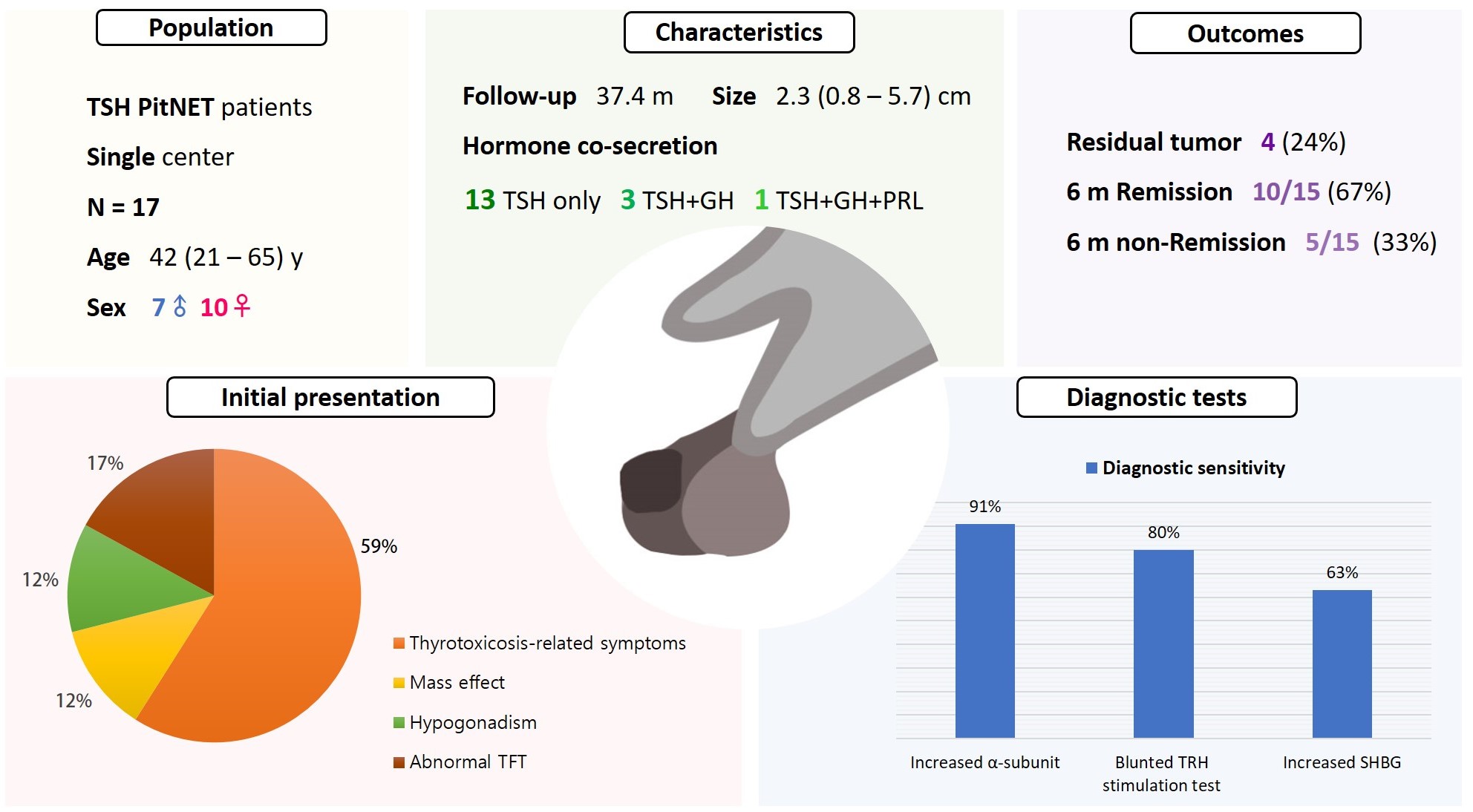
Thyroid-stimulating hormone (TSH)-secreting pituitary neuroendocrine tumor (TSH PitNET) is a rare subtype of PitNET. We investigated the comprehensive characteristics and outcomes of TSH PitNET cases from a single medical center. Also, we compared diagnostic methods to determine which showed superior sensitivity.
Methods
A total of 17 patients diagnosed with TSH PitNET after surgery between 2002 and 2022 in Samsung Medical Center was retrospectively reviewed. Data on comprehensive characteristics and treatment outcomes were collected. The sensitivities of diagnostic methods were compared.
Results
Seven were male (41%), and the median age at diagnosis was 42 years (range, 21 to 65); the median follow-up duration was 37.4 months. The most common (59%) initial presentation was hyperthyroidism-related symptoms. Hormonal co-secretion was present in four (23%) patients. Elevated serum alpha-subunit (α-SU) showed the greatest diagnostic sensitivity (91%), followed by blunted response at thyrotropin-releasing hormone (TRH) stimulation (80%) and elevated sex hormone binding globulin (63%). Fourteen (82%) patients had macroadenoma, and a specimen of one patient with heavy calcification was negative for TSH. Among 15 patients who were followed up for more than 6 months, 10 (67%) achieved hormonal and structural remission within 6 months postoperatively. A case of growth hormone (GH)/TSH/prolactin (PRL) co-secreting mixed gangliocytoma-pituitary adenoma (MGPA) was discovered.
Conclusion
The majority of the TSH PitNET cases was macroadenoma, and 23% showed hormone co-secretion. A rare case of GH/TSH/PRL co-secreting MGPA was discovered. Serum α-SU and TRH stimulation tests showed great diagnostic sensitivity. Careful consideration is needed in diagnosing TSH PitNET. Achieving remission requires complete tumor resection. In case of nonremission, radiotherapy or medical therapy can improve the long-term remission rate. -
Citations
Citations to this article as recorded by- Glucose metabolism in anterior pituitary adenomas
Valeria Hernández-Brito, Stephanie Lemoni Casco-Morales, Andrés Vega-Rosas
Clinica Chimica Acta.2026; 578: 120587. CrossRef - Clinical, Pathological, and Imaging Study of Pilomatrixoma: A Retrospective Study
Qi Hao, Cong‐Gai Huang, Chao‐Ying Wu, Rong Kuang, Meng‐Ze Li
Health Science Reports.2026;[Epub] CrossRef - Differential diagnosis of familial dysalbuminemic hyperthyroxinemia , RTH, and TSHomas: A single-center retrospective analysis
Yuanmeng Li, Ke Zhang, Xiaofeng Chai, He Liu, Xinqi Cheng, Xi Wang, Yue Chi, Naishi Li, Xiaolan Lian
Endocrine.2026;[Epub] CrossRef - Calcified pituitary adenomas: First comprehensive characterization of a distinct clinical entity driven by GNAQ-mediated calcium-mitochondrial axis
Changjun Rao, Lei Gong, Jingyuan Jia, Lei Cao, Weiyan Xie, Yazhuo Zhang, Chuzhong Li, Haibo Zhu
Experimental Neurology.2026; 406: 115953. CrossRef - TSH-secreting pituitary adenomas and bone
Marco Losa, Alberto Vassallo, Stefano Frara, Pietro Mortini, Andrea Giustina
Pituitary.2024; 27(6): 752. CrossRef
- Glucose metabolism in anterior pituitary adenomas
Brief Report
- Adrenal Gland
- Urinary Free Metanephrines for Diagnosis of Pheochromocytoma and Paraganglioma
- Jiyeon Ahn, Ji Yun Park, Gyuri Kim, Sang-Man Jin, Kyu Yeon Hur, Soo-Youn Lee, Jae Hyeon Kim
- Endocrinol Metab. 2021;36(3):697-701. Published online June 1, 2021
- DOI: https://doi.org/10.3803/EnM.2020.925

- 16,641 View
- 275 Download
- 9 Web of Science
- 9 Crossref
-
Abstract
PDFSupplementary MaterialPubReader ePub
- Background
Pheochromocytoma and paraganglioma (PPGL) is diagnosed through biochemical confirmation of excessive catecholamines in urine and plasma. Recent technological developments have allowed us to measure urinary free metanephrines; however, the diagnostic accuracy of these new methods and the diagnostic cutoff values have not been evaluated.
Methods
This is a retrospective study of 595 subjects, including 71 PPGL cases and 524 controls. PPGL was based on pathological confirmation. Subjects with no evidence of PPGL over 2 years were included in the control group.
Results
Urinary free metanephrines yielded similar area under the curve (AUC) to urinary fractionated metanephrines and plasma free metanephrines. However, urinary free normetanephrine yielded a better AUC than did urinary fractionated normetanephrine. The optimal cutoff for urinary free metanephrine and normetanephrine corrected for urinary creatinine yielded 97.2% sensitivity and 98.1% specificity.
Conclusion
Urinary free metanephrines are a reliable method for diagnosing PPGL in Asian populations compared with existing biochemical methods. -
Citations
Citations to this article as recorded by- The Effect of Dietary Lemon Intake on Organic Acids in Morning Urine
Wen Xiao, Yan Lu, Liping Wu, Lianwen Zhang, Yufan Hui, Hongmin Luo, Jing Li, Jiangtao Yang
Molecular Nutrition & Food Research.2026;[Epub] CrossRef - Reference intervals of urinary metanephrines: creatinine ratios in dogs: comparison of acidified and non-acidified samples collected by cystocentesis
Solène Niederlender, Kristina Museux, Maureen Lazard, Suzy Y. M. Valentin
Journal of Veterinary Diagnostic Investigation.2026; 38(5): 972. CrossRef - Pitfalls of Adrenal Washout on CT in the Adult Population: A Pictorial Review
Benjamin Hao Bai Tay, Jordan Zheng Ting Sim
Diagnostics.2026; 16(6): 920. CrossRef - Advances in laboratory diagnostic studies of pheochromocytoma and paraganglioma
Chang Li, Lei Li, Danni Mu, Yichen Ma, Yumeng Gao, Yuemeng Li, Xinqi Cheng
Clinica Chimica Acta.2026; 591: 121100. CrossRef - Advancements in understanding the molecular mechanisms and clinical implications of Von Hippel-Lindau syndrome: A comprehensive review
Yaochun Wang, Jingzhuo Song, Shuxing Zheng, Shuhong Wang
Translational Oncology.2025; 51: 102193. CrossRef - The role of the adrenalectomy in the management of pheochromocytoma: the experience of a Portuguese referral center
Inês Costa Carvalho, Miguel V. B. Machado, João P. Morais, Filipa Carvalho, Elisabete Barbosa, José Barbosa
Endocrine.2024; 86(1): 409. CrossRef - Laparoscopic Resection of Para-Aortic Mass at the Aortic Bifurcation: An Atypical Presentation of a Tailgut Cyst
Andy Wang, Jiddu A Guart, Danielle Li, Trenton Taros, Hongyi Cui
Cureus.2024;[Epub] CrossRef - Biochemical Assessment of Pheochromocytoma and Paraganglioma
Graeme Eisenhofer, Christina Pamporaki, Jacques W M Lenders
Endocrine Reviews.2023; 44(5): 862. CrossRef - Adrenal bleeding due to pheochromocytoma - A call for algorithm
Ewelina Rzepka, Joanna Kokoszka, Anna Grochowska, Magdalena Ulatowska-Białas, Martyna Lech, Marta Opalińska, Elwira Przybylik-Mazurek, Aleksandra Gilis-Januszewska, Alicja Hubalewska-Dydejczyk
Frontiers in Endocrinology.2022;[Epub] CrossRef
- The Effect of Dietary Lemon Intake on Organic Acids in Morning Urine
Original Article
- Clinical Study
- Association of Body Mass Index with the Risk of Incident Type 2 Diabetes, Cardiovascular Disease, and All-Cause Mortality: A Community-Based Prospective Study
- Ji Cheol Bae, Nam H. Cho, Jae Hyeon Kim, Kyu Yeon Hur, Sang-Man Jin, Moon-Kyu Lee
- Endocrinol Metab. 2020;35(2):416-424. Published online June 24, 2020
- DOI: https://doi.org/10.3803/EnM.2020.35.2.416
- 16,512 View
- 231 Download
- 19 Web of Science
- 19 Crossref
-
Abstract
PDFSupplementary MaterialPubReader ePub
- Background
Type 2 diabetes and cardiovascular disease (CVD) are the most important sequelae of obesity and the leading cause of death. We evaluated the association between body mass index (BMI) and the risk of incident type 2 diabetes, CVD, and all-cause mortality in a prospective study of a Korean population.
Methods
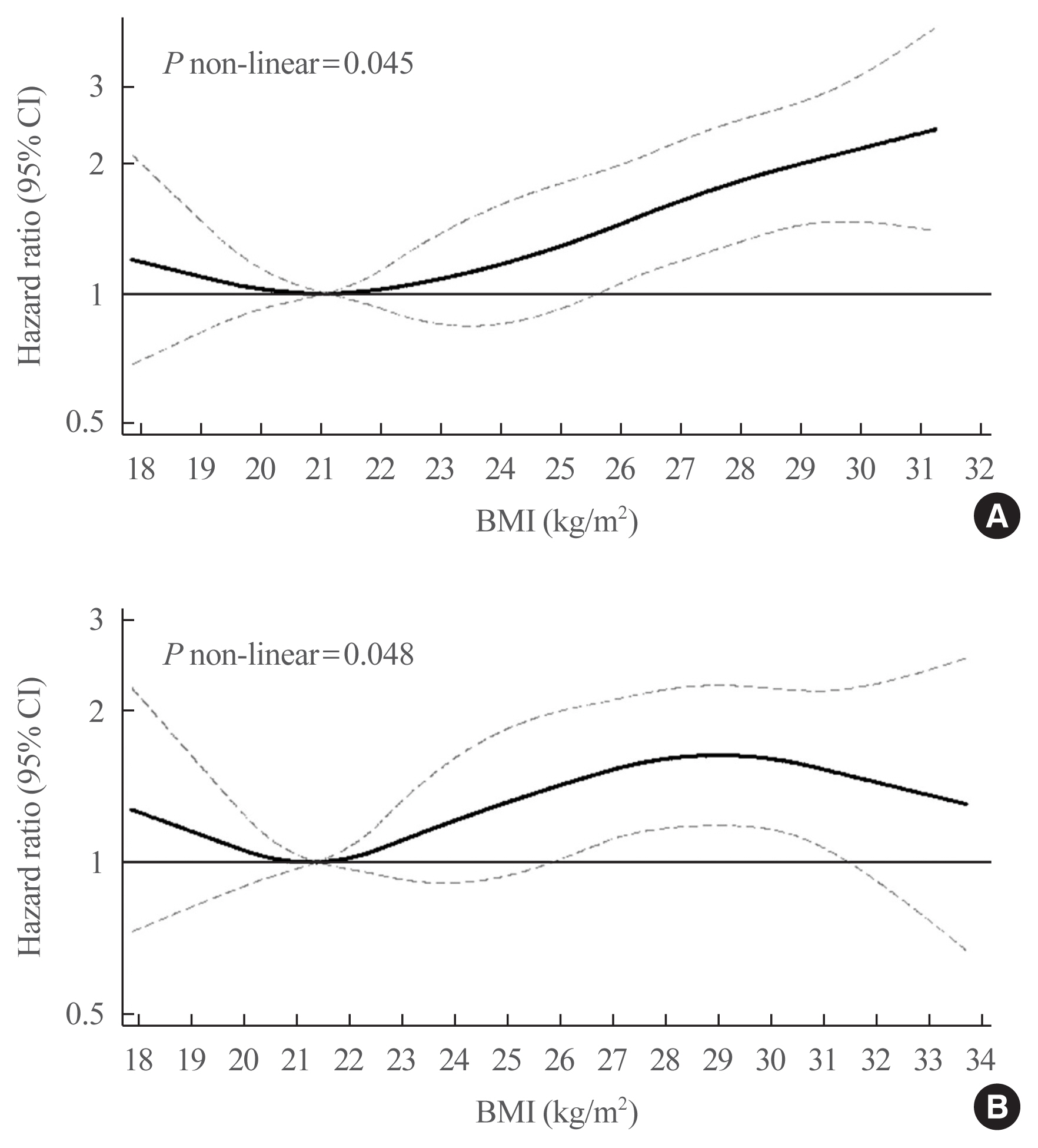
The shapes of the associations were modeled by restricted cubic splines regression analysis. After categorizing all subjects (n=8,900) into octiles based on their BMI levels, we estimated the hazard ratio (HR) for the association of categorized BMI levels with the risk of incident CVD and type 2 diabetes using a Cox’s proportional hazard analysis.
Results
The mean age of participants was 52 years and 48% were men. Of the subjects at baseline, 39.0% of men and 45.6% of women were classified as obese (BMI ≥25 kg/m2). Over a mean follow-up of 8.1 years, CVD events occurred in 509 participants; 436 died; and 1,258 subjects developed type 2 diabetes. The increased risk of incident diabetes began to be significant at BMI 23 to 24 kg/m2 in both sexes (HR, 1.8). For CVD events, the risk began to increase significantly at BMI 26 to 28 kg/m2 (HR, 1.6). We found a reverse J-shaped relationship between BMI and all-cause mortality, with an increased risk among individuals with BMI values in lower range (BMI <21 kg/m2).
Conclusion
These results suggest that the BMI cut-off points for observed risk were varied depending on the diseases and that the BMI classification of obesity need to be revised to reflect differential risk of obesity-related diseases. -
Citations
Citations to this article as recorded by- Effect of body mass index change on the development of diabetes mellitus
Masahiro Okano, Teruki Miyake, Shinya Furukawa, Osamu Yoshida, Yoshimasa Murakami, Ayumi Kanamoto, Masumi Miyazaki, Akihito Shiomi, Hironobu Nakaguchi, Yasunori Yamamoto, Yoshio Tokumoto, Masashi Hirooka, Teru Kumagi, Eiji Takesita, Yoshio Ikeda, Masanori
Endocrine Journal.2026; 73(2): 183. CrossRef - Association of Thyroid Function and Hormone Sensitivity With Abdominal Fat in Individuals With Overweight and Obesity
Yanning Xu, Jie Cai, Zixuan Wang, Minglan Yang, Jiang Yue, Shengyun He, Yicheng Qi, Qing Lu, Jing Ma
Diabetes, Obesity and Metabolism.2026; 28(8): 6801. CrossRef - The ‘Slow Burn’ Phenotype: How Relative Caloric Intake Reveals Hidden Cardiovascular Risk Beyond BMI
Yongin Cho, Jong Hyun Jhee, Jong Ho Jhee, Hye‐Sun Park
Diabetes, Obesity and Metabolism.2026; 28(10): 9644. CrossRef - Effect of nutritional profile assessment on dietary and lifestyle management in patients with type 2 diabetes in Morocco
Mohammed El Aameri, Imane Jaghror, Nadia Meskini, Bouchra Taib, Youness Taboz
Multidisciplinary Science Journal.2026; 9(3): 2027063. CrossRef - Predicting Metabolic and Cardiovascular Healthy from Nutritional Patterns and Psychological State Among Overweight and Obese Young Adults: A Neural Network Approach
Geovanny Genaro Reivan Ortiz, Laura Maraver-Capdevila, Roser Granero
Nutrients.2025; 17(16): 2651. CrossRef - Association of obesity with cardiovascular disease in the absence of traditional risk factors
Hui Luo, Yesong Liu, Xue Tian, Yuhan Zhao, Lulu Liu, Zemeng Zhao, Lili Luo, Yanmin Zhang, Xiaozhong Jiang, Yeqiang Liu, Yanxia Luo, Anxin Wang
International Journal of Obesity.2024; 48(2): 263. CrossRef - Clinical characteristics and degree of cardiovascular risk factor control in patients with newly-diagnosed type 2 diabetes in Catalonia
Anna Ramírez-Morros, Josep Franch-Nadal, Jordi Real, Queralt Miró-Catalina, Magdalena Bundó, Bogdan Vlacho, Didac Mauricio
Frontiers in Endocrinology.2024;[Epub] CrossRef - Research Progress on the Association and Mechanism between Obesity and Prostate Cancer
娜古丽·艾海提 热
Advances in Clinical Medicine.2024; 14(04): 1941. CrossRef - Assessing the health and economic burden of obesity-related complications in East-Asian populations: implementation of risk equations in the Core Obesity Model for Japan and model validation
Ichiro Tatsuno, Laetitia Gerlier, Anamaria-Vera Olivieri, James Baker-Knight, Mark Lamotte
BMJ Public Health.2024; 2(1): e000302. CrossRef - Metabolic status indicators and influencing factors in non-obese, non-centrally obese nonalcoholic fatty liver disease
Zhipeng Huang, Donghong Wei, Xueping Yu, Zicheng Huang, Yijie Lin, Wenji Lin, Zhijun Su, Jianjia Jiang
Medicine.2023; 102(6): e32922. CrossRef - Establishment and health management application of a prediction model for high-risk complication combination of type 2 diabetes mellitus based on data mining
Xin Luo, Jijia Sun, Hong Pan, Dian Zhou, Ping Huang, Jingjing Tang, Rong Shi, Hong Ye, Ying Zhao, An Zhang, Yee Gary Ang
PLOS ONE.2023; 18(8): e0289749. CrossRef - Differential Impact of Obesity on the Risk of Diabetes Development in Two Age Groups: Analysis from the National Health Screening Program
Tae Kyung Yoo, Kyung-Do Han, Yang-Hyun Kim, Ga Eun Nam, Sang Hyun Park, Eun-Jung Rhee, Won-Young Lee
Diabetes & Metabolism Journal.2023; 47(6): 846. CrossRef - Relationship between advanced lung cancer inflammation index and long-term all-cause, cardiovascular, and cancer mortality among type 2 diabetes mellitus patients: NHANES, 1999–2018
Yaying Chen, Mengqian Guan, Ruiqi Wang, Xuewen Wang
Frontiers in Endocrinology.2023;[Epub] CrossRef - Body mass index at baseline directly predicts new-onset diabetes and to a lesser extent incident cardio-cerebrovascular events, but has a J-shaped relationship to all-cause mortality
Yoon-Jong Bae, Sang-Jun Shin, Hee-Taik Kang
BMC Endocrine Disorders.2022;[Epub] CrossRef - Association of Shift Work with Normal-Weight Obesity in Community-Dwelling Adults
Chul Woo Ahn, Sungjae Shin, Seunghyun Lee, Hye-Sun Park, Namki Hong, Yumie Rhee
Endocrinology and Metabolism.2022; 37(5): 781. CrossRef - The Prognostic Value of Combined Status of Body Mass Index and Psychological Well-Being for the Estimation of All-Cause and CVD Mortality Risk: Results from a Long-Term Cohort Study in Lithuania
Dalia Lukšienė, Abdonas Tamosiunas, Ricardas Radisauskas, Martin Bobak
Medicina.2022; 58(11): 1591. CrossRef - The Relationship between Body Mass Index and Incident Diabetes Mellitus in Chinese Aged Population: A Cohort Study
M. L. Tang, Y. Q. Zhou, A. Q. Song, J. L. Wang, Y. P. Wan, R. Y. Xu, Carol Forsblom
Journal of Diabetes Research.2021; 2021: 1. CrossRef - Correlation between adiponectin level and the degree of fibrosis in patients with non-alcoholic fatty liver disease
Manal Sabry Mohamed, Tarek Mohammed Youssef, Esraa Ebrahim Abdullah, Ahmed Elmetwally Ahmed
Egyptian Liver Journal.2021;[Epub] CrossRef - Obesity Measures as Predictors of Type 2 Diabetes and Cardiovascular Diseases among the Jordanian Population: A Cross-Sectional Study
Hana Alkhalidy, Aliaa Orabi, Khadeejah Alnaser, Islam Al-Shami, Tamara Alzboun, Mohammad D. Obeidat, Dongmin Liu
International Journal of Environmental Research and Public Health.2021; 18(22): 12187. CrossRef
- Effect of body mass index change on the development of diabetes mellitus
Review Article
- Stepwise Approach to Problematic Hypoglycemia in Korea: Educational, Technological, and Transplant Interventions
- Sang-Man Jin
- Endocrinol Metab. 2017;32(2):190-194. Published online June 23, 2017
- DOI: https://doi.org/10.3803/EnM.2017.32.2.190
- 7,251 View
- 37 Download
- 3 Web of Science
- 3 Crossref
-
Abstract
PDFPubReader
Impaired awareness of hypoglycemia has been found to be prevalent in 20% to 40% of people with type 1 diabetes. If a similar prevalence exists in Koreans with type 1 diabetes, at a minimum, thousands of people with type 1 diabetes suffer at least one unpredicted episode of severe hypoglycemia per year in Korea. For patients with problematic hypoglycemia, an evidence-based stepwise approach was suggested in 2015. The first step is structured education regarding multiple daily injections of an insulin analog, and the second step is adding a technological intervention, such as continuous subcutaneous insulin infusion or real-time continuous glucose monitoring. The next step is a sensor-augmented pump, preferably with a low glucose suspension feature or very frequent contact, and the final step is islet or pancreas transplantation. In Korea, however, none of these treatments are reimbursed by the National Health Insurance, and thus have not been widely implemented. The low prevalence of type 1 diabetes means that Korean physicians are relatively unfamiliar with the new technologies in this field. Therefore, the roles of new technologies and pancreas or islet transplantation in the treatment of problematic hypoglycemia need to be defined in the current clinical setting of Korea.
-
Citations
Citations to this article as recorded by- Protective and risk factors of impaired awareness of hypoglycemia in patients with type 1 diabetes: a cross-sectional analysis of baseline data from the PR-IAH study
Naoki Sakane, Ken Kato, Sonyun Hata, Erika Nishimura, Rika Araki, Kunichi kouyama, Masako Hatao, Yuka Matoba, Yuichi Matsushita, Masayuki Domichi, Akiko Suganuma, Seiko Sakane, Takashi Murata, Fei Ling Wu
Diabetology & Metabolic Syndrome.2023;[Epub] CrossRef - A 4-Week, Two-Center, Open-Label, Single-Arm Study to Evaluate the Safety and Efficacy of EOPatch in Well-Controlled Type 1 Diabetes Mellitus
Jiyun Park, Nammi Park, Sangjin Han, You-Bin Lee, Gyuri Kim, Sang-Man Jin, Woo Je Lee, Jae Hyeon Kim
Diabetes & Metabolism Journal.2022; 46(6): 941. CrossRef - Impaired hypoglycemia awareness in diabetes: epidemiology, mechanisms and therapeutic approaches
Vadim V. Klimontov
Diabetes mellitus.2019; 21(6): 513. CrossRef
- Protective and risk factors of impaired awareness of hypoglycemia in patients with type 1 diabetes: a cross-sectional analysis of baseline data from the PR-IAH study
Original Article
- Adrenal gland
- Clinical Characteristics, Management, and Outcome of 22 Cases of Primary Hypophysitis
- Sun Mi Park, Ji Cheol Bae, Ji Young Joung, Yoon Young Cho, Tae Hun Kim, Sang-Man Jin, Sunghwan Suh, Kyu Yeon Hur, Kwang-Won Kim
- Endocrinol Metab. 2014;29(4):470-478. Published online December 29, 2014
- DOI: https://doi.org/10.3803/EnM.2014.29.4.470
- 14,628 View
- 53 Download
- 31 Web of Science
- 32 Crossref
-
Abstract
PDFPubReader
Background Primary hypophysitis causes varying degrees of endocrine dysfunction and mass effect. The natural course and best treatment have not been well established.
Methods Medical records of 22 patients who had been diagnosed with primary hypophysitis between January 2001 and March 2013 were retrospectively reviewed. Based on the anatomical location, we classified the cases as adenohypophysitis (AH), infundibuloneurohypophysitis (INH), and panhypophysitis (PH). Clinical presentation, endocrine function, pathologic findings, magnetic resonance imaging findings, and treatment courses were reviewed.
Results Among 22 patients with primary hypophysitis, 81.8% (18/22) had involvement of the posterior pituitary lobe. Two patients of the AH (2/3, 66.6%) and three patients of the PH (3/10, 30%) groups initially underwent surgical mass reduction. Five patients, including three of the PH (3/10, 33.3%) group and one from each of the AH (1/3, 33.3%) and INH (1/9, 11.1%) groups, initially received high-dose glucocorticoid treatment. Nearly all of the patients treated with surgery or high-dose steroid treatment (9/11, 82%) required continuous hormone replacement during the follow-up period. Twelve patients received no treatment for mass reduction due to the absence of acute symptoms and signs related to a compressive mass effect. Most of them (11/12, 92%) did not show disease progression, and three patients recovered partially from hormone deficiency.
Conclusion Deficits of the posterior pituitary were the most common features in our cases of primary hypophysitis. Pituitary endocrine defects responded less favorably to glucocorticoid treatment and surgery. In the absence of symptoms related to mass effect and with the mild defect of endocrine function, it may not require treatment to reduce mass except hormone replacement.
-
Citations
Citations to this article as recorded by- Primary Autoimmune Hypophysitis: Treatment and Predictors of Response to Glucocorticoid in a Single Center in China
Zhuoran Xu, Xiao Zhai, Tian Xu, Yueyang Zhang, Lian Duan, Yong Yao, Bing Xing, Kan Deng, Linjie Wang, Feng Feng, Zhiyong Liang, Hui You, Hongbo Yang, Lin Lu, Shi Chen, Hui Pan, Huijuan Zhu
Endocrine Practice.2026; 32(6): 887. CrossRef - Redefining the role of surgery in hypophysitis: Our experience, and a literature review
Léa Miquel, Benoit Testud, Nicolas Sahakian, Cécilia Piazzola, Frédérique Albarel, Thomas Cuny, Thierry Brue, Henry Dufour, Frederic Castinetti, Thomas Graillon
Annales d'Endocrinologie.2026; 87(4): 102582. CrossRef - Seronegative Hypophysitis Presenting as Unilateral Lateral Rectus Palsy
Edwin G Pullan, Mathew Abraham, Ramzeen N Hameed
Annals of Indian Academy of Neurology.2026; 29(4): 666. CrossRef - Spontaneous regression of paediatric pituitary lesions—report of 2 cases and literature review
Jonis M. L. Esguerra, Daniel C. W. Chan, Phua Hwee Tang, Ngee Lek, Sharon Y. Y. Low
Child's Nervous System.2025;[Epub] CrossRef - Hypophysites lymphocytaires et non lymphocytaires
I. Allix, V. Suteau, C. Briet
EMC - Endocrinologie - Nutrition.2025; 36(3): 1. CrossRef - A Rare Case of Idiopathic Granulomatous Hypophysitis: When Imaging Misleads and Histology Reveals
Shubham Gupta, Arvind Sharma, Ashok Gandhi, Bhoopesh Gupta, Naman Purohit, Praveen Rajpurohit
Neurology India Case Report.2025; 1(1): 54. CrossRef - Secondary xanthogranulomatous hypophysitis mimicking a pituitary macroadenoma: a case report
Salma Salhi, Ibtissem Oueslati, Yasmine Mouelhi, Alia Zehani, Nidhameddine Kchir, Elyes Kamoun, Meriem Yazidi, Melika Chihaoui
Journal of International Medical Research.2024;[Epub] CrossRef - Effects of glucocorticoid replacement therapy in patients with pituitary disease: A new perspective for personalized replacement therapy
Sabrina Chiloiro, Alessandra Vicari, Ginevra Mongelli, Flavia Costanza, Antonella Giampietro, Pier Paolo Mattogno, Liverana Lauretti, Alessandro Olivi, Laura De Marinis, Francesco Doglietto, Antonio Bianchi, Alfredo Pontecorvi
Reviews in Endocrine and Metabolic Disorders.2024; 25(5): 855. CrossRef - Hypophisitis in pregnant women with persistent diabetes insipidus in the outcome
L. K. Dzeranova, E. A. Pigarova, S. Yu. Vorotnikova, A. A. Voznesenskaya
Problems of Endocrinology.2024; 70(4): 15. CrossRef - Glucocorticoid therapy as first-line treatment in primary hypophysitis: a systematic review and individual patient data meta-analysis
Brijesh Krishnappa, Ravikumar Shah, Saba Samad Memon, Chakra Diwaker, Anurag R Lila, Virendra A Patil, Nalini S Shah, Tushar R Bandgar
Endocrine Connections.2023;[Epub] CrossRef - Hypophysitis, the Growing Spectrum of a Rare Pituitary Disease
Fabienne Langlois, Elena V Varlamov, Maria Fleseriu
The Journal of Clinical Endocrinology & Metabolism.2022; 107(1): 10. CrossRef - Outcomes of Initial Management Strategies in Patients With Autoimmune Lymphocytic Hypophysitis: A Systematic Review and Meta-analysis
Diane Donegan, Zeb Saeed, Danae A Delivanis, Mohammad Hassan Murad, Juergen Honegger, Felix Amereller, Seda Hanife Oguz, Dana Erickson, Irina Bancos
The Journal of Clinical Endocrinology & Metabolism.2022; 107(4): 1170. CrossRef - Early Pulse Glucocorticoid Therapy and Improved Hormonal Outcomes in Primary Hypophysitis
Brijesh Krishnappa, Ravikumar Shah, Vijaya Sarathi, Anurag Ranjan Lila, Manjeet Kaur Sehemby, Virendra A. Patil, Shilpa Sankhe, Nalini Shah, Tushar Bandgar
Neuroendocrinology.2022; 112(2): 186. CrossRef - Preoperative differentiation of hypophysitis and pituitary adenomas using a novel clinicoradiologic scoring system
Kyla Wright, Hyon Kim, Travis Hill, Matthew Lee, Cordelia Orillac, Nikita Mogar, Donato Pacione, Nidhi Agrawal
Pituitary.2022; 25(4): 602. CrossRef - Hypophysitis
Diane Donegan, Jürgen Honegger
Endocrine Practice.2022; 28(9): 901. CrossRef - Rare Case of a Disappearing Pituitary Adenoma During the Coronavirus Disease 2019 (COVID-19) Pandemic
David P. Bray, C. Arturo Solares, Nelson M. Oyesiku
World Neurosurgery.2021; 146: 148. CrossRef - Diabetes insipidus secondary to sellar/parasellar lesions
Anna Angelousi, Chrysoula Mytareli, Paraskevi Xekouki, Eva Kassi, Konstantinos Barkas, Ashley Grossman, Gregory Kaltsas
Journal of Neuroendocrinology.2021;[Epub] CrossRef - Clinical presentation and management of hypophysitis: An observational study of case series
Marouan Karrou, Salma Benyakhlef, Achwak Alla, Najoua Messaoudi, Asmae Oulad Amar, Siham Rouf, Imane Kamaoui, Noureddine Oulali, Faycal Moufid, Naima Abda, Hanane Latrech
Surgical Neurology International.2021; 12: 304. CrossRef - Clinical aspects of autoimmune hypothalamitis, a variant of autoimmune hypophysitis: Experience from one center
Qian Wei, Guoqing Yang, Zhaohui Lue, Jingtao Dou, Li Zang, Yijun Li, Jin Du, Weijun Gu, Yiming Mu
Journal of International Medical Research.2020;[Epub] CrossRef - Primary and Ipilimumab-induced Hypophysitis: A Single-center Case Series
Paul Atkins, Ehud Ur
Endocrine Research.2020; 45(4): 246. CrossRef - Hypophysitis (Including IgG4 and Immunotherapy)
Anna Angelousi, Krystallenia Alexandraki, Marina Tsoli, Gregory Kaltsas, Eva Kassi
Neuroendocrinology.2020; 110(9-10): 822. CrossRef - Hypophysitis in the era of immune checkpoint inhibitors and immunoglobulin G4-related disease
Leen Wehbeh, Sama Alreddawi, Roberto Salvatori
Expert Review of Endocrinology & Metabolism.2019; 14(3): 167. CrossRef - Immune check point inhibitors-induced hypophysitis: a retrospective analysis of the French Pharmacovigilance database
Julie Garon-Czmil, Nadine Petitpain, Franck Rouby, Marion Sassier, Samy Babai, Mélissa Yéléhé-Okouma, Georges Weryha, Marc Klein, Pierre Gillet
Scientific Reports.2019;[Epub] CrossRef - Clinical Features, Magnetic Resonance Imaging, and Treatment Experience of 20 Patients with Lymphocytic Hypophysitis in a Single Center
Qiang Zhu, Ke Qian, Guijun Jia, Gang Lv, Jisheng Wang, Liyong Zhong, Shuqing Yu
World Neurosurgery.2019; 127: e22. CrossRef - Idiopathic granulomatous hypophysitis presenting with galactorrhea, headache, and nausea in a woman: a case report and review of the literature
Guive Sharifi, Mohammad Reza Mohajeri-Tehrani, Behrouz Navabakhsh, Bagher Larijani, Touraj Valeh
Journal of Medical Case Reports.2019;[Epub] CrossRef - Paciente de 31 años con polidipsia
A.R. Benavides Aramburu, M. Seguí Díaz
Medicina de Familia. SEMERGEN.2018; 44(2): e77. CrossRef - Primary hypophysitis and other autoimmune disorders of the sellar and suprasellar regions
Sriram Gubbi, Fady Hannah-Shmouni, Constantine A. Stratakis, Christian A. Koch
Reviews in Endocrine and Metabolic Disorders.2018; 19(4): 335. CrossRef - Primary lymphocytic hypophysitis: Clinical characteristics and treatment of 50 cases in a single centre in China over 18 years
Shuchang Wang, Linjie Wang, Yong Yao, Feng Feng, Hongbo Yang, Zhiyong Liang, Kan Deng, Hui You, Jian Sun, Bing Xing, Zimeng Jin, Renzhi Wang, Hui Pan, Huijuan Zhu
Clinical Endocrinology.2017; 87(2): 177. CrossRef - Clinical presentation and outcome of children with central diabetes insipidus associated with a self‐limited or transient pituitary stalk thickening, diagnosed as infundibuloneurohypophysitis
J. Schaefers, M. Cools, K. De Waele, I. Gies, V. Beauloye, P. Lysy, I. Francois, D. Beckers, J. De Schepper
Clinical Endocrinology.2017; 87(2): 171. CrossRef - Intrachiasmatic abscess caused by IgG4-related hypophysitis
Georgios F. Hadjigeorgiou, Eva Løbner Lund, Lars Poulsgaard, Ulla Feldt-Rasmussen, Åse Krogh Rasmussen, Marianne Wegener, Kåre Fugleholm
Acta Neurochirurgica.2017; 159(11): 2229. CrossRef - Granulomatous and lymphocytic hypophysitis – are they immunologically distinct?
Shilpa Rao, Anita Mahadevan, Tanmoy Maiti, Manish Ranjan, Shivayogi Durgad Shwetha, Arimappamagan Arivazhagan, Jitender Saini
APMIS.2016; 124(12): 1072. CrossRef - Articles in 'Endocrinology and Metabolism' in 2014
Won-Young Lee
Endocrinology and Metabolism.2015; 30(1): 47. CrossRef
- Primary Autoimmune Hypophysitis: Treatment and Predictors of Response to Glucocorticoid in a Single Center in China
 First
 Prev


