
 KES

Search
- Page Path
- HOME > Search
Original Articles
- Ezetimibe Treatment Is Associated with Lower Risk of Incident Cancer: A Nationwide Population-Based Cohort Study
- Yongin Cho, Hye-Sun Park, Min-Ae Park, Sojeong Park, Da Hea Seo, Seong Hee Ahn, Seongbin Hong, So Hun Kim
- Received August 20, 2025 Accepted February 3, 2026 Published online September 2, 2026
- DOI: https://doi.org/10.3803/EnM.2025.2615 [Epub ahead of print]
- 967 View
- 49 Download
-
 Abstract
 PDF
 Supplementary Material
 PubReader
 ePub
- Background
Ezetimibe has demonstrated favorable outcomes, including a reduction in cardiovascular complications and improvement in insulin resistance. However, its association with cancer risk remains unclear. This study evaluated the association between the use of ezetimibe-statin combination therapy and cancer risk using real-world data.
Methods
Korean National Health Insurance Service database health records were analyzed using propensity score matching to compare the cancer-related outcomes between ezetimibe-statin combination therapy and statin monotherapy groups. Outcomes included cancer incidence, cancer-specific mortality, and all-cause mortality.
Results
In a cohort of 669,036 statin users, ezetimibe-statin combination therapy was associated with a significantly lower risk of cancer (hazard ratio [HR], 0.89; P<0.001) and cancer-related mortality (HR, 0.85; P<0.001) compared with statin monotherapy. Combination therapy was also associated with a lower risk of specific cancers, including colorectal, liver, breast, pancreatic, and biliary tract cancers. These inverse associations were consistent across subgroups stratified according to age, sex, alcohol consumption/smoking history, and the presence of diabetes or hypertension (all P for interaction >0.05). Moreover, a longer duration of ezetimibe use was linked to a lower cancer risk, with the most pronounced inverse associations observed in individuals who had used the drug for ≥4 years.
Conclusion
These findings suggest that ezetimibe combined with statins may be associated with a reduced risk of cancer.

- Elevated Serum CXCL9 Levels Are Associated with Greater Frailty Risk in Older Women
- Da Hea Seo, Nancy E. Lane, Seongbin Hong, Beom-Jun Kim
- Received November 11, 2025 Accepted March 17, 2026 Published online June 15, 2026
- DOI: https://doi.org/10.3803/EnM.2025.2783 [Epub ahead of print]

- 1,729 View
- 20 Download
-
Abstract
PDFSupplementary MaterialPubReader ePub
- Background
Frailty is a clinical syndrome that increases the vulnerability to adverse outcomes in older adults. C-X-C motif ligand 9 (CXCL9), a marker of chronic inflammation, has been implicated in musculoskeletal decline and mortality. However, its relationship with frailty in older individuals has not been well studied.
Methods
This study included 237 community-dwelling women, aged 65 years or older, who underwent a comprehensive geriatric assessment. Serum CXCL9 levels were measured by enzyme-linked immunosorbent assay. Frailty was defined using the Fried phenotype and the Rockwood deficit accumulation index. Associations between serum CXCL9 levels and frailty outcomes were examined using a multivariate regression analysis.
Results
Serum CXCL9 increased progressively across the frailty categories (robust: 239.3±110.1 pg/mL; frail: 347.5±119.0 pg/mL; P<0.001). Higher levels of CXCL9 were independently associated with a greater frailty index (β=0.0001, P<0.001), lower skeletal muscle index (β=−0.001, P=0.004), weaker grip strength (β=−0.010, P<0.001), and slower gait speed (β=−0.0003, P=0.039). Women in the highest CXCL9 quartile had 3.20-fold greater odds of frailty (95% confidence interval [CI], 1.70 to 14.56), 3.41-fold greater odds of sarcopenia (95% CI, 1.25 to 9.30), and 6.71-fold greater odds of low muscle strength (95% CI, 1.75 to 25.78) compared with the lowest quartile.
Conclusion
Elevated CXCL9 levels were independently associated with greater frailty burden and adverse musculoskeletal phenotypes in older women. These findings support CXCL9 as a promising biomarker of chronic inflammation and frailty, and warrant further investigation through longitudinal studies.
- Mineral, Bone & Muscle
- Elevated Circulating Sclerostin Levels in Frail Older Adults: Implications beyond Bone Health
- Ji Yeon Baek, Seong Hee Ahn, Il-Young Jang, Hee-Won Jung, Eunhye Ji, So Jeong Park, Yunju Jo, Eunju Lee, Dongryeol Ryu, Seongbin Hong, Beom-Jun Kim
- Endocrinol Metab. 2025;40(1):73-81. Published online October 24, 2024
- DOI: https://doi.org/10.3803/EnM.2024.2100

- 5,715 View
- 108 Download
- 2 Web of Science
- 2 Crossref
-
Abstract
PDFSupplementary MaterialPubReader ePub
- Background
Sclerostin, initially recognized for its pivotal role in bone metabolism, has gained attention for its multifaceted impact on overall human health. However, its influence on frailty—a condition that best reflects biological age—has not been thoroughly investigated.
Methods
We collected blood samples from 244 older adults who underwent comprehensive geriatric assessments. Sclerostin levels were quantified using an enzyme-linked immunosorbent assay. Frailty was assessed using two validated approaches: the phenotypic model by Fried and the deficit accumulation frailty index (FI) by Rockwood.
Results
After controlling for sex, age, and body mass index, we found that serum sclerostin levels were significantly elevated in frail individuals compared to their robust counterparts (P<0.001). There was a positive correlation between serum sclerostin concentrations and the FI (P<0.001). Each standard deviation increase in serum sclerostin was associated with an odds ratio of 1.87 for frailty (P=0.003). Moreover, participants in the highest quartile of sclerostin levels had a significantly higher FI and a 9.91-fold increased odds of frailty compared to those in the lowest quartile (P=0.003 and P=0.039, respectively).
Conclusion
These findings, which for the first time explore the association between circulating sclerostin levels and frailty, have significant clinical implications, positioning sclerostin as one of potential blood-based biomarkers for frailty that captures the comprehensive physical, mental, and social aspects of the elderly, extending beyond its traditional role in bone metabolism. -
Citations
Citations to this article as recorded by
- Irisin, Sclerostin, and Inflammatory Axis: Implication in Bone‐Muscle Wasting Diseases
Mohamad Maged, Sameh Heikal, Salma Ibrahim, Sameh E. Hassanein
Cell Biochemistry and Function.2026;[Epub] CrossRef - The bone-cerebrovascular axis: effects of bone aging on neurovascular dysfunction and neurodegeneration
Jiekang Wang, Xu Cao, Mei Wan
Journal of Clinical Investigation.2026;[Epub] CrossRef
- Irisin, Sclerostin, and Inflammatory Axis: Implication in Bone‐Muscle Wasting Diseases
- Diabetes, obesity and metabolism
- Study Design and Protocol for a Randomized Controlled Trial to Assess Long-Term Efficacy and Safety of a Triple Combination of Ezetimibe, Fenofibrate, and Moderate-Intensity Statin in Patients with Type 2 Diabetes and Modifiable Cardiovascular Risk Factors (ENSEMBLE)
- Nam Hoon Kim, Juneyoung Lee, Suk Chon, Jae Myung Yu, In-Kyung Jeong, Soo Lim, Won Jun Kim, Keeho Song, Ho Chan Cho, Hea Min Yu, Kyoung-Ah Kim, Sang Soo Kim, Soon Hee Lee, Chong Hwa Kim, Soo Heon Kwak, Yong‐ho Lee, Choon Hee Chung, Sihoon Lee, Heung Yong Jin, Jae Hyuk Lee, Gwanpyo Koh, Sang-Yong Kim, Jaetaek Kim, Ju Hee Lee, Tae Nyun Kim, Hyun Jeong Jeon, Ji Hyun Lee, Jae-Han Jeon, Hye Jin Yoo, Hee Kyung Kim, Hyeong-Kyu Park, Il Seong Nam-Goong, Seongbin Hong, Chul Woo Ahn, Ji Hee Yu, Jong Heon Park, Keun-Gyu Park, Chan Ho Park, Kyong Hye Joung, Ohk-Hyun Ryu, Keun Yong Park, Eun-Gyoung Hong, Bong-Soo Cha, Kyu Chang Won, Yoon-Sok Chung, Sin Gon Kim
- Endocrinol Metab. 2024;39(5):722-731. Published online August 22, 2024
- DOI: https://doi.org/10.3803/EnM.2024.1995

- 14,790 View
- 371 Download
- 8 Web of Science
- 6 Crossref
-
Abstract
PDFPubReader ePub
- Background
Atherogenic dyslipidemia, which is frequently associated with type 2 diabetes (T2D) and insulin resistance, contributes to the development of vascular complications. Statin therapy is the primary approach to dyslipidemia management in T2D, however, the role of non-statin therapy remains unclear. Ezetimibe reduces cholesterol burden by inhibiting intestinal cholesterol absorption. Fibrates lower triglyceride levels and increase high-density lipoprotein cholesterol (HDL-C) levels via peroxisome proliferator- activated receptor alpha agonism. Therefore, when combined, these drugs effectively lower non-HDL-C levels. Despite this, few clinical trials have specifically targeted non-HDL-C, and the efficacy of triple combination therapies, including statins, ezetimibe, and fibrates, has yet to be determined.
Methods
This is a multicenter, prospective, randomized, open-label, active-comparator controlled trial involving 3,958 eligible participants with T2D, cardiovascular risk factors, and elevated non-HDL-C (≥100 mg/dL). Participants, already on moderate-intensity statins, will be randomly assigned to either Ezefeno (ezetimibe/fenofibrate) addition or statin dose-escalation. The primary end point is the development of a composite of major adverse cardiovascular and diabetic microvascular events over 48 months.
Conclusion
This trial aims to assess whether combining statins, ezetimibe, and fenofibrate is as effective as, or possibly superior to, statin monotherapy intensification in lowering cardiovascular and microvascular disease risk for patients with T2D. This could propose a novel therapeutic approach for managing dyslipidemia in T2D. -
Citations
Citations to this article as recorded by- Beyond lipids: fenofibrate in diabetic retinopathy and nephropathy
Mengying Liu, Seok Ting Lim, Weihua Song, Thomas M. Coffman, Xiaomeng Wang
Trends in Pharmacological Sciences.2026; 47(3): 325. CrossRef - Differential Pre‐ and Post‐Treatment Effects of Low‐Dose Antidyslipidemic Drugs on Gentamicin‐Induced Acute Nephrotoxicity in the Rat: A Histopathological and Biochemical Study
Pitchai Balakumar, Sultan Alshahrani, Noohu Abdulla Khan, Rajavel Varatharajan, K. M. Sundram
Journal of Applied Toxicology.2026; 46(6): 1879. CrossRef - Ezetimibe attenuates diabetic retinopathy via NRF2-mediated suppression of inflammation and oxidative stress
Lei Cheng, Shan Cheng, Ran Zhu, Guoxu Xu
Journal of Diabetes and its Complications.2026; 40(2): 109250. CrossRef - Development and Validation of Green UV Spectrophotometric Method Using Augmented Classical Least Squares for Simultaneous Quantification of Atorvastatin, Ezetimibe, and Fenofibrate in Pharmaceutical and Environmental Samples
Ahmed M. Abdelzaher, Omkulthom Al kamaly, Anwar M. Alnakhli, Mona A. Abdel Rahman
ChemistrySelect.2026;[Epub] CrossRef - Current and Emerging Treatment Options for Hypertriglyceridemia: State-of-the-Art Review
Jakub Michal Zimodro, Manfredi Rizzo, Ioanna Gouni-Berthold
Pharmaceuticals.2025; 18(2): 147. CrossRef - Fenofibrate therapy and risk of heart failure outcomes in patients with Type 2 diabetes: a propensity-matched cohort study
Ji Yoon Kim, Nam Hoon Kim, Jiyoon Lee, Dong-Hoon Kim, Sin Gon Kim
European Heart Journal - Cardiovascular Pharmacotherapy.2025; 11(7): 620. CrossRef
- Beyond lipids: fenofibrate in diabetic retinopathy and nephropathy
- Mineral, Bone & Muscle
- Familial Correlation and Heritability of Hand Grip Strength in Korean Adults (Korea National Health and Nutrition Examination Survey 2014 to 2019)
- Seong Hee Ahn, Eun Byeol Park, Seongha Seo, Yongin Cho, Da Hea Seo, So Hun Kim, Young Ju Suh, Seongbin Hong
- Endocrinol Metab. 2023;38(6):709-719. Published online November 7, 2023
- DOI: https://doi.org/10.3803/EnM.2023.1740
- 9,716 View
- 86 Download
- 1 Web of Science
- 2 Crossref
-
Abstract
PDFSupplementary MaterialPubReader ePub
- Background
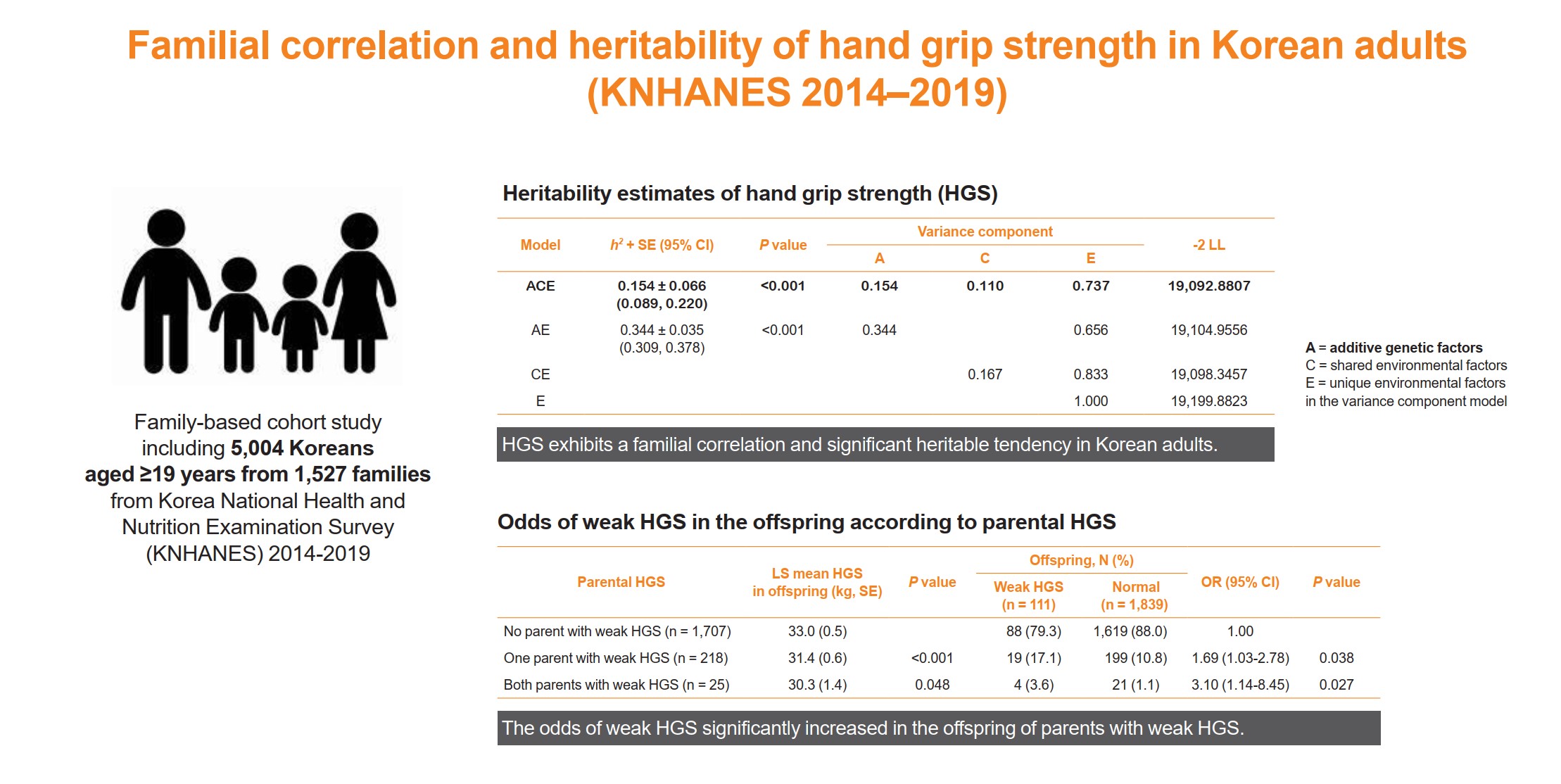
The onset and progression of sarcopenia are highly variable among individuals owing to genetic and environmental factors. However, there are a limited number of studies measuring the heritability of muscle strength in large numbers of parent-adult offspring pairs. We aimed to investigate the familial correlation and heritability of hand grip strength (HGS) among Korean adults.
Methods
This family-based cohort study on data from the Korea National Health and Nutrition Examination Survey (2014 to 2019) included 5,004 Koreans aged ≥19 years from 1,527 families. HGS was measured using a digital grip strength dynamometer. Familial correlations of HGS were calculated in different pairs of relatives. Variance component methods were used to estimate heritability.
Results
The heritability estimate of HGS among Korean adults was 0.154 (standard error, 0.066). Correlation coefficient estimates for HGS between parent-offspring, sibling, and spouse pairs were significant at 0.07, 0.10, and 0.23 (P<0.001, P=0.041, and P<0.001, respectively). The total variance in the HGS phenotype was explained by additive genetic (15.4%), shared environmental (11.0%), and unique environmental (73.6%) influences. The odds of weak HGS significantly increased in the offspring of parents with weak HGS (odds ratio [OR], 1.69–3.10; P=0.027–0.038), especially in daughters (OR, 2.04–4.64; P=0.029–0.034).
Conclusion
HGS exhibits a familial correlation and significant heritable tendency in Korean adults. Therefore, Asian adults, especially women, who have parents with weak HGS, need to pay special attention to their muscle health with the help of healthy environmental stimuli. -
Citations
Citations to this article as recorded by- Association of Handgrip Strength with Diabetes, Hypertension, and Comorbidities in a Korean Population: A Large-Scale Cross-Sectional Study
Bum Ju Lee
Journal of Clinical Medicine.2025; 14(8): 2801. CrossRef - Malnutrition and Handgrip Strength are Correlated in Community Dwelling Elderly
Mehmet Göl, Ayse Elkoca, İbrahim Halil Türkbeyler, Melek Tarakçıoğlu, Alican Çelik, Kazım Ersin Altınsoy
STED / Sürekli Tıp Eğitimi Dergisi.2024;[Epub] CrossRef
- Association of Handgrip Strength with Diabetes, Hypertension, and Comorbidities in a Korean Population: A Large-Scale Cross-Sectional Study
- Mineral, Bone & Muscle
- Decreased Serum Level of Sclerostin in Older Adults with Sarcopenia
- Seong Hee Ahn, Hee-Won Jung, Eunju Lee, Ji Yeon Baek, Il-Young Jang, So Jeong Park, Jin Young Lee, Eunah Choi, Yun Sun Lee, Seongbin Hong, Beom-Jun Kim
- Endocrinol Metab. 2022;37(3):487-496. Published online May 27, 2022
- DOI: https://doi.org/10.3803/EnM.2022.1428
- 9,395 View
- 189 Download
- 21 Web of Science
- 20 Crossref
-
Abstract
PDFPubReader ePub
- Background
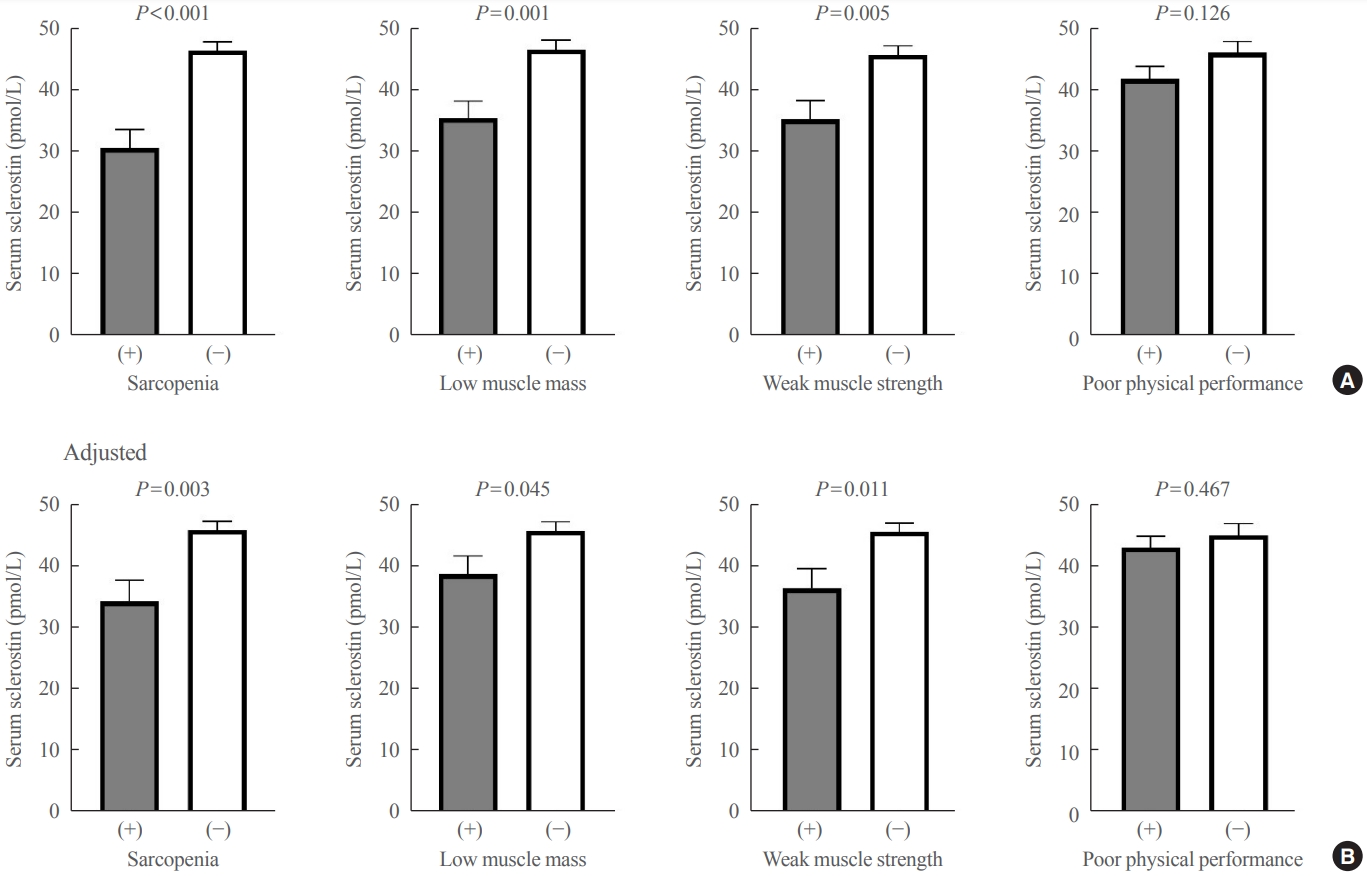
Although muscles and bones interact with each other through various secretory factors, the role of sclerostin, an osteocyte-secreted factor, on muscle metabolism has not been well studied. We investigated the levels of serum sclerostin in Korean older adults with sarcopenia.
Methods
Blood samples were collected from 129 participants who underwent evaluation of muscle mass and function in an outpatient geriatric clinic of a teaching hospital. Sarcopenia and related parameters were determined using cutoff values for the Asian population. Serum sclerostin levels were measured using an enzyme-linked immunosorbent assay.
Results
The mean age of the participants was 69.6 years, and 20 participants (15.5%) were classified as having sarcopenia. After adjusting for age, sex, and body mass index, serum sclerostin levels were significantly lower in participants with sarcopenia, low muscle mass, or weak muscle strength (P=0.003 to 0.045). Serum sclerostin levels were positively associated with skeletal muscle index and grip strength after adjusting for confounders (P=0.001 and P=0.003), whereas sarcopenic phenotype score showed a negative association (P=0.006). These increases in muscle mass and strength were also dose dependent as serum sclerostin levels increased (P for trends=0.003 and P for trends=0.015). Higher serum sclerostin levels were associated with lower odds ratio (ORs) for sarcopenia, low muscle mass, and weak muscle strength after adjusting for confounders (OR, 0.27 to 0.50; P<0.001 to 0.025).
Conclusion
Higher serum sclerostin levels were associated with a lower risk of sarcopenia, low muscle mass, and weak muscle strength in Korean older adults. -
Citations
Citations to this article as recorded by- Exploring osteosarcopenia from the gut microbiota perspective: mechanistic insights and therapeutic potentials based on the gut-muscle-bone Axis
Hao-bo Jiang, Jun-qi Zhang, Hao Liang, Li-ying Sun, Chang-qing Deng, Shao-feng Yang
Frontiers in Microbiology.2026;[Epub] CrossRef - Combined effects of a low-dose multi-target supplement (CaHMB, CBP, and HA) on delaying musculoskeletal aging
Haoqi Chen, Junhong Peng, Shanshan Guo, Ting Chen, Si Chen, Xinyuan Jin, Wenge Huang, Chao Xu, Mengchu Li, Mengxing Xie, Mengtao Yang, Jinzhu Pang, Huilian Zhu
Food & Function.2026; 17(8): 3639. CrossRef - Bone and muscle crosstalk in ageing and disease
Ben Kirk, Giovanni Lombardi, Gustavo Duque
Nature Reviews Endocrinology.2025; 21(6): 375. CrossRef - Elevated Circulating Sclerostin Levels in Frail Older Adults: Implications beyond Bone Health
Ji Yeon Baek, Seong Hee Ahn, Il-Young Jang, Hee-Won Jung, Eunhye Ji, So Jeong Park, Yunju Jo, Eunju Lee, Dongryeol Ryu, Seongbin Hong, Beom-Jun Kim
Endocrinology and Metabolism.2025; 40(1): 73. CrossRef - Sclerostin's role in bone–muscle crosstalk and osteoporosis pathogenesis
Hamzah Shahid, Vivek Kumar Morya, Kyu-Cheol Noh
Osteoporosis and Sarcopenia.2025; 11(3): 69. CrossRef - Rethinking Osteoporosis Drugs: Can We Simultaneously Address Sarcopenia?
Zoran Gavrilov, Jasna Lojk
International Journal of Molecular Sciences.2025; 26(14): 6924. CrossRef - The role of bone-derived factors in bone and muscle communication
Guobin Li, Mingyan Qi, Shibin Liang
Frontiers in Endocrinology.2025;[Epub] CrossRef - Chronic low-grade inflammation and primary osteoporosis
Jan Štěpán
Clinical Osteology.2025; 30(3): 145. CrossRef - Emerging roles of osteocytes in the regulation of bone and skeletal muscle mass
Md Rameez Moin, Shubhrajyoti Das, Sabyasachi Sanyal
Journal of Molecular Endocrinology.2025;[Epub] CrossRef - Mechanism and physical activities in bone-skeletal muscle crosstalk
Zhonghan Zhao, Kai Yan, Qiao Guan, Qiang Guo, Can Zhao
Frontiers in Endocrinology.2024;[Epub] CrossRef - Musculoskeletal disorders and coronary artery disease —promising molecular markers: literature review
Viktoria N. Karetnikova, Anastasiya G. Neeshpapa, Evgenia I. Carpova, Olga L. Barbarash
CardioSomatics.2024; 15(1): 55. CrossRef - Differences in Type 2 Fiber Composition in the Vastus Lateralis and Gluteus Maximus of Patients with Hip Fractures
Jingwen Tian, Minchul Song, Kyu Jeong Cho, Ho Yeop Lee, Sang Hyeon Ju, Jung Ryul Lim, Ha Thi Nga, Thi Linh Nguyen, Ji Sun Moon, Hyo Ju Jang, Jung-Mo Hwang, Hyon-Seung Yi
Endocrinology and Metabolism.2024; 39(3): 521. CrossRef - Determinants of bone mass in older adults with normal- and overweight derived from the crosstalk with muscle and adipose tissue
Carina O. Walowski, Catrin Herpich, Janna Enderle, Wiebke Braun, Marcus Both, Mario Hasler, Manfred J. Müller, Kristina Norman, Anja Bosy-Westphal
Scientific Reports.2023;[Epub] CrossRef - Role of the Osteocyte in Musculoskeletal Disease
Anika Shimonty, Lynda F. Bonewald, Fabrizio Pin
Current Osteoporosis Reports.2023; 21(3): 303. CrossRef - The role of sclerostin in lipid and glucose metabolism disorders
Hewen Jiang, Dijie Li, Ying Han, Nanxi Li, Xiaohui Tao, Jin Liu, Zongkang Zhang, Yuanyuan Yu, Luyao Wang, Sifan Yu, Ning Zhang, Huan Xiao, Xin Yang, Yihao Zhang, Ge Zhang, Bao-Ting Zhang
Biochemical Pharmacology.2023; 215: 115694. CrossRef - Cytokines and exosomal miRNAs in skeletal muscle–adipose crosstalk
Liu Guo, Menchus Quan, Weijun Pang, Yulong Yin, Fengna Li
Trends in Endocrinology & Metabolism.2023; 34(10): 666. CrossRef - Sclerostin: clinical insights in muscle–bone crosstalk
Antimo Moretti, Giovanni Iolascon
Journal of International Medical Research.2023;[Epub] CrossRef - Anti-sclerostin antibodies: a new frontier in fragility fractures treatment
Giovanni Iolascon, Sara Liguori, Marco Paoletta, Giuseppe Toro, Antimo Moretti
Therapeutic Advances in Musculoskeletal Disease.2023;[Epub] CrossRef - Sclerostin as a Putative Myokine in Sarcopenia
Hyon-Seung Yi
Endocrinology and Metabolism.2022; 37(3): 430. CrossRef - Organokines, Sarcopenia, and Metabolic Repercussions: The Vicious Cycle and the Interplay with Exercise
Giulia Minniti, Letícia Maria Pescinini-Salzedas, Guilherme Almeida dos Santos Minniti, Lucas Fornari Laurindo, Sandra Maria Barbalho, Renata Vargas Sinatora, Lance Alan Sloan, Rafael Santos de Argollo Haber, Adriano Cressoni Araújo, Karina Quesada, Jesse
International Journal of Molecular Sciences.2022; 23(21): 13452. CrossRef
- Exploring osteosarcopenia from the gut microbiota perspective: mechanistic insights and therapeutic potentials based on the gut-muscle-bone Axis
- Diabetes, Obesity and Metabolism
- Metformin-Associated Lactic Acidosis: Predisposing Factors and Outcome
- Min Ju Kim, Ju Young Han, Jun Young Shin, Shin Il Kim, Jeong Min Lee, Seongbin Hong, So Hun Kim, Moon Suk Nam, Yong Seong Kim
- Endocrinol Metab. 2015;30(1):78-83. Published online March 27, 2015
- DOI: https://doi.org/10.3803/EnM.2015.30.1.78
- 19,759 View
- 210 Download
- 40 Web of Science
- 40 Crossref
-
Abstract
PDFPubReader
Background Metformin is considered the first choice oral treatment for type 2 diabetes patients in the absence of contraindications. Rarely, life-threatening complications associated with metformin treatment are seen in some patients with underlying diseases. The aim of this study was to further investigate the clinical profiles and risk factors for metformin-associated lactic acidosis (MALA) and the treatment modalities according to survival.
Methods To identify MALA, we performed a retrospective study in seven diabetic patients who were taking metformin and had been diagnosed with lactic acidosis at Inha University Hospital between 1995 and 2012. For each patient, we recorded the age, sex, daily metformin dosage, laboratory test results, admission diagnosis, and risk factors. Also, concurrent conditions, treatment modalities, and outcomes were evaluated.
Results Six patients had risk factors for lactic acidosis before admission. All patients had renal impairment on admission as a precipitating risk factor. Five patients survived and two patients died despite early renal replacement therapy. Older patients tended to have a poorer prognosis.
Conclusion Renal function must be monitored in elderly type 2 diabetes mellitus patients with underlying diseases and conditions causing renal impairment who begin metformin treatment. Accurate recognition of MALA and initiation of renal replacement are essential for treatment.
-
Citations
Citations to this article as recorded by- Clinical outcomes of pediatric metformin exposures reported to the National Poison Data System®
Sarah Shafer, Haylea Stuteville, Shawn M. Varney
Clinical Toxicology.2026; 64(2): 123. CrossRef - Metformin—mechanisms of its glycemia-reducing effect
Jürgen Drewe, Marc Foretz, Stephan Krähenbühl
Pharmacological Reviews.2026; 78(1): 100106. CrossRef - Dexamethasone associated with lactic acidosis in a stroke patient with meningioma-associated vasogenic edema: a case report
Joon Sin Ser, Tze Chao Wee
Journal of Medical Case Reports.2026;[Epub] CrossRef - Severe Metformin‐Associated Lactic Acidosis—A Case Report
Elizabet Artinyan, Georgi Nikolov, Evelina Valcheva, Prajwol Baniya, Danika Sritharan, Adeel Khan, Marina Vaysilova, Nikolay Dimov
Clinical Case Reports.2026;[Epub] CrossRef - Neuromodulation using Bioelectronics-enabled therapies to combat insulin resistance and its comorbidities
Yosra Magdi Mekki, Jeongeun Park, Zeinah Alzaareer, Zaeem Hussain, Ayesha Gulzar, Abdelnaser Elzouki, Amparo Güemes, Susu M. Zughaier
Journal of Diabetes & Metabolic Disorders.2026;[Epub] CrossRef - Diagnosing Metformin Intoxication with High-Resolution Platelet Respirometry: A Case Report
Ondřej Sobotka, Pavla Staňková, Joao Fortunato, Eva Trčková, Pavel Skořepa
International Journal of Molecular Sciences.2026; 27(10): 4631. CrossRef - Causal association of metformin treatment with diverse immune-mediated inflammatory diseases: A Mendelian randomization analysis
Zheng Liao, Chenguang Su, Jian Li, Jinlong Liu
Medicine.2025; 104(6): e41400. CrossRef - Metformin-associated lactic acidosis: a serious complication of a common drug
Kanika Ajay Malani, Arkadiy Finn
Drug and Therapeutics Bulletin.2025; 63(4): 59. CrossRef - An Analysis of Clinical Outcomes of Exploratory Pediatric Metformin Ingestions Reported to the Texas Poison Center Network From 2011 to 2021
Shawn M. Varney, Sarah Watkins, Haylea Stuteville, Mark L. Winter, Han Tony Gao, Thomas G. Martin, Ryan P. Morrissey, Wayne R. Snodgrass, Brett A. Roth
Hospital Pharmacy.2024; 59(4): 465. CrossRef - Causal association of metformin treatment with diverse cardiovascular diseases: a Mendelian randomization analysis
Kaiyuan Li, Peng Liu, Jun Ye, Miao Liu, Li Zhu
Aging.2024;[Epub] CrossRef - Impact of Antidiabetic Drugs on Clinical Outcomes of COVID-19: A Nationwide Population-Based Study
Han Na Jang, Sun Joon Moon, Jin Hyung Jung, Kyung-Do Han, Eun-Jung Rhee, Won-Young Lee
Endocrinology and Metabolism.2024; 39(3): 479. CrossRef - Analytical probe for reliable sensing of metformin using cannon ball flower derived fluorescent CDs
Pradnya Khandagale, Akshata Pattanshetti, Prasad Mahajan, Rohant Dhabbe, Ashok Ubale, Rajratna Kakade, Sandip Nipane, Sandip Sabale
Emergent Materials.2024; 7(6): 2933. CrossRef - Metformin-associated lactic acidosis: a serious complication of a common drug
Kanika Ajay Malani, Arkadiy Finn
BMJ Case Reports.2024; 17(9): e260592. CrossRef - Metformin Treatment Reduces the Incidence of Rheumatoid Arthritis: A Two-Sample Mendelian Randomized Study
Jialin Liang, Yuanqing Cai, Jianan Zhang, Zhaopu Jing, Leifeng Lv, Guangyang Zhang, Rupeng Zhang, Ruiyu Liu, Kai Nan, Xiaoqian Dang
Journal of Clinical Medicine.2023; 12(7): 2461. CrossRef - PLGA-based microspheres loaded with metformin hydrochloride: Modified double emulsion method preparation, optimization, characterization, and in vitro evaluation
Priyanka Chauhan, Himanshu Paliwal, Chetan Singh Chauhan, Ankit Paliwal
Annales Pharmaceutiques Françaises.2023; 81(6): 997. CrossRef - Metformin-associated lactic acidosis: underlying multiple myeloma
Clara GOMES, Ana FERREIRA, Neuza SOARES, Vanessa CHAVES, Luís LEMOS, Sofia TAVARES, Marta COUTO
Gazzetta Medica Italiana Archivio per le Scienze Mediche.2022;[Epub] CrossRef - Metformin-associated lactic acidosis and factors associated with 30-day mortality
Kanin Thammavaranucupt, Boonchan Phonyangnok, Watanyu Parapiboon, Laddaporn Wongluechai, Watthikorn Pichitporn, Jirut Sumrittivanicha, Somnuek Sungkanuparph, Arkom Nongnuch, Kulapong Jayanama, Donovan Anthony McGrowder
PLOS ONE.2022; 17(8): e0273678. CrossRef - Metformin Associated Lactic Acidosis in Clinical Practice – A Case Series
Philipp Schädle, Otto Tschritter, Monika Kellerer
Experimental and Clinical Endocrinology & Diabetes.2021; 129(11): 842. CrossRef - Effect of continuous use of metformin on kidney function in diabetes patients with acute myocardial infarction undergoing primary percutaneous coronary intervention
Qi Yu, Jia-Jia Zhu, Wen-Xian Liu
BMC Cardiovascular Disorders.2020;[Epub] CrossRef - Metformin: current clinical applications in nondiabetic patients with cancer
Kailin Chen, Yajun Li, Zhen Guo, Yong Zeng, Wei Zhang, Hui Wang
Aging.2020; 12(4): 3993. CrossRef - Specifics of diabetes in old age
Markéta Kubíčková
Interní medicína pro praxi.2019; 21(4): 223. CrossRef - The Association between Metformin Therapy and Lactic Acidosis
Isabelle H. S. Kuan, Ruth L. Savage, Stephen B. Duffull, Robert J. Walker, Daniel F. B. Wright
Drug Safety.2019; 42(12): 1449. CrossRef - Metformin overdose: A serious iatrogenic complication—Western France Poison Control Centre Data Analysis
Alexandre Stevens, Jean‐François Hamel, Ali Toure, Samy Hadjadj, David Boels
Basic & Clinical Pharmacology & Toxicology.2019; 125(5): 466. CrossRef - Risk of Metformin-Associated Lactic Acidosis (MALA) in Patients After Gastric Bypass Surgery
Laura N. Deden, Edo O. Aarts, Stephanie C. W. Aelfers, Marcel M. G. J. van Borren, Ignace M. C. Janssen, Frits J. Berends, Hans de Boer
Obesity Surgery.2018; 28(4): 1080. CrossRef - Metformin-related lactic acidosis: Case report
Jesús Salvador Sánchez-Díaz, Enrique Monares-Zepeda, Enrique Antonio Martínez-Rodríguez, Jorge Samuel Cortés-Román, Oscar Torres-Aguilar, Karla Gabriela Peniche-Moguel, Susana Patricia Díaz-Gutiérrez, Eusebio Pin-Gutiérrez, Gerardo Rivera-Solís, Rosalba C
Colombian Journal of Anesthesiology.2017; 45(4): 353. CrossRef - Metformin-related lactic acidosis: Case report☆
Jesús Salvador Sánchez-Díaz, Enrique Monares-Zepeda, Enrique Antonio Martínez-Rodríguez, Jorge Samuel Cortés-Román, Oscar Torres-Aguilar, Karla Gabriela Peniche-Moguel, Susana Patricia Díaz-Gutiérrez, Eusebio Pin-Gutiérrez, Gerardo Rivera-Solís, Rosalba C
Colombian Journal of Anesthesiology.2017; 45(4): 353. CrossRef - Association between Metformin Use and Risk of Lactic Acidosis or Elevated Lactate Concentration in Type 2 Diabetes
Eun Young Lee, Sena Hwang, Yong-ho Lee, Seo Hee Lee, Young Mi Lee, Hua Pyong Kang, Eugene Han, Woonhyoung Lee, Byung-Wan Lee, Eun Seok Kang, Bong Soo Cha, Hyun Chul Lee
Yonsei Medical Journal.2017; 58(2): 312. CrossRef - Hypoglycemia and severe lactic acidosis in a dog following metformin exposure
Nicole Barrella, Beth Eisenberg, Stephanie Nicole Simpson
Clinical Case Reports.2017; 5(12): 2097. CrossRef - Acidosis láctica por metformina: reporte de caso
Jesús Salvador Sánchez-Díaz, Enrique Monares-Zepeda, Enrique Antonio Martínez-Rodríguez, Jorge Samuel Cortés-Román, Oscar Torres-Aguilar, Karla Gabriela Peniche-Moguel, Susana Patricia Díaz-Gutiérrez, Eusebio Pin-Gutiérrez, Gerardo Rivera-Solís, Rosalba C
Revista Colombiana de Anestesiología.2017; 45(4): 353. CrossRef - Towards natural mimetics of metformin and rapamycin
Alexander Aliper, Leslie Jellen, Franco Cortese, Artem Artemov, Darla Karpinsky-Semper, Alexey Moskalev, Andrew G. Swick, Alex Zhavoronkov
Aging.2017; 9(11): 2245. CrossRef - Metformin-Associated Lactic Acidosis
Martin R. Hevesy
Advanced Emergency Nursing Journal.2017; 39(1): 26. CrossRef - Lactate Levels and Risk of Lactic Acidosis with Metformin in Diabetic Kidney Disease Patients
P. K. Bipi, Jacob George, S. Gomathy, Noble Gracious, Sajeev Kumar, M. K. Mohandas
Saudi Journal of Kidney Diseases and Transplantation.2017; 28(6): 1356. CrossRef - Metformin associated lactic acidosis (MALA): clinical profiling and management
Alessandra Moioli, Barbara Maresca, Andrea Manzione, Antonello Maria Napoletano, Daniela Coclite, Nicola Pirozzi, Giorgio Punzo, Paolo Menè
Journal of Nephrology.2016; 29(6): 783. CrossRef - Risk assessment and management of post-transplant diabetes mellitus
Eugene Han, Myoung Soo Kim, Yu Seun Kim, Eun Seok Kang
Metabolism.2016; 65(10): 1559. CrossRef - Temporal trends in the use of antidiabetic medicines: a nationwide 9-year study in older people living in New Zealand
Prasad S. Nishtala, Mohammed Saji Salahudeen
Therapeutic Advances in Drug Safety.2016; 7(5): 184. CrossRef - Metformin-associated lactic acidosis: Current perspectives on causes and risk
Ralph DeFronzo, G. Alexander Fleming, Kim Chen, Thomas A. Bicsak
Metabolism.2016; 65(2): 20. CrossRef - Lactic acidosis and the relationship with metformin usage
Weiyi Huang, Ronald L. Castelino, Gregory M. Peterson
Medicine.2016; 95(46): e4998. CrossRef - Metformin stimulates IGFBP-2 gene expression through PPARalpha in diabetic states
Hye Suk Kang, Ho-Chan Cho, Jae-Ho Lee, Goo Taeg Oh, Seung-Hoi Koo, Byung-Hyun Park, In-Kyu Lee, Hueng-Sik Choi, Dae-Kyu Song, Seung-Soon Im
Scientific Reports.2016;[Epub] CrossRef - Metformin-associated lactic acidosis: time to let it go?
Chantal Mathieu
Journal of Diabetes and its Complications.2015; 29(8): 974. CrossRef - Metformin: risk-benefit profile with a focus on cancer
Nicoletta Provinciali, Matteo Lazzeroni, Massimiliano Cazzaniga, Franco Gorlero, Barbara K Dunn, Andrea DeCensi
Expert Opinion on Drug Safety.2015; 14(10): 1573. CrossRef
- Clinical outcomes of pediatric metformin exposures reported to the National Poison Data System®
 First
 Prev


