
 KES

Search
- Page Path
- HOME > Search
Original Article
- Steatotic Liver Disease Subtypes and Advanced Fibrosis as Independent Predictors of Ischemic Stroke in Type 2 Diabetes Mellitus
- Myunghwa Jang, Gyuri Kim, Kyu-na Lee, Rosa Oh, So Hyun Cho, Ji Yoon Kim, You-Bin Lee, Sang-Man Jin, Kyu Yeon Hur, Kyungdo Han, Jae Hyeon Kim
- Received November 15, 2025 Accepted February 13, 2026 Published online May 18, 2026
- DOI: https://doi.org/10.3803/EnM.2025.2792 [Epub ahead of print]

- 1,320 View
- 41 Download
-
 Abstract
 PDF
 Supplementary Material
 PubReader
 ePub
- Background
Although type 2 diabetes mellitus (T2DM) and metabolic dysfunction-associated steatotic liver disease (MASLD) are associated with an increased risk of ischemic stroke, the extent to which steatotic liver disease (SLD) subtypes and advanced liver fibrosis confer additional risk in individuals with T2DM remains unclear. We aimed to investigate the association of SLD categories and/or advanced liver fibrosis with ischemic stroke risk among patients with T2DM.
Methods
A total of 2,220,249 patients with T2DM were classified into five groups: no steatosis, MASLD, MASLD with other combined disease, metabolic dysfunction and alcohol-related steatotic liver disease (MetALD), and alcohol-related liver disease (ALD) with metabolic dysfunction (MD). SLD was defined using a fatty liver index (FLI) of ≥30, and advanced fibrosis was defined by a BARD score of ≥2.
Results
Over a median follow-up of 11 years, 135,482 ischemic strokes (6.10%) occurred. Compared with no steatosis, adjusted hazard ratios (aHRs) for stroke were higher in MASLD (aHR, 1.10; 95% confidence interval [CI], 1.08 to 1.11), MASLD with combined disease (aHR, 1.14; 95% CI, 1.12 to 1.17), MetALD (aHR, 1.13; 95% CI, 1.11 to 1.16), and ALD with MD (aHR, 1.32; 95% CI, 1.27 to 1.37). Advanced fibrosis progressively increased stroke risk compared with non-SLD and non-fibrotic SLD. Compared with the FLI <30 group, those with FLI 30–60 and ≥60 showed increased aHRs for stroke. Very heavy drinking was associated with a further increase in risk compared with non-drinking.
Conclusion
In patients with T2DM, all SLD categories and advanced liver fibrosis were associated with an increased risk of ischemic stroke. Very heavy alcohol consumption was generally associated with a higher stroke risk across FLI categories.

Brief Report
- Adrenal Gland
- Aldosterone Immunoassay-Specific Cutoff Value for Seated Saline Suppression Test for Diagnosing Primary Aldosteronism
- So Yoon Kwon, Jiyun Park, So Hee Park, So Hyun Cho, You-Bin Lee, Soo-Youn Lee, Jae Hyeon Kim
- Endocrinol Metab. 2022;37(6):938-942. Published online December 6, 2022
- DOI: https://doi.org/10.3803/EnM.2022.1535
- 16,583 View
- 231 Download
- 4 Web of Science
- 4 Crossref
-
Abstract
PDFSupplementary MaterialPubReader ePub
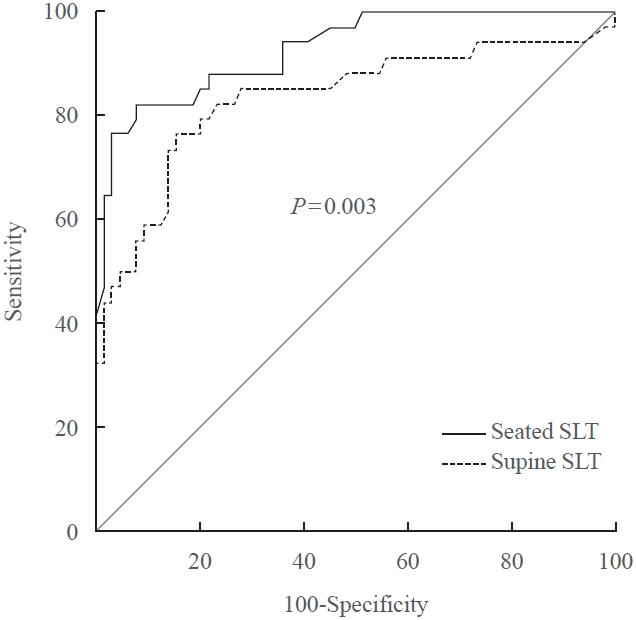
- A seated saline loading test (SLT) using liquid chromatography-tandem mass spectrometry (LC-MS/MS) is one of the most accepted confirmatory tests of primary aldosteronism. However, LC-MS/MS is time-consuming and is not widely available in diagnostic laboratories compared to immunoassay. With immunoassay, it is unknown whether SLT in the seated position is more accurate than that of the supine position, and a cutoff value of post-seated SLT plasma aldosterone concentration (PAC) must be established in the Korean population. Ninety-eight patients underwent SLT in both positions, and post-SLT PAC was measured by LC-MS/MS and radioimmunoassay. We confirmed primary aldosteronism if post-seated SLT PAC by LC-MS/MS exceeded 5.8 ng/dL. The area under the receiver operating characteristic curve was greater for seated than supine SLT (0.928 vs. 0.834, P=0.003). The optimal cutoff value of post-seated SLT by radioimmunoassay was 6.6 ng/dL (sensitivity 83.3%, specificity 92.2%).
-
Citations
Citations to this article as recorded by
- Investigating the cut-off values of captopril challenge test for primary aldosteronism using the novel chemiluminescent enzyme immunoassay method: a retrospective cohort study
Yuta Tezuka, Kei Omata, Yoshikiyo Ono, Kengo Kambara, Hiroki Kamada, Sota Oguro, Yuto Yamazaki, Celso E. Gomez-Sanchez, Akihiro Ito, Hironobu Sasano, Kei Takase, Tetsuhiro Tanaka, Hideki Katagiri, Fumitoshi Satoh
Hypertension Research.2024; 47(5): 1362. CrossRef - Usefulness of the Upright Posture Test in the Diagnosis of Primary Aldosteronism
Nada Younes, Matthieu St-Jean, Marie-Josée Desrochers, Eric Therasse, Mathieu Latour, Isabelle Bourdeau, André Lacroix
Journal of the Endocrine Society.2024;[Epub] CrossRef - Screening and treatment of endocrine hypertension focusing on adrenal gland disorders: a narrative review
Seung Min Chung
Journal of Yeungnam Medical Science.2024; 41(4): 269. CrossRef - Comparative Analysis of Liquid Chromatography-Tandem Mass Spectrometry and Radioimmunoassay in Determining Plasma Aldosterone Concentration and Plasma Renin Activity for Primary Aldosteronism Screening
So Yoon Kwon, Kyeong-Jin Kim, Soo-Youn Lee, Jae Hyeon Kim
Endocrinology and Metabolism.2024; 39(6): 965. CrossRef
- Investigating the cut-off values of captopril challenge test for primary aldosteronism using the novel chemiluminescent enzyme immunoassay method: a retrospective cohort study
 First
 Prev


