
 KES

Search
- Page Path
- HOME > Search
Original Articles
- Mineral, Bone & Muscle
- Differential Impact of Subcutaneous and Visceral Fat on Bone Changes after Gastrectomy
- Sungjoon Cho, Sungjae Shin, Seunghyun Lee, Yumie Rhee, Hyoung-Il Kim, Namki Hong
- Endocrinol Metab. 2024;39(4):632-640. Published online July 17, 2024
- DOI: https://doi.org/10.3803/EnM.2024.1956

- 5,938 View
- 88 Download
- 3 Web of Science
- 5 Crossref
-
 Abstract
 PDF
 Supplementary Material
 PubReader
 ePub
- Background
Osteoporosis and fragility fractures are crucial musculoskeletal complications in long-term survivors of gastric cancer. However, the relationship between changes in body composition after gastrectomy and bone loss has not been investigated. Therefore, this study aimed to explore whether computed tomography (CT)-derived body composition parameters are associated with bone loss after gastrectomy in patients with gastric cancer.
Methods
We retrospectively reviewed medical records and abdomen CT scans of patients who underwent gastrectomy at Yonsei University Severance Hospital between 2009 and 2018. Patients with non-metastatic gastric adenocarcinoma and preoperative and postoperative non-contrast CT scans were analyzed. Section area of skeletal muscle (SMA), visceral fat (VFA), and subcutaneous fat (SFA) were assessed using semi-automatic segmentation software. Changes in trabecular bone attenuation of L1 mid-vertebra level (L1 Hounsfield units [HU]) were measured.
Results
Fifty-seven patients (mean age, 65.5±10.6; 70.2% males) were analyzed, and the median duration was 31 months. Fortyseven patients (82.5%) lost weight after gastrectomy. Baseline SMA and VFA did not differ between the bone loss and preserved groups; however, baseline SFA was significantly higher in the bone preserved group than in the bone loss group (P=0.020). In a multivariable linear regression model adjusted for confounding factors, one standard deviation higher VFA at baseline was associated with greater annualized L1 HU loss (%) (P=0.034). However, higher preoperative SFA was associated with protection against bone loss after gastrectomy (P=0.025).
Conclusion
Higher preoperative SFA exhibited a protective effect against bone loss after gastrectomy in patients with non-metastatic gastric cancer, whereas VFA exhibited a negative effect. -
Citations
Citations to this article as recorded by
- Invited State of the Art Review for MCP Rethinking Obesity Beyond Body Mass Index: A Review of Body Composition and Chronic Disease Risk
Jason R. Jaggers, Madison Kindred, Ryan Porter, Xuemei Sui, Carl J. Lavie, Vivek K. Prasad
Mayo Clinic Proceedings.2026;[Epub] CrossRef - Obesity and Bone Fragility: The Hidden Impact of Insulin Resistance on Trabecular Bone Score, Not Bone Density
Taehoon Park, Kyungwon Seo, Ki Hyun Kim, Yoonhong Kim, Bukyung Kim
Endocrinology and Metabolism.2026;[Epub] CrossRef - Body fat percentage and the outcomes of hip fractures in adults aged 50 years and above: a 1-year follow-up study
Wenliang Fan, Zhibang Zhao, Liqiang Wang, Qingbo Chu
Frontiers in Medicine.2025;[Epub] CrossRef - Calorie Restriction and Bone Health: Lessons from Bariatric Metabolic Surgery
Bukyung Kim
Endocrinology and Metabolism.2025; 40(3): 388. CrossRef - Differential associations of subcutaneous and visceral fat with bone turnover markers: A study on bariatric surgery patients with severe obesity and individuals without obesity
Prince Dadson, Eleni Rebelos, Maria K. Jaakkola, Milena Monfort-Pires, Ronja Ojala, Henri Honka, Kari K. Kalliokoski, Riku Klén, Pirjo Nuutila, Kaisa K. Ivaska
International Journal of Obesity.2025; 49(12): 2494. CrossRef
- Invited State of the Art Review for MCP Rethinking Obesity Beyond Body Mass Index: A Review of Body Composition and Chronic Disease Risk

- Mineral, Bone & Muscle
- Characteristics Associated with Bone Loss after Spinal Cord Injury: Implications for Hip Region Vulnerability
- Sora Han, Sungjae Shin, Onyoo Kim, Namki Hong
- Endocrinol Metab. 2023;38(5):578-587. Published online October 10, 2023
- DOI: https://doi.org/10.3803/EnM.2023.1795
- 7,855 View
- 101 Download
- 4 Web of Science
- 3 Crossref
-
Abstract
PDFSupplementary MaterialPubReader ePub
- Background
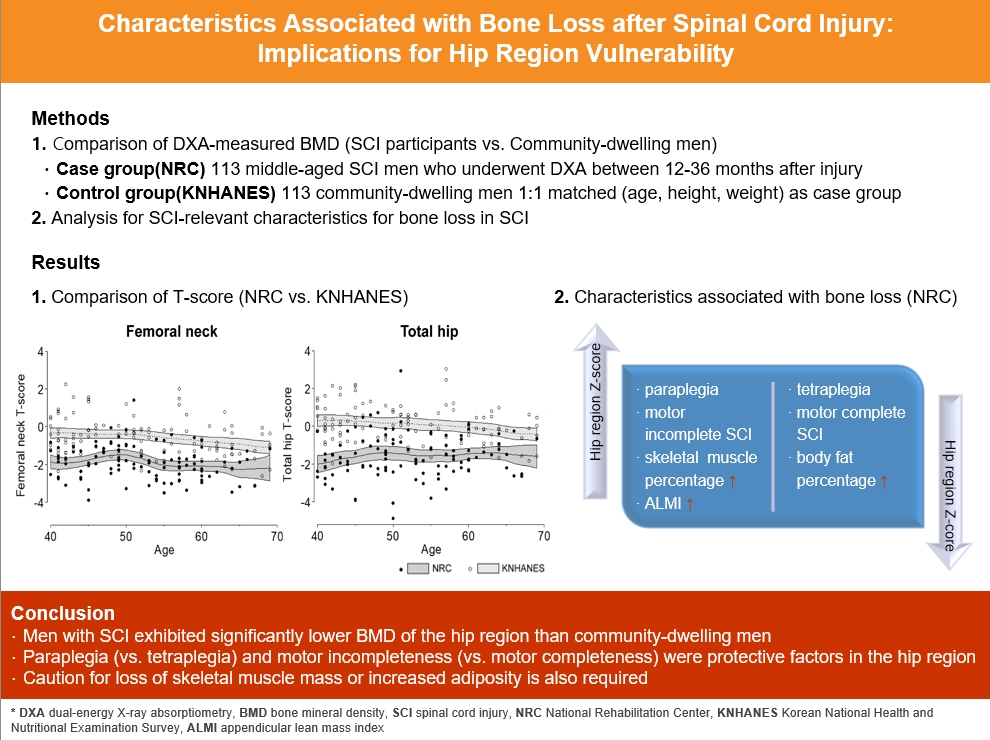
In individuals with spinal cord injury (SCI), bone loss progresses rapidly to the area below the level of injury, leading to an increased risk of fracture. However, there are limited data regarding SCI-relevant characteristics for bone loss and the degree of bone loss in individuals with SCI compared with that in non-SCI community-dwelling adults.
Methods
Data from men with SCI who underwent dual-energy X-ray absorptiometry at the National Rehabilitation Center (2008 to 2020) between 12 and 36 months after injury were collected and analyzed. Community-dwelling men were matched 1:1 for age, height, and weight as the control group, using data from the Korea National Health and Nutrition Examination Survey (KNHANES, 2008 to 2011).
Results
A comparison of the SCI and the matched control group revealed significantly lower hip region T-scores in the SCI group, whereas the lumbar spine T-score did not differ between groups. Among the 113 men with SCI, the paraplegia group exhibited significantly higher Z-scores of the hip region than the tetraplegia group. Participants with motor-incomplete SCI showed relatively preserved Z-scores of the hip region compared to those of the lumbar region. Moreover, in participants with SCI, the percentage of skeletal muscle displayed a moderate positive correlation with femoral neck Z-scores.
Conclusion
Men with SCI exhibited significantly lower bone mineral density of the hip region than community-dwelling men. Paraplegia rather than tetraplegia, and motor incompleteness rather than motor completeness were protective factors in the hip region. Caution for loss of skeletal muscle mass or increased adiposity is also required. -
Citations
Citations to this article as recorded by- Multifaceted Pathophysiology and Secondary Complications of Chronic Spinal Cord Injury: Focus on Pressure Injury
Mario Martínez-Torija, Pedro F. Esteban, Angela Santos-De-La-Mata, Matilde Castillo-Hermoso, Eduardo Molina-Holgado, Rafael Moreno-Luna
Journal of Clinical Medicine.2025; 14(5): 1556. CrossRef - The impact of ADL disability in middle-aged and older adults on the incidence of hip fractures and the mediating role of depression: a longitudinal evidence from CHARLS
Chenyang Li, Congcong Luo, Jiayi Zhu, Ruonan You, Qiang Yuan, Ning Zhang, Ying Zhang
Frontiers in Medicine.2025;[Epub] CrossRef - Integrating sensitive motor tasks with histopathology detects sex differences in recovery after spinal cord injury
Emily A. Swarts, Ashley I. Munro, Courtney A. Bannerman, Julie R. Zielonka, Colleen E. Tordoff, Nader Ghasemlou, Faith H. Brennan
Experimental Neurology.2025; 394: 115417. CrossRef
- Multifaceted Pathophysiology and Secondary Complications of Chronic Spinal Cord Injury: Focus on Pressure Injury
- Diabetes, Obesity and Metabolism
- Association of Shift Work with Normal-Weight Obesity in Community-Dwelling Adults
- Chul Woo Ahn, Sungjae Shin, Seunghyun Lee, Hye-Sun Park, Namki Hong, Yumie Rhee
- Endocrinol Metab. 2022;37(5):781-790. Published online October 25, 2022
- DOI: https://doi.org/10.3803/EnM.2022.1532
- 11,265 View
- 244 Download
- 9 Web of Science
- 10 Crossref
-
Abstract
PDFSupplementary MaterialPubReader ePub
- Background
Shift work is associated with obesity and metabolic syndrome. However, this association in the normal-weight population remains unclear. This study aimed to investigate whether shift work is associated with normal-weight obesity (NWO).
Methods
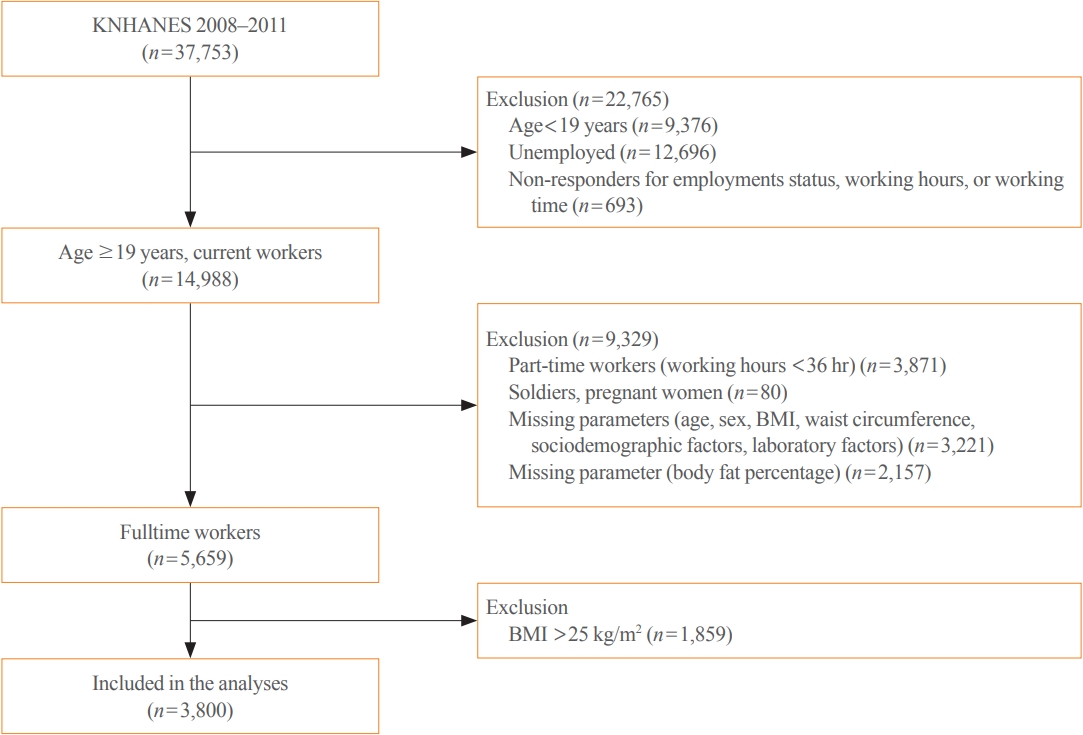
From the nationally representative Korea National Health and Nutrition Examination Survey (KNHANES) dataset (2008 to 2011), 3,800 full-time workers aged ≥19 years with a body mass index (BMI) ≤25 kg/m2 were analysed. We defined NWO as BMI ≤25 kg/m2 and body fat percentage ≥25% in men and ≥37% in women. Working patterns were classified into “daytime,” “other than daytime,” and “shift.” Multivariable logistic regression analysis was performed to evaluate the relationship between shift work and NWO.
Results
Shift work was associated with higher odds of NWO than daytime work (adjusted odds ratio [aOR], 1.47; 95% confidence interval [CI], 1.04 to 2.09) and night/evening work (aOR, 1.87; 95% CI, 1.11 to 3.14) after adjustment for type of work, working hours, age, sex, BMI, 25-hydroxyvitamin D levels, homeostatic model assessment for insulin resistance, and other sociodemographic factors. In subgroup analyses, the association between shift work and NWO was more robust in those aged ≥60 years and those working ≥56 hours/week.
Conclusion
Shift work was associated with NWO in community-dwelling Korean adults, independent of age, sex, BMI, and other covariates. -
Citations
Citations to this article as recorded by- Modifiable risk factors for cardiovascular diseases in aviation and prospects for their correction
E. E. Adeninskaya, N. B. Zabrodina, B. G. Potievsky, A. Y. Bushmanov, A. V. Dorofeev
Science and Innovations in Medicine.2026; 11(3): 185. CrossRef - Work-Related Factors, Sleep Problems, and Metabolic Syndrome among Taiwanese Workers: Sex-Specific Implications for Occupational Health Nursing
Ching Wen Hu, Yi Ching Tsai, Kuan Pin Lin
Advances in Nursing Science.2026; 49(4S): S31. CrossRef - Investigating the Risk of Obesity in European Night Shift Workers: A Study Protocol for Cross-Sectional and Mechanistic Studies in the SHIFT2HEALTH Project
Katrin Scionti, Vanessa Schoissengeier, Ivana Vaclavkova, Hella Fleiss, Catalina Cuparencu, Annemarie Olsen, Hannah Jilani, Desiree A. Lucassen, Emilie de Zoete, Edith Feskens, Hendriek C. Boshuizen, Monique H. Vingerhoeds, Meeke Ummels, Sandra Haider, Ev
Obesity Facts.2026; : 1. CrossRef - The research progress and prospects of circadian rhythm in obesity: a bibliometric analysis
Ye Dou, Xiaojin Guo, Xuefei Wang, Aolong He, Fanghe Li, Kuo Gao
Frontiers in Nutrition.2025;[Epub] CrossRef - Normal Weight Obesity Overview and Update: A narrative review
Antonino De Lorenzo, Paola Gualtieri, Giulia Frank, Roselisa Palma, Rossella Cianci, Leonardo Romano, Lucilla Ciancarella, Glauco Raffaelli, Laura Di Renzo
Current Obesity Reports.2025;[Epub] CrossRef - Development and interpretation of a machine learning predictive model for early cognitive impairment in hypertension associated with environmental factors
Xia Zhong, Tianen Zhao, Shimeng Lv, Guangheng Zhang, Jing Li, Donghai Liu, Huachen Jiao
Frontiers in Cardiovascular Medicine.2025;[Epub] CrossRef - Association of Shift Work, Sociodemographic Variables and Healthy Habits with Obesity Scales
Javier Tosoratto, Pedro Juan Tárraga López, Ángel Arturo López-González, Daniela Vallejos, Emilio Martínez-Almoyna Rifá, José Ignacio Ramirez-Manent
Life.2024; 14(11): 1503. CrossRef - Impaired Melatonin Secretion, Oxidative Stress and Metabolic Syndrome in Night Shift Work
Sorina Hohor, Cristina Mandanach, Andreea Maftei, Corina Aurelia Zugravu, Marina Ruxandra Oțelea
Antioxidants.2023; 12(4): 959. CrossRef - Normal-Weight Obesity and Metabolic Syndrome in Korean Adults: A Population-Based Cross-Sectional Study
Jeonghyeon Kim, Seamon Kang, Hyunsik Kang
Healthcare.2023; 11(16): 2303. CrossRef - You Can’t Avoid Shift Work? Then Focus on Body Fat Rather than Weight
Eun Kyung Lee
Endocrinology and Metabolism.2022; 37(5): 756. CrossRef
- Modifiable risk factors for cardiovascular diseases in aviation and prospects for their correction
 First
 Prev


