
 KES

Search
- Page Path
- HOME > Search
Original Articles
- Salivary 18-Hydroxycortisol as a Noninvasive Marker for Lateralization in Primary Aldosteronism
- Seung Shin Park, Soyeon Park, Man Ho Choi, Jung Hee Kim
- Received April 16, 2026 Accepted June 29, 2026 Published online October 6, 2026
- DOI: https://doi.org/10.3803/EnM.2026.3092 [Epub ahead of print]
- 167 View
- 11 Download
-
 Abstract
 PDF
- Background
Accurate subtyping of primary aldosteronism (PA) is necessary for selecting treatment, but adrenal venous sampling (AVS) is invasive and technically demanding. Plasma and urinary hybrid steroids, including 18-hydroxycortisol (18-OHF) and 18-oxocortisol, have been used to predict PA lateralization; however, whether salivary steroid measurements can provide similar diagnostic information remains unclear.
Methods
Six salivary steroids, including 18-OHF, were measured by liquid chromatography–mass spectrometry in 74 patients with confirmed PA who underwent AVS. The ability of salivary steroid markers to predict AVS-confirmed lateralized PA was evaluated using receiver operating characteristic analysis, net reclassification improvement (NRI), and integrated discrimination improvement (IDI), with the aldosterone-to-renin ratio (ARR) used as the reference model.
Results
Among the salivary steroids evaluated, only 18-OHF was significantly higher in patients with lateralized PA (n=38) than in those with bilateral disease (n=36) (median 0.66 ng/mL vs. 0.25 ng/mL, P<0.001). Salivary 18-OHF showed moderate discrimination for lateralization (area under the curve [AUC], 0.749; 95% confidence interval [CI], 0.633 to 0.866), similar to ARR. Adding salivary 18-OHF to ARR produced only a small increase in AUC, but reclassification analyses showed significant improvement (overall NRI, 0.684; P=0.006; IDI, 0.126; P=0.002), mainly through correct downward reclassification of patients without lateralized disease. Salivary 18-OHF correlated strongly with serum 18-OHF and performed comparably to serum 18-OHF in predicting lateralization.
Conclusion
Salivary 18-OHF may be a noninvasive marker for predicting lateralization in PA. Its addition to ARR improved risk reclassification, particularly by identifying patients less likely to have lateralized disease, and may therefore help refine stepwise diagnostic pathways that determine which patients proceed to AVS.

- Adrenal gland
- Liquid Chromatography-Tandem Mass Spectrometry Outperforms Radioimmunoassay in Guiding Surgical Decisions Based on Adrenal Venous Sampling in Primary Aldosteronism
- Bo-Ching Lee, Chien-Wei Huang, Chin-Chen Chang, Guan-Yuan Chen, Jia-Zheng Huang, Pin-Chen Chen, Te-I Weng, Kao-Lang Liu, Vin-Cent Wu, Yen-Hung Lin, on Behalf of the TAIPAI Study Group
- Endocrinol Metab. 2025;40(6):1002-1011. Published online July 1, 2025
- DOI: https://doi.org/10.3803/EnM.2024.2237

- 3,670 View
- 73 Download
-
Abstract
PDF
 Supplementary Material
 PubReader
 ePub
- Background
Adrenal venous sampling (AVS) is essential for diagnosing unilateral aldosterone oversecretion in primary aldosteronism (PA). Traditionally, AVS relies on radioimmunoassay (RIA) to measure plasma aldosterone concentration (PAC), although RIA has limited specificity and considerable variability. This study evaluated the role of liquid chromatography-tandem mass spectrometry (LC-MS/MS) in AVS and its impact on clinical outcomes.
Methods
Among 230 patients with PA (May 2020 to April 2023) who underwent AVS, successful sampling was achieved in 182 patients (79.1%) under unstimulated conditions and 206 patients (89.6%) under stimulated conditions. PAC levels from peripheral and adrenal veins measured by LC-MS/MS were compared with RIA results. Patient outcomes were categorized according to the Primary Aldosteronism Surgical Outcomes criteria.
Results
LC-MS/MS showed significant correlations with PAC levels measured by RIA in AVS (r=0.40 [unstimulated] and r=0.56 [stimulated]; both P<0.001). However, lateralization concordance between RIA and LC-MS/MS was moderate, at only 57.7% (unstimulated) and 64.6% (stimulated). LC-MS/MS identified more unilateral disease than RIA under both unstimulated (61.5% vs. 37.4%, P<0.001) and stimulated conditions (36.4% vs. 9.7%, P<0.001). Patients achieving complete clinical success after adrenalectomy were more accurately identified by LC-MS/MS than RIA under stimulated (55.6% vs. 22.2%, P=0.035), but not in unstimulated conditions.
Conclusion
LC-MS/MS outperformed RIA in identifying unilateral disease, resulting in higher rates of complete clinical success in adrenalectomy patients when surgical decisions were based on LC-MS/MS lateralization results.
Brief Report
- Adrenal gland
- Comparative Analysis of Liquid Chromatography-Tandem Mass Spectrometry and Radioimmunoassay in Determining Plasma Aldosterone Concentration and Plasma Renin Activity for Primary Aldosteronism Screening
- So Yoon Kwon, Kyeong-Jin Kim, Soo-Youn Lee, Jae Hyeon Kim
- Endocrinol Metab. 2024;39(6):965-969. Published online November 15, 2024
- DOI: https://doi.org/10.3803/EnM.2024.1985

- 5,589 View
- 88 Download
- 1 Web of Science
- 1 Crossref
-
Abstract
PDFSupplementary MaterialPubReader ePub
- Liquid chromatography-tandem mass spectrometry (LC-MS/MS) accurately measures plasma aldosterone concentration (PAC), but its correlation with radioimmunoassay (RIA), equivalent RIA levels, and optimal cutoff for PAC and aldosterone-to-renin ratio (ARR) in primary aldosteronism (PA) screening have not been determined in a Korean population. Our study of 127 patients who underwent diagnostic testing for PA showed that the LC-MS/MS and RIA methods have good correlation, with a mean bias of 29.3% for PAC. An LC-MS/MS PAC level of 11.7 ng/dL was equivalent to an RIA PAC level of 15 ng/dL. Receiver operating characteristic curve analysis showed that an LC-MS/MS PAC level of 10.3 ng/dL and LC-MS/MS ARR level of 20.0 provided sensitivity of 73.1% with a specificity of 57.3% and sensitivity of 92.3% with a specificity of 14.7%, respectively. When the LC-MS/MS method is used for PA screening, an adjustment of cutoff values is necessary.
-
Citations
Citations to this article as recorded by
- Magnetic bead-assisted extraction combined with LC–MS/MS for simultaneous quantification of aldosterone and related steroids in human plasma
Yudong Chu, Qin Su, Ziyuan Huang, Chenyi Yuan, Shazhou Ye, Xueyan Bian
Analytical and Bioanalytical Chemistry.2026; 418(1): 343. CrossRef
- Magnetic bead-assisted extraction combined with LC–MS/MS for simultaneous quantification of aldosterone and related steroids in human plasma
Special Article
- Adrenal gland
- 2023 Korean Endocrine Society Consensus Guidelines for the Diagnosis and Management of Primary Aldosteronism
- Jeonghoon Ha, Jung Hwan Park, Kyoung Jin Kim, Jung Hee Kim, Kyong Yeun Jung, Jeongmin Lee, Jong Han Choi, Seung Hun Lee, Namki Hong, Jung Soo Lim, Byung Kwan Park, Jung-Han Kim, Kyeong Cheon Jung, Jooyoung Cho, Mi-kyung Kim, Choon Hee Chung, The Committee of Clinical Practice Guideline of Korean Endocrine Society, The Korean Adrenal Study Group of Korean Endocrine Society
- Endocrinol Metab. 2023;38(6):597-618. Published online October 13, 2023
- DOI: https://doi.org/10.3803/EnM.2023.1789
- 42,820 View
- 1,492 Download
- 25 Web of Science
- 27 Crossref
-
Abstract
PDFPubReader ePub
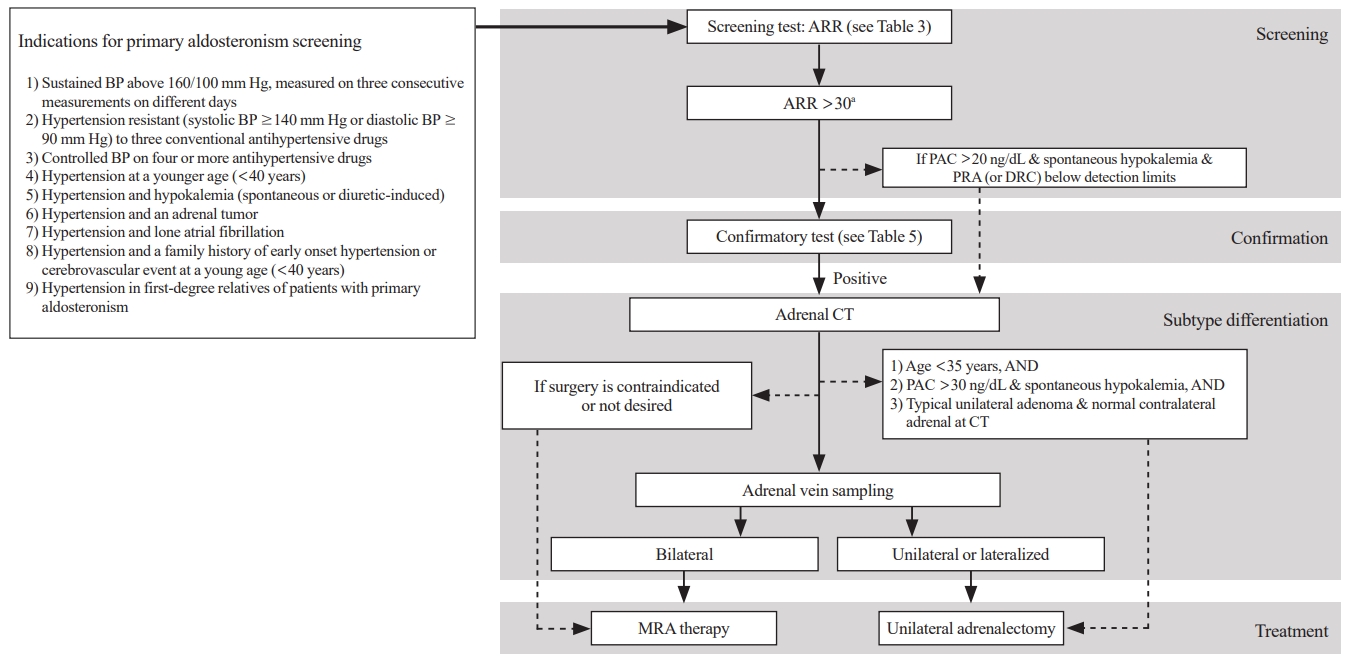
- Primary aldosteronism (PA) is a common, yet underdiagnosed cause of secondary hypertension. It is characterized by an overproduction of aldosterone, leading to hypertension and/or hypokalemia. Despite affecting between 5.9% and 34% of patients with hypertension, PA is frequently missed due to a lack of clinical awareness and systematic screening, which can result in significant cardiovascular complications. To address this, medical societies have developed clinical practice guidelines to improve the management of hypertension and PA. The Korean Endocrine Society, drawing on a wealth of research, has formulated new guidelines for PA. A task force has been established to prepare PA guidelines, which encompass epidemiology, pathophysiology, clinical presentation, diagnosis, treatment, and follow-up care. The Korean clinical guidelines for PA aim to deliver an evidence-based protocol for PA diagnosis, treatment, and patient monitoring. These guidelines are anticipated to ease the burden of this potentially curable condition.
-
Citations
Citations to this article as recorded by- High Plasma Renin and Aldosterone Levels Are Associated With a Unique Phenotype in Primary Hypertension
Jung Sun Cho, Ji-Hoon Jung, Woojin Kwon, Woo-Baek Chung, Sang Hyun Ihm
Korean Circulation Journal.2026; 56(1): 49. CrossRef - Risk of Hypertension and Chronic Kidney Disease Following Aldosterone Dysregulation
Raymond R Townsend, Abiy Agiro, Shan Luan, Kaylen Brzozowski, Erick Moyneur, Paule Tetreault-Langlois, Joanna Huang
American Journal of Hypertension.2026; 39(1): 161. CrossRef - Evaluation of the MAGLUMI non-competitive angiotensin I chemiluminescence immunoassay for measuring renin activity in human plasma
Lina Wu, Baohu Zhang, Yun Zhang, Shucai Yang, Chenyan Shi, Wenfeng Wang, Zhonggang Fang, Li Zhang, Xiaosong Qin
Clinical Chemistry and Laboratory Medicine (CCLM).2026; 64(5): 1142. CrossRef - Early-onset hypertension associated with a CACNA1H variant of uncertain significance: a case report and literature review
Xiang Fang, Ruhui Liu, Jing Zeng
BMC Cardiovascular Disorders.2026;[Epub] CrossRef - Endocrine hypertension: the role of imaging in diagnosis and management
Mohammed Azfar Siddiqui, Irfan Amir Kazi, Frank H Miller, Pardeep K Mittal, Esra Demirtas, Khaled M Elsayes, Ayman Nada
British Journal of Radiology.2026; 99(1180): 733. CrossRef - Evaluating simplified confirmation strategies for primary aldosteronism diagnosis
Kangxin Cai, Qin Luo, Menghui Wang, Mulalibieke Heizhati, Huimin Ma, Weiwei Zhang, Gulinuer Duiyimuhan, Ayinigeer Abulimiti, Li Cai, Wen Jiang, Qing Zhu, Junli Hu, Ling Yao, Delian Zhang, Nanfang Li
European Journal of Medical Research.2026;[Epub] CrossRef - Primary Hyperaldosteronism: Epidemiology, Diagnosis, and Clinical Associations
Christos Savvidis, Charalampos Milionis, Argyro Pachi, Athanasios Tselebis, Ioannis Ilias
Epidemiologia.2026; 7(2): 32. CrossRef - The Burden, Outcomes, and Management of Patients with Aldosterone Dysregulation: A Targeted Literature Review
Gianfranco Parati, Gbenga Ogedegbe, Abiy Agiro, Shan Luan, Harrison Davis, Ian Daniel, Jan McKendrick, Joanna Huang, Raymond R. Townsend
Advances in Therapy.2026; 43(5): 1926. CrossRef - Aldosterone fuels the progression of cardiovascular-kidney -metabolic syndrome: focus on primary aldosteronism spectrum
Huannan Wei, Xinyang Long, Mingli Li, Shengzhu Huang, Jianling Li, Zengnan Mo
Endocrine.2026;[Epub] CrossRef - A modifiable driver of dementia: cognitive impairment in primary aldosteronism
Ying-Ying Zheng, Kai-Ge Feng, Xiang Xie
Hypertension Research.2026; 49(8): 2386. CrossRef - Ablation for Aldosterone-Producing versus Cortisol-Producing Adrenal Adenomas: A Comprehensive Review
Byung Kwan Park, Jae Hyeon Kim, Young Lyun Oh, Jung-Han Kim
Journal of Vascular and Interventional Radiology.2026; 37(9): 108894. CrossRef - Association of the primary aldosteronism severity classification with lateralization and treatment outcomes
Ju Hee Lee, Ha Young Kim, Min Jeong Park, A Ram Hong, Jeongmin Lee, Kyong Yeun Jung, Hyo-Jeong Kim, Eu Jeong Ku, Seung Shin Park, Seung Hun Lee, Jung Hee Kim
The Journal of Clinical Endocrinology & Metabolism.2026;[Epub] CrossRef - Interpretation of Diagnostic Testing for Primary Aldosteronism
Eu Jeong Ku
The Korean Journal of Medicine.2026; 101(4): 202. CrossRef - Decision tree prediction of saline infusion test outcomes in suspected primary aldosteronism: a multicenter common data model study
Kyoung Jin Kim, Jimi Choi, Namyoung Baek, Min Jeong Park, Eyun Song, So Young Park, Da Young Lee, Kyeong Jin Kim, Nam Hoon Kim, Hye Jin Yoo, Ji A Seo, Sin Gon Kim, Kyung Mook Choi, Nan Hee Kim, Ji Hee Yu
The Journal of Clinical Endocrinology & Metabolism.2026;[Epub] CrossRef - Biochemical and renal-metabolic profiles distinguishing primary aldosteronism from essential hypertension: a systematic review and meta-analysis with implications for endocrine hypertension screening
Xuan Zhao, Caiyan Zhang, Chunxiu Yi, Xinyi Liu, Shujun Ding, Wen Zhang, Yajing Zhao
Frontiers in Endocrinology.2026;[Epub] CrossRef - Differences in target organ damage between captopril challenge test-defined definitive-positive and borderline-range groups among patients with primary aldosteronism
Naoki Fujiwara, Tatsuya Haze, Hiromichi Wakui, Kouichi Tamura, Mika Tsuiki, Kohei Kamemura, Daisuke Taura, Takamasa Ichijo, Yutaka Takahashi, Minemori Watanabe, Hiroki Kobayashi, Toshifumi Nakamura, Shoichiro Izawa, Norio Wada, Tetsuya Yamada, Kenichi Yok
Hypertension Research.2025; 48(2): 540. CrossRef - Major Adverse Cardiovascular Events in Primary Aldosteronism After Adrenalectomy or Mineralocorticoid Receptor Antagonist Treatment: A Systematic Review and Meta‐Analysis
Chien‐Wei Huang, Tse‐Ying Huang, Ya‐Fei Yang, Li‐Yang Chang, Yu‐Kang Tu, Vin‐Cent Wu, Jui‐Yi Chen
Journal of the American Heart Association.2025;[Epub] CrossRef - Bridging Global and Local Perspectives on Primary Aldosteronism
Ohk-Hyun Ryu
Endocrinology and Metabolism.2025; 40(2): 195. CrossRef - Subclassification of unilateral primary aldosteronism using an optimal cut-off value for positive CYP11B2 (aldosterone synthase) immunohistochemistry and modified histologic criteria in the Korean population
Won Gi Hong, Byung-Chang Kim, Tae-Yon Sung, Seung Hun Lee, Dong Eun Song
Human Pathology.2025; 163: 105876. CrossRef - Correlation of Histopathologic Subtypes of Primary Aldosteronism with Clinical Phenotypes and Postsurgical Outcomes
Chang Ho Ahn, You-Bin Lee, Jae Hyeon Kim, Young Lyun Oh, Jung Hee Kim, Kyeong Cheon Jung
The Journal of Clinical Endocrinology & Metabolism.2024; 109(8): e1582. CrossRef - Temporal trends in clinical features of patients with primary aldosteronism over 20 years
Seung Shin Park, Chang Ho Ahn, Sang Wan Kim, Jung-Min Koh, Seung Hun Lee, Jung Hee Kim
Hypertension Research.2024; 47(8): 2019. CrossRef - Primary aldosteronism: An underdiagnosed clinical entity
Peeyush Jain, Atul Kaushik, Nilashish Dey, Ashwani Mehta, Shaloo Kapoor, Chhavi Agrawal
Journal of Current Cardiology.2024; 2(2): 65. CrossRef - Historical changes in the clinical features of primary aldosteronism
Takamasa Ichijo
Hypertension Research.2024; 47(10): 2926. CrossRef - Comparing ARR Versus Suppressed PRA as Screening Tests for Primary Aldosteronism
Marco Marcelli, Caixia Bi, John W. Funder, Michael J. McPhaul
Hypertension.2024; 81(10): 2072. CrossRef - Screening and treatment of endocrine hypertension focusing on adrenal gland disorders: a narrative review
Seung Min Chung
Journal of Yeungnam Medical Science.2024; 41(4): 269. CrossRef - Diagnostic efficacy of aldosterone-to-renin ratio to screen primary aldosteronism in hypertension: a systemic review and meta-analysis
Ting-Wei Kao, Jui-Yi Chen, Jung-Hua Liu, Wen-Hsin Tseng, Chih-Chia Hsieh, Vin-Cent Wu, Yen-Hung Lin, Zheng-Wei Chen
Therapeutic Advances in Endocrinology and Metabolism.2024;[Epub] CrossRef - Comparative Analysis of Liquid Chromatography-Tandem Mass Spectrometry and Radioimmunoassay in Determining Plasma Aldosterone Concentration and Plasma Renin Activity for Primary Aldosteronism Screening
So Yoon Kwon, Kyeong-Jin Kim, Soo-Youn Lee, Jae Hyeon Kim
Endocrinology and Metabolism.2024; 39(6): 965. CrossRef
- High Plasma Renin and Aldosterone Levels Are Associated With a Unique Phenotype in Primary Hypertension
Brief Report
- Adrenal Gland
- Aldosterone Immunoassay-Specific Cutoff Value for Seated Saline Suppression Test for Diagnosing Primary Aldosteronism
- So Yoon Kwon, Jiyun Park, So Hee Park, So Hyun Cho, You-Bin Lee, Soo-Youn Lee, Jae Hyeon Kim
- Endocrinol Metab. 2022;37(6):938-942. Published online December 6, 2022
- DOI: https://doi.org/10.3803/EnM.2022.1535
- 16,575 View
- 231 Download
- 4 Web of Science
- 4 Crossref
-
Abstract
PDFSupplementary MaterialPubReader ePub
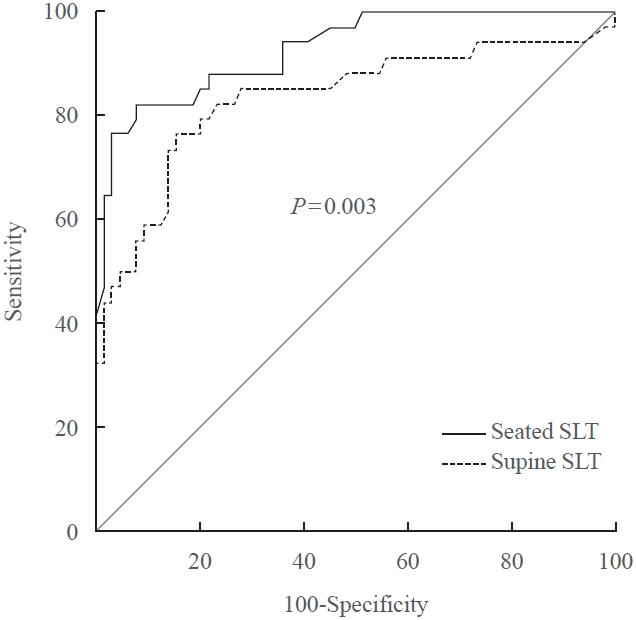
- A seated saline loading test (SLT) using liquid chromatography-tandem mass spectrometry (LC-MS/MS) is one of the most accepted confirmatory tests of primary aldosteronism. However, LC-MS/MS is time-consuming and is not widely available in diagnostic laboratories compared to immunoassay. With immunoassay, it is unknown whether SLT in the seated position is more accurate than that of the supine position, and a cutoff value of post-seated SLT plasma aldosterone concentration (PAC) must be established in the Korean population. Ninety-eight patients underwent SLT in both positions, and post-SLT PAC was measured by LC-MS/MS and radioimmunoassay. We confirmed primary aldosteronism if post-seated SLT PAC by LC-MS/MS exceeded 5.8 ng/dL. The area under the receiver operating characteristic curve was greater for seated than supine SLT (0.928 vs. 0.834, P=0.003). The optimal cutoff value of post-seated SLT by radioimmunoassay was 6.6 ng/dL (sensitivity 83.3%, specificity 92.2%).
-
Citations
Citations to this article as recorded by- Investigating the cut-off values of captopril challenge test for primary aldosteronism using the novel chemiluminescent enzyme immunoassay method: a retrospective cohort study
Yuta Tezuka, Kei Omata, Yoshikiyo Ono, Kengo Kambara, Hiroki Kamada, Sota Oguro, Yuto Yamazaki, Celso E. Gomez-Sanchez, Akihiro Ito, Hironobu Sasano, Kei Takase, Tetsuhiro Tanaka, Hideki Katagiri, Fumitoshi Satoh
Hypertension Research.2024; 47(5): 1362. CrossRef - Usefulness of the Upright Posture Test in the Diagnosis of Primary Aldosteronism
Nada Younes, Matthieu St-Jean, Marie-Josée Desrochers, Eric Therasse, Mathieu Latour, Isabelle Bourdeau, André Lacroix
Journal of the Endocrine Society.2024;[Epub] CrossRef - Screening and treatment of endocrine hypertension focusing on adrenal gland disorders: a narrative review
Seung Min Chung
Journal of Yeungnam Medical Science.2024; 41(4): 269. CrossRef - Comparative Analysis of Liquid Chromatography-Tandem Mass Spectrometry and Radioimmunoassay in Determining Plasma Aldosterone Concentration and Plasma Renin Activity for Primary Aldosteronism Screening
So Yoon Kwon, Kyeong-Jin Kim, Soo-Youn Lee, Jae Hyeon Kim
Endocrinology and Metabolism.2024; 39(6): 965. CrossRef
- Investigating the cut-off values of captopril challenge test for primary aldosteronism using the novel chemiluminescent enzyme immunoassay method: a retrospective cohort study
Original Article
- Adrenal Gland
- Outcome-Based Decision-Making Algorithm for Treating Patients with Primary Aldosteronism
- Jung Hee Kim, Chang Ho Ahn, Su Jin Kim, Kyu Eun Lee, Jong Woo Kim, Hyun-Ki Yoon, Yu-Mi Lee, Tae-Yon Sung, Sang Wan Kim, Chan Soo Shin, Jung-Min Koh, Seung Hun Lee
- Endocrinol Metab. 2022;37(2):369-382. Published online April 14, 2022
- DOI: https://doi.org/10.3803/EnM.2022.1391
- 10,637 View
- 198 Download
- 11 Web of Science
- 10 Crossref
-
Abstract
PDFPubReader ePub
- Background
Optimal management of primary aldosteronism (PA) is crucial due to the increased risk of cardiovascular and cerebrovascular diseases. Adrenal venous sampling (AVS) is the gold standard method for determining subtype but is technically challenging and invasive. Some PA patients do not benefit clinically from surgery. We sought to develop an algorithm to improve decision- making before engaging in AVS and surgery in clinical practice.
Methods
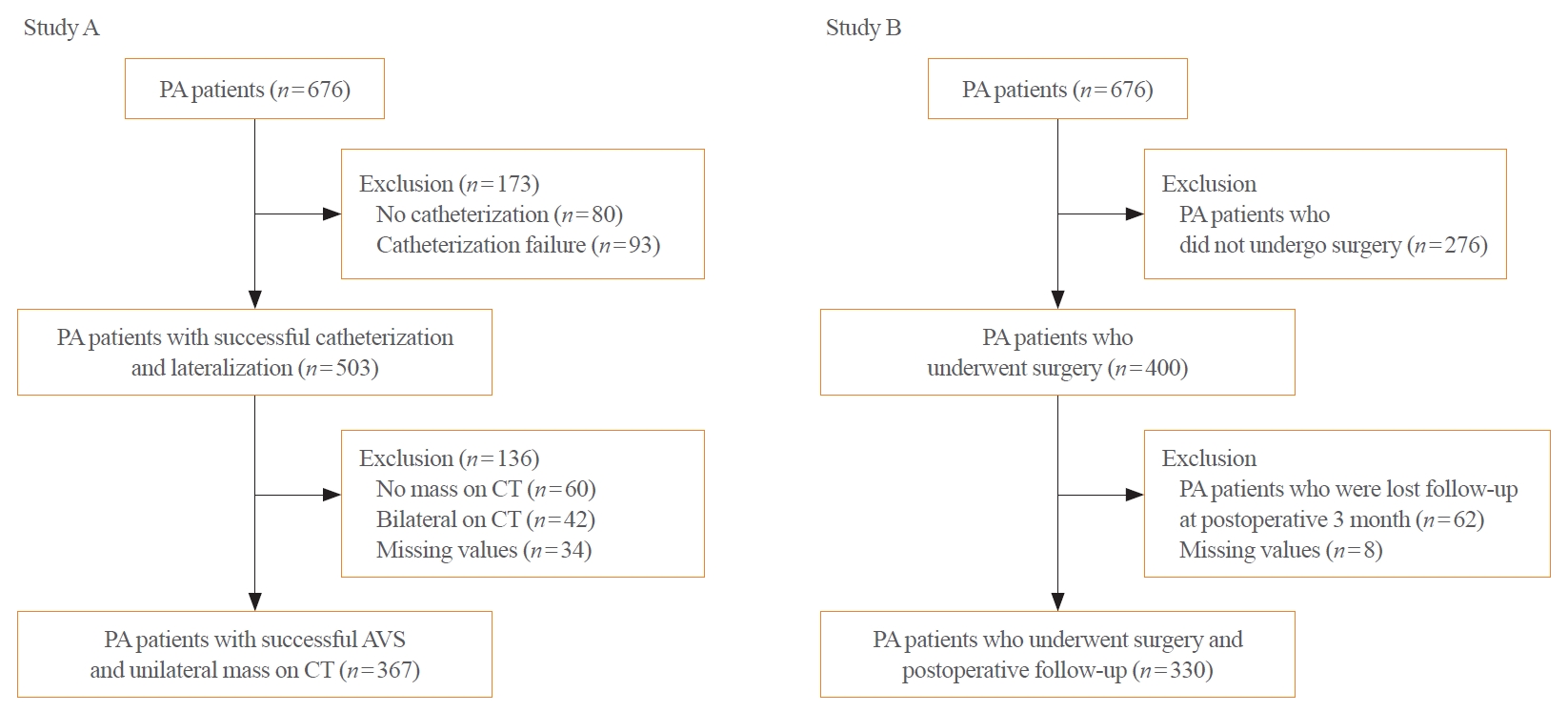
We conducted the ongoing Korean Primary Aldosteronism Study at two tertiary centers. Study A involved PA patients with successful catheterization and a unilateral nodule on computed tomography and aimed to predict unilateral aldosterone-producing adenoma (n=367). Study B involved similar patients who underwent adrenalectomy and aimed to predict postoperative outcome (n=330). In study A, we implemented important feature selection using the least absolute shrinkage and selection operator regression.
Results
We developed a unilateral PA prediction model using logistic regression analysis: lowest serum potassium level ≤3.4 mEq/L, aldosterone-to-renin ratio ≥150, plasma aldosterone concentration ≥30 ng/mL, and body mass index <25 kg/m2 (area under the curve, 0.819; 95% confidence interval, 0.774 to 0.865; sensitivity, 97.6%; specificity, 25.5%). In study B, we identified female, hypertension duration <5 years, anti-hypertension medication <2.5 daily defined dose, and the absence of coronary artery disease as predictors of clinical success, using stepwise logistic regression models (sensitivity, 94.2%; specificity, 49.3%). We validated our algorithm in the independent validation dataset (n=53).
Conclusion
We propose this new outcome-driven diagnostic algorithm, simultaneously considering unilateral aldosterone excess and clinical surgical benefits in PA patients. -
Citations
Citations to this article as recorded by- Influence of body mass index on disease severity and treatment outcomes in primary aldosteronism
Marta Araujo-Castro, Jessica Goi, Jacopo Burrello, Silvia Monticone, Paolo Mulatero, Elena Bersano, Holger Schneider, Erik Johann Petersenn, Stephanie Zopp, Virginia Capuzzo, Ana María García Cano, Elena Mena Ribas, Alicia Sanmartín Sánchez, Patricia Mart
Journal of the Endocrine Society.2026;[Epub] CrossRef - Association of the primary aldosteronism severity classification with lateralization and treatment outcomes
Ju Hee Lee, Ha Young Kim, Min Jeong Park, A Ram Hong, Jeongmin Lee, Kyong Yeun Jung, Hyo-Jeong Kim, Eu Jeong Ku, Seung Shin Park, Seung Hun Lee, Jung Hee Kim
The Journal of Clinical Endocrinology & Metabolism.2026;[Epub] CrossRef - CT-based body composition enhances prognostic performance of PASO score for surgical outcome in primary aldosteronism
Seunghyun Lee, Sung Joon Cho, Jin Ah Park, Seungjin Baek, Yumie Rhee, Namki Hong
Hypertension Research.2026; 49(10): 2854. CrossRef - Outcomes after medical treatment for primary aldosteronism: an international consensus and analysis of treatment response in an international cohort
Jun Yang, Jacopo Burrello, Jessica Goi, Martin Reincke, Christian Adolf, Evelyn Asbach, Denise Brűdgam, Qifu Li, Ying Song, Jinbo Hu, Shumin Yang, Fumitoshi Satoh, Yoshikiyo Ono, Renata Libianto, Michael Stowasser, Nanfang Li, Qing Zhu, Namki Hong, Drishy
The Lancet Diabetes & Endocrinology.2025; 13(2): 119. CrossRef - Bridging Global and Local Perspectives on Primary Aldosteronism
Ohk-Hyun Ryu
Endocrinology and Metabolism.2025; 40(2): 195. CrossRef - Subtype-specific Body Composition and Metabolic Risk in Patients With Primary Aldosteronism
Seung Shin Park, Chang Ho Ahn, Sang Wan Kim, Ji Won Yoon, Jung Hee Kim
The Journal of Clinical Endocrinology & Metabolism.2024; 109(2): e788. CrossRef - Correlation of Histopathologic Subtypes of Primary Aldosteronism with Clinical Phenotypes and Postsurgical Outcomes
Chang Ho Ahn, You-Bin Lee, Jae Hyeon Kim, Young Lyun Oh, Jung Hee Kim, Kyeong Cheon Jung
The Journal of Clinical Endocrinology & Metabolism.2024; 109(8): e1582. CrossRef - Predicting the resolution of hypertension following adrenalectomy in primary aldosteronism: Controversies and unresolved issues a narrative review
Luigi Marzano
Langenbeck's Archives of Surgery.2024;[Epub] CrossRef - Prognostic models to predict complete resolution of hypertension after adrenalectomy in primary aldosteronism: A systematic review and meta‐analysis
Luigi Marzano, Amir Kazory, Faeq Husain‐Syed, Claudio Ronco
Clinical Endocrinology.2023; 99(1): 17. CrossRef - 2023 Korean Endocrine Society Consensus Guidelines for the Diagnosis and Management of Primary Aldosteronism
Jeonghoon Ha, Jung Hwan Park, Kyoung Jin Kim, Jung Hee Kim, Kyong Yeun Jung, Jeongmin Lee, Jong Han Choi, Seung Hun Lee, Namki Hong, Jung Soo Lim, Byung Kwan Park, Jung-Han Kim, Kyeong Cheon Jung, Jooyoung Cho, Mi-kyung Kim, Choon Hee Chung
Endocrinology and Metabolism.2023; 38(6): 597. CrossRef
- Influence of body mass index on disease severity and treatment outcomes in primary aldosteronism
Review Article
- Adrenal Gland
- Adrenal Venous Sampling for Subtype Diagnosis of Primary Hyperaldosteronism
- Mitsuhide Naruse, Akiyo Tanabe, Koichi Yamamoto, Hiromi Rakugi, Mitsuhiro Kometani, Takashi Yoneda, Hiroki Kobayashi, Masanori Abe, Youichi Ohno, Nobuya Inagaki, Shoichiro Izawa, Masakatsu Sone
- Endocrinol Metab. 2021;36(5):965-973. Published online October 21, 2021
- DOI: https://doi.org/10.3803/EnM.2021.1192
- 22,301 View
- 444 Download
- 15 Web of Science
- 17 Crossref
-
Abstract
PDFPubReader ePub
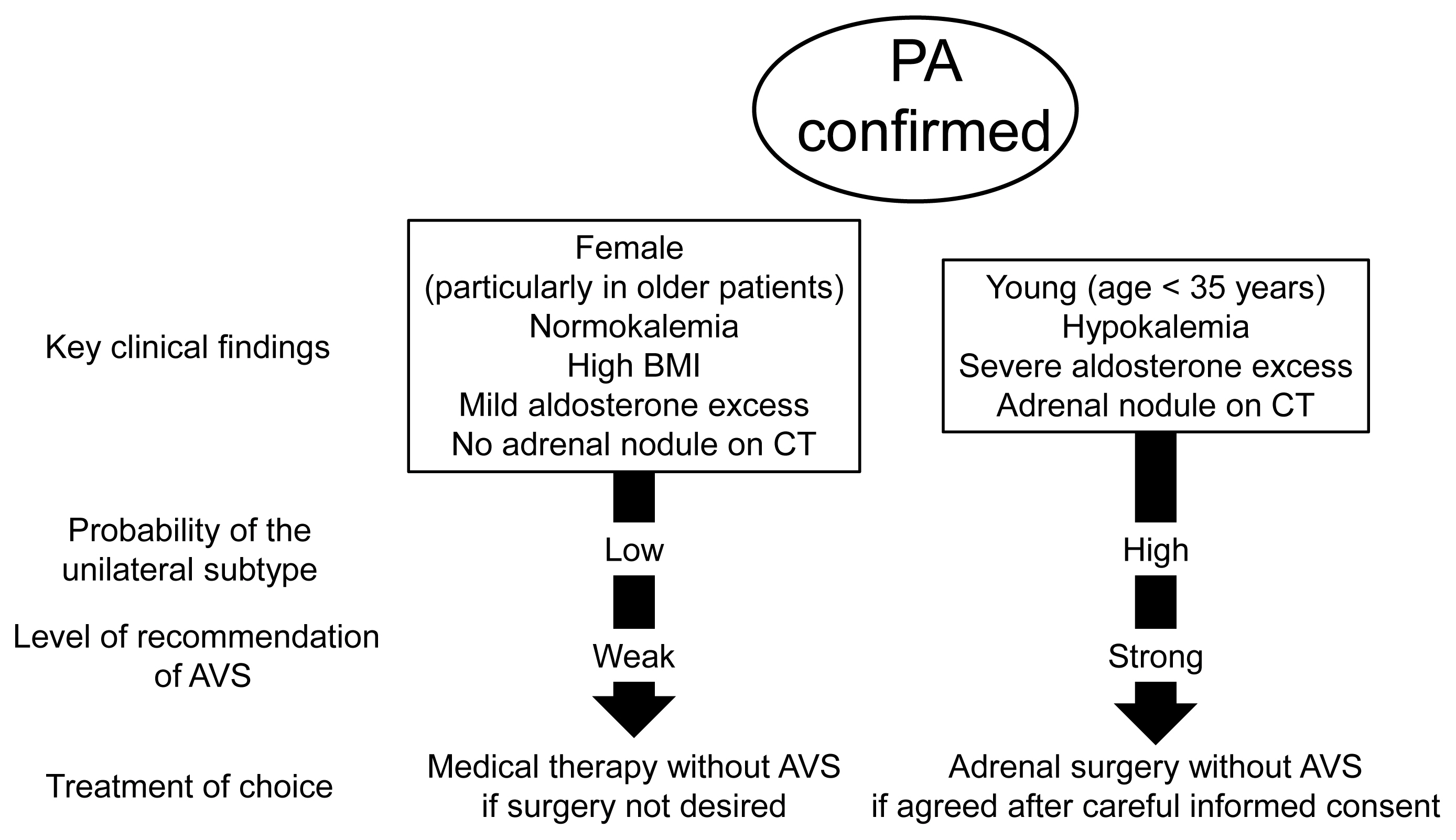
- Adrenal venous sampling (AVS) is the key procedure for lateralization of primary hyperaldosteronism (PA) before surgery. Identification of the adrenal veins using computed tomography (CT) and intraoperative cortisol assay facilitates the success of catheterization. Although administration of adrenocorticotropic hormone (ACTH) has benefits such as improving the success rate, some unilateral cases could be falsely diagnosed as bilateral. Selectivity index of 5 with ACTH stimulation to assess the selectivity of catheterization and lateralization index (LI) >4 with ACTH stimulation for unilateral diagnosis is used in many centers. Co-secretion of cortisol from the tumor potentially affects the lateralization by the LI. Patients aged <35 years with hypokalemia, marked aldosterone excess, and unilateral adrenal nodule on CT have a higher probability of unilateral disease. Patients with normokalemia, mild aldosterone excess, and no adrenal tumor on CT have a higher probability of bilateral disease. Although no methods have 100% specificity for subtype diagnosis that would allow bypassing AVS, prediction of the subtype should be considered when recommending AVS to patients. Methodological standardization and strict indication improve diagnostic quality of AVS. Development of non-invasive imaging and biochemical markers will drive a paradigm shift in the clinical practice of PA.
-
Citations
Citations to this article as recorded by- Adrenal Venous Sampling Aids in Distinguishing 17-Hydroxyprogesterone Hypersecreting Adrenal Cortical Adenomas from Non-Classical 21-Hydroxylase Deficiency
Ruojun Qiu, Tian Yang, Chengxin Shang, Weifen Zhu, Fenping Zheng
Diagnostics.2026; 16(2): 202. CrossRef - Ablation for Aldosterone-Producing versus Cortisol-Producing Adrenal Adenomas: A Comprehensive Review
Byung Kwan Park, Jae Hyeon Kim, Young Lyun Oh, Jung-Han Kim
Journal of Vascular and Interventional Radiology.2026; 37(9): 108894. CrossRef - Manejo quirúrgico del hiperaldosteronismo primario: un caso de suprarrenalectomía laparoscópica en una paciente joven
Hugo Javier Benítez Rios, Iván Alberto Núñez Guerrero, Sol Thalía Silvero Prieto, Daniel Fernández González
Revista científica ciencias de la salud..2026; 8: 01. CrossRef - Bilateral adrenal artery embolization for the treatment of idiopathic hyperaldosteronism: A proof-of-principle single center study
Guo Ji, Changqiang Yang, Jixin Hou, Yaqiong Zhou, Tao Luo, Yi Yang, Dan Wang, Sen Liu, Jindong Wan, Gaomin He, Anping Zeng, Xinquan Wang, Peijian Wang
Hypertension Research.2025; 48(1): 200. CrossRef - Adrenal vein sampling: accuracy of earlier sampling post adrenocorticotropic hormone (ACTH) administration
Q.X. Tee, J.C.G. Doery, A. Desra, P.J. Fuller, J. Yang, K.K. Lau
Clinical Radiology.2025; 84: 106861. CrossRef - Long-term Efficacy and Safety of Unilateral Adrenal Artery Embolization in Patients with Idiopathic Hyperaldosteronism: A 24-month Cohort Study
Guo Ji, Sen Liu, Jindong Wan, Yaqiong Zhou, Changqiang Yang, Xinquan Wang, Gaomin He, Anping Zeng, Lingling Zhang, Tao Luo, Yi Yang, Dan Wang, Kaige Feng, Jixin Hou, Peijian Wang
American Journal of Hypertension.2025; 38(9): 675. CrossRef - Expert Consensus on the Primary Aldosteronism Severity Classification and its strategic application in indicating adrenal venous sampling
Masanori Murakami, Mitsuhide Naruse, Hiroki Kobayashi, Mirko Parasiliti-Caprino, Fabio Bioletto, Denise Brüdgam, Isabel Stüfchen, Martin Reincke, Matthieu St-Jean, Ivana Kraljevic, Darko Kastelan, Pasi I Nevalainen, Marta Araujo-Castro, Norlela Sukor, Mic
European Journal of Endocrinology.2025; 193(1): 85. CrossRef - A controlled trial of percutaneous adrenal arterial embolization for hypertension in patients with idiopathic hyperaldosteronism
Yaqiong Zhou, Xinquan Wang, Jixin Hou, Jindong Wan, Yi Yang, Sen Liu, Tao Luo, Qiting Liu, Qiang Xue, Peijian Wang
Hypertension Research.2024; 47(2): 311. CrossRef - Correlation of Histopathologic Subtypes of Primary Aldosteronism with Clinical Phenotypes and Postsurgical Outcomes
Chang Ho Ahn, You-Bin Lee, Jae Hyeon Kim, Young Lyun Oh, Jung Hee Kim, Kyeong Cheon Jung
The Journal of Clinical Endocrinology & Metabolism.2024; 109(8): e1582. CrossRef - Screening and diagnosis of primary aldosteronism. Consensus document of all the Spanish Societies involved in the management of primary aldosteronism
Marta Araujo-Castro, Jorge Gabriel Ruiz-Sánchez, Paola Parra Ramírez, Patricia Martín Rojas-Marcos, Almudena Aguilera-Saborido, Jorge Francisco Gómez Cerezo, Nieves López Lazareno, María Eugenia Torregrosa Quesada, Jorge Gorrin Ramos, Josep Oriola, Esteba
Endocrine.2024; 85(1): 99. CrossRef - Temporal trends in clinical features of patients with primary aldosteronism over 20 years
Seung Shin Park, Chang Ho Ahn, Sang Wan Kim, Jung-Min Koh, Seung Hun Lee, Jung Hee Kim
Hypertension Research.2024; 47(8): 2019. CrossRef - Primary aldosteronism: An underdiagnosed clinical entity
Peeyush Jain, Atul Kaushik, Nilashish Dey, Ashwani Mehta, Shaloo Kapoor, Chhavi Agrawal
Journal of Current Cardiology.2024; 2(2): 65. CrossRef - Diagnostic accuracy of using multiple cytokines to predict aldosterone-producing adenoma
Fei Qin, Hong Wen, Xiaoge Zhong, Yajin Pan, Xiaomei Lai, Tingting Yang, Jing Huang, Jie Yu, Jianling Li
Scientific Reports.2023;[Epub] CrossRef - A clinical assessment of portable point-of-care testing for quick cortisol assay during adrenal vein sampling
Ko Aiga, Mitsuhiro Kometani, Shigehiro Karashima, Seigo Konishi, Takuya Higashitani, Daisuke Aono, Xurong Mai, Mikiya Usukura, Takahiro Asano, Ayako Wakayama, Yuko Noda, Wataru Koda, Tetsuya Minami, Satoshi Kobayashi, Toshinori Murayama, Takashi Yoneda
Scientific Reports.2023;[Epub] CrossRef - 2023 Korean Endocrine Society Consensus Guidelines for the Diagnosis and Management of Primary Aldosteronism
Jeonghoon Ha, Jung Hwan Park, Kyoung Jin Kim, Jung Hee Kim, Kyong Yeun Jung, Jeongmin Lee, Jong Han Choi, Seung Hun Lee, Namki Hong, Jung Soo Lim, Byung Kwan Park, Jung-Han Kim, Kyeong Cheon Jung, Jooyoung Cho, Mi-kyung Kim, Choon Hee Chung
Endocrinology and Metabolism.2023; 38(6): 597. CrossRef - Adrenal Venous Sampling in Primary Aldosteronism: Single-Centre Experience from Western India
Krantikumar Rathod, Saba S. Memon, Punit Mahajan, Anurag Lila, Dhaval Thakkar, Hemant Deshmukh, Tushar Bandgar
Indian Journal of Endocrinology and Metabolism.2023; 27(1): 80. CrossRef - The Entity of Connshing Syndrome: Primary Aldosteronism with Autonomous Cortisol Secretion
Mara Carsote
Diagnostics.2022; 12(11): 2772. CrossRef
- Adrenal Venous Sampling Aids in Distinguishing 17-Hydroxyprogesterone Hypersecreting Adrenal Cortical Adenomas from Non-Classical 21-Hydroxylase Deficiency
Original Articles
- Adrenal Gland
- Metabolic Subtyping of Adrenal Tumors: Prospective Multi-Center Cohort Study in Korea
- Eu Jeong Ku, Chaelin Lee, Jaeyoon Shim, Sihoon Lee, Kyoung-Ah Kim, Sang Wan Kim, Yumie Rhee, Hyo-Jeong Kim, Jung Soo Lim, Choon Hee Chung, Sung Wan Chun, Soon-Jib Yoo, Ohk-Hyun Ryu, Ho Chan Cho, A Ram Hong, Chang Ho Ahn, Jung Hee Kim, Man Ho Choi
- Endocrinol Metab. 2021;36(5):1131-1141. Published online October 21, 2021
- DOI: https://doi.org/10.3803/EnM.2021.1149
- 12,507 View
- 264 Download
- 20 Web of Science
- 19 Crossref
-
Abstract
PDFSupplementary MaterialPubReader ePub
- Background
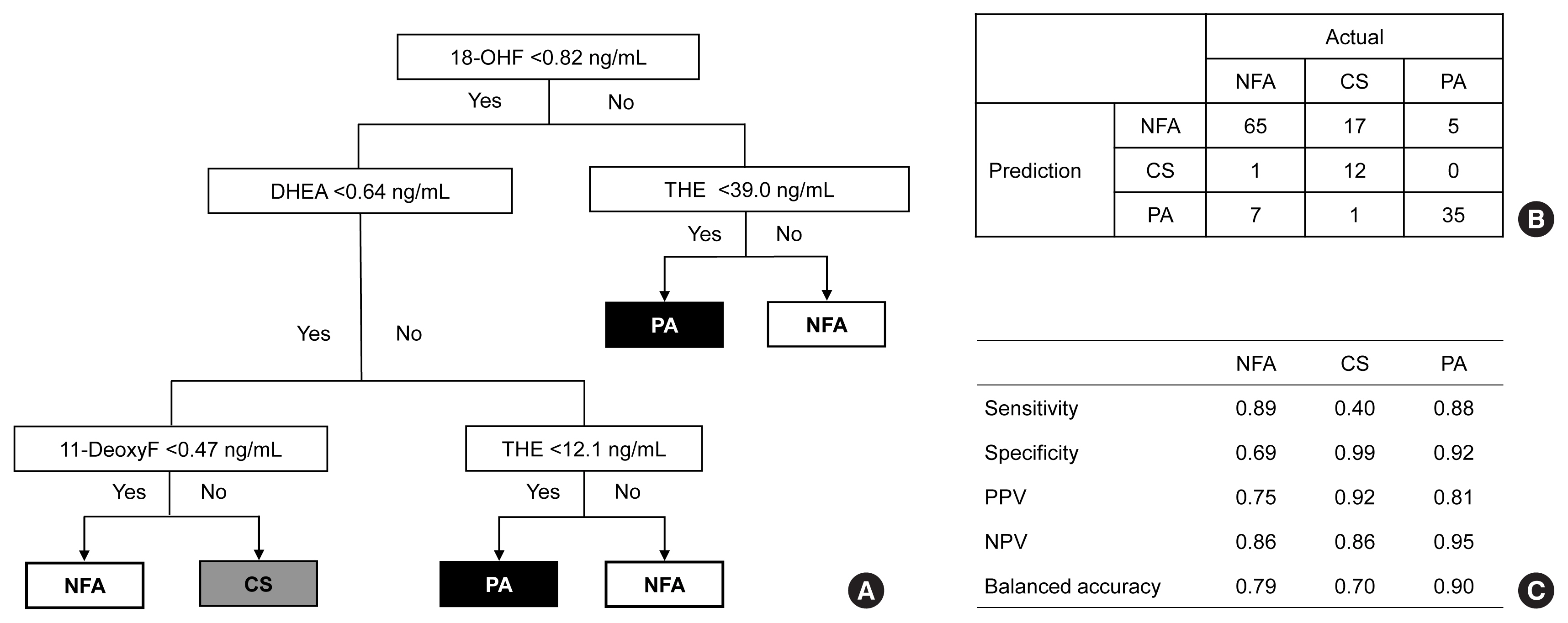
Conventional diagnostic approaches for adrenal tumors require multi-step processes, including imaging studies and dynamic hormone tests. Therefore, this study aimed to discriminate adrenal tumors from a single blood sample based on the combination of liquid chromatography-mass spectrometry (LC-MS) and machine learning algorithms in serum profiling of adrenal steroids.
Methods
The LC-MS-based steroid profiling was applied to serum samples obtained from patients with nonfunctioning adenoma (NFA, n=73), Cushing’s syndrome (CS, n=30), and primary aldosteronism (PA, n=40) in a prospective multicenter study of adrenal disease. The decision tree (DT), random forest (RF), and extreme gradient boost (XGBoost) were performed to categorize the subtypes of adrenal tumors.
Results
The CS group showed higher serum levels of 11-deoxycortisol than the NFA group, and increased levels of tetrahydrocortisone (THE), 20α-dihydrocortisol, and 6β-hydroxycortisol were found in the PA group. However, the CS group showed lower levels of dehydroepiandrosterone (DHEA) and its sulfate derivative (DHEA-S) than both the NFA and PA groups. Patients with PA expressed higher serum 18-hydroxycortisol and DHEA but lower THE than NFA patients. The balanced accuracies of DT, RF, and XGBoost for classifying each type were 78%, 96%, and 97%, respectively. In receiver operating characteristics (ROC) analysis for CS, XGBoost, and RF showed a significantly greater diagnostic power than the DT. However, in ROC analysis for PA, only RF exhibited better diagnostic performance than DT.
Conclusion
The combination of LC-MS-based steroid profiling with machine learning algorithms could be a promising one-step diagnostic approach for the classification of adrenal tumor subtypes. -
Citations
Citations to this article as recorded by- Clinical Utility of Salivary Steroid Profiling for the Differential Diagnosis of Adrenal Diseases
Kyoung Yeun Jung, Soyeon Park, Chaelin Lee, Eu Jeong Ku, Sihoon Lee, Kyoung-Ah Kim, Sang Wan Kim, Yumie Rhee, Jung Soo Lim, Choon Hee Chung, Sung Wan Chun, Soon-Jib Yoo, Ohk-Hyun Ryu, Hochan Cho, A Ram Hong, Hyo-Jeong Kim, Man Ho Choi, Jung Hee Kim
The Journal of Clinical Endocrinology & Metabolism.2026; 111(3): e827. CrossRef - The role of arachidonic acid metabolites in the subtype classification and pathogenesis of primary aldosteronism
Mei You, Li Li, Xintao Tan, Xiaoli Liu, Lijuan Wang, Tingbing Cao, Bowen Wang, Min Liu, Yue Gao, Qing Zhou, Ruomei Yang, Weihua Lan, Peng Gao, Zhiming Zhu, Zhencheng Yan
iScience.2026; 29(2): 114598. CrossRef - Usefulness of steroid profiling in the diagnosis of primary Aldosteronism a systematic review
Paola Parra Ramírez, Alberto Artiles Medina, Patricia Martín Rojas-Marcos, Gregori Casals, Manuel Morales, Imanol Madrid, Felicia A. Hanzu, Marta Araujo-Castro
Endocrine.2026;[Epub] CrossRef - An Analysis of Post-Adrenalectomy Dynamics in MACS (Mild Autonomous Cortisol Secretion)-Positive Adrenal Tumours: The Biomarkers and Clinical Impact
Alexandra-Ioana Trandafir, Mara Carsote, Alexandru-Florin Florescu
Journal of Clinical Medicine.2025; 14(15): 5217. CrossRef - Machine learning in endocrinology: current applications and future perspectives
Magdalena Kamińska, Małgorzata Trofimiuk-Müldner, Grzegorz Sokołowski, Alicja Hubalewska-Dydejczyk
Endocrine.2025; 90(2): 357. CrossRef - Dexamethasone Suppression Testing in Patients with Adrenal Incidentalomas with/Without Mild Autonomous Cortisol Secretion: Spectrum of Cortisol Cutoffs and Additional Assays (An Updated Analysis)
Alexandra-Ioana Trandafir, Mara Carsote
Biomedicines.2025; 13(9): 2169. CrossRef - Is evaluation of cortisol after dexamethasone suppression test enough? Analysis of steroid profile after dexamethasone suppression test using tandem mass spectrometry
Tomas Brutvan, Marcela Kotasova, Adela Krausova, Jarmila Krizova, Otakar Psenicka, Jan Sevcik, Martin Sevcik, Hana Vitkova, Jana Jezkova
Endocrine Connections.2025;[Epub] CrossRef - Treating Primary Aldosteronism-Induced Hypertension: Novel Approaches and Future Outlooks
Nathan Mullen, James Curneen, Padraig T Donlon, Punit Prakash, Irina Bancos, Mark Gurnell, Michael C Dennedy
Endocrine Reviews.2024; 45(1): 125. CrossRef - Steroid profiling in adrenal disease
Danni Mu, Dandan Sun, Xia Qian, Xiaoli Ma, Ling Qiu, Xinqi Cheng, Songlin Yu
Clinica Chimica Acta.2024; 553: 117749. CrossRef - Plasma Steroid Profiling Combined With Machine Learning for the Differential Diagnosis in Mild Autonomous Cortisol Secretion From Nonfunctioning Adenoma in Patients With Adrenal Incidentalomas
Danni Mu, Xia Qian, Yichen Ma, Xi Wang, Yumeng Gao, Xiaoli Ma, Shaowei Xie, Lian Hou, Qi Zhang, Fang Zhao, Liangyu Xia, Liling Lin, Ling Qiu, Jie Wu, Songlin Yu, Xinqi Cheng
Endocrine Practice.2024; 30(7): 647. CrossRef - Mild autonomous cortisol secretion: pathophysiology, comorbidities and management approaches
Alessandro Prete, Irina Bancos
Nature Reviews Endocrinology.2024; 20(8): 460. CrossRef - Plasma Steroid Profiling Between Patients With and Without Diabetes Mellitus in Nonfunctioning Adrenal Incidentalomas
Yui Nakano, Maki Yokomoto-Umakoshi, Kohta Nakatani, Hironobu Umakoshi, Hiroshi Nakao, Masamichi Fujita, Hiroki Kaneko, Norifusa Iwahashi, Tatsuki Ogasawara, Tazuru Fukumoto, Yayoi Matsuda, Ryuichi Sakamoto, Yoshihiro Izumi, Takeshi Bamba, Yoshihiro Ogawa
Journal of the Endocrine Society.2024;[Epub] CrossRef - Peak-Based Machine Learning for Plastic Type Classification in Time-of-Flight Secondary Ion Mass Spectrometry
Jin Gyeong Son, Hyun Kyong Shon, Ji-Eun Kim, In−Ho Lee, Tae Geol Lee
Journal of the American Society for Mass Spectrometry.2024; 35(12): 3107. CrossRef - Serum and hair steroid profiles in patients with nonfunctioning pituitary adenoma undergoing surgery: A prospective observational study
Seung Shin Park, Yong Hwy Kim, Ho Kang, Chang Ho Ahn, Dong Jun Byun, Man Ho Choi, Jung Hee Kim
The Journal of Steroid Biochemistry and Molecular Biology.2023; 230: 106276. CrossRef - Recent Updates on the Management of Adrenal Incidentalomas
Seung Shin Park, Jung Hee Kim
Endocrinology and Metabolism.2023; 38(4): 373. CrossRef - LC-MS based simultaneous profiling of adrenal hormones of steroids, catecholamines, and metanephrines
Jongsung Noh, Chaelin Lee, Jung Hee Kim, Seung Woon Myung, Man Ho Choi
Journal of Lipid Research.2023; 64(11): 100453. CrossRef - 2023 Korean Endocrine Society Consensus Guidelines for the Diagnosis and Management of Primary Aldosteronism
Jeonghoon Ha, Jung Hwan Park, Kyoung Jin Kim, Jung Hee Kim, Kyong Yeun Jung, Jeongmin Lee, Jong Han Choi, Seung Hun Lee, Namki Hong, Jung Soo Lim, Byung Kwan Park, Jung-Han Kim, Kyeong Cheon Jung, Jooyoung Cho, Mi-kyung Kim, Choon Hee Chung
Endocrinology and Metabolism.2023; 38(6): 597. CrossRef - Toward Systems-Level Metabolic Analysis in Endocrine Disorders and Cancer
Aliya Lakhani, Da Hyun Kang, Yea Eun Kang, Junyoung O. Park
Endocrinology and Metabolism.2023; 38(6): 619. CrossRef - Prevalence and Characteristics of Adrenal Tumors in an Unselected Screening Population
Ying Jing, Jinbo Hu, Rong Luo, Yun Mao, Zhixiao Luo, Mingjun Zhang, Jun Yang, Ying Song, Zhengping Feng, Zhihong Wang, Qingfeng Cheng, Linqiang Ma, Yi Yang, Li Zhong, Zhipeng Du, Yue Wang, Ting Luo, Wenwen He, Yue Sun, Fajin Lv, Qifu Li, Shumin Yang
Annals of Internal Medicine.2022; 175(10): 1383. CrossRef
- Clinical Utility of Salivary Steroid Profiling for the Differential Diagnosis of Adrenal Diseases
- Adrenal Gland
- Contralateral Suppression at Adrenal Venous Sampling Is Associated with Renal Impairment Following Adrenalectomy for Unilateral Primary Aldosteronism
- Ye Seul Yang, Seung Hun Lee, Jung Hee Kim, Jee Hee Yoo, Jung Hyun Lee, Seo Young Lee, A Ram Hong, Dong-Hwa Lee, Jung-Min Koh, Jae Hyeon Kim, Sang Wan Kim
- Endocrinol Metab. 2021;36(4):875-884. Published online August 11, 2021
- DOI: https://doi.org/10.3803/EnM.2021.1047
- 10,256 View
- 177 Download
- 11 Web of Science
- 11 Crossref
-
Abstract
PDFSupplementary MaterialPubReader ePub
- Background
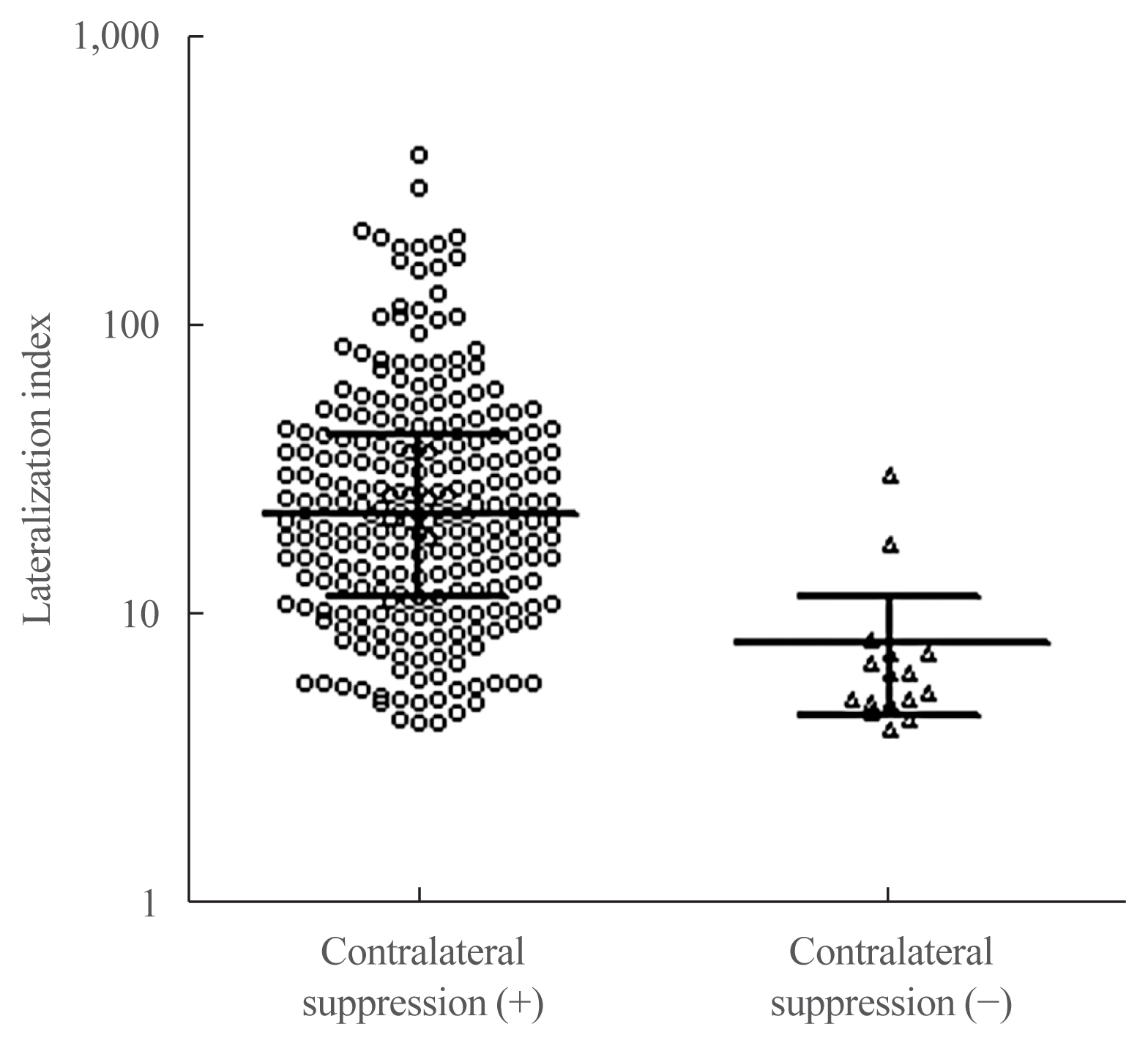
Adrenal venous sampling (AVS) is performed to distinguish the subtype of primary aldosteronism (PA). The clinical implication of contralateral suppression (CS; aldosterone/cortisolnondominantperipheral) at AVS remains unclear. We aimed to investigate the clinical significance of CS and its impact on postoperative outcomes after unilateral adrenalectomy.
Methods
In this retrospective observational multi-center study, we analyzed PA patients who underwent both successful adrenocorticotropin hormone-stimulated AVS and unilateral adrenalectomy. Successful cannulation was defined as the selectivity index (cortisoladrenal/ cortisolperipheral) ≥3. Clinical and biochemical outcomes after unilateral adrenalectomy were evaluated based on the international Primary Aldosteronism Surgical Outcome consensus.
Results
Among 263 patients analyzed, 247 had CS (93.9%). Patients with CS had lower serum potassium levels, higher plasma aldosterone concentration, higher aldosterone-to-renin ratio (ARR), and larger adenoma size than those without CS. Those with CS showed significantly higher lateralization index than those without CS (P<0.001). Although postoperative blood pressure and ARR significantly decreased in those with CS, clinical and biochemical outcomes were comparable in both groups. When the cut-off value of age was determined using receiver operating characteristic (ROC) analysis, patients aged ≥50 years old with contralateral suppression index (CSI; the ratio between aldosterone/cortisolnondominant and aldosterone/cortisolperipheral) ≤0.26 had greater odds ratio (6.43; 95% confidence interval, 1.30 to 31.69) of incident chronic kidney disease than those aged <50 years with CSI >0.26 after adjusting for other factors.
Conclusion
CS may not predict postoperative clinical and biochemical outcomes in subjects with unilateral aldosterone excess, but it is associated with postsurgical deterioration of renal function in subjects over 50 years with CSI ≤0.26. -
Citations
Citations to this article as recorded by- Partially Successful Adrenal Vein Sampling With and Without Cross-Sectional Imaging in Primary Aldosteronism Subtyping
Peeradon Vibhatavata, Livia M. Mermejo, Lili Zhao, James J. Shields, Adina F. Turcu
Hypertension.2026;[Epub] CrossRef - Subtyping of Primary Aldosteronism in Partial Adrenal Vein Sampling: The Relative Aldosterone Secretion Index
Federico Bernardo Rossi, Teresa Maria Seccia, Giacomo Rossitto, Gian Paolo Rossi
Hypertension.2026;[Epub] CrossRef - Transient Decline and Recovery of Renal Function Following Unilateral Adrenalectomy for Primary Aldosteronism
Şebnem Burhan, Aslıhan Pekmezci, Aykut Çelik, Mutlu Niyazoğlu, Esra Hatipoğlu
Istanbul Medical Journal.2026;[Epub] CrossRef - Treatment decision based on unilateral index from nonadrenocorticotropic hormone-stimulated and adrenocorticotropic hormone-stimulated adrenal vein sampling in primary aldosteronism
Xizi Zhang, Xiaoyu Shu, Feifei Wu, Jun Yang, Qingfeng Cheng, Zhipeng Du, Ying Song, Yi Yang, Jinbo Hu, Yue Wang, Qifu Li, Shumin Yang
Journal of Hypertension.2024; 42(3): 450. CrossRef - Correlation of Histopathologic Subtypes of Primary Aldosteronism with Clinical Phenotypes and Postsurgical Outcomes
Chang Ho Ahn, You-Bin Lee, Jae Hyeon Kim, Young Lyun Oh, Jung Hee Kim, Kyeong Cheon Jung
The Journal of Clinical Endocrinology & Metabolism.2024; 109(8): e1582. CrossRef - Development of a multivariate model predictive of post-adrenalectomy renal function decline in patients with primary aldosteronism: a large-cohort single-center study
Wenhao Lin, Juping Zhao, Chen Fang, Wei He, Xin Huang, Fukang Sun, Jun Dai
World Journal of Urology.2024;[Epub] CrossRef - Prognostic value of contralateral suppression on kidney function after surgery in patients with primary aldosteronism
Nathalie Voss, Sara Mørup, Caroline Clausen, Claus larsen Feltoft, Jan Viberg Jepsen, Mads Hornum, Mikkel Andreassen, Jesper Krogh
Clinical Endocrinology.2023; 98(3): 306. CrossRef - Factors Predicting Long-term Estimated Glomerular Filtration Rate Decrease, a Reliable Indicator of Renal Function After Adrenalectomy in Primary Aldosteronism
Qiyu He, Zhimin Tan, Yu Liu, Liang Zhou
Endocrine Practice.2023; 29(3): 199. CrossRef - Prognostic value of contralateral suppression for remission after surgery in patients with primary aldosteronism
Sara Mørup, Nathalie Voss, Caroline Clausen, Claus Larsen Feltoft, Mikkel Andreassen, Jesper Krogh
Clinical Endocrinology.2022; 96(6): 793. CrossRef - Contralateral Suppression at Adrenal Venous Sampling Is Associated with Renal Impairment Following Adrenalectomy for Unilateral Primary Aldosteronism (Endocrinol Metab 2021;36:875-84, Ye Seul Yang et al.)
Zhimin Tan, Qiyu He, Liang Zhou
Endocrinology and Metabolism.2022; 37(6): 951. CrossRef - Contralateral Suppression at Adrenal Venous Sampling Is Associated with Renal Impairment Following Adrenalectomy for Unilateral Primary Aldosteronism (Endocrinol Metab 2021;36:875-84, Ye Seul Yang et al.)
Ye Seul Yang, Sang Wan Kim
Endocrinology and Metabolism.2022; 37(6): 953. CrossRef
- Partially Successful Adrenal Vein Sampling With and Without Cross-Sectional Imaging in Primary Aldosteronism Subtyping
- Adrenal Gland
- Lipid Profiles in Primary Aldosteronism Compared with Essential Hypertension: Propensity-Score Matching Study
- Sun Joon Moon, Han Na Jang, Jung Hee Kim, Min Kyong Moon
- Endocrinol Metab. 2021;36(4):885-894. Published online August 10, 2021
- DOI: https://doi.org/10.3803/EnM.2021.1012
- 8,255 View
- 167 Download
- 12 Web of Science
- 12 Crossref
-
Abstract
PDFSupplementary MaterialPubReader ePub
- Background
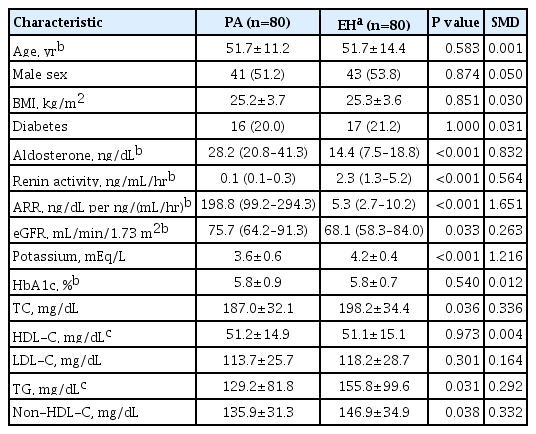
There has been controversy regarding the association between primary aldosteronism (PA) and dyslipidemia and few studies considered the effects of diabetes and renal function on lipid metabolism. We analyzed lipid profiles of PA patients and compared them to propensity-score (PS)-matched essential hypertension (EH) patients adjusting for glycemic status and renal function.
Methods
Patients who were diagnosed with PA using a saline-infusion test at Seoul National University Hospital from 2000 to 2018 were retrospectively analyzed. EH patients who had aldosterone-renin ratio (ARR) results were selected as controls. Covariates, including diabetes, were PS-matched for patients with PA, lateralized PA, non-lateralized PA, and high ARR to EH patients, respectively.
Results
Among a total of 80 PA and 80 EH patients, total cholesterol (TC) and triglyceride (TG) levels were significantly lower in the PA patients than in the EH patients (least-squares mean±standard error: 185.5±4.4 mg/dL vs. 196.2±4.4 mg/dL, P=0.047, for TC; and 132.3±11.5 mg/dL vs. 157.4±11.4 mg/dL, P=0.035, for TG) in fully adjusted model (adjusting for multiple covariates, including diabetes status, glycosylated hemoglobin level, and estimated glomerular filtration rate). There were no significant differences in high-density lipoprotein cholesterol (HDL-C) and low-density lipoprotein cholesterol levels between the two groups. According to increments in aldosterone levels, an increasing tendency of HDL-C and decreasing tendencies of TG and non-HDL-C were observed.
Conclusion
PA patients had lower TC and TG levels than EH patients, independent of glycemic status and renal function. -
Citations
Citations to this article as recorded by- DPA/AA ratio as a potential biomarker of primary aldosteronism in young and middle-aged adults
Wenli Xie, Runlong Lin, Yawen Meng, Lu Zhang, Zhi Zheng, Lijiao Zhang
Frontiers in Endocrinology.2026;[Epub] CrossRef - Lipid Profile in Primary Aldosteronism: Cross‐Sectional and Post‐Treatment Analyses
Meriem Yazidi, Arige Abid, Chayma Bel hadj Sliman, Elyes Kamoun, Ibtissem Oueslati, Fatma Chaker, Nadia Khessairi, Melika Chihaoui
Lipids.2026; 61(4): 527. CrossRef - Integrative Analysis of Metabolomic and Transcriptomic Data Reveals Metabolic Signatures and Major Metabolic Pathways in Primary Aldosteronism
Xiaomei Lai, Tingting Yang, Chaoping Wei, Shuangbei Zhu, Jianling Li
Endocrine, Metabolic & Immune Disorders - Drug Targets.2026;[Epub] CrossRef - Targeting cholesterol-dependent adrenal steroidogenesis for management of primary aldosteronism
Hao Wu, Hongbo He, Tong Han, Xiaoyu Tian, Zhiming Zhu
Trends in Endocrinology & Metabolism.2025; 36(9): 789. CrossRef - The association between aldosterone and lipid profiles in patients with primary aldosteronism
Ning-Peng Liang, Kun-Rui Rao, Ming Hu, Ru-Yi Bao, Jian-Wei Liu, Ze-Qun Lai, Hong-Jin Zhang, Huang Zhang, Meng-Bo Wu, Xiang-Tao Zhang, Yi-Fei Dong
Scientific Reports.2025;[Epub] CrossRef - Association of Plasma Aldosterone Concentration With Early Renal Injury Biomarkers in Primary Aldosteronism: A Propensity‐Matched Comparative Study
Hai‐Long Liu, Qing‐Tian Zeng, Yuan‐Yuan Xu, Xiang‐Tao Zhang, Ning Li, Ning‐Peng Liang, Yi‐Fei Dong
The Journal of Clinical Hypertension.2025;[Epub] CrossRef - Diagnostic Accuracy of 24‐Hour Urinary Aldosterone for Primary Aldosteronism in Northeast China
Kaiwen Sun, Minghui Gong, Yang Yu, Minghui Yang, Yinong Jiang, Ying Zhang, Wei Song
The Journal of Clinical Hypertension.2025;[Epub] CrossRef - Comparison of saline infusion test and captopril challenge test in the diagnosis of Chinese with primary aldosteronism in different age groups
Kaiwen Sun, Minghui Gong, Yang Yu, Minghui Yang, Ying Zhang, Yinong Jiang, Wei Song
Frontiers in Endocrinology.2024;[Epub] CrossRef - The prevalence of metabolic syndrome in primary aldosteronism and essential hypertension: A systematic review and meta‐analysis
Kaiwen Sun, Chenxu Zhou, Minghui Gong, Ying Zhang, Yinong Jiang, Wei Song
The Journal of Clinical Hypertension.2024; 26(8): 879. CrossRef - Meta‐analysis of blood parameters related to lipid and glucose metabolism between two subtypes of primary aldosteronism
Qiu‐Gen Zhu, Feng Zhu
The Journal of Clinical Hypertension.2023; 25(1): 13. CrossRef - 2023 Korean Endocrine Society Consensus Guidelines for the Diagnosis and Management of Primary Aldosteronism
Jeonghoon Ha, Jung Hwan Park, Kyoung Jin Kim, Jung Hee Kim, Kyong Yeun Jung, Jeongmin Lee, Jong Han Choi, Seung Hun Lee, Namki Hong, Jung Soo Lim, Byung Kwan Park, Jung-Han Kim, Kyeong Cheon Jung, Jooyoung Cho, Mi-kyung Kim, Choon Hee Chung
Endocrinology and Metabolism.2023; 38(6): 597. CrossRef - The differences of serum lipid profiles between primary aldosteronism and essential hypertension: a meta-analysis and systematic review
Worapaka Manosroi, Pitchaporn Phudphong, Pichitchai Atthakomol, Mattabhorn Phimphilai
BMC Endocrine Disorders.2022;[Epub] CrossRef
- DPA/AA ratio as a potential biomarker of primary aldosteronism in young and middle-aged adults
- Clinical Study
- Diagnostic Accuracy of Computed Tomography in Predicting Primary Aldosteronism Subtype According to Age
- Seung Hun Lee, Jong Woo Kim, Hyun-Ki Yoon, Jung-Min Koh, Chan Soo Shin, Sang Wan Kim, Jung Hee Kim
- Endocrinol Metab. 2021;36(2):401-412. Published online March 31, 2021
- DOI: https://doi.org/10.3803/EnM.2020.901
- 10,672 View
- 202 Download
- 31 Web of Science
- 27 Crossref
-
Abstract
PDFSupplementary MaterialPubReader ePub
- Background
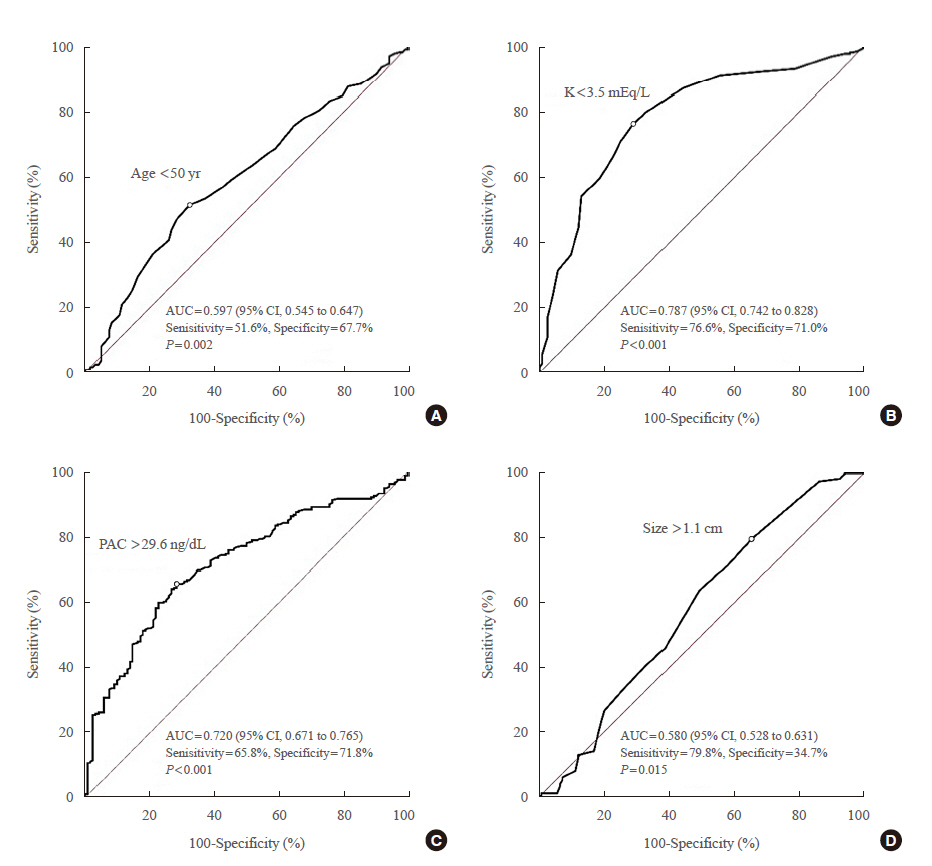
Guidelines by the Endocrine Society Guideline on bypassing adrenal vein sampling (AVS) in patients <35 years old with marked primary aldosteronism (PA) (hypokalemia and elevated plasma aldosterone concentration [PAC]) and a unilateral lesion on computed tomography (CT) are based on limited number of studies. We aimed to determine the accuracy of CT in PA patients according to age.
Methods
In this retrospective study, we investigated the concordance between CT and AVS in 466 PA patients from two tertiary centers who successfully underwent AVS.
Results
CT had an overall accuracy of 64.4% (300/466). In the group with unilateral lesion, patients with hypokalemia had higher concordance than those without hypokalemia (85.0% vs. 43.6%, P<0.001). In the group with marked PA (hypokalemia and PAC >15.9 ng/dL) and unilateral lesion, accuracy of CT was 84.6% (11/13) in patients aged <35 years; 100.0% (20/20), aged 35 to 39 years; 89.4% (59/66), aged 40 to 49 years; and 79.8% (79/99), aged ≥50 years. Cut-off age and PAC for concordance was <50 years and >29.6 ng/dL, respectively. The significant difference in accuracy of CT in 198 patients with marked PA and a unilateral lesion between the <50-year age group and ≥50-year age group (90.9% vs. 79.8%, P=0.044) disappeared in 139 of 198 patients with PAC > 30.0 ng/dL (91.9% vs. 87.7%, P=0.590).
Conclusion
Patients with hypokalemia, PAC >30.0 ng/dL, and unilateral lesion were at high risk of unilateral PA regardless of age. -
Citations
Citations to this article as recorded by- Modern capabilities of contrast-enhanced computed tomography in the diagnosis of adrenal adenomas
N. V. Tarbaeva, A. Chevais, A. V. Manaev, D. G. Beltsevich, N. M. Platonova, E. A. Troshina, G. A. Melnichenko, N. G. Mokrysheva
Problems of Endocrinology.2026; 72(1): 23. CrossRef - Left Aldosterone-Producing Adenoma Identified by Adrenal Venous Sampling in a Patient with Bilateral Adrenal Nodules: A Case Report
智宇 盖
Advances in Clinical Medicine.2026; 16(05): 3363. CrossRef - Optimising patient selection for adrenal vein sampling in primary aldosteronism: role of biochemical markers and scoring systems
Manasvini Bhatt, Rakesh Garg, Alpesh Goyal, Devasenathipathy Kandasamy, Vanshja Pandit, Eram Nahid, Sarah Alam, Rajesh Khadgawat
Endocrine.2026;[Epub] CrossRef - Assessment, External Verification and Modification of Models in Diagnosing Primary Aldosteronism Subtypes
Yingyu Jing, Yifan Zhang, Haonan Guo, Rongrong Hou, Jing Xu, Jingyue Wang, Xingyan Pan, Xinyi Niu, Lin Song, Lili Huang, Jinyan Zhang, Fang Jia, Bo Sun, Ning Wang
The Journal of Clinical Hypertension.2026;[Epub] CrossRef - Adrenal Vein Sampling for Primary Aldosteronism: Recommendations From the Australian and New Zealand Working Group
Jun Yang, Damon A. Bell, Richard Carroll, Cherie Chiang, Diane Cowley, Emma Croker, James C. G. Doery, Marianne Elston, Paul Glendenning, Julie Hetherington, Andrea R. Horvath, Shanshan Lu‐Shirzad, Elisabeth Ng, Amanda Mather, Nimalie Perera, Muddassir Ra
Clinical Endocrinology.2025; 102(1): 31. CrossRef - Evaluation of Predictive Risk Factors of Persistent Hypertension in Hyperaldosteronism After Surgery
Amal Ourdi, Youssra Laalaoua, Imane Assarrar, Bouichrat Nisrine, Siham Rouf, Hanane Latrech
International Journal of Endocrinology and Metabolism.2025;[Epub] CrossRef - A Systematic Review Supporting the Endocrine Society Clinical Practice Guideline on Management of Primary Aldosteronism
Magdoleen H Farah, Moustafa Hegazi, Mohammed Firwana, Mohamed Abusalih, Samer Saadi, Mohammad Al-Kordi, Arwa Elsheikh, Zhen Wang, Leslie Hassett, Irina Bancos, M Hassan Murad
The Journal of Clinical Endocrinology & Metabolism.2025; 110(9): e2833. CrossRef - Primary Aldosteronism: An Endocrine Society Clinical Practice Guideline
Gail K Adler, Michael Stowasser, Ricardo R Correa, Nadia Khan, Gregory Kline, Michael J McGowan, Paolo Mulatero, M Hassan Murad, Rhian M Touyz, Anand Vaidya, Tracy A Williams, Jun Yang, William F Young, Maria-Christina Zennaro, Juan P Brito
The Journal of Clinical Endocrinology & Metabolism.2025; 110(9): 2453. CrossRef - Identifying unilateral aldosterone-producing adenomas using published algorithms and imaging: a systematic review and meta-analysis
Elisabeth Ng, Stella May Gwini, Winston Zheng, Peter J Fuller, Jun Yang
Endocrine Connections.2025;[Epub] CrossRef - Case selection of adrenal vein sampling in young patients with primary aldosteronism: a retrospective analysis of imaging and AVS concordance, and histopathological outcomes
Zin Htut, Namir Asmar, Joshua Agilinko, Rashpal Flora, Fausto Palazzo, Aimee Di Marco, Jeannie Todd, Karim Meeran, Florian Wernig, Ali Alsafi
Endocrine Connections.2025;[Epub] CrossRef - Predicting Bilateral Subtypes of Primary Aldosteronism Without Adrenal Vein Sampling: A Systematic Review and Meta-analysis
Elisabeth Ng, Stella May Gwini, Winston Zheng, Peter J Fuller, Jun Yang
The Journal of Clinical Endocrinology & Metabolism.2024; 109(2): e837. CrossRef - Subtype-specific Body Composition and Metabolic Risk in Patients With Primary Aldosteronism
Seung Shin Park, Chang Ho Ahn, Sang Wan Kim, Ji Won Yoon, Jung Hee Kim
The Journal of Clinical Endocrinology & Metabolism.2024; 109(2): e788. CrossRef - Imaging Concordance With Vein Sampling for Primary Aldosteronism: A Cohort Study and Literature Review
Sara Cartwright, MaKayla Gordon, Jessica Shank, Abbey Fingeret
Journal of Surgical Research.2024; 296: 1. CrossRef - Correlation of Histopathologic Subtypes of Primary Aldosteronism with Clinical Phenotypes and Postsurgical Outcomes
Chang Ho Ahn, You-Bin Lee, Jae Hyeon Kim, Young Lyun Oh, Jung Hee Kim, Kyeong Cheon Jung
The Journal of Clinical Endocrinology & Metabolism.2024; 109(8): e1582. CrossRef - Temporal trends in clinical features of patients with primary aldosteronism over 20 years
Seung Shin Park, Chang Ho Ahn, Sang Wan Kim, Jung-Min Koh, Seung Hun Lee, Jung Hee Kim
Hypertension Research.2024; 47(8): 2019. CrossRef - Best Practices: Indications and Procedural Controversies of Adrenal Vein Sampling for Primary Aldosteronism
Keith B. Quencer, Abhilasha Singh, Anu Sharma
American Journal of Roentgenology.2023; 220(2): 190. CrossRef - Accuracy of Gallium-68 Pentixafor Positron Emission Tomography–Computed Tomography for Subtyping Diagnosis of Primary Aldosteronism
Jinbo Hu, Tingting Xu, Hang Shen, Ying Song, Jun Yang, Aipin Zhang, Haoyuan Ding, Naiguo Xing, Zhuoyuan Li, Lin Qiu, Linqiang Ma, Yi Yang, Zhengping Feng, Zhipeng Du, Wenwen He, Yue Sun, Jun Cai, Qifu Li, Yue Chen, Shumin Yang, Mei Mei, Suxin Luo, Kangla
JAMA Network Open.2023; 6(2): e2255609. CrossRef - Adrenal Vein Sampling in the Young – Necessary or
Not?
Eleftheria Gkaniatsa, Oskar Ragnarsson
Experimental and Clinical Endocrinology & Diabetes.2023; 131(07/08): 435. CrossRef - 2023 Korean Endocrine Society Consensus Guidelines for the Diagnosis and Management of Primary Aldosteronism
Jeonghoon Ha, Jung Hwan Park, Kyoung Jin Kim, Jung Hee Kim, Kyong Yeun Jung, Jeongmin Lee, Jong Han Choi, Seung Hun Lee, Namki Hong, Jung Soo Lim, Byung Kwan Park, Jung-Han Kim, Kyeong Cheon Jung, Jooyoung Cho, Mi-kyung Kim, Choon Hee Chung
Endocrinology and Metabolism.2023; 38(6): 597. CrossRef - Indices of ACTH‐stimulated adrenal venous sampling as predictors of postsurgical outcomes in primary aldosteronism
Seung Hun Lee, Jong Woo Kim, Hyun‐Ki Yoon, Sang Wan Kim, Su Jin Kim, Kyu Eun Lee, Yu‐Mi Lee, Tae‐Yon Sung, Suck Joon Hong, Chan Soo Shin, Jung‐Min Koh, Jung Hee Kim
Clinical Endocrinology.2022; 96(4): 521. CrossRef - Expression of CYP11B1 and CYP11B2 in adrenal adenoma correlates with clinical characteristics of primary aldosteronism
Chang Ho Ahn, Hee Young Na, So Yeon Park, Hyeong Won Yu, Su‐Jin Kim, June Young Choi, Kyu Eun Lee, Sang Wan Kim, Kyeong Cheon Jung, Jung Hee Kim
Clinical Endocrinology.2022; 96(1): 30. CrossRef - Letter to the Editor From Singhania et al: “Increasing Incidence of Primary Aldosteronism in Western Sweden During 3 Decades—Yet an Underdiagnosed Disorder”
Pankaj Singhania, Rana Bhattacharjee
The Journal of Clinical Endocrinology & Metabolism.2022; 107(3): e1315. CrossRef - Development and validation of model for sparing adrenal venous sampling in diagnosing unilateral primary aldosteronism
Ying Song, Jun Yang, Hang Shen, Elisabeth Ng, Peter J. Fuller, Zhengping Feng, Jinbo Hu, Linqiang Ma, Yi Yang, Zhipeng Du, Yue Wang, Ting Luo, Wenwen He, Qifu Li, Fei-Fei Wu, Shumin Yang
Journal of Hypertension.2022; 40(9): 1692. CrossRef - Validation of Existing Clinical Prediction Tools for Primary Aldosteronism Subtyping
Barbora Kološová, Petr Waldauf, Dan Wichterle, Jan Kvasnička, Tomáš Zelinka, Ondřej Petrák, Zuzana Krátká, Lubomíra Forejtová, Jan Kaván, Jiří Widimský, Robert Holaj
Diagnostics.2022; 12(11): 2806. CrossRef - Fully automatic volume measurement of the adrenal gland on CT using deep learning to classify adrenal hyperplasia
Taek Min Kim, Seung Jae Choi, Ji Yeon Ko, Sungwan Kim, Chang Wook Jeong, Jeong Yeon Cho, Sang Youn Kim, Young-Gon Kim
European Radiology.2022; 33(6): 4292. CrossRef - Diagnostic Accuracy of Computed Tomography in Predicting Primary Aldosteronism Subtype According to Age (Endocrinol Metab 2021;36:401-12, Seung Hun Lee et al.)
Seung Hun Lee, Jong Woo Kim, Hyun-Ki Yoon, Jung-Min Koh, Chan Soo Shin, Sang Wan Kim, Jung Hee Kim
Endocrinology and Metabolism.2021; 36(4): 914. CrossRef - Diagnostic Accuracy of Computed Tomography in Predicting Primary Aldosteronism Subtype According to Age (Endocrinol Metab 2021;36:401-12, Seung Hun Lee et al.)
Pankaj Singhania
Endocrinology and Metabolism.2021; 36(4): 912. CrossRef
- Modern capabilities of contrast-enhanced computed tomography in the diagnosis of adrenal adenomas
- Clinical Study
- Changes in Glucose Metabolism after Adrenalectomy or Treatment with a Mineralocorticoid Receptor Antagonist for Primary Aldosteronism
- Yu-Fang Lin, Kang-Yung Peng, Chia-Hui Chang, Ya-Hui Hu, Vin-Cent Wu, Shiu-Dong Chung, Taiwan Primary Aldosteronism Investigation (TAIPAI) Study Group
- Endocrinol Metab. 2020;35(4):838-846. Published online December 2, 2020
- DOI: https://doi.org/10.3803/EnM.2020.797
- 11,393 View
- 145 Download
- 10 Web of Science
- 11 Crossref
-
Abstract
PDFPubReader ePub
- Background
Data on the effects of excess aldosterone on glucose metabolism are inconsistent. This study compared the changes in glucose metabolism in patients with primary aldosteronism (PA) after adrenalectomy or treatment with a mineralocorticoid receptor antagonist (MRA).
Methods
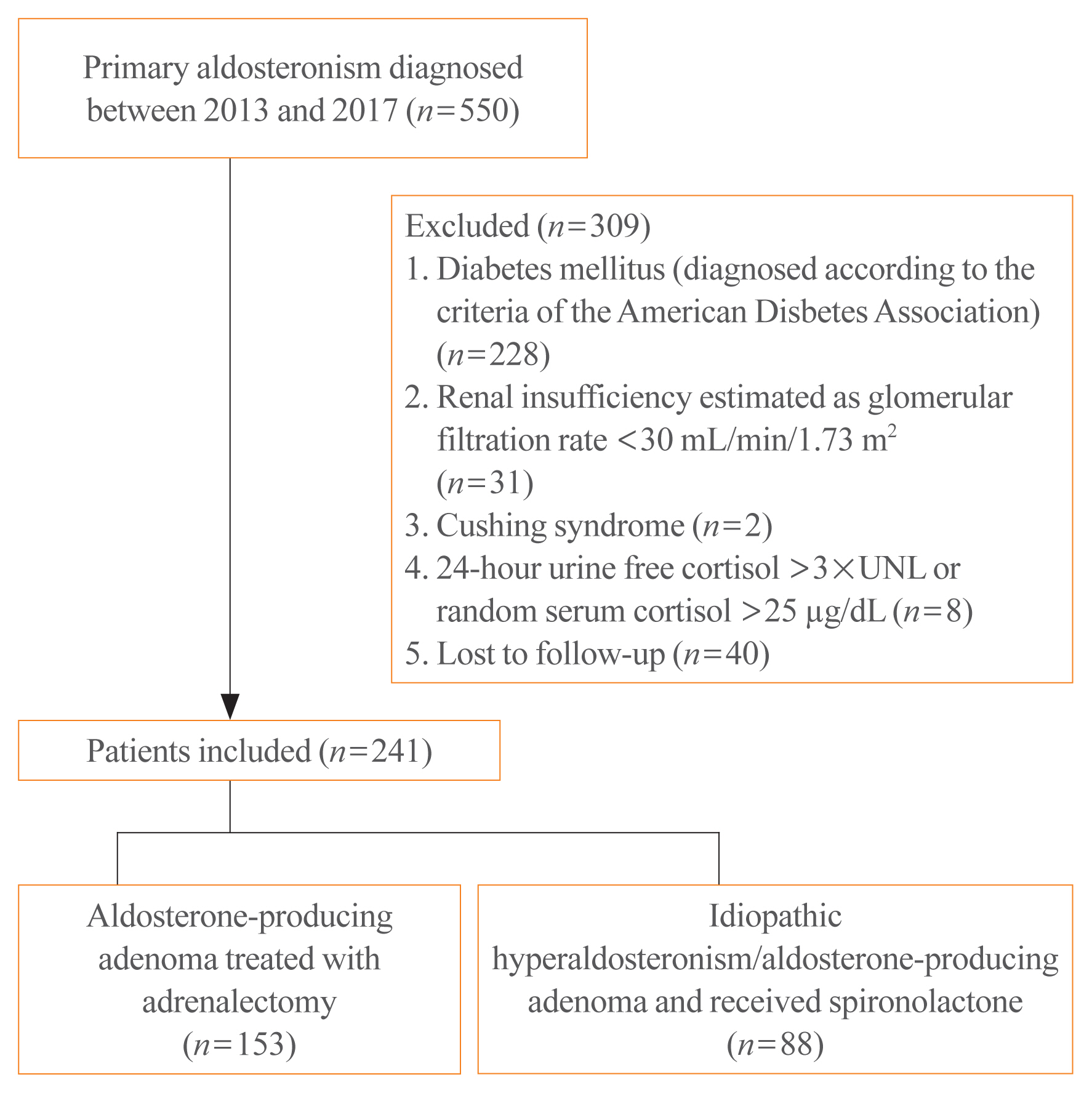
Overall, 241 patients were enrolled; 153 underwent adrenalectomy and 88 received an MRA. Fasting glucose, homeostatic model assessment of insulin resistance (HOMA-IR), and homeostatic model assessment of β-cell function (HOMA-β) were compared between the treatment groups after 1 year. Plasma aldosterone concentration (PAC) and factors determining HOMA-IR and PAC were evaluated.
Results
No baseline differences were observed between the groups. Fasting insulin, HOMA-IR, and HOMA-β increased in both groups and there were no significant differences in fasting glucose following treatment. Multiple regression analysis showed associations between PAC and HOMA-IR (β=0.172, P=0.017) after treatment. Treatment with spironolactone was the only risk factor associated with PAC >30 ng/dL (odds ratio, 5.2; 95% confidence interval [CI], 2.7 to 10; P<0.001) and conferred a 2.48-fold risk of insulin resistance after 1 year compared with surgery (95% CI, 1.3 to 4.8; P=0.007).
Conclusion
Spironolactone treatment might increase insulin resistance in patients with PA. This strengthened the current recommendation that adrenalectomy is the preferred strategy for patient with positive lateralization test. Achieving a post-treatment PAC of <30 ng/dL for improved insulin sensitivity may be appropriate. -
Citations
Citations to this article as recorded by- Metabolic and body composition shifts after adrenalectomy in unilateral primary aldosteronism
Yuanyuan Hu, Riqiang Bao, Cui Zhang, Yashu Zhu, Rui Xu, Chong Gao, Yuhan Guo, Yixiang Hu, Guang Ning, Shijia Pan, Yiran Jiang, Weiqing Wang
Hypertension Research.2026; 49(7): 2072. CrossRef - Comparative Outcomes of Adrenalectomy, Mineralocorticoid Receptor Antagonist, and Percutaneous Adrenal Ablation for Primary Aldosteronism: A Systematic Review and Network Meta-Analysis
Liyuan Yuan, Xinyi Li, Fang Sun, Yi Tang, Wuhao Wang, Wei Liu, Xiaona Sun, Yushuang Luo, Xiaona Bu, Zongshi Lu, Daoyan Liu, Qiang Li, Zhiming Zhu
American Journal of Hypertension.2025; 38(9): 654. CrossRef - A Systematic Review Supporting the Endocrine Society Clinical Practice Guideline on Management of Primary Aldosteronism
Magdoleen H Farah, Moustafa Hegazi, Mohammed Firwana, Mohamed Abusalih, Samer Saadi, Mohammad Al-Kordi, Arwa Elsheikh, Zhen Wang, Leslie Hassett, Irina Bancos, M Hassan Murad
The Journal of Clinical Endocrinology & Metabolism.2025; 110(9): e2833. CrossRef - How should anti-hypertensive medications be adjusted before screening for primary aldosteronism?
Jin-Ying Lu, Yi-Yao Chang, Ting-Wei Lee, Ming-Hsien Wu, Zheng-Wei Chen, Yen-Ta Huang, Tai-Shuan Lai, Leay Kiaw Er, Yen-Hung Lin, Vin-Cent Wu, Hao-Min Cheng, Hsien-Li Kao, Charles Jia-Yin Hou, Kwan-Dun Wu, Szu-Tah Chen, Feng-Hsuan Liu
Journal of the Formosan Medical Association.2024; 123: S91. CrossRef - Diabete e sindrome metabolica nel paziente con iperaldosteronismo primario
Stella Bernardi, Valerio Velardi, Federica De Luca, Giulia Zuolo, Veronica Calabrò, Riccardo Candido, Bruno Fabris
L'Endocrinologo.2024; 25(1): 48. CrossRef - Prevalence, risk factors and evolution of diabetes mellitus after treatment in primary aldosteronism. Results from the SPAIN-ALDO registry
M. Araujo-Castro, M. Paja Fano, B. Pla Peris, M. González Boillos, E. Pascual-Corrales, A. M. García Cano, P. Parra Ramírez, P. Martín Rojas-Marcos, J. G. Ruiz-Sanchez, A. Vicente Delgado, E. Gómez Hoyos, R. Ferreira, I. García Sanz, M. Recasens Sala, R.
Journal of Endocrinological Investigation.2023; 46(11): 2343. CrossRef - Estimated glomerular filtration rate-dip after medical target therapy associated with increased mortality and cardiovascular events in patients with primary aldosteronism
Jia-Yuh Sheu, Shuo-Meng Wang, Vin-Cent Wu, Kuo-How Huang, Chi-Shin Tseng, Yuan-Ju Lee, Yao-Chou Tsai, Yen-Hung Lin, Jeff S. Chueh
Journal of Hypertension.2023; 41(9): 1401. CrossRef - Risk of dementia in primary aldosteronism compared with essential hypertension: a nationwide cohort study
Namki Hong, Kyoung Jin Kim, Min Heui Yu, Seong Ho Jeong, Seunghyun Lee, Jung Soo Lim, Yumie Rhee
Alzheimer's Research & Therapy.2023;[Epub] CrossRef - Secondary diabetes mellitus due to primary aldosteronism
Melpomeni Moustaki, Stavroula A. Paschou, Eleni C. Vakali, Andromachi Vryonidou
Endocrine.2022; 79(1): 17. CrossRef - Serum Cystatin C Levels Could Predict Rapid Kidney Function Decline in A Community-Based Population
Wei-Ching Fang, Hsing-Yu Chen, Shao-Chi Chu, Po-Hsi Wang, Chin-Chan Lee, I-Wen Wu, Chiao-Yin Sun, Heng-Jung Hsu, Chun-Yu Chen, Yung-Chang Chen, Vin-Cent Wu, Heng-Chih Pan
Biomedicines.2022; 10(11): 2789. CrossRef - Recovery from diabetes mellitus in primary aldosteronism patients after adrenalectomy
Yu Liu, Lede Lin, Chi Yuan, Sikui Shen, Yin Tang, Zhihong Liu, Yuchun Zhu, Liang Zhou
BMC Endocrine Disorders.2022;[Epub] CrossRef
- Metabolic and body composition shifts after adrenalectomy in unilateral primary aldosteronism
Review Article
- Adrenal gland
- Molecular Mechanisms of Primary Aldosteronism
- Sergei G. Tevosian, Shawna C. Fox, Hans K. Ghayee
- Endocrinol Metab. 2019;34(4):355-366. Published online December 23, 2019
- DOI: https://doi.org/10.3803/EnM.2019.34.4.355
- 15,704 View
- 175 Download
- 7 Web of Science
- 7 Crossref
-
Abstract
PDFPubReader ePub
Primary aldosteronism (PA) results from excess production of mineralocorticoid hormone aldosterone by the adrenal cortex. It is normally caused either by unilateral aldosterone-producing adenoma (APA) or by bilateral aldosterone excess as a result of bilateral adrenal hyperplasia. PA is the most common cause of secondary hypertension and associated morbidity and mortality. While most cases of PA are sporadic, an important insight into this debilitating disease has been derived through investigating the familial forms of the disease that affect only a minor fraction of PA patients. The advent of gene expression profiling has shed light on the genes and intracellular signaling pathways that may play a role in the pathogenesis of these tumors. The genetic basis for several forms of familial PA has been uncovered in recent years although the list is likely to expand. Recently, the work from several laboratories provided evidence for the involvement of mammalian target of rapamycin pathway and inflammatory cytokines in APAs; however, their mechanism of action in tumor development and pathophysiology remains to be understood.
-
Citations
Citations to this article as recorded by- Mineralocorticoid Receptor and Aldosterone: Interaction Between NR3C2 Genetic Variants, Sex, and Age in a Mixed Cohort
Mahyar Heydarpour, Wasita W Parksook, Luminita H Pojoga, Gordon H Williams, Jonathan S Williams
The Journal of Clinical Endocrinology & Metabolism.2024; 110(1): e140. CrossRef - Subunit-Specific Developmental Roles of PI3K in SF1-Expressing Cells
My Khanh Q. Huynh, Sang Hee Lyoo, Dong Joo Yang, Yun-Hee Choi, Ki Woo Kim
Endocrinology and Metabolism.2024; 39(5): 793. CrossRef - Proteomic analysis of urinary extracellular vesicles highlights specific signatures for patients with primary aldosteronism
Lorenzo Bertolone, Annalisa Castagna, Marcello Manfredi, Domenica De Santis, Francesca Ambrosani, Elisa Antinori, Paolo Mulatero, Elisa Danese, Emilio Marengo, Elettra Barberis, Mariangela Veneri, Nicola Martinelli, Simonetta Friso, Francesca Pizzolo, Oli
Frontiers in Endocrinology.2023;[Epub] CrossRef - Focus on adrenal and related causes of hypertension in childhood and adolescence: Rare or rarely recognized?
Flávia A. Costa-Barbosa, Rafael B. Giorgi, Claudio E. Kater
Archives of Endocrinology and Metabolism.2022;[Epub] CrossRef - Diseases caused by mutations in the Na+/K+ pump α1 gene ATP1A1
Elisa D. Biondo, Kerri Spontarelli, Giovanna Ababioh, Lois Méndez, Pablo Artigas
American Journal of Physiology-Cell Physiology.2021; 321(2): C394. CrossRef - Aldosterone Inhibits In Vitro Myogenesis by Increasing Intracellular Oxidative Stress via Mineralocorticoid Receptor
Jin Young Lee, Da Ae Kim, Eunah Choi, Yun Sun Lee, So Jeong Park, Beom-Jun Kim
Endocrinology and Metabolism.2021; 36(4): 865. CrossRef - Progress on Genetic Basis of Primary Aldosteronism
Izabela Karwacka, Łukasz Obołończyk, Sonia Kaniuka-Jakubowska, Michał Bohdan, Krzysztof Sworczak
Biomedicines.2021; 9(11): 1708. CrossRef
- Mineralocorticoid Receptor and Aldosterone: Interaction Between NR3C2 Genetic Variants, Sex, and Age in a Mixed Cohort
Case Report
- A Case of Giant Adrenal Adenoma Presenting Primary Aldosteronism.
- Ji Hyun Lee, Bong Soo Cha, Moon Suk Nam, Young Duk Song, Sung Kil Lim, Hyun Chul Lee, Kap Bum Huh, Hyung Chan Suh, Young Hwa Choi, Jae Min Park, Jung Soo Park, Soon Won Hong, Dong Hwan Shin
- J Korean Endocr Soc. 1996;11(3):348-354. Published online November 7, 2019
- 2,271 View
- 30 Download
-
Abstract
PDF
- Primary aldosteronism is a syndrome chracterized by hypokalemic alkalosis and hypertension. Small sized adrenal cortical adenomas have been the major cause of this syndrome in most of the patients. However, if the adrenal mass is larger than 6cm in diameter and with irregular consistency, malignancy is more favored. We experienced a patient who had a giant adrenal adenoma with primary aldosteronism. A 24-year-old female presented with hypertension, hypokalemia, low plasma renin, and high plasrna aldosterone levels, was found to have a 6×5.5×5 cm sized left adrenal tumor by MRI. Her clinical laboratory feature did not revealed any evidence of Cushing's syndrome or pheochromocytoma. Preoperatively adrenal carcinoma presenting pure adrenal aldosteronism was suspected due to large size and heterogenous signal character of the adrenal mass in radiologic study. At operation well encapsulated, round giant adrenal tumor weighing 65gm(4.5×4×4 cm) was removed. There was no evidence of metastasis with return of adrenal function to normal after surgery. Benign adrenal adenoma was confirmed by the gross morphology and the histologic features.
Original Article
- Adrenal gland
- Effects of Altered Calcium Metabolism on Cardiac Parameters in Primary Aldosteronism
- Jung Soo Lim, Namki Hong, Sungha Park, Sung Il Park, Young Taik Oh, Min Heui Yu, Pil Yong Lim, Yumie Rhee
- Endocrinol Metab. 2018;33(4):485-492. Published online November 30, 2018
- DOI: https://doi.org/10.3803/EnM.2018.33.4.485
- 10,199 View
- 55 Download
- 1 Web of Science
- 1 Crossref
-
Abstract
PDFPubReader ePub
Background Increasing evidence supports interplay between aldosterone and parathyroid hormone (PTH), which may aggravate cardiovascular complications in various heart diseases. Negative structural cardiovascular remodeling by primary aldosteronism (PA) is also suspected to be associated with changes in calcium levels. However, to date, few clinical studies have examined how changes in calcium and PTH levels influence cardiovascular outcomes in PA patients. Therefore, we investigated the impact of altered calcium homeostasis caused by excessive aldosterone on cardiovascular parameters in patients with PA.
Methods Forty-two patients (mean age 48.8±10.9 years; 1:1, male:female) whose plasma aldosterone concentration/plasma renin activity ratio was more than 30 were selected among those who had visited Severance Hospital from 2010 to 2014. All patients underwent adrenal venous sampling with complete access to both adrenal veins.
Results The prevalence of unilateral adrenal adenoma (54.8%) was similar to that of bilateral adrenal hyperplasia. Mean serum corrected calcium level was 8.9±0.3 mg/dL (range, 8.3 to 9.9). The corrected calcium level had a negative linear correlation with left ventricular end-diastolic diameter (LVEDD, ρ=−0.424,
P =0.031). Moreover, multivariable regression analysis showed that the corrected calcium level was marginally associated with the LVEDD and corrected QT (QTc) interval (β=−0.366,P =0.068 and β=−0.252,P =0.070, respectively).Conclusion Aldosterone-mediated hypercalciuria and subsequent hypocalcemia may be partly involved in the development of cardiac remodeling as well as a prolonged QTc interval, in subjects with PA, thereby triggering deleterious effects on target organs additively.
-
Citations
Citations to this article as recorded by- Bone and mineral metabolism in patients with primary aldosteronism: A systematic review and meta-analysis
Anning Wang, Yuhan Wang, Hongzhou Liu, Xiaodong Hu, Jiefei Li, Huaijin Xu, Zhimei Nie, Lingjing Zhang, Zhaohui Lyu
Frontiers in Endocrinology.2022;[Epub] CrossRef
- Bone and mineral metabolism in patients with primary aldosteronism: A systematic review and meta-analysis
Review Article
- Adrenal gland
- Primary Aldosteronism and Cerebrovascular Diseases
- Zheng-Wei Chen, Chi-Sheng Hung, Vin-Cent Wu, Yen-Hung Lin
- Endocrinol Metab. 2018;33(4):429-434. Published online November 30, 2018
- DOI: https://doi.org/10.3803/EnM.2018.33.4.429
- 12,263 View
- 90 Download
- 30 Web of Science
- 28 Crossref
-
Abstract
PDFPubReader ePub
As diagnostic techniques have advanced, primary aldosteronism (PA) has emerged as the most common cause of secondary hypertension. The excess of aldosterone caused by PA resulted in not only cardiovascular complications, including coronary artery disease, myocardial infarction, arrhythmia, and heart failure, but also cerebrovascular complications, such as stroke and transient ischemic attack. Moreover, PA is associated more closely with these conditions than is essential hypertension. In this review, we present up-to-date findings on the association between PA and cerebrovascular diseases.
-
Citations
Citations to this article as recorded by- Primary aldosteronism in premature coronary artery disease: A cross-sectional study from a tertiary center in India
Manish Thakur, Manasvini Bhatt, Alpesh Goyal, Sandeep Singh, Ambuj Roy, Sarah Alam, Rajesh Khadgawat
Indian Heart Journal.2026; 78(4): 187. CrossRef - A modifiable driver of dementia: cognitive impairment in primary aldosteronism
Ying-Ying Zheng, Kai-Ge Feng, Xiang Xie
Hypertension Research.2026; 49(8): 2386. CrossRef -
KCNJ5 Somatic Mutations Are Associated With Better Long-term Outcomes in Patients With Unilateral Primary Aldosteronism
Chieh-Kai Chan, Wei-Shiung Yang, Yen-Hung Lin, Chin-Chen Chang, Vin-Cent Wu, Jeff S Chueh
The Journal of Clinical Endocrinology & Metabolism.2025; 110(9): e2918. CrossRef - Aldosterone and Aldosterone Modulation in Cardio-Kidney Diseases
Francesco Fioretti, Jeffrey M. Testani, Maria Clarissa Tio, Bertram Pitt, Javed Butler
JACC.2025; 86(5): 354. CrossRef - Establishment and evaluation of a patient-derived organoids-based xenograft model of primary aldosteronism using [18F]AlF-NOTA-pentixather PET/CT: bridging preclinical and clinical imaging
Xuezhou Zhang, Tiantian Mou, Yuxuan Wang, Qi Miao, Wei Wang, Zhipeng Sun, Yuxuan Bo, Jiayuan Cui, Jiahui Zhao, Mingchuan Li, Baoan Hong, Hongzhi Mi, Ning Zhang
Journal of Translational Medicine.2025;[Epub] CrossRef - Prevalence of primary aldosteronism among patients with a history of recent cerebrovascular accident
Manish Thakur, Alpesh Goyal, Manasvini Bhatt, Rohit Bhatia, Sarah Alam, Rajesh Khadgawat
Endocrine.2025; 90(3): 1544. CrossRef - Unilateral Primary Aldosteronism Lacking KCNJ5 Somatic Mutations Is Associated With an Elevated Risk of New-Onset Diabetes
Chieh-Kai Chan, Wei-Shiung Yang, Yen-Hung Lin, Vin-Cent Wu, Jeff S. Chueh
Diabetes.2025; 74(5): 850. CrossRef - Association of Dip in eGFR With Clinical Outcomes in Unilateral Primary Aldosteronism Patients After Adrenalectomy
Jui-Yi Chen, Kuo-How Huang, Yen-Hung Lin, Jeff S Chueh, Hsien-Yi Wang, Vin-Cent Wu
The Journal of Clinical Endocrinology & Metabolism.2024; 109(3): e965. CrossRef - Aldosterone and aldosterone synthase inhibitors in cardiorenal disease
Subodh Verma, Avinash Pandey, Arjun K. Pandey, Javed Butler, John S. Lee, Hwee Teoh, C. David Mazer, Mikhail N. Kosiborod, Francesco Cosentino, Stefan D. Anker, Kim A. Connelly, Deepak L. Bhatt
American Journal of Physiology-Heart and Circulatory Physiology.2024; 326(3): H670. CrossRef - Exploring the Spectrum of Comorbidities Associated with Primary Aldosteronism: Insights from a Large Real-World Case-Control Study
Andreas Krieg, Sarah Krieg, Andreas Heuser, Ulrich Laverenz, Valentin-Alin Istrate, Matthias Schott, Karel Kostev
Biomedicines.2024; 12(11): 2479. CrossRef - Cardiovascular and metabolic characters of KCNJ5 somatic mutations in primary aldosteronism
Yi-Yao Chang, Bo-Ching Lee, Zheng-Wei Chen, Cheng-Hsuan Tsai, Chin-Chen Chang, Che-Wei Liao, Chien-Ting Pan, Kang-Yung Peng, Chia-Hung Chou, Ching-Chu Lu, Vin-Cent Wu, Chi-Sheng Hung, Yen-Hung Lin
Frontiers in Endocrinology.2023;[Epub] CrossRef - Risk of dementia in primary aldosteronism compared with essential hypertension: a nationwide cohort study
Namki Hong, Kyoung Jin Kim, Min Heui Yu, Seong Ho Jeong, Seunghyun Lee, Jung Soo Lim, Yumie Rhee
Alzheimer's Research & Therapy.2023;[Epub] CrossRef - Study on the Association between Primary Aldosteronism and Cerebrovascular Disease
·阿卜杜克热木 阿依努尔
Advances in Clinical Medicine.2023; 13(10): 16819. CrossRef - Anticoagulant therapy in patients with atrial fibrillation and chronic kidney disease: Arguments for or against
A. G. Komarova, N. L. Lyakhova, S. D. Covantsev, E. A. Naryshkina, D. V. Slepukhova
Medical alphabet.2023; (25): 14. CrossRef - Hypertension outcomes of adrenalectomy for unilateral primary aldosteronism
Igor Hartmann, Frantisek Hruska, Jan Vaclavik, Eva Kocianova, Zdenek Frysak, Marika Nesvadbova, Zbynek Tudos, Filip Ctvrtlik, Klara Benesova
Endocrine.2022; 76(1): 142. CrossRef - Cerebro-Cardiovascular Risk, Target Organ Damage, and Treatment Outcomes in Primary Aldosteronism
Xiao Lin, Muhammad Hasnain Ehsan Ullah, Xiong Wu, Feng Xu, Su-Kang Shan, Li-Min Lei, Ling-Qing Yuan, Jun Liu
Frontiers in Cardiovascular Medicine.2022;[Epub] CrossRef - Primary Aldosteronism More Prevalent in Patients With Cardioembolic Stroke and Atrial Fibrillation
Van Nguyen, Tian Ming Tu, Marlie Jane B. Mamauag, Jovan Lai, Seyed Ehsan Saffari, Tar Choon Aw, Lizhen Ong, Roger S. Y. Foo, Siang Chew Chai, Shaun Fones, Meifen Zhang, Troy H. Puar
Frontiers in Endocrinology.2022;[Epub] CrossRef - Implication of MR Activity in Posttreatment Arterial Stiffness Reversal in Patients With Primary Aldosteronism
Zheng-Wei Chen, Chien-Ting Pan, Che-Wei Liao, Cheng-Hsuan Tsai, Yi-Yao Chang, Chin-Chen Chang, Bo-Ching Lee, Yu-Wei Chiu, Wei-Chieh Huang, Shuo-Meng Wang, Ching-Chu Lu, Jeff S Chueh, Vin-Cent Wu, Chi-Sheng Hung, Yen-Hung Lin
The Journal of Clinical Endocrinology & Metabolism.2022;[Epub] CrossRef - Time-Dependent Risk of Atrial Fibrillation in Patients With Primary Aldosteronism After Medical or Surgical Treatment Initiation
Kyoung Jin Kim, Namki Hong, Min Heui Yu, Hokyou Lee, Seunghyun Lee, Jung Soo Lim, Yumie Rhee
Hypertension.2021; 77(6): 1964. CrossRef - Pearls & Oy-sters: Cerebral Microbleeds Caused by Adrenocortical Adenoma-Related Primary Aldosteronism
Sun Min Lee, Yong Jun Choi, Kihwang Lee, Hyeung Kyoo Kim, Jin-Sun Park, Yong Cheol Lim, Jang-Hee Kim, So Young Moon
Neurology.2021; 96(20): 960. CrossRef - Cellular Senescence in Human Aldosterone-Producing Adrenocortical Cells and Related Disorders
Jacopo Pieroni, Yuto Yamazaki, Xin Gao, Yuta Tezuka, Hiroko Ogata, Kei Omata, Yoshikiyo Ono, Ryo Morimoto, Yasuhiro Nakamura, Fumitoshi Satoh, Hironobu Sasano
Biomedicines.2021; 9(5): 567. CrossRef - Contralateral Suppression at Adrenal Venous Sampling Is Associated with Renal Impairment Following Adrenalectomy for Unilateral Primary Aldosteronism
Ye Seul Yang, Seung Hun Lee, Jung Hee Kim, Jee Hee Yoo, Jung Hyun Lee, Seo Young Lee, A Ram Hong, Dong-Hwa Lee, Jung-Min Koh, Jae Hyeon Kim, Sang Wan Kim
Endocrinology and Metabolism.2021; 36(4): 875. CrossRef - Aldosterone Inhibits In Vitro Myogenesis by Increasing Intracellular Oxidative Stress via Mineralocorticoid Receptor
Jin Young Lee, Da Ae Kim, Eunah Choi, Yun Sun Lee, So Jeong Park, Beom-Jun Kim
Endocrinology and Metabolism.2021; 36(4): 865. CrossRef - Heart-Ankle Pulse Wave Velocity Is Superior to Brachial-Ankle Pulse Wave Velocity in Detecting Aldosterone-Induced Arterial Stiffness
Zheng-Wei Chen, Chien-Ting Pan, Cheng-Hsuan Tsai, Yi-Yao Chang, Chin-Chen Chang, Bo-Ching Lee, Yu-Wei Chiu, Wei-Chieh Huang, Yu-Li Lin, Vin-Cent Wu, Chi-Sheng Hung, Che-Wei Liao, Yen-Hung Lin
Biomedicines.2021; 9(10): 1285. CrossRef - Effects of nimodipine combined with betahistine on CRP and other inflammatory cytokines and vascular endothelial function in patients with hypertensive cerebral vasospasm
Xuanwei Liu, Na’na Zhao, Kexue Zeng, Peng Xiao, Pengjie Sheng, Xun Luo, Yulong Wang
Clinical Hemorheology and Microcirculation.2020; 75(3): 279. CrossRef - Associations between primary aldosteronism and diabetes, poor bone health, and sleep apnea—what do we know so far?
Huai Heng Loh, Norlela Sukor
Journal of Human Hypertension.2020; 34(1): 5. CrossRef - Predicting factors related with uncured hypertension after retroperitoneal laparoscopic adrenalectomy for unilateral primary aldosteronism
WuYun BiLiGe, Chaoqi Wang, JiRiGaLa Bao, Dahai Yu, A Min, Zhi Hong, Xiangbao Chen, Min Wang, Dongmei Wang
Medicine.2019; 98(30): e16611. CrossRef - Surgical Approach to Endocrine Hypertension in Patients with Adrenal Disorders
Jessica Shank, Jason D. Prescott, Aarti Mathur
Endocrinology and Metabolism Clinics of North America.2019; 48(4): 875. CrossRef
- Primary aldosteronism in premature coronary artery disease: A cross-sectional study from a tertiary center in India
Original Articles
- Clinical Study
- Factors Associated with Resolution of Hypertension after Adrenalectomy in Patients with Primary Aldosteronism
- Wann Jia Loh, Dawn Shao Ting Lim, Lih Ming Loh, Peng Chin Kek
- Endocrinol Metab. 2018;33(3):355-363. Published online August 14, 2018
- DOI: https://doi.org/10.3803/EnM.2018.33.3.355
- 9,143 View
- 64 Download
- 8 Web of Science
- 9 Crossref
-
Abstract
PDFPubReader ePub
Background The aim of this study was to investigate the factors associated with resolution of hypertension after adrenalectomy in patients with primary aldosteronism. A secondary aim was to describe our use of the contralateral ratio in adrenal venous sampling (AVS) in the setting of suboptimal successful cannulation rates.
Methods A retrospective review of patients who underwent AVS followed by unilateral adrenalectomy for primary aldosteronism was performed.
Results Complete resolution of hypertension and hypokalemia was seen in 17 of 40 patients (42.5%), while a clinical improvement in hypertension was seen in 38 of 40 (95%). Shorter duration of hypertension, mean aldosteronoma resolution score (ARS), and a high ARS of 3 to 5 were associated with resolution of hypertension after adrenalectomy (
P =0.02,P =0.02, andP =0.004, respectively). Of the individual components of ARS, only a duration of hypertension of ≤6 years was associated with resolution of hypertension after adrenalectomy (P =0.03).Conclusion A shorter duration of hypertension was significantly associated with resolution of hypertension after adrenalectomy in patients with primary aldosteronism.
-
Citations
Citations to this article as recorded by- Clinical and biochemical outcomes after adrenalectomy for primary aldosteronism in tertiary and quaternary referral centers: data from SOPRANO study
Luigi Marzano, Claudio Ronco
Hypertension Research.2024; 47(3): 721. CrossRef - Catheter-based adrenal ablation: an alternative therapy for patients with aldosterone-producing adenoma
Fang Sun, Xiaoli Liu, Hexuan Zhang, Xunmei Zhou, Zhigang Zhao, Hongbo He, Zhencheng Yan, Yingsha Li, Qiang Li, Yaoming Li, Jun Jiang, Zhiming Zhu, Hongyun Miao, Zhiyong Li, Ping Wei, Min Long, Xiaoli Chen, Xiaoyun Fan, Wuquan Deng, Yangjie He, Qingbin Lia
Hypertension Research.2023; 46(1): 91. CrossRef - Prognostic models to predict complete resolution of hypertension after adrenalectomy in primary aldosteronism: A systematic review and meta‐analysis
Luigi Marzano, Amir Kazory, Faeq Husain‐Syed, Claudio Ronco
Clinical Endocrinology.2023; 99(1): 17. CrossRef - A Retrospective Cohort Study on the Treatment Outcome after Unilateral Adrenalectomy among Patients with Aldosterone-Producing Adenoma at the University of Santo Tomas Hospital
Karren L Antonio, Bien J Matawaran
Philippine Journal of Internal Medicine.2022; 60(4): 287. CrossRef - Long-term outcome success after operative treatment for primary aldosteronism
Omar Picado, Bryan W. Whitfield, Zahra F. Khan, Mohammed Jeraq, Josefina C. Farrá, John I. Lew
Surgery.2021; 169(3): 528. CrossRef - Outcomes of Adrenalectomy and the Aldosteronoma Resolution Score in the Black and Hispanic Population
Gustavo Romero‐Velez, Amanda M. Laird, Manuel E. Barajas, Mauricio Sierra‐Salazar, Miguel F. Herrera, Steven K. Libutti, Michael K. Parides, Xavier Pereira, John C. McAuliffe
World Journal of Surgery.2021; 45(5): 1475. CrossRef - Comparison of cystatin C-based and creatinine-based glomerular filtration rate in the prediction of postoperative residual hypertension in aldosterone-producing adenoma patients after adrenalectomy
Ching-Way Chen, Cheng-Hsuan Tsai, Chi-Sheng Hung, I-Jung Tsai, Yu-Wei Chiu, Chin-Cheng Chang, Kao-Lang Liu, Shih-Cheng Liao, Vin-Cent Wu, Yen-Hung Lin
Clinica Chimica Acta.2021; 520: 147. CrossRef - Long-term blood pressure outcomes of patients with adrenal venous sampling-proven unilateral primary aldosteronism
Xu Meng, Wen-Jun Ma, Xiong-Jing Jiang, Pei-Pei Lu, Ying Zhang, Peng Fan, Jun Cai, Hui-Min Zhang, Lei Song, Hai-Ying Wu, Xian-Liang Zhou, Ying Lou
Journal of Human Hypertension.2020; 34(6): 440. CrossRef - Update on the Aldosterone Resolution Score and Lateralization in Patients with Primary Aldosteronism
Eun-Hee Cho
Endocrinology and Metabolism.2018; 33(3): 352. CrossRef
- Clinical and biochemical outcomes after adrenalectomy for primary aldosteronism in tertiary and quaternary referral centers: data from SOPRANO study
- Adrenal gland
- C-Arm Computed Tomography-Assisted Adrenal Venous Sampling Improved Right Adrenal Vein Cannulation and Sampling Quality in Primary Aldosteronism
- Chung Hyun Park, Namki Hong, Kichang Han, Sang-Wook Kang, Cho Rok Lee, Sungha Park, Yumie Rhee
- Endocrinol Metab. 2018;33(2):236-244. Published online May 4, 2018
- DOI: https://doi.org/10.3803/EnM.2018.33.2.236
- 8,482 View
- 55 Download
- 10 Web of Science
- 10 Crossref
-
Abstract
PDFSupplementary MaterialPubReader ePub
Background Adrenal venous sampling (AVS) is a gold standard for subtype classification of primary aldosteronism (PA). However, this procedure has a high failure rate because of the anatomical difficulties in accessing the right adrenal vein. We investigated whether C-arm computed tomography-assisted AVS (C-AVS) could improve the success rate of adrenal sampling.
Methods A total of 156 patients, diagnosed with PA who underwent AVS from May 2004 through April 2017, were included. Based on the medical records, we retrospectively compared the overall, left, and right catheterization success rates of adrenal veins during the periods without C-AVS (2004 to 2010,
n =32) and with C-AVS (2011 to 2016,n =124). The primary outcome was adequate bilateral sampling defined as a selectivity index (SI) >5.Results With C-AVS, the rates of adequate bilateral AVS increased from 40.6% to 88.7% (
P <0.001), with substantial decreases in failure rates (43.7% to 0.8%,P <0.001). There were significant increases in adequate sampling rates from right (43.7% to 91.9%,P <0.001) and left adrenal veins (53.1% to 95.9%,P <0.001) as well as decreases in catheterization failure from right adrenal vein (9.3% to 0.0%,P <0.001). Net improvement of SI on right side remained significant after adjustment for left side (adjusted SI, 1.1 to 9.0;P =0.038). C-AVS was an independent predictor of adequate bilateral sampling in the multivariate model (odds ratio, 9.01;P <0.001).Conclusion C-AVS improved the overall success rate of AVS, possibly as a result of better catheterization of right adrenal vein.
-
Citations
Citations to this article as recorded by- Recognizing the Right Adrenal Vein
Keith B. Quencer
Seminars in Interventional Radiology.2026; 43(02): 119. CrossRef - Utility of right adrenal signature veins in venous sampling for primary aldosteronism
Zhenglin Shen, Shaoyong Xu, Siyu Guan, Bo Chen, Qingan Li, Ming Yu, Zhao Gao
Annals of Medicine.2023;[Epub] CrossRef - Key to the Treatment of Primary Aldosteronism in Secondary Hypertension: Subtype Diagnosis
Rui Zuo, Shuang Liu, Lu Xu, Hua Pang
Current Hypertension Reports.2023; 25(12): 471. CrossRef - A clinical assessment of portable point-of-care testing for quick cortisol assay during adrenal vein sampling
Ko Aiga, Mitsuhiro Kometani, Shigehiro Karashima, Seigo Konishi, Takuya Higashitani, Daisuke Aono, Xurong Mai, Mikiya Usukura, Takahiro Asano, Ayako Wakayama, Yuko Noda, Wataru Koda, Tetsuya Minami, Satoshi Kobayashi, Toshinori Murayama, Takashi Yoneda
Scientific Reports.2023;[Epub] CrossRef - Does Intraprocedural CT Improve the Success Rate of Adrenal Venous Sampling? A Systematic Review and Meta-Analysis of Data from 809 Patients
Nima Hafezi-Nejad, David M. Gullotti, Christopher R. Bailey, Mark L. Lessne, Brian P. Holly
CardioVascular and Interventional Radiology.2022; 45(1): 29. CrossRef - Prevalence and clinical characteristics of primary aldosteronism in a tertiary-care center in Korea
Minjae Yoon, Namki Hong, Jaehyung Ha, Chan Joo Lee, Cheol Ryong Ku, Yumie Rhee, Sungha Park
Hypertension Research.2022; 45(9): 1418. CrossRef - Cone-beam computed tomography is not a mandatory procedure in adrenal venous sampling for primary hyperaldosteronism
Ran Cai, Chao Hu, Hai-Yang Li
BMC Medical Imaging.2022;[Epub] CrossRef - Adrenal Venous Sampling for Subtype Diagnosis of Primary Hyperaldosteronism
Mitsuhide Naruse, Akiyo Tanabe, Koichi Yamamoto, Hiromi Rakugi, Mitsuhiro Kometani, Takashi Yoneda, Hiroki Kobayashi, Masanori Abe, Youichi Ohno, Nobuya Inagaki, Shoichiro Izawa, Masakatsu Sone
Endocrinology and Metabolism.2021; 36(5): 965. CrossRef - Controversies and advances in adrenal venous sampling in the diagnostic workup of primary aldosteronism
Martin Wolley, Moe Thuzar, Michael Stowasser
Best Practice & Research Clinical Endocrinology & Metabolism.2020; 34(3): 101400. CrossRef - Update on the Aldosterone Resolution Score and Lateralization in Patients with Primary Aldosteronism
Eun-Hee Cho
Endocrinology and Metabolism.2018; 33(3): 352. CrossRef
- Recognizing the Right Adrenal Vein
Namgok Lecture 2017
- Adrenal gland
- Bone Health in Adrenal Disorders
- Beom-Jun Kim, Seung Hun Lee, Jung-Min Koh
- Endocrinol Metab. 2018;33(1):1-8. Published online March 21, 2018
- DOI: https://doi.org/10.3803/EnM.2018.33.1.1
- 11,602 View
- 66 Download
- 18 Web of Science
- 17 Crossref
-
Abstract
PDFPubReader ePub
Secondary osteoporosis resulting from specific clinical disorders may be potentially reversible, and thus continuous efforts to find and adequately treat the secondary causes of skeletal fragility are critical to ameliorate fracture risk and to avoid unnecessary treatment with anti-osteoporotic drugs. Among the hyperfunctional adrenal masses, Cushing's syndrome, pheochromocytoma, and primary aldosteronism are receiving particularly great attention due to their high morbidity and mortality mainly by increasing cardiovascular risk. Interestingly, there is accumulating experimental and clinical evidence that adrenal hormones may have direct detrimental effects on bone metabolism as well. Thus, the present review discusses the possibility of adrenal disorders, especially focusing on pheochromocytoma and primary aldosteronism, as secondary causes of osteoporosis.
-
Citations
Citations to this article as recorded by- Investigating the association between creatinine-adjusted urinary catecholamines and site-specific bone mineral density in older adults
Laith Ashour, Shahed Hammad, Randa Shahwan, Rashed Musamih, Omer Aziziye, Mohammad Zaita, Qusai Aref Fraihat, Ali Schumannalkhtib, Mohammad Al Khreisha, Hani Barakat, Mohammad Sawalmeh
Hormone Molecular Biology and Clinical Investigation.2026; 47(1): 9. CrossRef - Naringin and denosumab ameliorate osteoporosis and suppress the aldosterone-MR/SGK1 signaling axis by modulating the bone-kidney interorgan communication in Orchiectomized rats
Shishuo Xiong, Guoying Wu, Yelin Zhong, Rong Xiang, Yukai Zhang, Haiwei Guo, Zehua Guo, Wenhao Lu, Qing Lan, Yongzhen Chen, Ying Li
Frontiers in Endocrinology.2026;[Epub] CrossRef - A Correlative Study of Bone Metabolism Markers and Primary Aldosteronism
晓彤 潘
Advances in Clinical Medicine.2025; 15(05): 656. CrossRef - Exploring the experience and needs of postoperative rehabilitation management for elderly patients with osteoporotic vertebral compression fractures after percutaneous vertebroplasty: a qualitative study
Wei Kang, Junwei Shi, Yang Long, Li Li, Wei Xu
BMC Geriatrics.2025;[Epub] CrossRef - Imbalances in adrenal hormones and their effects on bone metabolism
Maki Yokomoto-Umakoshi, Hironobu Umakoshi, Yoshihiro Ogawa
Endocrine Journal.2025; 72(12): 1287. CrossRef - High Risk of Fractures Within 7 Years of Diagnosis in Asian Patients With Inflammatory Bowel Diseases
Hyung Jin Ahn, Ye-Jee Kim, Ho-Su Lee, Jin Hwa Park, Sung Wook Hwang, Dong-Hoon Yang, Byong Duk Ye, Jeong-Sik Byeon, Seung-Jae Myung, Suk-Kyun Yang, Beom-Jun Kim, Sang Hyoung Park
Clinical Gastroenterology and Hepatology.2022; 20(5): e1022. CrossRef - Change of Computed Tomography-Based Body Composition after Adrenalectomy in Patients with Pheochromocytoma
Yousun Ko, Heeryoel Jeong, Seungwoo Khang, Jeongjin Lee, Kyung Won Kim, Beom-Jun Kim
Cancers.2022; 14(8): 1967. CrossRef - Bone and mineral metabolism in patients with primary aldosteronism: A systematic review and meta-analysis
Anning Wang, Yuhan Wang, Hongzhou Liu, Xiaodong Hu, Jiefei Li, Huaijin Xu, Zhimei Nie, Lingjing Zhang, Zhaohui Lyu
Frontiers in Endocrinology.2022;[Epub] CrossRef - The Entity of Connshing Syndrome: Primary Aldosteronism with Autonomous Cortisol Secretion
Mara Carsote
Diagnostics.2022; 12(11): 2772. CrossRef - Elemental profiling of adrenal adenomas in solid tissue and blood samples by ICP-MS and ICP-OES
Jovana Jagodić, Branislav Rovčanin, Đurđa Krstić, Ivan Paunović, Vladan Živaljević, Dragan Manojlović, Aleksandar Stojsavljević
Microchemical Journal.2021; 165: 106194. CrossRef - Aldosterone Inhibits In Vitro Myogenesis by Increasing Intracellular Oxidative Stress via Mineralocorticoid Receptor
Jin Young Lee, Da Ae Kim, Eunah Choi, Yun Sun Lee, So Jeong Park, Beom-Jun Kim
Endocrinology and Metabolism.2021; 36(4): 865. CrossRef - Epidemiology and Prognosis of Pheochromocytoma/Paraganglioma in Korea: A Nationwide Study Based on the National Health Insurance Service
Jung Hee Kim, Hyemi Moon, Junghyun Noh, Juneyoung Lee, Sin Gon Kim
Endocrinology and Metabolism.2020; 35(1): 157. CrossRef - Pheochromocytoma and paraganglioma: An emerging cause of secondary osteoporosis
Maki Yokomoto-Umakoshi, Hironobu Umakoshi, Tazuru Fukumoto, Yayoi Matsuda, Hiromi Nagata, Masatoshi Ogata, Hisaya Kawate, Takashi Miyazawa, Ryuichi Sakamoto, Yoshihiro Ogawa
Bone.2020; 133: 115221. CrossRef - Spironolactone reduces biochemical markers of bone turnover in postmenopausal women with primary aldosteronism
Christian Adolf, Leah T. Braun, Carmina T. Fuss, Stefanie Hahner, Heike Künzel, Laura Handgriff, Lisa Sturm, Daniel A. Heinrich, Holger Schneider, Martin Bidlingmaier, Martin Reincke
Endocrine.2020; 69(3): 625. CrossRef - Primary Aldosteronism and Bone Metabolism: A Systematic Review and Meta-Analysis
Shaomin Shi, Chunyan Lu, Haoming Tian, Yan Ren, Tao Chen
Frontiers in Endocrinology.2020;[Epub] CrossRef - Understanding and managing secondary osteoporosis
Luciano Colangelo, Federica Biamonte, Jessica Pepe, Cristiana Cipriani, Salvatore Minisola
Expert Review of Endocrinology & Metabolism.2019; 14(2): 111. CrossRef - Evaluation of bone health in patients with adrenal tumors
Shobana Athimulam, Irina Bancos
Current Opinion in Endocrinology, Diabetes & Obesity.2019; 26(3): 125. CrossRef
- Investigating the association between creatinine-adjusted urinary catecholamines and site-specific bone mineral density in older adults
Review Article
- CTNNB1 Mutation in Aldosterone Producing Adenoma
- Jian-Jhong Wang, Kang-Yung Peng, Vin-Cent Wu, Fen-Yu Tseng, Kwan-Dun Wu
- Endocrinol Metab. 2017;32(3):332-338. Published online September 18, 2017
- DOI: https://doi.org/10.3803/EnM.2017.32.3.332
- 11,244 View
- 70 Download
- 14 Web of Science
- 13 Crossref
-
Abstract
PDFPubReader
Discoveries of somatic mutations permit the recognition of subtypes of aldosterone-producing adenomas (APAs) with distinct clinical presentations and pathological features. Catenin β1 (
CTNNB1 ) mutation in APAs has been recently described and discussed in the literature. However, significant knowledge gaps still remain regarding the prevalence, clinical characteristics, pathophysiology, and outcomes in APA patients harboringCTNNB1 mutations. Aberrant activation of the Wnt/β-catenin signaling pathway will further modulate tumorigenesis. We also discuss the recent knowledge ofCTNNB1 mutation in adrenal adenomas.-
Citations
Citations to this article as recorded by- The adrenal gland and primary aldosteronism: anatomy, steroidogenesis, regulation, and genetic insights
Kha Chin Long, Elena Aisha Azizan
Frontiers in Endocrinology.2026;[Epub] CrossRef - Integrated Transcriptomics Reveals Evolutionary Trajectories and Cell Density‐Dependent Mechanisms in Aldosterone‐Producing Adenomas
Zhuolun Sun, Changying Jing, Martina Tetti, Siyuan Gong, Jia Wei, Yingxian Pang, Martin Reincke, Tracy Ann Williams
Advanced Science.2026;[Epub] CrossRef - Primary aldosteronism
Anand Vaidya, Gregory A. Kline, Paolo Mulatero, Adina F. Turcu, Tracy Ann Williams, Vin-Cent Wu, Jun Yang, Maria-Christina Zennaro, André Lacroix
Nature Reviews Disease Primers.2026;[Epub] CrossRef - Molecular and Genetics Perspectives on Primary Adrenocortical Hyperfunction Disorders
Sanggu Kim, Preeti Kumari Chaudhary, Soochong Kim
International Journal of Molecular Sciences.2024; 25(21): 11341. CrossRef - CTNNB1 in neurodevelopmental disorders
Wenting Zhuang, Tong Ye, Wei Wang, Weihong Song, Tao Tan
Frontiers in Psychiatry.2023;[Epub] CrossRef - Aldosterone-Regulated Sodium Transport and Blood Pressure
Akaki Tsilosani, Chao Gao, Wenzheng Zhang
Frontiers in Physiology.2022;[Epub] CrossRef - Pathogenesis of Primary Aldosteronism: Impact on Clinical Outcome
Lucas S. Santana, Augusto G. Guimaraes, Madson Q. Almeida
Frontiers in Endocrinology.2022;[Epub] CrossRef - Molecular Mechanisms of Functional Adrenocortical Adenoma and Carcinoma: Genetic Characterization and Intracellular Signaling Pathway
Hiroki Shimada, Yuto Yamazaki, Akira Sugawara, Hironobu Sasano, Yasuhiro Nakamura
Biomedicines.2021; 9(8): 892. CrossRef - Somatic mutations of GNA11 and GNAQ in CTNNB1-mutant aldosterone-producing adenomas presenting in puberty, pregnancy or menopause
Junhua Zhou, Elena A. B. Azizan, Claudia P. Cabrera, Fabio L. Fernandes-Rosa, Sheerazed Boulkroun, Giulia Argentesi, Emily Cottrell, Laurence Amar, Xilin Wu, Sam O’Toole, Emily Goodchild, Alison Marker, Russell Senanayake, Sumedha Garg, Tobias Åkerström,
Nature Genetics.2021; 53(9): 1360. CrossRef - Beta-Catenin Causes Adrenal Hyperplasia by Blocking Zonal Transdifferentiation
Emanuele Pignatti, Sining Leng, Yixing Yuchi, Kleiton S. Borges, Nick A. Guagliardo, Manasvi S. Shah, Gerard Ruiz-Babot, Dulanjalee Kariyawasam, Makoto Mark Taketo, Ji Miao, Paula Q. Barrett, Diana L. Carlone, David T. Breault
Cell Reports.2020; 31(3): 107524. CrossRef - Genetics and pathophysiology of low-renin arterial hypertension
A. L. Markel
Vavilov Journal of Genetics and Breeding.2019; 22(8): 1000. CrossRef - Diagnostic approach to low‐renin hypertension
Silvia Monticone, Isabel Losano, Martina Tetti, Fabrizio Buffolo, Franco Veglio, Paolo Mulatero
Clinical Endocrinology.2018; 89(4): 385. CrossRef - Genetic Characterization of GnRH/LH-Responsive Primary Aldosteronism
Nadia Gagnon, Katia Y Cáceres-Gorriti, Gilles Corbeil, Nada El Ghoyareb, Natasha Ludwig, Mathieu Latour, André Lacroix, Isabelle Bourdeau
The Journal of Clinical Endocrinology & Metabolism.2018; 103(8): 2926. CrossRef
- The adrenal gland and primary aldosteronism: anatomy, steroidogenesis, regulation, and genetic insights
Original Articles
- Clinical Study
- Cardiac Dysfunction in Association with Increased Inflammatory Markers in Primary Aldosteronism
- Jung Soo Lim, Sungha Park, Sung Il Park, Young Taik Oh, Eunhee Choi, Jang Young Kim, Yumie Rhee
- Endocrinol Metab. 2016;31(4):567-576. Published online November 3, 2016
- DOI: https://doi.org/10.3803/EnM.2016.31.4.567
- Correction in: Endocrinol Metab 2020;35(3):671
- 10,332 View
- 48 Download
- 15 Web of Science
- 12 Crossref
-
Abstract
PDFPubReader
Background Oxidative stress in primary aldosteronism (PA) is thought to worsen aldosterone-induced damage by activating proinflammatory processes. Therefore, we investigated whether inflammatory markers associated with oxidative stress is increased with negative impacts on heart function as evaluated by echocardiography in patients with PA.
Methods Thirty-two subjects (mean age, 50.3±11.0 years; 14 males, 18 females) whose aldosterone-renin ratio was more than 30 among patients who visited Severance Hospital since 2010 were enrolled. Interleukin-1β (IL-1β), IL-6, IL-8, monocyte chemoattractant protein 1, tumor necrosis factor α (TNF-α), and matrix metalloproteinase 2 (MMP-2), and MMP-9 were measured. All patients underwent adrenal venous sampling with complete access to both adrenal veins.
Results Only MMP-2 level was significantly higher in the aldosterone-producing adenoma (APA) group than in the bilateral adrenal hyperplasia (BAH). Patients with APA had significantly higher left ventricular (LV) mass and A velocity, compared to those with BAH. IL-1β was positively correlated with left atrial volume index. Both TNF-α and MMP-2 also had positive linear correlation with A velocity. Furthermore, MMP-9 showed a positive correlation with LV mass, whereas it was negatively correlated with LV end-systolic diameter.
Conclusion These results suggest the possibility that some of inflammatory markers related to oxidative stress may be involved in developing diastolic dysfunction accompanied by LV hypertrophy in PA. Further investigations are needed to clarify the role of oxidative stress in the course of cardiac remodeling.
-
Citations
Citations to this article as recorded by- 2023 Korean Endocrine Society Consensus Guidelines for the Diagnosis and Management of Primary Aldosteronism
Jeonghoon Ha, Jung Hwan Park, Kyoung Jin Kim, Jung Hee Kim, Kyong Yeun Jung, Jeongmin Lee, Jong Han Choi, Seung Hun Lee, Namki Hong, Jung Soo Lim, Byung Kwan Park, Jung-Han Kim, Kyeong Cheon Jung, Jooyoung Cho, Mi-kyung Kim, Choon Hee Chung
Endocrinology and Metabolism.2023; 38(6): 597. CrossRef - The role of the mineralocorticoid receptor in immune cells in cardiovascular disease
Charlotte D. C. C. van der Heijden, Marlies Bode, Niels P. Riksen, Ulrich O. Wenzel
British Journal of Pharmacology.2022; 179(13): 3135. CrossRef - Prevalence and clinical characteristics of primary aldosteronism in a tertiary-care center in Korea
Minjae Yoon, Namki Hong, Jaehyung Ha, Chan Joo Lee, Cheol Ryong Ku, Yumie Rhee, Sungha Park
Hypertension Research.2022; 45(9): 1418. CrossRef - Functional Characteristic and Significance of Aldosterone-Producing Cell Clusters in Primary Aldosteronism and Age-Related Hypertension
Fatin Athirah Pauzi, Elena Aisha Azizan
Frontiers in Endocrinology.2021;[Epub] CrossRef - Aldosterone-Regulating Receptors and Aldosterone-Driver Somatic Mutations
Jung Soo Lim, Samuel W. Plaska, Juilee Rege, William E. Rainey, Adina F. Turcu
Frontiers in Endocrinology.2021;[Epub] CrossRef - Time-Dependent Risk of Atrial Fibrillation in Patients With Primary Aldosteronism After Medical or Surgical Treatment Initiation
Kyoung Jin Kim, Namki Hong, Min Heui Yu, Hokyou Lee, Seunghyun Lee, Jung Soo Lim, Yumie Rhee
Hypertension.2021; 77(6): 1964. CrossRef - Serum Matrix Metalloproteinases and Left Atrial Remodeling—The Hoorn Study
Pauline B. C. Linssen, Hans-Peter Brunner-La Rocca, Casper G. Schalkwijk, Joline W. J. Beulens, Petra J. M. Elders, Amber A. van der Heijden, Roderick C. Slieker, Coen D. A. Stehouwer, Ronald M. A. Henry
International Journal of Molecular Sciences.2020; 21(14): 4944. CrossRef - Endothelial Dysfunction in Primary Aldosteronism
Zheng-Wei Chen, Cheng-Hsuan Tsai, Chien-Ting Pan, Chia-Hung Chou, Che-Wei Liao, Chi-Sheng Hung, Vin-Cent Wu, Yen-Hung Lin
International Journal of Molecular Sciences.2019; 20(20): 5214. CrossRef - IL-6 trans-signalling contributes to aldosterone-induced cardiac fibrosis
Chia-Hung Chou, Chi-Sheng Hung, Che-Wei Liao, Lin-Hung Wei, Ching-Way Chen, Chia-Tung Shun, Wen-Fen Wen, Cho-Hua Wan, Xue-Ming Wu, Yi-Yao Chang, Vin-Cent Wu, Kwan-Dun Wu, Yen-Hung Lin
Cardiovascular Research.2018; 114(5): 690. CrossRef - European Heart Rhythm Association (EHRA) position paper on arrhythmia management and device therapies in endocrine disorders, endorsed by Asia Pacific Heart Rhythm Society (APHRS) and Latin American Heart Rhythm Society (LAHRS)
Bulent Gorenek, Giuseppe Boriani, Gheorge-Andrei Dan, Laurent Fauchier, Guilherme Fenelon, He Huang, Gulmira Kudaiberdieva, Gregory Y H Lip, Rajiv Mahajan, Tatjana Potpara, Juan David Ramirez, Marc A Vos, Francisco Marin, Carina Blomstrom-Lundqvist, Aldo
EP Europace.2018; 20(6): 895. CrossRef - Effects of Altered Calcium Metabolism on Cardiac Parameters in Primary Aldosteronism
Jung Soo Lim, Namki Hong, Sungha Park, Sung Il Park, Young Taik Oh, Min Heui Yu, Pil Yong Lim, Yumie Rhee
Endocrinology and Metabolism.2018; 33(4): 485. CrossRef - The mineralocorticoid receptor as a modulator of innate immunity and atherosclerosis
Charlotte D C C van der Heijden, Jaap Deinum, Leo A B Joosten, Mihai G Netea, Niels P Riksen
Cardiovascular Research.2018; 114(7): 944. CrossRef
- 2023 Korean Endocrine Society Consensus Guidelines for the Diagnosis and Management of Primary Aldosteronism
- Clinical Study
- Diagnostic Role of Captopril Challenge Test in Korean Subjects with High Aldosterone-to-Renin Ratios
- Jung Hee Kim, Kyeong Seon Park, A Ram Hong, Chan Soo Shin, Seong Yeon Kim, Sang Wan Kim
- Endocrinol Metab. 2016;31(2):277-283. Published online May 13, 2016
- DOI: https://doi.org/10.3803/EnM.2016.31.2.277
- 15,499 View
- 63 Download
- 18 Web of Science
- 17 Crossref
-
Abstract
PDFPubReader
Background Diagnosis of primary aldosteronism (PA) begins with aldosterone-to-renin ratio (ARR) measurement followed by confirmative tests. However, the ARR has high false positive rates which led to unnecessary confirmatory tests. Captopril challenge test (CCT) has been used as one of confirmatory tests, but the accuracy of it in the diagnosis of PA is still controversial. We aimed to examine the clinical efficacy of CCT as a post-screening test in PA.
Methods In a prospective study, we enrolled subjects with suspected PA who had hypertension and ARR >20 (ng/dL)/(ng/mL/hr). Sixty-four patients who underwent both the saline infusion test and the CCT were included.
Results The diagnostic performance of plasma aldosterone concentration (PAC) post-CCT was greater than that of ARR post-CCT and ARR pre-CCT in PA (area under the curve=0.956, 0.797, and 0.748, respectively;
P =0.001). A cut-off value of 13 ng/dL showed the highest diagnostic odds ratio considering PAC post-CCT at 60 and 90 minutes. A PAC post-CCT of 19 ng/dL had a specificity of 100%, which can be used as a cut-off value for the confirmative test. Determining the diagnostic performance of PAC post-CCT at 90 minutes was sufficient for PA diagnosis. Subjects with PAC post-CCT at 90 minutes <13 ng/dL are less likely to have PA, and those with PAC post-CCT at 90 minutes ≥13 but <19 ng/dL should undergo secondary confirmatory tests.Conclusion The CCT test may be a reliable post-screening test to avoid the hospitalization in the setting of falsely elevated ARR screening tests.
-
Citations
Citations to this article as recorded by- The diagnostic utility of the captopril challenge test for primary aldosteronism in a Bangladeshi population: a prospective study
Sharmin Jahan, Zhong X. Lu, Muhammad Akram, M.A. Hasanat, M. Fariduddin, Peter J. Fuller, Jun Yang
Pathology.2025; 57(7): 917. CrossRef - Comparison of different criteria of captopril challenge test for the diagnosis of primary aldosteronism
Qiang Fu, Shili Peng, Yixin Zhang, Ying Song, Jinbo Hu, Qifu Li, Yifan He, Shumin Yang, Yue Wang, Qifu Li, Ying Song, Shumin Yang, Wenwen He, Mei Mei, Jinbo Hu, Suxin Luo, Kangla Liao, Yao Zhang, Yunfeng He, Yihong He, Ming Xiao, Bin Peng
Endocrine.2025; 90(2): 952. CrossRef - Captopril's influence on Danio rerio embryonic development: Unveiling significant toxic outcomes at environmentally relevant concentrations
Fernando García-Valdespino, Gustavo Axel Elizalde-Velázquez, Selene Elizabeth Herrera-Vázquez, Leobardo Manuel Gómez-Oliván
Science of The Total Environment.2024; 933: 173179. CrossRef - Comparison of four confirmatory tests for the diagnosis of primary aldosteronism: Bayesian analysis in the absence of a gold standard
Hang Shen, Wenjin Luo, Jinbo Hu, Jun Yang, Ying Song, Xiangjun Chen, Yi Yang, Linqiang Ma, Qingfeng Cheng, Zhihong Wang, Qifu Li, Shumin Yang, Qifu Li, Ying Song, Shumin Yang, Wenwen He, Mei Mei, Jinbo Hu, Suxin Luo, Kangla Liao, Yao Zhang, Yunfeng He, Yi
Endocrine.2024; 85(3): 1417. CrossRef - Exclusion Tests in Unilateral Primary Aldosteronism (ExcluPA) Study
Rui Zhu, Tungalagtamir Shagjaa, Giacomo Rossitto, Brasilina Caroccia, Teresa Maria Seccia, Dario Gregori, Gian Paolo Rossi
The Journal of Clinical Endocrinology & Metabolism.2023; 108(2): 496. CrossRef - Captopril challenge test in the diagnosis of primary aldosteronism: consistency between 1- and 2- h sampling
Xinyu Liu, Chao Guo, Jin Bian, Sufang Hao, Ying Lou, Huimin Zhang, Xianliang Zhou, Jun Cai, Wenjun Ma
Frontiers in Endocrinology.2023;[Epub] CrossRef - Performance of Confirmatory Tests for Diagnosing Primary Aldosteronism: a Systematic Review and Meta-Analysis
Alexander A. Leung, Christopher J. Symonds, Gregory L. Hundemer, Paul E. Ronksley, Diane L. Lorenzetti, Janice L. Pasieka, Adrian Harvey, Gregory A. Kline
Hypertension.2022; 79(8): 1835. CrossRef - Baseline Plasma Aldosterone Level and Renin Activity Allowing Omission of Confirmatory Testing in Primary Aldosteronism
Junji Kawashima, Eiichi Araki, Mitsuhide Naruse, Isao Kurihara, Katsutoshi Takahashi, Kouichi Tamura, Hiroki Kobayashi, Shintaro Okamura, Shozo Miyauchi, Koichi Yamamoto, Shoichiro Izawa, Tomoko Suzuki, Akiyo Tanabe
The Journal of Clinical Endocrinology & Metabolism.2020; 105(5): e1990. CrossRef - The number of positive confirmatory tests is associated with the clinical presentation and incidence of cardiovascular and cerebrovascular events in primary aldosteronism
Aya Saiki, Daisuke Tamada, Reiko Hayashi, Kosuke Mukai, Tetsuhiro Kitamura, Mitsuyoshi Takahara, Michio Otsuki, Iichiro Shimomura
Hypertension Research.2019; 42(8): 1186. CrossRef - The characteristics of captopril challenge test–positive patients using various criteria
Satoshi Kidoguchi, Naoki Sugano, Naomi Hayashi-Ishikawa, Norihiko Morisawa, Goro Tokudome, Takashi Yokoo
Journal of the Renin-Angiotensin-Aldosterone System.2019;[Epub] CrossRef - Confirmatory tests for the diagnosis of primary aldosteronism: A systematic review and meta‐analysis
Sicen Wu, Jun Yang, Jinbo Hu, Ying Song, Wenwen He, Shumin Yang, Rong Luo, Qifu Li
Clinical Endocrinology.2019; 90(5): 641. CrossRef - The captopril challenge test for diagnosing primary Aldosteronism in a Chinese population
Ke-ying Zhu, Yan Zhang, Wen-jing Zhang, Hong-yun Li, Wen-huan Feng, Da-long Zhu, Ping Li
BMC Endocrine Disorders.2019;[Epub] CrossRef - Confirmatory Tests for the Diagnosis of Primary Aldosteronism
Ying Song, Shumin Yang, Wenwen He, Jinbo Hu, Qingfeng Cheng, Yue Wang, Ting Luo, Linqiang Ma, Qianna Zhen, Suhua Zhang, Mei Mei, Zhihong Wang, Hua Qing, Dennis Bruemmer, Bin Peng, Qifu Li
Hypertension.2018; 71(1): 118. CrossRef - Evaluation of the Saline Infusion Test and the Captopril Challenge Test in Chinese Patients With Primary Aldosteronism
Xiao Meng, Yanyan Li, Xiaohao Wang, Jianwei Li, Yuping Liu, Yerong Yu
The Journal of Clinical Endocrinology & Metabolism.2018; 103(3): 853. CrossRef - Articles inEndocrinology and Metabolismin 2016
Won-Young Lee
Endocrinology and Metabolism.2017; 32(1): 62. CrossRef - Optimal follow-up strategies for adrenal incidentalomas: reappraisal of the 2016 ESE-ENSAT guidelines in real clinical practice
A Ram Hong, Jung Hee Kim, Kyeong Seon Park, Kyong Young Kim, Ji Hyun Lee, Sung Hye Kong, Seo Young Lee, Chan Soo Shin, Sang Wan Kim, Seong Yeon Kim
European Journal of Endocrinology.2017; 177(6): 475. CrossRef - Agkihpin, a novel SVTLE from Gloydius halys Pallas, promotes platelet aggregation in vitro and inhibits thrombus formation in vivo in murine models of thrombosis
Huiqiong Xie, Miao Huang, Qiping Hu, Kejian Sun, Huayu Wu, Wei Shu, Xiaolong Li, Ling Fang
Toxicon.2016; 122: 78. CrossRef
- The diagnostic utility of the captopril challenge test for primary aldosteronism in a Bangladeshi population: a prospective study
Case Reports
- Adrenal gland
- Bilateral Adrenocortical Masses Producing Aldosterone and Cortisol Independently
- Seung-Eun Lee, Jae Hyeon Kim, You-Bin Lee, Hyeri Seok, In Seub Shin, Yeong Hee Eun, Jung-Han Kim, Young Lyun Oh
- Endocrinol Metab. 2015;30(4):607-613. Published online December 31, 2015
- DOI: https://doi.org/10.3803/EnM.2015.30.4.607
- 9,930 View
- 63 Download
- 8 Web of Science
- 8 Crossref
-
Abstract
PDFPubReader
A 31-year-old woman was referred to our hospital with symptoms of hypertension and bilateral adrenocortical masses with no feature of Cushing syndrome. The serum aldosterone/renin ratio was elevated and the saline loading test showed no suppression of the plasma aldosterone level, consistent with a diagnosis of primary hyperaldosteronism. Overnight and low-dose dexamethasone suppression tests showed no suppression of serum cortisol, indicating a secondary diagnosis of subclinical Cushing syndrome. Adrenal vein sampling during the low-dose dexamethasone suppression test demonstrated excess secretion of cortisol from the left adrenal mass. A partial right adrenalectomy was performed, resulting in normalization of blood pressure, hypokalemia, and high aldosterone level, implying that the right adrenal mass was the main cause of the hyperaldosteronism. A total adrenalectomy for the left adrenal mass was later performed, resulting in a normalization of cortisol level. The final diagnosis was bilateral adrenocortical adenomas, which were secreting aldosterone and cortisol independently. This case is the first report of a concurrent cortisol-producing left adrenal adenoma and an aldosterone-producing right adrenal adenoma in Korea, as demonstrated by adrenal vein sampling and sequential removal of adrenal masses.
-
Citations
Citations to this article as recorded by- Ablation for Aldosterone-Producing versus Cortisol-Producing Adrenal Adenomas: A Comprehensive Review
Byung Kwan Park, Jae Hyeon Kim, Young Lyun Oh, Jung-Han Kim
Journal of Vascular and Interventional Radiology.2026; 37(9): 108894. CrossRef - Bilateral adrenal adenomas presenting with ACTH-independent Cushing’s syndrome and primary aldosteronism: diagnostic insights from multi-steroid adrenal venous sampling
Rong Long, Yu Li, Xinyi Gong, Run Wu, Qinfei Yang, Dejun Wang, Ying Yang, Nan Chen
Frontiers in Endocrinology.2026;[Epub] CrossRef - Bilateral adrenal adenomas with autonomous cortisol secretion from both glands and autonomous aldosterone secretion from the left adrenal: a case report
Jung Eun Han, Soyeon Yoo, Sang Ah Lee, Gwanpyo Koh
Journal of Yeungnam Medical Science.2025; 42: 33. CrossRef - Problems of diagnosis and treatment of Connshing syndrome
M. S. Annaev, B. I. Geltser, K. V. Stegniy, O. I. Pak, R. A. Goncharuk, S. M. Selyutin, A. M. Morozova, O. G. Tsygankova, E. V. Maslyantsev, V. G. Fisenko
Clinical Medicine (Russian Journal).2024; 102(4): 367. CrossRef - Different cell compositions and a novel somatic KCNJ5 variant found in a patient with bilateral adrenocortical adenomas secreting aldosterone and cortisol
Liling Zhao, Jinjing Wan, Yujun Wang, Wenjun Yang, Qi Liang, Jinrong Wang, Ping Jin
Frontiers in Endocrinology.2023;[Epub] CrossRef - Adrenal Vein Cortisol to Metanephrine Ratio for Localizing ACTH-Independent Cortisol-Producing Adenoma: A Case Report
Rishi Raj, Philip A Kern, Neelima Ghanta, Edilfavia M Uy, Kamyar Asadipooya
Journal of the Endocrine Society.2021;[Epub] CrossRef - Adrenal Venous Sampling for Subtype Diagnosis of Primary Hyperaldosteronism
Mitsuhide Naruse, Akiyo Tanabe, Koichi Yamamoto, Hiromi Rakugi, Mitsuhiro Kometani, Takashi Yoneda, Hiroki Kobayashi, Masanori Abe, Youichi Ohno, Nobuya Inagaki, Shoichiro Izawa, Masakatsu Sone
Endocrinology and Metabolism.2021; 36(5): 965. CrossRef - Hypercortisolism and primary aldosteronism caused by bilateral adrenocortical adenomas: a case report
Kaiyun Ren, Jia Wei, Qilin Liu, Yuchun Zhu, Nianwei Wu, Ying Tang, Qianrui Li, Qianying Zhang, Yerong Yu, Zhenmei An, Jing Chen, Jianwei Li
BMC Endocrine Disorders.2019;[Epub] CrossRef
- Ablation for Aldosterone-Producing versus Cortisol-Producing Adrenal Adenomas: A Comprehensive Review
- Two Case of Primary Aldosteronism Induced by Aldosterone Producing Adrenal Adenoma in a Family.
- Young Rock Jang, Sei Hyun Kim, Young Sil Eom, Ki Young Lee
- Endocrinol Metab. 2012;27(4):329-333. Published online December 20, 2012
- DOI: https://doi.org/10.3803/EnM.2012.27.4.329
- 3,375 View
- 27 Download
-
Abstract
PDF
- Primary aldosteronism, is defined as a group of disorders characterized by the excess of aldosteron, with suppressed rennin activity, resulting in hypertension and hypokalemia. In most cases, primary aldosteronism is sporadic due to a unilateral adrenal adenoma or bilateral adrenal hyperplasia. Familial hyperaldosteronism is a rare cause of primary aldosteronism and its prevalence has not been established well. We describe two cases of primary aldosteronism in a family involving a sister and brother due to an aldosterone producing adenoma in the left adrenal gland. Their hypokalemia and hypertension were cured by complete resection of the adrenal adenoma. Genetic analyses could not be done because of patients' rejection.
- A Case of Adrenocortical Carcinoma Secreting Cortisol, Androgen and Aldosterone.
- Jae Ho Choi, Ye Ri So, Yu Chul Hwang, In Kyung Jeong, Kyu Jeung Ahn, Ho Yeon Chung, Seung Ae Yang
- Endocrinol Metab. 2011;26(3):239-242. Published online September 1, 2011
- DOI: https://doi.org/10.3803/EnM.2011.26.3.239
- 4,522 View
- 38 Download
- 2 Crossref
-
Abstract
PDF
- Primary adrenocortical carcinoma is a rare tumor, and is characterized by a peri-tumor mass effect and hormone excess signs. Adrenocortical carcinoma most commonly secretes cortisol, but tumors that secrete other adrenal hormones (aldosterone, androgen) are rare. Herein, we report the case of a 70-year-old woman with cortisol, androgen, and aldosterone-secreting adrenal carcinoma. The patient complained of generalized weakness, moon face, and central obesity. On laboratory examination, hypokalemia and metabolic alkalosis was detected. On the hormone test, cortisol, DHEA-S, and aldosterone were all increased. Abdominal CT showed a large right adrenal mass. She underwent right adrenalectomy and the histology revealed the presence of an adrenocortical carcinoma. After adrenalectomy, the patient was treated with hydrocortisone and mitotane.
-
Citations
Citations to this article as recorded by- Adrenocortical Carcinoma Presenting With Concurrent Cushing Syndrome and Primary Hyperaldosteronism
Naseem Eisa
AACE Endocrinology and Diabetes.2026; 13(5): 773. CrossRef - A Case of Adrenocortical Carcinoma Secreting Cortisol and Aldosterone
Jiyoon Ha, Min Kyung Kim, Yoon Jin Cha, Seung Kyu Kim, Gi Young Yun, Kwangwon Rhee, Joon Seong Park, Eun-Suk Cho, Chul Woo Ahn, Jong Suk Park
Yeungnam University Journal of Medicine.2012; 29(2): 132. CrossRef
- Adrenocortical Carcinoma Presenting With Concurrent Cushing Syndrome and Primary Hyperaldosteronism
Original Article
- Comparing the Prevalence of Primary Aldosteronism in Hypertensive Diabetic and Non-diabetic Patients.
- Yi Sun Jang, Koon Soon Kim, Hye Soo Kim
- J Korean Endocr Soc. 2009;24(4):254-259. Published online December 1, 2009
- DOI: https://doi.org/10.3803/jkes.2009.24.4.254
- 3,199 View
- 24 Download
-
Abstract
PDF
- BACKGROUND
Primary aldosteronism is the most common cause of secondary hypertension in humans. Its prevalence is estimated to be 10-15% among hypertensive patients. It is also associated with insulin resistance and diabetes mellitus. The aim of our study was to compare the prevalence of primary aldosteronism in hypertensive patients with presence of diabetes mellitus. METHODS: We reviewed retrospectively the clinical records of 104 hypertensive patients for whom we also measured plasma renin activity (PRA) and plasma aldosterone concentrations (PAC). RESULTS: Among 104 hypertensive patients, 44 had diabetes and 60 did not. There were no significant differences in clinical characteristics between non-diabetic and diabetic patients except for age and the number of antihypertensive agents. Patients with target organ damage were more common among diabetic patients. There was no correlation between PAC and the number of target organs damaged. In addition, Four patients from the non-diabetic and two from the diabetic group had a ratio over 30 for PRA/PAC and a PAC of over 15 ng/dL. Two non-diabetic patients and one diabetic patient were found, on abdomen CT, to have an adrenal adenoma. The rest of the patients refused further tests. CONCLUSION: The prevalence of primary aldosteronism in diabetic patients does not differ significantly from that in non-diabetic patients. Therefore, the present routine screening test for primary aldosteronism in hypertensive diabetic patients is not recommended.
Case Reports
- Aortic Intramural Hematoma Associated with Primary Aldosteronism.
- Jin Ook Chung, Dong Hyeok Cho, Dong Jin Chung, Min Young Chung
- J Korean Endocr Soc. 2009;24(3):217-220. Published online September 1, 2009
- DOI: https://doi.org/10.3803/jkes.2009.24.3.217
- 2,791 View
- 21 Download
-
Abstract
PDF
- Intramural hematoma of the aorta is a variant of aortic dissection characterized by the absence of direct communication between the false lumen and the true lumen of the aorta. Primary aldosteronism, which is an uncommon cause of hypertension, may direct alter arterial structure through the pleiotropic effects of aldosterone as well as pressure-mediated indirect alterations. There have been several reported cases of aortic dissection in patients with primary aldosteronism, which suggests a causal relationship between the two diagnostic entities. However, intramural hematoma has not been described in a patient with primary aldosteronism. We describe a case of aortic intramural hematoma in a patient with primary aldosteronism and speculate about the causal relationship between these two entities.
- A Case of Persistent Hyperkalemia After Unilateral Adrenalectomy for Aldosterone-Producing Adenoma.
- Min Jae Yang, Seung Jin Han, Min Seok Lee, Eun Kyung Kim, Hae Jin Kim, Dae Jung Kim, Yoon Sok Chung, Tae Hee Lee, Jang Hee Kim, Kwan Woo Lee
- J Korean Endocr Soc. 2009;24(3):201-205. Published online September 1, 2009
- DOI: https://doi.org/10.3803/jkes.2009.24.3.201
- 3,696 View
- 35 Download
-
Abstract
PDF
- Primary aldosteronism is a syndrome characterized by various clinical features that are due to excessive autonomous aldosterone secretion not sustained by the activation of the renin-angiotensin system. Aldosterone-producing adrenal adenoma is found in approximately 35% of the patients who suffer with primary aldosteronism. Laparoscopic adrenalectomy is the standard treatment for aldosterone-producing adrenal adenoma, and the result of this operation is normalization of the serum potassium and plasma aldosterone concentrations, as well as correcting the plasma renin activity in most cases. However, it is known that some of the patients with aldosterone-producing adrenal adenoma show transient hyperkalemia postoperatively due to the reversible suppression of the renin-aldosterone axis. We recently experienced the case of a 54-year-old woman with an aldosterone-producing adrenal adenoma, and she presented with severe hyperkalemia after unilateral adrenalectomy. Compared with the previously reported cases that showed transient suppression of the rennin-aldosterone axis for less than 7 months, our patient revealed a prolonged episode of hyperkalemia for 8 months postoperatively, and this required continuous mineralocorticoid replacement.
- A Case Report of an Aldosterone-producing Adrenocortical Carcinoma.
- You Hong Lee, Tae Jin Park, Hae Jin Kim, Dae Jung Kim, Kwan Woo Lee, Myung Wook Kim, Jang Hee Kim, Tae Hi Lee, Yoon Sok Chung
- J Korean Endocr Soc. 2008;23(1):56-61. Published online February 1, 2008
- DOI: https://doi.org/10.3803/jkes.2008.23.1.56
- 4,180 View
- 34 Download
- 1 Crossref
-
Abstract
PDF
- Primary aldosteronism is a syndrome characterized by hypokalemic alkalosis and hypertension. Aldosterone-producing adenomas and bilateral adrenal hyperplasia are common causes of this syndrome. An aldosterone-producing adrenocortical carcinoma is a very rare cause of primary aldosteronism. Recently we experienced a case of an aldosterone-producing adrenocortical carcinoma. A 41-year-old female was admitted for evaluation of a retroperitoneal mass. Because of hypokalemia and a history of hypertension, we evaluated the patient for primary aldosteronism. The high ratio of plasma aldosterone to renin activity suggested the possibility of the presence of primary aldosteronism. We performed adrenal vein sampling for differential diagnosis of an aldosterone-producing tumor from a retroperitoneal mass. The adrenal vein sampling showed that the primary aldosteronism was due to an aldosterone-producing tumor from the left adrenal gland. Surgical findings indicated that the retroperitoneal mass originated from the left adrenal gland and the pathological diagnosis for the mass was an adrenocortical carcinoma. In conclusion, the results from the adrenal vein sampling, as well as the surgical and pathological findings demonstrate that this case was an aldosterone-producing adrenocortical carcinoma.
-
Citations
Citations to this article as recorded by- Bone Mineral Density Reference of 10-20 year-old Korean Children and Adolescents - Based on Hologic DXA from the Korean National Health and Nutrition Examination Surveys -
Hyeon Jeong Lee, Bong sub Song, Dong Hwan Kim, Seung Youn Kim, Joong Bum Cho, Dong Ho Kim, Jun Ah Lee, Jung Sub Lim
Journal of Korean Society of Pediatric Endocrinology.2011; 16(2): 92. CrossRef
- Bone Mineral Density Reference of 10-20 year-old Korean Children and Adolescents - Based on Hologic DXA from the Korean National Health and Nutrition Examination Surveys -
Original Articles
- The Clinical Implication and Problems of Adrenal Vein Sampling in Patients with Primary Aldosteronism.
- Jie Seon Lee, Mi Yeon Kang, Sang Wan Kim, Chan Soo Shin, Seong Yeon Kim, Jin Wook Chung
- J Korean Endocr Soc. 2007;22(6):428-435. Published online December 1, 2007
- DOI: https://doi.org/10.3803/jkes.2007.22.6.428
- 4,499 View
- 24 Download
- 3 Crossref
-
Abstract
PDF
- BACKGROUND
Recently, the significance of primary aldosteronism is being recognized due to an increase in its incidence and its complications. However, it is difficult to differentiate primary aldosteronism based on radiological studies as the size of an aldosterone producing adenoma (APA) is small, and nonfunctioning adrenal incidentalomas are common. Adrenal vein sampling (AVS) has been considered as the gold standard for differentiating an aldosterone producing adenoma (APA) from bilateral idiopathic adrenal hyperplasia (BAH). The clinical implications and problems associated with AVS have not yet been reported in Korea. METHOD: Clinical data of 28 patients with primary aldosteronism who had undergone AVS in a hospital from 1995 to 2006 were retrospectively analyzed. RESULT: The study group comprised 13 males (46.4%) and 15 females (53.5%), with a mean age of 44.5 +/- 11.9 years. Clinical data indicated that 19 patients (67.9%) had APA and nine patients (32.1%) had BAH. AVS data demonstrated that 11 patients had APA and five patients had BAH. Two patients were not diagnosed despite successful AVS. AVS was not successful in 10 patients (37.5%); AV catheterization failed in two patients, was not selective in seven patients on the right side, and was not selective in one patient on the left side. CONCLUSION: AVS was helpful in primary aldosteronism patients with inconclusive CT and MRI findings. Selectivity of AVS should be appropriately assessed because of the technical problem of selective catheterization. -
Citations
Citations to this article as recorded by- Primary Hyperaldosteronism: Epidemiology, Diagnosis, and Clinical Associations
Christos Savvidis, Charalampos Milionis, Argyro Pachi, Athanasios Tselebis, Ioannis Ilias
Epidemiologia.2026; 7(2): 32. CrossRef - Bilateral Adrenocortical Masses Producing Aldosterone and Cortisol Independently
Seung-Eun Lee, Jae Hyeon Kim, You-Bin Lee, Hyeri Seok, In Seub Shin, Yeong Hee Eun, Jung-Han Kim, Young Lyun Oh
Endocrinology and Metabolism.2015; 30(4): 607. CrossRef - Primary Aldosteronism
Sang Wan Kim
Korean Journal of Medicine.2012; 82(4): 396. CrossRef
- Primary Hyperaldosteronism: Epidemiology, Diagnosis, and Clinical Associations
- Comparison of Target Organ Damages between Primary Aldosteronism and Essential Hypertension.
- Juri Park, Dong Jin Kim, Sae Jeong Yang, Sook Hae Kim, Soo Yeon Park, Hye Jin Yoo, Yun Jeong Lee, Hee Young Kim, Ohk Hyun Ryu, Kye Won Lee, Ji A Seo, Sin Gon Kim, Kyung Mook Choi, Sei Hyun Baik, Dong Seop Choi
- J Korean Endocr Soc. 2007;22(1):11-18. Published online February 1, 2007
- DOI: https://doi.org/10.3803/jkes.2007.22.1.11
- 4,108 View
- 21 Download
- 3 Crossref
-
Abstract
PDF
- BACKGROUND
A number of recent clinical studies have reported marked target organ damages in patients with primary aldosteronism. The aim of this study was to compare the incidence of target organ damages in patients with primary aldosteronism (PA) and essential hypertension (EHT). METHODS: The clinical records of 41 PA patients, over a 20-year period, were retrospectively analyzed. The clinical characteristics and incidence of target organ damages of 33 of the patients in this group were compared with those of 66 patients with essential hypertension, directly matched for age, gender and mean blood pressure. 8 of the PA patients could not be matched with EHT patients for age, gender and mean blood pressure, so were excluded from the comparison. The patients with essential hypertension were sampled from patients who visited for the evaluation of hypertension. RESULTS: Ischemic heart diseases were found in 18.2 and 10.6% of patients with PA and EHT, respectively (P = 0.22). From echocardiograms, left ventricular hypertrophy was found in 93.3% and 61.4% of patients with PA and EHT, respectively (P = 0.017). The degrees of left ventricular hypertrophy were correlated with the levels of serum aldosterone, with an r value of 0.490 (P < 0.005). Cerebrovascular attack was found in 18.2% and 1.5% of patients with PA and EHT, respectively (P = 0.005). Hypertensive retinopathy was found in 50% and 33.3% of patients with PA and EHT (P = 0.255), and nephropathy was found in 42.4% and 25.8% of patients with PA and EHT, respectively (P = 0.074). CONCLUSION: Patients with primary aldosteronism had target organ damages more frequently than with those with essential hypertension, which was independent of blood pressure. -
Citations
Citations to this article as recorded by- Changes in the clinical manifestations of primary aldosteronism
Sun Hwa Kim, Jae Hee Ahn, Ho Cheol Hong, Hae Yoon Choi, Yoon Jung Kim, Nam Hoon Kim, Hye Jin Yoo, Hee Young Kim, Ji A Seo, Nan Hee Kim, Sin Gon Kim, Kyung Mook Choi, Sei Hyun Baik, Dong Seop Choi
The Korean Journal of Internal Medicine.2014; 29(2): 217. CrossRef - Comparing the Prevalence of Primary Aldosteronism in Hypertensive Diabetic and Non-diabetic Patients
Yi Sun Jang, Koon Soon Kim, Hye Soo Kim
Journal of Korean Endocrine Society.2009; 24(4): 254. CrossRef - Aldosterone as a Cardiovascular Risk Factor
Soon Jib Yoo
Journal of Korean Endocrine Society.2007; 22(1): 8. CrossRef
- Changes in the clinical manifestations of primary aldosteronism
Case Reports
- A Case Of Transient Hyporeninemic Hypoaldosteronism After Unilateral Adrenalrectomy for Aldosterone-Producing Adenoma.
- Jungho Suh, Gwanpyo Koh, Keun Yong Park, Jongwook Hong, Suk Chon, Seungjoon Oh, Jeong taek Woo, Sung Woon Kim, Jin Woo Kim, Young Seol Kim
- J Korean Endocr Soc. 2005;20(5):502-506. Published online October 1, 2005
- DOI: https://doi.org/10.3803/jkes.2005.20.5.502
- 4,093 View
- 39 Download
- 1 Crossref
-
Abstract
PDF
- Primary aldosteronism is due to either a unilateral adrenal adenoma or bilateral hyperplasia of the adrenal cortex in most cases. A unilateral adrenalectomy in hypertensive and hypokalemic patients, with a well-documented adrenal adenoma, is usually followed by the correction of hypokalemia in all subjects, with the cure of hypertension in 60 to 87% of patients. Here, a unique case, in which a unilateral adrenalectomy for the removal of an adrenal adenoma was followed by severe hyperkalemia, low levels of plasma renin activity and serum aldosterone, suggestive of chronic suppression of the renin-aldosterone axis, is reported. In a follow-up Lasix stimulation test on the 70th day after surgery, the suppression of the renin-aldosterone axis was resolved, indicating the suppression was transient. Patients undergoing a unilateral adrenalectomy for an aldosterone-producing adenoma should be closely followed up to avoid severe hyperkalemia.
-
Citations
Citations to this article as recorded by- A Case of Persistent Hyperkalemia After Unilateral Adrenalectomy for Aldosterone-Producing Adenoma
Min Jae Yang, Seung Jin Han, Min Seok Lee, Eun Kyung Kim, Hae Jin Kim, Dae Jung Kim, Yoon Sok Chung, Tae Hee Lee, Jang Hee Kim, Kwan Woo Lee
Journal of Korean Endocrine Society.2009; 24(3): 201. CrossRef
- A Case of Persistent Hyperkalemia After Unilateral Adrenalectomy for Aldosterone-Producing Adenoma
- A Case of Primary Aldosteronism with Aortic Dissection.
- Jung Hyun Seo, Ji Young Kim, Young Sup Kim, Wan Suk Kim, Jin Hyang Shin, Dong Jik Ahn, Yoon Young Cho, Sung Hwan Park, Jae Bok Park, Hyun Dae Yoon, Ji Hyun Lee, Ho Sang Shon
- J Korean Endocr Soc. 2004;19(4):452-457. Published online August 1, 2004
- 1,976 View
- 24 Download
-
Abstract
PDF
- Hypertension and atherosclerosis are the most important factors contributing to the development of aortic dissection. Primary aldosteronism is a rare cause of hypertension. The concurrence of aortic dissection is very rare in primary aldosteronism. However, when aortic dissection is found as a life-threatening complication of primary aldosteronism, then the diagnosis of primary aldosteronism is important because the therapeutic intervention can be curative. Only 3 cases of primary aldosteronism with aortic dissection have been reported in the literature. We report here on a case of primary aldosteronism with aortic dissection, which was treated by laparoscopic adrenalectomy. We lowered the blood pressure with antihypertensive drugs and potassium replacement was done to treat the aortic dissection. After stabilization of aortic dissection, we removed his left adrenal mass by laparoscopic adrenalectomy. Postoperatively, the patient's blood pressure has been within normal limits and the serum potassium increased to a normal level without supplementation. The aortic dissection has remained in a stable state
- A Case of Adrenocortical Carcinoma with Concurrent Cushing's Syndrome and Primary Aldosteronism.
- Chang Won Lee, Hyun Ju Yoon, Won Min Hwang, Jung Kyu Kim, Hoon Sup Koo, Dong Mee Lim, Eu Gene Choi, Moon Jun Na, Do Yeun Cho, Bum Kyeong Kim, In Seok Choi, Keun Young Park
- J Korean Endocr Soc. 2004;19(4):446-451. Published online August 1, 2004
- 2,052 View
- 20 Download
-
Abstract
PDF
- An adrenocortical carcinoma is a rare malignancy, which is associated with a poor prognosis. Eighty percent of adrenal tumors are functional, and commonly secrete glucocorticoids alone (45%), glucocorticoids and androgens (45%) or androgen alone (10%). Less than 1% of all cases secrete aldosterone. A case of a 75 year old female patient was experienced, presenting with anadrenocortical carcinoma and associated concurrent Cushing's syndrome and primary aldosteronism. She had complained of left flank pain for 5 months, and also showed clinical features of Cushing's syndrome, hypertension, hypokalemia and a left abdominal mass. An abdominal CT* demonstrated a large left adrenal mass, with necrosis, and a hemorrhage in the left upper abdomen. The plasma renin activity was 0.51 ng/ml/hr, and the serum aldosterone level was increased by 46.4 ng/dL. A low and high dose dexamethasone suppression test revealed no suppression. Histologically, the tumor was diagnosed as a adrenocortical carcinoma. After complete removal of the mass, she received mitotan and prednisolone as adjuvant therapies. Liver and bone metastasis occurred after 6 months of treatment, so was treated with palliative radiotherapy for the bone metastasis
Original Article
- A Clinical Observation on Twelve Cases of Primary Aldosteronism.
- Seung Chul Cho, Yong Soo Park, Hwon Gyum Park, Sung Hee Lee, Soon Gil Kim, Woong Hwan Choi, Yu Hern Ahn, Pa Jong Jung, Tae Wha Kim
- J Korean Endocr Soc. 2004;19(2):194-202. Published online April 1, 2004
- 2,009 View
- 21 Download
-
Abstract
PDF
- BACKGROUND
Primary aldosteronism describes a group of disorders characterized by long-standing aldosterone excess, with suppressed renin activity, resulting in hypertension and hypokalemia. The protean clinical and biochemical characteristics of this syndrome have important implications regarding its pathophysiology and responsiveness to treatment. METHODS: The cases of 12 primary aldosteronisms, diagnosed at Hanyang University Hospital between 1996 and 1999, were reviewed. RESULTS: The 12 cases were composed of 9 aldosterone-producing adenoma, 2 adrenal hyperplasia and a case of idiopathic hyperaldosteronism. There were 9 women and 3 men. The mean age was 46 yrs (range, 23 to 64 yrs). At the initial visit, the mean blood pressure was 160+/-26/104+/-14 mmHg, and one case of idiopathic hyperplasia had normal blood pressure. The mean serum K+ level was 2.6+/-0.5 mEq/L (range, 1.5 to 3.5 mEq/L). The mean plasma renin activity and plasma aldosterone concentration were 0.4+/-0.4 ng/ml/hr (range, 0.2 to 1.6 ng/ml/hr) and 407.5+/-199.8 pg/mL (range, 225 to 800 pg/mL), respectively. Different steps of diagnostic modalities were applied for the preoperative differential diagnosis. All patients, with the exception of the one with idiopathic hyperaldosteronism, were managed by a unilateral laparoscopic adrenalectomy, as they were all diagnosed under the impression of adrenal adenomas. Ultimately, 9 cases were proven to have adrenal adenomas. One hypertensive case, with hypokalemia, had adrenal hyperplasia, and the case with normotension was found to have adrenal nodular hyperplasia from the pathology. The size of the tumors ranged from 1.4 to 2.4 cm in diameter. Among the 11 cases that underwent an adrenalectomy, the blood pressures in 6 cases normalized after the operation, while the other 5, including the one with unilateral hyperplasia, were still in need of antihypertensives for the control of elevated blood pressures, even after the operation. The other case of idiopathic hyperaldosteronism was managed by the prescription of spironolactone. CONCLUSION: From these, it can be suggested that the clinical diversity of the syndrome, especially in the pathophysiology and response to operation, awaits the development of a better preoperative lateralization procedure
Case Report
- Primary Hyperaldosteronism with Increased Plasma Renin Activity due to Secondary Hypertensive Renal Impairment.
- Kang Woo Lee, Hyuk Sang Kwon, Dong Il Shin, Chee Ho Noh, Jung Min Lee, Jong Min Lee, Kun Ho Yoon, Bong Yun Cha, Kwang Woo Lee, Ho Young Son, Sung Koo Kang
- J Korean Endocr Soc. 2003;18(4):433-438. Published online August 1, 2003
- 1,819 View
- 19 Download
-
Abstract
PDF
- An increased plasma aldosterone concentration, with suppressed plasma renin activity (PRA), is an abnormal finding in primary hyperaldosteronism. A suppressed PRA is caused by aldosterone- dependent sodium retention and extracellular volume expansion. A case of primary hyperaldosteronism, due to adenoma, with increased PRA, was observed. An adrenalectomy and intraoperative renal biopsy was performed. In our patient, histologically proven renal arteriosclerosis was the probable cause of the escape of the PRA from the suppression by an aldosterone-producing adenoma. Normal blood pressure was not attained after the adrenalectomy. However, the blood pressure was then controlled by small doses of antihypertensive drug before resection of the tumor. In this case, the patient was treated with spironolactone, but the blood pressure was not correctly controlled. After the adrenalectomy, the blood pressure was well controlled with smaller dose of calcium channel blockers. So, an early adrenalectomy may be beneficial as soon as the diagnosis of an aldosterone-producing adenoma is confirmed, even in patients with hypertensive nephrosclerosis.
Original Articles
- Hypertensive Complications in Patients with Primary Aldosteronism.
- Seong Hee Kwon, Yeong Min Cho, Heoung Kyu Park, Do Jun Park, Chan Soo Shin, Kyong Soo Park, Seong Yeon Kim, Bo Yeon Cho, Hong Kyu Lee
- J Korean Endocr Soc. 2002;17(1):95-103. Published online February 1, 2002
- 2,138 View
- 20 Download
-
Abstract
PDF
- BACKGROUND
Primary aldosteronism (PA) is believed to be a benign form of secondary hypertension due to the low incidence of hypertensive complications. Recently, several studies have shown that hypertensive complications were common in patients with PA. Therefore, we investigated hypertensive complications in 46 PA patients. METHEODS: Clinical and laboratory features of 46 46 patients were retrospectively analyzed. Hypertensive complications of this group were left ventricular hypertrophy, cerebrovascular accidents, hypertensive nephropathy and hypertensive retinopathy. RESULTS: Hypertensive complications were found in 30 (65.2%) of the 46 patients. The incidence of severe hypertension (higher than or equal to 110 mmHg in diastolic blood pressure) was 17.6%. Left ventricular hypertrophy was found in 26 (56.7%) of the 46 patients. Cerebrovascular accidents were found in 6 patients, and hypertensive nephropathy in 4 patients. The incidence of severe hypertensive retinopathy (higher than or equal to grade 3 in the Keith-Wagener Barker classification) was 17.6%. Of the 35 PA patients who underwent surgical treatment hypertension was found in 18 (51.4%). CONCLUSION: These results indicate that hypertensive complications are common in patients with PA, suggesting that early detection, treatment and close follow-up are necessary in PA.
- Primary Aldosteronism Due to Aldosterone Producing Adenama in the Presence of Contralateral Nonfunctioning Adenama.
- Ho Young Son, Eun Ah Kim, Jin Il Kwon, Young Joon Kim, Won Ho Chung, Kyung Rim Choi, Sang Jin Choi, Hye Young Park, Moon Ho Kang
- J Korean Endocr Soc. 1998;13(2):223-229. Published online January 1, 2001
- 2,076 View
- 19 Download
-
Abstract
PDF
- Primary aldosteronism is in most cases due either to a unilateral adrenal adenama or to a bilateral hyperplasia of the adrenal cortex. But, a few of bilateral adrena1 tumors in primary aldosteronism also have been reported. In these cases, it is important to differentiate the bilateral aldosterone producing adenomas from the unilateral aldosteronoma in the presence of a contralateral nonhmctioning adenoma for marking a treatment plan. We report a case of primary aldosteronism due to a unilateral aldosteronoma in the presence of a contralateral nonfunctioning adenoma. Abdominal CT sean revealed bilateral adrenal tumors, of which the functioning one was successfully localized using adrenal scintigraphy and selective adrenal venous sampling.
Case Report
- Unolateral Aldosterone-producing Adenoma with a Contralateral Black Adenoma.
- Eun Young Oh, Myung Shik Lee, Young Hee Lim, Soo Jung Kang, Jung Hak Chun, Byoung Joon Kim, Jae Hoon Chung, Yong Ki Min, Moon Kyu Lee, Kwang Won Kim, Jung Hyun Yang
- J Korean Endocr Soc. 1999;14(1):177-182. Published online January 1, 2001
- 1,798 View
- 18 Download
-
Abstract
PDF
- Primary aldosteronism due to unilateral adenoma is a rare cause of surgically curable hypertension. Bilateral adrenal mass has occasionally been reported in this syndrome, and bilateral aldosterone-producing adenoma (APA), or bilateral adrenal nodular hyperplasia have been demonstrated in some cases. However, another possibility is the coexistence of a unilateral APA with a contralateral benign or metastatic nonfunctioning mass, because adrenal tumors are frequently found at autopsy or incidentally detected during abdominal morphological evaluation in patients without adrenal dysfunction. A 39 year-old woman presented with hyperaldosteronism, suppressed renin levels, and bilateral adrenal mass on adrenal CT scanning. Selective adrenal venous sampling was unsuccessful in demonstrating concentration gradient of aldosterone. Postoperative measurement of hormone content in the tumor extract revealed unilateral aldosteron-producing adenoma with contralateral nonfunctioning black adenoma, Determination of hormone content in the tumor extract could be useful for the discrimination of functioning and nonfunctioning endocrine tumors, particularly in case of multiple tumors.
Original Article
- Aldosterone-Producing Adenoma Diagnosed by Selective Adrenal Venous Catheterization.
- Sung Kil Lim, Young Duk Song, Hyun Chul Lee, Kap Bum Huh, Min Kyung Song, Hyun Soo Kim, Kyung Rae Kim, Seok Won Park, Yoo Mi Lee, Yong Suk Yoon, Suk Ho Kwon, Jae Hyun Nam, Sul Hye Han, Do Yeon Lee
- J Korean Endocr Soc. 1998;13(4):652-658. Published online January 1, 2001
- 1,809 View
- 16 Download
-
Abstract
PDF
- Primary aldosteronism, not a common cause of high blood pressure, is a syndrome which results from excessively secreted aldosterone from adrenal gland and it accounts for 0.05-2.2% of unselected hypertension. In this case the lesion was not visualized on routine abdominal computed tomographic scan due to its small size. Therefore the selective adrenal venous catherterization & venous sampling was done. As there is some difficulty of sampling from Rt. adrenal vein, the method of measuring aldosterone vs. cortisol ratio of Lt. adrenal vein and inferior vena cava was used to localize the aldosterone-producing adenoma. Clinical symptoms normalized and laboratory data returned to normal range after the surgical adrenalectomy.
 First
 Prev


