
 KES

Search
- Page Path
- HOME > Search
Original Articles
- Diabetes, obesity and metabolism
- Association of Abdominal Myosteatosis and Visceral Fat Obesity with Arterial Stiffness
- Min Jung Lee, Hong-Kyu Kim, Eun Hee Kim, Sung Jin Bae, Hyo-Jung Nam, Sang Hoon Lee, Chang Hee Jung, Woo Je Lee
- Endocrinol Metab. 2026;41(4):543-557. Published online April 8, 2026
- DOI: https://doi.org/10.3803/EnM.2025.2734

- 2,783 View
- 95 Download
-
 Abstract
 PDF
 Supplementary Material
 PubReader
 ePub
- Background
Arterial stiffness with aging predicts cardiovascular diseases (CVDs) and target organ damage. While sarcopenia has been linked to arterial stiffness, the association of myosteatosis and visceral adiposity with arterial stiffness remains underexplored. As age-related fat redistribution, including myosteatosis and visceral obesity, often precedes overt sarcopenia, their early evaluation may be beneficial in preventing arterial stiffness. Therefore, this cross-sectional study aimed to assess whether myosteatosis and visceral obesity are associated with increased arterial stiffness.
Methods
A total of 6,004 subjects without CVD who underwent abdominal computed tomography and brachial-ankle pulse wave velocity (baPWV) between 2012 and 2013 during health examinations were included. Visceral fat area and total abdominal muscle area (TAMA) were measured at the L3 vertebral level. Muscle quality was assessed using the normal attenuation muscle area (NAMA)/TAMA index, where a lower value indicates a reduced proportion of healthy muscle (NAMA) and a higher presence of myosteatosis.
Results
After adjusting for multiple cardiovascular risk factors, including myosteatosis, visceral obesity was significantly associated with elevated baPWV in men (odds ratio [OR]=1.32; 95% confidence interval [CI]=1.10 to 1.60; P=0.004). In contrast, in women, myosteatosis was significantly associated with elevated baPWV in a fully adjusted model that included visceral obesity (OR=3.26; 95% CI=1.13 to 9.44; P=0.029).
Conclusion
Ectopic fat infiltration, including visceral obesity and myosteatosis, was significantly associated with increased arterial stiffness. Notably, visceral obesity was significantly associated with elevated baPWV in men, while myosteatosis was significantly associated with elevated baPWV in women after adjustment.

- Diabetes, Obesity and Metabolism
- The Leg Fat to Total Fat Ratio Is Associated with Lower Risks of Non-Alcoholic Fatty Liver Disease and Less Severe Hepatic Fibrosis: Results from Nationwide Surveys (KNHANES 2008–2011)
- Hyun Min Kim, Yong-ho Lee
- Endocrinol Metab. 2021;36(6):1232-1242. Published online November 23, 2021
- DOI: https://doi.org/10.3803/EnM.2021.1087
- 10,281 View
- 171 Download
- 10 Web of Science
- 10 Crossref
-
Abstract
PDFSupplementary MaterialPubReader ePub
- Background
The prevalence of non-alcoholic fatty liver disease (NAFLD) has rapidly increased worldwide. The aim of this study was to investigate whether there is an independent relationship between regional fat distribution, especially leg fat mass, and the presence of NAFLD using nationally representative data in Korea.
Methods
This cross-sectional study analyzed data from 14,502 participants in the Korea National Health and Nutrition Examination Survey 2008 to 2011. Total fat mass, leg fat mass, and appendicular skeletal muscle mass were measured by dual-energy X-ray absorptiometry. Validated NAFLD prediction models and scoring systems for hepatic fibrosis were used.
Results
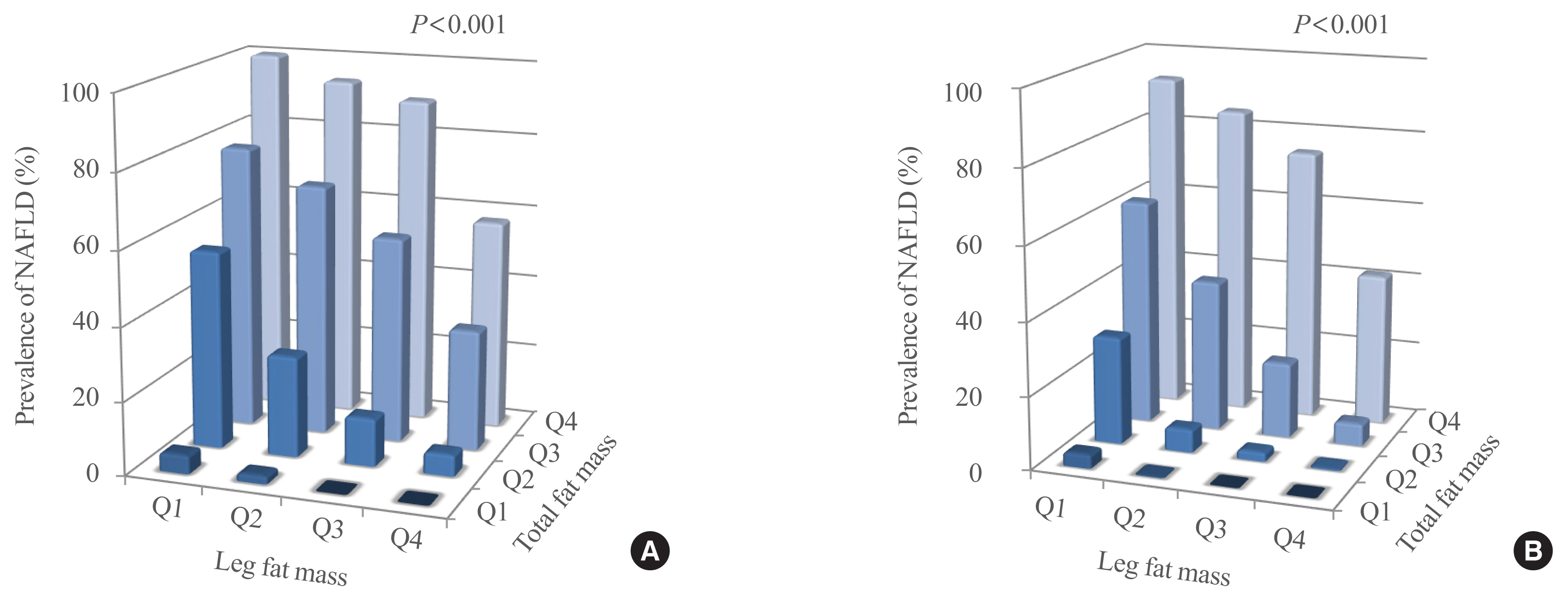
The leg fat to total fat (LF/TF) ratio showed a negative relationship with many factors, including body mass index, waist circumference, blood pressure, fasting blood glucose, and liver enzyme levels. When the LF/TF ratio and indices of hepatic steatosis were stratified by quartiles, the LF/TF ratio showed a negative correlation with the scoring systems that were used. The LF/TF ratio showed better accuracy in predicting NAFLD than total fat mass or leg fat mass alone. After adjusting for various traditional and lifestyle factors, a low LF/TF ratio remained a risk factor for NAFLD. Among NAFLD subjects, the LF/TF ratio showed a negative relationship with hepatic fibrosis.
Conclusion
A lower LF/TF ratio was markedly associated with a higher risk of hepatic steatosis and advanced hepatic fibrosis using various predictive models in a Korean population. Therefore, the LF/TF ratio could be a useful anthropometric parameter to predict NAFLD or advanced hepatic fibrosis. -
Citations
Citations to this article as recorded by
- Heterogeneous associations of regional adipose depots with liver fibrosis in U.S. adults
Kuan-Yu Lai, Chun-Yi Wang, Hsian-Han Kao, Wen-Yuan Lin, Tsung-Po Chen
Metabolism Open.2026; 30: 100461. CrossRef - Leg fat-to-total fat ratio improves waist-to-height ratio for discriminating metabolic syndrome: a nationwide cross-sectional study
Sena Hwang, Hyun Min Kim
Journal of Endocrinological Investigation.2026;[Epub] CrossRef - Low leg fat mass is associated with low insulin sensitivity, inflammatory markers, and β-cell dysfunction in non-obese Japanese people
Satomi Minato-Inokawa, Mari Honda, Ayaka Tsuboi-Kaji, Mika Takeuchi, Kaori Kitaoka, Miki Kurata, Bin Wu, Tsutomu Kazumi, Keisuke Fukuo
Scientific Reports.2025;[Epub] CrossRef - Body composition mediates the association between fatty acids and NAFLD risk: a prospective cohort study
Qishan Yang, Xinming Xu, Yue Chen, Zhicheng Zhang, Berty Ruping Song, Liang Sun, Xiang Gao
Journal of Health, Population and Nutrition.2025;[Epub] CrossRef - Waistline to thigh circumference ratio as a predictor of MAFLD: a health care worker study with 2-year follow-up
Xiaoyan Hao, Honghai He, Liyuan Tao, Wei Zhao, Peng Wang
BMC Gastroenterology.2024;[Epub] CrossRef - Regional fat distribution and hepatic fibrosis and steatosis severity in patients with nonalcoholic fatty liver disease and type 2 diabetes
Asieh Mansour, Saeed Pourhassan, Hadis Gerami, Mohammad Reza Mohajeri‐Tehrani, Marziye Salahshour, Ali Abbasi, Elham Madreseh, Sayed Mahmoud Sajjadi‐Jazi
Obesity Science & Practice.2024;[Epub] CrossRef - Insulin Resistance, Non-Alcoholic Fatty Liver Disease and Type 2 Diabetes Mellitus: Clinical and Experimental Perspective
Inha Jung, Dae-Jeong Koo, Won-Young Lee
Diabetes & Metabolism Journal.2024; 48(3): 327. CrossRef - Adipose tissue insulin resistance index was inversely associated with gluteofemoral fat and skeletal muscle mass in Japanese women
Satomi Minato-Inokawa, Mari Honda, Ayaka Tsuboi-Kaji, Mika Takeuchi, Kaori Kitaoka, Miki Kurata, Bin Wu, Tsutomu Kazumi, Keisuke Fukuo
Scientific Reports.2024;[Epub] CrossRef - A greater ratio of thigh subcutaneous fat to abdominal fat is associated with protection against non-alcoholic fatty liver disease
Yebei Liang, Peizhu Chen, Siyu Chen, Dan Liu, Fusong Jiang, Zhijun Zhu, Keqing Dong, Li Wei, Xuhong Hou
JHEP Reports.2023; 5(7): 100730. CrossRef - Association between Alcohol Consumption and Metabolic Dysfunction-Associated Steatotic Liver Disease Based on Alcohol Flushing Response in Men: The Korea National Health and Nutrition Examination Survey 2019–2021
Dae Eon Kang, Si Nae Oh
Nutrients.2023; 15(18): 3901. CrossRef
- Heterogeneous associations of regional adipose depots with liver fibrosis in U.S. adults
- Effects of B3-adrenergic Receptor Gene Mutation on the Body Fat Distribution and Weight Loss in Obese Subjects.
- Sung Kil Lim, Young Duk Song, Hyun Chul Lee, Kap Bum Huh, Kyung Rae Kim, Seok Won Park, Seok Joo Kwon, Eun Young Cho, Jong Ho Lee
- J Korean Endocr Soc. 1998;13(4):590-600. Published online January 1, 2001
- 2,009 View
- 19 Download
-
Abstract
PDF
- BACKGROUND
Recently, missense mutation of the B3-adrenergic receptor gene has been shown to be associated with early onset of type 2 diabetes, abdominal obesity and an increased capacity to gain weight. This study was performed to investigate the effects of Trp64Arg mutation in the B3-adrenergic receptor gene on body fat distribution and weight loss in obese subjects. METHODS: Determination of the B3-adrenergic receptor gene mutation with restriction enzyme digestion method, anthropometry, various biochemical studies, including oral glucose tolerance test were performed in 99 obese and 35 control subjects. Body fat distributions were also evaluated by computerized tomography before and after weight-reduction program. RESULTS: I) There were no differences in the frequencies of Trp64Arg mutation in the B3-adrenergic receptor gene between obese and control subjects (15.2 vs 12.9 %). 2) The obese subjects with Trp64Arg mutation had higher waist to hip circumference ratio(WHR) (0.93 +/- 0.05 vs 0.87 +/- 0.04, p<0.001), visceral fat area (115.0 +/- 25.9 vs 86.4 +/- 41.4 cm, p=0.01), but decreased plasma free fatty acid (618.0 +/- 163.1 vs 817.5 +/- 248.2 pEq/L, p=0.001), and triglyceride level (118.7 +/- 36.2 vs 158.4 +/- 105.8 mg/dL, p=0.015) than those without mutation. 3) The obese subjects with Trp64Arg mutation had smaller decreases in weight (-3.4 vs -5.1 kg, p<0.001), body fat content (-2.1 vs -3.8 %, p<0.001), WHR (-0.01 vs -0.03, p=0.025), and abdominal fat masses (total, subcutaneous, and visceral fat) after weight-reduction program than those without mutation. CONCLUSION: Trp64Arg mutation in the B3-adrenergic receptor gene might be one of genetic loci contributing to central obesity and a predictor of difficulty in losing weight in obese subjects.
 First
 Prev


