
 KES

Search
- Page Path
- HOME > Search
Original Articles
- Association of Multiple Obesity-Related Composite Indices with All-Cause Mortality in Patients with Stage 0–3 Cardiovascular-Kidney-Metabolic Syndrome
- Jianmin Lu, Jiajin Yang, Zhuoyi Peng, Cilu Huang, Yue Chen, Chuanzhao Zhang, Baohua Hou, Xiaoqing He, Shanzhou Huang
- Received October 14, 2025 Accepted December 31, 2025 Published online May 7, 2026
- DOI: https://doi.org/10.3803/EnM.2025.2711 [Epub ahead of print]

- 2,374 View
- 69 Download
-
 Abstract
 PDF
 Supplementary Material
 PubReader
 ePub
- Background
This study aimed to determine the predictive ability of eight composite obesity-related indices for all-cause mortality in adults with cardiovascular-kidney-metabolic (CKM) syndrome stages 0–3, given the inadequacy of conventional anthropometric measures.
Methods
We conducted a prospective cohort study using UK Biobank data, including 261,742 adults with CKM stages 0–3 at baseline. Eight indices (body mass index, relative fat mass [RFM], body roundness index [BRI], lipid accumulation product [LAP], visceral adiposity index, cardiometabolic index [CMI], atherogenic index of plasma, and triglyceride-glucose index) were evaluated using multivariable logistic regression, Cox proportional hazards models, receiver operating characteristic analysis, and restricted cubic spline (RCS) modeling to examine their associations with, and predictive ability for, all-cause mortality.
Results
During follow-up, 13,437 deaths (5.1%) occurred. All eight indices were positively associated with mortality (P<0.001). BRI was the strongest predictor (area under the curve [AUC]=0.658; optimal cutoff=4.515), outperforming LAP (AUC=0.616) and CMI (AUC=0.610). RFM exhibited the lowest discriminative ability (AUC=0.502). Higher quartiles of most indices were associated with progressively increased mortality risk, with BRI demonstrating consistent predictive value across subgroups in RCS analyses.
Conclusion
BRI showed the strongest and most consistent association with all-cause mortality in CKM stages 0–3, suggesting that it may act as a robust tool for early risk stratification and support targeted prevention strategies.

- Diabetes, obesity and metabolism
- Associations between Metabolic Syndrome Indicators and Colon Polyps: A Mendelian Randomization Study
- Dongya Chen, Hong Xu, Zhaolin Zhang, Fang Chen, Qingqing Lu, Feng Pan
- Endocrinol Metab. 2026;41(2):256-266. Published online January 22, 2026
- DOI: https://doi.org/10.3803/EnM.2025.2379

- 2,892 View
- 64 Download
-
Abstract
PDFSupplementary MaterialPubReader ePub
- Background
While observational studies have suggested a potential link between metabolic syndrome (MetS) and an increased risk of colon polyps, the causal nature of this association remains uncertain. This study used a two-sample Mendelian randomization (MR) approach to evaluate the relationship between MetS and colon polyps.
Methods
A two-sample MR analysis was performed using data on MetS, its indicators, and colon polyps obtained from publicly available genome-wide association studies in the Integrative Epidemiology Unit (IEU) and MAGIC databases. Outliers were removed using Mendelian Randomization Pleiotropy RESidual Sum and Outlier (MR-PRESSO), followed by MR calculations and false discovery rate (FDR) correction. The primary analysis was conducted with the inverse variance-weighted (IVW) method.
Results
The IVW results indicated no association between hypertension, hyperlipidemia, or diabetes and the risk of colon polyps. High-density lipoprotein cholesterol (HDL-C) (P=0.005), 2-hour glucose (P=0.004), glycated hemoglobin A1c (P=0.004), and the ratio of omega-6 to omega-3 fatty acids (P<0.001) were negatively associated with colon polyps. Conversely, body mass index (BMI) (P<0.001), body fat percentage (P=0.002), waist-to-hip ratio adjusted for BMI (P=0.001), total cholesterol (TC) (P=0.002), triglycerides (TG) (P<0.001), and both omega-3 (P<0.001) and omega-6 fatty acid levels (P=0.02) were positively associated with colon polyps. The relationships between these metabolic indicators and colon polyps remained significant after FDR correction.
Conclusion
Obesity-related traits, TC, and TG may increase the risk of colon polyps, while HDL-C may have a protective effect.
Brief Report
- Diabetes, obesity and metabolism
- From Anabolic to Reponic: Reclassifying Insulin’s Primary Metabolic Role
- Shelby Ford, Daniel Bryce, Joshua Moen
- Endocrinol Metab. 2026;41(1):185-189. Published online January 5, 2026
- DOI: https://doi.org/10.3803/EnM.2025.2558

- 2,795 View
- 44 Download
- 1 Crossref
-
Abstract
PDFPubReader ePub
- The classification of insulin as primarily an anabolic hormone is inconsistent with its metabolic signature of energy storage. This categorization, shared with anabolic hormones such as testosterone, obscures insulin’s role in the pathophysiology of metabolic disease. We propose a more precise classification: reponic, meaning ‘to store.’ To empirically support this framework, we analyzed data from 2,910 U.S. adults in the National Health and Nutrition Examination Survey 2011–2018. Higher insulin levels were strongly associated with increased central adiposity and dyslipidemia. In contrast, higher testosterone, particularly in males, was associated with a leaner phenotype, reflecting a metabolic profile antagonistic to insulin. These findings reinforce well-established physiology indicating that insulin’s primary role is energy storage. Adoption of the reponic classification provides a clearer conceptual framework for understanding hyperinsulinemia and its clinical consequences.
-
Citations
Citations to this article as recorded by
- Fasting insulin and the sarcopenic obesity phenotype in normoglycemic adults: a cross-sectional NHANES study (2011-2014)
Kalese Droge, Diana Nguyen, Shelby Ford, Joshua Moen
Obesity and Endocrinology.2026;[Epub] CrossRef
- Fasting insulin and the sarcopenic obesity phenotype in normoglycemic adults: a cross-sectional NHANES study (2011-2014)
Original Articles
- Thyroid
- Prevalence of Subclinical Hypothyroidism in a Non-Diabetic Young Female Population and Its Impact on Diabetes and Cardiometabolic Risk
- Nawoda Hewage, Udaya Wijesekara, Rasika Perera
- Endocrinol Metab. 2024;39(6):864-876. Published online November 5, 2024
- DOI: https://doi.org/10.3803/EnM.2024.2015

- 7,081 View
- 105 Download
- 4 Crossref
-
Abstract
PDFPubReader ePub
- Background
We evaluated the influence of subclinical hypothyroidism (SCH) on insulin resistance (IR), cardiometabolic risk, and obesity in childbearing-age women without diabetes.
Methods
This cross-sectional investigation included 282 women, aged 18 to 35 years, from rural and suburban Sri Lanka. Anthropometric and biochemical parameters, including IR and lipid/thyroid profiles, were recorded. Data were compared between SCH and euthyroidism (EU) for controls (normal weight) and cases (overweight/obese).
Results
The overall rates of SCH, EU, IR, and metabolic syndrome (MetS) were 40.42%, 59.57%, 73.40%, and 24.46%, respectively. Both controls and cases included individuals with SCH; overall, 168 participants (59.57%) had EU, while 114 (40.42%) exhibited SCH. IR was significantly associated with SCH in both weight groups (P<0.05). Among those with SCH, the odds ratios (ORs) for IR were >2 (95% confidence interval [CI], 0.45 to 3.87) in controls and >6 (95% CI, 3.52 to 8.41) in cases. Similarly, the ORs for MetS were >1 (95% CI, 0.38 to 4.16) in controls and >11 (95% CI, 8.73 to 15.01) in cases. Dyslipidemia and hypertriglyceridemia were significantly more prevalent in the SCH group (P<0.05). Women with SCH exhibited higher mean values for all obesity indices compared to their EU counterparts, surpassing normal thresholds (P<0.05). Among obesity measures, visceral adiposity index (VAI) demonstrated the highest area under the curve and sensitivity for assessing SCH and cardiovascular disease (CVD) risk.
Conclusion
SCH must be identified and managed in young women to help prevent diabetes and cardiometabolic disorders. VAI may aid in precisely detecting SCH and CVD. -
Citations
Citations to this article as recorded by- Cardiometabolic Outcomes and Levothyroxine Treatment Effects in Subclinical Hypothyroidism: A Systematic Review
Mohamed Abdelgadir Hag Elagib, Marwa A Alamin, Yousif Omer Amin Ahmed, Islam E Musa, Mona A Khaleifa, Elkhansaa A Elsamani, Hiba Najar, Asim Ahmed
Cureus.2026;[Epub] CrossRef - Endocrine–Metabolic Crosstalk Between Diabetes Mellitus and Hypothyroidism: From Network Mechanisms to Translational Stratification
Xiuqing Yang, Tao Jiang, Zhengkun Bao, Fengzhen Xu, Ke Zhang, Rongbing Chen, Lingchao Chen, Wenting Wang, Libo Jin, Da Sun, Xia Chen
The FASEB Journal.2026;[Epub] CrossRef - Increased Serum Lipopolysaccharide Levels are Related to a Higher Prevalent Risk of Subclinical Hypothyroidism
Xuan An, Xiaoyi Wang, Jin Zhang, Mingtong Xu, Muchao Wu, Suraiya Saleem
International Journal of Endocrinology.2025;[Epub] CrossRef - Incidence of Subclinical Hypothyroidism in Obese Adults and Its Metabolic Implications: A Prospective Cohort Study
Umer Jameel, Obaidullah Durrani, Ahmad Munib, Amanullah Khan
Cureus.2025;[Epub] CrossRef
- Cardiometabolic Outcomes and Levothyroxine Treatment Effects in Subclinical Hypothyroidism: A Systematic Review
- Diabetes, obesity and metabolism
Big Data Articles (National Health Insurance Service Database) - Long-Term Cumulative Exposure to High γ-Glutamyl Transferase Levels and the Risk of Cardiovascular Disease: A Nationwide Population-Based Cohort Study
- Han-Sang Baek, Bongseong Kim, Seung-Hwan Lee, Dong-Jun Lim, Hyuk-Sang Kwon, Sang-Ah Chang, Kyungdo Han, Jae-Seung Yun
- Endocrinol Metab. 2023;38(6):770-781. Published online November 6, 2023
- DOI: https://doi.org/10.3803/EnM.2023.1726
- 8,329 View
- 85 Download
- 10 Web of Science
- 9 Crossref
-
Abstract
PDFSupplementary MaterialPubReader ePub
- Background
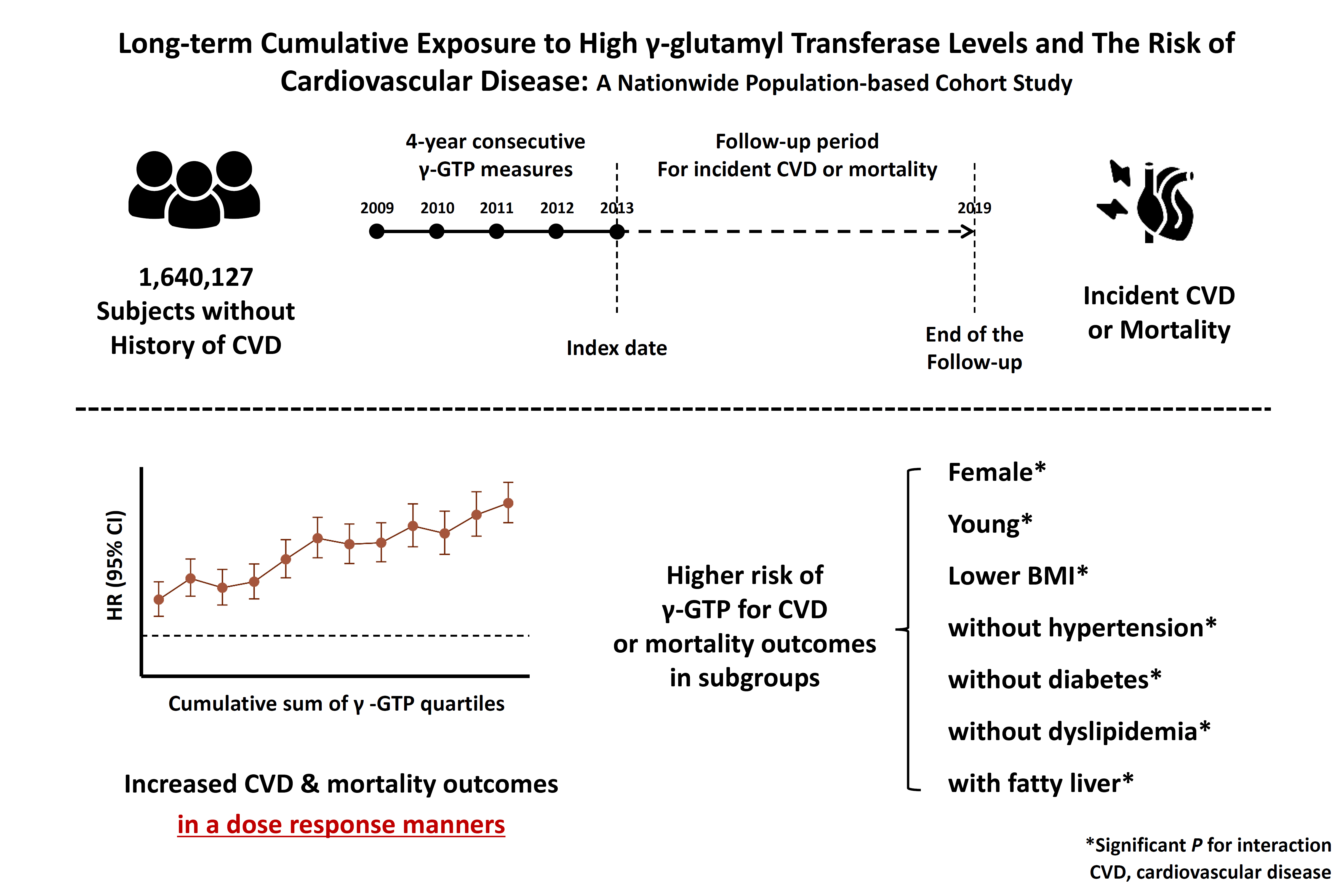
Elevated γ-glutamyl transferase (γ-GTP) levels are associated with metabolic syndrome. We investigated the association of cumulative exposure to high γ-GTP with the risk of cardiovascular disease (CVD) in a large-scale population.
Methods
Using nationally representative data from the Korean National Health Insurance system, 1,640,127 people with 4 years of consecutive γ-GTP measurements from 2009 to 2012 were included and followed up until the end of 2019. For each year of the study period, participants were grouped by the number of exposures to the highest γ-GTP quartile (0–4), and the sum of quartiles (0–12) was defined as cumulative γ-GTP exposure. The hazard ratio for CVD was evaluated using the Cox proportional hazards model.
Results
During the 6.4 years of follow-up, there were 15,980 cases (0.97%) of myocardial infarction (MI), 14,563 (0.89%) of stroke, 29,717 (1.81%) of CVD, and 25,916 (1.58%) of death. Persistent exposure to high γ-GTP levels was associated with higher risks of MI, stroke, CVD, and death than those without such exposure. The risks of MI, stroke, CVD, and mortality increased in a dose-dependent manner according to total cumulative γ-GTP (all P for trend <0.0001). Subjects younger than 65 years, with a body mass index <25 kg/m2, and without hypertension or fatty liver showed a stronger relationship between cumulative γ-GTP and the incidence of MI, CVD, and death.
Conclusion
Cumulative γ-GTP elevation is associated with CVD. γ-GTP could be more widely used as an early marker of CVD risk, especially in individuals without traditional CVD risk factors. -
Citations
Citations to this article as recorded by- Latent class analysis of association between occupational hazard factors and gamma-glutamyltransferase in automobile manufacturing workers: a cross-sectional study
Huixia Ji, Dandan Liu, Ye Chen
Frontiers in Public Health.2026;[Epub] CrossRef - Cardiovascular risk assessment using the DAS28-GGT score in rheumatoid arthritis patients initiating JAK inhibitors: Results from the MAJIK-SFR registry
Léa Perrot, Jerôme Avouac, Marie-Elise Truchetet, Clément Prati, Jean Hugues Salmon, René Marc Flipo, Christian Roux, André Basch, Emmanuelle Dernis, Carine Salliot, Fabienne Coury, Claire Immediato Daien, Philipe Goupille, Thierry Thomas, Béatrice Bannev
Joint Bone Spine.2026; 93(6): 106113. CrossRef - Association between gamma-glutamyl transferase and risk of major adverse cardiovascular events in patients with hypertrophic cardiomyopathy: a retrospective cohort study
Meng Yao, Xiaoyin Xing, Zhe Chen, Cunying Cui, Xinqiao Tian
Frontiers in Cardiovascular Medicine.2026;[Epub] CrossRef - Elevated White Blood Cell Counts Despite Normal C-Reactive Protein Independently Predict Metabolic Syndrome and Myocardial Infarction: Evidence for Genetic Susceptibility and Dietary Modification in a Prospective Cohort
In Seok Bang, Sunmin Park
Nutrients.2026; 18(18): 3040. CrossRef - Association of Serum Gamma-Glutamyltransferase with In-hospital Heart Failure in Patients with ST-segment Elevation Myocardial Infarction Undergoing Primary Percutaneous Coronary Intervention
An-Cheng Hou, Jian-Tong Hou, Wei-Ning Zhou, Yan-Jin Wei, Zhi-Hong Ou, Cun-Fei Liu
Reviews in Cardiovascular Medicine.2025;[Epub] CrossRef - The J-shaped relationship between the gamma-glutamyltransferase to high-density lipoprotein cholesterol ratio and mortality risk in U.S. adults
Shujuan Qiu, Chunlei Li, Zhentao Guo
Preventive Medicine Reports.2025; 52: 102958. CrossRef - Association between the levels of gamma-glutamyl transpeptidase and the risk of stroke: systematic review and meta-analysis
Gustavo Adolfo Vásquez-Tirado, Stefany M. Nieto-Rivera, Claudia Vanessa Quispe-Castañeda, Edinson Dante Meregildo-Rodríguez, Leslie Jacqueline Liñán-Díaz, Wilson Marcial Guzmán-Aguilar
Arquivos de Neuro-Psiquiatria.2025; 83(07): 001. CrossRef - Serum gamma-glutamyl transferase level is associated with the risk of pancreatic cystic neoplasms: A nationwide retrospective cohort study
Min Woo Lee, Jin Myung Park, In Rae Cho, Kwang Hyun Chung, Bong Seong Kim, Jin Ho Choi, Woo Hyun Paik, Ji Kon Ryu, Kyungdo Han, Sang Hyub Lee
World Journal of Gastroenterology.2025;[Epub] CrossRef - Interplay of serum biomarkers bilirubin and γ-glutamyltranspeptidase in predicting cardiovascular complications in type-2 diabetes mellitus
Ebtesam Abdullah Al-Suhaimi, Abdullah Ahmed Al-Rubaish
World Journal of Diabetes.2024; 15(6): 1074. CrossRef
- Latent class analysis of association between occupational hazard factors and gamma-glutamyltransferase in automobile manufacturing workers: a cross-sectional study
- Diabetes, Obesity and Metabolism
- Association of Shift Work with Normal-Weight Obesity in Community-Dwelling Adults
- Chul Woo Ahn, Sungjae Shin, Seunghyun Lee, Hye-Sun Park, Namki Hong, Yumie Rhee
- Endocrinol Metab. 2022;37(5):781-790. Published online October 25, 2022
- DOI: https://doi.org/10.3803/EnM.2022.1532
- 11,256 View
- 244 Download
- 9 Web of Science
- 10 Crossref
-
Abstract
PDFSupplementary MaterialPubReader ePub
- Background
Shift work is associated with obesity and metabolic syndrome. However, this association in the normal-weight population remains unclear. This study aimed to investigate whether shift work is associated with normal-weight obesity (NWO).
Methods
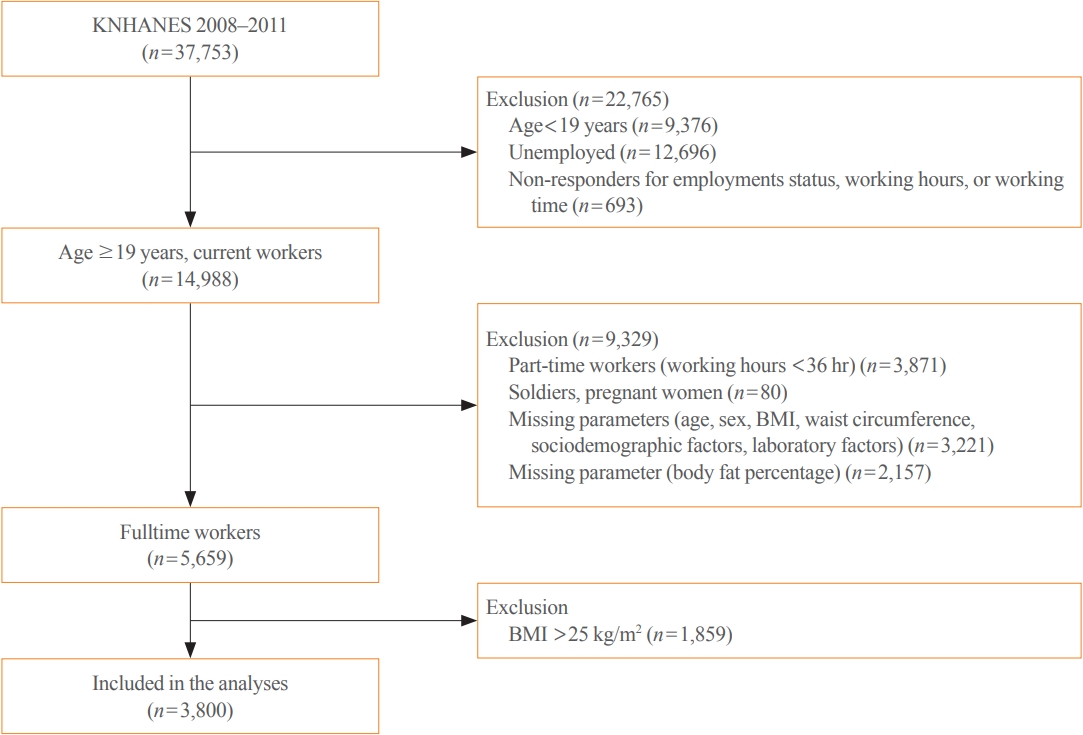
From the nationally representative Korea National Health and Nutrition Examination Survey (KNHANES) dataset (2008 to 2011), 3,800 full-time workers aged ≥19 years with a body mass index (BMI) ≤25 kg/m2 were analysed. We defined NWO as BMI ≤25 kg/m2 and body fat percentage ≥25% in men and ≥37% in women. Working patterns were classified into “daytime,” “other than daytime,” and “shift.” Multivariable logistic regression analysis was performed to evaluate the relationship between shift work and NWO.
Results
Shift work was associated with higher odds of NWO than daytime work (adjusted odds ratio [aOR], 1.47; 95% confidence interval [CI], 1.04 to 2.09) and night/evening work (aOR, 1.87; 95% CI, 1.11 to 3.14) after adjustment for type of work, working hours, age, sex, BMI, 25-hydroxyvitamin D levels, homeostatic model assessment for insulin resistance, and other sociodemographic factors. In subgroup analyses, the association between shift work and NWO was more robust in those aged ≥60 years and those working ≥56 hours/week.
Conclusion
Shift work was associated with NWO in community-dwelling Korean adults, independent of age, sex, BMI, and other covariates. -
Citations
Citations to this article as recorded by- Modifiable risk factors for cardiovascular diseases in aviation and prospects for their correction
E. E. Adeninskaya, N. B. Zabrodina, B. G. Potievsky, A. Y. Bushmanov, A. V. Dorofeev
Science and Innovations in Medicine.2026; 11(3): 185. CrossRef - Work-Related Factors, Sleep Problems, and Metabolic Syndrome among Taiwanese Workers: Sex-Specific Implications for Occupational Health Nursing
Ching Wen Hu, Yi Ching Tsai, Kuan Pin Lin
Advances in Nursing Science.2026; 49(4S): S31. CrossRef - Investigating the Risk of Obesity in European Night Shift Workers: A Study Protocol for Cross-Sectional and Mechanistic Studies in the SHIFT2HEALTH Project
Katrin Scionti, Vanessa Schoissengeier, Ivana Vaclavkova, Hella Fleiss, Catalina Cuparencu, Annemarie Olsen, Hannah Jilani, Desiree A. Lucassen, Emilie de Zoete, Edith Feskens, Hendriek C. Boshuizen, Monique H. Vingerhoeds, Meeke Ummels, Sandra Haider, Ev
Obesity Facts.2026; : 1. CrossRef - The research progress and prospects of circadian rhythm in obesity: a bibliometric analysis
Ye Dou, Xiaojin Guo, Xuefei Wang, Aolong He, Fanghe Li, Kuo Gao
Frontiers in Nutrition.2025;[Epub] CrossRef - Normal Weight Obesity Overview and Update: A narrative review
Antonino De Lorenzo, Paola Gualtieri, Giulia Frank, Roselisa Palma, Rossella Cianci, Leonardo Romano, Lucilla Ciancarella, Glauco Raffaelli, Laura Di Renzo
Current Obesity Reports.2025;[Epub] CrossRef - Development and interpretation of a machine learning predictive model for early cognitive impairment in hypertension associated with environmental factors
Xia Zhong, Tianen Zhao, Shimeng Lv, Guangheng Zhang, Jing Li, Donghai Liu, Huachen Jiao
Frontiers in Cardiovascular Medicine.2025;[Epub] CrossRef - Association of Shift Work, Sociodemographic Variables and Healthy Habits with Obesity Scales
Javier Tosoratto, Pedro Juan Tárraga López, Ángel Arturo López-González, Daniela Vallejos, Emilio Martínez-Almoyna Rifá, José Ignacio Ramirez-Manent
Life.2024; 14(11): 1503. CrossRef - Impaired Melatonin Secretion, Oxidative Stress and Metabolic Syndrome in Night Shift Work
Sorina Hohor, Cristina Mandanach, Andreea Maftei, Corina Aurelia Zugravu, Marina Ruxandra Oțelea
Antioxidants.2023; 12(4): 959. CrossRef - Normal-Weight Obesity and Metabolic Syndrome in Korean Adults: A Population-Based Cross-Sectional Study
Jeonghyeon Kim, Seamon Kang, Hyunsik Kang
Healthcare.2023; 11(16): 2303. CrossRef - You Can’t Avoid Shift Work? Then Focus on Body Fat Rather than Weight
Eun Kyung Lee
Endocrinology and Metabolism.2022; 37(5): 756. CrossRef
- Modifiable risk factors for cardiovascular diseases in aviation and prospects for their correction
- Diabetes, Obesity and Metabolism
- High Cardiorespiratory Fitness Protects against Molecular Impairments of Metabolism, Heart, and Brain with Higher Efficacy in Obesity-Induced Premature Aging
- Patcharapong Pantiya, Chanisa Thonusin, Natticha Sumneang, Benjamin Ongnok, Titikorn Chunchai, Sasiwan Kerdphoo, Thidarat Jaiwongkam, Busarin Arunsak, Natthaphat Siri-Angkul, Sirawit Sriwichaiin, Nipon Chattipakorn, Siriporn C. Chattipakorn
- Endocrinol Metab. 2022;37(4):630-640. Published online August 5, 2022
- DOI: https://doi.org/10.3803/EnM.2022.1430
- Correction in: Endocrinol Metab 2025;40(4):657
- 9,778 View
- 143 Download
- 6 Web of Science
- 6 Crossref
-
Abstract
PDFSupplementary MaterialPubReader ePub
- Background
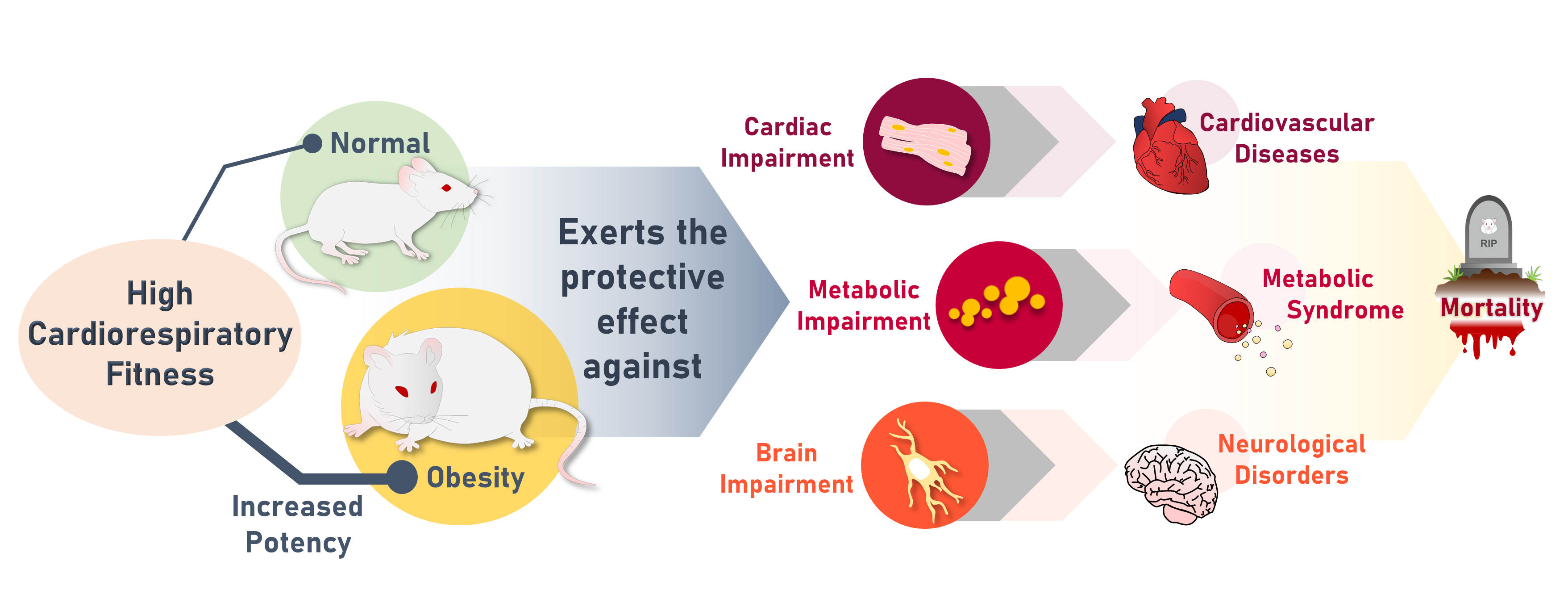
High cardiorespiratory fitness (CRF) protects against age-related diseases. However, the mechanisms mediating the protective effect of high intrinsic CRF against metabolic, cardiac, and brain impairments in non-obese versus obese conditions remain incompletely understood. We aimed to identify the mechanisms through which high intrinsic CRF protects against metabolic, cardiac, and brain impairments in non-obese versus obese untrained rats.
Methods
Seven-week-old male Wistar rats were divided into two groups (n=8 per group) to receive either a normal diet or a highfat diet (HFD). At weeks 12 and 28, CRF, carbohydrate and fatty acid oxidation, cardiac function, and metabolic parameters were evaluated. At week 28, behavior tests were performed. At the end of week 28, rats were euthanized to collect heart and brain samples for molecular studies.
Results
The obese rats exhibited higher values for aging-related parameters than the non-obese rats, indicating that they experienced obesity-induced premature aging. High baseline CRF levels were positively correlated with several favorable metabolic, cardiac, and brain parameters at follow-up. Specifically, the protective effects of high CRF against metabolic, cardiac, and brain impairments were mediated by the modulation of body weight and composition, the lipid profile, substrate oxidation, mitochondrial function, insulin signaling, autophagy, apoptosis, inflammation, oxidative stress, cardiac function, neurogenesis, blood-brain barrier, synaptic function, accumulation of Alzheimer’s disease-related proteins, and cognition. Interestingly, this effect was more obvious in HFD-fed rats.
Conclusion
The protective effect of high CRF is mediated by the modulation of several mechanisms. These effects exhibit greater efficacy under conditions of obesity-induced premature aging. -
Citations
Citations to this article as recorded by- Probiotic Lactobacillus reuteri KUB-AC5 provides cardioprotection via mitigating cardiac mitochondrial dysfunction in obese rats
Chanisa Thonusin, Titikorn Chunchai, Parameth Thiennimitr, Chayodom Maneechote, Chanon Kunasol, Jirapas Sripetchwandee, Siriporn C Chattipakorn, Nipon Chattipakorn
Journal of Endocrinology.2026;[Epub] CrossRef - The associations of diet quality and cardiometabolic indicators in children and the mediation role of cardiorespiratory fitness
Ping-Ping Zhang, Gao-Feng Lin, Jia-Ying Gu, Bi-Lian Wang, Jie Zhang, Ye Zhou, Miao Xu, Hui Wang, Li Li
Frontiers in Nutrition.2025;[Epub] CrossRef - Osteoprotective effects of lifestyle interventions against obesity-induced bone dyshomeostasis and bone loss in rats
Napatsorn Imerb, Patcharapong Pantiya, Chanisa Thonusin, Krittikan Chanpaisaeng, Nipon Chattipakorn, Narattaphol Charoenphandhu, Siriporn C Chattipakorn
Journal of Endocrinology.2025;[Epub] CrossRef - Associations that Cardiorespiratory Fitness and Body Mass Index Loss Have with Deficit Accumulation Frailty
KAYLONI OLSON, DENISE K. HOUSTON, JOHNATHAN ROSS, RENA R. WING, FELICIA R. SIMPSON, AMBARISH PANDEY, MICHAEL P. WALKUP, MIA YANG, MARK A. ESPELAND
Medicine & Science in Sports & Exercise.2024; 56(4): 717. CrossRef - Interplay between obesity and aging on myocardial geometry and function: Role of leptin-STAT3-stress signaling
Wei Jin, Fei Tu, Feng Dong, Qinqin Deng, Miyesaier Abudureyimu, Wei Yu, Guo-jun Cai, Jian-ming Pei, Zhaohui Pei, Jun Ren
Biochimica et Biophysica Acta (BBA) - General Subjects.2023; 1867(2): 130281. CrossRef - Epidemiological, mechanistic, and practical bases for assessment of cardiorespiratory fitness and muscle status in adults in healthcare settings
Jaime A. Gallo-Villegas, Juan C. Calderón
European Journal of Applied Physiology.2023; 123(5): 945. CrossRef
- Probiotic Lactobacillus reuteri KUB-AC5 provides cardioprotection via mitigating cardiac mitochondrial dysfunction in obese rats
- Diabetes, Obesity and Metabolism
- Prognostic Value of Triglyceride and Glucose Index for Incident Type 2 Diabetes beyond Metabolic Health and Obesity
- Hwi Seung Kim, Jiwoo Lee, Yun Kyung Cho, Eun Hee Kim, Min Jung Lee, Hong-Kyu Kim, Joong-Yeol Park, Woo Je Lee, Chang Hee Jung
- Endocrinol Metab. 2021;36(5):1042-1054. Published online October 21, 2021
- DOI: https://doi.org/10.3803/EnM.2021.1184
- 12,286 View
- 167 Download
- 5 Web of Science
- 5 Crossref
-
Abstract
PDFSupplementary MaterialPubReader ePub
- Background
Metabolically healthy obese (MHO) phenotype is metabolically heterogeneous in terms of type 2 diabetes (T2D). Previously, the triglyceride and glucose (TyG) index has been considered for identifying metabolic health and future risk of T2D. This study aimed to evaluate the risk of incident T2D according to obesity status and metabolic health, categorized by four different criteria and the TyG index.
Methods
The study included 39,418 Koreans without T2D at baseline. The risk of T2D was evaluated based on four different definitions of metabolic health and obesity status and according to the baseline TyG index within each metabolic health and obesity group.
Results
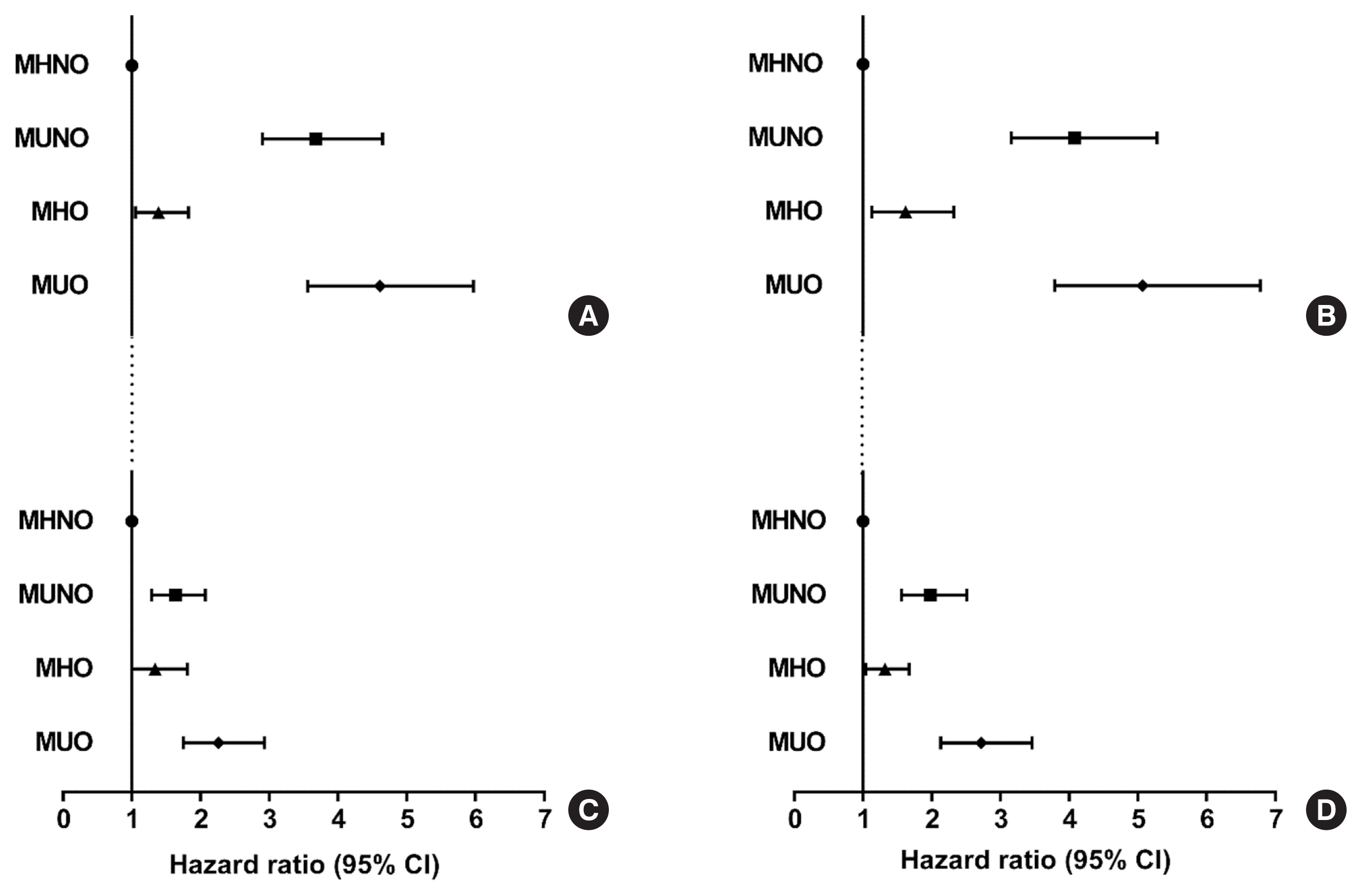
During the median follow-up at 38.1 months, 726 individuals developed T2D. Compared with the metabolically healthy non-obese (MHNO) group with low TyG index, the MHO group with high TyG index showed increased risk of T2D in all four definitions of metabolic health with multivariate-adjusted hazard ratios of 2.57 (95% confidence interval [CI], 1.76 to 3.75), 3.72 (95% CI, 2.15 to 6.43), 4.13 (95% CI, 2.67 to 6.38), and 3.05 (95% CI, 2.24 to 4.15), when defined by Adult Treatment Panel III, Wildman, Karelis, and homeostasis model assessment (HOMA) criteria, respectively.
Conclusion
MHO subjects with high TyG index were at an increased risk of developing T2D compared with MHNO subjects, regardless of the definition of metabolic health. TyG index may serve as an additional factor for predicting the individual risk of incident T2D in MHO subjects. -
Citations
Citations to this article as recorded by- Relationship between obesity and the triglyceride–glucose index in adults: A systematic review
Yury Rosales-Ricardo
Revista Española de Nutrición Humana y Dietética.2026;[Epub] CrossRef - Bridging the gap in obesity research: A consensus statement from the European Society for Clinical Investigation
Federico Carbone, Jean‐Pierre Després, John P. A. Ioannidis, Ian J. Neeland, Gabriella Garruti, Luca Busetto, Luca Liberale, Stefano Ministrini, Gemma Vilahur, Thomas H. Schindler, Maria Paula Macedo, Agostino Di Ciaula, Marcin Krawczyk, Andreas Geier, Gy
European Journal of Clinical Investigation.2025;[Epub] CrossRef - Association between triglyceride-glucose index and depression in patients with type 2 diabetes: A cross-sectional study from NHANES
Jiaju Ren, Cheng Lv, Jia Wang
Medicine.2024; 103(32): e39258. CrossRef - Ling-gui-zhu-gan promotes adipocytes browning via targeting the miR-27b/PRDM16 pathway in 3T3-L1 cells
Zimengwei Ye, Yi Zhao, Yanjing Cui, Bingrui Xu, Fan Wang, Dandan Zhao, Guangtong Dong, Zhufeng Wang, Rui Wu
Frontiers in Pharmacology.2024;[Epub] CrossRef - Insight into the Predictive Power of Surrogate Diagnostic Indices for
Identifying Individuals with Metabolic Syndrome
Shaghayegh Hosseinkhani, Katayoon Forouzanfar, Nastaran Hadizadeh, Farideh Razi, Somayeh Darzi, Fatemeh Bandarian
Endocrine, Metabolic & Immune Disorders - Drug Targets.2024; 24(11): 1291. CrossRef
- Relationship between obesity and the triglyceride–glucose index in adults: A systematic review
- Diabetes, Obesity and Metabolism
- Musclin Is Related to Insulin Resistance and Body Composition, but Not to Body Mass Index or Cardiorespiratory Capacity in Adults
- Yeliana L. Sánchez, Manuela Yepes-Calderón, Luis Valbuena, Andrés F. Milán, María C. Trillos-Almanza, Sergio Granados, Miguel Peña, Mauricio Estrada-Castrillón, Juan C. Aristizábal, Raúl Narvez-Sanchez, Jaime Gallo-Villegas, Juan C. Calderón
- Endocrinol Metab. 2021;36(5):1055-1068. Published online October 21, 2021
- DOI: https://doi.org/10.3803/EnM.2021.1104
- 12,921 View
- 165 Download
- 18 Web of Science
- 20 Crossref
-
Abstract
PDFPubReader ePub
- Background
We studied whether musclin function in humans is related to glycemic control, body composition, and cardiorespiratory capacity.
Methods
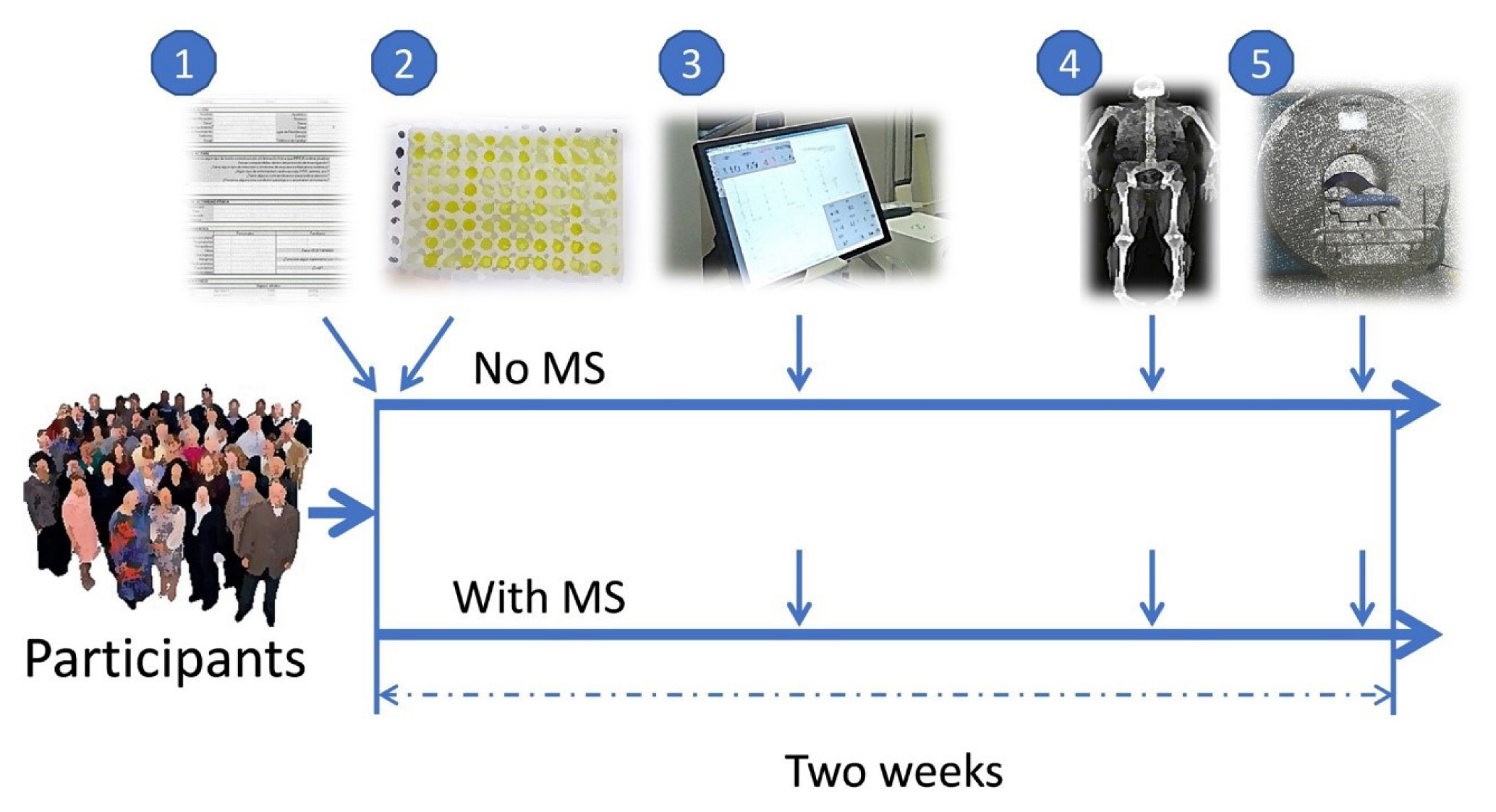
A cross-sectional study was performed in sedentary adults with or without metabolic syndrome (MS). Serum musclin was measured by enzyme-linked immunosorbent assay. Insulin resistance (IR) was evaluated by the homeostatic model assessment (HOMA-IR). Body composition was determined by dual-energy X-ray absorptiometry and muscle composition by measuring carnosine in the thigh, a surrogate of fiber types, through proton magnetic resonance spectroscopy. Cardiorespiratory capacity was assessed through direct ergospirometry.
Results
The control (n=29) and MS (n=61) groups were comparable in age (51.5±6.5 years old vs. 50.7±6.1 years old), sex (72.4% vs. 70.5% women), total lean mass (58.5%±7.4% vs. 57.3%±6.8%), and peak oxygen consumption (VOpeak) (31.0±5.8 mL O2./kg.min vs. 29.2±6.3 mL O2/kg.min). Individuals with MS had higher body mass index (BMI) (30.6±4.0 kg/m2 vs. 27.4± 3.6 kg/m2), HOMA-IR (3.5 [95% confidence interval, CI, 2.9 to 4.6] vs. 1.7 [95% CI, 1.1 to 2.0]), and musclin (206.7 pg/mL [95% CI, 122.7 to 387.8] vs. 111.1 pg/mL [95% CI, 63.2 to 218.5]) values than controls (P˂0.05). Musclin showed a significant relationship with HOMA-IR (β=0.23; 95% CI, 0.12 to 0.33; P˂0.01), but not with VOpeak, in multiple linear regression models adjusted for age, sex, fat mass, lean mass, and physical activity. Musclin was significantly associated with insulin, glycemia, visceral fat, and regional muscle mass, but not with BMI, VCO2peak, maximum heart rate, maximum time of work, or carnosine.
Conclusion
In humans, musclin positively correlates with insulinemia, IR, and a body composition profile with high visceral adiposity and lean mass, but low body fat percentage. Musclin is not related to BMI or cardiorespiratory capacity. -
Citations
Citations to this article as recorded by- The myokine musclin in metabolic syndrome: Pathological links and exercise interventions
Ruiming Wen, Yuan Yang, Haixia Wang, Yikun Teng, Bing Zhao, Hanxiao Zhu, Songtao Wang
iScience.2026; 29(1): 114367. CrossRef - LMS-based continuous reference values for the myokine musclin in serum in children and adults
Anne Schön, Hannah Weber, Katharina Schermuly, Anna Tschirner, Malgorzata Szaroszyk, Thomas Rebe, Jens Drube, Nele Kanzelmeyer, Ulrich Baumann, Anibh M. Das, Dieter Haffner, Maren Leifheit-Nestler
Frontiers in Endocrinology.2026;[Epub] CrossRef - Exercise-induced musclin enhances efferocytosis via metabolic reprogramming to alleviate periprosthetic joint infection
Zhiwei Fu, Jintao Wu, Shutao Zhang, Juyang Jiao, Qimin Hong, Yihan Wang, Liangjun Zheng, Xinhua Qu, Bing Yue
Journal of Sport and Health Science.2026; 15: 101143. CrossRef - Natriuretic peptide receptor C in cardiovascular–kidney–liver–metabolic syndrome: from natriuretic peptide deficiency to direct tissue signaling?
Matteo Landolfo, Francesco Spannella, Chiara Salvà, Bernhard Radlinger, Susanne Kaser, Alessandro Gezzi, Riccardo Sarzani
Reviews in Endocrine and Metabolic Disorders.2026; 27(5): 1091. CrossRef - Exerkines in precision management of metabolic diseases
Leigang Jin, Yifen Lin, Yixuan Zheng, Anli Wang, Peng Liao, Yucheng Luo, Zhongheng Sui, Xiayun Ni, Jianan Zhang, Qing Shen, Aimin Xu
Chinese Medical Journal.2026; 139(19): 2885. CrossRef - Preoperative Circulating Musclin as a Candidate Biomarker of Postoperative Skeletal Muscle Vulnerability in Colorectal Cancer
YuSik Kim, Ji Sun Nam, Su-Jin Shin, Younghyun Kim, Jeonghyun Kang, Chul Woo Ahn
European Journal of Surgical Oncology.2026; : 112208. CrossRef - Myokines and mitochondrial function in cardiometabolic diseases
Jairo E. Saavedra, Jaime Gallo-Villegas, Juan C. Calderón
Journal of Physiology and Biochemistry.2026;[Epub] CrossRef - Dynamic Response of Musclin, a Myokine, to Aerobic Exercise and Its Interplay With Natriuretic Peptides and Receptor C
Ji Sun Nam, Eun-Suk Cho, Yu Rim Kwon, Jong Suk Park, YuSik Kim
The Journal of Clinical Endocrinology & Metabolism.2025; 110(5): 1305. CrossRef - Relationship between myostatin, musclin, nutritional status, and functionality in older Colombian community-dwelling adults: A cross-sectional study
Nancy Marulanda-Díaz, Alejandro Estrada-Restrepo, Andrés F. Milán, Raul Narvaez-Sanchez, Juan C. Calderón, Nubia A. Giraldo-Giraldo
Nutrition.2025; 135: 112767. CrossRef - Response to Letter to the Editor From Prickett and Espiner: “Dynamic Response of Musclin, a Myokine, to Aerobic Exercise and Its Interplay With Natriuretic Peptides and Receptor C”
YuSik Kim
The Journal of Clinical Endocrinology & Metabolism.2025; 110(5): e1716. CrossRef - Myonectin and metabolic health: a systematic review
Jorge L. Petro, Jaime Gallo-Villegas, Juan C. Calderón
Frontiers in Endocrinology.2025;[Epub] CrossRef - Myokine-mediated muscle-organ interactions: Molecular mechanisms and clinical significance
Jia Yi, Junyang Chen, Xinlei Yao, Zihao Zhao, Xinxin Niu, Xia Li, Jiacheng Sun, Yanan Ji, Tongxin Shang, Leilei Gong, Bingqian Chen, Hualin Sun
Biochemical Pharmacology.2025; 242: 117326. CrossRef - Musclin Mitigates the Attachment of HUVECs to THP-1 Monocytes in Hyperlipidemic Conditions through PPARα/HO-1-Mediated Attenuation of Inflammation
Wonjun Cho, Heeseung Oh, Sung Woo Choi, A. M. Abd El-Aty, Fatma Yeşilyurt, Ji Hoon Jeong, Tae Woo Jung
Inflammation.2024; 47(1): 1. CrossRef - Glucose restriction enhances oxidative fiber formation: A multi-omic signal network involving AMPK and CaMK2
Kaiyi Zhang, Ning Xie, Huaqiong Ye, Jiakun Miao, Boce Xia, Yu Yang, Huanqi Peng, Shuang Xu, Tianwen Wu, Cong Tao, Jinxue Ruan, Yanfang Wang, Shulin Yang
iScience.2024; 27(1): 108590. CrossRef - Myokines: metabolic regulation in obesity and type 2 diabetes
Zhi-Tian Chen, Zhi-Xuan Weng, Jiandie D Lin, Zhuo-Xian Meng
Life Metabolism.2024;[Epub] CrossRef - Epidemiological, mechanistic, and practical bases for assessment of cardiorespiratory fitness and muscle status in adults in healthcare settings
Jaime A. Gallo-Villegas, Juan C. Calderón
European Journal of Applied Physiology.2023; 123(5): 945. CrossRef - Serum Levels of Myonectin Are Lower in Adults with Metabolic Syndrome and Are Negatively Correlated with Android Fat Mass
Jorge L. Petro, María Carolina Fragozo-Ramos, Andrés F. Milán, Juan C. Aristizabal, Jaime A. Gallo-Villegas, Juan C. Calderón
International Journal of Molecular Sciences.2023; 24(8): 6874. CrossRef - The correlation of serum musclin with diabetic nephropathy
Jie Zhang, Jing Shi, Zengguang Cheng, Wenchao Hu
Cytokine.2023; 167: 156211. CrossRef - Efficacy of high-intensity interval- or continuous aerobic-training on insulin resistance and muscle function in adults with metabolic syndrome: a clinical trial
Jaime Gallo-Villegas, Leonardo A. Castro-Valencia, Laura Pérez, Daniel Restrepo, Oscar Guerrero, Sergio Cardona, Yeliana L. Sánchez, Manuela Yepes-Calderón, Luis H. Valbuena, Miguel Peña, Andrés F. Milán, Maria C. Trillos-Almanza, Sergio Granados, Juan C.
European Journal of Applied Physiology.2022; 122(2): 331. CrossRef - Reactive Oxygen and Nitrogen Species (RONS) and Cytokines—Myokines Involved in Glucose Uptake and Insulin Resistance in Skeletal Muscle
Paola Llanos, Jesus Palomero
Cells.2022; 11(24): 4008. CrossRef
- The myokine musclin in metabolic syndrome: Pathological links and exercise interventions
- Adrenal Gland
- Lipid Profiles in Primary Aldosteronism Compared with Essential Hypertension: Propensity-Score Matching Study
- Sun Joon Moon, Han Na Jang, Jung Hee Kim, Min Kyong Moon
- Endocrinol Metab. 2021;36(4):885-894. Published online August 10, 2021
- DOI: https://doi.org/10.3803/EnM.2021.1012
- 8,255 View
- 167 Download
- 12 Web of Science
- 12 Crossref
-
Abstract
PDFSupplementary MaterialPubReader ePub
- Background
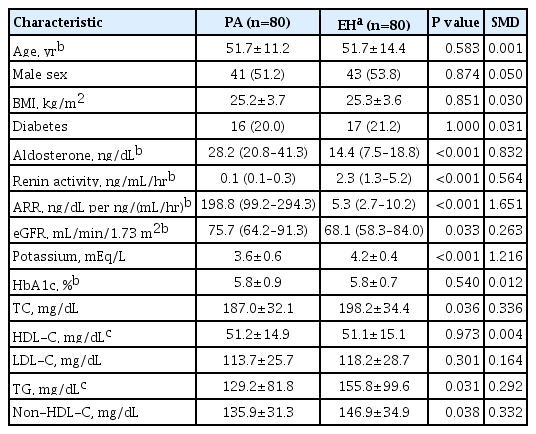
There has been controversy regarding the association between primary aldosteronism (PA) and dyslipidemia and few studies considered the effects of diabetes and renal function on lipid metabolism. We analyzed lipid profiles of PA patients and compared them to propensity-score (PS)-matched essential hypertension (EH) patients adjusting for glycemic status and renal function.
Methods
Patients who were diagnosed with PA using a saline-infusion test at Seoul National University Hospital from 2000 to 2018 were retrospectively analyzed. EH patients who had aldosterone-renin ratio (ARR) results were selected as controls. Covariates, including diabetes, were PS-matched for patients with PA, lateralized PA, non-lateralized PA, and high ARR to EH patients, respectively.
Results
Among a total of 80 PA and 80 EH patients, total cholesterol (TC) and triglyceride (TG) levels were significantly lower in the PA patients than in the EH patients (least-squares mean±standard error: 185.5±4.4 mg/dL vs. 196.2±4.4 mg/dL, P=0.047, for TC; and 132.3±11.5 mg/dL vs. 157.4±11.4 mg/dL, P=0.035, for TG) in fully adjusted model (adjusting for multiple covariates, including diabetes status, glycosylated hemoglobin level, and estimated glomerular filtration rate). There were no significant differences in high-density lipoprotein cholesterol (HDL-C) and low-density lipoprotein cholesterol levels between the two groups. According to increments in aldosterone levels, an increasing tendency of HDL-C and decreasing tendencies of TG and non-HDL-C were observed.
Conclusion
PA patients had lower TC and TG levels than EH patients, independent of glycemic status and renal function. -
Citations
Citations to this article as recorded by- DPA/AA ratio as a potential biomarker of primary aldosteronism in young and middle-aged adults
Wenli Xie, Runlong Lin, Yawen Meng, Lu Zhang, Zhi Zheng, Lijiao Zhang
Frontiers in Endocrinology.2026;[Epub] CrossRef - Lipid Profile in Primary Aldosteronism: Cross‐Sectional and Post‐Treatment Analyses
Meriem Yazidi, Arige Abid, Chayma Bel hadj Sliman, Elyes Kamoun, Ibtissem Oueslati, Fatma Chaker, Nadia Khessairi, Melika Chihaoui
Lipids.2026; 61(4): 527. CrossRef - Integrative Analysis of Metabolomic and Transcriptomic Data Reveals Metabolic Signatures and Major Metabolic Pathways in Primary Aldosteronism
Xiaomei Lai, Tingting Yang, Chaoping Wei, Shuangbei Zhu, Jianling Li
Endocrine, Metabolic & Immune Disorders - Drug Targets.2026;[Epub] CrossRef - Targeting cholesterol-dependent adrenal steroidogenesis for management of primary aldosteronism
Hao Wu, Hongbo He, Tong Han, Xiaoyu Tian, Zhiming Zhu
Trends in Endocrinology & Metabolism.2025; 36(9): 789. CrossRef - The association between aldosterone and lipid profiles in patients with primary aldosteronism
Ning-Peng Liang, Kun-Rui Rao, Ming Hu, Ru-Yi Bao, Jian-Wei Liu, Ze-Qun Lai, Hong-Jin Zhang, Huang Zhang, Meng-Bo Wu, Xiang-Tao Zhang, Yi-Fei Dong
Scientific Reports.2025;[Epub] CrossRef - Association of Plasma Aldosterone Concentration With Early Renal Injury Biomarkers in Primary Aldosteronism: A Propensity‐Matched Comparative Study
Hai‐Long Liu, Qing‐Tian Zeng, Yuan‐Yuan Xu, Xiang‐Tao Zhang, Ning Li, Ning‐Peng Liang, Yi‐Fei Dong
The Journal of Clinical Hypertension.2025;[Epub] CrossRef - Diagnostic Accuracy of 24‐Hour Urinary Aldosterone for Primary Aldosteronism in Northeast China
Kaiwen Sun, Minghui Gong, Yang Yu, Minghui Yang, Yinong Jiang, Ying Zhang, Wei Song
The Journal of Clinical Hypertension.2025;[Epub] CrossRef - Comparison of saline infusion test and captopril challenge test in the diagnosis of Chinese with primary aldosteronism in different age groups
Kaiwen Sun, Minghui Gong, Yang Yu, Minghui Yang, Ying Zhang, Yinong Jiang, Wei Song
Frontiers in Endocrinology.2024;[Epub] CrossRef - The prevalence of metabolic syndrome in primary aldosteronism and essential hypertension: A systematic review and meta‐analysis
Kaiwen Sun, Chenxu Zhou, Minghui Gong, Ying Zhang, Yinong Jiang, Wei Song
The Journal of Clinical Hypertension.2024; 26(8): 879. CrossRef - Meta‐analysis of blood parameters related to lipid and glucose metabolism between two subtypes of primary aldosteronism
Qiu‐Gen Zhu, Feng Zhu
The Journal of Clinical Hypertension.2023; 25(1): 13. CrossRef - 2023 Korean Endocrine Society Consensus Guidelines for the Diagnosis and Management of Primary Aldosteronism
Jeonghoon Ha, Jung Hwan Park, Kyoung Jin Kim, Jung Hee Kim, Kyong Yeun Jung, Jeongmin Lee, Jong Han Choi, Seung Hun Lee, Namki Hong, Jung Soo Lim, Byung Kwan Park, Jung-Han Kim, Kyeong Cheon Jung, Jooyoung Cho, Mi-kyung Kim, Choon Hee Chung
Endocrinology and Metabolism.2023; 38(6): 597. CrossRef - The differences of serum lipid profiles between primary aldosteronism and essential hypertension: a meta-analysis and systematic review
Worapaka Manosroi, Pitchaporn Phudphong, Pichitchai Atthakomol, Mattabhorn Phimphilai
BMC Endocrine Disorders.2022;[Epub] CrossRef
- DPA/AA ratio as a potential biomarker of primary aldosteronism in young and middle-aged adults
- Diabetes, Obesity and Metabolism
- Expression of LONP1 Is High in Visceral Adipose Tissue in Obesity, and Is Associated with Glucose and Lipid Metabolism
- Ju Hee Lee, Saet-Byel Jung, Seong Eun Lee, Ji Eun Kim, Jung Tae Kim, Yea Eun Kang, Seul Gi Kang, Hyon-Seung Yi, Young Bok Ko, Ki Hwan Lee, Bon Jeong Ku, Minho Shong, Hyun Jin Kim
- Endocrinol Metab. 2021;36(3):661-671. Published online June 22, 2021
- DOI: https://doi.org/10.3803/EnM.2021.1023
- 10,009 View
- 181 Download
- 14 Web of Science
- 12 Crossref
-
Abstract
PDFSupplementary MaterialPubReader ePub
- Background
The nature and role of the mitochondrial stress response in adipose tissue in relation to obesity are not yet known. To determine whether the mitochondrial unfolded protein response (UPRmt) in adipose tissue is associated with obesity in humans and rodents.
Methods
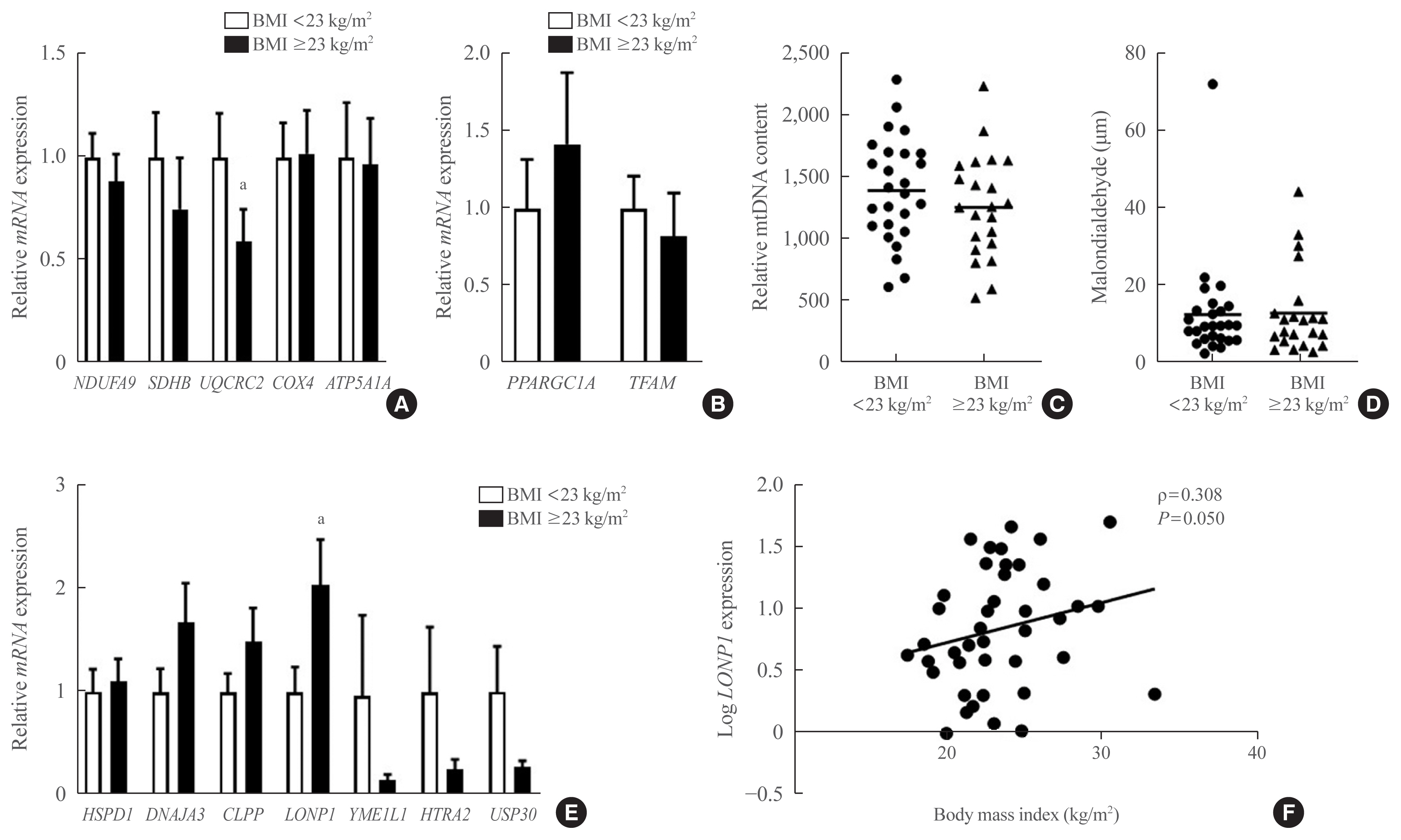
Visceral adipose tissue (VAT) was obtained from 48 normoglycemic women who underwent surgery. Expression levels of mRNA and proteins were measured for mitochondrial chaperones, intrinsic proteases, and components of electron-transport chains. Furthermore, we systematically analyzed metabolic phenotypes with a large panel of isogenic BXD inbred mouse strains and Genotype-Tissue Expression (GTEx) data.
Results
In VAT, expression of mitochondrial chaperones and intrinsic proteases localized in inner and outer mitochondrial membranes was not associated with body mass index (BMI), except for the Lon protease homolog, mitochondrial, and the corresponding gene LONP1, which showed high-level expression in the VAT of overweight or obese individuals. Expression of LONP1 in VAT positively correlated with BMI. Analysis of the GTEx database revealed that elevation of LONP1 expression is associated with enhancement of genes involved in glucose and lipid metabolism in VAT. Mice with higher Lonp1 expression in adipose tissue had better systemic glucose metabolism than mice with lower Lonp1 expression.
Conclusion
Expression of mitochondrial LONP1, which is involved in the mitochondrial quality control stress response, was elevated in the VAT of obese individuals. In a bioinformatics analysis, high LONP1 expression in VAT was associated with enhanced glucose and lipid metabolism. -
Citations
Citations to this article as recorded by- The role and mechanism of UPRmt in adipocytes
Hao Liu, Jie Chen, Dan-Qi Qiu, Miao-Wei Jiang, Hao-Qi Chen, Li Li, Shu-Qin Chen
Adipocyte.2026;[Epub] CrossRef - HSP60-mediated UPRmt overactivation drives triptolide-induced hepatocellular lipoapoptosis
Zhichao Yu, Lan Hu, Jing Ding, Xiang Li, Qi Zhang, Qiaoyu Zhang, Shuoyu Chen, Pei Zhang, Jiaqi Zhang, Baoping Jiang, Xueping Zhou, Lingling Zhou
Cellular Signalling.2026; 145: 112575. CrossRef - Mitochondrial UQCRC2 as a Redox-Regulatory Node in Metabolic and Cardiometabolic Diseases
Shiyi Chen, Yang Jiao, Wen Shen, Xingru Hu, Guoyue Yuan, Jue Jia
Antioxidants.2026; 15(7): 794. CrossRef - Enhanced mitochondrial biogenesis facilitates the development of cutaneous squamous cell carcinoma
Ziyang Wang, Ke He, Meng Liu, Weiqiang Lv, Baochen Cheng, Guanfei Zhang, Xueqiang Wang, Mengqi Zeng, Lianying Jiao, Shujun Han, Yan Zheng, Zhihui Feng
Cancer Letters.2025; 618: 217623. CrossRef - LONP1 facilitates pulmonary artery smooth muscle cell glycolytic reprogramming by degrading MPC1 in pulmonary hypertension
Mingkang Li, Wenkang Zhang, Minhao Zhang, Linqing Li, Yuyu Yao, Yuhan Qin, Dong Wang, Gaoliang Yan, Yong Qiao, Chengchun Tang
Clinical Science.2025; 139(10): 479. CrossRef - LONP1 ameliorates liver injury and improves gluconeogenesis dysfunction in acute-on-chronic liver failure
Muchen Wu, Jing Wu, Kai Liu, Minjie Jiang, Fang Xie, Xuehong Yin, Jushan Wu, Qinghua Meng
Chinese Medical Journal.2024; 137(2): 190. CrossRef - Tissue‐specific roles of mitochondrial unfolded protein response during obesity
Fernanda S. Carneiro, Carlos K. Katashima, Joshua D. Dodge, Dennys E. Cintra, José Rodrigo Pauli, Adelino S. R. Da Silva, Eduardo R. Ropelle
Obesity Reviews.2024;[Epub] CrossRef - Mitochondrial quality control proteases and their modulation for cancer therapy
Jiangnan Zhang, Wenliang Qiao, Youfu Luo
Medicinal Research Reviews.2023; 43(2): 399. CrossRef - Effects of Obesity and Calorie Restriction on Cancer Development
Ekaterina Sergeeva, Tatiana Ruksha, Yulia Fefelova
International Journal of Molecular Sciences.2023; 24(11): 9601. CrossRef - Mitochondrial Dysfunction Associated with mtDNA in Metabolic Syndrome and Obesity
Natalia Todosenko, Olga Khaziakhmatova, Vladimir Malashchenko, Kristina Yurova, Maria Bograya, Maria Beletskaya, Maria Vulf, Natalia Gazatova, Larisa Litvinova
International Journal of Molecular Sciences.2023; 24(15): 12012. CrossRef - Down‐regulation of Lon protease 1 lysine crotonylation aggravates mitochondrial dysfunction in polycystic ovary syndrome
Yuan Xie, Shuwen Chen, Zaixin Guo, Ying Tian, Xinyu Hong, Penghui Feng, Qiu Xie, Qi Yu
MedComm.2023;[Epub] CrossRef - The mitochondrial unfolded protein response: A multitasking giant in the fight against human diseases
Zixin Zhou, Yumei Fan, Ruikai Zong, Ke Tan
Ageing Research Reviews.2022; 81: 101702. CrossRef
- The role and mechanism of UPRmt in adipocytes
- Diabetes, Obesity and Metabolism
- Efficacy and Safety of the New Appetite Suppressant, Liraglutide: A Meta-Analysis of Randomized Controlled Trials
- Shinje Moon, Jibeom Lee, Hye Soo Chung, Yoon Jung Kim, Jae Myung Yu, Sung Hoon Yu, Chang-Myung Oh
- Endocrinol Metab. 2021;36(3):647-660. Published online June 18, 2021
- DOI: https://doi.org/10.3803/EnM.2020.934
- 17,749 View
- 379 Download
- 25 Web of Science
- 28 Crossref
-
Abstract
PDFSupplementary MaterialPubReader ePub
- Background
Obesity is a chronic disease associated with metabolic diseases such as diabetes and cardiovascular disease. Since the U.S. Food and Drug Administration approved liraglutide as an anti-obesity drug for nondiabetic patients in 2014, it has been widely used for weight control in overweight and obese people. This study aimed to systematically analyze the effects of liraglutide on body weight and other cardiometabolic parameters.
Methods
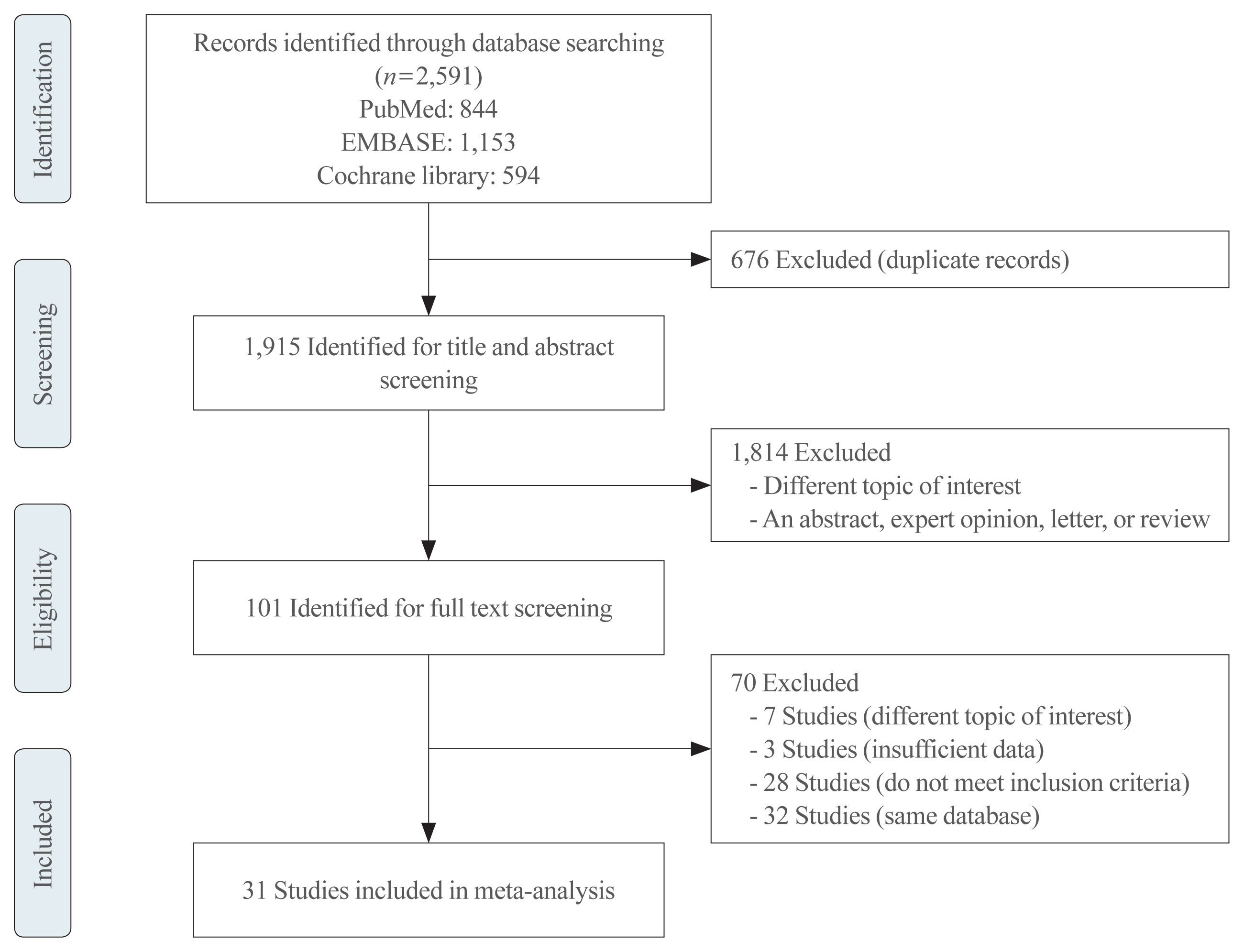
We investigated articles from PubMed, EMBASE, and the Cochrane Library to search randomized clinical trials that examined body weight changes with liraglutide treatment.
Results
We included 31 studies with 8,060 participants for this meta-analysis. The mean difference (MD) between the liraglutide group and the placebo group was −4.19 kg (95% confidence interval [CI], −4.84 to −3.55), with a −4.16% change from the baseline (95% CI, −4.90 to −3.43). Liraglutide treatment correlated with a significantly reduced body mass index (MD: −1.55; 95% CI, −1.76 to −1.34) and waist circumference (MD: −3.11 cm; 95% CI, −3.59 to −2.62) and significantly decreased blood pressure (systolic blood pressure, MD: −2.85 mm Hg; 95% CI, −3.36 to −2.35; diastolic blood pressure, MD: −0.66 mm Hg; 95% CI, −1.02 to −0.30), glycated hemoglobin (MD: −0.40%; 95% CI, −0.49 to −0.31), and low-density lipoprotein cholesterol (MD: –2.91 mg/dL; 95% CI, −5.28 to −0.53; MD: −0.87% change from baseline; 95% CI, −1.17 to −0.56).
Conclusion
Liraglutide is effective for weight control and can be a promising drug for cardiovascular protection in overweight and obese people. -
Citations
Citations to this article as recorded by- Clinical and metabolic profile of adults with obesity attending lifestyle medicine clinics
Hanan N. AlTaib, Reem AlAqeel, Amr A. Arafat, Faisal Kunnathodi, Abdulmajeed AlShaikh, Haifa F. AlOtaibi, Marwan Salih Al-Nimer
PLOS One.2026; 21(2): e0342153. CrossRef - Anti-obesity medications in adults with congenital heart disease: a comprehensive review and expert clinical recommendations
Panagiota Mitropoulou, Katja Prokšelj, Andrej Janež, Fernando Riesgo Gil, Suman Verma, Ivana Jurić, Vladimiro Vida, Michael A Gatzoulis, Margarita Brida
European Heart Journal - Quality of Care and Clinical Outcomes.2026; 12(6): 927. CrossRef - The impact of visceral obesity on the outcomes after resection of colorectal cancer: a systematic review and meta-analysis
Shihao Wang, Yichen Ding, Wanling Lin, Tianrong Ma, Jiaxin Mei, Li Lin, Zhen Li, Weiling He
Surgery for Obesity and Related Diseases.2026; 22(9): 1044. CrossRef - Modern Obesity Treatment: Efficacy, Safety, and Future Directions of GLP-1 (Glucagon-Like Peptide-1) and GIP (Glucose-Dependent Insulinotropic Polypeptide) Receptor Agonists
Dorota Bartkowiak, Barlomiej Jakubczyk, Adam Lasota, Lukasz Kopoczynski, Michal Wiesner, Lukasz Wodzinski, Kamil Boguszewski, Hubert Porazinski, Agnieszka Młynarska, Oskar Ratajski
Cureus.2026;[Epub] CrossRef - Comparison of GLP-1RAs vs Other Pharmacotherapy for Obesity
Andrew Overholser, Eric Czech, Linda Speer, Joel Wilson, Alex Overholser
Translation: The University of Toledo Journal of Medical Sciences.2025;[Epub] CrossRef - Once‐Weekly Semaglutide Versus Once‐Daily Liraglutide for Weight Loss in Adults: A Meta‐Analysis of Randomized Controlled Trials
Tallal Mushtaq Hashmi, Mushood Ahmed, Ali Haider, Salman Naseem, Uzair Jafar, Munir Hussain, Javed Iqbal, Waqar Ali, Raheel Ahmed
Clinical and Translational Science.2025;[Epub] CrossRef - Mechanisms and treatment of obesity-related hypertension—Part 2: Treatments
Aneliya Parvanova, Manuela Abbate, Elia Reseghetti, Piero Ruggenenti
Clinical Kidney Journal.2025;[Epub] CrossRef - The efficacy and safety of glucagon-like peptide-1 receptor agonists in non-diabetic adults with overweight/obesity: An umbrella review of systematic reviews and meta-analyses
Nazanin Zamanian, Hossein Imani, Sepide Talebi, Mehran Rahimlou, Reza Amiri Khosroshahi, Hamed Mohammadi
European Journal of Pharmacology.2025; 1003: 177966. CrossRef - Weight Loss Efficacy of Tirzepatide Compared to Placebo or GLP‐1 Receptor Agonists in Adults With Obesity or Overweight: A Meta‐Analysis of Randomized Controlled Trials With ≥ 20 Weeks Treatment Duration
Alhussain Khawaji, Abdulaziz A. Jaly, Hanan A. Bakri, Renju Ravi, Ahmed Hattan, Abdullah Khawaji, Wael Najmi, Claire Stocker
Journal of Obesity.2025;[Epub] CrossRef - Modern approaches to obesity management: Is dietary intervention sufficient?
Jelena Gligorijević, Slavica Stevanović, Veroslava Stanković, Andrijana Zuber, Dušan Avramović
PONS - medicinski casopis.2025; 22(1): 28. CrossRef - Pharmacotherapy for obesity: moving towards efficacy improvement
Walmir Coutinho, Bruno Halpern
Diabetology & Metabolic Syndrome.2024;[Epub] CrossRef - Physiopathology and Treatment of Obesity and Overweight: A Proposal for a New Anorectic
Bruno Silvestrini, Mauro Silvestrini, Mayank Choubey
Journal of Obesity.2024;[Epub] CrossRef - Potent synergistic effects of dulaglutide and food restriction in prevention of olanzapine-induced metabolic adverse effects in a rodent model
Katerina Horska, Jan Kucera, Eva Drazanova, Gabriela Kuzminova, Petra Amchova, Maria Hrickova, Jana Ruda-Kucerova, Silje Skrede
Biomedicine & Pharmacotherapy.2024; 176: 116763. CrossRef - Association between weight loss and cardiovascular outcomes and mortality in Korea: A nationwide cohort study
So Yoon Kwon, Gyuri Kim, Seohyun Kim, Jae Hyeon Kim
Diabetes Research and Clinical Practice.2024; 214: 111767. CrossRef - Glucagon-like peptide-1 receptor: mechanisms and advances in therapy
Zhikai Zheng, Yao Zong, Yiyang Ma, Yucheng Tian, Yidan Pang, Changqing Zhang, Junjie Gao
Signal Transduction and Targeted Therapy.2024;[Epub] CrossRef - De la découverte des hormones incrétines aux doubles et triples agonistes GIP / GLP-1 / glucagon
Franck Phan, Romane Bertrand, Chloé Amouyal, Fabrizio Andreelli
médecine/sciences.2024; 40(11): 837. CrossRef - Side effect profile of pharmacologic therapies for liver fibrosis in nonalcoholic fatty liver disease: a systematic review and network meta-analysis
Yilin Li, Rong Lei, Honglin Lei, Qin Xiong, Fengjiao Xie, Chengjiao Yao, Peimin Feng
European Journal of Gastroenterology & Hepatology.2023; 35(1): 1. CrossRef - Recommendations for the prevention and management of obesity in the Iraqi population
Hussein Ali Nwayyir, Esraa Majid Mutasher, Osama Mohammed Alabid, Muthana Abdulrazzaq Jabbar, Wefak Hasan Abdulraheem Al-Kawaz, Haider Ayad Alidrisi, Majid Alabbood, Muhammed Chabek, Munib AlZubaidi, Lujain Anwar Al-khazrajy, Ibtihal Shukri Abd Alhaleem,
Postgraduate Medicine.2023; 135(5): 425. CrossRef - A Comprehensive Review on Weight Loss Associated with Anti-Diabetic Medications
Fatma Haddad, Ghadeer Dokmak, Maryam Bader, Rafik Karaman
Life.2023; 13(4): 1012. CrossRef - Liraglutide, a glucagon-like peptide-1 analog, in individuals with obesity in clinical practice
Juyoung Shin, Raeun Kim, Hun-Sung Kim
Cardiovascular Prevention and Pharmacotherapy.2023; 5(2): 49. CrossRef - The effects of subcutaneous Tirzepatide on obesity and overweight: a systematic review and meta‐regression analysis of randomized controlled trials
Pejman Rohani, Nasser Malekpour Alamdari, Seyedeh Elaheh Bagheri, Azita Hekmatdoost, Mohammad Hassan Sohouli
Frontiers in Endocrinology.2023;[Epub] CrossRef - Efficacy and safety of liraglutide for weight management in children and adolescents: a systematic review and meta-analysis of randomized controlled trials
Hao Gou, Yiman Zhai, Junjun Guo
European Journal of Pediatrics.2023; 182(11): 5095. CrossRef - Efficacy and safety of once-weekly semaglutide in adults with overweight or obesity: a meta-analysis
Ping Zhong, Hai Zeng, Miaochun Huang, Wenbin Fu, Zhixia Chen
Endocrine.2022; 75(3): 718. CrossRef - Pharmacological profile of once-weekly injectable semaglutide for chronic weight management
David C. W. Lau, Rachel L Batterham, Carel W. le Roux
Expert Review of Clinical Pharmacology.2022; 15(3): 251. CrossRef - Pharmacological Management of Obesity: A Century of Expert Opinions in Cecil Textbook of Medicine
Peter Manu, Cristina-Mihaela Lăcătuşu, Liliana M. Rogozea, Simona Cernea
American Journal of Therapeutics.2022; 29(4): e410. CrossRef - GLP-1 agonists: superior for mind and body in antipsychotic-treated patients?
Katerina Horska, Jana Ruda-Kucerova, Silje Skrede
Trends in Endocrinology & Metabolism.2022; 33(9): 628. CrossRef - Targeting skeletal muscle mitochondrial health in obesity
Chantal A. Pileggi, Breana G. Hooks, Ruth McPherson, Robert R.M. Dent, Mary-Ellen Harper
Clinical Science.2022; 136(14): 1081. CrossRef - A Study on Weight Loss Cause as per the Side Effect of Liraglutide
Jin Yu, Jeongmin Lee, Seung-Hwan Lee, Jae-Hyung Cho, Hun-Sung Kim, Heng Zhou
Cardiovascular Therapeutics.2022; 2022: 1. CrossRef
- Clinical and metabolic profile of adults with obesity attending lifestyle medicine clinics
- Clinical Study
- High Serum-Induced AhRL Is Associated with Prevalent Metabolic Syndrome and Future Impairment of Glucose Tolerance in the Elderly
- Youngmi Kim Pak, Hoon Sung Choi, Wook Ha Park, Suyeol Im, P. Monica Lind, Lars Lind, Hong Kyu Lee
- Endocrinol Metab. 2021;36(2):436-446. Published online April 19, 2021
- DOI: https://doi.org/10.3803/EnM.2020.883
- 8,249 View
- 122 Download
- 6 Web of Science
- 6 Crossref
-
Abstract
PDFSupplementary MaterialPubReader ePub
- Background
High circulating levels of dioxins and dioxin-like chemicals, acting via the aryl hydrocarbon receptor (AhR), have previously been linked to diabetes. We now investigated whether the serum AhR ligands (AhRL) were higher in subjects with metabolic syndrome (MetS) and in subjects who had developed a worsened glucose tolerance over time.
Methods
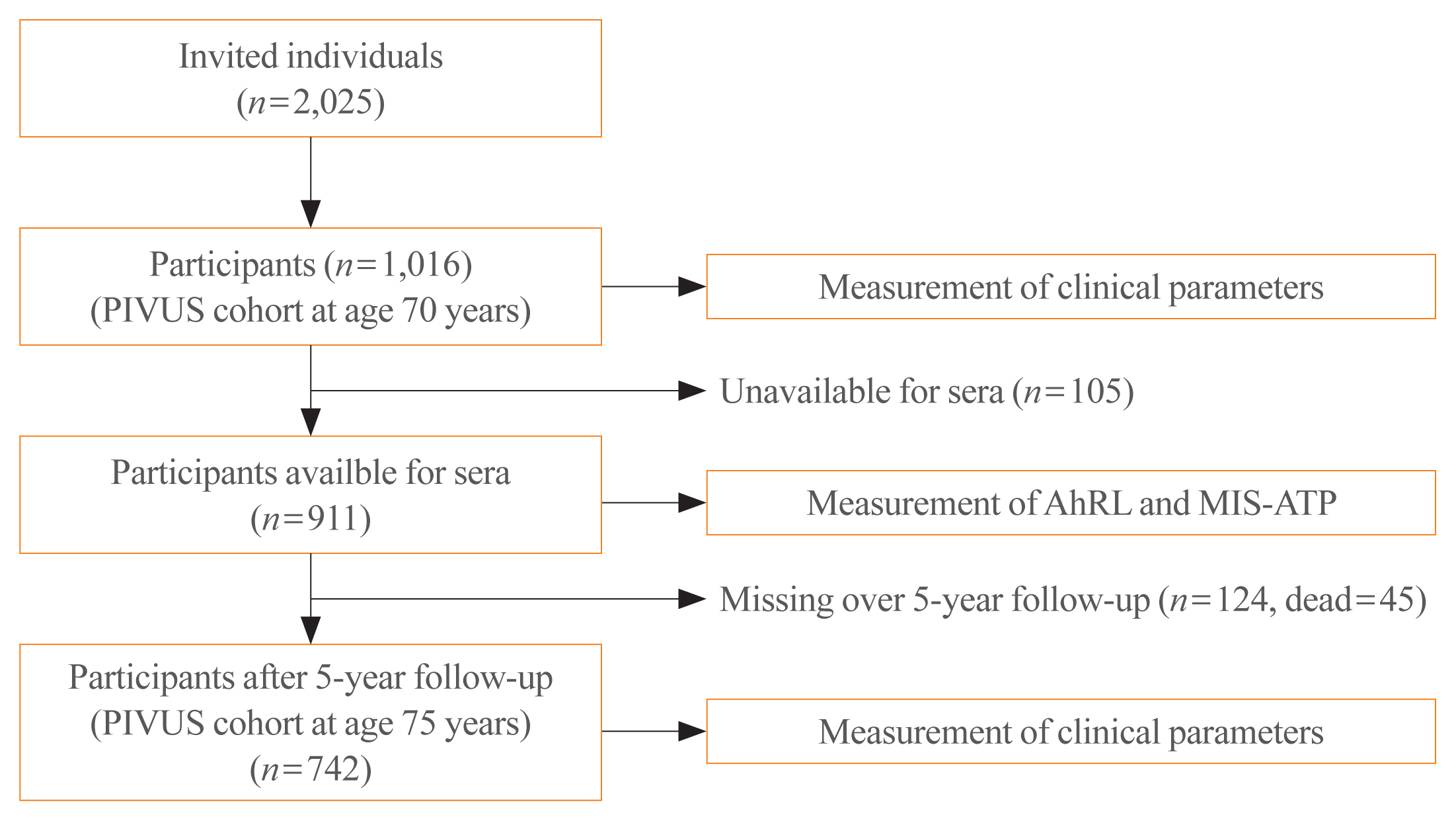
Serum AhRL at baseline was measured by a cell-based AhRL activity assay in 70-year-old subjects (n=911) in the Prospective Investigation of the Vasculature in Uppsala Seniors (PIVUS) study. The main outcome measures were prevalent MetS and worsening of glucose tolerance over 5 years of follow-up.
Results
AhRL was significantly elevated in subjects with prevalent MetS as compared to those without MetS, following adjustment for sex, smoking, exercise habits, alcohol intake and educational level (P=0.009). AhRL at baseline was higher in subjects who developed impaired fasting glucose or diabetes at age 75 years than in those who remained normoglycemic (P=0.0081). The odds ratio (OR) of AhRL for worsening glucose tolerance over 5 years was 1.43 (95% confidence interval [CI], 1.13 to 1.81; P=0.003, continuous variables) and 2.81 (95% CI, 1.31 to 6.02; P=0.008, in the highest quartile) adjusted for sex, life style factors, body mass index, and glucose.
Conclusion
These findings support a large body of epidemiologic evidence that exposure to AhR transactivating substances, such as dioxins and dioxin-like chemicals, might be involved in the pathogenesis of MetS and diabetes development. Measurement of serum AhRL in humans can be a useful tool in predicting the onset of metabolic disorders. -
Citations
Citations to this article as recorded by- Correlation between environmental pollutant exposure and cardiopulmonary health by serum biomarker analysis in the Swedish elderly population
Youngmi Kim Pak, Suyeol Im, Hoon Sung Choi, Lars Lind, Monica Lind, Hong Kyu Lee
International Journal of Environmental Health Research.2025; 35(5): 1156. CrossRef - Hepatic AhR Activation by TCDD Induces Obesity and Steatosis via Hepatic Plasminogen Activator Inhibitor-1 (PAI-1)
Seung Jun Oh, Suyeol Im, Sora Kang, Aden Geonhee Lee, Byung Cheol Lee, Youngmi Kim Pak
International Journal of Molecular Sciences.2025; 26(17): 8452. CrossRef - Association between polychlorinated biphenyl (PCB) and dioxin with metabolic syndrome (METS): a systematic review and meta-analysis
Mohd Danial Mohd Efendy Goon, Sarah Zulkifli, Siti Suhana Abdullah Soheimi, Sharaniza Ab. Rahim, Normala Abd Latip, Norbaya Hashim, Nirmala Devi Kerisnan, Nasehir Khan E. M. Yahaya, Alias Mohamed, Siti Hamimah Sheikh Abdul Kadir
Scientific Reports.2024;[Epub] CrossRef - Relationships among Dioxin-like Mitochondria Inhibitor Substances (MIS)-Mediated Mitochondria Dysfunction, Obesity, and Lung Function in a Korean Cohort
Hoonsung Choi, Kyungho Ha, Jin Taek Kim, Min Kyong Moon, Hyojee Joung, Hong Kyu Lee, Youngmi Kim Pak
Toxics.2024; 12(10): 735. CrossRef - An Interactive Online App for Predicting Diabetes via Machine Learning from Environment-Polluting Chemical Exposure Data
Rosy Oh, Hong Kyu Lee, Youngmi Kim Pak, Man-Suk Oh
International Journal of Environmental Research and Public Health.2022; 19(10): 5800. CrossRef - A Novel Aryl Hydrocarbon Receptor Antagonist HBU651 Ameliorates Peripheral and Hypothalamic Inflammation in High-Fat Diet-Induced Obese Mice
Sora Kang, Aden Geonhee Lee, Suyeol Im, Seung Jun Oh, Hye Ji Yoon, Jeong Ho Park, Youngmi Kim Pak
International Journal of Molecular Sciences.2022; 23(23): 14871. CrossRef
- Correlation between environmental pollutant exposure and cardiopulmonary health by serum biomarker analysis in the Swedish elderly population
- Clinical Study
Big Data Articles (National Health Insurance Service Database) - Cumulative Exposure to Metabolic Syndrome Components and the Risk of Dementia: A Nationwide Population-Based Study
- Yunjung Cho, Kyungdo Han, Da Hye Kim, Yong-Moon Park, Kun-Ho Yoon, Mee Kyoung Kim, Seung-Hwan Lee
- Endocrinol Metab. 2021;36(2):424-435. Published online April 14, 2021
- DOI: https://doi.org/10.3803/EnM.2020.935

- 15,006 View
- 241 Download
- 28 Web of Science
- 29 Crossref
-
Abstract
PDFSupplementary MaterialPubReader ePub
- Background
Metabolic disturbances are modifiable risk factors for dementia. Because the status of metabolic syndrome (MetS) and its components changes over time, we aimed to investigate the association of the cumulative exposure to MetS and its components with the risk of dementia.
Methods
Adults (n=1,492,776; ≥45-years-old) who received health examinations for 4 consecutive years were identified from a nationwide population-based cohort in Korea. Two exposure-weighted scores were calculated: cumulative number of MetS diagnoses (MetS exposure score, range of 0 to 4) and the composite of its five components (MetS component exposure score, range of 0 to 20). Hazard ratio (HR) and 95% confidence interval (CI) values for dementia were analyzed using the multivariable Cox proportional-hazards model.
Results
Overall, 47.1% of subjects were diagnosed with MetS at least once, and 11.5% had persistent MetS. During the mean 5.2 years of follow-up, there were 7,341 cases (0.5%) of incident dementia. There was a stepwise increase in the risk of all-cause dementia, Alzheimer’s disease, and vascular dementia with increasing MetS exposure score and MetS component exposure score (each P for trend <0.0001). The HR of all-cause dementia was 2.62 (95% CI, 1.87 to 3.68) in subjects with a MetS component exposure score of 20 compared with those with a score of 0. People fulfilling only one MetS component out of 20 already had an approximately 40% increased risk of all-cause dementia and Alzheimer’s disease.
Conclusion
More cumulative exposure to metabolic disturbances was associated with a higher risk of dementia. Of note, even minimal exposure to MetS components had a significant effect on the risk of dementia. -
Citations
Citations to this article as recorded by- Effects of Changes in Metabolic Syndrome Status on Cognitive Function: A 10‐Year Study in a Middle‐Aged Population
Kelly Lim, Meng‐Ni Wu, Wei‐Chia Tsao, Wei‐Hao Lin, Suh‐Hang Hank Juo, Cheng‐Sheng Chen, Hsiu‐Fen Lin
The Kaohsiung Journal of Medical Sciences.2026;[Epub] CrossRef - Metabolomic aging clock predicts risk of different cardiovascular diseases in the UK Biobank
Guochang You, Kangjie Wang, Runnan Shen, Xiong Chen, Jinjin Jiang, Yunhao Sun, Dan Wu, Jiatang Xu, Kai Huang, Chen Yao
Metabolism.2026; 176: 156467. CrossRef - Association of metabolic syndrome severity with cognitive decline among Chinese older adults: evidence from two prospective cohort studies
Ming Chen, Lu Liu, Na Liu, Ji-Wen Che, Yuan-Yuan Peng, Yan Zeng
Frontiers in Neuroscience.2026;[Epub] CrossRef - Association of Weight‐Adjusted‐Waist Index With Brain Health: A 16‐Year Population‐Based Longitudinal Cohort Study
Qi Sun, Li Yu, Ling Yang, Yanbo Liang, Qunya Qi, Ying Hui, Mingze Xu, Zhenchang Wang, Shouling Wu, Yuntao Wu, Han Lv
CNS Neuroscience & Therapeutics.2026;[Epub] CrossRef - Metabolic risk and metabolic dysfunction–associated steatotic liver disease and steatohepatitis in cognitive decline: A retrospective cohort study
Ahmad Basil Nasir, Yassine Kilani, Mohammad Aldiabat, Omar Abdelghany, Youssef Hafez, Nitin Desai, Mahmoud Y. Madi, Francis G. Wade, Kamran Qureshi, Lewis J. Frey, Adam D. Farmer, Wing-Kin Syn, Anna Di Sessa
PLOS One.2026; 21(7): e0353160. CrossRef - Association between Alzheimer’s disease and metabolic syndrome: Unveiling the role of dyslipidemia mechanisms
Chenyu Yue, Yan Fu, Yongli Zhao, Yanan Ou, Yanping Sun, Lan Tan
Brain Network Disorders.2025; 1(1): 21. CrossRef - Longitudinal Association of Changes in Metabolic Syndrome with Cognitive Function: 12-Year Follow-up of the Guangzhou Biobank Cohort Study
Yu Meng Tian, Wei Sen Zhang, Chao Qiang Jiang, Feng Zhu, Ya Li Jin, Shiu Lun Au Yeung, Jiao Wang, Kar Keung Cheng, Tai Hing Lam, Lin Xu
Diabetes & Metabolism Journal.2025; 49(1): 60. CrossRef - Associations of metabolic syndrome with risks of dementia and cognitive impairment: A systematic review and meta-analysis
Shu-Dong Qiu, Dan-Dan Zhang, Li-Yun Ma, Qiong-Yao Li, Lan-Yang Wang, Yu-Dong Wang, Yong-Chang Wang, Shi-Yin Xiong, Lan Tan
Journal of Alzheimer’s Disease.2025; 105(1): 15. CrossRef - Association Between Metabolic Syndrome and Young-Onset Dementia
Jeong-Yoon Lee, Kyungdo Han, Jonguk Kim, Jae-Sung Lim, Dae Young Cheon, Minwoo Lee
Neurology.2025;[Epub] CrossRef - Optimizing midlife metabolic syndrome thresholds for dementia: a prospective study of two UK population-based cohorts
Sam Vidil, Archana Singh-Manoux, Benjamin Landré, Aurore Fayosse, Séverine Sabia, Marcos D. Machado-Fragua
Alzheimer's Research & Therapy.2025;[Epub] CrossRef - Association between metabolic syndrome and cognitive impairment: a meta-analysis of analytical observational studies
Mobin Azami, Maryam Afraie, Pardis Mohammadzadeh, Asra Moradkhani, Matin Shanazari, Danial Soltanian, Yousef Moradi
Cognitive Neuropsychiatry.2025; 30(2): 127. CrossRef - Impact of triglyceride glucose-weight adjusted waist index and its cumulative exposure on stroke risk: a nationwide prospective cohort study
Shiming He, Yinghao Kuang, Xinfang Huang, Yafei Jian, Jinyan Zhang, Wanfen Huang, Yang Zou, Guotai Sheng, Wei Wang, Hongyi Yang
Lipids in Health and Disease.2025;[Epub] CrossRef - Risk factors for dementia and cognitive impairment within 5 years after stroke: a prospective multicentre cohort study
Jule Filler, Marios K. Georgakis, Daniel Janowitz, Marco Duering, Rong Fang, Anna Dewenter, Felix J. Bode, Sebastian Stoesser, Christine Kindler, Peter Hermann, Christian H. Nolte, Thomas G. Liman, Lucia Kerti, Kathleen Bernkopf, Benno Ikenberg, Wenzel Gl
The Lancet Regional Health - Europe.2025; 56: 101428. CrossRef - Inflammation mediates the association between metabolic syndrome and vascular dementia: A large prospective cohort study
Ting Jiang, Qianlin Zuo, Lingling Song, Xinxin Gao, Xihang Fu, Shifan Qin, Jing Wu
Atherosclerosis.2025; 411: 120554. CrossRef - Metabolic syndrome and risk of dementia and cognitive decline: a systematic review and meta-analysis of prospective cohort studies from 6,753,197 participants
Qi Wang, Luyi Zhang, Ruiqi Xu, Kexin Meng, Lutong Pan, Xiaoyu Zhang, Long Ge, Dongshan Zhu
GeroScience.2025;[Epub] CrossRef - Association between metabolic syndrome and risk of incident dementia in UK Biobank
Danial Qureshi, Jennifer Collister, Naomi E. Allen, Elżbieta Kuźma, Thomas Littlejohns
Alzheimer's & Dementia.2024; 20(1): 447. CrossRef - Cumulative exposure to metabolic syndrome affects the risk of psoriasis differently according to age group: a nationwide cohort study in South Korea
Se Young Jung, Kyungdo Han, Jin Hyung Jung, Hyunsun Park, Dong Wook Shin
British Journal of Dermatology.2024; 190(3): 447. CrossRef - Electroacupuncture stimulation improves cognitive ability and regulates metabolic disorders in Alzheimer’s disease model mice: new insights from brown adipose tissue thermogenesis
Ting Li, Junjian Tian, Meng Wu, Yuanshuo Tian, Zhigang Li
Frontiers in Endocrinology.2024;[Epub] CrossRef - Investigating the nexus of metabolic syndrome, serum uric acid, and dementia risk: a prospective cohort study
Tara SR Chen, Ning-Ning Mi, Hubert Yuenhei Lao, Chen-Yu Wang, Wai Leung Ambrose Lo, Yu-Rong Mao, Yan Tang, Zhong Pei, Jin-Qiu Yuan, Dong-Feng Huang
BMC Medicine.2024;[Epub] CrossRef - Blood-Brain Barrier: A Shield Against Cognitive Decline
Nabil J. Alkayed
Stroke.2024; 55(12): 2906. CrossRef - Clustering of Cardiometabolic Risk Factors and Dementia Incidence in Older Adults: A Cross-Country Comparison in England, the United States, and China
Panagiota Kontari, Chris Fife-Schaw, Kimberley Smith, Lewis A Lipsitz
The Journals of Gerontology: Series A.2023; 78(6): 1035. CrossRef - Predicting the Risk of Insulin-Requiring Gestational Diabetes before Pregnancy: A Model Generated from a Nationwide Population-Based Cohort Study in Korea
Seung-Hwan Lee, Jin Yu, Kyungdo Han, Seung Woo Lee, Sang Youn You, Hun-Sung Kim, Jae-Hyoung Cho, Kun-Ho Yoon, Mee Kyoung Kim
Endocrinology and Metabolism.2023; 38(1): 129. CrossRef - Metabolic syndrome and the risk of postoperative delirium and postoperative cognitive dysfunction: a multi-centre cohort study
Insa Feinkohl, Jürgen Janke, Arjen J.C. Slooter, Georg Winterer, Claudia Spies, Tobias Pischon
British Journal of Anaesthesia.2023; 131(2): 338. CrossRef - Is metabolic-healthy obesity associated with risk of dementia? An age-stratified analysis of the Whitehall II cohort study
Marcos D. Machado-Fragua, Séverine Sabia, Aurore Fayosse, Céline Ben Hassen, Frank van der Heide, Mika Kivimaki, Archana Singh-Manoux
BMC Medicine.2023;[Epub] CrossRef - Cumulative effect of impaired fasting glucose on the risk of dementia in middle-aged and elderly people: a nationwide cohort study
Jin Yu, Kyu-Na Lee, Hun-Sung Kim, Kyungdo Han, Seung-Hwan Lee
Scientific Reports.2023;[Epub] CrossRef - Early metabolic impairment as a contributor to neurodegenerative disease: Mechanisms and potential pharmacological intervention
Walaa Fakih, Ralph Zeitoun, Ibrahim AlZaim, Ali H. Eid, Firas Kobeissy, Khaled S. Abd‐Elrahman, Ahmed F. El‐Yazbi
Obesity.2022; 30(5): 982. CrossRef - Current Trends of Big Data Research Using the Korean National Health Information Database
Mee Kyoung Kim, Kyungdo Han, Seung-Hwan Lee
Diabetes & Metabolism Journal.2022; 46(4): 552. CrossRef - Association of Metabolic Syndrome With Incident Dementia: Role of Number and Age at Measurement of Components in a 28-Year Follow-up of the Whitehall II Cohort Study
Marcos D. Machado-Fragua, Aurore Fayosse, Manasa Shanta Yerramalla, Thomas T. van Sloten, Adam G. Tabak, Mika Kivimaki, Séverine Sabia, Archana Singh-Manoux
Diabetes Care.2022; 45(9): 2127. CrossRef - Risk of Neurodegenerative Diseases in Patients With Acromegaly
Sangmo Hong, Kyungdo Han, Kyung-Soo Kim, Cheol-Young Park
Neurology.2022;[Epub] CrossRef
- Effects of Changes in Metabolic Syndrome Status on Cognitive Function: A 10‐Year Study in a Middle‐Aged Population
- Clinical Study
- Association between Secondhand Smoke Exposure and Metabolic Syndrome in 118,609 Korean Never Smokers Verified by Self-Reported Questionnaire and Urine Cotinine
- Ji Hye Kim, Byung Jin Kim, Young Youl Hyun, Jin Ho Kang
- Endocrinol Metab. 2020;35(4):892-900. Published online December 23, 2020
- DOI: https://doi.org/10.3803/EnM.2020.847
- 9,372 View
- 112 Download
- 10 Web of Science
- 13 Crossref
-
Abstract
PDFSupplementary MaterialPubReader ePub
- Background
No study has reported the association between secondhand smoke (SHS) exposure and metabolic syndrome (MetS) in self-reported never smokers verified by both self-reported questionnaire and urine cotinine.
Methods
A total of 118,609 self-reported and cotinine-verified never smokers (38,385 male; age 34.8±7.1 years) who participated in the Kangbuk Samsung Health Study between 2011 and 2016 were included. Cotinine-verified never smokers were defined as individuals with urinary cotinine <50 ng/mL. SHS exposure was defined as current exposure to passive smoking indoors at home or workplace.
Results
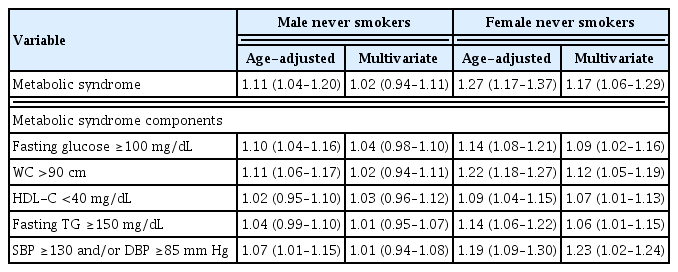
Prevalence of SHS exposure in the overall population was 22.6% (27.4% for males and 20.3% for females (P<0.001). The overall prevalence of MetS was 6.8% and was higher in males than in females (10.7% vs. 4.9%, P<0.001). In both genders, MetS prevalence was higher in the SHS exposure group than the non-SHS exposure group (11.3% vs. 10.4%, P=0.010 for males; 5.8% vs. 4.6%, P<0.001 for females). However, there was significant gender interaction for the association between SHS exposure and MetS (P for interaction=0.010). In the multivariate regression analyses, SHS exposure was associated with increased MetS odds only in females (odds ratio [95% confidence interval], 1.02 [0.94 to 1.11] in male vs. 1.17 [1.06 to 1.29] in female). In particular, females with SHS exposure of ≥1 hour/day and ≥3 times showed increased odds of MetS compared with those without SHS exposure (1.22 [1.02 to 1.45], 1.30 [1.14 to 1.49]).
Conclusion
This cross-sectional study showed that SHS exposure was significantly associated with prevalence of MetS in self-reported and cotinine-verified female never smokers. -
Citations
Citations to this article as recorded by- Association between changes in secondhand smoke exposure and incident metabolic syndrome among Korean former smokers
Byung Jin Kim, Jeong-Gyu Kang
Nutrition, Metabolism and Cardiovascular Diseases.2026; 36(1): 104278. CrossRef - Associations between exposure to environmental pollutants, metabolic syndrome risk, and obesity-related anthropometric indices
Iman Al-Saleh, Rola Elkhatib, Reem Alswayeh, Reem Al-Rouqi, Mawadah Baali, Yara Aljerayed, Sophia S. De Padua, Hissah Alnuwaysir, Ghada Hussein, Habiba Sultana, Naveed Yousaf, Abass Waqar, Khalid Alhusayn, Shoaib Khan, Amber Shammama, Abdullah Aldowaish,
International Journal of Hygiene and Environmental Health.2026; 272: 114720. CrossRef - Prevalence and predictors of indoor secondhand tobacco smoke exposure among Senegalese household population
Vishal Ramesh Tikhute, Fortune Okafor, Dhananjay Kumar
Journal of Human Behavior in the Social Environment.2025; 35(7): 1326. CrossRef - Global burden of type 2 diabetes attributable to secondhand smoke: a comprehensive analysis from the GBD 2021 study
Dongke Guo, Yanna Yu, Zhongxin Zhu
Frontiers in Endocrinology.2025;[Epub] CrossRef - Relationship of Urinary Cotinine and Secondhand Smoke Exposure With Metabolic Syndrome Among Self-Reported Never-Smokers
Byung Jin Kim
CardioMetabolic Syndrome Journal.2025; 5(2): 114. CrossRef - Urinary Cotinine Testing Elevates the Standard for Measuring Smoking Exposure in Patients With Cardiometabolic Risk
Sang Min Park
CardioMetabolic Syndrome Journal.2025; 5(2): 124. CrossRef - Effects of Smoking on Women’s Health: A Review of Reviews
Seung-Ah Choe
Journal of the Korean Society for Research on Nicotine and Tobacco.2025; 16(4): 108. CrossRef - Association between Urinary 3-hydroxypropyl Mercapturic Acid Levels and Metabolic Syndrome: Increased Risk in Female Non-smokers
Sang Shin PYO
Korean Journal of Clinical Laboratory Science.2025; 57(4): 491. CrossRef - Association between secondhand smoke exposure and incidence of metabolic syndrome: analyses of Korean Genome and Epidemiology Study (KoGES) data
Seungmi Choi, Sanghyuk Bae
Epidemiology and Health.2025; 47: e2025041. CrossRef - Combined Influence of Eight Lifestyle Factors on Metabolic Syndrome Incidence: A Prospective Cohort Study from the MECH-HK Study
Yun-Yang Deng, Fei-Wan Ngai, Jing Qin, Lin Yang, Ka-Po Wong, Harry-Haoxiang Wang, Yao-Jie Xie
Nutrients.2024; 16(4): 547. CrossRef - Association of Zinc Intake, Tobacco Smoke Exposure, With Metabolic Syndrome: Evidence from NHANES 2007–2018
Shengxiang Yang, Qian Chen, Lin Wang
Biological Trace Element Research.2024; 202(12): 5429. CrossRef - The association between urinary cotinine level and metabolic syndrome profiles among adolescents: findings from the Ewha Birth and growth study
Hyunjin Park, Ui-Jeong Kim, Eun Jeong Choi, Seunghee Jun, Bomi Park, Hye Ah Lee, Hae Soon Kim, Hyesook Park
BMC Public Health.2023;[Epub] CrossRef - Association of environmental tobacco smoke exposure with metabolic syndrome: A longitudinal Cohort Study of 71,055 never smokers
Hyo-In Choi, Seung Jae Lee, Jeong Gyu Kang, Sung Ho Lee, Bum Soo Kim, Byung Jin Kim
Nutrition, Metabolism and Cardiovascular Diseases.2022; 32(11): 2534. CrossRef
- Association between changes in secondhand smoke exposure and incident metabolic syndrome among Korean former smokers
Brief Report
- Diabetes, Obesity and Metabolism
- Comparison of Serum PCSK9 Levels in Subjects with Normoglycemia, Impaired Fasting Glucose, and Impaired Glucose Tolerance
- Eugene Han, Nan Hee Cho, Seong-Su Moon, Hochan Cho
- Endocrinol Metab. 2020;35(2):480-483. Published online June 24, 2020
- DOI: https://doi.org/10.3803/EnM.2020.35.2.480
- 9,165 View
- 133 Download
- 7 Web of Science
- 6 Crossref
-
Abstract
PDFPubReader ePub
- We investigated proprotein convertase subtilisin/kexin type 9 (PCSK9) concentrations in individuals with normoglycemia, impaired fasting glucose (IFG), and impaired glucose tolerance (IGT). This was a pilot, cross-sectional study including 92 individuals who had not been diagnosed with or treated for diabetes. We measured PCSK9 levels in three groups of subjects; namely, normoglycemia (n=57), IFG (n=21), and IGT (n=14). Individuals with IFG and IGT showed higher PCSK9 concentrations than those in the normoglycemic group, with the highest serum PCSK9 concentrations found in individuals with IGT (55.25±15.29 ng/mL for normoglycemia, 63.47±17.78 ng/mL for IFG, 72.22±15.46 ng/mL for IGT, analysis of variance P=0.001). There were no significant differences in high- or low-density lipoprotein cholesterol among groups. Serum PCSK9 levels are increased in patients with prediabetes compared to subjects with normoglycemia.
-
Citations
Citations to this article as recorded by- High circulating PCSK9 concentration is associated with increased and sex-specific risks of metabolic disease, diabetes mellitus, MASLD, and long-term mortality in a Taiwanese population
Kuan-Hung Yeh, Lung-An Hsu, Ngoc Yen Tran, Semon Wu, Yu-Lin Ko
Lipids in Health and Disease.2025;[Epub] CrossRef - Mediation effect of metabolic factors and inflammation on the association of serum uric acid with serum proprotein convertase subtilisin/kexin type 9 levels
Wen Guo, Qin Cui, Zhenzhen Fu, Qun Zhang, Jue Jia
Journal of Clinical Lipidology.2024; 18(6): e995. CrossRef - PCSK9 inhibitor effectively alleviated cognitive dysfunction in a type 2 diabetes mellitus rat model
Yang Yang, Yeying Wang, Yuwen Wang, Tingyu Ke, Ling Zhao
PeerJ.2024; 12: e17676. CrossRef - Emerging Insights on the Diverse Roles of Proprotein Convertase Subtilisin/Kexin Type 9 (PCSK9) in Chronic Liver Diseases: Cholesterol Metabolism and Beyond
Thomas Grewal, Christa Buechler
International Journal of Molecular Sciences.2022; 23(3): 1070. CrossRef - Insight into the Evolving Role of PCSK9
Mateusz Maligłówka, Michał Kosowski, Marcin Hachuła, Marcin Cyrnek, Łukasz Bułdak, Marcin Basiak, Aleksandra Bołdys, Grzegorz Machnik, Rafał Jakub Bułdak, Bogusław Okopień
Metabolites.2022; 12(3): 256. CrossRef - Proprotein convertase subtilisin/kexin type 9 (PCSK9) levels are not associated with severity of liver disease and are inversely related to cholesterol in a cohort of thirty eight patients with liver cirrhosis
Susanne Feder, Reiner Wiest, Thomas S. Weiss, Charalampos Aslanidis, Doris Schacherer, Sabrina Krautbauer, Gerhard Liebisch, Christa Buechler
Lipids in Health and Disease.2021;[Epub] CrossRef
- High circulating PCSK9 concentration is associated with increased and sex-specific risks of metabolic disease, diabetes mellitus, MASLD, and long-term mortality in a Taiwanese population
Namgok Lecture 2019
- Diabetes, Obesity and Metabolism
- Impact of Skeletal Muscle Mass on Metabolic Health
- Gyuri Kim, Jae Hyeon Kim
- Endocrinol Metab. 2020;35(1):1-6. Published online March 19, 2020
- DOI: https://doi.org/10.3803/EnM.2020.35.1.1
- 32,152 View
- 574 Download
- 145 Web of Science
- 148 Crossref
-
Abstract
PDFPubReader ePub
Skeletal muscle is regarded as an endocrine and paracrine organ. Muscle-derived secretory proteins, referred to as myokines, mediate interactions between skeletal muscle mass and other organs such as the liver, adipose tissue, pancreas, bone, and the cardiovascular system. As individuals age, reduced levels of physical activity and sarcopenia (loss of skeletal muscle mass and strength) are associated with physical frailty and disability. Recently, several studies have suggested that the loss of skeletal muscle mass may contribute to metabolic disease. Therefore, herein, we focus on the relationships between skeletal muscle mass and metabolic diseases, including metabolic syndrome and non-alcoholic fatty liver disease.
-
Citations
Citations to this article as recorded by- Muscle strength changes and physical activity during gender‐affirming hormone therapy: A systematic review
Mathilde Kamp Nørlund, Louise Lehmann Christensen, Marianne Skovsager Andersen, Tine Taulbjerg Kristensen, Jan Frystyk, Jonas Mathiesen, Jakob Lindberg Nielsen, Dorte Glintborg
Andrology.2026; 14(1): 303. CrossRef - Prognostic significance of nutritional and muscular indices in immune checkpoint inhibitor therapy for metastatic urothelial carcinoma: A preliminary study
Satoshi Yamamoto, Keita Higa, Koichiro Kurokawa, Hiroki Bamba, Sanji Kanaoka, Kazuyoshi Nakamura
Nutrition.2026; 143: 113028. CrossRef - Effects of exercise-based prehabilitation programs on sleep in patients with cancer undergoing surgery: a systematic review and meta-analysis
Manuel Fernandez-Escabias, Benito Miron, Marta Flor-Alemany, Sofia Carrilho-Candeias, Andrea Orellana-Jaen, Rodrigo Fernandez-Escabias, Maria Tomas-Garcia, José Juan Jiménez-Moleón, Almudena Carneiro-Barrera, Francisco J. Amaro-Gahete
European Journal of Surgical Oncology.2026; 52(2): 111314. CrossRef - Body mass index and a body shape index: Individual and interactive predictors of all-cause and cardiovascular mortality risk in depression
Shuwu Wei, Mingjun Xu, Xinyu Pan, Yao Xiao, Junping Wei
Psychiatry Research.2026; 356: 116907. CrossRef - Big bones mean big muscles: an MRI-based dataset of muscle-bone-body size relationships across 70 human muscles of the upper limb, trunk, and lower limb
Lara Riem, Megan Pinette, Olivia DuCharme, Valeria Pabon, Jacob Morris, Ashley Coggins, Liza Harold, Kathryn Eve Costanzo, Matthew Cousins, Raina Hein, Matt Rhodes, Eline Lievens, Rajvi Shah, Xue Feng, Savannah Benusa, Tim Breeding, Michael D. Nelson, Wim
Journal of Applied Physiology.2026; 140(1): 1. CrossRef - Association Between Body Composition and Risk of Primary Open-Angle Glaucoma
Jianqi Chen, Yue Xiao, Xiaohong Chen, Yingting Zhu, Zhidong Li, Shitong Huang, Hanyang Yu, Yehong Zhuo, Yunxia Leng
American Journal of Ophthalmology.2026; 283: 256. CrossRef - Impact of time‐restricted feeding on metabolic health and adipose tissue metabolism in aged female mice with high‐fat diet‐induced obesity
Theresa Bushman, Hongming Su, Xiaoli Chen
The Journal of Physiology.2026; 604(3): 1137. CrossRef - In Vitro Study on the Effects of Rhododendron mucronulatum Branch Extract, Taxifolin-3-O-Arabinopyranoside and Taxifolin on Muscle Loss and Muscle Atrophy in C2C12 Murine Skeletal Muscle Cells
Hyun Seo Lee, Hyeon Du Jang, Tae Hee Kim, Da Hyeon An, Ye Eun Kwon, Eun Ji Kim, Jae In Jung, Sangil Min, Hee Kyu Kim, Kwang-Hyun Park, Heesung Woo, Sun Eun Choi
International Journal of Molecular Sciences.2026; 27(2): 570. CrossRef - Polygenic risk score for lower limb skeletal muscle mass and its interaction with protein and vitamin D intake in older adults
Meiling Liu, Sunmin Park
Nutrition.2026; 145: 113100. CrossRef - The Effects of Gamified Virtual Reality on Muscle Strength and Physical Function in the Oldest Old—A Pilot Study on Sarcopenia-Related Functional Outcomes
Żaneta Grzywacz, Justyna Jaśniewicz, Anna Koziarska, Joanna Macierzyńska, Edyta Majorczyk
Journal of Clinical Medicine.2026; 15(2): 621. CrossRef - Metabolomic fingerprinting of soft tissues uncovers taxonomic, physiological, and ecological aspects of river fishes
Benjamin Marie, Pierre Foucault, Sébastien Duperron, Catherine Quiblier
Fish Physiology and Biochemistry.2026;[Epub] CrossRef - Opposing effects of Gα12 and Gα13 loss on myotube size regulation via mTORC1 signaling
Mai Kubota, Shuhei Fujita, Ryohei Kamata, Kazuma Tamura, Keiichiro Sugimoto, Tomoya Kitakaze, Naoki Harada, Ryoichi Yamaji
Biochemical and Biophysical Research Communications.2026; 802: 153326. CrossRef - Administration of Humulus scandens extract ameliorates cisplatin-induced muscle atrophy by attenuating inflammatory and oxidative stress responses in mice
Shi Qi Xu, Wenchao Gong, Jing Li, Wenjie Qin, Yanming Yu, Dong-Hwa Chung, De Xin Dang
Advances in Traditional Medicine.2026; 26(3): 645. CrossRef - Resistance training for the prevention and management of sarcopenia in older adults: Mechanisms, efficacy, and future applications
Lan Lu, Caini Liu, Wei Wei
Experimental Gerontology.2026; 216: 113085. CrossRef - Relationship Between Body Composition With Carotid Intima Media Thickness in Young Adults: Tehran Lipid and Glucose Study
Mohammad Nikoohemmat, Behnaz Abiri, Majid Valizadeh, Maryam Mahdavi, Pooneh Dehghan, Fereidoun Azizi, Farhad Hosseinpanah
Endocrinology, Diabetes & Metabolism.2026;[Epub] CrossRef - Sarcopenia changes and incident type 2 diabetes mellitus: a prospective analysis of the CHARLS cohort
Lingli Gao, Yan Chen, Shuoshuo Su, Yixun Chen, Lidian Chen, Jing Gao, Xiaodong Feng
BMC Geriatrics.2026;[Epub] CrossRef - Nuclear receptors in age-related diseases: From mechanisms to drug discovery
Lijun Zhang, Xiangyi Li, Chanjuan Ren, Yumeng Hao, Yanyan Deng, Hui Pan, Young-Bum Kim, Shengjie Fan, Cheng Huang, Guangbo Ge, Hong Zhao
Ageing Research Reviews.2026; 118: 103125. CrossRef - Exercise-Induced Epigenetic Regulation of Chchd10 Promoter Methylation Improves Muscle Morphology in Zebrafish
Jiaxin Liu, Hui Tang, Yirong Li, Haiyang Yu, Jianguang Cai, Chongqing Wang
Fishes.2026; 11(4): 241. CrossRef - Effects of Resistance Exercise and Whey Protein Supplementation on Irisin Levels in Patients with MASLD Under a Calorie-Restricted Diet
Feng-Rui Zhang, Chae-Been Kim, Dohyun Ahn, Jinwoo Sung, Ju-Hwan Oh, Hae-Ri Heo, Eun-Ah Jo, Hong-Soo Kim, Jung-Jun Park
Nutrients.2026; 18(8): 1272. CrossRef - Fat reduction mediates the efficacy of intensive lifestyle interventions on fertility‐sparing treatment in overweight patients with endometrial cancer and intraepithelial neoplasia
Sijia Liu, Li Li, Pengfei Wu, Lulu Wang, Qujia Gama, Manrong Wang, Jinyu Zhang, Liping Jin, Xuezhen Luo, Weiwei Shan, Bingyi Yang
Acta Obstetricia et Gynecologica Scandinavica.2026; 105(6): 1052. CrossRef - A Polyphenol-Rich Olive Oil Byproduct-Derived Nutraceutical Preserves Muscle Health in Adults at Metabolic Risk: A Secondary Analysis of a Pilot Study
Danilo Morelli, Sara Nofri, Paola Corradino, Domenico E. Pellegrini-Giampietro, Calogero Caruso, Anna Aiello, Adriana Albini
Nutrients.2026; 18(10): 1551. CrossRef - Effect of Korean Medicine-Based Weight Loss Treatment on Preservation of Skeletal Muscle in Obese Males: A Retrospective Chart Review
Inwoo Choi, Minwoo Bang, Suyong Shin, Jungsang Kim, Minwhee Kang, Donghun Lee, Junho Kim, Chunghee Kim, Jiyoung Son, Seonghyeon Jeon, Byungsoo Kang
Journal of Korean Medicine Rehabilitation.2026; 36(1): 73. CrossRef - Cardiorespiratory fitness in working adults undergoing rehabilitation: the role of lifestyle and body composition– a cross-sectional study
Natalia Chróścielewska, Tomasz Chomiuk, Diana Pałasz, Katarzyna Laprus-Abramska, Artur Mamcarz, Daniel Śliż
Frontiers in Physiology.2026;[Epub] CrossRef - Associations of Hand-Grip Strength and Arm Muscle Mass Index Relative to Body Weight with Risk of Non-Alcoholic Fatty Liver Disease in Wheelchair Users
Minjun Kim, Jeonghyeon Kim, Inhwan Lee
Nutrients.2026; 18(11): 1715. CrossRef - Association of the skeletal muscle mass-to-visceral fat area ratio with cardiovascular disease: a cross-sectional study based on NHANES
Ruixue Li, Tianqi Liu, Wei Xin, Zi Liang, Chenguang Zhao, Zinan Zhao, Tian Zhang, Fei Zhao, Wenfeng Xu, Pengfei Jin
Eating and Weight Disorders - Studies on Anorexia, Bulimia and Obesity.2026;[Epub] CrossRef - Heat treatment combined with hybrid exercises retraining mitigates cellular markers of protein turnover after hindlimb suspension in male mice: A pilot study
Tom Normand‐Gravier, Robert Solsona, Christelle Bertrand‐Gaday, Margot Issertine, Florence Sabatier, Flavie Arnould, Sébastien Racinais, Fabio Borrani, Henri Bernardi, Anthony M. J. Sanchez
Experimental Physiology.2026;[Epub] CrossRef - Dietary patterns and protein density associations with fat-free mass in a cross-sectional analysis of rural Iranian adults with overweight and obesity
Mohammad Ariya, Paul P. Fahey, Reza Homayounfar, Evan Atlantis
Scientific Reports.2026;[Epub] CrossRef - Associations between preoperative weight and body composition changes and surgical outcomes in patients with obesity and gastrointestinal cancer: a protocol for a prospective observational study in the active together cancer prehabilitation service
Scott Newbould, Anna Myers, Kerry Rosenthal, Keith Harris, Michael Thelwell, Robert Copeland, Sade Allott
BMJ Open.2026; 16(6): e120499. CrossRef - Association Between Nutritional Biomarkers and Low Muscle Mass, Obesity, and Low Muscle Mass with Obesity Across Physical Activity Levels Among U.S. Adults: Finding from the National Health and Nutrition Examination Survey 2015–2018
Uraiporn Booranasuksakul, Mario Siervo, Alongkote Singhato, Narisa Rueangsri, Tepparit Samrit, Wichukorn Suriyawongpaisal, Piyapong Prasertsri
International Journal of Environmental Research and Public Health.2026; 23(6): 815. CrossRef - Mediating effects of lipid metabolic and inflammatory factors on skeletal muscle mass in adults: A cross-sectional study
Jingran Hu, Bin Gu, Fei Wang
Medicine.2026; 105(25): e49428. CrossRef - Traditional Chinese Medicine for Diabetic Sarcopenia: A Review and Its Related Mechanisms
Zicheng Ye, Haoyu Yuan, Hanyu He, Weibo Wen, Hannah Wesley
Journal of Diabetes Research.2026;[Epub] CrossRef - Hemp seed protein hydrolysates and its bioactive peptides mitigate muscle atrophy in in vitro and in vivo models
Jae Jung Lee, Junho Nam, Yoon Jeong Lee, Ju Hee Kim, Suh Hyuk Kim, Dong Hyun Kim, Bey Hing Goh, Jun Ho Kim
Food Research International.2026; 242: 120028. CrossRef - Skeletal muscle health and the development of prediabetes in middle-aged and older adults: mediated by inflammation and lipid indices
Xuezhong Shi, Yuting Xie, Yongli Yang, Chaojun Yang, Nana Wang, Shijia Wang, Xiaocan Jia
Diabetes & Metabolic Syndrome: Clinical Research & Reviews.2026; 20(7): 103453. CrossRef - Association between sarcopenia and MCID-defined motor recovery in patients with paraplegia following spinal cord injury
Jeonga Seo, Minjae Cho, Seongeun Park, Ji Cheol Shin, Su Ji Lee
Spinal Cord.2026; 64(9): 819. CrossRef - Effects of plyometric-based high-intensity interval training on muscle-to-fat ratio in children: protocol for a randomized controlled trial in primary school settings
Ying Liu, Bjorn T. Tam, Sin-Yee Chan, Yu-Ying Wang, Ke-Wen Wan, Wing-Lam Chung, Asefa Adimasu Taddese, Ka-Yin Chan
World Journal of Pediatrics.2026; 22(6): 678. CrossRef - The Relationships Between Diet Quality Index, Appendicular Skeletal Muscle Mass, and Metabolic Syndrome in a Population with Metabolic Dysfunction-Associated Steatotic Liver Disease: A Single Center from the Yucatan Peninsula
Roberto Lugo, Ana Ligia Gutiérrez-Solis, Paul Góngora-Chan, Ricardo Emmanuel Jimeno-Figueroa, Brenda Pacheco-Hernández, Rodolfo Chim-Aké, Mayra Vera-Aviles, Dayana Williams-Jacquez, Marlene Chaurand-Lara, Jorge Arturo Valdivieso-Jimenez, Isabel Medina-Ver
Metabolites.2026; 16(8): 546. CrossRef - SegmentAnyMuscle: A universal muscle segmentation model across different locations in MRI
Roy Colglazier, Jisoo Lee, Haoyu Dong, Hanxue Gu, Yaqian Chen, Joseph Cao, Zafer Yildiz, Zhonghao Liu, Nicholas Konz, Jichen Yang, Jikai Zhang, Yuwen Chen, Lin Li, Adrian Camarena, Maciej A. Mazurowski
Computers in Biology and Medicine.2026; 216: 111944. CrossRef - Nonlinear Association Between Weight-Adjusted Waist Index (WWI) and Sarcopenia in Adults With Functional Limitations
Jingran Hu, Chang-Ryeol Lee, Joonsuk Yi
Journal of The Korean Society of Physical Medicine.2026; 21(3): 69. CrossRef - Higher estimated cardiorespiratory fitness levels were associated with lower risk of cardiometabolic multimorbidity: a retrospective cohort study from CHARLS
Lina Zhu, Yetong Wu, Yangzong Yu, Yake Lou, Dongmei Zhou, Shaoshen Wang
Nutrition, Metabolism and Cardiovascular Diseases.2026; : 105001. CrossRef - Nap timing matters: later siesta associates with increased muscle mass and decreased fat mass in Spain and the United States
María Rodríguez-Martín, Aishi Ghosh, Richa Saxena, Frank A J L Scheer, Hassan S Dashti, Marta Garaulet
SLEEP.2026;[Epub] CrossRef - Combined associations of triglyceride-glucose index and biochemical sarcopenia index with cardiometabolic multimorbidity in middle-aged and older Chinese adults
Yan Chen, Jun Chen, Zijia Meng, Jing Gao, Xiaodong Feng
Maturitas.2026; 214: 109137. CrossRef - Sex- and fiber type-specific remodeling of the muscle proteome implicates CSRP3 in resistance training-induced hypertrophy
Lukas Moesgaard, Roger Moreno-Justicia, Johann Schmalbruch, Søren Jessen, Ben Stocks, Nicoline R. Andersen, Jens J. Nielsen, Caio Y. Yonamine, Jonas T. Treebak, Jens Bangsbo, Clara Prats, Lykke Sylow, Atul S. Deshmukh, Morten Hostrup
Nature Communications.2026;[Epub] CrossRef - Dietary Calcium-to-Phosphorous Ratio, Metabolic Risk Factors and Lipid Accumulation Product, Skeletal Muscle Mass, and Visceral Fat Area Among Healthy Young Individuals
Xuanshang Jin, Xiangchuan Jin, Wen Guan, Maolin Tang
International Journal of Sport Nutrition and Exercise Metabolism.2025; 35(1): 43. CrossRef - Risk factors for metabolic syndrome are associated with low handgrip strength in people with HIV
Izabella Bernardes Araujo, Camila Ferreira Silva, Eduardo Vignoto Fernandes, Morganna Alves Siqueira, Marília Brasil Xavier, Luiz Fernando Gouvêa-e-Silva
Sport Sciences for Health.2025; 21(1): 465. CrossRef - Changes in muscle performance among older adults with myeloid malignancies engaging in a mobile health (mHealth) exercise intervention: a single arm pilot study
Marielle Jensen-Battaglia, Po-Ju Lin, Chandrika Sanapala, Erin E. Watson, Jason H. Mendler, Jane Liesveld, Ying Wang, Elisabeth Hayward, Marissa LoCastro, Soroush Mortaz, Richard F. Dunne, Karen Mustian, Kah Poh Loh
BMC Geriatrics.2025;[Epub] CrossRef - The Use of SGLT-2 Inhibitors and GLP-1RA in Frail Older People with Diabetes: A Personalised Approach Is Required
Alan J. Sinclair, Ahmed H. Abdelhafiz
Metabolites.2025; 15(1): 49. CrossRef - Effects of 12-month physical and cognitive training on sarcopenia determinants in older adults: a subgroup analysis of a randomised clinical trial
Onni Oskari Hämäläinen, Tiina Marketta Savikangas, Anna-Katriina Tirkkonen, Markku Juhani Alén, Arto Jorma Hautala, Sarianna Sipilä
Aging Clinical and Experimental Research.2025;[Epub] CrossRef - Preliminary Evidence Suggests That a 12-Week Treatment with Tirzepatide Plus Low-Energy Ketogenic Therapy Is More Effective than Its Combination with a Low-Calorie Diet in Preserving Fat-Free Mass, Muscle Strength, and Resting Metabolic Rate in Patients w
Luigi Schiavo, Biagio Santella, Monica Mingo, Gianluca Rossetti, Marcello Orio, Luigi Cobellis, Attilio Maurano, Antonio Iannelli, Vincenzo Pilone
Nutrients.2025; 17(7): 1216. CrossRef - Effects of protein supplementation on muscle mass, muscle strength, and physical performance in older adults with physical inactivity: a systematic review and meta-analysis
Liying Zhang, Gongxiang Liu, Xiaoli Huang, Fuqian He
BMC Geriatrics.2025;[Epub] CrossRef - Growth hormone–deficient Ames dwarf mice resist sarcopenia and exhibit enhanced endurance running performance at 24 months
Matthew J. Johnston, Sharlene G. Rakoczy, LaDora V. Thompson, Holly M. Brown-Borg
GeroScience.2025; 47(3): 4827. CrossRef - Effects of a Combination of Morus bombycis Koidz. and Angelica keiskei Extracts on Muscle Atrophy in an Aging Mouse Model
Hyun Hwangbo, Min Yeong Kim, Seon Yeong Ji, Da Hye Kim, Jae Hyun Yoon, Seong Un Jeong, Tae Hee Kim, Yung Hyun Choi
Journal of the Korean Society of Food Science and Nutrition.2025; 54(3): 218. CrossRef - Association between the skeletal muscle-to-visceral fat ratio and kidney stones: a cross-sectional study
Yuan-Zhuo Du, Jia-Qing Yang, Jian Tang, Chi-Teng Zhang, Yi-Fu Liu
Frontiers in Nutrition.2025;[Epub] CrossRef - Relationship between bmi and glomerular filtration rate in a large cohort initiating a weight loss program: differential contributions of fat mass, fat-free mass, and abdominal fat compartments
Alessandro Leone, Francesca Menichetti, Laila Vignati, Federica Sileo, Ramona De Amicis, Andrea Foppiani, Simona Bertoli, Alberto Battezzati
Nutrition Journal.2025;[Epub] CrossRef - Sarcopenic obesity in the Asia-Pacific region: Epidemiology, risk factors, and management
Chun-Feng Huang, Chih-Hsing Wu
Osteoporosis and Sarcopenia.2025; 11(2): 40. CrossRef - The relationship between cognitive function and muscle mass in older adults: a longitudinal study based on CLHLS
Yin Shi, Yu Zhang, Xinyu Yang, Jiali Yang, Shilang Wang, YanFang Hong
Frontiers in Psychiatry.2025;[Epub] CrossRef - Dual energy X-ray absorptiometry-measured fat mass and lean mass indices and cardiometabolic diseases in elderly Japanese men: the Fujiwara-kyo Osteoporosis Risk in Men (FORMEN) study
Katsuyasu Kouda, Yuki Fujita, Yuki Murakami, Kumiko Ohara, Takahiro Tachiki, Junko Tamaki, Jong-Seong Moon, Etsuko Kajita, Akemi Nitta, Nami Imai, Kazuhiro Uenishi, Masayuki Iki
Environmental Health and Preventive Medicine.2025; 30: 59. CrossRef - Combination of intermittent fasting and endurance exercise impedes the development of the musculoskeletal system in non-obese growing rats
Zilin Wang, Wenduo Liu, Yu Gu, Jae Cheol Kim, Yoonjung Park, Sang Hyun Kim
Nutrition Research and Practice.2025; 19(4): 483. CrossRef - Characteristics, Prognosis, and European Society of Cardiology and European Respiratory Society Risk Stratification in Patients With Obesity and Pulmonary Arterial Hypertension
Giulio Savonitto, Davide Barbisan, Pietro Ameri, Carlo Maria Lombardi, Mauro Driussi, Piero Gentile, Luke Howard, Matteo Toma, Matteo Pagnesi, Valentino Collini, Carolina Bauleo, Matteo Rugolotto, Giovanni Santi, Francesca Coppi, Gianluca Pagnoni, Pier Pa
CHEST.2025; 168(3): 749. CrossRef - Glucagon-like peptide-1 receptor agonists and muscle mass effects
Alexandr Ceasovschih, Andreea Asaftei, Maria Giovanna Lupo, Stanislav Kotlyarov, Hana Bartušková, Anastasia Balta, Victorita Sorodoc, Laurentiu Sorodoc, Maciej Banach
Pharmacological Research.2025; 220: 107927. CrossRef - Metabolic syndrome: epidemiology, mechanisms, and current therapeutic approaches
Benson M. Hamooya, Lukundo Siame, Lweendo Muchaili, Sepiso K. Masenga, Annet Kirabo
Frontiers in Nutrition.2025;[Epub] CrossRef - Differential impact of coffee quantity and sweetening on body composition parameters and inflammation
Giuseppe Annunziata, Evelyn Frias-Toral, Francesco Campa, Maria Antonieta Touriz Bonifaz, Ludovica Verde, Martina Galasso, Silvia Savastano, Annamaria Colao, Antonio Paoli, Daniel Simancas-Racines, Giovanna Muscogiuri, Luigi Barrea
Frontiers in Nutrition.2025;[Epub] CrossRef - Joint trajectories of skeletal muscle and fat mass in relation to glucose homeostasis: 6‐Year findings from adults aged ≥50 years
Qiao Xiang, Yuxiao Li, Gregory Y. H. Lip, Daniel J. Cuthbertson, Wei Huang, Ziyi Zhong, Birong Dong, Jirong Yue, Masoud Isanejad
Diabetes, Obesity and Metabolism.2025; 27(12): 7133. CrossRef - Mediation of fasting blood glucose between relative muscle strength and hypertension: insights from two cohorts
Pengyu Wang, Li Huang, Zhou Zhu, Xinyue Hu, Bingxin Wu, Xiaofang Yang
Diabetology & Metabolic Syndrome.2025;[Epub] CrossRef - Muscle Mass Mediates the Effect of Physical Activity and Sedentary Behavior on Metabolic Syndrome, with Differences by Gender
Jaehee Kim
Healthcare.2025; 13(19): 2432. CrossRef - Association between Cardiometabolic Index (CMI) with muscle mass and strength in US adults: A cross-sectional study
Yuwen Shangguan, Shiqi Yu, Young-Je Sim, Kunyi Huang, Han Yuan, Yang Wang, Chen Chen, Zhenhao Lin, Zining Zhu
Medicine.2025; 104(47): e46128. CrossRef - Selective Mid-Wall Cardiac Dysfunction in Obesity: The Role of Muscle-to-Fat Balance
Karolina Angela Sieradzka Uchnár, Ingrid Schusterová, Štefan Tóth, Tibor Porubän, Mariana Dvorožňáková, Pavol Fülöp
Biomedicines.2025; 13(12): 3083. CrossRef - Weight Loss and Adverse Events According to Baseline Skeletal Muscle Mass in Overweight Patients Treated with Gamitaeeumjowee-tang : A Retrospective Chart Review
Jung-Mi Seok, Ji-Yeon Oh, Ji-Myung Ok
Journal of Korean Medicine.2025; 46(4): 148. CrossRef - Metabolic phenotypes of frailty and the course of type 2 diabetes mellitus
L. A. Batrshina, S. V. Bulgakova, D. P. Kurmaev, E. V. Treneva, O. V. Kosareva, P. Ya. Merzlova, L. A. Sharonova, Yu. A. Dolgikh, N. A. Pervyshin, A. S. Bulgakov, E. A. Romanenko
Experimental and Clinical Gastroenterology.2025; (3): 236. CrossRef - Sex differences in the association between dual‐energy x‐ray absorptiometry‐measured body composition and periodontitis
Peijun Zhu, An Li, Qingqing Cai, Yuntao Chen, Yang Liu, Harriët Jager‐Wittenaar, Geerten‐Has E. Tjakkes, Shulan Xu
Journal of Periodontology.2024; 95(3): 219. CrossRef - Advances in the treatment of functional male hypogonadism
Giovanni Corona, Giulia Rastrelli, Clotilde Sparano, Linda Vignozzi, Alessandra Sforza, Mario Maggi
Expert Review of Endocrinology & Metabolism.2024; 19(2): 163. CrossRef - Heterogeneously elevated branched-chain/aromatic amino acids among new-onset type-2 diabetes mellitus patients are potentially skewed diabetes predictors
Min Wang, Yang Ou, Xiang-Lian Yuan, Xiu-Fang Zhu, Ben Niu, Zhuang Kang, Bing Zhang, Anwar Ahmed, Guo-Qiang Xing, Heng Su
World Journal of Diabetes.2024; 15(1): 53. CrossRef - The Vicious Cycle of Type 2 Diabetes Mellitus and Skeletal Muscle Atrophy: Clinical, Biochemical, and Nutritional Bases
Jose M. Lopez-Pedrosa, Maria Camprubi-Robles, German Guzman-Rolo, Andres Lopez-Gonzalez, Jose Manuel Garcia-Almeida, Alejandro Sanz-Paris, Ricardo Rueda
Nutrients.2024; 16(1): 172. CrossRef - FGF21 Induces Skeletal Muscle Atrophy and Increases Amino Acids in Female Mice: A Potential Role for Glucocorticoids
Karlton R Larson, Devi Jayakrishnan, Karla A Soto Sauza, Michael L Goodson, Aki T Chaffin, Arik Davidyan, Suraj Pathak, Yanbin Fang, Diego Gonzalez Magaña, Benjamin F Miller, Karen K Ryan
Endocrinology.2024;[Epub] CrossRef - Sarcopenic Obesity and Cardiovascular Disease: An Overlooked but High-Risk Syndrome
Saeid Mirzai, Salvatore Carbone, John A. Batsis, Stephen B. Kritchevsky, Dalane W. Kitzman, Michael D. Shapiro
Current Obesity Reports.2024; 13(3): 532. CrossRef - Mortality risk relationship using standard categorized BMI or knee-height based BMI – does the overweight/lower mortality paradox hold true?
Nivetha Natarajan Gavriilidou, Mats Pihlsgård, Sölve Elmståhl, Henrik Ekström
Aging Clinical and Experimental Research.2024;[Epub] CrossRef - Gromwell (Lithospermum erythrorhizon) Attenuates High-Fat-Induced Skeletal Muscle Wasting by Increasing Protein Synthesis and Mitochondrial Biogenesis
Ji-Sun Kim, Hyunjung Lee, Ahyoung Yoo, Hang Yeon Jeong, Chang Hwa Jung, Jiyun Ahn, Tae-Youl Ha
Journal of Microbiology and Biotechnology.2024; 34(3): 495. CrossRef - L-shaped association between lean body mass to visceral fat mass ratio with hyperuricemia: a cross-sectional study
Longti Li, Ya Shao, Huiqin Zhong, Yu Wang, Rong Zhang, Boxiong Gong, Xiaoxv Yin
Lipids in Health and Disease.2024;[Epub] CrossRef - Effect of COVID‐19 pandemic on bioimpedance health indicators in young adults
Darina Falbová, Radoslav Beňuš, Simona Sulis, Lenka Vorobeľová
American Journal of Human Biology.2024;[Epub] CrossRef - Sex difference in skeletal muscle mass in relation to metabolic dysfunction-associated steatotic liver disease: a propensity score matching study
Da-Hye Son, Yu-Jin Kwon, Jun-Hyuk Lee
The Journal of nutrition, health and aging.2024; 28(6): 100270. CrossRef - Critical variables regulating age-related anabolic responses to protein nutrition in skeletal muscle
Colleen S. Deane, Jake Cox, Philip J. Atherton
Frontiers in Nutrition.2024;[Epub] CrossRef - Molecular mechanism of skeletal muscle loss and its prevention by natural resources
Jin Tae Kim, Dong Hyeon Jeon, Hong Jin Lee
Food Science and Biotechnology.2024; 33(15): 3387. CrossRef - Why you should not skip tailored exercise interventions when using incretin mimetics for weight loss
Katharina Gross, Christian Brinkmann
Frontiers in Endocrinology.2024;[Epub] CrossRef - The Effects of Blood Flow Restriction Aerobic Exercise on Body Composition, Muscle Strength, Blood Biomarkers, and Cardiovascular Function: A Narrative Review
Chaeeun Cho, Sewon Lee
International Journal of Molecular Sciences.2024; 25(17): 9274. CrossRef - Low muscle mass is associated with efficacy of biologics in Crohn's disease
Ye Fang, Luyan Fang, Mengqian Ye, Hanyue Jiang, Xinyu Long, Haoxuan Zhang, Qianqian Zhang, Daopo Lin, Xiaoxiao Shao
Clinical Nutrition.2024; 43(10): 2354. CrossRef - Pre-Transplant Dual-Energy X-ray Absorptiometry (DXA)-Derived Body Composition Measures as Predictors of Treatment Outcomes and Early Post-Transplant Complications in Patients with Multiple Myeloma (MM) Treated with Autologous Hematopoietic Stem Cell Tran
Paula Jabłonowska-Babij, Diana Jędrzejuk, Maciej Majcherek, Agnieszka Szeremet, Magdalena Karasek, Bartłomiej Kuszczak, Krzysztof Kujawa, Milena Sitkiewicz, Marcin Landwójtowicz, Tomasz Wróbel, Maciej Tomasiewicz, Anna Czyż
Journal of Clinical Medicine.2024; 13(19): 5987. CrossRef - circAGO3 facilitates NF-κB pathway-mediated inflammatory atrophy in chicken skeletal muscle via the miR-34b-5p/TRAF3 axis
Xiyu Zhao, Shuyue Tang, Zhenyu Lei, Xiaoxu Shen, Yao Zhang, Shunshun Han, Huadong Yin, Can Cui
International Journal of Biological Macromolecules.2024; 283: 137614. CrossRef - Analyzing body composition in living kidney donors: impact on post-transplant kidney function
Evelien E. Quint, Lisa B. Westenberg, Gertrude J. Nieuwenhuijs-Moeke, Eva A. N. van den Broek, Marcel Zorgdrager, Alain R. Viddeleer, Stephan J. L. Bakker, Ija M. Nolte, Marco van Londen, Robert A. Pol
Frontiers in Nephrology.2024;[Epub] CrossRef - Eccentric Resistance Exercise Effects on Older Adults With Metabolic Syndrome
Wafina Rohadhia, Christine Kudiarasu, Tomoko Koeda, Yoshihiro Katsura, Kazunori Nosaka, Favil Singh
Journal of Clinical Exercise Physiology.2024; 13(4): 129. CrossRef - Prevalence of adiposity-based chronic disease and its association with anthropometric and clinical indices: a cross-sectional study
Luis E González-Salazar, Aurora E Serralde-Zúñiga, Adriana Flores-López, Juan P Díaz-Sánchez, Isabel Medina-Vera, Edgar Pichardo-Ontiveros, Rocío Guizar-Heredia, Karla G Hernández-Gómez, Ana Vigil-Martínez, Liliana Arteaga-Sánchez, Azalia Avila-Nava, Nata
British Journal of Nutrition.2023; 130(1): 93. CrossRef - Skeletal Muscle Myokine Expression in Critical Illness, Association With Outcome and Impact of Therapeutic Interventions
Ilse Vanhorebeek, Jan Gunst, Michaël P Casaer, Inge Derese, Sarah Derde, Lies Pauwels, Johan Segers, Greet Hermans, Rik Gosselink, Greet Van den Berghe
Journal of the Endocrine Society.2023;[Epub] CrossRef - Effect of Circadian Rhythm Disturbance on the Human Musculoskeletal System and the Importance of Nutritional Strategies
Norsham Juliana, Liyana Azmi, Nadia Mohd Effendy, Nur Islami Mohd Fahmi Teng, Izuddin Fahmy Abu, Nur Nabilah Abu Bakar, Sahar Azmani, Noor Anisah Abu Yazit, Suhaini Kadiman, Srijit Das
Nutrients.2023; 15(3): 734. CrossRef - Molecular mechanisms of post‐burn muscle wasting and the therapeutic potential of physical exercise
Dorien Dombrecht, Ulrike Van Daele, Birgit Van Asbroeck, David Schieffelers, Pieter‐Jan Guns, Nick Gebruers, Jill Meirte, Eric van Breda
Journal of Cachexia, Sarcopenia and Muscle.2023; 14(2): 758. CrossRef - Metabolic Impact of Frailty Changes Diabetes Trajectory
Alan J. Sinclair, Ahmed H. Abdelhafiz
Metabolites.2023; 13(2): 295. CrossRef - From Single- to Multi-organ-on-a-Chip System for Studying Metabolic Diseases
Minjeong Jang, Hong Nam Kim
BioChip Journal.2023; 17(2): 133. CrossRef - INFLUENCE OF SARCOPENIA ON THE COURSE AND PROGNOSIS IN PATIENTS WITH CHRONIC HEART FAILURE
Gulyaev N.I., Adamov A.A., Akhmetshin I.M.
"Medical & pharmaceutical journal "Pulse".2023; : 124. CrossRef - Frailty and the Interactions between Skeletal Muscle, Bone, and Adipose Tissue-Impact on Cardiovascular Disease and Possible Therapeutic Measures
María Elena Soto, Israel Pérez-Torres, María Esther Rubio-Ruiz, Agustina Cano-Martínez, Linaloe Manzano-Pech, Verónica Guarner-Lans
International Journal of Molecular Sciences.2023; 24(5): 4534. CrossRef - Sarcoplasmic Reticulum Ca2+ Buffer Proteins: A Focus on the Yet-To-Be-Explored Role of Sarcalumenin in Skeletal Muscle Health and Disease
Elena Conte, Giorgia Dinoi, Paola Imbrici, Annamaria De Luca, Antonella Liantonio
Cells.2023; 12(5): 715. CrossRef - Antarctic krill extracts enhance muscle regeneration and muscle function via mammalian target of rapamycin regulation
Seongmin Lee, Mi-Ock Baek, Sana Abdul Khaliq, Amna Parveen, Sun Yeou Kim, Jin-Hyoung Kim, Il-Chan Kim, Mee-Sup Yoon
Journal of Functional Foods.2023; 103: 105483. CrossRef - Pharmacological and physiological roles of adipokines and myokines in metabolic-related dementia
Archana Arjunan, Juhyun Song
Biomedicine & Pharmacotherapy.2023; 163: 114847. CrossRef - PRMT5 links lipid metabolism to contractile function of skeletal muscles
Kun Ho Kim, Zhihao Jia, Madigan Snyder, Jingjuan Chen, Jiamin Qiu, Stephanie N Oprescu, Xiyue Chen, Sabriya A Syed, Feng Yue, Bruno T Roseguini, Anthony N Imbalzano, Changdeng Hu, Shihuan Kuang
EMBO Reports.2023;[Epub] CrossRef - “Biqi” Bayberry Extract Promotes Skeletal Muscle Fiber Type Remodeling by Increasing Fast Myofiber Formation via the Akt/FoxO1 Pathway in Mice
Jinjie Li, Yi Li, Xiangying Suo, Jiangtao Li, Da Huang, Guangning Kou
Foods.2023; 12(13): 2471. CrossRef - Effects of high-intensity interval training (HIIT) on skeletal muscle atrophy, function, and myokine profile in diabetic myopathy
Yeşim Özçatal, Fırat Akat, Yakup Tatar, Hakan Fıçıcılar, Bilge Serdaroğlu, Ferda Topal Çelikkan, Metin Baştuğ
Cytokine.2023; 169: 156279. CrossRef - Impaired proteostatic mechanisms other than decreased protein synthesis limit old skeletal muscle recovery after disuse atrophy
Jordan D. Fuqua, Marcus M. Lawrence, Zachary R. Hettinger, Agnieszka K. Borowik, Parker L. Brecheen, Marcelina M. Szczygiel, Claire B. Abbott, Frederick F. Peelor, Amy L. Confides, Michael Kinter, Sue C. Bodine, Esther E. Dupont‐Versteegden, Benjamin F. M
Journal of Cachexia, Sarcopenia and Muscle.2023; 14(5): 2076. CrossRef - Body physique rating as a factor to identify at-risk Mexicans for Metabolic Syndrome
Oscar Herrera-Fomperosa, Sergio K. Bustamante-Villagomez, Sarahí Vazquez-Álvarez, Gabriela Vázquez-Marroquín, Leonardo M. Porchia, Enrique Torres-Rasgado, Ricardo Pérez-Fuentes, M. Elba Gonzalez-Mejia
Human Nutrition & Metabolism.2023; 33: 200206. CrossRef - Association between Fractional Oxygen Extraction from Resting Quadriceps Muscle and Body Composition in Healthy Men
Rodrigo Yáñez-Sepúlveda, Jorge Olivares-Arancibia, Guillermo Cortés-Roco, Aldo Vasquez-Bonilla, Matías Monsalves-Álvarez, Ildefonso Alvear-Órdenes, Marcelo Tuesta
Journal of Functional Morphology and Kinesiology.2023; 8(4): 149. CrossRef - Correlations between Mental Health, Physical Activity, and Body Composition in American College Students after the COVID-19 Pandemic Lockdown
Luis Torres, Manuela C. Caciula, Alin S. Tomoiaga, Carmen Gugu-Gramatopol
International Journal of Environmental Research and Public Health.2023; 20(22): 7045. CrossRef - Association between total body muscle percentage and prevalence of non-alcoholic fatty liver disease in Korean adults findings from an 18-year follow-up: a prospective cohort study
Byoung Chan Ahn, Chul Yong Park, Jung Hee Hong, Ki Ook Baek
Journal of Yeungnam Medical Science.2023; 40(Suppl): S47. CrossRef - The independent and joint associations among muscle strength, abdominal obesity and cardiometabolic variables among adults
Tiago Rodrigues de Lima, David Alejandro González‐Chica, Xuemei Sui, Diego Augusto Santos Silva
European Journal of Sport Science.2022; 22(7): 1122. CrossRef - Mentale Gesundheit und physische Aktivität
Wolfgang Laube
Manuelle Medizin.2022; 60(1): 13. CrossRef - A new paradigm in sarcopenia: Cognitive impairment caused by imbalanced myokine secretion and vascular dysfunction
Danbi Jo, Gwangho Yoon, Oh Yoen Kim, Juhyun Song
Biomedicine & Pharmacotherapy.2022; 147: 112636. CrossRef - Sarcopenia Is a Cause and Consequence of Metabolic Dysregulation in Aging Humans: Effects of Gut Dysbiosis, Glucose Dysregulation, Diet and Lifestyle
James W. Daily, Sunmin Park
Cells.2022; 11(3): 338. CrossRef - Leveraging deep phenotyping from health check-up cohort with 10,000 Korean individuals for phenome-wide association study of 136 traits
Eun Kyung Choe, Manu Shivakumar, Anurag Verma, Shefali Setia Verma, Seung Ho Choi, Joo Sung Kim, Dokyoon Kim
Scientific Reports.2022;[Epub] CrossRef - Zika virus disrupts gene expression in human myoblasts and myotubes: Relationship with susceptibility to infection
Ingo Riederer, Daniella Arêas Mendes-da-Cruz, Guilherme Cordenonsi da Fonseca, Mariela Natacha González, Otavio Brustolini, Cássia Rocha, Guilherme Loss, Joseane Biso de Carvalho, Mariane Talon Menezes, Lidiane Menezes Souza Raphael, Alexandra Gerber, Myr
PLOS Neglected Tropical Diseases.2022; 16(2): e0010166. CrossRef - Teil 1: Muskeldysfunktionen – mit Training gegen Schmerz
Wolfgang Laube
Manuelle Medizin.2022; 60(2): 84. CrossRef - Transcription factors KLF15 and PPARδ cooperatively orchestrate genome-wide regulation of lipid metabolism in skeletal muscle
Liyan Fan, David R. Sweet, Erica K. Fan, Domenick A. Prosdocimo, Annmarie Madera, Zhen Jiang, Roshan Padmanabhan, Saptarsi M. Haldar, Vinesh Vinayachandran, Mukesh K. Jain
Journal of Biological Chemistry.2022; 298(6): 101926. CrossRef - An Overview of the TRP-Oxidative Stress Axis in Metabolic Syndrome: Insights for Novel Therapeutic Approaches
Mizael C. Araújo, Suzany H. S. Soczek, Jaqueline P. Pontes, Leonardo A. C. Marques, Gabriela S. Santos, Gisele Simão, Laryssa R. Bueno, Daniele Maria-Ferreira, Marcelo N. Muscará, Elizabeth S. Fernandes
Cells.2022; 11(8): 1292. CrossRef - Effects of a 10-Week Physical Activity Intervention on Asylum Seekers’ Physiological Health
Matheus Guerra, Danilo Garcia, Maryam Kazemitabar, Erik Lindskär, Erica Schütz, Daniel Berglind
Brain Sciences.2022; 12(7): 822. CrossRef - Low muscle mass and mortality risk later in life: A 10-year follow-up study
Cristina Camargo Pereira, Valéria Pagotto, Cesar de Oliveira, Erika Aparecida Silveira, Kiyoshi Sanada
PLOS ONE.2022; 17(7): e0271579. CrossRef - Independent and joint associations of weightlifting and aerobic activity with all-cause, cardiovascular disease and cancer mortality in the Prostate, Lung, Colorectal and Ovarian Cancer Screening Trial
Jessica Gorzelitz, Britton Trabert, Hormuzd A Katki, Steven C Moore, Eleanor L Watts, Charles E Matthews
British Journal of Sports Medicine.2022; 56(22): 1277. CrossRef - Handgrip Strength Cutoff Value Among Korean Adolescents with Metabolic Syndrome Components: Korean National Health and Nutrition Examination Survey Data 2014–2017
Chang Hoon Lee, Jun Hyeok Lee, Yong Whi Jeong, Hong Koh, Yunkoo Kang
Metabolic Syndrome and Related Disorders.2022; 20(10): 584. CrossRef - Physical activity level, sitting time, and skeletal muscle mass between esports players and non-esports players
Zhi H. SEE, Mohamad S. ABDUL HAMID
Gazzetta Medica Italiana Archivio per le Scienze Mediche.2022;[Epub] CrossRef - Impact of the Nutrition–Inflammation Status on the Functionality of Patients with Chronic Kidney Disease
Ángel Nogueira, Graciela Álvarez, Guillermina Barril
Nutrients.2022; 14(22): 4745. CrossRef - Does Timing Matter? A Narrative Review of Intermittent Fasting Variants and Their Effects on Bodyweight and Body Composition
Alan A. Aragon, Brad J. Schoenfeld
Nutrients.2022; 14(23): 5022. CrossRef - Sex- and region-specific associations of skeletal muscle mass with metabolic dysfunction-associated fatty liver disease
Pei Xiao, Pu Liang, Panjun Gao, Jinyi Wu
Frontiers in Endocrinology.2022;[Epub] CrossRef - Donor Skeletal Muscle Quality Affects Graft Mortality After Living Donor Liver Transplantation- A Single Center, Retrospective Study
Takahiro Tomiyama, Noboru Harada, Takeo Toshima, Yuki Nakayama, Katsuya Toshida, Akinari Morinaga, Yukiko Kosai-Fujimoto, Takahiro Tomino, Takeshi Kurihara, Kazuki Takeishi, Yoshihiro Nagao, Kazutoyo Morita, Shinji Itoh, Tomoharu Yoshizumi
Transplant International.2022;[Epub] CrossRef - Handgrip Strength Is Associated with Metabolic Syndrome and Insulin Resistance in Children and Adolescents: Analysis of Korea National Health and Nutrition Examination Survey 2014–2018
Hae Woon Jung, Jieun Lee, Jaehyun Kim
Journal of Obesity & Metabolic Syndrome.2022; 31(4): 334. CrossRef - Diet quality and a traditional dietary pattern predict lean mass in Australian women: Longitudinal data from the Geelong Osteoporosis Study
Jessica A. Davis, Mohammadreza Mohebbi, Fiona Collier, Amy Loughman, Nitin Shivappa, James R. Hébert, Julie A. Pasco, Felice N. Jacka
Preventive Medicine Reports.2021; 21: 101316. CrossRef - Association between serum FGF21 level and sarcopenia in older adults
Hee-Won Jung, Jin Hoon Park, Da Ae Kim, Il-Young Jang, So Jeong Park, Jin Young Lee, Seungjoo Lee, Jeoung Hee Kim, Hyon-Seung Yi, Eunju Lee, Beom-Jun Kim
Bone.2021; 145: 115877. CrossRef - Benchside to the bedside of frailty and cardiovascular aging: Main shared cellular and molecular mechanisms
Sandra Maria Barbalho, Ricardo José Tofano, Eduardo Federigui Baisi Chagas, Cláudia Rucco Penteado Detregiachi, Ricardo de Alvares Goulart, Uri Arian Princ Flato
Experimental Gerontology.2021; 148: 111302. CrossRef - Effect of CCL11 on In Vitro Myogenesis and Its Clinical Relevance for Sarcopenia in Older Adults
Da Ae Kim, So Jeong Park, Jin Young Lee, Jeoung Hee Kim, Seungjoo Lee, Eunju Lee, Il-Young Jang, Hee-Won Jung, Jin Hoon Park, Beom-Jun Kim
Endocrinology and Metabolism.2021; 36(2): 455. CrossRef - Sarcopenic obesity as a determinant of cardiovascular disease risk in older people: a systematic review
Katherine Evans, Dima Abdelhafiz, Ahmed H Abdelhafiz
Postgraduate Medicine.2021; 133(8): 831. CrossRef - Decreased continuous sitting time increases heart rate variability in patients with cardiovascular risk factors
Natsuki Nakayama, Masahiko Miyachi, Koji Tamakoshi, Toshio Hayashi, Koji Negi, Koji Watanabe, Makoto Hirai, Sharon Mary Brownie
PLOS ONE.2021; 16(6): e0253399. CrossRef - Muskeltraining – ein universelles Medikament
Wolfgang Laube
Manuelle Medizin.2021; 59(3): 179. CrossRef - The Effects of Oxytocin on Appetite Regulation, Food Intake and Metabolism in Humans
Liya Kerem, Elizabeth A. Lawson
International Journal of Molecular Sciences.2021; 22(14): 7737. CrossRef - Weight Loss Strategies and the Risk of Skeletal Muscle Mass Loss
David McCarthy, Aloys Berg
Nutrients.2021; 13(7): 2473. CrossRef - Association of FGF‐19 and FGF‐21 levels with primary sarcopenia
Rabia Bag Soytas, Veysel Suzan, Pinar Arman, Tugce Emiroglu Gedik, Damla Unal, Mahir Cengiz, Ibrahim Murat Bolayirli, Deniz Suna Erdincler, Alper Doventas, Hakan Yavuzer
Geriatrics & Gerontology International.2021; 21(10): 959. CrossRef - Der Muskulatur mehr Aufmerksamkeit schenken!
Wolfgang Laube
Manuelle Medizin.2021; 59(4): 302. CrossRef - Methodology, clinical applications, and future directions of body composition analysis using computed tomography (CT) images: A review
Antti Tolonen, Tomppa Pakarinen, Antti Sassi, Jere Kyttä, William Cancino, Irina Rinta-Kiikka, Said Pertuz, Otso Arponen
European Journal of Radiology.2021; 145: 109943. CrossRef - Waist and hip circumference are independently associated with the risk of liver disease in population‐based studies
Oscar Danielsson, Markku J. Nissinen, Antti Jula, Veikko Salomaa, Satu Männistö, Annamari Lundqvist, Markus Perola, Fredrik Åberg
Liver International.2021; 41(12): 2903. CrossRef - Understanding of sarcopenia: from definition to therapeutic strategies
Jee Won Kim, Ryuni Kim, Hyerim Choi, Sang-Jin Lee, Gyu-Un Bae
Archives of Pharmacal Research.2021; 44(9-10): 876. CrossRef - Muscle strength and its association with cardiometabolic variables in adolescents: does the expression of muscle strength values matter?
Tiago Rodrigues de Lima, Xuemei Sui, Luiz Rodrigo Augustemak de Lima, Diego Augusto Santos Silva
World Journal of Pediatrics.2021; 17(6): 597. CrossRef - Musclin Is Related to Insulin Resistance and Body Composition, but Not to Body Mass Index or Cardiorespiratory Capacity in Adults
Yeliana L. Sánchez, Manuela Yepes-Calderón, Luis Valbuena, Andrés F. Milán, María C. Trillos-Almanza, Sergio Granados, Miguel Peña, Mauricio Estrada-Castrillón, Juan C. Aristizábal, Raúl Narvez-Sanchez, Jaime Gallo-Villegas, Juan C. Calderón
Endocrinology and Metabolism.2021; 36(5): 1055. CrossRef - Physical Exercise and Myokines: Relationships with Sarcopenia and Cardiovascular Complications
Sandra Maria Barbalho, Uri Adrian Prync Flato, Ricardo José Tofano, Ricardo de Alvares Goulart, Elen Landgraf Guiguer, Cláudia Rucco P. Detregiachi, Daniela Vieira Buchaim, Adriano Cressoni Araújo, Rogério Leone Buchaim, Fábio Tadeu Rodrigues Reina, Piero
International Journal of Molecular Sciences.2020; 21(10): 3607. CrossRef Prevalence of Metabolic Syndrome and Association with Grip Strength in Older Adults: Findings from the HOPE Study
Reshma Aziz Merchant, Yiong Huak Chan, Jia Yi Lim, John E Morley
Diabetes, Metabolic Syndrome and Obesity: Targets and Therapy.2020; Volume 13: 2677. CrossRef- Lower Serum n-3 Fatty Acid Level in Older Adults with Sarcopenia
Il-Young Jang, Hee-Won Jung, Jin Hoon Park, Jeoung Hee Kim, Seungjoo Lee, Eunju Lee, Jin Young Lee, So Jeong Park, Da Ae Kim, Su Jung Kim, Hyun Ju Yoo, Beom-Jun Kim
Nutrients.2020; 12(10): 2959. CrossRef - Advances in understanding of health‐promoting benefits of medicine and food homology using analysis of gut microbiota and metabolomics
Minmin Yang, Tao Yan, Meng Yu, Jie Kang, Ruoxi Gao, Peng Wang, Yuhuan Zhang, Huafeng Zhang, Lin Shi
Food Frontiers.2020; 1(4): 398. CrossRef - The association of circulating kynurenine, a tryptophan metabolite, with frailty in older adults
Il-Young Jang, Jin Hoon Park, Jeoung Hee Kim, Seungjoo Lee, Eunju Lee, Jin Young Lee, So Jeong Park, Da Ae Kim, Mark W. Hamrick, Beom-Jun Kim
Aging.2020; 12(21): 22253. CrossRef - Sarcopenia and Muscle Aging: A Brief Overview
Tam Dao, Alexander E. Green, Yun A Kim, Sung-Jin Bae, Ki-Tae Ha, Karim Gariani, Mi-ra Lee, Keir J. Menzies, Dongryeol Ryu
Endocrinology and Metabolism.2020; 35(4): 716. CrossRef
- Muscle strength changes and physical activity during gender‐affirming hormone therapy: A systematic review
Original Articles
- Clinical Study
- Impact of the Dynamic Change of Metabolic Health Status on the Incident Type 2 Diabetes: A Nationwide Population-Based Cohort Study
- Jung A Kim, Da Hye Kim, Seon Mee Kim, Yong Gyu Park, Nan Hee Kim, Sei Hyun Baik, Kyung Mook Choi, Kyungdo Han, Hye Jin Yoo
- Endocrinol Metab. 2019;34(4):406-414. Published online December 23, 2019
- DOI: https://doi.org/10.3803/EnM.2019.34.4.406
- 11,908 View
- 100 Download
- 24 Web of Science
- 28 Crossref
-
Abstract
PDFSupplementary MaterialPubReader ePub
Background Metabolically healthy obese (MHO) is regarded as a transient concept. We examined the effect of the dynamic change of metabolic health status on the incidence of type 2 diabetes mellitus (T2DM) both in obese and normal weight individuals.
Methods We analyzed 3,479,514 metabolically healthy subjects aged over 20 years from the Korean National Health Screening Program, who underwent health examination between 2009 and 2010, with a follow-up after 4 years. The relative risk for T2DM incidence until the December 2017 was compared among the four groups: stable metabolically healthy normal weight (MHNW), unstable MHNW, stable MHO, and unstable MHO.
Results During the 4 years, 11.1% of subjects in the MHNW group, and 31.5% in the MHO group converted to a metabolically unhealthy phenotype. In the multivariate adjusted model, the unstable MHO group showed the highest risk of T2DM (hazard ratio [HR], 4.67; 95% confidence interval [CI], 4.58 to 4.77). The unstable MHNW group had a higher risk of T2DM than stable MHO group ([HR, 3.23; 95% CI, 3.16 to 3.30] vs. [HR, 1.81; 95% CI, 1.76 to 1.85]). The stable MHO group showed a higher risk of T2DM than the stable MHNW group. The influence of the transition into a metabolically unhealthy phenotype on T2DM incidence was greater in subjects with aged <65 years, women, and those with weight gain.
Conclusion Metabolically healthy phenotype was transient both in normal weight and obese individuals. Maintaining metabolic health was critical for the prevention of T2DM, irrespective of their baseline body mass index.
-
Citations
Citations to this article as recorded by- Association between albumin-bilirubin (ALBI) score and metabolically healthy obesity among US adults: findings from NHANES 2005–2018
Chenyi Ji, Fang Liu
BMC Endocrine Disorders.2026;[Epub] CrossRef - Metabolic health phenotypes and cardiovascular disease among U.S. adults with central obesity: Evidence from NHANES 2011– March 2020
David Kweku Aseda Donkor, Emmanuel Amoako Agyei, Samuel Prince Osei, Frederick Frimpong Opuni, Evelyn Gyau-Boakye, Maxwell Emmie, Adwoa Benyiwah Amoah, Sandra Agyenim Boateng, Dennis Dela Tsagli, Eunice Akomaning
Obesity Pillars.2026; 18: 100267. CrossRef - Dynamic Changes in Metabolic Syndrome Severity Score and Its Components with Risk of Type 2 Diabetes Mellitus: Insights from Joint Longitudinal and Survival Modeling
Safdar Masoumi, Ebrahim Hajizadeh, Farzad Eskandari, Davood Khalili
Metabolic Syndrome and Related Disorders.2026; 24(6): 258. CrossRef - Sex-stratified associations of TyG index and HOMA-IR changes with incident type 2 diabetes
Sojin Kim, Sujeong Shin, Yoosoo Chang, Eunju Sung, Jae-Heon Kang
Scientific Reports.2026;[Epub] CrossRef - Metabolic health, independent of body mass index, is associated with mortality risk in type 1 diabetes
Jung A Kim, Jimi Choi, Kyeong Jin Kim, Soo Myoung Shin, Young‐Eun Kim, Kyoung Jin Kim, Hee Young Kim, Nam Hoon Kim, Sin Gon Kim
Journal of Diabetes Investigation.2026;[Epub] CrossRef - Association of obesity phenotypes with risk of cardiovascular disease mortality: a prospective cohort study
Ruixue Song, Yanfeng Jiang, Jiaojiao Pang, Shuo Wu, Jingjing Ma, Ping Li, Xiaohui Wu, Feng Xu, Jiali Wang, Xingdong Chen, Yuguo Chen
BMC Public Health.2025;[Epub] CrossRef - Dynamic Changes in Metabolic Status Are Associated With Risk of Ocular Motor Cranial Nerve Palsies
Daye Diana Choi, Kyung-Ah Park, Kyungdo Han, Sei Yeul Oh
Journal of Neuro-Ophthalmology.2024; 44(3): 386. CrossRef - Metabolically healthy obese individuals are still at high risk for diabetes: Application of the marginal structural model
Hye Ah Lee, Hyesook Park
Diabetes, Obesity and Metabolism.2024; 26(2): 431. CrossRef - The prevalence of metabolically healthy obesity and its transition into the unhealthy state: A 5‐year follow‐up study
Amir Baniasad, Mohammad Javad Najafzadeh, Hamid Najafipour, Mohammad Hossein Gozashti
Clinical Obesity.2024;[Epub] CrossRef - When Being Lean Is Not Enough: The Metabolically Unhealthy Normal Weight Phenotype and Cardiometabolic Disease
Dahyun Park, Min-Jeong Shin, Faidon Magkos
CardioMetabolic Syndrome Journal.2024; 4(2): 57. CrossRef - Association of anthropometric parameters as a risk factor for development of diabetic retinopathy in patients with diabetes mellitus
Aditya Verma, Ashok Jha, Ahmed Roshdy Alagorie, Rishi Sharma
Eye.2023; 37(2): 303. CrossRef - From Metabolic Syndrome to Type 2 Diabetes in Youth
Dario Iafusco, Roberto Franceschi, Alice Maguolo, Salvatore Guercio Nuzio, Antonino Crinò, Maurizio Delvecchio, Lorenzo Iughetti, Claudio Maffeis, Valeria Calcaterra, Melania Manco
Children.2023; 10(3): 516. CrossRef - Assessment of Metabolic Syndrome Risk Based on Body Size Phenotype in Korean Adults: Analysis of Community-based Cohort Data
Ji Young Kim, Youngran Yang
Research in Community and Public Health Nursing.2023; 34: 158. CrossRef - Prevalence and factors related to the metabolically obese normalweight (MONW) phenotype: a review
Edyta Suliga, Martyna Głuszek-Osuch, Stanisław Głuszek
Medical Studies.2023; 39(1): 73. CrossRef - New metabolic health definition might not be a reliable predictor for diabetes in the nonobese Chinese population
Liying Li, Ziqiong Wang, Haiyan Ruan, Muxin Zhang, Linxia Zhou, Xin Wei, Ye Zhu, Jiafu Wei, Xiaoping Chen, Sen He
Diabetes Research and Clinical Practice.2022; 184: 109213. CrossRef - Metabolically healthy obesity: Is it really healthy for type 2 diabetes mellitus?
Qi Wu, Ming-Feng Xia, Xin Gao
World Journal of Diabetes.2022; 13(2): 70. CrossRef - Metabolically obese phenotype and its dynamic change are associated with increased carotid intima-media thickness: Results from a cohort study
Liping Yang, Xue Li, Li Wang, Shan Xu, Yanmei Lou, Fulan Hu
Nutrition, Metabolism and Cardiovascular Diseases.2022; 32(9): 2238. CrossRef - Obesity Metabolic Phenotype, Changes in Time and Risk of Diabetes Mellitus in an Observational Prospective Study on General Population
Chan Yang, Xiaowei Liu, Yuanyuan Dang, Juan Li, Jingyun Jing, Di Tian, Jiangwei Qiu, Jiaxing Zhang, Ni Yan, Xiuying Liu, Yi Zhao, Yuhong Zhang
International Journal of Public Health.2022;[Epub] CrossRef - Implications of metabolic health status and obesity on the risk of kidney cancer: A nationwide population-based cohort study
Yun Kyung Cho, Hwi Seung Kim, Joong-Yeol Park, Woo Je Lee, Ye-Jee Kim, Chang Hee Jung
Frontiers in Endocrinology.2022;[Epub] CrossRef - Metabolic health is a determining factor for incident colorectal cancer in the obese population: A nationwide population‐based cohort study
Yun Kyung Cho, Jiwoo Lee, Hwi Seung Kim, Joong‐Yeol Park, Woo Je Lee, Ye‐Jee Kim, Chang Hee Jung
Cancer Medicine.2021; 10(1): 220. CrossRef - Cumulative Exposure to Metabolic Syndrome Components and the Risk of Dementia: A Nationwide Population-Based Study
Yunjung Cho, Kyungdo Han, Da Hye Kim, Yong-Moon Park, Kun-Ho Yoon, Mee Kyoung Kim, Seung-Hwan Lee
Endocrinology and Metabolism.2021; 36(2): 424. CrossRef - Excessive Intake of High-Fructose Corn Syrup Drinks Induces Impaired Glucose Tolerance
Hidemi Hattori, Yuma Hanai, Yuto Oshima, Hiroaki Kataoka, Nozomu Eto
Biomedicines.2021; 9(5): 541. CrossRef - The risk of Alzheimer’s disease according to dynamic changes in metabolic health and obesity: a nationwide population-based cohort study
Yun Kyung Cho, Jiwoo Lee, Hwi Seung Kim, Joong-Yeol Park, Woo Je Lee, Ye-Jee Kim, Chang Hee Jung
Aging.2021; 13(13): 16974. CrossRef - Metabolically healthy obesity: predictors of transformation to unhealthy phenotype in St Petersburg population (according to the ESSE-RF study)
M. A. Boyarinova, O. P. Rotar, A. M. Erina, N. A. Paskar, A. S. Alieva, E. V. Moguchaia, E. P. Kolesova, A. O. Konradi
"Arterial’naya Gipertenziya" ("Arterial Hypertension").2021; 27(3): 279. CrossRef - Physiological and Lifestyle Traits of Metabolic Dysfunction in the Absence of Obesity
Hanna Bjørk Klitgaard, Jesper Hoffmann Kilbak, Erica Arhnung Nozawa, Ann V. Seidel, Faidon Magkos
Current Diabetes Reports.2020;[Epub] CrossRef - Exploring Therapeutic Targets to Reverse or Prevent the Transition from Metabolically Healthy to Unhealthy Obesity
Tenzin D. Dagpo, Christopher J. Nolan, Viviane Delghingaro-Augusto
Cells.2020; 9(7): 1596. CrossRef - Prepregnancy smoking and the risk of gestational diabetes requiring insulin therapy
Mee Kyoung Kim, Kyungdo Han, Sang Youn You, Hyuk-Sang Kwon, Kun-Ho Yoon, Seung-Hwan Lee
Scientific Reports.2020;[Epub] CrossRef - Obesity with and without type 2 diabetes: are there differences in obesity history, lifestyle factors or concomitant pathology?
E. A. Shestakova, Yu. I. Yashkov, O. Yu. Rebrova, M. V. Kats, M. D. Samsonova, I. I. Dedov
Obesity and metabolism.2020; 17(4): 332. CrossRef
- Association between albumin-bilirubin (ALBI) score and metabolically healthy obesity among US adults: findings from NHANES 2005–2018
- Clinical Study
- Association between Serum Gamma-Glutamyltransferase and Prevalence of Metabolic Syndrome Using Data from the Korean Genome and Epidemiology Study
- Mi Young Lee, Dae Sung Hyon, Ji Hye Huh, Hae Kyung Kim, Sul Ki Han, Jang Young Kim, Sang Baek Koh
- Endocrinol Metab. 2019;34(4):390-397. Published online December 23, 2019
- DOI: https://doi.org/10.3803/EnM.2019.34.4.390
- 13,292 View
- 147 Download
- 17 Web of Science
- 17 Crossref
-
Abstract
PDFPubReader ePub
Background The aim of this study was to determine whether there is a positive correlation between gamma-glutamyltransferase (GGT) levels and the prevalence of metabolic syndrome and whether GGT can be used as an easily checkable metabolic index using data from the large-scale Korean Genome and Epidemiology Study (KoGES).
Methods We obtained data of 211,725 participants of the KoGES. The collected data included age, sex, height, weight, waist circumference, and various biochemical characteristics, including serum GGT levels. The data of study participants who ingested more than 40 g/day of alcohol and who were diagnosed with metabolic syndrome at baseline was excluded. We analyzed the prevalence of metabolic syndrome according to GGT quartiles in both genders.
Results The GGT level was significantly higher in subjects with metabolic syndrome compared to normal subjects (37.92±48.20 mg/dL vs. 25.62±33.56 mg/dL). The prevalence of metabolic syndrome showed a stepwise increase with GGT quartiles in both male and female subjects. Compared to the lowest GGT quartile, the odds ratio was 1.534 (95% confidence interval [CI], 1.432 to 1.643), 1.939 (95% CI, 1.811 to 2.076), and 2.754 (95% CI, 2.572 to 2.948) in men and 1.155 (95% CI, 1.094 to 1.218), 1.528 (95% CI, 1.451 to 1.609), and 2.022 (95% CI, 1.921 to 2.218) in women with increasing GGT quartile. The cutoff value of GGT predicting risk of metabolic syndrome was 27 IU/L in men and 17 IU/L in women.
Conclusion We suggested that GGT could be an easily checkable marker for the prediction of metabolic syndrome.
-
Citations
Citations to this article as recorded by- Serum γ-glutamyl transferase as a novel risk indicator for lung cancer: insights from four million Koreans
Chiwook Chung, Kyu Na Lee, Dong Wook Shin, Sei Won Lee, Kyungdo Han
Respiratory Research.2025;[Epub] CrossRef - Inflammatory markers CRP and WBC as predictors of liver function impairment in multiple injury trauma patients: a repeated measures analysis
Gang Wang, Cui Tang, Rui Wang, Chundao Xu, Tugang Shen, Gaokai Li
Frontiers in Medicine.2025;[Epub] CrossRef - Associating Liver Enzymes and Their Interactions with Metabolic Syndrome Prevalence in a Japanese Working Population
Aziz Jamal, Akira Babazono, Ning Liu, Rieko Yamao, Takako Fujita, Sung-a Kim, Yunfei Li
Metabolic Syndrome and Related Disorders.2024; 22(1): 27. CrossRef - Association between gamma glutamyl transpeptidase to HDL-Cholesterol (GGT/HDL-C) ratio and metabolic syndrome resolution after sleeve gastrectomy
Melanni L. Lizarbe-Lezama, Jhoel E. Rodriguez-Macedo, Daniel Fernandez-Guzman, Ana L. Alcantara-Diaz, Gustavo Salinas-Sedo, Carlos J. Toro-Huamanchumo
Diabetes and Vascular Disease Research.2024;[Epub] CrossRef - Liver fat content assessed by conventional B-mode ultrasound and metabolic profile in non-diabetic patients: Implications for clinical practice
Rosanna Villani, Grazia Pia Magnati, Giulia Tuccari, Moris Sangineto, Antonino Davide Romano, Tommaso Cassano, Gaetano Serviddio
Ultrasound.2023; 31(3): 177. CrossRef - Serum γ-glutamyltransferase level and incidence risk of metabolic syndrome in community dwelling adults: longitudinal findings over 12 years
Jiwon Kwak, In-Ho Seo, Yong-Jae Lee
Diabetology & Metabolic Syndrome.2023;[Epub] CrossRef - Gamma-Glutamyl Transferase as a Diagnostic Marker of Metabolic Syndrome
Bobbili Tarun Kesava Naidu, Kakarlapudi Santosh Raju, Janapareddi V BhaskaraRao, Nallapati Sunil Kumar
Cureus.2023;[Epub] CrossRef - Metabolic syndrome and transaminases: systematic review and meta-analysis
Elena Raya-Cano, Rafael Molina-Luque, Manuel Vaquero-Abellán, Guillermo Molina-Recio, Rocío Jiménez-Mérida, Manuel Romero-Saldaña
Diabetology & Metabolic Syndrome.2023;[Epub] CrossRef - Association between Serum Gamma-glutamyl Transferase and Metabolic Syndrome: A Case–control Study
Akshay Shelar, Nalini Humaney, Akshay Chhajed, Krunal Domki, Ajay Narwade
Journal of Datta Meghe Institute of Medical Sciences University.2023; 18(4): 651. CrossRef - “Big Data” Approaches for Prevention of the Metabolic Syndrome
Xinping Jiang, Zhang Yang, Shuai Wang, Shuanglin Deng
Frontiers in Genetics.2022;[Epub] CrossRef - Can Gamma-glutamyl Transferase Predict Unhealthy Metabolic Phenotypes Among Healthcare Workers in Azar Cohort Study?
Mohammadhossein Somi, Seyed Sina Zakavi, Alireza Ostadrahimi, Negin Frounchi, Neda Gilani, Sarvin Sanaie, Elnaz Faramarzi
Hepatitis Monthly.2022;[Epub] CrossRef - Association between liver enzymes and metabolic syndrome in Canadian adults: results from the Canadian health measures survey - cycles 3 &4
Luan Manh Chu, Chandima Karunanayake, Palok Aich, Markus Hecker, Punam Pahwa
Journal of Diabetes & Metabolic Disorders.2022; 21(2): 1699. CrossRef - Repeatedly elevated γ-glutamyltransferase levels are associated with an increased incidence of digestive cancers: A population-based cohort study
Chang-Hoon Lee, Kyungdo Han, Da Hye Kim, Min-Sun Kwak
World Journal of Gastroenterology.2021; 27(2): 176. CrossRef - Index of Cardiac Age Index and Cardiometabolic Biomarkers in Adults with Metabolic Syndrome
Eun Jung Choi, Sang Yeoup Lee
Metabolic Syndrome and Related Disorders.2021; 19(5): 288. CrossRef - Simple metabolic markers associated with tophaceous gout
Wei Liu, Hui Song, Siliang Man, Hongchao Li, Siming Gao
Clinical Rheumatology.2021; 40(12): 5047. CrossRef - Expression Status and Prognostic Significance of Gamma-Glutamyl Transpeptidase Family Genes in Hepatocellular Carcinoma
Shan Tian, Jiao Li, Yingyun Guo, Weiguo Dong, Xin Zheng
Frontiers in Oncology.2021;[Epub] CrossRef - Nonalcoholic fatty liver disease and the risk of insulin-requiring gestational diabetes
Sang Youn You, Kyungdo Han, Seung-Hawn Lee, Mee Kyoung Kim
Diabetology & Metabolic Syndrome.2021;[Epub] CrossRef
- Serum γ-glutamyl transferase as a novel risk indicator for lung cancer: insights from four million Koreans
- Clinical Study
- Associations of Metabolic Syndrome with Total Testosterone and Homocysteine Levels in Male Korean Workers
- Sook Hee Sung, Nam Hee Kim, Sun Pyo Hong, Jong-Keun Lee, Seung Jin Choi
- Endocrinol Metab. 2019;34(2):158-168. Published online June 24, 2019
- DOI: https://doi.org/10.3803/EnM.2019.34.2.158
- 9,978 View
- 74 Download
- 9 Web of Science
- 9 Crossref
-
Abstract
PDFPubReader ePub
Background Low testosterone is associated with metabolic syndrome (MetS), and homocysteine (Hcy) is elevated in individuals with MetS. We investigated the relationships of total testosterone (TT) and serum Hcy levels with MetS in male Korean workers.
Methods We conducted a cross-sectional study including 8,606 male workers, aged 20 to 58 years, who underwent a physical examination in 2015. MetS was diagnosed based on the criteria of the 2009 harmonized definition, while the Korean standard for waist circumference (WC) was used. Participants' biochemical parameters, including TT and serum Hcy, were measured, and participants were divided into quartiles. Multiple logistic regression models were used to estimate the association of MetS and its individual components depending on TT and serum Hcy quartiles.
Results The prevalence of MetS in the study population was 16%. TT was lower in participants with MetS than in those without MetS (
P <0.001). By contrast, Hcy level was similar between groups (P =0.694). In multiple logistic regression analysis, the odds ratio for the lowest TT quartile was 1.29 (95% confidence interval, 1.06 to 1.57) after adjusting for potential confounders. Participants with lower TT were more likely to have high WC, hypertriglyceridemia, and low high density lipoprotein levels. Serum Hcy levels were not significantly associated with MetS. Of the five components of MetS, only WC was significantly associated with serum Hcy.Conclusion In male Korean workers, TT may be an independent predictor of MetS, and serum Hcy levels could be a marker of abdominal obesity. However, future prospective studies are needed.
-
Citations
Citations to this article as recorded by- Association of elevated TyHGB index with higher prevalence of testosterone deficiency in male patients with type 2 diabetes mellitus
Chunmei Li, Shouxing Yang, Jing Xu, Zhijuan Dai
European Journal of Medical Research.2026;[Epub] CrossRef - Inverse association between atherogenic index of plasma and testosterone in US adult males: A large cross-sectional study from the NAHNES 2011–2016
Tanjian Li, Lulu Chen, Xin Liang, Xinya Li, Yaqin Li, Yuting Huang, Yu Wang
Frontiers in Physiology.2025;[Epub] CrossRef - Gender-specific negative association between serum vitamin B12 and testosterone levels in females: the modifying role of BMI in a US adult population
Xin Zhao, Xiaohong Lyu, Hai Wang, Yanan Li, Fei Peng, Yushi Zhang
Frontiers in Nutrition.2025;[Epub] CrossRef - Steroids and One-Carbon Metabolism: Clinical Implications in Endocrine Disorders
Nicolas Scheyer, Rosa-Maria Guéant-Rodriguez, Mikaël Agopiantz, Brigitte Leininger-Muller
Neuroendocrinology.2025; 115(10-11): 875. CrossRef - Hyperlipidemia Is Not Related to Semen Quality, but to Serum Testosterone Levels
Jiajie Bi, Jing Ma, Chaoju Yang, Yuanjing Li, Xuan Liu, Yanqing Tie, Shusong Wang, Raul Sanchez
Andrologia.2024;[Epub] CrossRef - Causal inference between pernicious anemia and cancers: a bidirectional two-sample mendelian randomization analysis
Bangwei Che, Shenglan Yuan, Hongyan Zhang, Jiancheng Zhai, Yang Zhang, Chuanchuan Wu, Kaifa Tang
BMC Cancer.2024;[Epub] CrossRef - Negative correlation between metabolic score for insulin resistance index and testosterone in male adults
ChunMei Li, Jing Xu
Diabetology & Metabolic Syndrome.2024;[Epub] CrossRef - A negative association between triglyceride glucose-body mass index and testosterone in adult males: a cross-sectional study
Shenghao Wu, Yanhong Wu, Lizi Fang, Junzhao Zhao, Yaoyao Cai, Weiting Xia
Frontiers in Endocrinology.2023;[Epub] CrossRef - Vitamin B12, folate, and homocysteine in metabolic syndrome: a systematic review and meta-analysis
Juan R. Ulloque-Badaracco, Enrique A. Hernandez-Bustamante, Esteban A. Alarcon-Braga, Ali Al-kassab-Córdova, Juan C. Cabrera-Guzmán, Percy Herrera-Añazco, Vicente A. Benites-Zapata
Frontiers in Endocrinology.2023;[Epub] CrossRef
- Association of elevated TyHGB index with higher prevalence of testosterone deficiency in male patients with type 2 diabetes mellitus
- Diabetes, Obesity and Metabolism
- Metabolic Syndrome and Insulin Resistance Syndrome among Infertile Women with Polycystic Ovary Syndrome: A Cross-Sectional Study from Central Vietnam
- Minh Tam Le, Vu Quoc Huy Nguyen, Quang Vinh Truong, Dinh Duong Le, Viet Nguyen Sa Le, Ngoc Thanh Cao
- Endocrinol Metab. 2018;33(4):447-458. Published online November 30, 2018
- DOI: https://doi.org/10.3803/EnM.2018.33.4.447
- 10,411 View
- 109 Download
- 13 Web of Science
- 17 Crossref
-
Abstract
PDFPubReader ePub
Background Polycystic ovarian syndrome (PCOS) is one of the most common endocrinopathies among reproductive-age women. Its metabolic features often overlap with those associated with metabolic syndrome (MS) and insulin resistance syndrome (IRS). The objective of this study was to determine the prevalence and predictors of MS and IRS in infertile Vietnamese women with PCOS.
Methods A cross-sectional study was conducted at a tertiary fertility centre at Hue University Hospital from June 2016 to November 2017. A total of 441 infertile women diagnosed with PCOS based on the revised 2003 Rotterdam consensus criteria were enrolled. MS and IRS were defined based on the National Heart, Lung, and Blood Institute/American Heart Association Adult Treatment Panel III 2005 and American College of Endocrinology IRS 2003 criteria, respectively. Complete clinical and biochemical measurements of 318 women were available for analysis. Independent predictors of MS and IRS were identified using multivariate logistic regression.
Results The overall prevalence of MS and IRS in women with PCOS was 10.4% and 27.0%, respectively. We identified older age (>30 years) and obesity as independent predictors of MS and IRS. Elevated anti-Müllerian hormone levels increased the risk of IRS, but not that of MS.
Conclusion MS and IRS are prevalent disorders among infertile Vietnamese women with PCOS. PCOS is not solely a reproductive problem. Screening and early intervention for MS and/or IRS based on anthropometric, metabolic, and reproductive hormone risk factors should be an integral part of fertility care.
-
Citations
Citations to this article as recorded by- The association between triglyceride glucose-body mass index and live birth outcomes in women with clinical pregnancy after frozen-thawed embryo transfer: a cohort study
Xiliang Wang, Pengshu Zou, Jing Zhou, Yuexin Yu
BMC Pregnancy and Childbirth.2026;[Epub] CrossRef - The effects of metformin on clinical features, endocrine and metabolic profiles of infertile women with polycystic ovary syndrome
Le Viet Nguyen Sa, Le Minh Tam, Tran Thi Nhu Quynh, Cao Ngoc Thanh
Tạp chí Y học lâm sàng Bệnh viện Trung Ương Huế.2025; (83): 57. CrossRef - Role of the tripartite motif‐containing (TRIM) family of proteins in insulin resistance and related disorders
Jianrong Chen, Xianjie Feng, Xu Zhou, Yong Li
Diabetes, Obesity and Metabolism.2024; 26(1): 3. CrossRef - Effect of pharmacological interventions on lipid profiles and C‐reactive protein in polycystic ovary syndrome: A systematic review and meta‐analysis
Mohammed A. Abdalla, Najeeb Shah, Harshal Deshmukh, Amirhossein Sahebkar, Linda Östlundh, Rami H. Al‐Rifai, Stephen L. Atkin, Thozhukat Sathyapalan
Clinical Endocrinology.2022; 96(4): 443. CrossRef - A Cross-Sectional Study of Serum Ferritin Levels in Vietnamese Adults with Metabolic Syndrome
Thua Nguyen Tran, Huu Dang Tran, Thanh Tung Tran-Huu, Duc Minh Tran, Quang Nhat Tran
Diabetes, Metabolic Syndrome and Obesity: Targets and Therapy.2022; Volume 15: 1517. CrossRef - Psychophysiological responses of women with polycystic ovary syndrome during sessions of high-intensity interval training
Isis Kelly Dos Santos, Luiz Fernando Farias-Junior, Gabriel Soares Pichini, Carlindo Daniel De Medeiros Lopes Ferreira, Victor Sabino Queiros, Gustavo Mafaldo Soares, Breno Guilherme De Araújo Tinoco Cabral, Tecia Maria De Oliveira Maranhão, Paulo Moreira
Human Movement.2022; 23(4): 112. CrossRef - Uric acid metabolism in polycystic ovary syndrome
Yan-Nan Liu, Hai Luo, Xuan Che, Hui Peng, Ming Li, Ke-Xuan Liu
Clinica Chimica Acta.2021; 517: 74. CrossRef - PREVALENCE OF METABOLIC SYNDROME AND INSULIN RESISTANCE AMONG PCOS WOMEN ATTENDING TERTIARY CARE HOSPITAL IN NORTH INDIAN POPULATION.
Anita R Bhatia, Peyir Bagra, Jyotsna Suri, Rajni Dawar
INTERNATIONAL JOURNAL OF SCIENTIFIC RESEARCH.2021; : 35. CrossRef - “Obesity and Insulin Resistance” Is the Component of the Metabolic Syndrome Most Strongly Associated with Oxidative Stress
Grzegorz K. Jakubiak, Kamila Osadnik, Mateusz Lejawa, Tadeusz Osadnik, Marcin Goławski, Piotr Lewandowski, Natalia Pawlas
Antioxidants.2021; 11(1): 79. CrossRef - Correlation Between Serum AMH Levels and Cardiometabolic Indices in PCOS Women
Subarna Mitra, Gautom K. Saharia, Saubhagya K. Jena
Indian Journal of Endocrinology and Metabolism.2021; 25(6): 545. CrossRef - [Retracted] Predicting Risk of Insulin Resistance in a Chinese Population with Polycystic Ovary Syndrome: Designing and Testing a New Predictive Nomogram
Feng Jiang, Ke Wei, Wenjun Lyu, Chuyan Wu, Mingyue Zheng
BioMed Research International.2020;[Epub] CrossRef - Association of the Genetic Polymorphisms rs6259 and rs727428 of the SHBG Gene with Polycystic Ovary Syndrome Risk: A Meta-Analysis
Xihong Liao, Shujun Cao
Genetic Testing and Molecular Biomarkers.2020; 24(8): 492. CrossRef - The relationship between glomerular filtration rate, and metabolic and inflammatory parameters in obese and non-obese patients with polycystic ovary syndrome
Mustafa Can, Cevdet Duran, Ibrahim Guney, Halis Elmas, Mehmet Ayhan, Said Sami Erdem
Clínica e Investigación en Arteriosclerosis.2020; 32(6): 256. CrossRef - Effect of Central Obesity and Hyperandrogenism on Selected Inflammatory Markers in Patients with PCOS: A WHtR-Matched Case-Control Study
Małgorzata Kałużna, Magdalena Człapka-Matyasik, Katarzyna Wachowiak-Ochmańska, Jerzy Moczko, Jolanta Kaczmarek, Adam Janicki, Katarzyna Piątek, Marek Ruchała, Katarzyna Ziemnicka
Journal of Clinical Medicine.2020; 9(9): 3024. CrossRef - The relationship between glomerular filtration rate, and metabolic and inflammatory parameters in obese and non-obese patients with polycystic ovary syndrome
Mustafa Can, Cevdet Duran, Ibrahim Guney, Halis Elmas, Mehmet Ayhan, Said Sami Erdem
Clínica e Investigación en Arteriosclerosis (English Edition).2020; 32(6): 256. CrossRef - Dyslipidemia involvement in the development of polycystic ovary syndrome
Qi Liu, Yuan-jie Xie, Li-hua Qu, Meng-xia Zhang, Zhong-cheng Mo
Taiwanese Journal of Obstetrics and Gynecology.2019; 58(4): 447. CrossRef - Insulin Resistance and Its Associated Risk Factors in Nigerian Women with Polycystic Ovary Syndrome
Chinyere B. N. Akpata, Patrick O. Uadia, Friday E. Okonofua
Open Journal of Obstetrics and Gynecology.2019; 09(03): 382. CrossRef
- The association between triglyceride glucose-body mass index and live birth outcomes in women with clinical pregnancy after frozen-thawed embryo transfer: a cohort study
- Mineral, Bone & Muscle
- Association between Bone Mineral Density and Albuminuria: Cross-Sectional Analysis of Data from the 2011 Korea National Health and Nutrition Examination Survey V-2
- Tae Yang Yu, Ha-Young Kim, Jeong Mi Lee, Dae Ho Lee, Chung Gu Cho
- Endocrinol Metab. 2018;33(2):211-218. Published online May 4, 2018
- DOI: https://doi.org/10.3803/EnM.2018.33.2.211
- 8,497 View
- 56 Download
- 4 Web of Science
- 4 Crossref
-
Abstract
PDFPubReader ePub
Background Albuminuria is known to be independently associated with progression of renal and cardiovascular disease. However, little is known regarding the exact relationship between albuminuria and bone mineral density (BMD). The aim of this population-based study conducted in Korea was to identify the association between albuminuria and BMD.
Methods We performed a cross-sectional analysis of data from the Korea National Health and Nutrition Examination Survey (KNHANES V-2) 2011. BMD was measured for total hip (TH), femur neck (FN), and lumbar spine (LS). Analysis of covariance was used to compare BMD levels between the groups at the TH, FN, and LS sites, after adjusting for age. Separate analyses were performed according to sex; women were divided into two groups according to menopausal status and each group was subdivided into three according to urine albumin-to-creatinine ratio (level 1, <30 mg/g; level 2, 30 to 299 mg/g; level 3, ≥300 mg/g).
Results Data on a total of 1,831 adults (857 men and 974 women) were analyzed. In postmenopausal women, after adjusting for age, BMD of TH tended to decrease as levels of albuminuria increased (0.767±0.117, 0.757±0.129, 0.752±0.118, respectively;
P =0.040). However, there was no significant difference in BMD according to albuminuria level in premenopausal women and men.Conclusion Level of albuminuria was closely related with BMD of TH in postmenopausal women, after adjusting for age, but there was no significant relationship between albuminuria and BMD in premenopausal women and men.
-
Citations
Citations to this article as recorded by- Association between urinary albumin creatinine ratio and cardiovascular disease
Yoo Jin Kim, Sang Won Hwang, Taesic Lee, Jun Young Lee, Young Uh, Gulali Aktas
PLOS ONE.2023; 18(3): e0283083. CrossRef - Association between urine albumin to creatinine ratio and bone mineral density: a cross-sectional study
Kemal Sherefa Oumer, Yawen Liu, Tesfaye Getachew Charkos, Shuman Yang
Irish Journal of Medical Science (1971 -).2022; 191(1): 427. CrossRef - Association between perfluoroalkyl substances concentration and bone mineral density in the US adolescents aged 12-19 years in NHANES 2005-2010
Xianmei Xiong, Baihang Chen, Zhongqing Wang, Liqiong Ma, Shijie Li, Yijia Gao
Frontiers in Endocrinology.2022;[Epub] CrossRef - Mood and Metabolic Health Status of Elderly Osteoporotic Patients in Korea: A Cross-Sectional Study of a Nationally Representative Sample
Hyen Chul Jo, Gu-Hee Jung, Seong-Ho Ok, Ji Eun Park, Jong Chul Baek
Healthcare.2021; 9(1): 77. CrossRef
- Association between urinary albumin creatinine ratio and cardiovascular disease
Review Articles
- Prevalence and Clinical Characteristics of Dyslipidemia in Koreans
- Jee-Sun Jeong, Hyuk-Sang Kwon
- Endocrinol Metab. 2017;32(1):30-35. Published online March 20, 2017
- DOI: https://doi.org/10.3803/EnM.2017.32.1.30
- 10,609 View
- 56 Download
- 24 Web of Science
- 27 Crossref
-
Abstract
PDFPubReader
The prevalence of hypercholesterolemia in Koreans 30 years old and over was 19.5% in 2015 according to the Korean Nutrition and Health Examination Survey, which means that one-fifth of adults had hypercholesterolemia. The prevalence of hypertriglyceridemia in adults 30 years of age and older was 16.8% in 2015, and men had a 2-fold higher prevalence of hypertriglyceridemia than women (23.9% vs. 10.4%). The awareness of hypercholesterolemia in Koreans was higher in women than among men (62.4% vs. 51.4%). It increased with age; the level of awareness in participants 30 to 49 years of age (32.1% in men and 32.6% in women) was less than half of that observed among respondents ≥65 years old (77.5% in men and 78.0% in women). Regular check-ups for dyslipidemia and the active management thereof are urgent in Korean men aged 30 to 49. In women, the perimenopausal period is crucial for the prevention and management of metabolic syndrome, including dyslipidemia. Overall, improvements in awareness and treatment in the age group of 30 to 49 years in both men and women remain necessary.
-
Citations
Citations to this article as recorded by- Sex‐Specific Prevalence and Associated Factors of Dyslipidemia in Korean Adults: A Cross‐Sectional Study
Do‐Youn Lee, Hamid Salehiniya
Health Science Reports.2026;[Epub] CrossRef - Association between plant-based diets and the risk of coronary heart disease predicted using the Framingham Risk Score in Korean men: data from the HEXA cohort study
Khongorzul Ganbat, Bayarmaa Nasan Ulzii, Sangah Shin
Epidemiology and Health.2024; 46: e2024035. CrossRef - Association between weekend catch-up sleep and dyslipidemia among Korean workers
Ye Seul Jang, Yu Shin Park, Kyungduk Hurh, Eun-Cheol Park, Sung-In Jang
Scientific Reports.2023;[Epub] CrossRef - The association between meat intake and the risk of coronary heart disease in Korean men using the Framingham risk score: A prospective cohort study
Jiwon Jeong, Kyungjoon Lim, Sangah Shin
Nutrition, Metabolism and Cardiovascular Diseases.2023; 33(6): 1158. CrossRef - New-onset dyslipidemia in adult cancer survivors from medically underserved areas: a 10-year retrospective cohort study
Yun Hwa Jung, IL Yun, Eun-Cheol Park, Sung-In Jang
BMC Cancer.2023;[Epub] CrossRef - A Paradigm Shift in Dyslipidemia Management in Primary Care: A 12-Month Cohort Study
Jun Hwa Hong, Ung Jeon, Won-Yong Shin, Weon Kim, Kayeon Seong, Sang-Ho Park, Hee-dong Kim, Joong-Wha Chung, Jaehyuk Choi
Clinical Therapeutics.2022; 44(5): 698. CrossRef - Temporal trends in heart failure over 11 years in the aging Korean population: A retrospective study using the national health insurance database
Dong-Hyuk Cho, Chan Joo Lee, Jung-Woo Son, Jimi Choi, Jinseub Hwang, Byung-Su Yoo, Yajing Wang
PLOS ONE.2022; 17(12): e0279541. CrossRef - Cardiovascular risk and undertreatment of dyslipidemia in lung cancer survivors: A nationwide population-based study
In Young Cho, Kyungdo Han, Dong Wook Shin, Sang Hyun Park, Dong Woog Yoon, Sujeong Shin, Su-Min Jeong, Jong Ho Cho
Current Problems in Cancer.2021; 45(1): 100615. CrossRef - Association Between Blood Heavy Metal Concentrations and Dyslipidemia in the Elderly
Xingmeng Zhu, Yong Fan, Jie Sheng, Ling Gu, Qi Tao, Rui Huang, Kaiyong Liu, Linsheng Yang, Guimei Chen, Hongjuan Cao, Kaichun Li, Fangbiao Tao, Sufang Wang
Biological Trace Element Research.2021; 199(4): 1280. CrossRef - The prevalence of hypercholesterolemia and associated risk factors in Al-Kharj population, Saudi Arabia: a cross-sectional survey
Jamaan Al-Zahrani, Mamdouh M. Shubair, Sameer Al-Ghamdi, Abdullah A. Alrasheed, Abdulrahman A. Alduraywish, Fayez Saud Alreshidi, Saeed Mastour Alshahrani, Majid Alsalamah, Badr F. Al-Khateeb, Aljawharah Ibraheem Ashathri, Ashraf El-Metwally, Khaled K. Al
BMC Cardiovascular Disorders.2021;[Epub] CrossRef - Prevalence, awareness, treatment, and control of dyslipidemia among diabetes mellitus patients and predictors of optimal dyslipidemia control: results from the Korea National Health and Nutrition Examination Survey
Seung Jae Kim, Oh. Deog Kwon, Kyung-Soo Kim
Lipids in Health and Disease.2021;[Epub] CrossRef - Case Report of a Patient Diagnosed with Fatty Liver Accompanied by Hypertriglyceridemia
Soyoung Hur, Soyeon An, Eujin Kim, Cho-Hyun Hwang, Eungyeong Jang, Youngchul Kim, Jang-Hoon Lee
The Journal of Internal Korean Medicine.2021; 42(2): 207. CrossRef - Changes in Cardiovascular Risk Factors in Residents of the Siberian Region (According to Epidemiological Studies)
G. V. Artamonova, S. A. Maksimov, D. P. Tsygankova, E. D. Bazdyrev, E. V. Indukaeva, T. A. Mulerova, E. B. Shapovalova, A. S. Agienko, O. V. Nakhratova, O. L. Barbarash
Rational Pharmacotherapy in Cardiology.2021; 17(3): 362. CrossRef - Pre-existing Depression among Newly Diagnosed Dyslipidemia Patients and Cardiovascular Disease Risk
Jihoon Andrew Kim, Seulggie Choi, Daein Choi, Sang Min Park
Diabetes & Metabolism Journal.2020; 44(2): 307. CrossRef - Low-density lipoprotein cholesterol goal attainment rates in high-risk patients with cardiovascular diseases and diabetes mellitus in Korea: a retrospective cohort study
Ye Seul Yang, Bo Ram Yang, Mi-Sook Kim, Yunji Hwang, Sung Hee Choi
Lipids in Health and Disease.2020;[Epub] CrossRef - Risk factors for cardiovascular disease in ethnic Europeans and Koreans living in the Primorsky Krai
D. Yu. Bogdanov, V. A. Nevzorova, V. B. Shumatov, E. A. Kondrashova, E. Yu. Shestopalov
Cardiovascular Therapy and Prevention.2020; 19(1): 40. CrossRef - Effect of Smartphone-Based Lifestyle Coaching App on Community-Dwelling Population With Moderate Metabolic Abnormalities: Randomized Controlled Trial
So Mi Jemma Cho, Jung Hyun Lee, Jee-Seon Shim, Hyungseon Yeom, Su Jin Lee, Yong Woo Jeon, Hyeon Chang Kim
Journal of Medical Internet Research.2020; 22(10): e17435. CrossRef - Risk factors for cardiovascular disease in ethnic Europeans and Koreans living in the Primorsky Krai
D. Yu. Bogdanov, V. A. Nevzorova, V. B. Shumatov, E. A. Kondrashova, E. Yu. Shestopalov
Cardiovascular Therapy and Prevention.2020; 19(1): 40. CrossRef - The effect of healthy Nordic diet on cardio-metabolic markers: a systematic review and meta-analysis of randomized controlled clinical trials
Nahid Ramezani-Jolfaie, Mohammad Mohammadi, Amin Salehi-Abargouei
European Journal of Nutrition.2019; 58(6): 2159. CrossRef - Association between Low-Intensity Smoking and Metabolic Syndrome in Korean Men
Minji Park, Seran Min, Yu Jin Cho, Sunwoo Kim, Hyuktae Kwon, Hee-Kyung Joh, Bumjo Oh, Seung-Won Oh, Ho Chun Choi, Cheol Min Lee
Journal of the Korean Society for Research on Nicotine and Tobacco.2019; 10(2): 89. CrossRef - Efficacy and safety of alirocumab in Korean patients with hypercholesterolemia and high cardiovascular risk: subanalysis of the ODYSSEY-KT study
Chang-Wook Nam, Dong-Soo Kim, Jianyong Li, Marie T. Baccara-Dinet, Ivy Li, Ji-Hyun Kim, Chong-Jin Kim
The Korean Journal of Internal Medicine.2019; 34(6): 1252. CrossRef - Progress of Short-term Herbal Medicine Administration for Hypertriglyceridemia: a Case Report
Bo-min Kim, Hee-geun Jo
The Journal of Internal Korean Medicine.2019; 40(3): 517. CrossRef - Use of fenofibrate on cardiovascular outcomes in statin users with metabolic syndrome: propensity matched cohort study
Nam Hoon Kim, Ki Hoon Han, Jimi Choi, Juneyoung Lee, Sin Gon Kim
BMJ.2019; : l5125. CrossRef - The risk of herpes zoster virus infection in patients with depression
Hyo Geun Choi, Eui-Joong Kim, Young Kyung Lee, Miyoung Kim
Medicine.2019; 98(40): e17430. CrossRef - Effect of Change in Total Cholesterol Levels on Cardiovascular Disease Among Young Adults
Su‐Min Jeong, Seulggie Choi, Kyuwoong Kim, Sung Min Kim, Gyeongsil Lee, Seong Yong Park, Yeon‐Yong Kim, Joung Sik Son, Jae‐Moon Yun, Sang Min Park
Journal of the American Heart Association.2018;[Epub] CrossRef - Efficacy and Safety of Ezetimibe and Rosuvastatin Combination Therapy Versus Those of Rosuvastatin Monotherapy in Patients With Primary Hypercholesterolemia
Woohyeun Kim, Yeonyee E. Yoon, Sung-Hee Shin, Jang-Whan Bae, Bum-Kee Hong, Soon Jun Hong, Ki Chul Sung, Seung Hwan Han, Weon Kim, Moo-Yong Rhee, Sang-Hyun Kim, Sang Eun Lee, Min Su Hyon, Gyo-Seung Hwang, Jang Won Son, Jang-Young Kim, Min Kyu Kim, Sang Woo
Clinical Therapeutics.2018; 40(6): 993. CrossRef - Prevalence of dyslipidemia among the population of a large region of Eastern Siberia and its association with sociodemographic and behavioral factors
Yu. I. Grinshtein, V. V. Shabalin, R. R. Ruf, M. M. Petrova, S. A. Shal'nova
Profilakticheskaya meditsina.2018; 21(5): 63. CrossRef
- Sex‐Specific Prevalence and Associated Factors of Dyslipidemia in Korean Adults: A Cross‐Sectional Study
- Diabetes, Obesity and Metabolism
- Epidemiology of Childhood Obesity in Korea
- Kyoung Hwa Ha, Dae Jung Kim
- Endocrinol Metab. 2016;31(4):510-518. Published online November 3, 2016
- DOI: https://doi.org/10.3803/EnM.2016.31.4.510
- 14,543 View
- 82 Download
- 46 Web of Science
- 43 Crossref
-
Abstract
PDFPubReader
Over the past several decades, the prevalence of obesity has increased dramatically worldwide and is increasing not only in developed countries, but also in developing countries. This increase may lead to an increase in the incidence of chronic diseases throughout the lifespan. In Korean children and adolescents, the prevalence of obesity increased from 6.8% in 1998 to 10.0% in 2013. Obesity is a state that more commonly influences children and adolescents of lower socioeconomic status (SES) than those with a higher SES. However, the prevalence of metabolic syndrome in a nationally representative sample of Korean adolescents decreased from 1998 to 2012. According to the Diabetes Fact Sheet of the Korean Diabetes Association, the prevalence of type 2 diabetes among children aged 18 years or younger was 153.5 per 100,000 in 2006 and 205.0 per 100,000 in 2013. Obesity is a complex disease influenced by many interacting factors, such as adipocytokines, lipopolysaccharide-binding protein, adenovirus 36 infection, birth weight, lifestyle, and endocrine-disrupting chemicals. Obesity in youth can adversely impact practically every organ system and lead to serious consequences, such as metabolic, gastrointestinal, pulmonary, cardiovascular, and psychosocial complications. Therefore, coordinated efforts by governments, organizations, communities, and individuals are needed to prevent and treat childhood obesity. In particular, a long-term policy to improve the social environment will also be necessary.
-
Citations
Citations to this article as recorded by- The economic burden of adolescent internet addiction: A Korean health cost case study
Robert W. Mead, Edward Nall
The Social Science Journal.2026; 63(3): 974. CrossRef - Association of LDL-C between parents and younger offspring: A cross-sectional study using the Korea National Health and Nutrition Examination Survey
Hee Yeon Kay, Hyun Ik Kim, Ha Young Jang
Journal of Clinical Lipidology.2026;[Epub] CrossRef - Nutritional and behavioral determinants of overweight and obesity among school-aged children in Shandong Province, China: evidence from a large-scale cross-sectional study
Wance Wang, Lei Yan, Bowen Xu, Xiangwei Pang, Qianqian Li, Ke Chen, Renkai Ge
Frontiers in Nutrition.2026;[Epub] CrossRef - Global trends in importance of 24-hour movement behaviors to pediatric health: implications for South Korea
Eun-Young Lee, Reyana Jayawardena, Seiyeong Park, Justin Y Jeon, Yeon-Soo Kim, Mark S. Tremblay
Clinical and Experimental Pediatrics.2025; 68(1): 16. CrossRef - Factorial validation of the children’s eating behavior questionnaire and the association between the eating behaviors assessed and BMI Z score in Chinese preschoolers aged 2–5 years
Jinsong Mou, Haishan Zhou, Shiya Huang, Zhangui Feng
Journal of Health, Population and Nutrition.2024;[Epub] CrossRef - Sulfur Metabolism of the Gut Microbiome and Colorectal Cancer: The Threat to the Younger Generation
Ji-Yeon Moon, Bong-Hyeon Kye, Seung-Hyun Ko, Ri Na Yoo
Nutrients.2023; 15(8): 1966. CrossRef - Association between Obesity and Cardiovascular Disease Risk Factors in Different Age Groups of Adolescents: An Analysis of Data from the Korean National Health and Nutritional Examination Survey
Joowon Lee, Seul Gi Cha, Jue Seong Lee, Susan Taejung Kim, Young Hwan Song
Children.2023; 10(5): 827. CrossRef - Trends in socioeconomic inequalities in obesity among Korean adolescents: the Korea Youth Risk Behavior Web-based Survey (KYRBS) 2006 to 2020
Eunji Kim, Ga Bin Lee, Dong Keon Yon, Hyeon Chang Kim
Epidemiology and Health.2023; 45: e2023033. CrossRef - Protective Effects of Melatonin in High-Fat Diet-Induced Hepatic Steatosis via Decreased Intestinal Lipid Absorption and Hepatic Cholesterol Synthesis
Hyungjune Ku, Yeonji Kim, Alvin Lyle Kim, Garam Lee, Youngsik Choi, Bukyung Kim
Endocrinology and Metabolism.2023; 38(5): 557. CrossRef - Time Trends in the Prevalence of Atopic Dermatitis in Korean Children According to Age
Ji Young Lee, Jihyun Kim, Kangmo Ahn
Allergy, Asthma & Immunology Research.2022; 14(1): 123. CrossRef - Additive Effects of Exercise or Nutrition Intervention in a 24-Month Multidisciplinary Treatment with a Booster Intervention for Children and Adolescents with Overweight or Obesity: The ICAAN Study
Sarah Woo, Young-Su Ju, Young-Gyun Seo, Yoon-Myung Kim, Hyunjung Lim, Kyung-Hee Park
Nutrients.2022; 14(2): 387. CrossRef - Effectiveness of obesity interventions among South Korean children and adolescents and importance of the type of intervention component: a meta-analysis
Siyoung Choe, Jaesin Sa, Jean-Philippe Chaput, Deokjin Kim
Clinical and Experimental Pediatrics.2022; 65(2): 98. CrossRef - Effects of a 12-Week Diet versus Diet plus Aerobic and Resistance Exercise Program on Acylated and Desacylated Ghrelin, and Ghrelin O-Acyltransferase in Adolescent Girls with Obesity
Hyun Jun Kim, Young Jin Tak, Sang Yeoup Lee, Jeong Pyo Seo
International Journal of Environmental Research and Public Health.2022; 19(3): 1480. CrossRef - Trends and Risk Factors of Metabolic Syndrome among Korean Adolescents, 2007 to 2018 (Diabetes Metab J 2021;45:880-9)
Dae Jung Kim
Diabetes & Metabolism Journal.2022; 46(2): 349. CrossRef - Adenovirus 36 infection and daycare starting age are associated with adiposity in children and adolescents
Ana Carolina Lobor Cancelier, Nikhil V. Dhurandhar, Swetha Peddibhotla, Richard L. Atkinson, Helena C.G. Silva, Daisson J. Trevisol, Fabiana Schuelter-Trevisol
Jornal de Pediatria.2021; 97(4): 420. CrossRef - The association of obstructive sleep apnea with dyslipidemia in Korean children and adolescents: a single-center, cross-sectional study
Eun Kyeong Kang, Min Jeong Jang, Ki Duk Kim, Young Min Ahn
Journal of Clinical Sleep Medicine.2021; 17(8): 1599. CrossRef - Trajectories in glycated hemoglobin and body mass index in children and adolescents with diabetes using the common data model
Yun Jeong Lee, Sooyoung Yoo, Soyoung Yi, Seok Kim, Chunggak Lee, Jihoon Cho, Soyeon Ahn, Sunkyu Choi, Hee Hwang, Young Ah Lee, Choong Ho Shin, Hyung-Jin Yoon, Kwangsoo Kim, Eunhye Song, Jin Ho Choi, Han Wook Yoo, Young-Hak Kim, Ji Seon Oh, Eun-Ae Kang, Ga
Scientific Reports.2021;[Epub] CrossRef - Comparison of eating habits and inappropriate weight control efforts of secondary school students enrolled in a weight control program
EunKyo Kang, Soojeong Kim, Young Ho Yun
Nutrition Research and Practice.2021; 15(5): 628. CrossRef - Association between childhood obesity and familial salt intake: analysis of data from Korean National Health and Nutrition Examination Survey, 2014–2017
Byung Min Yoo, Mijin Kim, Min Jae Kang
Endocrine Journal.2021; 68(9): 1127. CrossRef - Regional Adolescent Obesity and Overweight Status in Korea from 2018–2019: Comparison between Two Data Sources
Dong-Hee Ryu, Su-Jin Lee
Healthcare.2021; 9(12): 1751. CrossRef - Family Factors and Obesity in Relation to Mental Health Among Korean Children and Adolescents
Hye-Mi Noh, Jane Park, Eun-Ju Sung, Young Soo Ju, Hye-Ja Lee, Yoon-Kyoung Jeong, Kyung Hee Park
Journal of Child and Family Studies.2020; 29(5): 1284. CrossRef - Distribution of Tri-Ponderal Mass Index and its Relation to Body Mass Index in Children and Adolescents Aged 10 to 20 Years
Hong Kyu Park, Young Suk Shim
The Journal of Clinical Endocrinology & Metabolism.2020; 105(3): e826. CrossRef - The change in prevalence of suspected non-alcoholic fatty liver disease in Korean adolescents from 2001 to 2017
Seung Ha Park, Yong Eun Park, Jin Lee, Joon Hyuk Choi, Nae Yun Heo, Jongha Park, Tae Oh Kim, Jun Seong Hwang, Eunju Kim, Eun Hye Oh, Hang Jea Jang, Ha Young Park, Hyun Kuk Kim
Paediatrics and International Child Health.2020; 40(3): 166. CrossRef - Effect of inactivated Bifidobacterium longum intake on obese diabetes model mice (TSOD)
Mahmoud Ben Othman, Kazuichi Sakamoto
Food Research International.2020; 129: 108792. CrossRef - Self and parent-proxy rated health-related quality of life (HRQoL) in youth with obesity: are parents good surrogates?
Delicia Shu Qin Ooi, Kah Yin Loke, Cindy Wei Li Ho, Yvonne Yijuan Lim, Veronica Tay, Vijaya Karuppiah, Andrew Anjian Sng, Lester Yousheng Lai, Yung Seng Lee, Konstadina Griva
Quality of Life Research.2020; 29(8): 2171. CrossRef - Chinese men living in urban areas of Shijiazhuang, Hebei at higher risk of overweight or obesity
De-Xian Kong, Xiao-feng Su, Jing-wei Zhao, Lian Chen, Ling-bing Meng, Zhen-xi Zhang, Sen Yang, Lei Zhang, Ya-bin Liu
Journal of International Medical Research.2020;[Epub] CrossRef - Association between Parent’s Metabolic Syndrome and 12- to18-Year-Old Offspring’s Overweight: Results from the Korea National Health and Nutrition Examination Survey (K-NHANES) 2009–2016
Na Yeong Lee, Kyungdo Han, Yoonji Lee, Seulki Kim, Seonhwa Lee, Yujung Choi, Moon bae Ahn, Shin Hee Kim, Won Kyoung Cho, Kyoung Soon Cho, Min Ho Jung, Yong-Gyu Park, Byung-Kyu Suh, Silvia Monticone
International Journal of Endocrinology.2020; 2020: 1. CrossRef - Incidence and Prevalence of Type 1 Diabetes Mellitus among Korean Children and Adolescents between 2007 and 2017: An Epidemiologic Study Based on a National Database
Hyun Wook Chae, Gi Hyeon Seo, Kyungchul Song, Han Saem Choi, Junghwan Suh, Ahreum Kwon, Sangmi Ha, Ho-Seong Kim
Diabetes & Metabolism Journal.2020; 44(6): 866. CrossRef - Quick assessment with controlled attenuation parameter for hepatic steatosis in children based on MRI-PDFF as the gold standard
Jaeseung Shin, Myung-Joon Kim, Hyun Joo Shin, Haesung Yoon, Seung Kim, Hong Koh, Mi-Jung Lee
BMC Pediatrics.2019;[Epub] CrossRef - Changing patterns of multiple sclerosis in Korea: Toward a more baseline MRI lesions and intrathecal humoral immune responses
Hyun-June Shin, Jae-Won Hyun, Su-Hyun Kim, Min Su Park, Eun Hee Sohn, Seol-Hee Baek, Byung-Jo Kim, Kyomin Choi, Jeeyoung Oh, Joong-Yang Cho, Ohyun Kwon, Woojun Kim, Jee-Eun Kim, Ju-Hong Min, Byoung Joon Kim, Sun-Young Oh, Jong Seok Bae, Kee Hong Park, Jun
Multiple Sclerosis and Related Disorders.2019; 35: 209. CrossRef - Serum osteocalcin levels in overweight children
Seok Bin Oh, Won Young Lee, Hyo-Kyoung Nam, Young-Jun Rhie, Kee-Hyoung Lee
Annals of Pediatric Endocrinology & Metabolism.2019; 24(2): 104. CrossRef - Associations between lipid profiles of adolescents and their mothers based on a nationwide health and nutrition survey in South Korea
Ji Hyung Nam, Jaeyong Shin, Sung-In Jang, Ji Hyun Kim, Kyu-Tae Han, Jun Kyu Lee, Yun Jeong Lim, Eun-Cheol Park
BMJ Open.2019; 9(3): e024731. CrossRef - Association of Weight Control Behaviors with Body Mass Index in Korean Adolescents: A Quantile Regression Approach
Sun-Mi Chae, Mi Ja Kim, Chang Gi Park, Ji-Young Yeo, Ji-Hye Hwang, Insook Kwon, Soo-Yeon Han
Journal of Pediatric Nursing.2018; 40: e18. CrossRef - Associations between birth weight, obesity, fat mass and lean mass in Korean adolescents: the Fifth Korea National Health and Nutrition Examination Survey
Myunggee Kang, Jung Eun Yoo, Kyuwoong Kim, Seulggie Choi, Sang Min Park
BMJ Open.2018; 8(2): e018039. CrossRef - Thyroid function in obese Korean children and adolescents: Korea National Health and Nutrition Examination Survey 2013–2015
Young Min An, Soon Jeong Moon, Soon Ki Kim, Young Ju Suh, Ji Eun Lee
Annals of Pediatric Endocrinology & Metabolism.2018; 23(3): 141. CrossRef - Validation of Dietary Reference Intakes for predicting energy requirements in elementary school-age children
Eun-Kyung Kim, Didace Ndahimana, Kazuko Ishikawa-Takata, Sangjik Lee, Hyungryul Kim, Kiwon Lim, In-Sook Lee, Shigeho Tanaka, Ye-Jin Kim, Yeon-Jung Choi, Mun-Jeong Ju, Jonghoon Park
Nutrition Research and Practice.2018; 12(4): 336. CrossRef - Family-based treatment for obesity in tweens: a three-year longitudinal follow-up study
Hongsik J. Cheon, Jay R. Fraser, Trang Kieu Nguyen
International Journal of Advertising.2018; 37(4): 548. CrossRef - Anti-obesity effects of Clausena excavata in high-fat diet-induced obese mice
Young-Rak Cho, Jung A. Lee, Yoon Yeon Kim, Jae-Shin Kang, Jae-Ho Lee, Eun-Kyung Ahn
Biomedicine & Pharmacotherapy.2018; 99: 253. CrossRef - Hypertension Risk of Obesity and Abdominal Obesity in High School Students
Yu jin Kwak, Ji Hyen Lee, Young Mi Hong, Hae Soon Kim
The Ewha Medical Journal.2018; 41(1): 13. CrossRef - Articles inEndocrinology and Metabolismin 2016
Won-Young Lee
Endocrinology and Metabolism.2017; 32(1): 62. CrossRef - Management of childhood obesity
Shin-Hye Kim, Mi-Jung Park
Journal of the Korean Medical Association.2017; 60(3): 233. CrossRef - Prevalences and Management of Diabetes and Pre-diabetes among Korean Teenagers and Young Adults: Results from the Korea National Health and Nutrition Examination Survey 2005–2014
Eun-Hee Cho, Dayeon Shin, Keun-Hyok Cho, Junguk Hur
Journal of Korean Medical Science.2017; 32(12): 1984. CrossRef - Prevalence and risk factors for type 2 diabetes mellitus with Prader–Willi syndrome: a single center experience
Aram Yang, Jinsup Kim, Sung Yoon Cho, Dong-Kyu Jin
Orphanet Journal of Rare Diseases.2017;[Epub] CrossRef
- The economic burden of adolescent internet addiction: A Korean health cost case study
Original Articles
- Clinical Study
- Prevalence of Reduced Kidney Function by Estimated Glomerular Filtration Rate Using an Equation Based on Creatinine and Cystatin C in Metabolic Syndrome and Its Components in Korean Adults
- Yang Ho Kang, Dong Wook Jeong, Seok Man Son
- Endocrinol Metab. 2016;31(3):446-453. Published online August 2, 2016
- DOI: https://doi.org/10.3803/EnM.2016.31.3.446
- 7,872 View
- 35 Download
- 3 Web of Science
- 4 Crossref
-
Abstract
PDFPubReader
Background It is known that metabolic syndrome (MetS) is associated with chronic kidney disease. We evaluated and compared the prevalence of reduced kidney function in MetS and its components by estimated glomerular filtration rate (eGFR) using an equation based on creatinine (eGFRcr), cystatin C (eGFRcys), and combined creatinine-cystatin C (eGFRcr-cys) in Korean adults.
Methods We analyzed data from 3,649 adults who participated in a comprehensive health examination.
Results Mean values of eGFRcys were higher compared with mean values of eGFRcr (96.1±18.2 mL/min/1.73 m2 vs. 91.2±13.6 mL/min/1.73 m2) in total subjects. The prevalence of reduced kidney function increased with age (9.6% for eGFRcys vs. 5.8% for eGFRcr-cys vs. 4.9% for eGFRcr, in subjects aged ≥60 years), and significantly increased with MetS, abdominal obesity, hypertension, high triglyceride, low high density lipoprotein (HDL), and high insulin resistance. The prevalence of MetS, abdominal obesity, hypertension, high insulin resistance, low HDL, and hepatic steatosis was significantly increased in subjects with reduced kidney function. This increased prevalence and the odds ratio of reduced kidney function for prevalence of MetS was highest for eGFRcys, followed by those of eGFRcr-cys, and eGFRcr.
Conclusion The prevalence of reduced kidney function by eGFR was significantly increased in subjects with MetS and its related components. eGFRcys and eGFRcr-cys were superior to eGFRcr in detecting reduced kidney function.
-
Citations
Citations to this article as recorded by- Association Between CST3 Gene Polymorphisms and Large-Artery Atherosclerotic Stroke
Yarong Ding, Zhe Xu, Yuesong Pan, Xia Meng, Xianglong Xiang, Hao Li, Liping Liu, Yongjun Wang
Frontiers in Neurology.2021;[Epub] CrossRef - Long-term effects of various types of 3-hydroxy-3-methylglutaryl coenzyme A reductase inhibitors on changes in glomerular filtration rate in Korea
Seo Yeon Baik, Hyunah Kim, So Jung Yang, Tong Min Kim, Seung-Hwan Lee, Jae Hyoung Cho, Hyunyong Lee, Hyeon Woo Yim, Kun-Ho Yoon, Hun-Sung Kim
Frontiers of Medicine.2019; 13(6): 713. CrossRef - Gender specific association of parathyroid hormone and vitamin D with metabolic syndrome in population with preserved renal function
Min-Hee Kim, Jeongmin Lee, Jeonghoon Ha, Kwanhoon Jo, Dong-Jun Lim, Jung-Min Lee, Sang-Ah Chang, Moo-Il Kang, Bong Yun Cha
Scientific Reports.2018;[Epub] CrossRef - PROBLEM OF THE ASSESMENT OF GLOMERULAR FILTRATION RATE IN OBESITY
A. V. Smirnov, I. G. Kayukov, A. Sh. Rumyantsev
Nephrology (Saint-Petersburg).2017; 21(2): 20. CrossRef
- Association Between CST3 Gene Polymorphisms and Large-Artery Atherosclerotic Stroke
- Clinical Study
- Triiodothyronine Levels Are Independently Associated with Metabolic Syndrome in Euthyroid Middle-Aged Subjects
- Hye Jeong Kim, Ji Cheol Bae, Hyeong Kyu Park, Dong Won Byun, Kyoil Suh, Myung Hi Yoo, Jae Hyeon Kim, Yong-Ki Min, Sun Wook Kim, Jae Hoon Chung
- Endocrinol Metab. 2016;31(2):311-319. Published online May 13, 2016
- DOI: https://doi.org/10.3803/EnM.2016.31.2.311
- 10,765 View
- 43 Download
- 31 Web of Science
- 30 Crossref
-
Abstract
PDFSupplementary MaterialPubReader
Background Recent studies have shown an association between thyroid hormone levels and metabolic syndrome (MetS) among euthyroid individuals; however, there have been some inconsistencies between studies. Here, we evaluated the relationship between thyroid hormone levels and MetS in euthyroid middle-aged subjects in a large cohort.
Methods A retrospective analysis of 13,496 euthyroid middle-aged subjects who participated in comprehensive health examinations was performed. Subjects were grouped according to thyroid stimulating hormone, total triiodothyronine (T3), total thyroxine (T4), and T3-to-T4 ratio quartile categories. We estimated the odds ratios (ORs) for MetS according to thyroid hormone quartiles using logistic regression models, adjusted for potential confounders.
Results Of the study patients, 12% (
n =1,664) had MetS. A higher T3 level and T3-to-T4 ratio were associated with unfavourable metabolic profiles, such as higher body mass index, systolic and diastolic blood pressure, triglycerides, fasting glucose and glycated hemoglobin, and lower high density lipoprotein cholesterol levels. The proportion of participants with MetS increased across the T3 quartile categories (P for trend <0.001) and the T3-to-T4 ratio quartile categories (P for trend <0.001). The multi-variate-adjusted OR (95% confidence interval) for MetS in the highest T3 quartile group was 1.249 (1.020 to 1.529) compared to the lowest T3 quartile group, and that in the highest T3-to-T4 ratio quartile group was 1.458 (1.141 to 1.863) compared to the lowest T3-to-T4 ratio quartile group, even after adjustment for potential confounders.Conclusion Serum T3 levels and T3-to-T4 ratio are independently associated with MetS in euthyroid middle-aged subjects. Longitudinal studies are needed to define this association and its potential health implications.
-
Citations
Citations to this article as recorded by- Neudesin alterations in hypothyroidism with and without metabolic syndrome and type 2 diabetes: association with metabolic disturbances and potential biomarker value
Aliaa A. Razzak, Dhamyaa O. Shalgam, Noor T. Tahir, Ghassan M. Sulaiman, Hamdoon A. Mohammed
Clinica Chimica Acta.2027; 594: 122899. CrossRef - Association between cardiometabolic index and thyroid function: insights from NHANES
Jinyan Chen, Kexin Zhang, Yuqun Wang, Xiaofei Zhang, Guoji Xiong, Xiaodong Sun, Ningning Hou, Yang Zhang, Chengxia Kan
Hormones.2026; 25(1): 249. CrossRef - Correlation of Thyroid Hormone Levels and Sensitivity With Metabolic Syndrome in Older Adults
Fengjuan Hu, Hu Liu, Linlin Gu, Shuli Jia, Lixing Zhou, Wanyu Zhao, Xiaolei Liu, Birong Dong
Journal of Diabetes.2026;[Epub] CrossRef - Associations of free triiodothyronine and thyroxine with blood pressure in Chinese coronary artery disease adults
Hongli Dong, Ping Hu, Jie Wang, Nan Lu
BMC Cardiovascular Disorders.2025;[Epub] CrossRef - Gender Differences in Prevalence and Clinical Correlates of Initial-Treatment and Drug-Naïve Bipolar Disorder Patients With Metabolic Syndrome: A Cross-Sectional Study
Hao Chen, Ye-Hong Chen, Xue-Bing Liu
Alpha Psychiatry.2025;[Epub] CrossRef - Thyroid Hormones and Diabetes in Euthyroid Hispanic/Latino Adults of Diverse Backgrounds: HCHS/SOL
Victoria Persky, Chibuzor Abasilim, Konstantina Tsintsifas, Tessa Day, Robert M Sargis, Martha Daviglus, Jianwen Cai, Sally Freels, Robert Kaplan, Carmen R Isasi, Amber Pirzada, Michelle L Meyer, Gregory A Talavera, Bharat Thyagarajan, Shivani Agarwal, No
Journal of the Endocrine Society.2024;[Epub] CrossRef - Myxedema in Both Hyperthyroidism and Hypothyroidism: A Hormetic Response?
Salvatore Sciacchitano, Angela Napoli, Monica Rocco, Claudia De Vitis, Rita Mancini
International Journal of Molecular Sciences.2024; 25(18): 9957. CrossRef - The effect of endocrine disrupting chemicals on the vitronectin-receptor (integrin αvβ3)-mediated cell adhesion of human umbilical vein endothelial cells
Maša Kenda, Urša Pečar Fonović, Janko Kos, Marija Sollner Dolenc
Toxicology in Vitro.2022; 79: 105275. CrossRef - Could the ketogenic diet induce a shift in thyroid function and support a metabolic advantage in healthy participants? A pilot randomized-controlled-crossover trial
Stella Iacovides, Shane K. Maloney, Sindeep Bhana, Zareena Angamia, Rebecca M. Meiring, Carla Pegoraro
PLOS ONE.2022; 17(6): e0269440. CrossRef - Mediation effects of thyroid function in the associations between phthalate exposure and lipid metabolism in adults
Han-Bin Huang, Po-Keng Cheng, Chi-Ying Siao, Yuan-Ting C. Lo, Wei-Chun Chou, Po-Chin Huang
Environmental Health.2022;[Epub] CrossRef - Cholinesterase homozygous genotype as susceptible biomarker of hypertriglyceridaemia for pesticide-exposed agricultural workers
Xingfan Zhou, Min Zhang, Yuqian Wang, Hailing Xia, Lijin Zhu, Guangyi Li, Li Rong, Huahuang Dong, Rui Chen, Shichuan Tang, Min Yu
Biomarkers.2021; 26(4): 335. CrossRef - Association between thyroid hormone and components of metabolic syndrome in euthyroid Korean adults
Kyung A. Shin, Eun Jae Kim
Medicine.2021; 100(51): e28409. CrossRef - Clinical Parameters Are More Likely to Be Associated with Thyroid Hormone Levels than with Thyrotropin Levels: A Systematic Review and Meta-Analysis
Stephen P. Fitzgerald, Nigel G. Bean, Henrik Falhammar, Jono Tuke
Thyroid®.2020; 30(12): 1695. CrossRef - The role of thyroid hormone in metabolism and metabolic syndrome
Patrícia de Fátima dos Santos Teixeira, Patrícia Borges dos Santos, Carmen Cabanelas Pazos-Moura
Therapeutic Advances in Endocrinology and Metabolism.2020;[Epub] CrossRef - Association between Abdominal Fat Distribution and Free Triiodothyronine in a Euthyroid Population
Xiaomin Nie, Yiting Xu, Xiaojing Ma, Yunfeng Xiao, Yufei Wang, Yuqian Bao
Obesity Facts.2020; 13(3): 358. CrossRef - Association of thyroid function with white coat hypertension and sustained hypertension
Peng Cai, Yan Peng, YuXi Chen, Li Li, Wei Chu, Yan Wang, Xukai Wang
The Journal of Clinical Hypertension.2019; 21(5): 674. CrossRef - Thyroid function is associated with body mass index and fasting plasma glucose in Thai euthyroid population
Amornpan Lertrit, La-or Chailurkit, Boonsong Ongphiphadhanakul, Wichai Aekplakorn, Chutintorn Sriphrapradang
Diabetes & Metabolic Syndrome: Clinical Research & Reviews.2019; 13(1): 468. CrossRef - Thyroid disease and the metabolic syndrome
Ladan Mehran, Atieh Amouzegar, Fereidoun Azizi
Current Opinion in Endocrinology, Diabetes & Obesity.2019; 26(5): 256. CrossRef - Morbid obez hastalarda kilo kaybının insulin direnci, bazal metabolizma hızı, antropometrik ölçümler ve tiroid fonksiyonlarına etkisi
Şenay DURMAZ CEYLAN, Şuuri Ahsen CEYLAN, Fatih EKER, Aşkın GÜNGÜNEŞ
Anadolu Güncel Tıp Dergisi.2019; 1(4): 99. CrossRef - Body Composition, Resting Energy Expenditure, and Metabolic Changes in Women Diagnosed with Differentiated Thyroid Carcinoma
Elena Izkhakov, Nachum Vaisman, Sophie Barnes, Micha Barchana, Naftali Stern, Lital Keinan-Boker
Thyroid®.2019; 29(8): 1044. CrossRef - High TSH Level within Normal Range Is Associated with Obesity, Dyslipidemia, Hypertension, Inflammation, Hypercoagulability, and the Metabolic Syndrome: A Novel Cardiometabolic Marker
Yi-Cheng Chang, Shih-Che Hua, Chia-Hsuin Chang, Wei-Yi Kao, Hsiao-Lin Lee, Lee-Ming Chuang, Yen-Tsung Huang, Mei-Shu Lai
Journal of Clinical Medicine.2019; 8(6): 817. CrossRef - Metabolic Syndrome, Thyroid Function and Autoimmunity - The PORMETS Study
Luís Raposo, Sandra Martins, Daniela Ferreira, João Tiago Guimarães, Ana Cristina Santos
Endocrine, Metabolic & Immune Disorders - Drug Targets.2019; 19(1): 75. CrossRef - Hormesis in Health and Chronic Diseases
Xin Li, Tingting Yang, Zheng Sun
Trends in Endocrinology & Metabolism.2019; 30(12): 944. CrossRef - Relationship of metabolic syndrome and its components with thyroid dysfunction in Algerian patients
Mohamed Larbi Hamlaoui, Ammar Ayachi, Aoulia Dekaken, Adel Gouri
Diabetes & Metabolic Syndrome: Clinical Research & Reviews.2018; 12(1): 1. CrossRef - High free triiodothyronine and free-triiodothyronine-to-free-thyroxine ratio levels are associated with metabolic syndrome in a euthyroid population
Diego Urrunaga-Pastor, Mirella Guarnizo-Poma, Enrique Moncada-Mapelli, Luis G. Aguirre, Herbert Lazaro-Alcantara, Socorro Paico-Palacios, Betzi Pantoja-Torres, Vicente A. Benites-Zapata
Diabetes & Metabolic Syndrome: Clinical Research & Reviews.2018; 12(2): 155. CrossRef - Exploring the association between thyroid- stimulating hormone and metabolic syndrome: A large population-based study
Yi-Chao Zhou, Wen-Hui Fang, Tung-Wei Kao, Chung-Ching Wang, Yaw-Wen Chang, Tao-Chun Peng, Chen-Jung Wu, Hui-Fang Yang, James Yi-Hsin Chan, Wei-Liang Chen, Tatsuo Shimosawa
PLOS ONE.2018; 13(6): e0199209. CrossRef - Thyroid function and metabolic syndrome in the population-based LifeLines cohort study
Bruce H. R. Wolffenbuttel, Hanneke J. C. M. Wouters, Sandra N. Slagter, Robert P. van Waateringe, Anneke C. Muller Kobold, Jana V. van Vliet-Ostaptchouk, Thera P. Links, Melanie M. van der Klauw
BMC Endocrine Disorders.2017;[Epub] CrossRef - Hormetic effect of triiodothyronine in metabolically healthy obese persons
Ji Eun Jun, Tae Hyuk Kim, Seung-Eun Lee, You-Bin Lee, Jae Hwan Jee, Ji Cheol Bae, Sang-Man Jin, Kyu Yeon Hur, Jae Hyeon Kim, Sun Wook Kim, Jae Hoon Chung, Yong-Ki Min, Moon-Kyu Lee
Endocrine.2017; 57(3): 418. CrossRef - Association of triiodothyronine levels with future development of metabolic syndrome in euthyroid middle-aged subjects: a 6-year retrospective longitudinal study
Hye Jeong Kim, Ji Cheol Bae, Hyeong Kyu Park, Dong Won Byun, Kyoil Suh, Myung Hi Yoo, Jee Jae Hwan, Jae Hyeon Kim, Yong-Ki Min, Sun Wook Kim, Jae Hoon Chung
European Journal of Endocrinology.2017; 176(4): 443. CrossRef - Articles inEndocrinology and Metabolismin 2016
Won-Young Lee
Endocrinology and Metabolism.2017; 32(1): 62. CrossRef
- Neudesin alterations in hypothyroidism with and without metabolic syndrome and type 2 diabetes: association with metabolic disturbances and potential biomarker value
- Clinical Study
- Effect of Pitavastatin Treatment on ApoB-48 and Lp-PLA2 in Patients with Metabolic Syndrome: Substudy of PROspective Comparative Clinical Study Evaluating the Efficacy and Safety of PITavastatin in Patients with Metabolic Syndrome
- Hyo-Sun Lee, Chang Hee Jung, Sung Rae Kim, Hak Chul Jang, Cheol-Young Park
- Endocrinol Metab. 2016;31(1):120-126. Published online March 16, 2016
- DOI: https://doi.org/10.3803/EnM.2016.31.1.120
- 9,553 View
- 41 Download
- 6 Web of Science
- 7 Crossref
-
Abstract
PDFPubReader
Background Apolipoprotein (Apo) B-48 is an intestinally derived lipoprotein that is expected to be a marker for cardiovascular disease (CVD). Lipoprotein-associated phospholipase A2 (Lp-PLA2) is a vascular-specific inflammatory marker and important risk predictor of CVD. The aim of this study was to explore the effect of pitavastatin treatment and life style modification (LSM) on ApoB-48 and Lp-PLA2 levels in metabolic syndrome (MS) patients at relatively low risk for CVD, as a sub-analysis of a previous multi-center prospective study.
Methods We enrolled 75 patients with MS from the PROPIT study and randomized them into two treatment groups: 2 mg pitavastatin daily+intensive LSM or intensive LSM only. We measured the change of lipid profiles, ApoB-48 and Lp-PLA2 for 48 weeks.
Results Total cholesterol, low density lipoprotein cholesterol, non-high density lipoprotein cholesterol, and ApoB-100/A1 ratio were significantly improved in the pitavastatin+LSM group compared to the LSM only group (
P ≤0.001). Pitavastatin+LSM did not change the level of ApoB-48 in subjects overall, but the level of ApoB-48 was significantly lower in the higher mean baseline value group of ApoB-48. The change in Lp-PLA2 was not significant after intervention in either group after treatment with pitavastatin for 1 year.Conclusion Pitavastatin treatment and LSM significantly improved lipid profiles, ApoB-100/A1 ratio, and reduced ApoB-48 levels in the higher mean baseline value group of ApoB-48, but did not significantly alter the Lp-PLA2 levels.
-
Citations
Citations to this article as recorded by- Lipid-lowering therapy opportunities in young men with metabolic syndrome
P. G. Madonov, L. D. Khidirova, M. V. Bolshakova, S. A. Zakharova
Medical alphabet.2025; (17): 33. CrossRef - A comprehensive review on the lipid and pleiotropic effects of pitavastatin
Amirhossein Sahebkar, Nasim Kiaie, Armita Mahdavi Gorabi, Massimo R. Mannarino, Vanessa Bianconi, Tannaz Jamialahmadi, Matteo Pirro, Maciej Banach
Progress in Lipid Research.2021; 84: 101127. CrossRef - Change in ALT levels after administration of HMG‐CoA reductase inhibitors to subjects with pretreatment levels three times the upper normal limit in clinical practice
Hyunah Kim, Hyeseon Lee, Tong Min Kim, So Jung Yang, Seo Yeon Baik, Seung‐Hwan Lee, Jae‐Hyoung Cho, Hyunyong Lee, Hyeon Woo Yim, In Young Choi, Kun‐Ho Yoon, Hun‐Sung Kim
Cardiovascular Therapeutics.2018;[Epub] CrossRef - Articles inEndocrinology and Metabolismin 2016
Won-Young Lee
Endocrinology and Metabolism.2017; 32(1): 62. CrossRef - Use of Moderate‐Intensity Statins for Low‐Density Lipoprotein Cholesterol Level above 190 mg/dL at Baseline in Koreans
Hun‐Sung Kim, Hyeseon Lee, Sue Hyun Lee, Yoo Jin Jeong, Tong Min Kim, So Jung Yang, Sun Jung Baik, Hyunah Kim, Seung‐Hwan Lee, Jae Hyoung Cho, In‐Young Choi, Kun‐Ho Yoon, Ju Han Kim
Basic & Clinical Pharmacology & Toxicology.2017; 121(4): 272. CrossRef - Another statin option in HIV
Philip E Tarr, Helen Kovari
The Lancet HIV.2017; 4(7): e278. CrossRef - Clinical Benefits of Pitavastatin: Focus On Patients With Diabetes Or at Risk of Developing Diabetes
Vivencio Barrios, Carlos Escobar
Future Cardiology.2016; 12(4): 449. CrossRef
- Lipid-lowering therapy opportunities in young men with metabolic syndrome
- Diabetes, Obesity and Metabolism
- Plasma Adiponectin Levels in Elderly Patients with Prediabetes
- Si Eun Kong, Yea Eun Kang, Kyong Hye Joung, Ju Hee Lee, Hyun Jin Kim, Bon Jeong Ku
- Endocrinol Metab. 2015;30(3):326-333. Published online August 4, 2015
- DOI: https://doi.org/10.3803/EnM.2015.30.3.326
- 7,425 View
- 44 Download
- 9 Web of Science
- 4 Crossref
-
Abstract
PDFPubReader
Background The significance of adiponectin levels in elderly individuals with prediabetes has yet to be determined. Thus, the present study was performed to evaluate the relationships between adiponectin levels and anthropometric variables, body composition parameters, insulin sensitivity, and lipid profiles in elderly prediabetic patients.
Methods The present study included 120 subjects with prediabetes who were >65 years of age and were selected from among 1,993 subjects enrolled in the Korea Rural Genomic Cohort Study. All subjects underwent a 75 g oral glucose tolerance test and tests for measurement of insulin sensitivity. All diagnoses of prediabetes satisfied the criteria of the American Diabetes Association.
Results Plasma adiponectin levels were lower in elderly prediabetic subjects than elderly subjects with normal glucose tolerance (
P <0.01) as well as in elderly prediabetic patients with metabolic syndrome (MetS) than in those without MetS (P <0.02). When the subjects were categorized into two groups according to plasma adiponectin levels, the waist-to-hip ratio and 2-hour insulin levels were significantly lower in individuals with high plasma adiponectin levels than in those with low plasma adiponectin levels. Additionally, the plasma adiponectin levels of elderly prediabetic subject were inversely correlated with body mass index (BMI), waist circumference (WC), waist-to-hip ratio, visceral fat, visceral fat ratio, and 2-hour insulin levels.Conclusion The present findings demonstrated that the major factors correlated with adiponectin levels in elderly prediabetic subjects were BMI, WC, waist-to-hip ratio, visceral fat, visceral fat ratio, and 2-hour insulin levels.
-
Citations
Citations to this article as recorded by- Prevalence and Risk Factors of Plasma Adiponectin Deficiency: A Cross-Sectional Study in a Physical Examination Cohort from Southwest China
Mingxia Wu, Chunyu Hu, He Yu, Li Sun, Zongtao Chen
Diabetes, Metabolic Syndrome and Obesity.2025; Volume 18: 2945. CrossRef - Differential Association of Selected Adipocytokines, Adiponectin, Leptin, Resistin, Visfatin and Chemerin, with the Pathogenesis and Progression of Type 2 Diabetes Mellitus (T2DM) in the Asir Region of Saudi Arabia: A Case Control Study
Mohammad Muzaffar Mir, Rashid Mir, Mushabab Ayed Abdullah Alghamdi, Javed Iqbal Wani, Zia Ul Sabah, Mohammed Jeelani, Vijaya Marakala, Shahzada Khalid Sohail, Mohamed O’haj, Muffarah Hamid Alharthi, Mohannad Mohammad S. Alamri
Journal of Personalized Medicine.2022; 12(5): 735. CrossRef - Postloading insulinemia is independently associated with arterial stiffness in young Japanese persons
Norimitsu Murai, Naoko Saito, Sayuri Nii, Yuto Nishikawa, Asami Suzuki, Eriko Kodama, Tatsuya Iida, Kentaro Mikura, Hideyuki Imai, Mai Hashizume, Yasuyoshi Kigawa, Rie Tadokoro, Chiho Sugisawa, Kei Endo, Toru Iizaka, Fumiko Otsuka, Shun Ishibashi, Shoichi
Hypertension Research.2021; 44(11): 1515. CrossRef - Association of Adiponectin and rs1501299 of the ADIPOQ Gene with Prediabetes in Jordan
Mahmoud A. Alfaqih, Faheem Al-Mughales, Othman Al-Shboul, Mohammad Al Qudah, Yousef S. Khader, Muhammad Al-Jarrah
Biomolecules.2018; 8(4): 117. CrossRef
- Prevalence and Risk Factors of Plasma Adiponectin Deficiency: A Cross-Sectional Study in a Physical Examination Cohort from Southwest China
- Diabetes, Obesity and Metabolism
- Apolipoprotein B Is Related to Metabolic Syndrome Independently of Low Density Lipoprotein Cholesterol in Patients with Type 2 Diabetes
- Younghyup Lim, Soyeon Yoo, Sang Ah Lee, Sang Ouk Chin, Dahee Heo, Jae Cheol Moon, Shinhang Moon, Kiyoung Boo, Seong Taeg Kim, Hye Mi Seo, Hyeyoung Jwa, Gwanpyo Koh
- Endocrinol Metab. 2015;30(2):208-215. Published online June 30, 2015
- DOI: https://doi.org/10.3803/EnM.2015.30.2.208
- 11,284 View
- 62 Download
- 24 Web of Science
- 27 Crossref
-
Abstract
PDFPubReader
Background Increased low density lipoprotein cholesterol (LDL-C) level and the presence of metabolic syndrome (MetS) are important risk factors for cardiovascular disease (CVD) in type 2 diabetes mellitus (T2DM). Recent studies demonstrated apolipoprotein B (apoB), a protein mainly located in LDL-C, was an independent predictor of the development of CVD especially in patients with T2DM. The aim of this study was to investigate the relationship between apoB and MetS in T2DM patients.
Methods We analyzed 912 patients with T2DM. Fasting blood samples were taken for glycated hemoglobin, high-sensitivity C-reactive protein, total cholesterol, triglyceride (TG), high density lipoprotein cholesterol, LDL-C, and apoB. MetS was defined by the modified National Cholesterol Education Program Adult Treatment Panel III criteria. We performed a hierarchical regression analysis with apoB as the dependent variable. Age, sex, the number of components of MetS and LDL-C were entered at model 1, the use of lipid-lowering medications at model 2, and the individual components of MetS were added at model 3.
Results Seventy percent of total subjects had MetS. ApoB level was higher in subjects with than those without MetS (104.5±53.3 mg/dL vs. 87.7±33.7 mg/dL,
P <0.01) even after adjusting for LDL-C. ApoB and LDL-C were positively correlated to the number of MetS components. The hierarchical regression analysis showed that the increasing number of MetS components was associated with higher level of apoB at step 1 and step 2 (β=0.120,P <0.001 and β=0.110,P <0.001, respectively). At step 3, TG (β=0.116,P <0.001) and systolic blood pressure (β=0.099,P <0.05) were found to significantly contribute to apoB.Conclusion In patients with T2DM, apoB is significantly related to MetS independently of LDL-C level. Of the components of MetS, TG, and systolic blood pressure appeared to be determinants of apoB.
-
Citations
Citations to this article as recorded by- Beyond eGFR and Albuminuria: Biological Pathways and Multiomics in Cardiovascular–Kidney–Metabolic Disease
William R. Marshall, Thomas McDonnell, Darren Green, Smeeta Sinha, Philip A. Kalra
Kidney International Reports.2026; 11(8): 106592. CrossRef - Cardiometabolic Syndrome Part 1: Epidemiology, Pathophysiology, and Prevention Strategies
Soo Lim, You-Cheol Hwang, Jang Won Son, Seung-Hwan Lee, Chang Hee Jung, Hyun-Jin Kim, Hyunjung Lim, Sang-Ho Jo, Sang Hyun Ihm, Il Suk Sohn, Byung Jin Kim, Mi-Seung Shin, Soon Jun Hong, Jeonggeun Moon, Jin Wi, Weon Kim, Shin-ichiro Miura, Aijun Sun, Samia
CardioMetabolic Syndrome Journal.2026; 6(2): 175. CrossRef - Lipid profiles in major depression, both with and without metabolic syndrome: associations with suicidal behaviors and neuroticism
Ketsupar Jirakran, Asara Vasupanrajit, Chavit Tunvirachaisakul, Abbas F. Almulla, Marta Kubera, Michael Maes
BMC Psychiatry.2025;[Epub] CrossRef - Lipoprotein trajectories from prediabetes to type 2 diabetes with complications: a Chinese population-specific formula for sdLDL-C estimation
Bin Feng, Yi Wang, Jingjie Xu, Liang Sang, Yanhua Zhao, Wei Gan
Lipids in Health and Disease.2025;[Epub] CrossRef - Metabolic syndrome–associated kidney disease in young adolescents and children
Rupesh Raina, Jieji Hu, Eugene Yu-hin Chan, Jared Hinton, Mark M. Mitsnefes
Kidney International.2025; 108(5): 791. CrossRef - A Study on Risk Factors Associated with Gestational Diabetes Mellitus
Isabel Salas Lorenzo, Jair J. Pineda-Pineda, Ernesto Parra Inza, Saylé Sigarreta Ricardo, Sergio José Torralbas Fitz
Diabetology.2025; 6(10): 119. CrossRef - ApoB100 and Atherosclerosis: What’s New in the 21st Century?
Dimitris Kounatidis, Natalia G. Vallianou, Aikaterini Poulaki, Angelos Evangelopoulos, Fotis Panagopoulos, Theodora Stratigou, Eleni Geladari, Irene Karampela, Maria Dalamaga
Metabolites.2024; 14(2): 123. CrossRef - Association of apolipoproteins and lipoprotein(a) with metabolic syndrome: a systematic review and meta-analysis
Juan R. Ulloque-Badaracco, Ali Al-kassab-Córdova, Enrique A. Hernandez-Bustamante, Esteban A. Alarcon-Braga, Miguel Huayta-Cortez, Ximena L. Carballo-Tello, Rosa A. Seminario-Amez, Percy Herrera-Añazco, Vicente A. Benites-Zapata
Lipids in Health and Disease.2023;[Epub] CrossRef - Current Data and New Insights into the Genetic Factors of Atherogenic Dyslipidemia Associated with Metabolic Syndrome
Lăcramioara Ionela Butnariu, Eusebiu Vlad Gorduza, Elena Țarcă, Monica-Cristina Pânzaru, Setalia Popa, Simona Stoleriu, Vasile Valeriu Lupu, Ancuta Lupu, Elena Cojocaru, Laura Mihaela Trandafir, Ștefana Maria Moisă, Andreea Florea, Laura Stătescu, Minerva
Diagnostics.2023; 13(14): 2348. CrossRef - Apolipoprotein B compared with low-density lipoprotein cholesterol in the atherosclerotic cardiovascular diseases risk assessment
Federica Galimberti, Manuela Casula, Elena Olmastroni
Pharmacological Research.2023; 195: 106873. CrossRef - Circulating lipids and breast cancer prognosis in the Malmö diet and cancer study
Sixten Harborg, Thomas P. Ahern, Maria Feldt, Ann H. Rosendahl, Deirdre Cronin-Fenton, Olle Melander, Signe Borgquist
Breast Cancer Research and Treatment.2022; 191(3): 611. CrossRef - Metabolic disorders in patients with impaired glucose tolerance, with or without underlying ischaemic heart disease
Milena Brkić, Danijel Đekić, Jelena Jovanić, Goran Topić, Aleksandra Grbić, Tatjana Šutilović
Scripta Medica.2022; 53(3): 175. CrossRef - Genetics of Cholesterol-Related Genes in Metabolic Syndrome: A Review of Current Evidence
Sok Kuan Wong, Fitri Fareez Ramli, Adli Ali, Nurul ‘Izzah Ibrahim
Biomedicines.2022; 10(12): 3239. CrossRef - Prevalence of ApoB100 rs693 gene polymorphism in metabolic syndrome among female students at King Abdulaziz University
Rana A. Alghamdi, Maryam H. Al-Zahrani, Maha J. Balgoon, Nuha A. Alkhattabi
Saudi Journal of Biological Sciences.2021; 28(6): 3249. CrossRef - Local ablation of gastric cancer by reconstituted apolipoprotein B lipoparticles carrying epigenetic drugs
Chia-Lung Yang, Ying-Jui Chao, Hao-Chen Wang, Ya-Chin Hou, Caleb Gonshen Chen, Chia-Ching Chang, Yan-Shen Shan
Nanomedicine: Nanotechnology, Biology and Medicine.2021; 37: 102450. CrossRef - Cardiovascular Biomarkers of Obesity and Overlap With Cardiometabolic Dysfunction
Emily S. Lau, Samantha M. Paniagua, Shahrooz Zarbafian, Udo Hoffman, Michelle T. Long, Shih‐Jen Hwang, Paul Courchesne, Chen Yao, Jiantao Ma, Martin G. Larson, Daniel Levy, Ravi V. Shah, Jennifer E. Ho
Journal of the American Heart Association.2021;[Epub] CrossRef - The association of ecg TV1>TV6 phenomenon as electrophysiological sign of metabolic myocardial disorders with risk factors for ischemic heart disease in the population of 25–44 years
N. A. Kuzminykh, L. V. Shcherbakova, V. S. Shramko, D. V. Denisova, Yu. I. Ragino
Ateroscleroz.2021; 17(2): 22. CrossRef - Regulation of Apolipoprotein B by Natural Products and Nutraceuticals: A Comprehensive Review
Mohammad Bagherniya, Thomas P. Johnston, Amirhossein Sahebkar
Current Medicinal Chemistry.2021; 28(7): 1363. CrossRef - Apolipoprotein B and non-high-density lipoprotein cholesterol reveal a high atherogenicity in individuals with type 2 diabetes and controlled low-density lipoprotein-cholesterol
Liliana Fonseca, Sílvia Paredes, Helena Ramos, José Carlos Oliveira, Isabel Palma
Lipids in Health and Disease.2020;[Epub] CrossRef - Menopause-Associated Lipid Metabolic Disorders and Foods Beneficial for Postmenopausal Women
Seong-Hee Ko, Hyun-Sook Kim
Nutrients.2020; 12(1): 202. CrossRef - Lipoprotein A, combined with alanine aminotransferase and aspartate aminotransferase, contributes to predicting the occurrence of NASH: a cross-sectional study
Yu Zhang, He He, Yu-Ping Zeng, Li-Dan Yang, Dan Jia, Zhen-Mei An, Wei-Guo Jia
Lipids in Health and Disease.2020;[Epub] CrossRef - Novel and traditional lipid profiles in Metabolic Syndrome reveal a high atherogenicity
Sílvia Paredes, Liliana Fonseca, Laura Ribeiro, Helena Ramos, José Carlos Oliveira, Isabel Palma
Scientific Reports.2019;[Epub] CrossRef - Serum apolipoprotein B is associated with increased risk of metabolic syndrome among middle‐aged and elderly Chinese: A cross‐sectional and prospective cohort study
Rui Du, Xueyan Wu, Kui Peng, Lin Lin, Mian Li, Yu Xu, Min Xu, Yuhong Chen, Donghui Li, Jieli Lu, Yufang Bi, Weiqing Wang, Guang Ning
Journal of Diabetes.2019; 11(9): 752. CrossRef - The role of metabolism disorders, inflammation, myocardial injury in development chronic heart failure in metabolic syndrome patients
A. P. Roytman, T. A. Fedorova, E. A. Ivanova, A. V. Bugrov, V. V. Dolgov
Laboratornaya sluzhba.2018; 7(4): 5. CrossRef - Serum apoB levels independently predict the development of non‐alcoholic fatty liver disease: A 7‐year prospective study
Jinghua Wang, Wanlin Zhu, Shujun Huang, Lei Xu, Min Miao, Chenjiao Wu, Chaohui Yu, Youming Li, Chengfu Xu
Liver International.2017; 37(8): 1202. CrossRef - Comprehensive assessment of lipoprotein subfraction profiles according to glucose metabolism status, and association with insulin resistance in subjects with early-stage impaired glucose metabolism
Jie-Eun Lee, Se Hee Min, Dong-Hwa Lee, Tae Jung Oh, Kyoung Min Kim, Jae Hoon Moon, Sung Hee Choi, Kyong Soo Park, Hak Chul Jang, Soo Lim
International Journal of Cardiology.2016; 225: 327. CrossRef - Association of Serum Apolipoprotein B with the Increased Risk of Diabetes in Korean Men
Hyo Hee Lim, Oh Yoen Kim
Clinical Nutrition Research.2016; 5(3): 204. CrossRef
- Beyond eGFR and Albuminuria: Biological Pathways and Multiomics in Cardiovascular–Kidney–Metabolic Disease
- Diabetes, Obesity and Metabolism
- Sugar-Sweetened Beverage Consumption Is Associated with Metabolic Syndrome in Iranian Adults: Tehran Lipid and Glucose Study
- Hanieh-Sadat Ejtahed, Zahra Bahadoran, Parvin Mirmiran, Fereidoun Azizi
- Endocrinol Metab. 2015;30(3):334-342. Published online May 18, 2015
- DOI: https://doi.org/10.3803/EnM.2015.30.3.334
- 8,868 View
- 40 Download
- 27 Web of Science
- 28 Crossref
-
Abstract
PDFPubReader
Background Metabolic syndrome (MetS), a cluster of multiple metabolic abnormalities, is one of the major public health challenges worldwide. The current study was conducted to evaluate the association between sugar-sweetened beverage (SSB) consumption and MetS and its components in Iranian adults.
Methods This cross-sectional study was conducted among 5,852 men and women, aged 19 to 70 years, who participated in the fourth phase (2009 to 2011) of the Tehran Lipid and Glucose Study. Demographics, anthropometrics, biochemical measurements, and blood pressure (BP) were assessed and MetS was defined by National Cholesterol Education Program Adult Treatment Panel III definition. Frequency and quantity of SSB intakes including carbonated drinks and synthetic fruit juices were collected using a validated semiquantitative food frequency questionnaire.
Results Mean age of participants (43%, men) was 40.6±12.9 years. Significant positive associations between SSBs and waist circumference, triglyceride level, systolic and diastolic BP in the third and fourth quartile of SSBs were observed, after adjustment for all potential confounding variables. The odds of MetS in the third and fourth quartiles compared to the first quartile category of SSBs was 1.21 (95% confidence interval [CI], 1.01 to 1.45) and 1.30 (95% CI, 1.06 to 1.58), respectively (
P for trend=0.03). The odds of MetS, abdominal obesity, low high density lipoprotein cholesterol and elevated BP had increasing trends across increasing of SSB consumption (P for trend <0.05).Conclusion Higher intake of SSBs was associated with the higher odds of MetS in adults. It is suggested that reducing consumption of SSBs could be a practical approach to prevent metabolic abnormalities.
-
Citations
Citations to this article as recorded by- Ultra-processed foods and advanced stages of sarcopenia: multinomial evidence from the Birjand longitudinal ageing study
Akam Ramezani, Ariyan Ayati Firoozabadi, Bafrin Dabestani, Hossein Fakhrzadeh, Mitra Moodi, Azin Pakmehr, Hanieh-Sadat Ejtahed, Farshad Sharifi
Age and Ageing.2026;[Epub] CrossRef - Trends in Dairy and Sugar-Sweetened Beverage Consumption among Korean Young Adults Aged 19–29 Years: Analysis of Korea National Health and Nutrition Examination Survey 2010–2021
Jiwon Bang, Mi-Jung Choi, Eun-Hee Cho
Journal of Obesity & Metabolic Syndrome.2026; 35(3): 313. CrossRef - The association between sugars sweetened beverages and glycemic profile among children and youth: A systematic review and dose-response meta-analysis
Mahdieh Abbasalizad Farhangi, Zeinab Nikniaz, Seyedeh-Tarlan Mirzohreh, Leila Nikniaz
International Journal of Cardiology Cardiovascular Risk and Prevention.2025; 26: 200453. CrossRef - The association of dietary pattern with the risk of common chronic diseases in Shandong Province, China: a cross-sectional study
Xi Wu, Jianwei Liu, Xinyue Li, Wanxin Zhang, Yong Yang, Jiazi Ma, Mao Cao, Mengjie Cheng, Guangjian Wu, Haidi Xiu, Zhongjun Du
Frontiers in Public Health.2025;[Epub] CrossRef - Exploring the effect of sedentary behavior on increased adiposity in middle-aged adults
Nayeli Macías, Eric Monterrubio-Flores, Jorge Salmerón, Joacim Meneses-León, Yvonne N. Flores, Alejandra Jáuregui, Deborah Salvo, Umberto Villa, Armando G. Olvera, Katia Gallegos-Carrillo
BMC Public Health.2024;[Epub] CrossRef - Association between Sugar-Sweetened Beverage Consumption and the Risk of the Metabolic Syndrome: A Systematic Review and Meta-Analysis
Ainara Muñoz-Cabrejas, Pilar Guallar-Castillón, Martín Laclaustra, Helena Sandoval-Insausti, Belén Moreno-Franco
Nutrients.2023; 15(2): 430. CrossRef - Relationship between Coffee, Tea, and Carbonated Beverages and Cardiovascular Risk Factors
Hye-Ji An, Yejin Kim, Young-Gyun Seo
Nutrients.2023; 15(4): 934. CrossRef - The Association between the Consumption of Sugar-Sweetened Beverages and Metabolic Syndrome Components in Young Rural Adults in South Africa
Mohlago Ablonia Seloka, Moloko Matshipi, Peter Modupi Mphekgwana, Kotsedi Daniel Monyeki
Applied Sciences.2022; 12(6): 3015. CrossRef - A comparison between body mass index and waist circumference for identifying continuous metabolic syndrome risk score components in Iranian school-aged children using a structural equation modeling approach: the CASPIAN-V study
Hanieh-Sadat Ejtahed, Zohreh Mahmoodi, Mostafa Qorbani, Pooneh Angoorani, Mohammad Esmaeil Motlagh, Shirin Hasani-Ranjbar, Hasan Ziaodini, Majzoubeh Taheri, Ramin Heshmat, Roya Kelishadi
Eating and Weight Disorders - Studies on Anorexia, Bulimia and Obesity.2021; 26(5): 1609. CrossRef - Dietary Intake and Health Status of Elderly Patients With Type 2 Diabetes Mellitus: Cross-sectional Study Using a Mobile App in Primary Care
Joane Diomara Coleone, Ericles Andrei Bellei, Mateus Klein Roman, Vanessa Ramos Kirsten, Ana Carolina Bertoletti De Marchi
JMIR Formative Research.2021; 5(8): e27454. CrossRef - Prevalence and Incidence of Metabolic Syndrome in Iran: A Systematic Review and Meta-Analysis
Azad Fatahi, Amin Doosti-Irani, Zahra Cheraghi
International Journal of Preventive Medicine.2020;[Epub] CrossRef - Sugar-sweetened beverages consumption in relation to hypertension among Iranian university students: the MEPHASOUS study
Masoume Mansouri, Farshad Sharifi, Hamid Yaghubi, Mehdi Varmaghani, Yousef Moghadas Tabrizi, Morteza Nasiri, Omid Sadeghi
Eating and Weight Disorders - Studies on Anorexia, Bulimia and Obesity.2020; 25(4): 973. CrossRef - Sugary beverages are associated with cardiovascular risk factors in diabetic patients
Razieh Anari, Reza Amani, Masoud Veissi
Journal of Diabetes & Metabolic Disorders.2019; 18(1): 7. CrossRef - Consumo de bebidas açucaradas e fatores associados em adultos
Danielle Cristina Guimarães da Silva, Wellington Segheto, Fernanda Cristina da Silva Amaral, Nínive de Almeida Reis, Ghéssica Santana Silva Veloso, Milene Cristine Pessoa, Juliana Farias de Novaes, Giana Zarbato Longo
Ciência & Saúde Coletiva.2019; 24(3): 899. CrossRef - The amounts and contributions of total drinking fluids and water from food to total water intake of young adults in Baoding, China
Jianfen Zhang, Na Zhang, Shuxin Liang, Yan Wang, Shuzhuo Liu, Shufang Liu, Songming Du, Hairong He, Yifan Xu, Hao Cai, Xiaohui Guo, Lixin Ma, Guansheng Ma
European Journal of Nutrition.2019; 58(7): 2669. CrossRef - The association of glycemic index and glycemic load with elevated blood pressure in Iranian women
Seyedeh Forough Sajjadi, Alireza Milajerdi, Leila Azadbakht
Journal of Cardiovascular and Thoracic Research.2019; 11(4): 272. CrossRef - Utility of waist circumference‐to‐height ratio as a screening tool for generalized and central obesity among Iranian children and adolescents: The CASPIAN‐V study
Hanieh‐Sadat Ejtahed, Roya Kelishadi, Mostafa Qorbani, Mohammad Esmaeil Motlagh, Shirin Hasani‐Ranjbar, Pooneh Angoorani, Shaghayegh Beshtar, Hasan Ziaodini, Majzoubeh Taheri, Ramin Heshmat
Pediatric Diabetes.2019;[Epub] CrossRef - Discriminatory ability of visceral adiposity index as an indicator for modeling cardio-metabolic risk factors in pediatric population: the CASPIAN-V study
Hanieh-Sadat Ejtahed, Roya Kelishadi, Shirin Hasani-Ranjbar, Pooneh Angoorani, Mohammad Esmaeil Motlagh, Gita Shafiee, Hasan Ziaodini, Majzoubeh Taheri, Mostafa Qorbani, Ramin Heshmat
Journal of Cardiovascular and Thoracic Research.2019; 11(4): 280. CrossRef - The Association between Various Lifestyle Patterns and the Body Mass Index in Adolescents
Irina-Bianca Kosovski, Dana-Valentina Ghiga, Monica Tarcea, Cristina Nicoleta Ciurea, Ana Ioana Savin, Anca Bacârea
Acta Medica Marisiensis.2019; 65(3): 111. CrossRef - Sugar-Sweetened Beverages Consumption Positively Associated with the Risks of Obesity and Hypertriglyceridemia Among Children Aged 7–18 Years in South China
Baoting He, Weiqing Long, Xiuhong Li, Wenhan Yang, Yajun Chen, Yanna Zhu
Journal of Atherosclerosis and Thrombosis.2018; 25(1): 81. CrossRef - Nutrition and Cardio-Metabolic Risk Factors: 20 Years of the Tehran Lipid and Glucose Study Findings
Firoozeh Hosseini-Esfahani, Somaye Hosseinipour, Golaleh Asghari, Zahra Bahadoran, Nazanin Moslehi, Mahdieh Golzarand, Hanieh Ejtahed, Parvin Mirmiran, Fereidoun Azizi
International Journal of Endocrinology and Metabolism.2018;[Epub] CrossRef - Are non-high–density lipoprotein fractions associated with pediatric metabolic syndrome? The CASPIAN-V study
Pooneh Angoorani, Majid Khademian, Hanieh-Sadat Ejtahed, Ramin Heshmat, Mohammad Esmaeil Motlagh, Mahya Vafaeenia, Gita Shafiee, Armita Mahdivi-Gorabi, Mostafa Qorbani, Roya Kelishadi
Lipids in Health and Disease.2018;[Epub] CrossRef - Sugar-sweetened beverages consumption is associated with abdominal obesity risk in diabetic patients
Razieh Anari, Reza Amani, Masoud Veissi
Diabetes & Metabolic Syndrome: Clinical Research & Reviews.2017; 11: S675. CrossRef - Prevalence of metabolic syndrome and health-related quality of life in war-related bilateral lower limb amputees
Hanieh-Sadat Ejtahed, Mohammad-Reza Soroush, Shirin Hasani-Ranjbar, Pooneh Angoorani, Batool Mousavi, Mehdi Masumi, Farhad Edjtehadi, Mahmood Soveid
Journal of Diabetes & Metabolic Disorders.2017;[Epub] CrossRef - Soft drink intake and the risk of metabolic syndrome: A systematic review and meta-analysis
Aditya Narain, Chun Shing Kwok, Mamas A. Mamas
International Journal of Clinical Practice.2017; 71(2): e12927. CrossRef - Long-term consumption of sugar-sweetened beverage during the growth period promotes social aggression in adult mice with proinflammatory responses in the brain
Jung-Yun Choi, Mi-Na Park, Chong-Su Kim, Young-Kwan Lee, Eun Young Choi, Woo Young Chun, Dong-Mi Shin
Scientific Reports.2017;[Epub] CrossRef - Frequent Consumption of Sugar- and Artificially Sweetened Beverages and Natural and Bottled Fruit Juices Is Associated with an Increased Risk of Metabolic Syndrome in a Mediterranean Population at High Cardiovascular Disease Risk
Cíntia Ferreira-Pêgo, Nancy Babio, Maira Bes-Rastrollo, Dolores Corella, Ramon Estruch, Emilio Ros, Montserrat Fitó, Lluís Serra-Majem, Fernando Arós, Miguel Fiol, José Manuel Santos-Lozano, Carlos Muñoz-Bravo, Xavier Pintó, Miguel Ruiz-Canela, Jordi Sala
The Journal of Nutrition.2016; 146(8): 1528. CrossRef - The effect of interaction between Melanocortin-4 receptor polymorphism and dietary factors on the risk of metabolic syndrome
Gelareh Koochakpoor, Maryam S. Daneshpour, Parvin Mirmiran, Seyed Ahmad Hosseini, Firoozeh Hosseini-Esfahani, Bahareh Sedaghatikhayat, Fereidoun Azizi
Nutrition & Metabolism.2016;[Epub] CrossRef
- Ultra-processed foods and advanced stages of sarcopenia: multinomial evidence from the Birjand longitudinal ageing study
- Diabetes, Obesity and Metabolism
- Sex Factors in the Metabolic Syndrome as a Predictor of Cardiovascular Disease
- Sunghwan Suh, Jongha Baek, Ji Cheol Bae, Kyoung-Nyoun Kim, Mi Kyoung Park, Duk Kyu Kim, Nam H. Cho, Moon-Kyu Lee
- Endocrinol Metab. 2014;29(4):522-529. Published online December 29, 2014
- DOI: https://doi.org/10.3803/EnM.2014.29.4.522
- 9,999 View
- 43 Download
- 19 Web of Science
- 21 Crossref
-
Abstract
PDFPubReader
Background Metabolic syndrome (MetS) is a condition characterized by a cluster of metabolic disorders and is associated with increased risk of cardiovascular disease (CVD). This study analyzed data from the Korean Health and Genome Study to examine the impact of MetS on CVD.
Methods A total of 8,898 subjects (4,241 males and 4,657 females), 40 to 69 years of age, were enrolled and evaluated for the development of new onset CVD from 2001 to 2012 (median 8.1 years of follow-up).
Results The prevalence of MetS at baseline was 22.0% (932/4,241) and 29.7% (1,383/4,657) in males and females, respectively. MetS was associated with increased risk of coronary heart disease (CHD; hazard ratio [HR], 1.818; 95% confidence interval [CI], 1.312 to 2.520 in males; HR, 1.789; 95% CI, 1.332 to 2.404 in females) and CVD (HR, 1.689; 95% CI, 1.295 to 2.204 in males; HR, 1.686; 95% CI, 1.007 to 2.192 in females). Specifically, MetS was associated with risk of future stroke in females only (HR, 1.486; 95% CI, 1.007 to 2.192). Among MetS components, abdominal obesity and hypertension were independent predictors of both CHD and CVD. In addition, a higher number of MetS components correlated with higher CVD risk.
Conclusion MetS is a significant risk factor for the development of CVD although its impact varies between sexes.
-
Citations
Citations to this article as recorded by- Inspecting the association between metabolic obese phenotypes and heart failure subtypes risk
Jiancheng Zhang, Bin Dong, Jiayong Li, Yu Ning, Yilong Wang, Jiale Huang, Wengen Zhu, Zhe Zhen, Weihao Liang, Fangfei Wei, Peisen Huang, Chen Chen, Min Ye, Yugang Dong, Chen Liu, Yuzhong Wu, Ruicong Xue
American Journal of Preventive Cardiology.2026; 25: 101365. CrossRef - Genome-Wide Association of Cardiovascular Disease and Lifestyle in Korean Adults With Metabolic Syndrome
Haejung Lee, DaeEun Lee, Sukhyun Jun
Nursing Research.2026; 75(5): 369. CrossRef - Plant-Based Dietary Patterns and the Risk of Cardiovascular Disease in Middle-Aged Korean Adults: A Community-Based Prospective Cohort Study
Chaeyoung Park, Boeun Han, Yujin Lee
Nutrients.2025; 17(17): 2805. CrossRef - Metabolic syndrome and the risk of incident heart failure: a prospective cohort study
Hongye Wei, Ziyi Qiu, Ziting Gao, Yajing Wei, Jun Xiao, Wuqing Huang
American Journal of Preventive Cardiology.2025; 23: 101279. CrossRef - Cardiovascular age of workers with different employment categories
Byung-Kook Lee, Jaeouk Ahn, Nam-Soo Kim, Jungsun Park, Yangho Kim
Archives of Environmental & Occupational Health.2022; 77(3): 243. CrossRef - Effects of Anthocyanin-rich Berries on the Risk of Metabolic Syndrome: A Systematic Review and Meta-analysis
Mikkel Roulund Wilken, Max Norman Tandrup Lambert, Christine Bodelund Christensen, Per Bendix Jeppesen
Review of Diabetic Studies.2022; 18(1): 42. CrossRef - Rate and risk factors of metabolic components and component combinations according to hypertension status in Tibetans in a cross-sectional study
Jihong Hu, Brian Thompson, Shuxia Wang, Minhao Guo, Chunjuan Yan, Fengfeng Ding, Peng Guo, Li Chen, Zhuoma Cao, Jianzong Wang
Medicine.2022; 101(43): e31320. CrossRef - Gender differences in changes in metabolic syndrome status and its components and risk of cardiovascular disease: a longitudinal cohort study
Azra Ramezankhani, Fereidoun Azizi, Farzad Hadaegh
Cardiovascular Diabetology.2022;[Epub] CrossRef - The Association of Metabolic Syndrome with the development of cardiovascular disease among Kazakhs in remote rural areas of Xinjiang, China: a cohort study
Wenwen Yang, Shuxia Guo, Haixia Wang, Yu Li, Xianghui Zhang, Yunhua Hu, Heng Guo, Kui Wang, Yizhong Yan, Jingyu Zhang, Jiaolong Ma, Lei Mao, Lati Mu, Jiaming Liu, Yanpeng Song, Changjing Li, Zhuo Ma, Rulin Ma, Jia He
BMC Public Health.2021;[Epub] CrossRef - Serum Arylsulfatase and Acid Phosphatase Activity in Patients with Metabolic Syndrome as a Result of Oxidative Damage to Lysosomes
Dorota M. Olszewska-Słonina
Protein & Peptide Letters.2021; 28(11): 1246. CrossRef - Validation of Risk Prediction Models for Atherosclerotic Cardiovascular Disease in a Prospective Korean Community-Based Cohort
Jae Hyun Bae, Min Kyong Moon, Sohee Oh, Bo Kyung Koo, Nam Han Cho, Moon-Kyu Lee
Diabetes & Metabolism Journal.2020; 44(3): 458. CrossRef - The Prevalence of Obesity and Metabolic Syndrome in the Korean Military Compared with the General Population
Jung Hwan Lee, Da Hea Seo, Min Jung Nam, Geon Hui Lee, Dong Hee Yang, Min Joo Lee, Ung-Rim Choi, Seongbin Hong
Journal of Korean Medical Science.2018;[Epub] CrossRef - Relationship between serum bilirubin levels and cardiovascular disease
Sunghwan Suh, Young Rak Cho, Mi Kyoung Park, Duk Kyu Kim, Nam H. Cho, Moon-Kyu Lee, Christian Herder
PLOS ONE.2018; 13(2): e0193041. CrossRef - Comparison Between Metabolic Syndrome and the Framingham Risk Score as Predictors of Cardiovascular Diseases Among Kazakhs in Xinjiang
Wenwen Yang, Rulin Ma, Xianghui Zhang, Heng Guo, Jia He, Lei Mao, Lati Mu, Yunhua Hu, Yizhong Yan, Jiaming Liu, Jiaolong Ma, Shugang Li, Yusong Ding, Mei Zhang, Jingyu Zhang, Shuxia Guo
Scientific Reports.2018;[Epub] CrossRef - Impact of interactions among metabolic syndrome components on the development of cardiovascular disease among Kazakhs in Xinjiang
Wenwen Yang, Xiang Gao, Xianghui Zhang, Yunhua Hu, Heng Guo, Kui Wang, Yizhong Yan, Jia He, Jingyu Zhang, Jiaolong Ma, Lei Mao, Lati Mu, Jiaming Liu, Shugang Li, Yusong Ding, Mei Zhang, Rulin Ma, Shuxia Guo, Mahesh Narayan
PLOS ONE.2018; 13(10): e0205703. CrossRef - Prediction of cardiovascular disease in Korean population: based on health risk appraisal of national health screening program
Jae Moon Yun, Tae Gon Yoo, Seung-Won Oh, Be Long Cho, Eunyoung Kim, Insob Hwang
Journal of the Korean Medical Association.2017; 60(9): 746. CrossRef - Metabolic Syndrome Is a Strong Risk Factor for Minor Ischemic Stroke and Subsequent Vascular Events
Guang-Sheng Wang, Dao-Ming Tong, Xiao-Dong Chen, Tong-Hui Yang, Ye-Ting Zhou, Xiao-Bo Ma, Gianpaolo Reboldi
PLOS ONE.2016; 11(8): e0156243. CrossRef - Metabolic syndrome related to cardiovascular events in a 10-year prospective study
Laura Kazlauskienė, Jūratė Butnorienė, Antanas Norkus
Diabetology & Metabolic Syndrome.2015;[Epub] CrossRef - Articles in 'Endocrinology and Metabolism' in 2014
Won-Young Lee
Endocrinology and Metabolism.2015; 30(1): 47. CrossRef - Impact of Cadmium Exposure on the Association between Lipopolysaccharide and Metabolic Syndrome
Seung Han, Kyoung Ha, Ja Jeon, Hae Kim, Kwan Lee, Dae Kim
International Journal of Environmental Research and Public Health.2015; 12(9): 11396. CrossRef - Heat Killed Lactobacillus reuteri GMNL-263 Reduces Fibrosis Effects on the Liver and Heart in High Fat Diet-Hamsters via TGF-β Suppression
Wei-Jen Ting, Wei-Wen Kuo, Dennis Hsieh, Yu-Lan Yeh, Cecilia-Hsuan Day, Ya-Hui Chen, Ray-Jade Chen, Viswanadha Padma, Yi-Hsing Chen, Chih-Yang Huang
International Journal of Molecular Sciences.2015; 16(10): 25881. CrossRef
- Inspecting the association between metabolic obese phenotypes and heart failure subtypes risk
- Diabetes, Obesity and Metabolism
- Increased Risk of Diabetes Development in Subjects with the Hypertriglyceridemic Waist Phenotype: A 4-Year Longitudinal Study
- Ki Joong Han, Shin Yeoung Lee, Nam Hee Kim, Hyun Beom Chae, Tae Hoon Lee, Choel Min Jang, Kyung Mo Yoo, Hae Jung Park, Min Kyung Lee, Won Seon Jeon, Se Eun Park, Cheol-Young Park, Won-Young Lee, Ki-Won Oh, Sung-Woo Park, Eun-Jung Rhee
- Endocrinol Metab. 2014;29(4):514-521. Published online December 29, 2014
- DOI: https://doi.org/10.3803/EnM.2014.29.4.514
- 9,355 View
- 32 Download
- 22 Web of Science
- 22 Crossref
-
Abstract
PDFPubReader
Background The hypertriglyceridemic waist (HTGW) phenotype is a simple and inexpensive screening parameter to identify people at increased risk of cardiovascular disease. We evaluated whether the HTGW phenotype predicts diabetes in urban Korean adults.
Methods A total of 2,900 nondiabetic subjects (mean age 44.3 years), comprising 2,078 males (71.7%) and 822 females (28.3%) who underwent annual medical check-ups at our center between January 2005 and December 2009, were recruited. The subjects were divided into four groups according to baseline serum triglyceride (TG) level and waist circumference (WC): normal WC-normal TG (NWNT) level, normal WC-high TG level, enlarged WC-normal TG level, and enlarged WC-high TG (EWHT) level. High serum TG level was defined as ≥150 mg/dL and enlarged WC was defined as ≥90 cm for men and ≥85 cm for women. New cases of diabetes were determined according to questionnaires filled in by participants and the diagnostic criteria of the American Diabetes Association. Cox proportional hazards model analysis was used to assess the association of HTGW phenotype with the incidence of diabetes.
Results A total of 101 (3.5%) new diabetes cases were diagnosed during the study period. The EWHT group had a higher incidence of diabetes (8.3%) compared with the NWNT group (2.2%). The adjusted hazard ratio for diabetes for subjects with the EWHT phenotype at baseline was 4.113 (95% confidence interval [CI], 2.397 to 7.059) after adjustment for age, and 2.429 (95% CI, 1.370 to 4.307) after adjustment for age, sex, total cholesterol, systolic blood pressure, and alcohol drinking history. It was attenuated by inclusion of baseline fasting glucose level in the model.
Conclusion Subjects with the HTGW phenotype showed the highest risk of incident diabetes. This tool could be useful for identifying individuals at high risk of diabetes.
-
Citations
Citations to this article as recorded by- Hypertriglyceridemia is a dose-dependent risk factor for type 2 diabetes mellitus: a systematic review and meta-analysis
Luca Havelda, Eszter Ágnes Szalai, Mahmoud Obeidat, Dalma Dobszai, Dániel Sándor Veres, Tamás Kói, Emese Sipter, Szilárd Váncsa, Péter Jenő Hegyi, Maria Bucur, Anita Molnár, Klára Lara Vámossy, Péter Hegyi, Andrea Szentesi
Frontiers in Endocrinology.2025;[Epub] CrossRef - Triglyceridemic Waist Phenotypes as Risk Factors for Type 2 Diabetes Mellitus: A Systematic Review and Meta-Analysis
Fiorella E. Zuzunaga-Montoya, Víctor Juan Vera-Ponce
International Journal of Statistics in Medical Research.2024; 13: 19. CrossRef - Association between hypertriglyceridemic-waist phenotype and circadian syndrome risk: a longitudinal cohort study
Li-Kun Hu, Yu-Hong Liu, Kun Yang, Ning Chen, Lin-Lin Ma, Yu-Xiang Yan
Hormones.2023; 22(3): 457. CrossRef - Caracterización del fenotipo de cintura hipertrigliceridémica en pacientes con diabetes mellitus tipo 2 en España: un estudio epidemiológico
I. Miñambres, J. Sánchez-Hernández, G. Cuixart, A. Sánchez-Pinto, J. Sarroca, A. Pérez
Revista Clínica Española.2021; 221(10): 576. CrossRef - Association of “hypertriglyceridemic waist” with increased 5-year risk of subclinical atherosclerosis in a multi-ethnic population: a prospective cohort study
Peyman Namdarimoghaddam, Adeleke Fowokan, Karin H. Humphries, G. B. John Mancini, Scott Lear
BMC Cardiovascular Disorders.2021;[Epub] CrossRef - Characterization of the hypertriglyceridemic waist phenotype in patients with type 2 diabetes mellitus in Spain: an epidemiological study
I. Miñambres, J. Sánchez-Hernandez, G. Cuixart, A. Sánchez-Pinto, J. Sarroca, A. Pérez
Revista Clínica Española (English Edition).2021; 221(10): 576. CrossRef - Association between Hypertriglyceridemic-Waist Phenotype and Risk of Type 2 Diabetes Mellitus in Middle-Aged and Older Chinese Population: A Longitudinal Cohort Study
Dezhong Chen, Ziyun Liang, Huimin Sun, Ciyong Lu, Weiqing Chen, Harry H. X. Wang, Vivian Yawei Guo
International Journal of Environmental Research and Public Health.2021; 18(18): 9618. CrossRef - Metabolic Syndrome, and Particularly the Hypertriglyceridemic-Waist Phenotype, Increases Breast Cancer Risk, and Adiponectin Is a Potential Mechanism: A Case–Control Study in Chinese Women
Yujuan Xiang, Wenzhong Zhou, Xuening Duan, Zhimin Fan, Shu Wang, Shuchen Liu, Liyuan Liu, Fei Wang, Lixiang Yu, Fei Zhou, Shuya Huang, Liang Li, Qiang Zhang, Qinye Fu, Zhongbing Ma, Dezong Gao, Shude Cui, Cuizhi Geng, Xuchen Cao, Zhenlin Yang, Xiang Wang,
Frontiers in Endocrinology.2020;[Epub] CrossRef - Hypertriglyceridemic Waist Phenotype and Lipid Accumulation Product: Two Comprehensive Obese Indicators of Waist Circumference and Triglyceride to Predict Type 2 Diabetes Mellitus in Chinese Population
Minrui Xu, Mingtao Huang, Deren Qiang, Jianxin Gu, Yong Li, Yingzi Pan, Xingjuan Yao, Wenchao Xu, Yuan Tao, Yihong Zhou, Hongxia Ma, Ulrike Rothe
Journal of Diabetes Research.2020; 2020: 1. CrossRef - Prevalence and relationship of hypertriglyceridaemic–waist phenotype and type 2 diabetes mellitus among a rural adult Chinese population
Yong-Cheng Ren, Yu Liu, Xi-Zhuo Sun, Bing-Yuan Wang, Yi Liu, Hu Ni, Yang Zhao, Dechen Liu, Xuejiao Liu, Dongdong Zhang, Feiyan Liu, Cheng Cheng, Leilei Liu, Xu Chen, Qionggui Zhou, Ming Zhang, Dongsheng Hu
Public Health Nutrition.2019; 22(8): 1361. CrossRef - Hypertriglyceridemic waist phenotype and abnormal glucose metabolism: a system review and meta-analysis
Chun-Ming Ma, Xiao-Li Liu, Na Lu, Rui Wang, Qiang Lu, Fu-Zai Yin
Endocrine.2019; 64(3): 469. CrossRef - Superior Role of Waist Circumference to Body-Mass Index in the Prediction of Cardiometabolic Risk in Dyslipidemic Patients
Ľ. Cibičková, K. Langová, H. Vaverková, J. Lukeš, N. Cibiček
Physiological Research.2019; : 931. CrossRef - Being Metabolically Healthy, the Most Responsible Factor for Vascular Health
Eun-Jung Rhee
Diabetes & Metabolism Journal.2018; 42(1): 19. CrossRef - Letter: Utility of the Visceral Adiposity Index and Hypertriglyceridemic Waist Phenotype for Predicting Incident Hypertension (Endocrinol Metab 2017;32:221-9, Mohsen Janghorbani et al.)
Eun-Jung Rhee
Endocrinology and Metabolism.2017; 32(3): 396. CrossRef - The Relationship between Hypertriglyceridemic Waist Phenotype and Early Diabetic Nephropathy in Type 2 Diabetes
Chun-Ming Ma, Rui Wang, Xiao-Li Liu, Na Lu, Qiang Lu, Fu-Zai Yin
Cardiorenal Medicine.2017; 7(4): 295. CrossRef - The Association of Hypertriglyceridemic Waist Phenotype with Chronic Kidney Disease and Its Sex Difference: A Cross-Sectional Study in an Urban Chinese Elderly Population
Jing Zeng, Miao Liu, Lei Wu, Jianhua Wang, Shanshan Yang, Yiyan Wang, Yao Yao, Bin Jiang, Yao He
International Journal of Environmental Research and Public Health.2016; 13(12): 1233. CrossRef - Prevalence of hypertriglyceridemic waist and association with risk of type 2 diabetes mellitus: a meta‐analysis
Yongcheng Ren, Xinping Luo, Chongjian Wang, Lei Yin, Chao Pang, Tianping Feng, Bingyuan Wang, Lu Zhang, Linlin Li, Xiangyu Yang, Hongyan Zhang, Jingzhi Zhao, Dongsheng Hu
Diabetes/Metabolism Research and Reviews.2016; 32(4): 405. CrossRef - Utility of hypertriglyceridemic waist phenotype for predicting incident type 2 diabetes: The Isfahan Diabetes Prevention Study
Mohsen Janghorbani, Masoud Amini
Journal of Diabetes Investigation.2016; 7(6): 860. CrossRef - βig-h3 Represses T-Cell Activation in Type 1 Diabetes
Maeva Patry, Romain Teinturier, Delphine Goehrig, Cornelia Zetu, Doriane Ripoche, In-San Kim, Philippe Bertolino, Ana Hennino
Diabetes.2015; 64(12): 4212. CrossRef - Hypertriglyceridemic Waist – a Simple Clinical Tool to Detect Cardiometabolic Risk: Comparison With Harmonized Definition of Metabolic Syndrome
H. VAVERKOVÁ, D. KARÁSEK, D. NOVOTNÝ, M. HALENKA, J. ORSÁG, L. SLAVÍK
Physiological Research.2015; : S385. CrossRef - Articles in 'Endocrinology and Metabolism' in 2014
Won-Young Lee
Endocrinology and Metabolism.2015; 30(1): 47. CrossRef - Changes in Metabolic Health Status Over Time and Risk of Developing Type 2 Diabetes
Seung-Hwan Lee, Hae Kyung Yang, Hee-Sung Ha, Jin-Hee Lee, Hyuk-Sang Kwon, Yong-Moon Park, Hyeon-Woo Yim, Moo-Il Kang, Won-Chul Lee, Ho-Young Son, Kun-Ho Yoon
Medicine.2015; 94(40): e1705. CrossRef
- Hypertriglyceridemia is a dose-dependent risk factor for type 2 diabetes mellitus: a systematic review and meta-analysis
- Diabetes, Obesity and Metabolism
- Comparison of Serum Ferritin and Vitamin D in Association with the Severity of Nonalcoholic Fatty Liver Disease in Korean Adults
- Dong Wook Jeong, Hye Won Lee, Young Hye Cho, Dong Won Yi, Sang Yeoup Lee, Seok Man Son, Yang Ho Kang
- Endocrinol Metab. 2014;29(4):479-488. Published online December 29, 2014
- DOI: https://doi.org/10.3803/EnM.2014.29.4.479
- 12,665 View
- 45 Download
- 14 Web of Science
- 14 Crossref
-
Abstract
PDFPubReader
Background Increased serum ferritin and decreased vitamin D levels associated with nonalcoholic fatty liver disease (NAFLD). However, their association with the severity of NAFLD has not been fully evaluated. The aim of this study was to compare the association of serum ferritin and 25(OH)D3 levels with the severity of ultrasonographically detected NAFLD (US-NAFLD) and hepatic steatosis defined by fatty liver index (FLI) in Korean adults.
Methods A cross-sectional analysis of clinical and anthropometric data, including serum ferritin and 25(OH)D3, from men (
n =295) and women (n =263) who underwent a routine health check-up in 2012.Results In men, with an increase in the quartile of serum ferritin level, the incidences of subjects with metabolic syndrome (
P =0.002), US-NAFLD (P =0.041), and FLI ≥60 (P =0.010) were significantly elevated. In women, the incidence of subjects with US-NAFLD was also significantly elevated with increases in the serum ferritin quartile (P =0.012). Regarding 25(OH)D3, no statistical differences were observed among the different quartiles in either gender. Serum ferritin level significantly increased as the severity of US-NAFLD increased (P <0.001); however, no significant differences in 25(OH)D3 level were observed in men. No significant differences in either serum ferritin or 25(OH)D3 level were observed among women with different levels of severity of US-NAFLD.Conclusion Increased serum ferritin level showed a closer association with severity of NAFLD compared with level of serum vitamin D, suggesting that serum ferritin level may be a better marker than vitamin D level for predicting the severity of US-NAFLD and hepatic steatosis in a clinical setting.
-
Citations
Citations to this article as recorded by- Maternal vitamin D intake correlates with serum 25-Hydroxyvitamin D, Interleukin-6, and ferritin in maternal and umbilical cord
Yusrawati Yusrawati, Efrida Efrida, Nasrum Massi, Bahrul Fikri, Naoki Shimojo
Scientific Reports.2025;[Epub] CrossRef - Serum 25-hydroxyvitamin D levels and the risk of non-alcoholic fatty liver
Qi Sheng, Huanchen Shi, Shousheng Liu, Likun Zhuang, Zhenzhen Zhao, Yongning Xin
Saudi Journal of Gastroenterology.2023; 29(1): 39. CrossRef - 2019 Global NAFLD Prevalence: A Systematic Review and Meta-analysis
Michael H. Le, Yee Hui Yeo, Xiaohe Li, Jie Li, Biyao Zou, Yuankai Wu, Qing Ye, Daniel Q. Huang, Changqing Zhao, Jie Zhang, Chenxi Liu, Na Chang, Feng Xing, Shiping Yan, Zi Hui Wan, Natasha Sook Yee Tang, Maeda Mayumi, Xinting Liu, Chuanli Liu, Fajuan Rui,
Clinical Gastroenterology and Hepatology.2022; 20(12): 2809. CrossRef - Do Vitamin D Levels Affect Bone Mineral Density in Reproductive Women with Low Ferritin Levels?
Hatice Hamarat, Göknur Yorulmaz, Ayşe Ekim Aydemir, Emel Örge Gönüllü, Ahmet Musmul, Sinem Gürcü
Turkish Journal of Osteoporosis.2022; 28(1): 26. CrossRef - Associations between Abnormal Iron Metabolism and Elevated Alanine Aminotransferase in Adults
Xin Su, Danping Zhang, Zhe Chen, Xu Han, Peichen Xia, Minhao Yin, Hong Zhu
SSRN Electronic Journal .2022;[Epub] CrossRef - Ferritin as a key risk factor for nonalcoholic fatty liver disease in children with obesity
Junfeng Zhang, Jiajia Cao, Hui Xu, Guanping Dong, Ke Huang, Wei Wu, Jingjing Ye, Junfen Fu
Journal of Clinical Laboratory Analysis.2021;[Epub] CrossRef - Serum ferritin level as a noninvasive marker for detection and staging of hepatocellular injury, liver fibrosis, and steatosis in children and adolescents with nonalcoholic fatty liver disease
Ahmed A. Hassan, Mohiee E.-D.A. El-Aziz Awad, Hanan H. Soliman, Reda A.F. Usef, Dina S. Ata
Alexandria Journal of Pediatrics.2021; 34(3): 253. CrossRef - Low vitamin D level was associated with metabolic syndrome and high leptin level in subjects with nonalcoholic fatty liver disease: a community-based study
Li-Wei Chen, Cheng-Hung Chien, Sheng-Fong Kuo, Chia-Ying Yu, Chih-Lang Lin, Rong-Nan Chien
BMC Gastroenterology.2019;[Epub] CrossRef - Association between Vitamin D Levels and Nonalcoholic Fatty Liver Disease: Potential Confounding Variables
Lucia Pacifico, John F. Osborn, Enea Bonci, Pasquale Pierimarchi, Claudio Chiesa
Mini-Reviews in Medicinal Chemistry.2019; 19(4): 310. CrossRef - The association between serum ferritin and 25-hydroxyvitamin D and metabolic syndrome in Korean women: the Korea National Health and Nutrition Examination Survey 2010–2012
Hyun Yoon, Nan Young Bae, Mi Young Gi, Bu Yeon Park, Jeong Min Seong
Journal of Clinical Biochemistry and Nutrition.2017; 61(1): 60. CrossRef - Gender difference in relationship between serum ferritin and 25-hydroxyvitamin D in Korean adults
Jeong Min Seong, Yo Sang Yoon, Kyu Su Lee, Nan Young Bae, Mi Young Gi, Hyun Yoon, Andrzej T Slominski
PLOS ONE.2017; 12(5): e0177722. CrossRef - The Association of Serum Ferritin and Metabolic Syndrome and Metabolic Syndrome Score in Korean Adults
Hyun Yoon, Jae Seong Go, Kang Uk Kim, Keon Woo Lee
The Korean Journal of Clinical Laboratory Science.2016; 48(4): 287. CrossRef - AMP-activated protein kinase suppresses the expression of LXR/SREBP-1 signaling-induced ANGPTL8 in HepG2 cells
Jinmi Lee, Seok-Woo Hong, Se Eun Park, Eun-Jung Rhee, Cheol-Young Park, Ki-Won Oh, Sung-Woo Park, Won-Young Lee
Molecular and Cellular Endocrinology.2015; 414: 148. CrossRef - Articles in 'Endocrinology and Metabolism' in 2014
Won-Young Lee
Endocrinology and Metabolism.2015; 30(1): 47. CrossRef
- Maternal vitamin D intake correlates with serum 25-Hydroxyvitamin D, Interleukin-6, and ferritin in maternal and umbilical cord
Review Article
- Diabetes, Obesity and Metabolism
- Optimal Waist Circumference Cutoff Values for the Diagnosis of Abdominal Obesity in Korean Adults
- Yeong Sook Yoon, Sang Woo Oh
- Endocrinol Metab. 2014;29(4):418-426. Published online December 29, 2014
- DOI: https://doi.org/10.3803/EnM.2014.29.4.418
- 20,250 View
- 94 Download
- 87 Web of Science
- 95 Crossref
-
Abstract
PDFPubReader
Abdominal obesity is associated closely with insulin resistance, diabetes, and cardiovascular disease. Waist circumference (WC) is a useful surrogate marker commonly used for abdominal adiposity. The determination of WC cutoff levels is important in the prevention and treatment of obesity, type 2 diabetes, and related cardiovascular diseases. Recent epidemiological evidence suggested that appropriate optimal cutoffs for Koreans ranged over 80 to 89.8 cm in males and 76.1 to 86.5 cm in females. We analyzed the data from two large cohorts using receiver operating characteristic curve analysis with the incidences of diabetes, hypertension, dyslipidemia, cerebrovascular disease, myocardial infarct, angina, coronary artery disease, and multiple metabolic risk factors as outcome variables. Optimal WC cutoff points for Koreans were 85 cm in males and 80 cm in females. However, considering the prevalence of abdominal obesity and the health costs for its prevention and management, 90 cm in males and 85 cm in females are probably more appropriate thresholds for abdominal obesity. These values may be modified once better research is performed through prospective studies using representative populations, common health outcomes, and proper analytical approaches.
-
Citations
Citations to this article as recorded by- Transforming health systems in Vietnam's demographic transition: sarcopenia screening thresholds
Hien Thi Nguyen, Charuai Suwanbamrung, Apichai Wattanapisit, Thang Nguyen, Warapone Satheannoppakao, Dung Tam Nguyen Huynh, Tam Thai Thanh Tran, Khanh Hoang Pham, Cua Ngoc Le
Global Transitions.2026; 8(1): 120. CrossRef - Combined effects of glycemic status and adiposity on cardiovascular risk in chronic kidney disease: A nationwide population-based study
Eun Hui Bae, Sang Yup Lim, Bong Seong Kim, Kyungdo Han, Sang Heon Suh, Hong Sang Choi, Eun Mi Yang, Chang Seong Kim, Seong Kwon Ma, Soo Wan Kim
World Journal of Diabetes.2026;[Epub] CrossRef - PROFIL ANTROPOMETRI OBESITAS ANTARA MAHASISWA DENGAN METABOLIC HEALTHY OBESE (MHO) DAN METABOLIC UNHEALTHY OBESE (MUO)
Fillah Fithra Dieny, Puji Rahayu, Ani Margawati, Hartanti Sandi Wijayanti
Journal of Nutrition College.2026; 15(1): 94. CrossRef - Clinical Usefulness and Cut-Off Value of Computed Tomography-Measured Visceral Adipose Tissue in Coronary Artery Disease
Yi-Jhen Hsieh, Tsyh-Jyi Hsieh, Chung-Han Ho, Kung-Hsun Weng, Yi-Chen Chou
Diagnostics.2026; 16(3): 483. CrossRef - Obesity Assessment in Cirrhosis with Ascites: Challenges and Emerging Solutions
Maha Elsabaawy
Current Hepatology Reports.2026;[Epub] CrossRef - Waist‐to‐Height Ratio and the Risk of Cardiovascular Outcomes and Mortality in Type 2 Diabetes With and Without Abdominal Obesity
Kye‐Yeung Park, Kyungdo Han, Jung Hwan Park, Chang Beom Lee, Hoon‐Ki Park, Hwan‐Sik Hwang, Sangmo Hong, Sung Hoon Yu
Diabetes, Obesity and Metabolism.2026; 28(6): 4949. CrossRef - Cardiometabolic Biomarkers at Age 44-45 in the Psychosis Spectrum: The British National Child Development Study
Eugenia Kravariti, Abraham Reichenberg, Anna Maria Fragkaki, Robin M Murray, George B Ploubidis
Schizophrenia Bulletin.2026;[Epub] CrossRef - Association between steatotic liver disease subtype and thyroid cancer in women: A nationwide population-based cohort study
Hyunju Park, Arim Choi, Soo-Kyung Kim, Yong-Wook Cho, Kyungdo Han, Kyung-Soo Kim
Frontiers in Endocrinology.2026;[Epub] CrossRef - Appendicular-to-trunk lean mass ratio resolves the height-based normalization paradox in low muscle mass and metabolic syndrome: A population-based cross-sectional study
Jung Ah Lim, Sung Hoon Yu, Jung Hwan Park, Shinje Moon, Chang Beom Lee, Sangmo Hong, Girish C Melkani
PLOS One.2026; 21(8): e0357017. CrossRef - Age- and Sex-Specific Relative Handgrip Strength Thresholds Associated with Prevalent Metabolic Syndrome in Korean Adults
Soo Hyun Park, Sunghee Lee, Saejong Park
Exercise Science.2026;[Epub] CrossRef - Nap timing matters: later siesta associates with increased muscle mass and decreased fat mass in Spain and the United States
María Rodríguez-Martín, Aishi Ghosh, Richa Saxena, Frank A J L Scheer, Hassan S Dashti, Marta Garaulet
SLEEP.2026;[Epub] CrossRef - Smoking Experience before Adulthood Is Associated with an Increased Risk of Developing Ulcerative Colitis in Adult Ex-Smokers
Yu Kyung Jun, Bongseong Kim, Yonghoon Choi, Cheol Min Shin, Young Soo Park, Nayoung Kim, Dong Ho Lee, Kyungdo Han, Hyuk Yoon
Yonsei Medical Journal.2025; 66(1): 9. CrossRef - Sex differences in the relationship between short sleep duration and obesity among koreans
Youngmee Kim, Ye-Jee Kim, Seonok Kim, Won-Kyung Cho
Scientific Reports.2025;[Epub] CrossRef - Body-Weight Fluctuations and the Association Between the Consumption of Protein-Rich Foods and the Incidence of Metabolic Syndrome Among Middle-Aged Women in Korea
Hyejin Chun, Jung-Heun Ha, Jongchul Oh, Miae Doo
Healthcare.2025; 13(7): 709. CrossRef - Ultrasound and high frequency equipment efficacy for abdominal obesity reduction in women
Yeo Ju Sohn, Hyejin Chun
Scientific Reports.2025;[Epub] CrossRef - Association of Body Metrics and Ocular Diseases
Hae-Nah Gwon, Hye-Jin Son, Young-Joo Shin
Journal of Clinical Medicine.2025; 14(16): 5835. CrossRef - Waist Circumference as an Independent Marker of Insulin Resistance: Evidence from a Nationwide Korean Population Study
Sung Ha Lim, Taesic Lee, Jiyeon Oh, Kyu-Hee Hwang, Eung Ho Choi, Seung-Kuy Cha
Journal of Clinical Medicine.2025; 14(22): 7957. CrossRef - Cardiovascular Health Trends Among Korean Working Women: 7‐Year Trend Analysis by Workplace Size Using the Female Employees Database From the National Health Insurance Service
Ji Hyun Moon, Eunhye Seo
Nursing & Health Sciences.2025;[Epub] CrossRef - Metabolic syndrome and related factors in early-old and late-old cancer survivors
Sookyung Jeong, Minjeong An
Physical Activity and Nutrition.2025; 29(4): 92. CrossRef - The prevalence and factors associated with sarcopenia in Thai older adults: A systematic review and meta-analysis
Phatcharaphon Whaikid, Noppawan Piaseu
International Journal of Nursing Sciences.2024; 11(1): 31. CrossRef - Machine learning analysis for the association between breast feeding and metabolic syndrome in women
Jue Seong Lee, Eun-Saem Choi, Hwasun Lee, Serhim Son, Kwang-Sig Lee, Ki Hoon Ahn
Scientific Reports.2024;[Epub] CrossRef - Association between waist circumference change after smoking cessation and incidence of hypertension in Korean adults
H.J. Lee, J.W. Choi
Public Health.2024; 229: 73. CrossRef - Surrogate indices of insulin resistance using the Matsuda index as reference in adult men—a computational approach
Víctor Antonio Malagón-Soriano, Andres Julian Ledezma-Forero, Cristian Felipe Espinel-Pachon, Álvaro Javier Burgos-Cárdenas, Maria Fernanda Garces, Gustavo Eduardo Ortega-Ramírez, Roberto Franco-Vega, Jhon Jairo Peralta-Franco, Luis Miguel Maldonado-Acost
Frontiers in Endocrinology.2024;[Epub] CrossRef - The positive impact of smoking cessation on fracture risk in a nationwide cohort study
Jin-Sung Park, Kyung-Chung Kang, Se-Jun Park, Jeong-Keun Kim, Kyungdo Han, Jae-Young Hong
Scientific Reports.2024;[Epub] CrossRef - Relationship between perception of body image on obesity and smoking status by age group in women: Findings of a seven-year Korean National Survey
Hye Jung Hwang+, Youngmee Kim+, Won-Kyung Cho
Tobacco Induced Diseases.2024; 22(October): 1. CrossRef - Association between waist circumference or weight change after smoking cessation and incidence of cardiovascular disease or all-cause death in Korean adults with type 2 diabetes
Heajung Lee, Jaeyong Shin, Jae Woo Choi
Frontiers in Endocrinology.2024;[Epub] CrossRef - Risk factors for metabolic syndrome in the premetabolic state assessed using hierarchical clustering study in a health screening group
Se-Jun PARK, Yu Na Kim, Byeong Kil Oh, Jeonggyu Kang
Scientific Reports.2024;[Epub] CrossRef - Effects of Sleep Duration on Prevalence of Metabolic Syndrome and Metabolic Syndrome Components in Korean Adults
Jiyoung PARK, Byung-sun CHOI
Korean Journal of Health Promotion.2024; 24(4): 167. CrossRef - Waist circumference and end‐stage renal disease based on glycaemic status: National Health Insurance Service data 2009–2018
Yun Kyung Cho, Ji Hye Huh, Shinje Moon, Yoon Jung Kim, Yang‐Hyun Kim, Kyung‐do Han, Jun Goo Kang, Seong Jin Lee, Sung‐Hee Ihm
Journal of Cachexia, Sarcopenia and Muscle.2023; 14(1): 585. CrossRef - Simple anthropometric measures to predict visceral adipose tissue area in middle-aged Indonesian men
Sahat Basana Romanti Ezer Matondang, Bennadi Adiandrian, Komang Shary Karismaputri, Cicilia Marcella, Joedo Prihartono, Dicky Levenus Tahapary, Yosuke Yamada
PLOS ONE.2023; 18(1): e0280033. CrossRef - Sleep Quality in Women with Premenstrual Syndrome Is Associated with Metabolic Syndrome-Related Variables
Hyejin Chun, Miae Doo
Healthcare.2023; 11(10): 1492. CrossRef - Gender, Age and Clinical Characteristics of Older Adults with High-Risk of Obstructive Sleep Apnea Assessed by the STOP-Bang Questionnaire
Gyu Lee Kim, Yun Jin Kim, Jeong Gyu Lee, Yu Hyeon Yi, Young Jin Tak, Seung Hun Lee, Young Jin Ra, Sang Yeoup Lee, Young Hye Cho, Eun Ju Park, Youngin Lee, Jung In Choi, Sae Rom Lee, Ryuk Jun Kwon, Soo Min Son
Korean Journal of Clinical Geriatrics.2023; 24(2): 72. CrossRef - Body Composition and Cardiovascular Risk: A Study of Polish Military Flying Personnel
Agata Gaździńska, Stefan Gaździński, Paweł Jagielski, Paweł Kler
Metabolites.2023; 13(10): 1102. CrossRef - Associated Factors with Changes of Metabolic Abnormalities among General Population in COVID-19 Pandemic
Eunjoo Kwon, Eun-Hee Nah, Suyoung Kim, Seon Cho, Hyeran Park
Korean Journal of Health Promotion.2023; 23(2): 55. CrossRef - Effects of Pharmacoacupuncture for Obesity: A Systematic Review and Meta-Analysis
Seyun Kim, Mi-Yeon Song, Won-Seok Chung, Hyungsuk Kim, Woo-Chul Shin, Junhyuk Kang, Joonwon Seo, Sangwoo Seo, Seung Ho Yu, Jung-Hyun Lim, Su-Hwan Ji, Jae-Heung Cho
Journal of Korean Medicine for Obesity Research.2023; 23(2): 112. CrossRef - Associations Between Elevated Growth Differentiation Factor-15 and Sarcopenia Among Community-dwelling Older Adults
Miji Kim, Jeremy D Walston, Chang Won Won, Anne B Newman
The Journals of Gerontology: Series A.2022; 77(4): 770. CrossRef - The association of obesity with thyroid carcinoma risk
Xiao‐Ni Ma, Cheng‐Xu Ma, Li‐Jie Hou, Song‐Bo Fu
Cancer Medicine.2022; 11(4): 1136. CrossRef - A Longitudinal Retrospective Observational Study on Obesity Indicators and the Risk of Impaired Fasting Glucose in Pre- and Postmenopausal Women
Myung Ji Nam, Hyunjin Kim, Yeon Joo Choi, Kyung-Hwan Cho, Seon Mee Kim, Yong-Kyun Roh, Kyungdo Han, Jin-Hyung Jung, Yong-Gyu Park, Joo-Hyun Park, Do-Hoon Kim
Journal of Clinical Medicine.2022; 11(10): 2795. CrossRef - Association of Metabolic Health and Central Obesity with the Risk of Thyroid Cancer: Data from the Korean Genome and Epidemiology Study
Dung N. Nguyen, Jin Hee Kim, Mi Kyung Kim
Cancer Epidemiology, Biomarkers & Prevention.2022; 31(3): 543. CrossRef - Interaction of polygenic variants specific for abdominal obesity risk with energy metabolism in large Korean cohorts
Sunmin Park
Nutrition Bulletin.2022; 47(3): 307. CrossRef - Effects of Oral Health Behavior and Mental Health on Metabolic Syndrome in Korean Adults
Jin-Ah Jung, Hye-Won Cheon, Sang-Eun Moon, Sun-Hwa Hong
Journal of Dental Hygiene Science.2022; 22(2): 90. CrossRef - Relation of Dietary n-3 and n-6 Fatty Acid Intakes to Metabolic Syndrome in Middle-Aged People Depending on the Level of HbA1c: A Review of National Health and Nutrition Survey Data from 2014 to 2016
Seo-Woo Park, Do-Yeong Kim, Gyeong-Tae Bak, Dae-Sung Hyun, Sung-Kyung Kim
Medicina.2022; 58(8): 1017. CrossRef - Synergistic Interaction between Hyperuricemia and Abdominal Obesity as a Risk Factor for Metabolic Syndrome Components in Korean Population
Min Jin Lee, Ah Reum Khang, Yang Ho Kang, Mi Sook Yun, Dongwon Yi
Diabetes & Metabolism Journal.2022; 46(5): 756. CrossRef - Risk of Carotid Atherosclerosis in Subjects with Prediabetes Overlapping Metabolic Syndrome
Seol A Jang, Kyoung Min Kim, Seok Won Park, Chul Sik Kim
Metabolic Syndrome and Related Disorders.2022; 20(10): 599. CrossRef - Association of high body mass index, waist circumference, and body fat percentage with sarcopenia in older women
Myung Chul Yoo, Chang Won Won, Yunsoo Soh
BMC Geriatrics.2022;[Epub] CrossRef - Relationship between low skeletal muscle mass, sarcopenic obesity and left ventricular diastolic dysfunction in Korean adults
Jee Hee Yoo, Sung Woon Park, Ji Eun Jun, Sang‐Man Jin, Kyu Yeon Hur, Moon‐Kyu Lee, Mira Kang, Gyuri Kim, Jae Hyeon Kim
Diabetes/Metabolism Research and Reviews.2021;[Epub] CrossRef - Association of Early-Life Mental Health With Biomarkers in Midlife and Premature Mortality
George B. Ploubidis, G. David Batty, Praveetha Patalay, David Bann, Alissa Goodman
JAMA Psychiatry.2021; 78(1): 38. CrossRef - A clinical evaluation of noninvasive and contactless radiofrequency technique in the treatment of abdominal fat
Jie Qin, Meng‐er Guo, Xue‐gang Xu, Chao Zhang, Cheng‐qian Yu, Yuan‐hong Li, Hong‐duo Chen
Journal of Cosmetic Dermatology.2021; 20(9): 2765. CrossRef - Exercise training and burdock root (Arctium lappa L.) extract independently improve abdominal obesity and sex hormones in elderly women with metabolic syndrome
Min-Seong Ha, Jang Soo Yook, Minchul Lee, Kazuya Suwabe, Woo-Min Jeong, Jae-Jun Kwak, Hideaki Soya
Scientific Reports.2021;[Epub] CrossRef - Effect of body mass index and abdominal obesity on mortality after percutaneous coronary intervention: a nationwide, population-based study
Woo-Hyuk Song, Eun Hui Bae, Jeong Cheon Ahn, Tae Ryom Oh, Yong-Hyun Kim, Jin Seok Kim, Sun-Won Kim, Soo Wan Kim, Kyung-Do Han, Sang-Yup Lim
The Korean Journal of Internal Medicine.2021; 36(Suppl 1): S90. CrossRef - Individual and Synergistic Relationships of Low Muscle Mass and Low Muscle Function with Depressive Symptoms in Korean Older Adults
Youngyun Jin, Seamon Kang, Hyunsik Kang
International Journal of Environmental Research and Public Health.2021; 18(19): 10129. CrossRef - Association between Metabolic Syndrome and the Number of Remaining Teeth in Postmenopausal Women: A Cross-Sectional Analysis Using the Korean National Health and Nutritional Examination Survey
Jeong-In Kim, Choong-Ho Choi, Ki-Ho Chung
Journal of Clinical Medicine.2021; 10(20): 4759. CrossRef - No Association between Metabolic Syndrome and Periodontitis in Korean Postmenopausal Women
Jeong-In Kim, Choong-Ho Choi, Ki-Ho Chung
International Journal of Environmental Research and Public Health.2021; 18(21): 11110. CrossRef - Relative Lean Body Mass and Waist Circumference for the Identification of Metabolic Syndrome in the Korean General Population
Eunjoo Kwon, Eun-Hee Nah, Suyoung Kim, Seon Cho
International Journal of Environmental Research and Public Health.2021; 18(24): 13186. CrossRef - SVM-based waist circumference estimation using Kinect
Dasom Seo, Euncheol Kang, Yu-mi Kim, Sun-Young Kim, Il-Seok Oh, Min-Gul Kim
Computer Methods and Programs in Biomedicine.2020; 191: 105418. CrossRef - Effects of abdominal obesity on the association between air pollution and kidney function
Su-Min Jeong, Jin-Ho Park, Hyun-Jin Kim, Hyuktae Kwon, Seo Eun Hwang
International Journal of Obesity.2020; 44(7): 1568. CrossRef - Effect of sarcopenic obesity on deterioration of physical function in the elderly
Hyun Ho Kong, Chang Won Won, Won Kim
Archives of Gerontology and Geriatrics.2020; 89: 104065. CrossRef - Effects of low skeletal muscle mass and sarcopenic obesity on albuminuria: a 7-year longitudinal study
Jee Hee Yoo, Gyuri Kim, Sung Woon Park, Min Sun Choi, Jiyeon Ahn, Sang-Man Jin, Kyu Yeon Hur, Moon-Kyu Lee, Mira Kang, Jae Hyeon Kim
Scientific Reports.2020;[Epub] CrossRef A Novel Indicator of Children’s Lipid Accumulation Product Associated with Impaired Fasting Glucose in Chinese Children and Adolescents
Yongting Yuan, Hong Xie, Lili Sun, Bangxuan Wang, Li Zhang, Hui Han, Rongying Yao, Yehuan Sun, Lianguo Fu
Diabetes, Metabolic Syndrome and Obesity: Targets and Therapy.2020; Volume 13: 1653. CrossRef- The Association between the Ratio of Energy Intake to Basal Metabolic Rate and Physical Activity to Sarcopenia: Using the Korea National Health and Nutrition Examination Surveys (2008–2011)
Yu Jin Cho, Mi Hee Cho, Bomi Han, Minji Park, Seolah Bak, Minseon Park
Korean Journal of Family Medicine.2020; 41(3): 167. CrossRef - Waist circumference as a vital sign in clinical practice: a Consensus Statement from the IAS and ICCR Working Group on Visceral Obesity
Robert Ross, Ian J. Neeland, Shizuya Yamashita, Iris Shai, Jaap Seidell, Paolo Magni, Raul D. Santos, Benoit Arsenault, Ada Cuevas, Frank B. Hu, Bruce A. Griffin, Alberto Zambon, Philip Barter, Jean-Charles Fruchart, Robert H. Eckel, Yuji Matsuzawa, Jean-
Nature Reviews Endocrinology.2020; 16(3): 177. CrossRef - Lung function as a predictor of incident type 2 diabetes in community-dwelling adults: A longitudinal finding over 12 years from the Korean Genome and Epidemiology Study
J.H. Lee, H.S. Lee, Y.J. Lee
Diabetes & Metabolism.2020; 46(5): 392. CrossRef - Sex- and age-specific effects of energy intake and physical activity on sarcopenia
Yu Jin Cho, Youn-Hee Lim, Jae Moon Yun, Hyung-Jin Yoon, Minseon Park
Scientific Reports.2020;[Epub] CrossRef - Protective effect of smoking cessation on subsequent myocardial infarction and ischemic stroke independent of weight gain: A nationwide cohort study
Jung-Hwan Cho, Hye-Mi Kwon, Se-Eun Park, Jin-Hyung Jung, Kyung-Do Han, Yong-Gyu Park, Yang-Hyun Kim, Eun-Jung Rhee, Won-Young Lee, Michael Cummings
PLOS ONE.2020; 15(7): e0235276. CrossRef - Optimal Cutoff Values for Anthropometric Adiposity Measures of Sri Lankan Adult Women
Nirmala Rathnayake, Gayani Alwis, Janaka Lenora, Sarath Lekamwasam
Journal of Obesity.2020; 2020: 1. CrossRef Differences in the Association Among the Vitamin D Concentration, Dietary Macronutrient Consumption, and Metabolic Syndrome Depending on Pre- and Postmenopausal Status in Korean Women: A Cross-Sectional Study
Hyejin Chun, Gi Dae Kim, Miae Doo
Diabetes, Metabolic Syndrome and Obesity: Targets and Therapy.2020; Volume 13: 3601. CrossRef- Patterns of change in cardiovascular risks of Korean male workers: a 10-year cohort analysis using the National Health Insurance Service–National Sample Cohort (NHIS-NSC) 2.0 database
Hosihn Ryu, Jiyeon Jung, Jihyun Moon
BMJ Open.2020; 10(11): e038446. CrossRef - Predictive Performance of Glycated Hemoglobin for Incident Diabetes Compared with Glucose Tolerance Test According to Central Obesity
Suji Yoo, Jaehoon Jung, Hosu Kim, Kyoung Young Kim, Soo Kyoung Kim, Jungwha Jung, Jong Ryeal Hahm, Jong Ha Baek
Endocrinology and Metabolism.2020; 35(4): 873. CrossRef - Metabolic Syndrome and Risk of Lung Cancer: An Analysis of Korean National Health Insurance Corporation Database
Sooim Sin, Chang-Hoon Lee, Sun Mi Choi, Kyung-Do Han, Jinwoo Lee
The Journal of Clinical Endocrinology & Metabolism.2020; 105(11): e4102. CrossRef - Association of body mass index with bladder cancer risk in men depends on abdominal obesity
Jin Bong Choi, Jung Ho Kim, Sung-Hoo Hong, Kyung-Do Han, U-Syn Ha
World Journal of Urology.2019; 37(11): 2393. CrossRef - Lower Leg Fat Depots Are Associated with Albuminuria Independently of Obesity, Insulin Resistance, and Metabolic Syndrome (Korea National Health and Nutrition Examination Surveys 2008 to 2011)
Eugene Han, Nan Hee Cho, Mi Kyung Kim, Hye Soon Kim
Diabetes & Metabolism Journal.2019; 43(4): 461. CrossRef - The Risk of Myocardial Infarction and Ischemic Stroke According to Waist Circumference in 21,749,261 Korean Adults: A Nationwide Population-Based Study
Jung-Hwan Cho, Eun-Jung Rhee, Se-Eun Park, Hyemi Kwon, Jin-Hyung Jung, Kyung-Do Han, Yong-Gyu Park, Hye Soon Park, Yang-Hyun Kim, Soon-Jib Yoo, Won-Young Lee
Diabetes & Metabolism Journal.2019; 43(2): 206. CrossRef - Association between Serum Gamma-Glutamyltransferase and Prevalence of Metabolic Syndrome Using Data from the Korean Genome and Epidemiology Study
Mi Young Lee, Dae Sung Hyon, Ji Hye Huh, Hae Kyung Kim, Sul Ki Han, Jang Young Kim, Sang Baek Koh
Endocrinology and Metabolism.2019; 34(4): 390. CrossRef - The Association between Obesity Phenotypes and Early Renal Function Decline in Adults without Hypertension, Dyslipidemia, and Diabetes
Jung In Choi, Young Hye Cho, Sang Yeoup Lee, Dong Wook Jeong, Jeong Gyu Lee, Yu Hyeon Yi, Young Jin Tak, Seung Hun Lee, Hye Rim Hwang, Eun Ju Park
Korean Journal of Family Medicine.2019; 40(3): 176. CrossRef - Sex differences in the association between asthma incidence and modifiable risk factors in Korean middle-aged and older adults: NHIS-HEALS 10-year cohort
Susan Park, Sun-Young Jung, Jin-Won Kwon
BMC Pulmonary Medicine.2019;[Epub] CrossRef - Plasma sphingomyelins increase in pre-diabetic Korean men with abdominal obesity
Seung-Soon Im, Hyeon Young Park, Jong Cheol Shon, In-Sung Chung, Ho Chan Cho, Kwang-Hyeon Liu, Dae-Kyu Song, Kyoung Heon Kim
PLOS ONE.2019; 14(3): e0213285. CrossRef - Estimating the Cutoff Points of Time-Dependent Risk Factors by Using Joint Modeling of Longitudinal and Time-to-Event Data: A 14-Year Follow-up Study—Tehran Lipid and Glucose Study
Nezhat Shakeri, Fereidoun Azizi
Asia Pacific Journal of Public Health.2019; 31(8): 728. CrossRef - Metabolic Obesity Phenotypes and Thyroid Cancer Risk: A Cohort Study
Hyemi Kwon, Yoosoo Chang, Ara Cho, Jiin Ahn, Se Eun Park, Cheol-Young Park, Won-Young Lee, Ki-Won Oh, Sung-Woo Park, Hocheol Shin, Seungho Ryu, Eun-Jung Rhee
Thyroid®.2019; 29(3): 349. CrossRef - Trends and Cut-Point Changes in Obesity Parameters by Age Groups Considering Metabolic Syndrome
Hyung Jun Park, Young Ho Hong, Yun Jung Cho, Ji Eun Lee, Jae Moon Yun, Hyuktae Kwon, Sang Hyuck Kim
Journal of Korean Medical Science.2018;[Epub] CrossRef - Difference in prostate cancer incidence around sixty years: effects of age and metabolic diseases
Jin Bong Choi, Jung Ho Kim, Sung‐Hoo Hong, Kyung‐Do Han, U‐Syn Ha
Cancer Medicine.2018; 7(6): 2736. CrossRef - The Association of Low Back Pain with Obesity and Abdominal Obesity among Koreans Aged 50 Years or More
Eun Young Choi
Korean Journal of Health Promotion.2018; 18(3): 119. CrossRef - Association between oral health and colorectal adenoma in a screening population
Donghyoun Lee, Kyung Uk Jung, Hyung Ook Kim, Hungdai Kim, Ho-Kyung Chun
Medicine.2018; 97(37): e12244. CrossRef - An association of metabolic syndrome and chronic kidney disease from a 10-year prospective cohort study
Ji Hye Huh, Dhananjay Yadav, Jae Seok Kim, Jung-Woo Son, Eunhee Choi, Seong Hwan Kim, Chol Shin, Ki-Chul Sung, Jang Young Kim
Metabolism.2017; 67: 54. CrossRef - Anatomic fat depots and cardiovascular risk: a focus on the leg fat using nationwide surveys (KNHANES 2008–2011)
Eugene Han, Yong-ho Lee, Byung-Wan Lee, Eun Seok Kang, In-Kyu Lee, Bong-Soo Cha
Cardiovascular Diabetology.2017;[Epub] CrossRef - Association between Body Weight Changes and Menstrual Irregularity: The Korea National Health and Nutrition Examination Survey 2010 to 2012
Kyung Min Ko, Kyungdo Han, Youn Jee Chung, Kun-Ho Yoon, Yong Gyu Park, Seung-Hwan Lee
Endocrinology and Metabolism.2017; 32(2): 248. CrossRef - Low muscle mass and risk of type 2 diabetes in middle-aged and older adults: findings from the KoGES
Jang Won Son, Seong Su Lee, Sung Rae Kim, Soon Jib Yoo, Bong Yun Cha, Ho Young Son, Nam H. Cho
Diabetologia.2017; 60(5): 865. CrossRef - Safety and efficacy of a non-contact radiofrequency device for body contouring in Asians
Dong Hye Suh, Chang Min Kim, Sang Jun Lee, Hyunjoo Kim, Suk Keu Yeom, Hwa Jung Ryu
Journal of Cosmetic and Laser Therapy.2017; 19(2): 89. CrossRef - Arterial stiffness and its association with clustering of metabolic syndrome risk factors
Wanda R. P. Lopes-Vicente, Sara Rodrigues, Felipe X. Cepeda, Camila Paixão Jordão, Valéria Costa-Hong, Akothirene C. B. Dutra-Marques, Jefferson C. Carvalho, Maria Janieire N. N. Alves, Luiz A. Bortolotto, Ivani C. Trombetta
Diabetology & Metabolic Syndrome.2017;[Epub] CrossRef - Associations of sitting time and occupation with metabolic syndrome in South Korean adults: a cross-sectional study
Jin Young Nam, Juyoung Kim, Kyung Hee Cho, Young Choi, Jaewoo Choi, Jaeyong Shin, Eun-Cheol Park
BMC Public Health.2016;[Epub] CrossRef - Associations of Obesity and Dyslipidemia with Intake of Sodium, Fat, and Sugar among Koreans: a Qualitative Systematic Review
Yoon Jung Kang, Hye Won Wang, Se Young Cheon, Hwa Jung Lee, Kyung Mi Hwang, Hae Seong Yoon
Clinical Nutrition Research.2016; 5(4): 290. CrossRef - Articles in 'Endocrinology and Metabolism' in 2014
Won-Young Lee
Endocrinology and Metabolism.2015; 30(1): 47. CrossRef - Ambient Temperature and Prevalence of Obesity: A Nationwide Population-Based Study in Korea
Hae Kyung Yang, Kyungdo Han, Jae-Hyoung Cho, Kun-Ho Yoon, Bong-Yun Cha, Seung-Hwan Lee, David Meyre
PLOS ONE.2015; 10(11): e0141724. CrossRef - Acupoint Catgut Embedding for Obesity: Systematic Review and Meta-Analysis
Taipin Guo, Yulan Ren, Jun Kou, Jing Shi, Sun Tianxiao, Fanrong Liang
Evidence-Based Complementary and Alternative Medicine.2015; 2015: 1. CrossRef - Elderly men over 65 years of age with late-onset hypogonadism benefit as much from testosterone treatment as do younger men
Farid Saad, Aksam Yassin, Ahmad Haider, Gheorghe Doros, Louis Gooren
Korean Journal of Urology.2015; 56(4): 310. CrossRef - Administration of Hwang-Ryun-Haedok-tang, a Herbal Complex, for Patients With Abdominal Obesity: A Case Series
Seungwon Kwon, WooSang Jung, A Ri Byun, SangKwan Moon, KiHo Cho, KyoungHo Shin
EXPLORE.2015; 11(5): 401. CrossRef
- Transforming health systems in Vietnam's demographic transition: sarcopenia screening thresholds
Original Articles
- APOA5 Polymorphism Is Associated with Metabolic Syndrome in Korean Postmenopausal Women.
- Doh Hee Kim, Seung Hee Lee, Kyung Hoon Han, Chae Bong Kim, Kwan Young Song, Sook Cho, Kye Heui Lee
- Endocrinol Metab. 2012;27(4):276-281. Published online December 20, 2012
- DOI: https://doi.org/10.3803/EnM.2012.27.4.276
- 6,599 View
- 24 Download
- 2 Crossref
-
Abstract
PDF
- BACKGROUND
Menopause is an independent risk factor in metabolic syndrome which induced an alteration of the lipid metabolism by hormonal changes. Apolipoprotein A5 gene (APOA5) was related to the regulation of triglyceride and high density lipoprotein cholesterol (HDL-C) level with biosynthesis and decomposition. This study was conducted to investigate the relationship between APOA5 polymorphism and metabolic syndrome in Korean postmenopausal women. METHODS: This study included 307 postmenopausal women with anthropometric and biochemical measurement in 2010-2011. The polymorphism of APOA5 was analyzed by polymerase chain reaction-restriction fragment length polymorphism method with MseI restriction enzyme. RESULTS: The metabolic syndrome prevalence with TT genotype was significantly lower than the frequency in those with TC/CC (27.09%, 38.46%, and 45.71% for TT, TC, and CC, respectively; P < 0.05). Multiple regression analysis of metabolic syndrome risk factors indicated that postmenopausal women with CC genotype had a higher risk with 3 times than that in TT genotype (P < 0.05). APOA5 C carriers showed an increased risk of triglyceride level (odd ratio, 2.93 and 1.85 for CC and TC+CC, respectively; P < 0.05). Interestingly, HDL-C was related to triglyceride directly in comparison to APOA5. CONCLUSION: The results of this study indicate that APOA5 has an influence on serum triglyceride and HDL-C, which contribute to metabolic syndrome in Korean postmenopausal women. -
Citations
Citations to this article as recorded by- Effects of a 3-year dietary intervention on age-related changes in triglyceride and apolipoprotein A-V levels in patients with impaired fasting glucose or new-onset type 2 diabetes as a function of the APOA5 -1131 T > C polymorphism
Minjoo Kim, Jey Sook Chae, Miri Kim, Sang-Hyun Lee, Jong Ho Lee
Nutrition Journal.2014;[Epub] CrossRef - APOA5Polymorphism Is Associated with Metabolic Syndrome in Korean Postmenopausal Women
Mi Hae Seo, Won Young Lee
Endocrinology and Metabolism.2012; 27(4): 274. CrossRef
- Effects of a 3-year dietary intervention on age-related changes in triglyceride and apolipoprotein A-V levels in patients with impaired fasting glucose or new-onset type 2 diabetes as a function of the APOA5 -1131 T > C polymorphism
- Alanine Aminotransferase as a Predictor of Metabolic Syndrome in Koreans.
- Ji Hae Kwon, Yong Seong An, Yang Ho Kang, Seok Man Son, In Ju Kim, Yong Ki Kim
- J Korean Endocr Soc. 2008;23(6):404-412. Published online December 1, 2008
- DOI: https://doi.org/10.3803/jkes.2008.23.6.404
- 3,531 View
- 21 Download
- 3 Crossref
-
Abstract
PDF
- AIMS: Alanine aminotransferase (ALT) is associated with insulin resistance, and is independent of the general metabolic measures. Gamma-glutamyltransferase (GGT) is regarded as a predictor of diabetes mellitus. We analyzed which of ALT or GGT is better tool to preestimate the development of metabolic syndrome. METHOD: A total of 1203 Koreans who visited the Institute of Health in Pusan National University Hospital from January 2005 to August 2006 were enrolled in this cross-sectional study. Their median age was 51 years old, and the prevalence of metabolic syndrome was 16.4% (n = 197). We excluded the subjects with diabetes mellitus, hypertension and viral hepatitis or those subjects with a level of alanine aminotransferase (ALT) or gamma-glutamyltransferase (r-GGT) > 80 IU/L. RESULTS: For all the patients in the metabolic syndrome group, the median homeostatic assessment of insulin resistance (HOMA-IR), the waist circumference, the fasting blood glucose level, the systolic and diastolic blood pressure were all associated with the ALT level (P < 0.05). For the nonmetabolic syndrome group, all the metabolic risk factors were associated with the ALT level (P < 0.05). On logistic regression analysis, after correction for age, alcohol intake, HOMA-IR and body mass index, the logALT maintained a highly predictive value for metabolic syndrome, and this was better than the logGGT [odds ratio (OR) of logALT: 18.489, odds ratio of logGGT: 2.024] (P < 0.001). The risk of developing metabolic syndrome was significantly higher in the above 50 percentile and the above 75 percentile of ALT than in the lowest quartile. [for men - OR: 3.6; 95% confidence interval (CI), 2.2-5.9; OR: 6.9; 95% CI: 4.3-10.9] [for women - OR: 2.7; 95% CI: 1.5-4.7; OR: 6.5; 95% CI: 3.8-11] (P < 0.001). The cut-off value of ALT by the ROC curve was 24 IU/L for men (sensitivity: 64.3%, specificity: 66%, negative predictive value: 99.5%) and 20 IU/L for women (sensitivity: 78.9%, specificity: 61.4%, negative predictive value: 84.9%). CONCLUSIONS: Even although patients can have an ALT level that's included within the upper normal level, we may consider the probability that these patients will have metabolic syndrome. Furthermore, in our analysis, the ALT level is a better predictor of metabolic syndrome than the GGT level.
-
Citations
Citations to this article as recorded by- Nutritional Status of Hypertensive Men in Gyeongnam Area
Hae-Jin Park, Ye-Ji Choi, Sung-Hee Kim
Journal of the East Asian Society of Dietary Life.2016; 26(4): 297. CrossRef - Risks of borderline liver enzyme abnormalities to the incidence of impaired fasting glucose and diabetes mellitus: a 7 year follow up study of workers
Jin-Hyun Yu, Jin-Seok Kim, Mee-Ra Lee, Seong-Yong Yoon, Seong-Yong Cho, Seung-Hyun Yoo, Boo-Il Kim
Annals of Occupational and Environmental Medicine.2016;[Epub] CrossRef - Prevalence of Metabolic Syndrome and Related Risk Factors of Elderly Residents in Andong Rural Area 2. Based on the Biochemical Measurements and Nutrient Intakes
Hye-Sang Lee, Chong-Suk Kwon
Journal of the Korean Society of Food Science and Nutrition.2010; 39(10): 1459. CrossRef
- Nutritional Status of Hypertensive Men in Gyeongnam Area
- The Effect of Fenofibrate and Exercise on Metabolic Syndrome and Hepatic Steatosis in OLETF Rats.
- Kyung II Lee, Ji Min Kim, Ja Young Park, Ja Won Kim, Ji Young Mok, Mi Kyoung Park, Hye Jeong Lee, Sook Hee Hong, Wenjun Li, Duk Kyu Kim
- J Korean Endocr Soc. 2007;22(3):192-202. Published online June 1, 2007
- DOI: https://doi.org/10.3803/jkes.2007.22.3.192
- 4,319 View
- 25 Download
- 1 Crossref
-
Abstract
PDF
- BACKGROUND
The aim of this study is to verify the effects of fenofibrate monotherapy and fenofibrate combined with exercise for improving metabolic syndrome and hepatic steatosis. METHODS: Thirty-four weeks old OLETF rats (Otsuka Long-Evans Tokushima Fatty Rats, n = 20) were divided four groups: the regular diet group (n = 5, DD group), the exercise group (n = 5, DE group), the fenofibrate (100 mg/kg) treated group (n = 5, DF group) and the combination treatment group {fenofibrate and exercise (n = 5, EF group)}. After 5 weeks of treatment, blood was drawn for measuring the blood glucose, insulin, lipid and leptin levels. All the subjects were sacrificed for assessment of their body adiposity and hepatic steatosis. RESULTS: The total amount of food intake, body weight and total body weight of the rat were significantly decreased in the EF and DF groups compared to the DD group. The plasma triglyceride and glucose levels were significantly decreased in the EF and DF groups compared to the DD group. The HOMA-IR of EF, DF and DE groups were significantly decreased compared with that of the DD group. The plasma leptin levels of the EF and DF groups were significantly decreased compared with those of the DD and DE groups. The hepatic steatosis index was significantly decreased in the EF and DF groups compared to the DD and DE groups. CONCLUSION: Fenofibrate monotherapy was effective to control three major components (obesity, hypertriglyceridemia and hyperglycemia) of metabolic syndrome and hepatic steatosis in OLETF rats. Exercise combined with fenofibrate treatment showed an additional effect compared to that of fenofibrate monotherapy. -
Citations
Citations to this article as recorded by- Effect of Fenofibrate and Exercise on Metabolic Syndrome and Hepatic Steatosis
Bong Soo Cha, Jae Hyuk Lee
Journal of Korean Endocrine Society.2007; 22(3): 188. CrossRef
- Effect of Fenofibrate and Exercise on Metabolic Syndrome and Hepatic Steatosis
- Relationship between Serum Adiponectin and Development of the Metabolic Syndrome.
- S S Park, K M Choi, S B Kwon, O H Ryu, H J Ryu, S Y Park, H Y Kim, J A Seo, K W Lee, S G Kim, N H Kim, D S Choi, S H Baik
- J Korean Endocr Soc. 2004;19(5):492-500. Published online October 1, 2004
- 2,107 View
- 22 Download
-
Abstract
PDF
- BACKGROUND
We investigated whether low serum adiponectin concentrations are able to predict the future development of type 2 diabetes and metabolic syndrome. METHODS: This was a prospective cohort study, which included 372 elderly Koreans that participated in the South-West Seoul (SWS) study, conducted in 1999 and 2002 in Seoul, Korea. Fasting and post-challenge 2-hour plasma glucose, body mass index (BMI), waist-to-hip ratio (WHR), blood pressure, lipid profiles, and serum adiponectin data were examined. RESULTS: Adiponectin concentrations obtained in 1999 and 2002 were highly correlated (r = 0.63, P < 0.0001), and the three-year within-person variation of the adiponectin concentrations was not significant (P=0.61). The serum adiponectin level was closely correlated with metabolic syndrome; negatively with BMI, WHR, blood pressure, triglyceride and blood glucose, and positively with HDL cholesterol. Subjects with metabolic syndrome showed lower serum adiponectin concentrations than those without (P < 0.0001). The baseline adiponectin levels were found to be correlated with subsequent changes in the WHR, LDL cholesterol, and fasting and post-load 2h glucose over the 3-year period, after adjusting the baseline values. A multiple logistic regression analysis showed that lower baseline serum adiponectin concentrations were significantly associated with the developments of type 2 diabetes and the metabolic syndrome after adjusting for age, gender, obesity, history of impaired fasting glucose or impaired glucose tolerance, hypertension and dyslipidemia. CONCLUSION: Reduced concentrations of adiponectin were found to be independently associated with increase risks of both type 2 diabetes and metabolic syndrome in elderly Koreans
- Metabolic Abnormalities according to Severity of Non-alcoholic Fatty Liver Disease in Korean Adults.
- H J Kim, D J Kim, S K Kim, S H Kim, Y M Rhee, C W Ahn, B S Cha, Y D Song, S K Lim, K R Kim, H C Lee, K B Huh
- J Korean Endocr Soc. 2002;17(4):514-525. Published online August 1, 2002
- 2,017 View
- 21 Download
-
Abstract
PDF
- BACKGROUND
We evaluated the frequency of non-alcoholic fatty liver diseases, and the associations between the metabolic abnormalities and severity of non-alcoholic fatty liver disease in Korean adults using ultrasonography. METHODS: We examined 1074 Korean adults above the age of 30 years, comprising of 502 men and 572 women, participating in medical check-ups at the Health Promotion Center. Hepatitis B and C serologies were negative, and the average weekly alcohol intake was < or = 2 standard drinks. A standard interview, physical exam and biochemical study, were conducted, and an experienced operator carried out ultrasound liver studies. RESULTS: 522 of the subjects had non-alcoholic fatty liver disease, and the remaining 552 did not. The frequency in the men was higher than that in the women (57 vs 42%, p<0.05). The frequency of non-alcoholic fatty liver disease in the subjects without diabetes, obesity or dyslipidemia was 20%. We classified subjects into 4 groups: the controls (n=552) and those with mild (n=218), moderate (n=273) or severe fatty liver disease (n=31), according to their ultrasonographic findings. BMI, waist circumference, body fat, systolic blood pressure, aspartate aminotransferase, alanine aminotransferase, total cholesterol, triglyceride, the total- to HDL-cholesterol ratio, impaired fasting glucose, hypertension and insulin resistance, were all significantly increased with the increased severity of non-alcoholic fatty liver disease (p<0.05). Following the multiple regression analyses, waist, alanine aminotransferase, HOMAIR, the total- to HDL-cholesterol ratio, aspartate aminotransferase and systolic blood pressure, were all associated with the severity of non-alcoholic fatty liver disease. Odd ratios of insulin resistance in the mild, moderate and severe non-alcoholic fatty liver disease were 14.7 (CI: 6.8~32.0), 6.9 (CI: 4.6~10.3) and 5.7 (CI3.6~8.8), respectively. The percentages of subjects with insulin resistance in each group were 7.6, 32.0, 36.0 and 55.0% (p<0.05), respectively. The percentages of subjects with risk of non-alcoholic steatohepatitis in each groups were 5.0, 21.6, 27.8 and 58.1% (p<0.05) respectively. CONCLUSION: The frequency of non-alcoholic fatty liver disease was relatively high in Korean adults. Proportional differences in metabolic abnormalities, relation to the severity of non-alcoholic fatty liver disease, were found by ultrasonography.
- The Association between CRP and the Metabolic Syndrome in Korean Adults.
- Sin Gon Kim, Dong Lim Kim, Dong Hyun Shin, Nan Hee Kim, Kyung Mook Choi, Sei Hyun Baik, Dong Seop Choi
- J Korean Endocr Soc. 2002;17(2):226-235. Published online April 1, 2002
- 2,182 View
- 18 Download
-
Abstract
PDF
- BACKGROUND
Metabolic syndrome (MS) is characterized by insulin resistance accompanied by one or more of the following: obesity, hypertension, impaired glucose tolerance, low HDL cholesterol levels, and/or hypertriglyceridemia. However, the precise underlying pathogenic mechanism of MS is not known. Several recent reports have suggested a positive association between components of MS and markers of the acute-phase response, including C-reactive protein (CRP). These results imply that MS is accompanied by an ongoing inflammatory process. The purpose of our study was to evaluate the association between circulating levels of C-reactive protein, a sensitive systemic marker of inflammation, with components of metabolic syndrome in Korean adults. METHODS: A total of 1,461 subjects aged between 20 and 81 years, who visited the Health Management Center at Korea university between November 2000 and February 2001 were studied. We investigated the correlation between CRP levels and components of MS. The components of MS were categorized, and age-sex adjusted mean values of CRP calculated for the categorized components. The BMI was categorized into 5 classes, and the CRP levels examined according to their BMI class. In addition, subjects with a different number of the MS components were grouped as follows: group 1 for 0 components, group 2 for 1 components, group 3 for 2 components and group 4 for > or = 3 components, and the CRP levels calculated for each group. RESULTS: There were significant positive correlations of CRP levels with age, BMI, TG, systolic blood pressure (SBP), diastolic blood pressure (DBP), fasting blood glucose (FBS), uric acid, insulin,and homeostasis model assessment IR (HOMAIR). A significant inverse correlation was observed between CRP levels and serum HDL. From the multivariate analysis, age and BMI were significantly correlated with CRP levels. The means of the CRP for the categorized components of MS were significantly higher in the BMI categories: > or =25 for female/27 for male, TG > or =200 mg/dL, fasting plasma glucose > or =126 mg/dL and blood pressure > or =140/90 mmHg, and the CRP levels by BMI class were: 1.19 (BMI <18.5), 1.54 (BMI 18.5~22.9), 1.59 (BMI 23.0~24.9), 1.77 (BMI 25.0~29.9) and 2.07 (BMI >30.0) mg/L. Furthermore, the increase in the CRP levels in relation to the numbers of MS were 1.46 (group 1), 1.70 (group 2), 1.95 (group 3) and 2.11 mg/L (group 4) with statistical significance. CONCLUSION: The above data showed associations between the CRP levels and the different components of MS. This might suggest that MS in Koreans could be accompanied by a systemic inflammation response
 First
 Prev


