
 KES

Search
- Page Path
- HOME > Search
Review Articles
- Mineral, Bone & Muscle
- Roles of Parathyroid Hormone and Fibroblast Growth Factor 23 in Advanced Chronic Kidney Disease
- Yosuke Nakagawa, Hirotaka Komaba
- Endocrinol Metab. 2024;39(3):407-415. Published online May 16, 2024
- DOI: https://doi.org/10.3803/EnM.2024.1978

- 21,541 View
- 448 Download
- 20 Web of Science
- 24 Crossref
-
 Abstract
 PDF
 PubReader
 ePub
- Parathyroid hormone (PTH) and fibroblast growth factor 23 (FGF23) each play a central role in the pathogenesis of chronic kidney disease (CKD)-mineral and bone disorder. Levels of both hormones increase progressively in advanced CKD and can lead to damage in multiple organs. Secondary hyperparathyroidism (SHPT), characterized by parathyroid hyperplasia with increased PTH secretion, is associated with fractures and mortality. Emerging evidence suggests that these associations may be partially explained by PTH-induced browning of adipose tissue and increased energy expenditure. Observational studies suggest a survival benefit of PTHlowering therapy, and a recent study comparing parathyroidectomy and calcimimetics further suggests the importance of intensive PTH control. The mechanisms underlying the regulation of FGF23 secretion by osteocytes in response to phosphate load have been unclear, but recent experimental studies have identified glycerol-3-phosphate, a byproduct of glycolysis released by the kidney, as a key regulator of FGF23 production. Elevated FGF23 levels have been shown to be associated with mortality, and experimental data suggest off-target adverse effects of FGF23. However, the causal role of FGF23 in adverse outcomes in CKD patients remains to be established. Further studies are needed to determine whether intensive SHPT control improves clinical outcomes and whether treatment targeting FGF23 can improve patient outcomes.
-
Citations
Citations to this article as recorded by
- Fibroblast growth factor 23 (FGF23): From synthesis to cleavage
Shusen Yuan, Qi Wang, Chao Meng, Hongjie Ji, Baowei Li
Molecular and Cellular Endocrinology.2027; 623: 112909. CrossRef - Heterogeneous regulation of fibroblast growth factor 23 in acute kidney injury, chronic kidney disease, and polycystic kidney disease: mechanisms, diagnostic utility, and clinical implications
Xiaohua Hu, Bo Yang, Haimin Chen, Min Min, Nanmei Liu, Cheng Xue
Frontiers in Molecular Biosciences.2026;[Epub] CrossRef - Endocrine disorders linked to chronic kidney disease: Mechanisms and clinical implications
Marcio J Concepción-Zavaleta, Jenyfer M Fuentes-Mendoza, Elida P López-Ramírez, Jesús A Martínez-García, Luis A Concepción-Urteaga, José Paz-Ibarra
World Journal of Nephrology.2026;[Epub] CrossRef - Diabetes progression and its association with fracture risk in type 2 diabetes
Bongsung Kim, Kyu-Na Lee, Kyungdo Han, Mee Kyoung Kim
Osteoporosis International.2026;[Epub] CrossRef - Pre-Parathyroidectomy PTH as an Integrated Biomarker of Glandular Remodeling and Skeletal Turnover in Secondary Hyperparathyroidism
Min-Tser Liao, Chia-Chao Wu, Yi-Chou Hou, Kuo-Wang Tsai, Li-Jane Shih, Kuo-Cheng Lu, Chien-Lin Lu
International Journal of Molecular Sciences.2026; 27(11): 5094. CrossRef - Allopurinol has no effect on calcitriol or other CKD-MBD biomarkers: a randomized double-blind study
Tiago E Costa, Julia C Lauar, Mariana L R Innecchi, Luiza Karla R P Araujo, Venceslau A Coelho, Luciene M dos Reis, Rosa M A Moysés, Rosilene M Elias
Journal of the Endocrine Society.2026;[Epub] CrossRef - Combination therapy with nutritional vitamin D and calcimimetics in secondary hyperparathyroidism: a mechanism-based approach to restoring PTH regulation
Chien-Lin Lu, Yi-Chou Hou, Chia-Chao Wu, Te-Chao Fang, Cai-Mei Zheng, Kuo-Cheng Lu
Frontiers in Nutrition.2026;[Epub] CrossRef - Fracture prevention in osteoporosis and nephrolithiasis: maintaining the balance of mineral metabolism
O.I. Nishkumai, O.B. Iaremenko, V.E. Kondratiuk, Mike K.S. Chan, M.B. Dzhus, I.V. Rudenko, A.B. Bezrodnyi
TRAUMA.2026; 27(3): 233. CrossRef - Safety, tolerability, pharmacokinetics, and pharmacodynamics of oral JMKX003002 in Chinese healthy participants: a randomized, double-blind, placebo-controlled, single- and multiple-ascending dose, and food-effect phase I clinical trial
Guoying Cao, Xiaomeng Mao, Xiaojie Wu, Nanyang Li, Haijing Yang, Jingjing Wang, Jicheng Yu, Jingqiu Hu, Lingli Zhang, Jingyun Chen, Jing Zhang
Annals of Medicine.2026;[Epub] CrossRef - Association Between Serum Parathyroid Hormone Levels and Femoral Bone Mineral Density in Patients with Chronic Kidney Disease Stage 3
Laura Montaño-Azor, Petra Cantón Guerrero, María Ángeles Jiménez Sánchez, María José Jiménez Moral, Raquel María García-Sáez, María Encarnación Rodríguez-Ortiz, Mariano Rodríguez, Victoria Pendón-Ruiz de Mier, Esperanza Romero-Rodríguez
Journal of Clinical Medicine.2026; 15(14): 5519. CrossRef - Role of fibroblast growth factor-23 in renal disease activity and bone density involvement in patients with lupus nephritis
Nashwa M Azoz, Ammar A Ammar, Howaida A Nafady, Rabea A Gadelkareem, Essam M Abdel Aziz, Randa A Elzohne
World Journal of Nephrology.2026;[Epub] CrossRef - Headache across the spectrum of kidney disease: epidemiology, clinical patterns, pathophysiological mechanisms, and management-a narrative review
Amin Roshdy Soliman, Rabab Mahmoud Ahmed, Ahmed Fayed
The Egyptian Journal of Internal Medicine.2026;[Epub] CrossRef - Bone turnover markers associated with cognitive dysfunction in patients undergoing hemodialysis: a cross-sectional study
Kazuhiko Kato, Akio Nakashima, Chiharu Aizawa, Arisa Kobayashi, Shunichiro Shinagawa, Ichiro Ohkido, Mitsuyoshi Urashima, Takashi Yokoo
JBMR Plus.2026;[Epub] CrossRef - Gene expression and hormonal signaling in osteoporosis: from molecular mechanisms to clinical breakthroughs
Gurinderdeep Singh, Ronald Darwin, Krishna Chandra Panda, Shaikh Amir Afzal, Shashwat Katiyar, Ram C. Dhakar, Sangeetha Mani
Journal of Biomaterials Science, Polymer Edition.2025; 36(10): 1466. CrossRef - Correlation linking fibroblast growth factor 23 in circulation (FGF-23) and serum aldosterone levels in different stages of chronic kidney disease
Amira Hassan Elsaid Dohuim, Medhat Abd El Megeid Ghazy, Nahla Abdel Aziz Nosair, Amr Khalifa Hussien
The Egyptian Journal of Internal Medicine.2025;[Epub] CrossRef - Effects of Blood Flow Restriction Training and Possible Applications in Chronic Kidney Disease: A Narrative Review
Shen Liu, Zhuo Wang, Jia-fu Tang, Yong-long Yang, Wei-xiu Ji, Da-qi Xu
Current Physical Medicine and Rehabilitation Reports.2025;[Epub] CrossRef - Correlation Between Fibroblast Growth Factor 23 and Biochemical Parameters in Hemodialysis Patients With End-Stage Renal Disease
Barat Yusubov, Mirkhalig Javadov, Khanbaba Huseynov, Muradali Bakhshiyev
Cureus.2025;[Epub] CrossRef - Serum FGF-23 and Vitamin D Deficiency as Predictors of Metabolic Syndrome in Chronic Kidney Disease
Pakistan Journal of Medicine and Dentistry.2025; : 334. CrossRef - Efficacy of Different Doses of Sodium in the Dialysis Fluid on the Levels of Calcium, Phosphorus and Parathyroid Hormone in Patients Undergoing Chronic Hemodialysis
Asieh Aref, Ladan Mirzaei, Ali Ghorbani, Samaneh Tirom, Elham Farhadi
Nephro-Urology Monthly.2025;[Epub] CrossRef - Skeletal Health in Youth with Type 2 Diabetes
Hanine AlArab, Anna Zenno, Melinda Pierce
Current Osteoporosis Reports.2025;[Epub] CrossRef - Capture the superior anti-osteoporotic innovative multi-component complex from Ligustri Lucidi Fructus based on Component Recombination strategy
Jun Jiang, Baixiu Zhao, Yuwen Ma, Yichen Zeng, Yusong Zeng, Jin Fang, Wenjiao Kang, Tong Chen
Phytomedicine.2025; 146: 157116. CrossRef - Serum Calcium as a Determinant of Fibroblast Growth Factor 23 Levels in Patients With Primary Hyperparathyroidism and Graves’ Disease
Hiroyuki Yamashita, Yusuke Mori, Yasuo Imanishi, Hisakazu Shindo, Daisuke Tatsushima, Seigo Tachibana, Takashi Fukuda, Hiroshi Takahashi, Yuji Nagayama, Shinya Satoh
Cureus.2025;[Epub] CrossRef - Immune mechanisms in chronic kidney disease-mineral and bone disorder: current insights and therapeutic implications
Bin Xu, Rui Ma, Yuqiang Wu, Chi Liu, Xiangrong Song
Frontiers in Medicine.2025;[Epub] CrossRef - Treatment outcomes and determinants of combined hemodialysis-hemoperfusion therapy in chronic glomerulonephritis
Xiaotong Yuan
American Journal of Translational Research.2025; 17(11): 8612. CrossRef
- Fibroblast growth factor 23 (FGF23): From synthesis to cleavage

- Mineral, Bone & Muscle
- Treatment of Hypoparathyroidism by Re-Establishing the Effects of Parathyroid Hormone
- Lars Rejnmark
- Endocrinol Metab. 2024;39(2):262-266. Published online April 4, 2024
- DOI: https://doi.org/10.3803/EnM.2024.1916

- 37,712 View
- 956 Download
- 19 Web of Science
- 20 Crossref
-
Abstract
PDFPubReader ePub
- The conventional treatment of hypoparathyroidism (HypoPT) includes active vitamin D and calcium. Despite normalization of calcium levels, the conventional treatment is associated with fluctuations in calcium levels, hypercalciuria, renal impairment, and decreased quality of life (QoL). Replacement therapy with parathyroid hormone (PTH)(1-84) is an option in some countries. However, convincing beneficial effects have not been demonstrated, which may be due to the short duration of action of this treatment. Recently, palopegteriparatide (also known as TransCon PTH) has been marketed in Europe and is expected also to be approved in other countries. Palopegteriparatide is a prodrug with sustained release of PTH(1-34) designed to provide stable physiological PTH levels for 24 hours/day. A phase 3 study demonstrated maintenance of normocalcemia in patients with chronic HypoPT, with no need for conventional therapy. Furthermore, this treatment lowers urinary calcium and improves QoL. Another long-acting PTH analog with effects on the parathyroid hormone receptor (eneboparatide) is currently being tested in a phase 3 trial. Furthermore, the treatment of autosomal dominant hypocalcemia type 1 with a calcilytic (encaleret) is also being tested. All in all, improved treatment options are on the way that will likely take the treatment of HypoPT to the next level.
-
Citations
Citations to this article as recorded by- Construction of a predictive model for postoperative hypoparathyroidism in papillary thyroid cancer based on the Inflammatory Load Index
Xiangdong ZHAO, Yakun ZHANG, Yang PEI, Kewen LU, Shuaichong JI, Yuexin WANG
Chirurgia.2026;[Epub] CrossRef - Long-Term Morbidity after Postoperative Hypoparathyroidism in Thyroid Cancer Patients: A Nationwide Population-Based Cohort Study
Seong Hee Ahn, Sung-Hyo Seo, Chai Young Jung, Dong Han Yu, Ki-Pyo Kim, Youngjoon Kim, Yongin Cho, Da Hea Seo, So Hun Kim, Jun-Il Yoo, Seongbin Hong
Thyroid®.2026; 36(3): 320. CrossRef - First Reported Use of Recombinant Parathyroid Hormone in Kenny–Caffey Syndrome Type 2: A Case Report and Literature Review
Maja Djordjevic Milosevic, Anita Skakic, Marina Andjelkovic, Angelica Maria Delgado-Vega, Håkan Thonberg, Kristel Klaassen, Jovana Komazec, Bozica Kecman, Nikola Jocic, Erik Björck, Anna Lindstrand, Maja Stojiljkovic
Diseases.2026; 14(3): 91. CrossRef - Clinical characteristics of chinese patients with autosomal dominant hypocalcemia type 1: a single-center study
Yiyang Gao, Yue Jiang, Yabing Wang, Jing Yang, Jiajia Wang, An Song, Yan Jiang, Mei Li, Weibo Xia, Xiaoping Xing, Min Nie, Ou Wang
Journal of Endocrinological Investigation.2026; 49(8): 1971. CrossRef - Gender differences in long-term complications of chronic hypoparathyroidism: a systematic review
Filomena Cetani, Laura Pierotti, Ilaria Bodini, Claudia Bongermino, Serena Cagnina, Silvia Carrara, Veronica De Michelis, Laura Gianotti, Alessia Pusterla, Sabrina Corbetta
Journal of Endocrinological Investigation.2026; 49(9): 2135. CrossRef - Approach to the patient: management of bone fragility in patients with chronic hypoparathyroidism
Symeon Tournis, Evanthia Kassi, Andrea Palermo, Maria P Yavropoulou, Fotini Adamidou, Panagiotis Anagnostis, Polyzois Makras, Athanasios D Anastasilakis
The Journal of Clinical Endocrinology & Metabolism.2026; 111(8): e2030. CrossRef - Combination therapy with nutritional vitamin D and calcimimetics in secondary hyperparathyroidism: a mechanism-based approach to restoring PTH regulation
Chien-Lin Lu, Yi-Chou Hou, Chia-Chao Wu, Te-Chao Fang, Cai-Mei Zheng, Kuo-Cheng Lu
Frontiers in Nutrition.2026;[Epub] CrossRef - Hypoparathyroidism: clinical profiles, healthcare use, and costs from real-world data from Italy
Andrea Palermo, Guido Zavatta, Erica Solaroli, Letizia Dondi, Nicola Ambrosio, Leonardo Dondi, Giulia Ronconi, Irene Dell’Anno, Alice Addesi, Immacolata Esposito, Anna Piazza, Nello Martini, Carlo Piccinni
Endocrine Connections.2026;[Epub] CrossRef - Pharmacodynamics of sustained levels of PTH following palopegteriparatide treatment in adults with hypoparathyroidism
Aliya A Khan, Lars Rejnmark, Rajesh Jain, Susanne Pihl, Vibeke Miller Breinholt, Carol Zhao, Bryant Lai, Jenny Ukena, Christopher T Sibley, Aimee D Shu
Journal of the Endocrine Society.2026;[Epub] CrossRef
Experimental and Clinical Transplantation.2026;[Epub] CrossRef- Gene expression and hormonal signaling in osteoporosis: from molecular mechanisms to clinical breakthroughs
Gurinderdeep Singh, Ronald Darwin, Krishna Chandra Panda, Shaikh Amir Afzal, Shashwat Katiyar, Ram C. Dhakar, Sangeetha Mani
Journal of Biomaterials Science, Polymer Edition.2025; 36(10): 1466. CrossRef - Hypoparathyroidism: diagnosis, management and emerging therapies
Sarah Khan, Aliya A. Khan
Nature Reviews Endocrinology.2025; 21(6): 360. CrossRef - 2024 FDA TIDES (Peptides and Oligonucleotides) Harvest
Othman Al Musaimi, Danah AlShaer, Beatriz G. de la Torre, Fernando Albericio
Pharmaceuticals.2025; 18(3): 291. CrossRef - PTH Substitution Therapy for Chronic Hypoparathyroidism: PTH 1–84 and Palopegteriparatide
Andrea Palermo, Anda Mihaela Naciu, Yu Kwang Tay Donovan, Gaia Tabacco, Guido Zavatta
Current Osteoporosis Reports.2025;[Epub] CrossRef - La gestione terapeutica dell’ipoparatiroidismo: tra terapia convenzionale e nuove prospettive
Giulia Del Sindaco, Giovanna Mantovani
L'Endocrinologo.2025; 26(2): 189. CrossRef - Advancements and Clinical Strategies in Parathyroid Transplantation: A Comprehensive Review
Sun Ae Hwang, Ik Jin Yun, Kyoung Sik Park
Journal of Endocrine Surgery.2025; 25(1): 1. CrossRef - Chronic Hypoparathyroidism—Current and Emerging Therapies
Sarah Khan, Aliya A. Khan
Endocrine Practice.2025; 31(11): 1478. CrossRef - HIPOPARATIREOIDISMO SECUNDÁRIO À HIPOMAGNESEMIA EM UM PACIENTE EM USO DE POLIMIXINA B: UM RELATO DE CASO
Victor Soriano Duarte Prado Tenório, Caio Raphael Coura De Alencar, Laura Quintella Souto Méro, Gabriela Rocha Nascimento, Jhony Wilams Gusmão Do Nascimento
LUMEN ET VIRTUS.2025; 16(51): e7483. CrossRef - Hypoparathyroidism update
Cherie Chiang
Current Opinion in Endocrinology, Diabetes & Obesity.2024; 31(4): 164. CrossRef - Potential of Calcilytics as a Novel Treatment for Post-Surgical Hypoparathyroidism
Han Seok Choi
Endocrinology and Metabolism.2024; 39(3): 534. CrossRef
- Construction of a predictive model for postoperative hypoparathyroidism in papillary thyroid cancer based on the Inflammatory Load Index
Original Article
- Mineral, Bone & Muscle
- Protein Signatures of Parathyroid Adenoma according to Tumor Volume and Functionality
- Sung Hye Kong, Jeong Mo Bae, Jung Hee Kim, Sang Wan Kim, Dohyun Han, Chan Soo Shin
- Endocrinol Metab. 2024;39(2):375-386. Published online March 21, 2024
- DOI: https://doi.org/10.3803/EnM.2023.1827

- 7,980 View
- 89 Download
- 3 Web of Science
- 2 Crossref
-
Abstract
PDF
 Supplementary MaterialPubReader ePub
- Background
Parathyroid adenoma (PA) is a common endocrine disease linked to multiple complications, but the pathophysiology of the disease remains incompletely understood. The study aimed to identify the key regulator proteins and pathways of PA according to functionality and volume through quantitative proteomic analyses.
Methods
We conducted a retrospective study of 15 formalin-fixed, paraffin-embedded PA samples from tertiary hospitals in South Korea. Proteins were extracted, digested, and the resulting peptides were analyzed using liquid chromatography-tandem mass spectrometry. Pearson correlation analysis was employed to identify proteins significantly correlated with clinical variables. Canonical pathways and transcription factors were analyzed using Ingenuity Pathway Analysis.
Results
The median age of the participants was 52 years, and 60.0% were female. Among the 8,153 protein groups analyzed, 496 showed significant positive correlations with adenoma volume, while 431 proteins were significantly correlated with parathyroid hormone (PTH) levels. The proteins SLC12A9, LGALS3, and CARM1 were positively correlated with adenoma volume, while HSP90AB2P, HLA-DRA, and SCD5 showed negative correlations. DCPS, IRF2BPL, and FAM98A were the main proteins that exhibited positive correlations with PTH levels, and SLITRK4, LAP3, and AP4E1 had negative correlations. Canonical pathway analysis demonstrated that the RAN and sirtuin signaling pathways were positively correlated with both PTH levels and adenoma volume, while epithelial adherence junction pathways had negative correlations.
Conclusion
Our study identified pivotal proteins and pathways associated with PA, offering potential therapeutic targets. These findings accentuate the importance of proteomics in understanding disease pathophysiology and the need for further research. -
Citations
Citations to this article as recorded by- Aberrant Histone Methylation Profile in Patients with Sporadic Primary Hyperparathyroidism
Poonam Kumari, Sanjay Kumar Bhadada, Ashutosh Kumar Arya, Jyotdeep Kaur, Naresh Sachdeva, Uma Nahar Saikia, Divya Dahiya, Anoop Kumar, Chirag Kharbanda, Sudhaker D Rao
The Journal of Clinical Endocrinology & Metabolism.2026; 111(6): 1680. CrossRef - Stearoyl-CoA desaturase 5 (SCD5) in lipid remodeling: From molecular control to pathophysiology
Veronika Zámbó, Gabriella Orosz, Miklós Csala, Éva Kereszturi
Journal of Lipid Research.2026; 67(7): 101078. CrossRef
- Aberrant Histone Methylation Profile in Patients with Sporadic Primary Hyperparathyroidism
Review Articles
- Mineral, Bone & Muscle
- New Insights into Calorie Restriction Induced Bone Loss
- Linyi Liu, Clifford J. Rosen
- Endocrinol Metab. 2023;38(2):203-213. Published online April 27, 2023
- DOI: https://doi.org/10.3803/EnM.2023.1673

- 25,684 View
- 332 Download
- 23 Web of Science
- 25 Crossref
-
Abstract
PDFPubReader ePub
- Caloric restriction (CR) is now a popular lifestyle choice due to its ability in experimental animals to improve lifespan, reduce body weight, and lessen oxidative stress. However, more and more emerging evidence suggests this treatment requires careful consideration because of its detrimental effects on the skeletal system. Experimental and clinical studies show that CR can suppress bone growth and raise the risk of fracture, but the specific mechanisms are poorly understood. Reduced mechanical loading has long been thought to be the primary cause of weight loss-induced bone loss from calorie restriction. Despite fat loss in peripheral depots with calorie restriction, bone marrow adipose tissue (BMAT) increases, and this may play a significant role in this pathological process. Here, we update recent advances in our understanding of the effects of CR on the skeleton, the possible pathogenic role of BMAT in CR-induced bone loss, and some strategies to mitigate any potential side effects on the skeletal system.
-
Citations
Citations to this article as recorded by- 20% Caloric Restriction did not Impact Bone Health nor Exercise-Induced Elevations in Bone Mass in Young Female Rats
Ken D. Sumida, Brady Slater, Haley Folta, Kassandra Lee, Sarina Karwande, Quinton Wong, S. Victoria Jaque, Frank Frisch
Calcified Tissue International.2026;[Epub] CrossRef - Skeletal effect of semaglutide and tirzepatide in patients with increased risk of fractures
Yi Liu, Dalia Walzer, Sarah Schmitz, Alpana P Shukla, Xiaoyue Ma, Dawn Chirko, Ilissa Pipia, Swetha Sathi, Uthman Shukairy, Michael Greenberg, Sangeeta R Kashyap, Emily M Stein
The Journal of Clinical Endocrinology & Metabolism.2026; 111(7): 1959. CrossRef - D, L-Buthionine-(S, R)-sulfoximine recapitulates the anti-obesity effects of sulfur amino acid restriction without the associated deleterious effects on bone in male mice
Naidu B. Ommi, Dwight A. L. Mattocks, Mark C. Horowitz, Sailendra N. Nichenametla
Aging.2026; 18(1): 82. CrossRef - Fueling failure or fostering fusion? A critical review of the potential effect of ketogenic, intermittent fasting, and low-carbohydrate diets on dental implant osseointegration
Faris A. Alshahrani, Noha Taymour
The Saudi Dental Journal.2026;[Epub] CrossRef - Diet-mediated bioenergetic flux: a double-edged sword for health and diseases
Mohammad Nasb, Anbang Luo, Lamis Dayoub, Minghui Wang, Ning Chen
Food Science and Human Wellness.2026; 15(4): 9250724. CrossRef - Bone as an endocrine regulator of lipid and energy metabolism
Hanghang Liu, Junyu Zhao, Linyi Liu, Wangyang Ying, Shibo Liu, En Luo, Clifford J. Rosen
Reviews in Endocrine and Metabolic Disorders.2026;[Epub] CrossRef - Adolescent dietary restriction improves cognition and frailty in aged female Wistar rats
Valentina Simeunovic, Aleksandra Mladenovic, Milica Prvulovic, Milena Jovic, Smilja Pracer, Srdjan Sokanovic, Susan Howlett
The Journals of Gerontology, Series A: Biological Sciences and Medical Sciences.2026;[Epub] CrossRef - Weight Loss‐Dependent Changes in Body Composition and Bone Health in People With Obesity and Type 1 Diabetes Treated With Liraglutide, Semaglutide, or Tirzepatide
Ebaa Al Ozairi, Mohammad Irshad, Jumana Alkandri, Anant Mashankar, Stuart R. Gray, Carel W. le Roux
Diabetes/Metabolism Research and Reviews.2026;[Epub] CrossRef - Strategies for minimizing muscle loss during use of incretin‐mimetic drugs for treatment of obesity
Jeffrey I. Mechanick, W. Scott Butsch, Sandra M. Christensen, Osama Hamdy, Zhaoping Li, Carla M. Prado, Steven B. Heymsfield
Obesity Reviews.2025;[Epub] CrossRef - Calorie restriction induces mandible bone loss by regulating mitochondrial function
Linyi Liu, Phuong T. Le, Victoria E. DeMambro, Tiange Feng, Hanghang Liu, Wangyang Ying, Roland Baron, Clifford J. Rosen
Bone.2025; 190: 117326. CrossRef - Medium-Chain Fatty Acids Extracted from Black Soldier Fly (Hermetia illucens) Larvae Prevents High-Fat Diet-Induced Obesity In Vivo in C57BL/6J Mice
Kyu-Shik Lee, Min-Gu Lee, Kyuho Jeong, Eun-Young Yun, Tae-Won Goo
Animals.2025; 15(10): 1384. CrossRef - Novel strategies for medical management of obesity: mechanisms, clinical implications, and societal impacts—a report from the 25th Annual Harvard Nutrition Obesity Symposium
Gitanjali Srivastava, Sophia L Campbell, Conner R Hill, Takara L Stanley, Elizabeth A Lawson, Caroline M Apovian, Jaime P Almandoz, Lorenzo Leggio, Darius N Lakdawalla, Mohammad Dar, Carmela Socolovsky, Fatima Cody Stanford, Sarah Armstrong, Steven K Grin
The American Journal of Clinical Nutrition.2025; 122(3): 866. CrossRef - Calorie Restriction and Bone Health: Lessons from Bariatric Metabolic Surgery
Bukyung Kim
Endocrinology and Metabolism.2025; 40(3): 388. CrossRef - Addressing osteoblast senescence: Molecular pathways and the frontier of anti‐ageing treatments
Zhengdong Zhang, Pan Liu, Yu Song, Liang Ma, Yan Xu, Jie Lei, Bide Tong, Dingchao Zhu, Huaizhen Liang, Hongchuan Wang, Xingyu Zhou, Zixuan Ou, Junyu Wei, Hanpeng Xu, Di Wu, Shuchang Peng, Yifan Du, Zhi Du, Bingjin Wang, Zhiwei Liao, Wencan Ke, Kangcheng Z
Clinical and Translational Medicine.2025;[Epub] CrossRef - Association of Energy, Macronutrients, and Fiber Intakes with Bone Health in Adolescent Athletes
Clair Costa Miranda, André de Araújo Pinto, Tiago Rodrigues de Lima, Mateus Augusto Bim, Romulo Araujo Fernandes, Andreia Pelegrini
Calcified Tissue International.2025;[Epub] CrossRef - Recovery from immobilisation-associated osteoporosis with anti-resorptive and anabolic therapy
Maryell Urroz Lopez, Gregory Kline
BMJ Case Reports.2025; 18(9): e267469. CrossRef - Effects of weight-loss interventions on bone health in people living with obesity
Julien Paccou, Claudia Gagnon, Elaine W Yu, Clifford J Rosen
Journal of Bone and Mineral Research.2025; 40(12): 1319. CrossRef - Weight loss induced bone loss: mechanism of action and clinical implications
Hanghang Liu, Bolun Li, Linyi Liu, Wangyang Ying, Clifford J. Rosen
Bone Research.2025;[Epub] CrossRef - Impact of Dietary Patterns on Skeletal Health: A Systematic Review and Meta-Analysis of Bone Mineral Density, Fracture, Bone Turnover Markers, and Nutritional Status
Adhithya Mullath Ullas, Joseph Boamah, Amir Hussain, Ioanna Myrtziou, Ioannis Kanakis
Nutrients.2025; 17(24): 3845. CrossRef - Obesity, diabetes and risk of bone fragility: How BMAT behavior is affected by metabolic disturbances and its influence on bone health
Gregório Corrêa Guimarães, João Bosco Costa Coelho, João Gabriel Oliveira Silva, Ana Carolina Chalfun de Sant’Ana, Cássia Alves Carrilho de Sá, Júlia Marques Moreno, Lívia Marçal Reis, Camila Souza de Oliveira Guimarães
Osteoporosis International.2024; 35(4): 575. CrossRef - Bone Marrow Adipose Tissue Is Not Required for Reconstitution of the Immune System Following Irradiation in Male Mice
Jessica A. Keune, Carmen P. Wong, Adam J. Branscum, Scott A. Menn, Urszula T. Iwaniec, Russell T. Turner
International Journal of Molecular Sciences.2024; 25(4): 1980. CrossRef - Dietary restriction plus exercise change gene expression of Cxcl12 abundant reticular cells in female mice
Aoi Ikedo, Yuuki Imai
Journal of Bone and Mineral Metabolism.2024; 42(3): 271. CrossRef - Once-weekly semaglutide versus placebo in adults with increased fracture risk: a randomised, double-blinded, two-centre, phase 2 trial
Morten S. Hansen, Eva M. Wölfel, Shakespeare Jeromdesella, Jens-Jakob K. Møller, Charlotte Ejersted, Niklas R. Jørgensen, Richard Eastell, Stinus G. Hansen, Morten Frost
eClinicalMedicine.2024; 72: 102624. CrossRef - Calorie restriction in mice impairs cortical but not trabecular peak bone mass by suppressing bone remodeling
Linyi Liu, Phuong T Le, J Patrizia Stohn, Hanghang Liu, Wangyang Ying, Roland Baron, Clifford J Rosen
Journal of Bone and Mineral Research.2024;[Epub] CrossRef - Connecting bone metastasis, adipose tissue and adipokines: How does physical activity fit?
Paola Maroni, Marta Gomarasca, Michela Signo, Giovanni Lombardi
Advanced Exercise and Health Science.2024; 1(3): 149. CrossRef
- 20% Caloric Restriction did not Impact Bone Health nor Exercise-Induced Elevations in Bone Mass in Young Female Rats
- Mineral, Bone & Muscle
- Normocalcemic Primary Hyperparathyroidism: Need for a Standardized Clinical Approach
- Guido Zavatta, Bart L. Clarke
- Endocrinol Metab. 2021;36(3):525-535. Published online June 1, 2021
- DOI: https://doi.org/10.3803/EnM.2021.1061
- 21,648 View
- 657 Download
- 21 Web of Science
- 26 Crossref
-
Abstract
PDFPubReader ePub
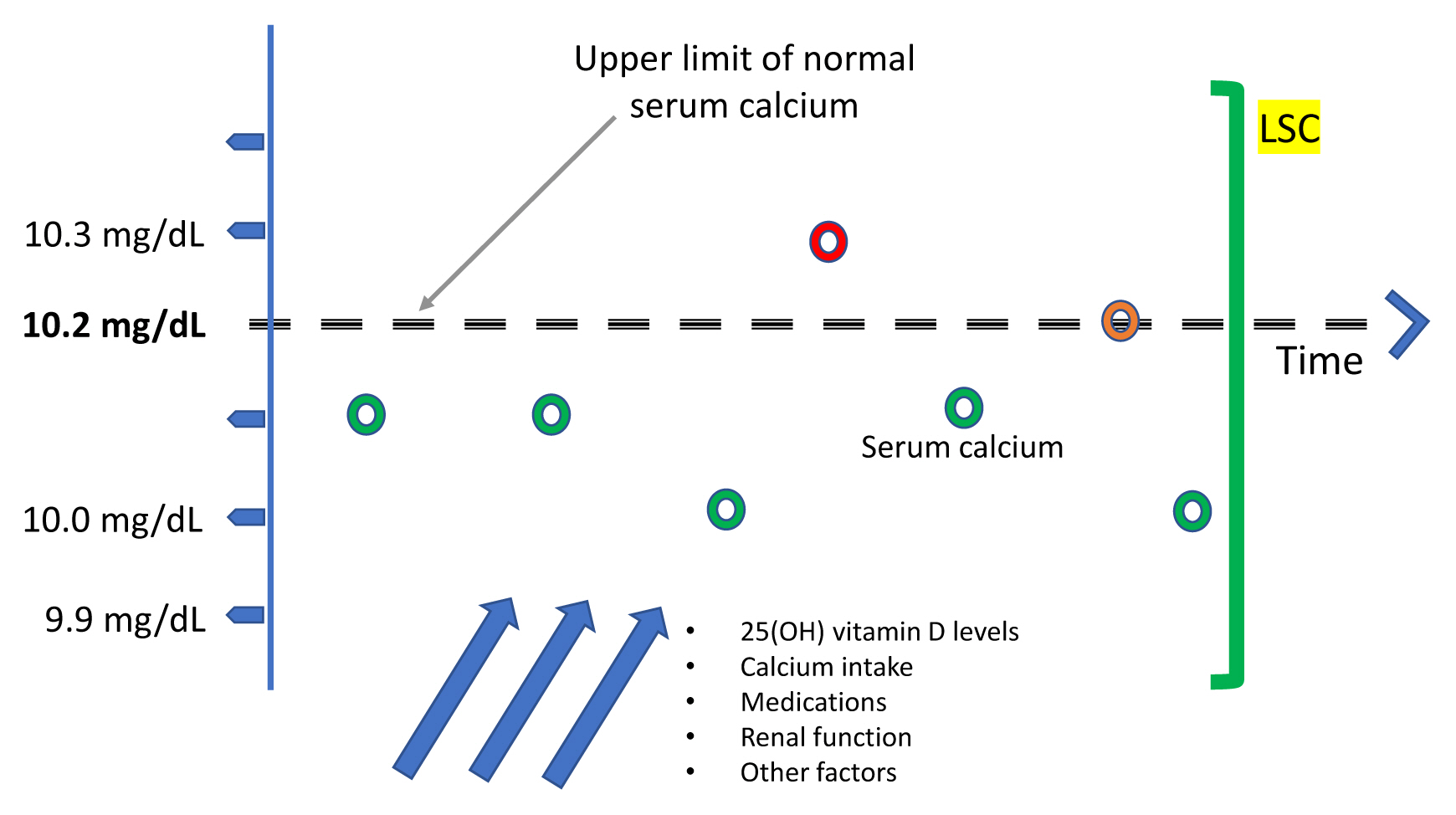
- Since normocalcemic primary hyperparathyroidism (NHPT) was first defined at the Third International Workshop on the Management of Asymptomatic Primary Hyperparathyroidism in 2008, many papers have been published describing its prevalence and possible complications. Guidelines for the management of this condition are still lacking, and making the diagnosis requires fulfillment of strict criteria. Recent studies have shown that intermittent oscillations of serum calcium just below and slightly above the normal limits are very frequent, therefore challenging the assumption that serum calcium must be consistently normal to make the diagnosis. There is debate if these variations in serum calcium outside the normal range should be included under the rubric of NHPT or, rather, a milder form of classical primary hyperparathyroidism. Innovative approaches to define NHPT have been proposed that still need to be validated in prospective studies. Non-classical complications, especially cardiovascular complications, have been associated with NHPT, indicating that hyperparathyroidism may be a cardiovascular risk factor. New associations between parathyroid hormone (PTH) and several other comorbidities have also been reported from observational studies, suggesting that excessive PTH secretion might cause tissue dysfunction independent of serum calcium. Heterogeneous studies using different definitions of NHPT, however, make it difficult to draw definitive conclusions regarding the role of PTH excess when complications other than osteoporosis or kidney stones are described. This review will focus on clinical aspects and suggest an approach to NHPT.
-
Citations
Citations to this article as recorded by- Future Directions in Hypercalcemic and Normocalcemic Primary Hyperparathyroidism: FRAXplus for 10-Year Fracture Risk Assessment (A Retrospective Study)
Ana-Maria Gheorghe, Oana-Claudia Sima, Mihai Costachescu, Nina Ionovici, Mara Carsote
Life.2026; 16(6): 932. CrossRef - Effects of Normocalcemic Hyperparathyroidism on Structural Bone Compromise: A Prospective Observational Cohort Study
John Pietro, Amr Kaadan, Travis Cotton, Jon Olansen, Janine Molino, Roy Aaron
Journal of Bone Metabolism.2026; 33(2): 152. CrossRef - Evaluating the preoperative diagnostic value of 99mTc‐MIBI/99mTcO4− dual‐isotope SPECT/CT fusion imaging and ultrasonography in suspected primary hyperparathyroidism
Yanmei Li, Danna Hou, Zhehao Lyu, Xingrong Lan, Ziyue Zhang, Yu Lu, Peng Fu, Huiqi Gao
Journal of Applied Clinical Medical Physics.2026;[Epub] CrossRef - Parathyroid carcinoma and primary hyperparathyroidism: trends and outcomes
Seungjin Baek, Min Heui Yu, Dong Wook Kim, Chang gon Kim, Na-young Shin, Milim Kim, Yumie Rhee, Jong Ju Jeong, Namki Hong
Endocrine-Related Cancer.2026;[Epub] CrossRef - Diagnostic Performance of Routine Biochemical Markers and Internally
Validated Multivariable Models in Primary and Normocalcemic Primary
Hyperparathyroidism: A Multicenter Retrospective Study
Berçem Ayçiçek, Musab Ahmed Khan Umair, Şenol Pişkin, J.S. Femilda Josephin, Umit Çavdar, Beyza Zeynep Kocabiçak, Özlem Eren, Kadir Alper Küçüker, Tevhid Turan, Mazhar Muslum Tuna, Ersen Karakiliç, Rumeysa Sahinbaş, Remziye Çetin, Denizcan Demir, Ümran Ke
Hormone and Metabolic Research.2026;[Epub] CrossRef - Evaluation of the Thiazide Challenge Test to Differentiate Primary From Hypercalciuria-Related Hyperparathyroidism
Ewout Verly, Bruno Lapauw, Charlotte Verroken
The Journal of Clinical Endocrinology & Metabolism.2025; 110(3): e783. CrossRef - How has the diagnostic approach to parathyroid localization techniques evolved in the past decade? Insights from a single-center experience
Giuseppe Cacciatore, Manuela Mastronardi, Lucia Paiano, Hussein Abdallah, Carmelo Crisafulli, Franca Dore, Stella Bernardi, Nicolò de Manzini, Margherita Sandano, Chiara Dobrinja
Updates in Surgery.2025; 77(2): 389. CrossRef - Dietary calcium intake in primary hyperparathyroidism and in its normocalcemic variant: a case-control study
Nicolò Bisceglia, Matteo Malagrinò, Anna Piazza, Giulia Vandi, Andrea Repaci, Uberto Pagotto, Guido Zavatta
Frontiers in Endocrinology.2025;[Epub] CrossRef - Primary Hyperparathyroidism: An Analysis Amid the Co-Occurrence of Type 2 Diabetes Mellitus
Ana-Maria Gheorghe, Mihaela Stanciu, Claudiu Nistor, Ioana Codruta Lebada, Mara Carsote
Life.2025; 15(4): 677. CrossRef - Micro-costing analysis from Italian Guidelines for the management of sporadic primary hyperparathyroidism
Ilaria Valentini, Michele Basile, Fabio Vescini, Giorgio Borretta, Iacopo Chiodini, Marco Boniardi, Marina Carotti, Elena Castellano, Cristiana Cipriani, Cristina Eller-Vainicher, Sandro Giannini, Maurizio Iacobone, Antonio Stefano Salcuni, Federica Sapon
Global and Regional Health Technology Assessment.2025; 12(1): 186. CrossRef - Temporal Variation of Biochemical Markers and Adenoma Predictors in Normocalcemic Primary Hyperparathyroidism: A Multicenter Retrospective Analysis
Berçem Ayçiçek, Mazhar Müslüm Tuna, Ismail Engin, Mustafa Şahin, Sayid Zuhur, Neşe Ersöz Gülçelik, Hüseyin Yağcı, Ersen Karakılıç, Evin Bozkur, Bekir Çakır, Elif Güneş, Süleyman Baldane, Özen Öz Gül, Gulhan Akbaba, Cevdet Duran, Faruk Kılınç, Güven Barış
Clinical Endocrinology.2025; 103(6): 805. CrossRef - CLINICAL ANALYSIS OF THE FREQUENCY OF PARATHYROID HYPERPLASIA AND HYPERPARATHYROIDISM IN THE CHORNOBYL NPP ACCIDENT SURVIVORS
O. V. Kaminskiy, O. V. Kopylova, D. E. Afanasyev, I. G. Chikalova, I. M. Muraviova, L. O. Tsvet, V. M. Kolodiy, N. S. Dombrovska, Yu. O. Kaminska, I. O. Kiseliova, O. Ya. Pleskach
Проблеми радіаційної медицини та радіобіології = Problems of Radiation Medicine and Radiobiology.2025; 30: 414. CrossRef - Surgery for Normocalcemic Hyperparathyroidism
Pallavi Kulkarni, David Goldenberg
Otolaryngologic Clinics of North America.2024; 57(1): 111. CrossRef - Linea guida sulla gestione terapeutica dell’iperparatiroidismo primario sporadico nell’adulto
Fabio Vescini, Marco Boniardi, Marina Carotti, Elena Castellano, Cristiana Cipriani, Cristina Eller-Vainicher, Sandro Giannini, Maurizio Iacobone, Francesca Pace, Antonio Stefano Salcuni, Federica Saponaro, Stefano Spiezia, Annibale Versari, Guido Zavatta
L'Endocrinologo.2024; 25(2): 222. CrossRef - Secular trends in the incidence and treatment patterns of primary hyperparathyroidism in Korea: a nationwide cohort study
Kyoung Jin Kim, Seungjin Baek, Min Heui Yu, Sungjae Shin, Sungjoon Cho, Yumie Rhee, Namki Hong
JBMR Plus.2024;[Epub] CrossRef - Primary hyperparathyroidism: from guidelines to outpatient clinic
Andrea Palermo, Gaia Tabacco, Polyzois Makras, Guido Zavatta, Pierpaolo Trimboli, Elena Castellano, Maria P. Yavropoulou, Anda Mihaela Naciu, Athanasios D. Anastasilakis
Reviews in Endocrine and Metabolic Disorders.2024; 25(5): 875. CrossRef - Primary hyperparathyroidism caused by an ectopic parathyroid adenoma in the mediastinum (case report)
Y. B. Topolnitskiy, T. A. Milovanova, D. G. Apalkov, Е. Е. Bibik, A. I. Goncharova, M. O. Tsvetukhin
Endocrine Surgery.2024; 18(3): 36. CrossRef - DXA-based bone strain index in normocalcemic primary hyperparathyroidism
Gaia Tabacco, Anda Mihaela Naciu, Carmelo Messina, Gianfranco Sanson, Luca Rinaudo, Roberto Cesareo, Stefania Falcone, Nicola Napoli, Fabio Massimo Ulivieri, Andrea Palermo
Osteoporosis International.2023; 34(5): 999. CrossRef - Iperparatiroidismo primario normocalcemico
Silvia Egiddi, Luigi Bonifazi Meffe, Anda Mihaela Naciu, Gaia Tabacco, Nicola Napoli, Andrea Palermo
L'Endocrinologo.2023; 24(3): 249. CrossRef - The Russian registry of primary hyperparathyroidism, latest update
Natalia G. Mokrysheva, Anna K. Eremkina, Alina R. Elfimova, Elena V. Kovaleva, Anastasiia P. Miliutina, Ekaterina E. Bibik, Anna M. Gorbacheva, Ekaterina A. Dobreva, Irina S. Maganeva, Julia A. Krupinova, Rustam H. Salimkhanov, Lizaveta A. Aboishava, Elen
Frontiers in Endocrinology.2023;[Epub] CrossRef - Incidental Normocalcemic Primary Hyperparathyroidism Presenting With Symptomatic Hypophosphatemia: A Case Report
Omar Tabbikha, Joanne Chamy, Michael El Khoury
Cureus.2023;[Epub] CrossRef - Long-term effects of hypercalcemia in kidney transplant recipients with persistent hyperparathyroidism
Juan Carlos Ramirez-Sandoval, Lluvia Marino, Gabriel Cojuc-Konigsberg, Estefania Reul-Linares, Nathalie Desire Pichardo-Cabrera, Cristino Cruz, Elisa Naomi Hernández-Paredes, Nathan Berman-Parks, Vanessa Vidal-Ruíz, Jonathan Mauricio Estrada-Linares, Alfr
Journal of Nephrology.2023; 37(6): 1497. CrossRef - Evaluating Patients for Secondary Causes of Osteoporosis
E. Michael Lewiecki
Current Osteoporosis Reports.2022; 20(1): 1. CrossRef - Preoperative Thoracic Muscle Mass Predicts Bone Density Change After Parathyroidectomy in Primary Hyperparathyroidism
Seung Won Burm, Namki Hong, Seunghyun Lee, Gi Jeong Kim, Sang Hyun Hwang, Jongju Jeong, Yumie Rhee
The Journal of Clinical Endocrinology & Metabolism.2022; 107(6): e2474. CrossRef - Applications of Metabolomics in Calcium Metabolism Disorders in Humans
Beata Podgórska, Marta Wielogórska-Partyka, Joanna Godzień, Julia Siemińska, Michał Ciborowski, Małgorzata Szelachowska, Adam Krętowski, Katarzyna Siewko
International Journal of Molecular Sciences.2022; 23(18): 10407. CrossRef - Serum Calcium/Phosphorus Ratio in Biochemical Screening of Primary Hyperparathyroidism
Nagihan Bestepe, Fatma Neslihan Cuhaci, Burcak Polat, Berna Evranos Ogmen, Didem Ozdemir, Reyhan Ersoy, Bekir Cakir
Revista da Associação Médica Brasileira.2022; 68(12): 1668. CrossRef
- Future Directions in Hypercalcemic and Normocalcemic Primary Hyperparathyroidism: FRAXplus for 10-Year Fracture Risk Assessment (A Retrospective Study)
Original Article
- Clinical Study
- Radioactive Parathyroid Adenomas on Sestamibi Scans: Low Parathyroid Hormone Secretory Potential and Large Volume
- Sung Hye Kong, Jung Hee Kim, Sang Wan Kim, Chan Soo Shin
- Endocrinol Metab. 2021;36(2):351-358. Published online April 6, 2021
- DOI: https://doi.org/10.3803/EnM.2020.823
- 8,974 View
- 182 Download
- 8 Web of Science
- 9 Crossref
-
Abstract
PDFPubReader ePub
- Background
We investigated the clinical characteristics of parathyroid adenomas according to radioactivity on 99mTc-methoxyisobutylisonitrile (99mTc-MIBI) single-photon emission computed tomography/computed tomography (SPECT/CT) in primary hyperparathyroidism (PHPT) patients.
Methods
The study included 217 patients diagnosed with PHPT from 2000 to 2019 at Seoul National University Hospital who underwent 99mTc-MIBI SPECT/CT scans. On SPECT/CT, the radioactivity of parathyroid adenomas was measured as the ratio of the mean radioactivity count of the parathyroid adenoma to that of the contralateral thyroid.
Results
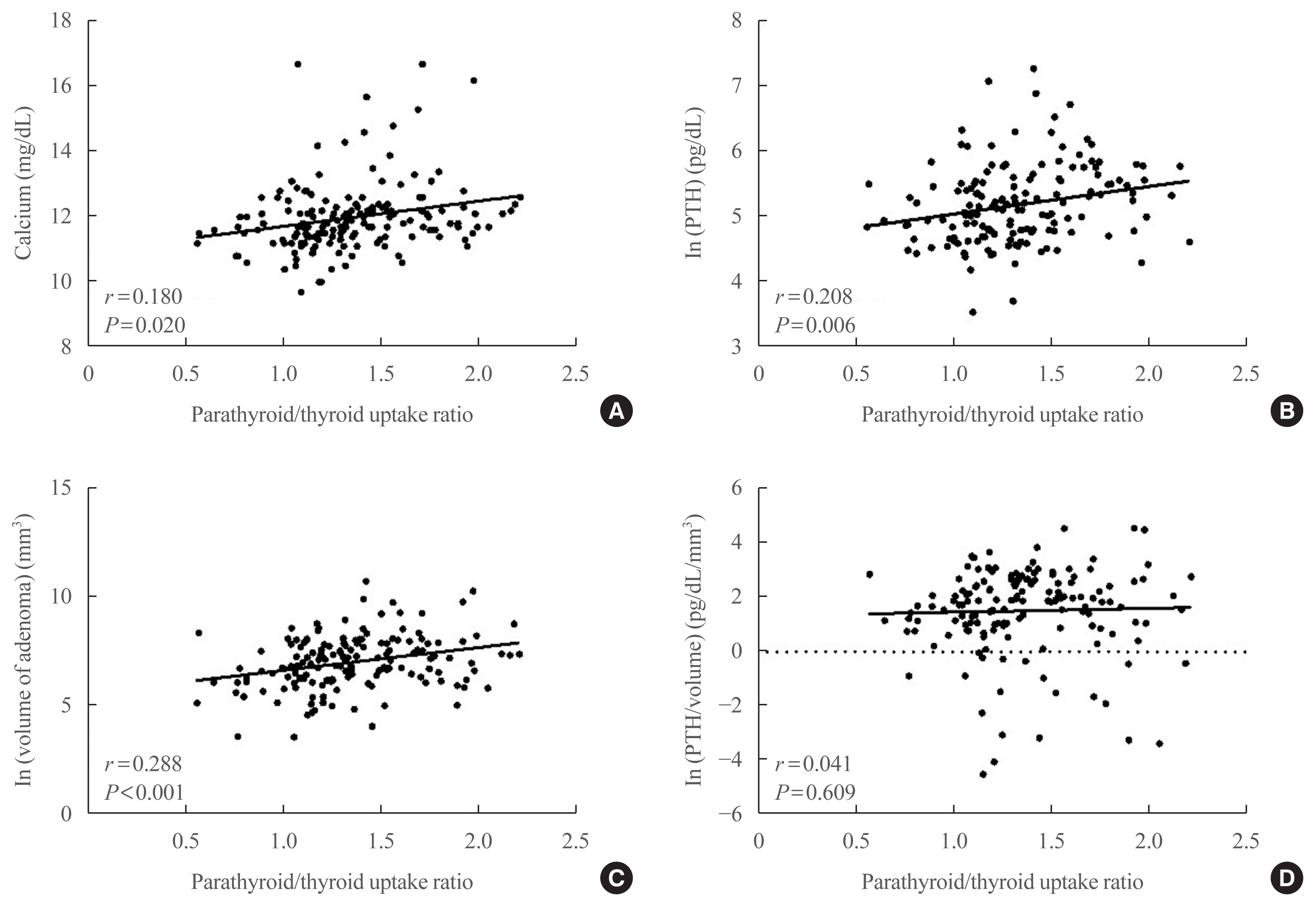
Tumors were localized by MIBI scans in 190 patients (MIBI [+] group) and by ultrasound or parathyroid four-dimensional CT in 27 patients (MIBI [–] group). The mean age was 55 years, and mean body mass index was 23.4 kg/m2. Patients in the MIBI (+) group had higher parathyroid hormone (iPTH) and lower 25-hydroxy vitamin D levels than those in the MIBI (–) group (168.0 pg/mL [interquartile range, IQR, 111.0 to 250.7] vs. 134.7 pg/mL [IQR, 98.2 to 191.2], P=0.049; 15.4 ng/mL [IQR, 11.1 to 20.8] vs. 21.2 ng/mL [IQR, 13.9 to 24.8], P=0.012, respectively). Patients in the MIBI (+) group had larger tumor volumes, but lower iPTH/volume ratios than those in the MIBI (–) group (1,216.66 [IQR, 513.40 to 2,663.02], 499.82 mm3 [IQR, 167.77 to 1,229.80], P=0.002; 0.18 [IQR, 0.08 to 0.46], 0.40 pg/mL/mm3 [IQR, 0.16 to 1.29], P=0.016, respectively). Adenoma radioactivity was positively correlated with calcium, iPTH, and volume (r=0.180, P=0.020; r=0.208, P=0.006; r=0.288, P<0.001, respectively), but not with iPTH/volume.
Conclusion
Parathyroid adenomas with positive MIBI scans had larger volumes and higher iPTH than adenomas with negative scans, but lower iPTH per unit volume. -
Citations
Citations to this article as recorded by- Association Between Biochemical Parameters, Parathyroid Gland Morphometry, and Dual-Phase MIBI SPECT/CT Findings in Primary Hyperparathyroidism
Anna Krzentowska, Aleksander Józef Konturek, Filip Gołkowski, Anna Merklinger-Gruchała, Marcin Barczyński
Journal of Clinical Medicine.2026; 15(5): 1973. CrossRef - Occult Parathyroid Lesions on 99mTc-Sestamibi Scintigraphy: Morphometric, Histopathological and Anatomical Determinants of Detection
Oriana-Eliana Pelineagră, Ioana Golu, Melania Balaș, Daniela Georgiana Amzăr, Iulia Plotuna, Oana Popa, Diana Aruncutean, Dan Cristian Roşu, Ion Icma, Agneta Maria Pusztai, Mărioara Cornianu, Mihaela Iacob, Nicu Olariu, Mihaela Vlad
Biomedicines.2026; 14(7): 1650. CrossRef - Software-Assisted Subtraction with Ultrasound-Correlated Interpretation Reduces Interpretive Ambiguity in Parathyroid Scintigraphy: A Preliminary Prospective Reporting Study
Seckin Bilgic, Elif Isleyen Colak, Irem Koroglu, Degercan Yesilyurt, Kadircan Karatoprak, Ozen Oz Gul, Ercument Gurluler, Eray Alper
Diagnostics.2026; 16(15): 2379. CrossRef - Integrin αvβ6 Expression in Parathyroid Adenomas and Adjacent Non-Neoplastic Parathyroid Tissue: Immunohistochemical Rationale for Integrin αvβ6-Targeted PET Imaging
Amro Tuffaha, Wael Hananeh, Mario Liese, Dai Que Vu, Muin Tuffaha, Michael Starke
Cancers.2026; 18(18): 3026. CrossRef - Study on Uptake Ratio of 99mTc-MIBI Parathyroid Scan
Jung-Soo Kim, Jin-Eui Kim
Journal of Radiological Science and Technology.2025; 48(5): 513. CrossRef - Protein Signatures of Parathyroid Adenoma according to Tumor Volume and Functionality
Sung Hye Kong, Jeong Mo Bae, Jung Hee Kim, Sang Wan Kim, Dohyun Han, Chan Soo Shin
Endocrinology and Metabolism.2024; 39(2): 375. CrossRef - Incidentally detected follicular thyroid carcinoma mimicking parathyroid adenoma on Tc-99m MIBI scan: A case report
Yeon-Hee Han, Hwan-Jeong Jeong, Sun Young Lee, Seok Tae Lim
Medicine.2024; 103(18): e38107. CrossRef - Atypical parathyroid tumor: clinical and parathyroid hormone response to surgical treatment
Antonio Giulio Napolitano, Massimo Monacelli, Valeria Liparulo, Eleonora Coviello, Domenico Pourmolkara, Stefano Avenia, Andrea Polistena
Annals of Surgical Treatment and Research.2023; 105(2): 76. CrossRef - The Relationship between Planar and SPECT/CT Parameters and Functional Markers in Primary Hyperparathyroidism
Guler Silov, Serpil Erdogan Ozbodur
Diagnostics.2023; 13(20): 3182. CrossRef
- Association Between Biochemical Parameters, Parathyroid Gland Morphometry, and Dual-Phase MIBI SPECT/CT Findings in Primary Hyperparathyroidism
Review Articles
- Miscellaneous
- Rare PTH Gene Mutations Causing Parathyroid Disorders: A Review
- Joon-Hyop Lee, Munkhtugs Davaatseren, Sihoon Lee
- Endocrinol Metab. 2020;35(1):64-70. Published online March 19, 2020
- DOI: https://doi.org/10.3803/EnM.2020.35.1.64
- 13,248 View
- 149 Download
- 14 Web of Science
- 12 Crossref
-
Abstract
PDFPubReader ePub
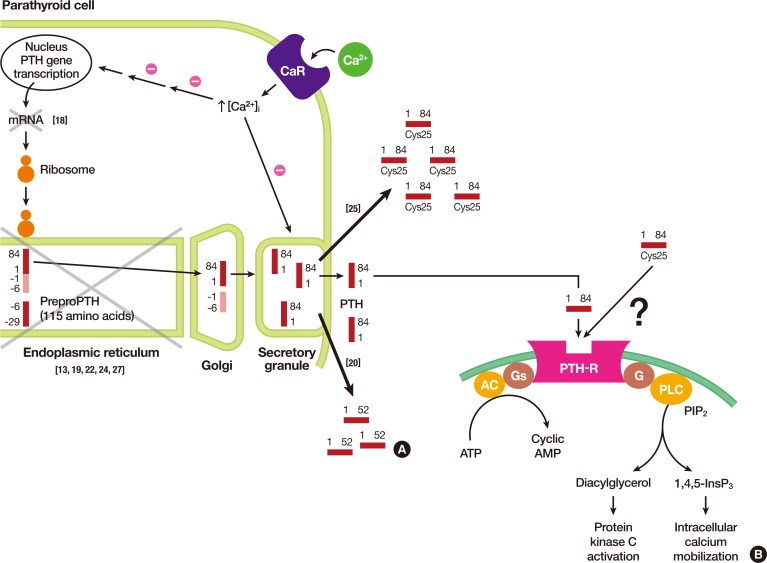
Since parathyroid hormone (PTH) was first isolated and its gene (
PTH ) was sequenced, only eightPTH mutations have been discovered. The C18R mutation inPTH , discovered in 1990, was the first to be reported. This autosomal dominant mutation induces endoplasmic reticulum stress and subsequent apoptosis in parathyroid cells. The next mutation, which was reported in 1992, is associated with exon skipping. The substitution of G with C in the first nucleotide of the second intron results in the exclusion of the second exon; since this exon includes the initiation codon, translation initiation is prevented. An S23P mutation and an S23X mutation at the same residue were reported in 1999 and 2012, respectively. Both mutations resulted in hypoparathyroidism. In 2008, a somatic R83X mutation was detected in a parathyroid adenoma tissue sample collected from a patient with hyperparathyroidism. In 2013, a heterozygous p.Met1_Asp6del mutation was incidentally discovered in a case-control study. Two years later, the R56C mutation was reported; this is the only reported hypoparathyroidism-causing mutation in the mature bioactive part ofPTH . In 2017, another heterozygous mutation, M14K, was detected. The discovery of these eight mutations in thePTH gene has provided insights into its function and broadened our understanding of the molecular mechanisms underlying mutation progression. Further attempts to detect other such mutations will help elucidate the functions of PTH in a more sophisticated manner.-
Citations
Citations to this article as recorded by- The Molecular Biology of Placental Transport of Calcium to the Human Foetus
Valerie Walker
International Journal of Molecular Sciences.2025; 26(1): 383. CrossRef - Hypoparathyroidism: Similarities and differences between Western and Eastern countries
Yu-ying Yang, Yan-hua Deng, Li-hao Sun, Lars Rejnmark, Ling Wang, Peter Pietschmann, Claus‐Christian Glüer, Aliya A. Khan, Salvatore Minisola, Jian-min Liu
Osteoporosis International.2025; 36(3): 391. CrossRef - The Intricacies of Renal Phosphate Reabsorption—An Overview
Valerie Walker
International Journal of Molecular Sciences.2024; 25(9): 4684. CrossRef - Case report: Familial hypoparathyroidism with elevated parathyroid hormone due to an inactivating PTH mutation
Noha Mukhtar, Balgees Alghamdi, Meshael Alswailem, Afaf Alsagheir, Ali S. Alzahrani
Frontiers in Endocrinology.2024;[Epub] CrossRef - Primary Hyperparathyroidism With Undetectable Intact Parathyroid Hormone
Zhixing Song, Jessica McMullin, Forest Huls, Richard Rosenthal, Sravani Bantu, Christopher Wu, Herbert Chen, Brenessa Lindeman
Clinical Medicine Insights: Endocrinology and Diabetes.2024;[Epub] CrossRef - Enhancing bone regeneration and osseointegration using rhPTH(1-34) and dimeric R25CPTH(1-34) in an osteoporotic beagle model
Jeong-Oh Shin, Jong-Bin Lee, Sihoon Lee, Jin-Woo Kim
eLife.2024;[Epub] CrossRef - Molecular and Clinical Spectrum of Primary Hyperparathyroidism
Smita Jha, William F Simonds
Endocrine Reviews.2023; 44(5): 779. CrossRef - Rare cause of persistent hypocalcaemia in infancy due to PTH gene mutation
Savita Khadse, Vrushali Satish Takalikar, Radha Ghildiyal, Nikhil Shah
BMJ Case Reports.2023; 16(9): e256358. CrossRef - Homozygous Ser-1 to Pro-1 mutation in parathyroid hormone identified in hypocalcemic patients results in secretion of a biologically inactive pro-hormone
Patrick Hanna, Ashok Khatri, Shawn Choi, Severine Brabant, Matti L. Gild, Marie L. Piketty, Bruno Francou, Dominique Prié, John T. Potts, Roderick J. Clifton-Bligh, Agnès Linglart, Thomas J. Gardella, Harald Jüppner
Proceedings of the National Academy of Sciences.2023;[Epub] CrossRef - Genetics of monogenic disorders of calcium and bone metabolism
Paul J. Newey, Fadil M. Hannan, Abbie Wilson, Rajesh V. Thakker
Clinical Endocrinology.2022; 97(4): 483. CrossRef - Homozygous missense variant of PTH (c.166C>T, p.(Arg56Cys)) as the cause of familial isolated hypoparathyroidism in a three-year-old child
Stine Linding Andersen, Anja Lisbeth Frederiksen, Astrid Bruun Rasmussen, Mette Madsen, Ann-Margrethe Rønholt Christensen
Journal of Pediatric Endocrinology and Metabolism.2022; 35(5): 691. CrossRef - Novel PTH Gene Mutations Causing Isolated Hypoparathyroidism
Colin P Hawkes, Jamal M Al Jubeh, Dong Li, Susan E Tucker, Tara Rajiyah, Michael A Levine
The Journal of Clinical Endocrinology & Metabolism.2022; 107(6): e2449. CrossRef
- The Molecular Biology of Placental Transport of Calcium to the Human Foetus
- Miscellaneous
- Intraoperative Parathyroid Hormone Monitoring in the Surgical Management of Sporadic Primary Hyperparathyroidism
- Zahra F. Khan, John I. Lew
- Endocrinol Metab. 2019;34(4):327-339. Published online December 23, 2019
- DOI: https://doi.org/10.3803/EnM.2019.34.4.327
- 18,634 View
- 247 Download
- 50 Web of Science
- 54 Crossref
-
Abstract
PDFPubReader ePub
Intraoperative parathyroid hormone monitoring (IPM) has been shown to be a useful adjunct during parathyroidectomy to ensure operative success at many specialized medical centers worldwide. Using the Miami or “>50% intraoperative PTH drop” criterion, IPM confirms the complete excision of all hyperfunctioning parathyroid tissue before the operation is finished, and helps guide the surgeon to identify additional hyperfunctioning parathyroid glands that may necessitate further extensive neck exploration when intraoperative parathyroid hormone (PTH) levels do not drop sufficiently. The intraoperative PTH assay is also used to differentiate parathyroid from non-parathyroid tissues during operations using fine needle aspiration samples and to lateralize the side of the neck harboring the hypersecreting parathyroid through differential jugular venous sampling when preoperative localization studies are negative or equivocal. The use of IPM underscores the recognition and understanding of sporadic primary hyperparathyroidism (SPHPT) as a disease of function rather than form, where the surgeon is better equipped to treat such patients with quantitative instead of qualitative information for durable long-term operative success. There has been a significant paradigm shift over the last 2 decades from conventional to focused parathyroidectomy guided by IPM. This approach has proven to be a safe and rapid operation requiring minimal dissection performed in an ambulatory setting for the treatment of SPHPT.
-
Citations
Citations to this article as recorded by- Improving Intraoperative Parathyroid Hormone Monitoring with a Multidisciplinary Checklist: A Quality Improvement Initiative
Austin R. Swisher, Justin M. Hintze, Chee‐Chee H. Stucky, Patricia A. Cronin, Payam Entezami, Michael L. Hinni, Brent A. Chang
Otolaryngology–Head and Neck Surgery.2026; 174(2): 561. CrossRef - Intraoperative Parathyroid Hormone Estimation: A Critical Adjunct in Minimally Invasive Parathyroidectomy
Susan K. Sebastian, Arvindkumar Baid, Rajeevkumar Malhotra
Indian Journal of Otolaryngology and Head & Neck Surgery.2026; 78(5): 3124. CrossRef - Hyperparathyroidism: current concepts in diagnosis and surgical treatment
Zhiyuan Wang, Xianqiang Yu
Frontiers in Endocrinology.2026;[Epub] CrossRef - Parathyroid Carcinoma in Long-Standing Primary Hyperparathyroidism
C.V.S. Manasa, Aishwarya Bora, Arun Guddeti, Siddhartha Chakravarthy, Michelle De Padua, K.V.S. Hari Kumar
AACE Endocrinology and Diabetes.2026;[Epub] CrossRef - Minimally Invasive Surgical Management of Intrathoracic Ectopic Parathyroid Glands in Primary Hyperparathyroidism
Alberto Busetto, Alessandro Bonis, Vincenzo Verzeletti, Carla Andaloro, Giovanni Comacchio, Elisa de Franceschi, Francesco Londero, William Grossi, Andrea Zuin, Andrea Dell’Amore
Surgical Techniques Development.2026; 15(3): 30. CrossRef - Parathyroid hormone heterogeneity and assay-dependent interpretation in practice
Ewa Kozłowska, Witold Chudziński, Olga Ciepiela
European Journal of Endocrinology.2026; 195(2): R56. CrossRef - Thyroid and Parathyroid
Crystal Diaz, Jennifer A. Wylie, Reese W. Randle
Surgical Clinics of North America.2026;[Epub] CrossRef - Intraoperative PTH monitoring during parathyroid surgery: when 10 minutes is not enough—Can delayed decline be predicted?
Juan M. Rangone, Martín Gallardo, Agustina Forcada, Rita Maria Alvo, Tomás Seip, Marcelo Figari, Andrea Kozak, María Diehl, Juan J. Larrañaga, Ana Jaén, Alejandro Yanzon
Clinical Biochemistry.2026; 145: 111181. CrossRef - Parathyroid Surgery for Primary Hyperparathyroidism in 2026
Shawn Thomas, Fausto F Palazzo
British Journal of Hospital Medicine.2026;[Epub] CrossRef - Refining the role of presurgical PET/4D‐CT in a large series of patients with primary hyperparathyroidism undergoing [18F]Fluorocholine PET/CT
Ashjan Kaseb, Houda Benider, Giorgio Treglia, Caterina Cusumano, Darejan Bessac, Pierpaolo Trimboli, Michel Vix, Arnoldo Piccardo, Adrien Latgé, Alessio Imperiale
European Journal of Clinical Investigation.2025;[Epub] CrossRef - Intraoperative Parathyroid Hormone Kinetics are Variable: An In-Vivo Analysis
Antoinette R. Esce, Robert G. Nicholas, Noah P. Syme, Garth T. Olson, Nathan H. Boyd
Annals of Otology, Rhinology & Laryngology.2025; 134(2): 142. CrossRef - Intraoperative Parathyroid Hormone Monitoring Criteria in Primary Hyperparathyroidism
Phillip Staibano, Michael Au, Han Zhang, Sheila Yu, Winnie Liu, Jesse D. Pasternak, Xing Xing, Carolyn D. Seib, Lisa Orloff, Nhu-Tram Nguyen, Michael K. Gupta, Eric Monteiro, Sameer Parpia, Tyler McKechnie, Alex Thabane, J. E. M. (Ted) Young, Mohit Bhanda
JAMA Otolaryngology–Head & Neck Surgery.2025; 151(3): 190. CrossRef - Increase in serum parathyroid hormone level intraoperatively after parathyroidectomy for primary hyperparathyroidism
Bassam Abboud, Christopher Abboud
American Journal of Otolaryngology.2025; 46(2): 104598. CrossRef - Adenoma weight: the only predictive factor for multiple gland disease in primary hyperparathyroidism
Kirsten LINDNER, Jochen KUSSMANN, Volker FENDRICH, K. Alexander IWEN, Alexandra ZAHN
Minerva Endocrinology.2025;[Epub] CrossRef - Persistence and Recurrence of Primary Hyperparathyroidism
Rasha A.Y. Alnajmi, Dalal S. Ali, Aliya A. Khan
Best Practice & Research Clinical Endocrinology & Metabolism.2025; 39(2): 101986. CrossRef - Validation and implementation of an intraoperative parathyroid hormone assay and workflow: practical advice for endocrine surgery centres
Phillip Staibano, Basma Ahmed, Josko Ivica, Joseph Macri, Michael Au, Han Zhang, Jesse D. Pasternak, Mohit Bhandari, Peter Kavsak
Journal of Laboratory Medicine.2025; 49(3): 107. CrossRef - Unlocking the diagnostic potential of parathormone washout: a path to accurate parathyroid tumor localization
Ekin Yiğit Köroğlu, Berna Evranos Öğmen, Belma Tural Balsak, Mustafa Ömer Yazicioğlu, Cevdet Aydin, Oya Topaloğlu, Reyhan Ersoy, Bekir Çakir
Postgraduate Medicine.2025; 137(5): 439. CrossRef - Analysis of central and peripheral PTH decay values in patients with primary hyperparathyroidism
Giovanna Luiza Caxeiro, Davi Knoll Ribeiro, Rafael Dias Romero, Marcello Rosano, Rodrigo Oliveira Santos, Murilo Catafesta Neves, Marcio Abrahao
Brazilian Journal of Otorhinolaryngology.2025; 91: 101606. CrossRef - Differences in histopathologic features and diagnostic performance of 99mTc-methoxy-isobutyl-isonitrol single photon emission tomography–CT and 18F-fluorocholine positron emission tomography–CT in primary hyperparathyroidism
Irene Osorio-Silla, Diego Meneses González, Hernán Darío Quiceno Arias, Paula Pastor Peinado, Jersy Jair Cárdenas Salas, María Miguélez González, Carlos Augusto Pestana Soares, Luisa Fernanda Martínez Ruiz, Laura Cristina Landaeta Kancev, Luis Martínez Dh
Surgery.2025; 186: 109595. CrossRef - Diagnostic Accuracy of 4D CT in Detecting Parathyroid Adenoma Compared With Ultrasound and Sestamibi SPECT/CT in Primary Hyperparathyroidism: A Retrospective Study
Somdatta Giri, Krishnan Nagarajan, Balamourougan Krishnaraj, Debasis Gochhait, Madhusudhanan Ponnusamy, Anitha Sebastian, Baskararaj Sriviruthi, Jayaprakash Sahoo, Sadishkumar Kamalanathan, Dukhabandhu Naik
Cureus.2025;[Epub] CrossRef - Variable Presentations of Primary Hyperparathyroidism: an Experience of 5 Cases from a Tertiary-Care General Surgery Unit of Northern India
Sukesh Kudumallige Sudhakara, Urvij Jaiswal, Shubhajeet Roy, Kushagra Gaurav, Akshay Anand, Abhinav Arun Sonkar
Indian Journal of Otolaryngology and Head & Neck Surgery.2025; 77(12): 5373. CrossRef - Clinical Features and Management of Rare Giant Parathyroid Adenoma: A Case Series
Dhritiman Maitra, Kaustuv Das, Kaushik Mitra
Archives of Medicine and Health Sciences.2025; 13(2): 278. CrossRef - Predictors of Hungry Bone Syndrome After Parathyroidectomy in Secondary Hyperparathyroidism: A Narrative Review of Bone Turnover Biomarkers and Risk Prediction Tools
Adina Coman, Cristi Tarta, Alexandru Isaic, Marco Marian, Sorin Olariu, Andrei Ardelean, Anca-Monica Macovei-Oprescu, Fazakas Roland, Gheorghe-Nanu Pupca, Silviu Latcu, Cristian Silviu Suciu, Marius Murariu
Journal of Clinical Medicine.2025; 14(21): 7849. CrossRef - Advances in rapid parathyroid gland identification: clinical significance and emerging handheld imaging technologies
Yun Sung Lee, Jong Soo Kim, Seung Hoon Woo
Medical Lasers.2025; 14(3): 140. CrossRef - Intraoperative parathyroid hormone monitoring criteria in secondary and tertiary hyperparathyroidism: A systematic review
Phillip Staibano, Michael Au, Han Zhang, Jesse D. Pasternak, Carolyn D. Seib, Lisa Orloff, Xing Xing, Sheila Yu, Winnie Liu, Jason W. Busse, Sameer Parpia, Nhu-Tram Nguyen, Tyler McKechnie, Alex Thabane, J.E.M. (Ted) Young, Mohit Bhandari
Current Problems in Surgery.2025; 73: 101934. CrossRef - Chasing the Drop: Miami Versus Dual Criteria for Intraoperative Parathyroid Hormone Monitoring in Primary Hyperparathyroidism
Senthil Rajamanickam , Anurag Agarwal, Shruti Senthilkumar, Dimitrios Chatzoudis, Rachel Curran, Vignesh Balasubaramaniam, Shon Williams
Cureus.2025;[Epub] CrossRef - Thermal ablation for primary hyperparathyroidism: long-term follow-up results
RunZhe Wang, Xiao Yang, FeiHong Yu, BoQiang Fan
European Radiology.2025; 36(5): 3570. CrossRef - A >50% Intraoperative Parathyroid Hormone Level Decrease Into Normal Reference Range Predicts Complete Excision of Malignancy in Patients With Parathyroid Carcinoma
Valerie L. Armstrong, Tanaz M. Vaghaiwalla, Cima Saghira, Cheng-Bang Chen, Yujie Wang, Johan Anantharaj, Mehmet Ackin, John I. Lew
Journal of Surgical Research.2024; 300: 567. CrossRef - Intraoperative parathyroid hormone monitoring in parathyroidectomy for hyperparathyroidism: a protocol for a network meta-analysis of diagnostic test accuracy
Phillip Staibano, Kevin Um, Sheila Yu, Mohit Bhandari, Michael K. Gupta, Michael Au, JEM (Ted) Young, Han Zhang
Frontiers in Surgery.2024;[Epub] CrossRef - Primary Hyperparathyroidism
Saba Kurtom, Sally E. Carty
Surgical Clinics of North America.2024; 104(4): 799. CrossRef - Characteristics, management and outcomes of primary hyperparathyroidism from 2009 to 2021: a single centre report from South Africa
Kamal Govind, Imran M. Paruk, Ayesha A. Motala
BMC Endocrine Disorders.2024;[Epub] CrossRef - The significance of determining the Intraoperative level of parathormone during surgical treatment of hyperparathyroidism
Stefan Janičić, Kristina Stepanović, Mia Manojlović, Dean Bjelajac, Slađana Pejaković, Milan Mirković, Dragana Tomić-Naglić, Ivana Bajkin, Tijana Ičin
Hospital Pharmacology - International Multidisciplinary Journal.2024; 11(2): 1462. CrossRef - Revolutionizing parathyroid surgery: the impact of ultrafast intraoperative parathyroid hormone monitoring on patient outcomes
Ayush Anand, Ghomsi M.C. Nathalie, Obianuju Iheomamere Muoghallu, Prakasini Satapathy, Rakesh Kumar Sharma, Mahalaqua Nazli Khatib, Shilpa Gaidhane, Quazi Syed Zahiruddin, Sarvesh Rustagi, Kelechi Michael Azode
International Journal of Surgery Open.2024; 62(4): 534. CrossRef - A new approach for perioperative parathyroid hormone (PTH) measurement to establish cure in patients with primary hyperparathyroidism
Beatrice Sperotto, Natalie Meurer, Anke Meyer, Parviz Ahmad-Nejad, Norbert Bösing, Nadine Lange, Cornelia Dotzenrath, Pier Francesco Alesina
Langenbeck's Archives of Surgery.2024;[Epub] CrossRef - Parathyroidectomy for primary hyperparathyroidism: A retrospective analysis of localization, surgical characteristics, and treatment outcomes
Dongbin Ahn, Ji Hye Kwak, Gil Joon Lee, Jin Ho Sohn
Asian Journal of Surgery.2023; 46(2): 788. CrossRef - Magnitude of parathyroid hormone elevation in primary hyperparathyroidism: Does time of day matter?
C. Corbin Frye, Janessa Sullivan, Sai Anusha Sanka, Jingxia Liu, L. Michael Brunt, William Gillanders, Taylor C. Brown, T.K. Pandian
Surgery.2023; 173(3): 659. CrossRef - Analysis of intraoperative laboratory measurements and imaging techniques such as Tc-99 m-MIBI SPECT/CT, 18F-fluorocholine PET/CT and ultrasound in patients operated with prediagnosis of parathyroid adenoma
Nurullah Bilen, Mehmet Avni Gokalp, Latif Yilmaz, Alper Aytekin, Ilyas Baskonus
Irish Journal of Medical Science (1971 -).2023; 192(4): 1695. CrossRef - Intraoperative Parathyroid Hormone Monitoring Is of Limited Usefulness in Guiding Autotransplantation in Reoperative or Subtotal Parathyroidectomy for Primary Hyperparathyroidism
Bradley A. Richards, Robert A. Vierkant, Benzon M. Dy, Trenton R. Foster, Travis J. McKenzie, Melanie L. Lyden
The American Surgeon™.2023; 89(12): 5421. CrossRef - Does 18F-Fluorocholine PET/CT add value to positive parathyroid scintigraphy in the presurgical assessment of primary hyperparathyroidism?
Alessio Imperiale, Jacob Bani, Gianluca Bottoni, Adrien Latgé, Céline Heimburger, Ugo Catrambone, Michel Vix, Giorgio Treglia, Arnoldo Piccardo
Frontiers in Medicine.2023;[Epub] CrossRef - Intraoperative Identification of Thyroid and Parathyroid Tissues During Human Endocrine Surgery Using the MasSpec Pen
Rachel J. DeHoog, Mary E. King, Michael F. Keating, Jialing Zhang, Marta Sans, Clara L. Feider, Kyana Y. Garza, Alena Bensussan, Anna Krieger, John Q. Lin, Sunil Badal, Elizabeth Alore, Christopher Pirko, Kirtan Brahmbhatt, Wendong Yu, Raymon Grogan, Livi
JAMA Surgery.2023; 158(10): 1050. CrossRef - A Rare Case of Recurrent Parathyroid Adenomas After Initial Parathyroidectomy
Grant N Schalet, Luke Vincent, Carl Eguez, Gerardo Diaz, Mark S Shachner
Cureus.2023;[Epub] CrossRef - Surgical treatment of tertiary hyperparathyroidism: does one fit for all?
Claudio Casella, Claudio Guarneri, Manuela Campanile, Xavier Adhoute, Pier Paolo Gelera, Riccardo Morandi
Frontiers in Endocrinology.2023;[Epub] CrossRef - Variation in parathyroid adenoma size in patients with sporadic, primary hyperparathyroidism: small gland size does not preclude single gland disease
Sophie Dream, Tina W. F. Yen, Kara Doffek, Douglas B. Evans, Tracy S. Wang
Langenbeck's Archives of Surgery.2022; 407(5): 2067. CrossRef - Role and Recent Trend of Intraoperative Parathyroid Hormone Monitoring During Parathyroidectomy in Patients With Primary Hyperparathyroidism
Dongbin Ahn, Ji Hye Kwak
Korean Journal of Otorhinolaryngology-Head and Neck Surgery.2022; 65(5): 253. CrossRef - Parathyroid Adenoma: Rare Cause of Acute Recurrent Pancreatitis
Shikha Mahajan, Alka Kumar, Vivek Aggarwal, Vikas Jain, Vipul Baweja, Ajay Ajmani, Diplomate CBNC, Fellow EBNM LNU
Annals of Pediatric Gastroenterology and Hepatology.2022; 2(3-4): 9. CrossRef - Long-term outcome of surgical techniques for sporadic primary hyperparathyroidism in a tertiary referral center in Belgium
Klaas Van Den Heede, Amélie Bonheure, Nele Brusselaers, Sam Van Slycke
Langenbeck's Archives of Surgery.2022; 407(7): 3045. CrossRef - Contribution of intraoperative parathyroid hormone monitoring to the surgical success in minimal invasive parathyroidectomy
Ismail Ethem Akgün, Mehmet Taner Ünlü, Nurcihan Aygun, Mehmet Kostek, Mehmet Uludag
Frontiers in Surgery.2022;[Epub] CrossRef - Surgery for primary hyperparathyroidism
Murilo Catafesta das Neves, Rodrigo Oliveira Santos, Monique Nakayama Ohe
Archives of Endocrinology and Metabolism.2022; 66(5): 678. CrossRef - Використання інтраопераційного моніторингу рівня паратиреоїдного гормону в мінімально інвазивній хірургії щитоподібної та паращитоподібних залоз
S.V. Chernyshov, A.V. Tymkiv, A.V. Vovkanych, I.I. Komisarenko
Endokrynologia.2022; 27(4): 311. CrossRef - Diagnostic Values of Intraoperative (1-84) Parathyroid Hormone Levels are Superior to Intact Parathyroid Hormone for Successful Parathyroidectomy in Patients With Chronic Kidney Disease
Fangyan Xu, Yaoyu Huang, Ming Zeng, Lina Zhang, Wenkai Ren, Hanyang Qian, Ying Cui, Guang Yang, Wenbin Zhou, Shui Wang, Hui Huang, Huimin Chen, Yujie Xiao, Xueyan Gao, Zhanhui Gao, Jing Wang, Cuiping Liu, Jing Zhang, Baiqiao Zhao, Anning Bian, Fan Li, Hui
Endocrine Practice.2021; 27(11): 1065. CrossRef - Delayed Calcium Normalization after Successful Parathyroidectomy in Primary Hyperparathyroidism
Iván Emilio de la Cruz Rodríguez, Elsy Sarahí García Montesinos, María Fernanda Rodríguez-Delgado, Guadalupe Vargas Ortega, Lourdes Balcázar Hernández, Victoria Mendoza Zubieta, Victor Hernández Avendaño, Baldomero González Virla, Micha�l R. Laurent
Case Reports in Endocrinology.2021;[Epub] CrossRef - Parathyroid Surgery
Aditya S. Shirali, Uriel Clemente-Gutierrez, Nancy D. Perrier
Neuroimaging Clinics of North America.2021; 31(3): 397. CrossRef - Focused parathyroidectomy without intraoperative parathyroid hormone measurement in primary hyperparathyroidism: Still a valid approach?
Shelby Holt
Surgery.2021; 170(6): 1860. CrossRef - Response to the Comment on “Risk Factors of Redo Surgery After Unilateral Focused Parathyroidectomy – Conclusions From a Comprehensive Nationwide Database of 13,247 Interventions Over 6 Years”
Robert Caiazzo, Camille Marciniak, Francois Pattou
Annals of Surgery.2021; 274(6): e861. CrossRef
- Improving Intraoperative Parathyroid Hormone Monitoring with a Multidisciplinary Checklist: A Quality Improvement Initiative
Original Articles
- Adrenal gland
- Effects of Altered Calcium Metabolism on Cardiac Parameters in Primary Aldosteronism
- Jung Soo Lim, Namki Hong, Sungha Park, Sung Il Park, Young Taik Oh, Min Heui Yu, Pil Yong Lim, Yumie Rhee
- Endocrinol Metab. 2018;33(4):485-492. Published online November 30, 2018
- DOI: https://doi.org/10.3803/EnM.2018.33.4.485
- 10,199 View
- 55 Download
- 1 Web of Science
- 1 Crossref
-
Abstract
PDFPubReader ePub
Background Increasing evidence supports interplay between aldosterone and parathyroid hormone (PTH), which may aggravate cardiovascular complications in various heart diseases. Negative structural cardiovascular remodeling by primary aldosteronism (PA) is also suspected to be associated with changes in calcium levels. However, to date, few clinical studies have examined how changes in calcium and PTH levels influence cardiovascular outcomes in PA patients. Therefore, we investigated the impact of altered calcium homeostasis caused by excessive aldosterone on cardiovascular parameters in patients with PA.
Methods Forty-two patients (mean age 48.8±10.9 years; 1:1, male:female) whose plasma aldosterone concentration/plasma renin activity ratio was more than 30 were selected among those who had visited Severance Hospital from 2010 to 2014. All patients underwent adrenal venous sampling with complete access to both adrenal veins.
Results The prevalence of unilateral adrenal adenoma (54.8%) was similar to that of bilateral adrenal hyperplasia. Mean serum corrected calcium level was 8.9±0.3 mg/dL (range, 8.3 to 9.9). The corrected calcium level had a negative linear correlation with left ventricular end-diastolic diameter (LVEDD, ρ=−0.424,
P =0.031). Moreover, multivariable regression analysis showed that the corrected calcium level was marginally associated with the LVEDD and corrected QT (QTc) interval (β=−0.366,P =0.068 and β=−0.252,P =0.070, respectively).Conclusion Aldosterone-mediated hypercalciuria and subsequent hypocalcemia may be partly involved in the development of cardiac remodeling as well as a prolonged QTc interval, in subjects with PA, thereby triggering deleterious effects on target organs additively.
-
Citations
Citations to this article as recorded by- Bone and mineral metabolism in patients with primary aldosteronism: A systematic review and meta-analysis
Anning Wang, Yuhan Wang, Hongzhou Liu, Xiaodong Hu, Jiefei Li, Huaijin Xu, Zhimei Nie, Lingjing Zhang, Zhaohui Lyu
Frontiers in Endocrinology.2022;[Epub] CrossRef
- Bone and mineral metabolism in patients with primary aldosteronism: A systematic review and meta-analysis
- Miscellaneous
- Novel Mutation in PTHLH Related to Brachydactyly Type E2 Initially Confused with Unclassical Pseudopseudohypoparathyroidism
- Jihong Bae, Hong Seok Choi, So Young Park, Do-Eun Lee, Sihoon Lee
- Endocrinol Metab. 2018;33(2):252-259. Published online June 21, 2018
- DOI: https://doi.org/10.3803/EnM.2018.33.2.252
- 10,296 View
- 83 Download
- 13 Web of Science
- 12 Crossref
-
Abstract
PDFPubReader ePub
Background Autosomal-dominant brachydactyly type E is a congenital abnormality characterized by small hands and feet, which is a consequence of shortened metacarpals and metatarsals. We recently encountered a young gentleman exhibiting shortening of 4th and 5th fingers and toes. Initially, we suspected him having pseudopseudohypoparathyroidism (PPHP) because of normal biochemical parameters, including electrolyte, Ca, P, and parathyroid hormone (PTH) levels; however, his mother and maternal grandmother had the same conditions in their hands and feet. Furthermore, his mother showed normal biochemical parameters. To the best of our knowledge, PPHP is inherited via a mutated paternal allele, owing to the paternal imprinting of GNAS (guanine nucleotide binding protein, alpha stimulating) in the renal proximal tubule. Therefore, we decided to further analyze the genetic background in this family.
Methods Whole exome sequencing was performed using genomic DNA from the affected mother, son, and the unaffected father as a negative control.
Results We selected the intersection between 45,490 variants from the mother and 45,646 variants from the son and excluded 27,512 overlapping variants identified from the father. By excluding homogenous and compound heterozygous variants and removing all previously reported variants, 147 variants were identified to be shared by the mother and son. Variants that had least proximities among species were excluded and finally 23 variants remained.
Conclusion Among them, we identified a defect in parathyroid hormone like hormone (
PTHLH ), encoding the PTH-related protein, to be disease-causative. Herein, we report a family affected with brachydactyly type E2 caused by a novelPTHLH mutation, which was confused with PPHP with unclassical genetic penetrance.-
Citations
Citations to this article as recorded by- PTHLH gene variant in an Indian boy with brachydactyly type E: A case report and literature review
Anjana Hulse, Priya Ranganath
Clinical Pediatric Endocrinology.2026; 35(3): 266. CrossRef - Case Report: A novel PTHLH nonsense variant in a mother–son pair with brachydactyly type E and short stature, with a genotype–stature review
Hui Huang, Binyang Zhu, Zaisheng Wang, Zhuqiang Wu, Jinqiu Rao, Yu Yang, Xiangyu Xiong
Frontiers in Endocrinology.2026;[Epub] CrossRef - Human diseases caused by homozygous PTH1R mutations
Ignacio Portales-Castillo, Jakob Höppner, Harald Jüppner, Thomas J. Gardella
Frontiers in Endocrinology.2025;[Epub] CrossRef - A novel heterozygous mutation in PTHLH causing autosomal dominant brachydactyly type E complicated with short stature
Jian Sun, Nian Yang, Zhengquan Xu, Hongbo Cheng, Xiangxin Zhang
Molecular Genetics & Genomic Medicine.2024;[Epub] CrossRef - A novel mutation in PTHLH in a family with a variable phenotype with brachydactyly, short stature, oligodontia and developmental delay
Mirjam E.A. Scheffer-Rath, Hermine E. Veenstra-Knol, Annemieke M. Boot
Bone Reports.2023; 19: 101699. CrossRef - Bioactive phytoconstituents as potent inhibitors of casein kinase-2: dual implications in cancer and COVID-19 therapeutics
Farah Anjum, Md Nayab Sulaimani, Alaa Shafie, Taj Mohammad, Ghulam Md. Ashraf, Anwar L. Bilgrami, Fahad A. Alhumaydhi, Suliman A. Alsagaby, Dharmendra Kumar Yadav, Md. Imtaiyaz Hassan
RSC Advances.2022; 12(13): 7872. CrossRef - Characterization and expression profiling of G protein-coupled receptors (GPCRs) in Spodoptera litura (Lepidoptera: Noctuidae)
Yanxiao Li, Han Gao, Hui Zhang, Runnan Yu, Fan Feng, Jing Tang, Bin Li
Comparative Biochemistry and Physiology Part D: Genomics and Proteomics.2022; 44: 101018. CrossRef - Genes with specificity for expression in the round cell layer of the growth plate are enriched in genomewide association study (GWAS) of human height
Nora E. Renthal, Priyanka Nakka, John M. Baronas, Henry M. Kronenberg, Joel N. Hirschhorn
Journal of Bone and Mineral Research.2020; 36(12): 2300. CrossRef - Search for Novel Mutational Targets in Human Endocrine Diseases
So Young Park, Myeong Han Seo, Sihoon Lee
Endocrinology and Metabolism.2019; 34(1): 23. CrossRef - A Heterozygous Splice-Site Mutation in PTHLH Causes Autosomal Dominant Shortening of Metacarpals and Metatarsals
Monica Reyes, Bert Bravenboer, Harald Jüppner
Journal of Bone and Mineral Research.2019; 34(3): 482. CrossRef - A 3.06-Mb interstitial deletion on 12p11.22-12.1 caused brachydactyly type E combined with pectus carinatum
Jia Huang, Hong-Yan Liu, Rong-Rong Wang, Hai Xiao, Dong Wu, Tao Li, Ying-Hai Jiang, Xue Zhang
Chinese Medical Journal.2019; 132(14): 1681. CrossRef - Parathyroid Hormone-Related Protein in the Hand or Out of Hand?
Sang Wan Kim
Endocrinology and Metabolism.2018; 33(2): 202. CrossRef
- PTHLH gene variant in an Indian boy with brachydactyly type E: A case report and literature review
- Miscellaneous
- Effects of Serum Albumin, Calcium Levels, Cancer Stage and Performance Status on Weight Loss in Parathyroid Hormone-Related Peptide Positive or Negative Patients with Cancer
- Ji-Yeon Lee, Namki Hong, Hye Ryun Kim, Byung Wan Lee, Eun Seok Kang, Bong-Soo Cha, Yong-ho Lee
- Endocrinol Metab. 2018;33(1):97-104. Published online March 21, 2018
- DOI: https://doi.org/10.3803/EnM.2018.33.1.97
- 9,766 View
- 54 Download
- 10 Web of Science
- 8 Crossref
-
Abstract
PDFSupplementary MaterialPubReader ePub
Background A recent animal study showed that parathyroid hormone-related peptide (PTHrP) is associated with cancer cachexia by promoting adipose tissue browning, and we previously demonstrated that PTHrP predicts weight loss (WL) in patients with cancer. In this study, we investigated whether prediction of WL by PTHrP is influenced by clinical factors such as serum albumin, corrected calcium levels, cancer stage, and performance status (PS).
Methods A cohort of 219 patients with cancer whose PTHrP level was measured was enrolled and followed for body weight (BW) changes. Subjects were divided into two groups by serum albumin (cutoff value, 3.7 g/dL), corrected calcium (cutoff value, 10.5 mg/dL), cancer stage (stage 1 to 3 or 4), or PS (Eastern Cooperative Oncology Group 0 to 1 or 2 to 4), respectively. Clinically significant WL was defined as either percent of BW change (% BW) <−5% or % BW <−2% plus body mass index (BMI) <20 kg/m2.
Results After a median follow-up of 327 days, 74 patients (33.8%) experienced clinically significant WL. A positive PTHrP level was associated with a 2-fold increased risk of WL after adjusting for age, baseline BMI, serum albumin, corrected calcium level, cancer stage, and PS. The effect of PTHrP on WL remained significant in patients with low serum albumin, stage 4 cancer, and good PS. Regardless of calcium level, the effect of PTHrP on WL was maintained, although there was an additive effect of higher calcium and PTHrP levels.
Conclusion Early recognition of patients with advanced cancer who are PTHrP positive with hypercalcemia or hypoalbuminemia is needed for their clinical management.
-
Citations
Citations to this article as recorded by- Targeting of HIF2-driven cachexia in kidney cancer
Muhannad Abu-Remaileh, Laura A. Stransky, Nikita Bhalerao, Nitin H. Shirole, Qinqin Jiang, Eddy Saad, Marc Machaalani, Sean M. Vigeant, Hilina Woldemichael, Charles Xu, Jing Lu, Hairong Wei, Zhihong Liu, William Sun, Kei Enomoto, Toni K. Choueiri, Jason R
Nature Medicine.2026; 32(1): 245. CrossRef - Cancer knocks you out by fasting: Cachexia as a consequence of metabolic alterations in cancer
Salvatore Cortellino, Margherita D'Angelo, Massimiliano Quintiliani, Antonio Giordano
Journal of Cellular Physiology.2025;[Epub] CrossRef - Can Patients with Electrolyte Disturbances Be Safely and Effectively Treated in a Hospital-at-Home, Telemedicine-Controlled Environment? A Retrospective Analysis of 267 Patients
Cohn May, Gueron Or, Segal Gad, Zubli Daniel, Hakim Hila, Fizdel Boris, Liber Pninit, Amir Hadar, Barkai Galia
Journal of Clinical Medicine.2024; 13(5): 1409. CrossRef - Parathyroid hormone related protein (PTHrP) in patients with pancreatic carcinoma and overt signs of disease progression and host tissue wasting
Britt-Marie Iresjö, Serkan Kir, Kent Lundholm
Translational Oncology.2023; 36: 101752. CrossRef - Development and Characterization of a Cancer Cachexia Rat Model Transplanted with Cells of the Rat Lung Adenocarcinoma Cell Line Sato Lung Cancer (SLC)
Eiji Kasumi, Miku Chiba, Yoshie Kuzumaki, Hiroyuki Kuzuoka, Norifumi Sato, Banyu Takahashi
Biomedicines.2023; 11(10): 2824. CrossRef - Role of Parathyroid Hormone and Parathyroid Hormone-Related Protein in Protein-Energy Malnutrition
Praopilad Srisuwarn, Sinee Disthabanchong
Frontiers in Bioscience-Landmark.2023;[Epub] CrossRef - Inhibition of epidermal growth factor receptor suppresses parathyroid hormone‐related protein expression in tumours and ameliorates cancer‐associated cachexia
Bahar Zehra Camurdanoglu Weber, Samet Agca, Aylin Domaniku, Sevval Nur Bilgic, Dilsad H. Arabaci, Serkan Kir
Journal of Cachexia, Sarcopenia and Muscle.2022; 13(3): 1582. CrossRef - Metabolic Reprogramming in Adipose Tissue During Cancer Cachexia
Bahar Zehra Camurdanoglu Weber, Dilsad H. Arabaci, Serkan Kir
Frontiers in Oncology.2022;[Epub] CrossRef
- Targeting of HIF2-driven cachexia in kidney cancer
- Site-Specific Difference of Bone Geometry Indices in Hypoparathyroid Patients
- Hye-Sun Park, Da Hea Seo, Yumie Rhee, Sung-Kil Lim
- Endocrinol Metab. 2017;32(1):68-76. Published online February 6, 2017
- DOI: https://doi.org/10.3803/EnM.2017.32.1.68
- 7,486 View
- 39 Download
- 3 Web of Science
- 4 Crossref
-
Abstract
PDFPubReader
Background Hypoparathyroid patients often have a higher bone mineral density (BMD) than the general population. However, an increase in BMD does not necessarily correlate with a solid bone microstructure. This study aimed to evaluate the bone microstructure of hypoparathyroid patients by using hip structure analysis (HSA).
Methods Ninety-five hypoparathyroid patients >20 years old were enrolled and 31 of them had eligible data for analyzing bone geometry parameters using HSA. And among the control data, we extracted sex-, age-, and body mass index-matched three control subjects to each patient. The BMD data were reviewed retrospectively and the bone geometry parameters of the patients were analyzed by HSA.
Results The mean Z-scores of hypoparathyroid patients at the lumbar spine, femoral neck, and total hip were above zero (0.63±1.17, 0.48±1.13, and 0.62±1.10, respectively). The differences in bone geometric parameters were site specific. At the femoral neck and intertrochanter, the cross-sectional area (CSA) and cortical thickness (C.th) were higher, whereas the buckling ratio (BR) was lower than in controls. However, those trends were opposite at the femoral shaft; that is, the CSA and C.th were low and the BR was high.
Conclusion Our study shows the site-specific effects of hypoparathyroidism on the bone. Differences in bone components, marrow composition, or modeling based bone formation may explain these findings. However, further studies are warranted to investigate the mechanism, and its relation to fracture risk.
-
Citations
Citations to this article as recorded by- Vertebral fractures, trabecular bone score and their determinants in chronic hypoparathyroidism
S. Saha, V. Mannar, D. Kandasamy, V. Sreenivas, R. Goswami
Journal of Endocrinological Investigation.2022; 45(9): 1777. CrossRef - Epidemiology and Financial Burden of Adult Chronic Hypoparathyroidism
Sigridur Bjornsdottir, Steven Ing, Deborah M Mitchell, Tanja Sikjaer, Line Underbjerg, Zaki Hassan-Smith, Jad Sfeir, Neil J Gittoes, Bart L Clarke L
Journal of Bone and Mineral Research.2020; 37(12): 2602. CrossRef - Effect of Endogenous Parathyroid Hormone on Bone Geometry and Skeletal Microarchitecture
A Ram Hong, Ji Hyun Lee, Jung Hee Kim, Sang Wan Kim, Chan Soo Shin
Calcified Tissue International.2019; 104(4): 382. CrossRef - Bone responses to chronic treatment of adult hypoparathyroid patients with PTH peptides
Sofie Malmstroem, Lars Rejnmark, Dolores M. Shoback
Current Opinion in Endocrine and Metabolic Research.2018; 3: 51. CrossRef
- Vertebral fractures, trabecular bone score and their determinants in chronic hypoparathyroidism
Review Articles
- Adrenal gland
- Hypoparathyroidism: Replacement Therapy with Parathyroid Hormone
- Lars Rejnmark, Line Underbjerg, Tanja Sikjaer
- Endocrinol Metab. 2015;30(4):436-442. Published online December 31, 2015
- DOI: https://doi.org/10.3803/EnM.2015.30.4.436
- 9,079 View
- 54 Download
- 17 Web of Science
- 17 Crossref
-
Abstract
PDFPubReader
Hypoparathyroidism (HypoPT) is characterized by low serum calcium levels caused by an insufficient secretion of parathyroid hormone (PTH). Despite normalization of serum calcium levels by treatment with activated vitamin D analogues and calcium supplementation, patients are suffering from impaired quality of life (QoL) and are at increased risk of a number of comorbidities. Thus, despite normalization of calcium levels in response to conventional therapy, this should only be considered as an apparent normalization, as patients are suffering from a number of complications and calcium-phosphate homeostasis is not normalized in a physiological manner. In a number of recent studies, replacement therapy with recombinant human PTH (rhPTH(1-84)) as well as therapy with the N-terminal PTH fragment (rhPTH(1-34)) have been investigated. Both drugs have been shown to normalize serum calcium while reducing needs for activated vitamin D and calcium supplements. However, once a day injections cause large fluctuations in serum calcium. Twice a day injections diminish fluctuations, but don't restore the normal physiology of calcium homeostasis. Recent studies using pump-delivery have shown promising results on maintaining normocalcemia with minimal fluctuations in calcium levels. Further studies are needed to determine whether this may improve QoL and lower risk of complications. Such data are needed before replacement with the missing hormone can be recommended as standard therapy.
-
Citations
Citations to this article as recorded by- First Reported Use of Recombinant Parathyroid Hormone in Kenny–Caffey Syndrome Type 2: A Case Report and Literature Review
Maja Djordjevic Milosevic, Anita Skakic, Marina Andjelkovic, Angelica Maria Delgado-Vega, Håkan Thonberg, Kristel Klaassen, Jovana Komazec, Bozica Kecman, Nikola Jocic, Erik Björck, Anna Lindstrand, Maja Stojiljkovic
Diseases.2026; 14(3): 91. CrossRef - Static Magnetic Field-Mediated Parathyroid Xenotransplantation Modulates Lymphocyte Migration: A Potential Immunosuppression-Free Long-Term Treatment for Hypoparathyroidism
Ahmed Alperen Tuncer, Gülnihal Bozdağ, Ezgi Hacıhasanoğlu, Özge Karabıyık Acar, Fikrettin Şahin, Gamze Torun Köse, Erhan Ayşan
Cells.2026; 15(7): 600. CrossRef - Pharmacodynamics of sustained levels of PTH following palopegteriparatide treatment in adults with hypoparathyroidism
Aliya A Khan, Lars Rejnmark, Rajesh Jain, Susanne Pihl, Vibeke Miller Breinholt, Carol Zhao, Bryant Lai, Jenny Ukena, Christopher T Sibley, Aimee D Shu
Journal of the Endocrine Society.2026;[Epub] CrossRef - Consensus-Based Recommendations for the Diagnosis, Treatment, and Monitoring of Hypoparathyroidism: Insights from the DACH Region
Elena Tsourdi, Karin Amrein, Christian Meier, Markus Ketteler, Michael C. Kreissl, Annie Mathew, Tobias Vogelmann, Tino Schubert, Heide Siggelkow
Calcified Tissue International.2025;[Epub] CrossRef - Hypocalcaemia
Zahra Ravat, Zaki Hassan-Smith, Neil Gittoes
Medicine.2025; 53(10): 678. CrossRef - Hydrochlorothiazide with salt restriction in nonsurgical hypoparathyroidism: a placebo-controlled single-blinded randomized crossover trial assessing efficacy and safety
Vivek Jha, Soham Mukherjee, Sanjay Kumar Bhadada, Nancy Sahni, Sant Ram, Pinaki Dutta
JBMR Plus.2025;[Epub] CrossRef - Point-of-Care Peptide Hormone Production Enabled by Cell-Free Protein Synthesis
Madison A. DeWinter, Ariel Helms Thames, Laura Guerrero, Weston Kightlinger, Ashty S. Karim, Michael C. Jewett
ACS Synthetic Biology.2023; 12(4): 1216. CrossRef - Comparing laser speckle contrast imaging and indocyanine green angiography for assessment of parathyroid perfusion
Emmanuel A. Mannoh, Naira Baregamian, Giju Thomas, Carmen C. Solόrzano, Anita Mahadevan-Jansen
Scientific Reports.2023;[Epub] CrossRef - Effects of Multi-stage Procurement on the Viability and Function of Human Donor Parathyroid Glands
Yvonne M. Kelly, Casey Ward, Run Zhang, Shareef Syed, Peter G. Stock, Quan-Yang Duh, Julie A. Sosa, James Koh
Journal of Surgical Research.2022; 276: 404. CrossRef - Kidney Complications and Hospitalization in Patients With Chronic Hypoparathyroidism: A Cohort Study in Sweden
Oskar Swartling, Marie Evans, Tim Spelman, Wafa Kamal, Olle Kämpe, Michael Mannstadt, Ylva Trolle Lagerros, Sigridur Björnsdottir
The Journal of Clinical Endocrinology & Metabolism.2022; 107(10): e4098. CrossRef - Hypocalcaemia
Zaki Hassan-Smith, Neil Gittoes
Medicine.2021; 49(9): 562. CrossRef - Safety and Efficacy of 5 Years of Treatment With Recombinant Human Parathyroid Hormone in Adults With Hypoparathyroidism
Michael Mannstadt, Bart L Clarke, John P Bilezikian, Henry Bone, Douglas Denham, Michael A Levine, Munro Peacock, Jeffrey Rothman, Dolores M Shoback, Mark L Warren, Nelson B Watts, Hak-Myung Lee, Nicole Sherry, Tamara J Vokes
The Journal of Clinical Endocrinology & Metabolism.2019; 104(11): 5136. CrossRef - Management of Endocrine Emergencies in the ICU
Judith Jacobi
Journal of Pharmacy Practice.2019; 32(3): 314. CrossRef - Microencapsulated parathyroid allotransplantation in the omental tissue
Emrah Yucesan, Harun Basoglu, Beyza Goncu, Fahri Akbas, Yeliz Emine Ersoy, Erhan Aysan
Artificial Organs.2019; 43(10): 1022. CrossRef - Die HypAus-Studie
Maximilian Zach, Adelina Tmava-Berisha, Stefan Schatzl, Michael Lehner, Greisa Vila, Karin Amrein
Journal für Klinische Endokrinologie und Stoffwechsel.2018; 11(2): 45. CrossRef -
Sustained release of parathyroid hormone via
in situ
cross‐linking gelatin hydrogels improves the therapeutic potential of tonsil‐derived mesenchymal stem cells for hypoparathyroidism
Yoon Shin Park, Yunki Lee, Yoon Mi Jin, Gyungah Kim, Sung Chul Jung, Yoon Jeong Park, Ki Dong Park, Inho Jo
Journal of Tissue Engineering and Regenerative Medicine.2018;[Epub] CrossRef - Hypocalcaemia
Zaki Hassan-Smith, Neil Gittoes
Medicine.2017; 45(9): 555. CrossRef
- First Reported Use of Recombinant Parathyroid Hormone in Kenny–Caffey Syndrome Type 2: A Case Report and Literature Review
- Mineral, Bone & Muscle
- Emerging Therapies for Osteoporosis
- Michael R. McClung
- Endocrinol Metab. 2015;30(4):429-435. Published online December 31, 2015
- DOI: https://doi.org/10.3803/EnM.2015.30.4.429
- 10,000 View
- 50 Download
- 25 Web of Science
- 23 Crossref
-
Abstract
PDFPubReader
Although several effective therapies are available for the treatment of osteoporosis in postmenopausal women and older men, there remains a need for the development of even more effective and acceptable drugs. Several new drugs that are in late-stage clinical development will be discussed. Abaloparatide (recombinant parathyroid hormone related peptide [PTHrP] analogue) has anabolic activity like teriparatide. Recent data from the phase 3 fracture prevention trial demonstrate that this agent is effective in reducing fracture risk. Inhibiting cathepsin K reduces bone resorption without decreasing the numbers or activity of osteoclasts, thereby preserving or promoting osteoblast function. Progressive increases in bone mineral density (BMD) have been observed over 5 years. Early data suggest that odanacatib effectively reduces fracture risk. Lastly, inhibiting sclerostin with humanized antibodies promotes rapid, substantial but transient increases in bone formation while inhibiting bone resorption. Marked increases in BMD have been observed in phase 2 studies. Fracture prevention studies are underway. The new therapies with novel and unique mechanisms of action may, alone or in combination, provide more effective treatment options for our patients.
-
Citations
Citations to this article as recorded by- Synthetic Vesicle-Based Drug Delivery Systems for Oral Disease Therapy: Current Applications and Future Directions
Pengjie Huang, Weichang Li, Jiezhong Guan, Yibing Jia, Dan Wang, Yurun Chen, Niu Xiao, Songyue Ou, Yan Wang, Bo Yang
Journal of Functional Biomaterials.2025; 16(1): 25. CrossRef - Elevated sclerostin levels contribute to reduced bone mineral density in non-ambulatory stroke patients
Hye Kyoung Lee, Geneva Rose Notario, Sun Young Won, Jung Hwan Kim, Su Min Lee, Ha Seong Kim, Sung-Rae Cho
Bone Reports.2025; 25: 101829. CrossRef - The osteocyte as a signaling cell
Jesus Delgado-Calle, Teresita Bellido
Physiological Reviews.2022; 102(1): 379. CrossRef - Combining sclerostin neutralization with tissue engineering: An improved strategy for craniofacial bone repair
Sophie Maillard, Ludovic Sicard, Caroline Andrique, Coralie Torrens, Julie Lesieur, Brigitte Baroukh, Thibaud Coradin, Anne Poliard, Lotfi Slimani, Catherine Chaussain
Acta Biomaterialia.2022; 140: 178. CrossRef - Effects of sclerostin antibody on bone healing
Atsushi Mihara, Kiminori Yukata, Toshihiro Seki, Ryuta Iwanaga, Norihiro Nishida, Kenzo Fujii, Yuji Nagao, Takashi Sakai
World Journal of Orthopedics.2021; 12(9): 651. CrossRef - Combining Sclerostin Neutralization with Tissue Engineering: An Improved Strategy for Craniofacial Bone Repair
Sophie Maillard, Ludovic Sicard, Caroline Andrique, Coralie Torrens, Julie Lesieur, Brigitte Baroukh, Thibaud Coradin, Anne Poliard, Lotfi Slimani, Catherine Chaussain
SSRN Electronic Journal.2021;[Epub] CrossRef - Potential Biomarkers to Improve the Prediction of Osteoporotic Fractures
Beom-Jun Kim, Seung Hun Lee, Jung-Min Koh
Endocrinology and Metabolism.2020; 35(1): 55. CrossRef - Clinical Application of Teriparatide in Fracture Prevention
Yuehong Chen, Ronghan Liu, Aubryanna Hettinghouse, Shuya Wang, Gang Liu, Chuan-ju Liu
JBJS Reviews.2019; 7(1): e10. CrossRef - The Emerging Role of Osteocytes in Cancer in Bone
Emily G Atkinson, Jesús Delgado‐Calle
JBMR Plus.2019;[Epub] CrossRef - Osteoporosis therapies might lead to intervertebral disc degeneration via affecting cartilage endplate
Zhen Sun, Zhuo-Jing Luo
Medical Hypotheses.2019; 125: 5. CrossRef - Polymersome nanoparticles for delivery of Wnt-activating small molecules
Edoardo Scarpa, Agnieszka A Janeczek, Alethia Hailes, Maria C de Andrés, Antonio De Grazia, Richard OC Oreffo, Tracey A Newman, Nicholas D Evans
Nanomedicine: Nanotechnology, Biology and Medicine.2018; 14(4): 1267. CrossRef - Dual roles of QOA-8a in antiosteoporosis: a combination of bone anabolic and anti-resorptive effects
Jing Wu, Qi Shen, Wei Cui, Yu Zhao, Yue Huai, Yu-chao Zhang, Bei-hua Bao, Chen-xi Liu, Qing Jiang, Jian-xin Li
Acta Pharmacologica Sinica.2018; 39(2): 230. CrossRef - Abaloparatide: Recombinant human PTHrP (1–34) anabolic therapy for osteoporosis
Chee Kian Chew, Bart L. Clarke
Maturitas.2017; 97: 53. CrossRef - Dried and free flowing granules of Spinacia oleracea accelerate bone regeneration and alleviate postmenopausal osteoporosis
Sulekha Adhikary, Dharmendra Choudhary, Naseer Ahmad, Sudhir Kumar, Kapil Dev, Naresh Mittapelly, Gitu Pandey, Prabhat Ranjan Mishra, Rakesh Maurya, Ritu Trivedi
Menopause.2017; 24(6): 686. CrossRef - Romosozumab for the treatment of osteoporosis
Leonardo Bandeira, E. Michael Lewiecki, John P. Bilezikian
Expert Opinion on Biological Therapy.2017; 17(2): 255. CrossRef - The quest for new drugs to prevent osteoporosis-related fractures
T. J. de Villiers
Climacteric.2017; 20(2): 103. CrossRef - Role and mechanism of action of sclerostin in bone
Jesus Delgado-Calle, Amy Y. Sato, Teresita Bellido
Bone.2017; 96: 29. CrossRef - Biochemical Testing Relevant to Bone
Chee Kian Chew, Bart L. Clarke
Endocrinology and Metabolism Clinics of North America.2017; 46(3): 649. CrossRef - Re-Invigorating the Osteoporosis Message
Michael R. McClung
Endocrine Practice.2016; 22(9): 1130. CrossRef - Pharmacodynamics and pharmacokinetics of oral salmon calcitonin in the treatment of osteoporosis
Leonardo Bandeira, E. Michael Lewiecki, John P. Bilezikian
Expert Opinion on Drug Metabolism & Toxicology.2016; 12(6): 681. CrossRef - Osteoporosis treatment: bisphosphonates reign to continue for a few more years, at least?
Michael Pazianas, Bo Abrahamsen
Annals of the New York Academy of Sciences.2016; 1376(1): 5. CrossRef - Anti-senescence and Anti-inflammatory Effects of the C-terminal Moiety of PTHrP Peptides in OA Osteoblasts
Julia Platas, Maria Isabel Guillén, Francisco Gomar, Miguel Angel Castejón, Pedro Esbrit, Maria José Alcaraz
The Journals of Gerontology Series A: Biological Sciences and Medical Sciences.2016; : glw100. CrossRef - Osteocytic signalling pathways as therapeutic targets for bone fragility
Lilian I. Plotkin, Teresita Bellido
Nature Reviews Endocrinology.2016; 12(10): 593. CrossRef
- Synthetic Vesicle-Based Drug Delivery Systems for Oral Disease Therapy: Current Applications and Future Directions
Original Article
- Preoperative Localization and Intraoperative Parathyroid Hormone Assay in Korean Patients with Primary Hyperparathyroidism
- Eirie Cho, Jung Mi Chang, Seok Young Yoon, Gil Tae Lee, Yun Hyi Ku, Hong Il Kim, Myung-Chul Lee, Guk Haeng Lee, Min Joo Kim
- Endocrinol Metab. 2014;29(4):464-469. Published online December 29, 2014
- DOI: https://doi.org/10.3803/EnM.2014.29.4.464
- 8,545 View
- 45 Download
- 10 Web of Science
- 6 Crossref
-
Abstract
PDFPubReader
Background The intraoperative parathyroid hormone (IOPTH) assay is widely used in patients with primary hyperparathyroidism (PHPT). We investigated the usefulness of the IOPTH assay in Korean patients with PHPT.
Methods We retrospectively reviewed the data of 33 patients with PHPT who underwent parathyroidectomy. Neck ultrasonography (US) and 99mTc-sestamibi scintigraphy (MIBI scan) were performed preoperatively and IOPTH assays were conducted.
Results The sensitivity of neck US and MIBI scans were 91% and 94%, respectively. A 50% decrease in parathyroid hormone (PTH) levels 10 minutes after excision of the parathyroid gland was obtained in 91% (30/33) of patients and operative success was achieved in 97% (32/33) of patients. The IOPTH assay was 91% true-positive, 3% true-negative, 0% false-positive, and 6% false-negative. The overall accuracy of the IOPTH assay was 94%. In five cases with discordant neck US and MIBI scan results, a sufficient decrease in IOPTH levels helped the surgeon confirm the complete excision of the parathyroid gland with no additional neck exploration.
Conclusion The IOPTH assay is an accurate tool for localizing hyperfunctioning parathyroid glands and is helpful for evaluating cases with discordant neck US and MIBI scan results.
-
Citations
Citations to this article as recorded by- The Economics of Intraoperative Parathyroid Hormone Monitoring for Parathyroid Surgery: A Scoping Review of Cost Analyses and Economic Evaluations
Phillip Staibano, Mohit Bhandari, Ankit Parmar, Jackie Han, Samyan Shahid, Michael Au, Jesse D. Pasternak, Catlin Yeo, Feng Xie, Martin Almquist, Sameer Parpia, Alexander Rogers, Jason W. Busse, Lisa Orloff, Carolyn Seib, Nhu‐Tram Nguyen, Alex Thabane, Ty
Laryngoscope Investigative Otolaryngology.2026;[Epub] CrossRef - Intraoperative Parathyroid Hormone Monitoring Criteria in Primary Hyperparathyroidism
Phillip Staibano, Michael Au, Han Zhang, Sheila Yu, Winnie Liu, Jesse D. Pasternak, Xing Xing, Carolyn D. Seib, Lisa Orloff, Nhu-Tram Nguyen, Michael K. Gupta, Eric Monteiro, Sameer Parpia, Tyler McKechnie, Alex Thabane, J. E. M. (Ted) Young, Mohit Bhanda
JAMA Otolaryngology–Head & Neck Surgery.2025; 151(3): 190. CrossRef - Single-Center Experience of Parathyroidectomy Using Intraoperative Parathyroid Hormone Monitoring
Seong Hoon Kim, Si Yeon Lee, Eun Ah Min, Young Mi Hwang, Yun Suk Choi, Jin Wook Yi
Medicina.2022; 58(10): 1464. CrossRef - The natural history and hip geometric changes of primary hyperparathyroidism without parathyroid surgery
Kyong Yeun Jung, A. Ram Hong, Dong Hwa Lee, Jung Hee Kim, Kyoung Min Kim, Chan Soo Shin, Seong Yeon Kim, Sang Wan Kim
Journal of Bone and Mineral Metabolism.2017; 35(3): 278. CrossRef - The utility of the radionuclide probe in parathyroidectomy for primary hyperparathyroidism
MS Lim, M Jinih, CH Ngai, NM Foley, HP Redmond
The Annals of The Royal College of Surgeons of England.2017; 99(5): 369. CrossRef - Articles in 'Endocrinology and Metabolism' in 2014
Won-Young Lee
Endocrinology and Metabolism.2015; 30(1): 47. CrossRef
- The Economics of Intraoperative Parathyroid Hormone Monitoring for Parathyroid Surgery: A Scoping Review of Cost Analyses and Economic Evaluations
Case Reports
- 1-34 PTH Could Reverse Impaired Bone Mineralization Induced By the Overdose of Bisphosphonate.
- Kyeong Hye Park, Kwang Joon Kim, Han Seok Choi, Kyoung Min Kim, Eun Young Lee, Seonhui Han, Hyun Sil Kim, Daham Kim, Hannah Seok, Eun Yeong Choe, Yumie Rhee, Sung Kil Lim
- Endocrinol Metab. 2012;27(3):247-250. Published online September 19, 2012
- DOI: https://doi.org/10.3803/EnM.2012.27.3.247
- 14,101 View
- 28 Download
-
Abstract
PDF
- Bisphosphonates are the mainstay of osteoporosis treatment. Despite the fact that bisphosphonates have a relatively good safety record and are tolerated well by the majority of patients, serious adverse events have been associated with their use. A 41-year-old man had been diagnosed with osteoporosis and had taken etidronate 200 mg/day daily for 2 years due to the judgmental error. He was referred for the management of refractory bone pain and generalized muscle ache. Serum calcium, phosphate, 25-hydroxy-vitamin D (25(OH)D), and immunoreactive parathyroid hormone (iPTH) were within normal range. Plain X-ray showed multiple fractures. Whole body bone scan confirmed multiple sites of increased bone uptakes. Tetracycline-labeled bone biopsy showed typical findings of osteomalacia. He was diagnosed with iatrogenic, etidronate-induced osteomalacia. The patient received daily parathyroid hormone (PTH) injection for 18 months. PTH effectively reverses impaired bone mineralization caused by etidronate misuse. Currently, he is doing well without bone pain. Bone mineral density significantly increased, and the increased bone uptake was almost normalized after 18 months. This case seems to suggest that human PTH (1-34) therapy, possibly in association with calcium and vitamin D, is associated with important clinical improvements in patients with impaired bone mineralization due to the side effect of bisphosphonate.
- A Case of CATCH22 Syndrome with Normal Parathyroid Function.
- Min Jeong Lee, So Yeon An, Chang Bum Bae, Young Bae Sohn, Yoon Sok Chung
- Endocrinol Metab. 2012;27(2):151-154. Published online June 20, 2012
- DOI: https://doi.org/10.3803/EnM.2012.27.2.151
- 3,787 View
- 22 Download
- 1 Crossref
-
Abstract
PDF
- CATCH 22 is a medical acronym for cardiac defects, abnormal faces, thymic hypoplasia, cleft palate, and hypocalcemia, and a variable deletion on chromosome 22. It includes DiGeorge syndrome, conotruncal anomaly face syndrome, and velo-cardio-facial syndrome. It has a prevalence estimated at 1:3,000-1:6,000. Most deletions occur at de novo, but autosomal dominant inheritance is observed in 6-10% of cases. Hormonal disorders are common in patients with CATCH22 syndrome. While hypoparathyroidism was the predominant endocrine disturbance that has been documented in the DiGeorge syndrome, other hormonal defects, such as growth hormone deficiency, hypothyroidism, and hyperthyroidism have been occurred in patients with CATCH22 syndrome. The spectrum of parathyroid gland dysfunction in this syndrome ranges from severe neonatal hypocalcemia to normal parathyroid function. Most patients are usually diagnosed in young age, but a few patients with mild abnormality are presented later in life. We report a case of CATCH22 syndrome with normal parathyroid hormone and calcium level in an adult. The diagnosis of CATCH22 syndrome was confirmed by fluorescence in situ hybridization analysis.
-
Citations
Citations to this article as recorded by- A Case of CATCH22 Syndrome Diagnosed in Postmenopausal Woman
Seung Kyung Lee, Min Jeong Lee, Hyo Jin Lee, Bu Kyung Kim, Young Bae Sohn, Yoon-Sok Chung
Journal of Bone Metabolism.2013; 20(1): 57. CrossRef
- A Case of CATCH22 Syndrome Diagnosed in Postmenopausal Woman
Original Article
- The Effects of Combination Therapy of Cathepsin K Inhibitor and PTH on Change in Bone Mineral Density in an Animal Model of Osteoporosis.
- Seung Hun Lee, Jung Min Koh, Young Sun Lee, Beom Jun Kim, Je Yong Choi, Ghi Su Kim
- Endocrinol Metab. 2011;26(4):303-309. Published online December 1, 2011
- DOI: https://doi.org/10.3803/EnM.2011.26.4.303
- 4,167 View
- 35 Download
- 1 Crossref
-
Abstract
PDF
- BACKGROUND
We hypothesized that combination therapy of cathepsin K inhibitor (CTKi) and human parathyroid hormone (1-34) (teriparatide, PTH) would overcome the coupling phenomenon of bone resorption and formation and thus may rapidly increase bone mass. METHODS: We selected a dose of zoledronic acid (ZA) that had shown similar effects with CTKi on body bone mineral density (BMD) change during the preliminary experiment. Female mice were subjected to ovariectomized (OVX control) or a sham operation (SHAM group). The mice were treated with CTKi (CTKi group), ZA (ZA group), PTH (PTH group) or with a combination of PTH with ZA (ZA + PTH group) or CTKi (CTKi + PTH group) for 8 weeks. Total BMD was measured before the operation and at 4 and 8 weeks. RESULTS: In the preliminary results, 10 microg/kg of ZA showed similar BMD changes with CTKi. Compared with the OVX control, BMD in the SHAM, ZA, CTKi, PTH, ZA + PTH, and CTKi + PTH groups was significantly increased after treatment. BMD in the CTKi + PTH group, but not in the ZA + PTH group increased more significantly than in the PTH group at the end of treatment. Compared with the OVX control, changes in BMD in the SHAM, ZA, CTKi, PTH, ZA + PTH, and CTKi + PTH groups increased significantly after 8 weeks of treatment. The change in BMD in the CTKi + PTH group, but not in the ZA + PTH group was more significantly increased than the change in BMD in the PTH group. CONCLUSION: When combined with PTH, CTKi augmented the anabolic action of PTH. Therefore, combination therapy with CTKi and PTH might be a new therapeutic modality capable of overcoming the coupling phenomenon, thereby markedly and rapidly increasing bone mass. -
Citations
Citations to this article as recorded by- The Effects of Combination Therapy of Cathepsin K Inhibitor and PTH on Change of Bone Mineral Density in Animal Model of Osteoporosis
Yumie Rhee
Endocrinology and Metabolism.2011; 26(4): 295. CrossRef
- The Effects of Combination Therapy of Cathepsin K Inhibitor and PTH on Change of Bone Mineral Density in Animal Model of Osteoporosis
Case Report
- Successful Localization of Distant Metastasis in Parathyroid Carcinoma Using Intraoperative Parathyroid Hormone Assay.
- Ho Cheol Hong, Sun Won Kim, Tae Hyung Kim, In Hye Cha, Jae Hee Ahn, Hye Jin Yoo, Hee Young Kim, Ji A Seo, Hyun Koo Kim, Sin Gon Kim, Nan Hee Kim, Kyung Mook Choi, Jae Bok Lee, Sei Hyun Baik, Dong Seop Choi
- Endocrinol Metab. 2011;26(1):92-96. Published online March 1, 2011
- DOI: https://doi.org/10.3803/EnM.2011.26.1.92
- 3,899 View
- 24 Download
- 1 Crossref
-
Abstract
PDF
- Intra-operative parathyroid hormone (IOPTH) assay is a useful tool to confirm complete excision of all hyper-functioning parathyroid gland tissue. In this report, we describe a case with successful localization of distant metastasis in a patient with parathyroid carcinoma using the IOPTH assay. A 53-year-old man presented to our clinic with a serum calcium level of 11.8 mg/dL and an intact PTH level of 233.3 pg/mL. He had been treated for parathyroid carcinoma eleven years ago. Two suspected metastatic lesions were detected on the chest computed tomography. Due to the vastly different surgical field necessary to excise each lesion, we preferentially removed only one lesion and we monitored the other remaining suspected lesion without resection via IOPTH assay. Six months later, the patient's serum calcium and intact PTH levels remained within their normal ranges. To the best of our knowledge, this is the first case to effectively utilize IOPTH assay for the management of metastatic parathyroid carcinoma.
-
Citations
Citations to this article as recorded by- The association of abdominal obesity, obesity and parathyroid hormone in Korean adults (aged≥50 years): The Korea National Health and Nutrition Survey, 2011
Kyu Su Lee, Yo Sang Yoon, Hyun Yoon
Journal of the Korea Academia-Industrial cooperation Society.2015; 16(6): 3882. CrossRef
- The association of abdominal obesity, obesity and parathyroid hormone in Korean adults (aged≥50 years): The Korea National Health and Nutrition Survey, 2011
Original Article
- Identification and Validation of the Relationship of the Anabolic Effect of Parathyroid Hormone with the Wnt/beta-catenin Canonical Pathway.
- Se Hwa Kim, Juan Ji An, Yumie Rhee, Sung Kil Lim
- J Korean Endocr Soc. 2007;22(6):411-418. Published online December 1, 2007
- DOI: https://doi.org/10.3803/jkes.2007.22.6.411
- 3,460 View
- 21 Download
- 2 Crossref
-
Abstract
PDF
- BACKGROUND
It has been well established that daily injections of low dose parathyroid hormone (PTH) increase bone mass in animals and humans. However, the precise mechanisms by which PTH exerts its anabolic action on bone are incompletely understood. The canonical Wnt-b-catenin signaling pathway has recently been demonstrated to have an important role in bone cell function. In the present study, we have examined the interaction between the PTH and Wnt signaling pathways in mouse osteoblastic MC3T3-E1 cells. METHODS & RESULTS: MC3T3-E1 cells were treated with 0.01-0.84 micrometer recombinant PTH. beta-catenin expression was significantly increased after 30 minutes of exposure to PTH and reached a maximum 2.7 fold increase at 1 hr and expression then faded at 6 hrs. In addition, treatment with PTH increased nuclear accumulation of activated beta-catenin; the ratio between the nuclear to cytoplasmic protein was more than three fold at 30 minutes and beyond. Moreover, PTH stimulated T-cell factor/lymphoid enhancer factor (TCF/LEF) reporter gene activity in MC3T3-E1 cells. Confocal microscopy revealed nuclear translocation of beta-catenin by PTH as compared with a glycogen synthase kinase-3beta (GSK-3beta) inhibitor. CONCLUSION: These results suggest that the anabolic mechanism of PTH might be partially associated with the Wnt-canonical pathway. The appropriate target of another anabolic agent should be determined through further studies of this pathway. -
Citations
Citations to this article as recorded by- Effects of N-acetyl-l-cysteine on fish hepatoma cells treated with mercury chloride and ionizing radiation
Jin Kyu Kim, Min Han, Mohammad Nili
Chemosphere.2011; 85(10): 1635. CrossRef - Bone Forming Effect of PTH through Wnt/β-catenin Signaling System
Dong Jin Chung, Min Young Chung
Journal of Korean Endocrine Society.2007; 22(6): 407. CrossRef
- Effects of N-acetyl-l-cysteine on fish hepatoma cells treated with mercury chloride and ionizing radiation
Case Report
- A Case of Primary Hyperparathyroidism Caused by Cystic Parathyroid Adenoma, Diagnosed during Intra-Operative PTH Monitoring.
- Hye Jin Yoo, Nan Hee Kim, Soo Yeon Park, Dong Jin Kim, Sae Jeung Yang, Ju Ri Park, Hee Young Kim, Ji A Seo, Kye Won Lee, Sin Gon Kim, Kyung Mook Choi, Jae Bok Lee, Young Seok Lee, Sei Hyun Baik, Dong Seop Choi
- J Korean Endocr Soc. 2005;20(3):278-282. Published online June 1, 2005
- DOI: https://doi.org/10.3803/jkes.2005.20.3.278
- 2,939 View
- 27 Download
-
Abstract
PDF
- Primary hyperparathyroidism is the most frequent cause of hypercalcemia, and its prevalence is increasing due to the routine examination of serum calcium levels. Primary hyperparathyroidims is most commonly caused by an adenoma or hyperplasia of the parathyroid gland. A cystic parathyroid adenoma is an extremely rare cause of primary hyperparathyroidism. In our case, a-79-year old female presented with lower back pain and constipation. Her serum calcium, phosphate and immunoreactive parathyroid homone levels were 15.6, 1.8mg/dL and 371.8pg/mL, respectively. Neck CT revealed a cystic mass and a contour bulging heterogeneous mass in the left inferior right thyroid gland, respectively. These mass lesions were removed, and the intra-operative parathyroid hormone levels monitored, to confirm the complete resection. After removing the left cystic mass to the inferior thyroid, the serum calcium and immunoreactive parathyroid hormone levels quickly returned to normal. We report a case of primary hyperparathyroidism, caused by a cystic parathyroid adenoma, with a brief review of the literature
Original Article
- Anabolic Effects of Recombinant Human Parathyroid Hormone (1-84) on Bone Histomorphometry in Overiectomized Rats.
- Young Jun Won, Du Hong Park, Jae Hyun Nam, Jong In Yook, Jin Kim, Kyung Rae Kim, Hyun Chul Lee, Kap Bum Huh, Sung Kil Lim
- J Korean Endocr Soc. 1999;14(1):81-90. Published online January 1, 2001
- 1,857 View
- 21 Download
-
Abstract
PDF
- To evaluate the anabolic effects of human recombinant parathyroid hormone [hrPTH(1-84)], we examined effect of low-dose and high-dose of [hrPTH(1-84)] and estradiol on bone histomorphometry in ovariectomized rats. Sixty Sprague-Dawley female rats aged 8~10 weeks were used. Eight weeks after ovariectomy, or sham operation, rats were given daily sc injection of hrPTH (1-84), 30 pg/kg (OVX+L group), 150 pg/kg (OVX+H group), 17-estradiol (30 pg/kg, OVX+E group) or vehicle (OVX+V group) for 4 weeks. After double tetracycline labeling, all rats were killed at day 84. We completed the histomorphometric analysis of distal femoral metaphyseal cancellous bone for trabecular bone volume (TBV), mean trabecular plate thickness (MTPT), mean trabecular plate density (MTPD), mean trabecular plate separation (MTPS), mean osteoid seam width (OSW) and appositional rate (AR). The histomorphometric parameters (TBV, MTPT, OSW and AR) of trabecular bone mass in (OVX+E) group were higher than those in (OVX+V) group. The TBV of trabecular bone in PTH treated groups were higher than that in sham operated, (OVX+V) and (OVX+E) group. The histomorphometric parameters (TBV, MTPD, OSW and AR) of trabecular bone mass in (OVX+H) group showed a tendency to be higher than those in (OVX+L) group, but statistically not significant. In conclusion, Low dose (30 mg/kg) hrPTH (1-84) also shows a sufficient anabolic effect on trabecular bone.
 First
 Prev


