
 KES

Search
- Page Path
- HOME > Search
Original Articles
- Thyroid
- Risk Stratification of Thyroid Nodules Diagnosed as Follicular Neoplasm on Core Needle Biopsy
- Byeong-Joo Noh, Won Jun Kim, Jin Yub Kim, Ha Young Kim, Jong Cheol Lee, Myoung Sook Shim, Yong Jin Song, Kwang Hyun Yoon, In-Hye Jung, Hyo Sang Lee, Wooyul Paik, Dong Gyu Na
- Endocrinol Metab. 2025;40(4):610-622. Published online May 28, 2025
- DOI: https://doi.org/10.3803/EnM.2024.2256

- 4,129 View
- 89 Download
- 1 Web of Science
- 1 Crossref
-
 Abstract
 PDF
 Supplementary Material
 PubReader
 ePub
- Background
This study assessed risk stratification and diagnostic performance for malignancy in thyroid nodules diagnosed as follicular neoplasm (FN) based on core needle biopsy (CNB) subcategories.
Methods
A total of 313 consecutive nodules (>1 cm) diagnosed as FN on CNB with corresponding surgical histology were included. FN subcategories were classified retrospectively for nodules diagnosed before 2022 (retrospective dataset) and prospectively for nodules diagnosed since 2022 (prospective dataset). CNB subcategories were determined using histologic criteria based on architectural uniformity and nuclear atypia, as modified from the 2019 Korean CNB pathology guideline. The diagnostic performance of CNB subcategories, nodule size, and ultrasound risk stratification systems (RSSs) for malignancy was assessed.
Results
CNB subcategory IVb showed a significantly higher malignancy risk compared to other subcategories in both datasets (34.5%–83.7% vs. 4.2%–13.6%, P<0.001). It was also identified as an independent predictor of malignancy in both datasets (P< 0.001), whereas nodule size and all ultrasound RSSs were not predictive of malignancy, including noninvasive follicular thyroid neoplasm with papillary-like nuclear features (NIFTP) (P≥0.079). CNB subcategory IVb demonstrated higher sensitivity for malignancy and a lower surgical rate for benign nodules compared to the nodule size criterion (>2 cm). The combined criterion of CNB subcategory IVb or nodule size >3 cm identified all malignant tumors, excluding NIFTP, in the prospective dataset.
Conclusion
CNB subcategory IVb effectively stratifies malignancy risk in thyroid nodules and outperforms nodule size (>2 cm) and ultrasound RSSs in diagnostic performance. Non-IVb nodules ≤3 cm can be safely managed with ultrasound surveillance instead of immediate surgery. -
Citations
Citations to this article as recorded by
- Advantages of thyroid core needle biopsy: an emerging selective first-line biopsy modality
Jae Ho Shin, Yeseul Kim, Min Kyoung Lee, Jung Hwan Baek, So Lyung Jung
Ultrasonography.2026; 45(3): 205. CrossRef
- Advantages of thyroid core needle biopsy: an emerging selective first-line biopsy modality

- Thyroid
- Comprehensive Proteomics and Machine Learning Analysis to Distinguish Follicular Adenoma and Follicular Thyroid Carcinoma from Indeterminate Thyroid Nodules
- Hee-Sung Ahn, Eyun Song, Chae A Kim, Min Ji Jeon, Yu-Mi Lee, Tea-Yon Sung, Dong Eun Song, Jiyoung Yu, Ji Min Shin, Yeon-Sook Choi, Kyunggon Kim, Won Gu Kim
- Endocrinol Metab. 2025;40(4):623-636. Published online April 10, 2025
- DOI: https://doi.org/10.3803/EnM.2024.2208

- 8,039 View
- 165 Download
- 1 Crossref
-
Abstract
PDFSupplementary MaterialPubReader ePub
- Background
The preoperative diagnosis of follicular thyroid carcinoma (FTC) is challenging because it cannot be readily distinguished from follicular adenoma (FA) or benign follicular nodular disease (FND) using the sonographic and cytological features typically employed in clinical practice.
Methods
We employed comprehensive proteomics and machine learning (ML) models to identify novel diagnostic biomarkers capable of classifying three subtypes: FTC, FA, and FND. Bottom-up proteomics techniques were applied to quantify proteins in formalin-fixed, paraffin-embedded (FFPE) thyroid tissues. In total, 202 FFPE tissue samples, comprising 62 FNDs, 72 FAs, and 68 FTCs, were analyzed.
Results
Close spectrum-spectrum matching quantified 6,332 proteins, with approximately 9% (780 proteins) differentially expressed among the groups. When applying an ML model to the proteomics data from samples with preoperative indeterminate cytopathology (n=183), we identified distinct protein panels: five proteins (CNDP2, DNAAF5, DYNC1H1, FARSB, and PDCD4) for the FND prediction model, six proteins (DNAAF5, FAM149B1, RPS9, TAGLN2, UPF1, and UQCRC1) for the FA model, and seven proteins (ACTN4, DSTN, MACROH2A1, NUCB1, SPTAN1, TAGLN, and XRCC5) for the FTC model. The classifiers’ performance, evaluated by the median area under the curve values of the random forest models, was 0.832 (95% confidence interval [CI], 0.824 to 0.839) for FND, 0.826 (95% CI, 0.817 to 0.835) for FA, and 0.870 (95% CI, 0.863 to 0.877) for FTC.
Conclusion
Quantitative proteome analysis combined with an ML model yielded an optimized multi‐protein panel that can distinguish FTC from benign subtypes. Our findings indicate that a proteomic approach holds promise for the differential diagnosis of FTC. -
Citations
Citations to this article as recorded by- Artificial Intelligence for Thyroid Nodule Diagnosis: From Multimodal Integration to Clinical Utility
Jie Li, Xiaofei Wang
Diagnostics.2026; 16(19): 3255. CrossRef
- Artificial Intelligence for Thyroid Nodule Diagnosis: From Multimodal Integration to Clinical Utility
- Thyroid
- Deep Learning Technology for Classification of Thyroid Nodules Using Multi-View Ultrasound Images: Potential Benefits and Challenges in Clinical Application
- Jinyoung Kim, Min-Hee Kim, Dong-Jun Lim, Hankyeol Lee, Jae Jun Lee, Hyuk-Sang Kwon, Mee Kyoung Kim, Ki-Ho Song, Tae-Jung Kim, So Lyung Jung, Yong Oh Lee, Ki-Hyun Baek
- Endocrinol Metab. 2025;40(2):216-224. Published online January 13, 2025
- DOI: https://doi.org/10.3803/EnM.2024.2058

- 13,240 View
- 327 Download
- 20 Web of Science
- 21 Crossref
-
Abstract
PDFSupplementary MaterialPubReader ePub
- Background
This study aimed to evaluate the applicability of deep learning technology to thyroid ultrasound images for classification of thyroid nodules.
Methods
This retrospective analysis included ultrasound images of patients with thyroid nodules investigated by fine-needle aspiration at the thyroid clinic of a single center from April 2010 to September 2012. Thyroid nodules with cytopathologic results of Bethesda category V (suspicious for malignancy) or VI (malignant) were defined as thyroid cancer. Multiple deep learning algorithms based on convolutional neural networks (CNNs) —ResNet, DenseNet, and EfficientNet—were utilized, and Siamese neural networks facilitated multi-view analysis of paired transverse and longitudinal ultrasound images.
Results
Among 1,048 analyzed thyroid nodules from 943 patients, 306 (29%) were identified as thyroid cancer. In a subgroup analysis of transverse and longitudinal images, longitudinal images showed superior prediction ability. Multi-view modeling, based on paired transverse and longitudinal images, significantly improved the model performance; with an accuracy of 0.82 (95% confidence intervals [CI], 0.80 to 0.86) with ResNet50, 0.83 (95% CI, 0.83 to 0.88) with DenseNet201, and 0.81 (95% CI, 0.79 to 0.84) with EfficientNetv2_ s. Training with high-resolution images obtained using the latest equipment tended to improve model performance in association with increased sensitivity.
Conclusion
CNN algorithms applied to ultrasound images demonstrated substantial accuracy in thyroid nodule classification, indicating their potential as valuable tools for diagnosing thyroid cancer. However, in real-world clinical settings, it is important to aware that model performance may vary depending on the quality of images acquired by different physicians and imaging devices. -
Citations
Citations to this article as recorded by- Molecular intelligence and immune reconnaissance in thyroid cancer: a new paradigm for diagnosis, risk stratification, and therapeutic precision
Marcio J. Concepción-Zavaleta, Jenyfer M. Fuentes-Mendoza, Alfredo Cruz-Quintá, Argelia V. Cadena-Guerrero, Ximena Barrón, Luis Concepción-Urteaga, Cristian D. Armas, José Paz-Ibarra, Juan Eduardo Quiroz-Aldave
Expert Review of Anticancer Therapy.2026; 26(5): 585. CrossRef - Deep Learning for Ultrasound Classification to Identify Noninvasive Follicular Thyroid Neoplasms with Papillary–Like Nuclear Features
I-Hung Chien, Yi-Chiung Hsu, Shih-Ping Cheng
Journal of Imaging Informatics in Medicine.2026;[Epub] CrossRef - Knowledge-Prompted Trustworthy Disentangled Learning for Thyroid Ultrasound Segmentation With Limited Annotations
Wenxu Wang, Weizhen Wang, Qianjin Feng, Yu Zhang, Zhenyuan Ning
IEEE Transactions on Image Processing.2026; 35: 983. CrossRef - Integrating Robotic Bilateral Axillo-Breast Approach Thyroidectomy with Molecular Diagnostics and Artificial Intelligence in Thyroid Cancer Care
Qiang Deng, Xiaoping Men, Duo Jin, Yuzhuo Bai
Biomolecules & Therapeutics.2026; 34(1): 45. CrossRef - Improving Non-Invasive Prediction of Thyroid Nodule Malignancy: A Machine Learning-Based Clinical Approach
Maja Reiner, Hanna Drobińska, Michał Miciak, Michał Kisiel, Szymon Biernat, Krzysztof Kaliszewski
Cancer Management and Research.2026; Volume 18: 1. CrossRef - An early evaluation of MedSigLIP in thyroid cytology: a comparative frozen-encoder benchmark against ImageNet-pretrained encoders
Mehmet Poyrazer, Rıdvan Erten
Frontiers in Endocrinology.2026;[Epub] CrossRef - The Role of Cytology, Histology and Molecular Pathology in the Diagnostic Process of Thyroid Nodules
Mathilde Ribeiro, Sule Canberk, Massimo Bongiovanni
Cancers.2026; 18(11): 1814. CrossRef - Classification of Thyroid Nodules from Ultrasound Images Using Deep Learning Methods
Mehmet Emre Özbey, Mehmet Kaplan, Sercan Yalçın, Muhammed Yıldırım
Muş Alparslan Üniversitesi Fen Bilimleri Dergisi.2026; 14(1): 95. CrossRef - Explainable AI for accurate diagnosis of papillary thyroid carcinoma via fine-needle aspiration cytopathology
Ahmet Kilicarslan, Canan Tastimur, Gokhan Gundogdu, Erhan Akin
The Visual Computer.2026;[Epub] CrossRef - Artificial intelligence-assisted risk stratification of thyroid nodules with atypia of undetermined significance
Jinyoung Kim, Jeongmin Lee, Jeonghoon Ha, Ohjoon Kwon, Ki-Hyun Baek, Chang Myeon Song, Hyeon A Lee, Hyemi Kwon, Inyoung Youn, Mi-ri Kwon, Dong-Jun Lim
European Thyroid Journal.2026;[Epub] CrossRef - Artificial intelligence in otorhinolaryngology: a scoping review of diagnostic, surgical, and rehabilitative applications
Wan-Ling Lin, Sheng-Han Chen, Shih-Shuan Fang
The Egyptian Journal of Otolaryngology.2026;[Epub] CrossRef - Diagnostic performance of multimodal ultrasound-based deep learning models in differentiating benign and malignant thyroid nodules
Huajie Ding, Lei Na, Meiling Hao, Wanlou Chen, Zhen Zhang
Frontiers in Oncology.2026;[Epub] CrossRef - Development and clinical application of an ultrasound-based deep learning model for preoperative staging of colorectal cancer
Jing Zhao, Li-Juan Du, Ying Liu, Dan-Dan Zhu, Hui-Qing Wang, Ming-Kui Shen, Ling-Yue Wang, Hai-Yan Wang
World Journal of Gastrointestinal Oncology.2026;[Epub] CrossRef - Automated segmentation of thyroid tissue and carotid artery in ultrasound videos using expert-in-the-loop deep learning: a foundational step toward AI-assisted thyroid diagnostics
Maria Bolomiti, Joel Burman, Keyur Radiya, Olav Inge Håskjold, Karl Øyvind Mikalsen, Vegard Heimly Brun
Updates in Surgery.2026;[Epub] CrossRef - Artificial intelligence-driven transformation in the management of atypia of undetermined significance (AUS) thyroid nodules
Dehui Qiao, Weiting Huang, Xiaoyu Chen, Maolin Fang, Linjun Xie, Yongsheng Luo, Xiangyu Zhou
Critical Reviews in Oncology/Hematology.2026; 227: 105538. CrossRef - Multimodal Ultrasound-Based Decision Support for Bethesda IV Thyroid Nodules: Integration of Clinical, Radiomics, Deep Learning, and Topological Features
Haolun Ding, Shuangshuang Zhao, Yanwei Chen, Xin Zhang, Zheng Zhang, Jing Yang, Qi Ren, Baoding Chen
Journal of Imaging Informatics in Medicine.2026;[Epub] CrossRef - Artificial intelligence in thyroid nodules and cancer: clinical validation and real-world performance
Mustafa Sahin, Nikolaos George Angelopoulos, Rodis D Paparodis
Endocrine Connections.2026;[Epub] CrossRef - Transforming the Imaging Assessment of Thyroid Nodules with Artificial Intelligence: Advancements and Clinical Integration
Sanaz Vahdati, Kathryn A. Robinson, M. Regina Castro, Marius N. Stan, Kuan Zhang, Bradley J. Erickson
Journal of Imaging Informatics in Medicine.2026;[Epub] CrossRef - Role of artificial intelligence in head and neck surgery - A narrative review
Sarkheel Sarshar, Noor-ul-Huda Bhatti, Momina Amir, Nida Jaffar, Muhammad Hasnain, Syed Ghazi Ali Kirmani, Raza Hussain, Shayan Khalid Ghaloo
Turkish Journal of Surgery.2026;[Epub] CrossRef - Deep Learning for the Diagnosis and Treatment of Thyroid Cancer: A Review
Rili Gao, Shangqing Mai, Song Wang, Wuqiang Hu, Zhangqi Chang, Guozhi Wu, Haixia Guan
Endocrine Practice.2025; 31(12): 1608. CrossRef - Artificial Intelligence for Thyroid Ultrasound: Clinical Performance, Pitfalls, and Practice Integration
Junseok Kang, Jihyun Ahn, Jeong Hun Hah
Clinical Ultrasound.2025; 10(2): 59. CrossRef
- Molecular intelligence and immune reconnaissance in thyroid cancer: a new paradigm for diagnosis, risk stratification, and therapeutic precision
- Thyroid
- Small Multi-Gene DNA Panel Can Aid in Reducing the Surgical Resection Rate and Predicting the Malignancy Risk of Thyroid Nodules
- Moon Young Oh, Hye-Mi Choi, Jinsun Jang, Heejun Son, Seung Shin Park, Minchul Song, Yoo Hyung Kim, Sun Wook Cho, Young Jun Chai, Woosung Chung, Young Joo Park
- Endocrinol Metab. 2024;39(5):777-792. Published online October 14, 2024
- DOI: https://doi.org/10.3803/EnM.2024.2034

- 7,114 View
- 119 Download
- 5 Web of Science
- 6 Crossref
-
Abstract
PDFSupplementary MaterialPubReader ePub
- Background
We explored the utility of a small multi-gene DNA panel for assessing molecular profiles of thyroid nodules and influencing clinical decisions by comparing outcomes between tested and untested nodules.
Methods
Between April 2022 and May 2023, we prospectively performed fine-needle aspiration (FNA) with gene testing via DNA panel of 11 genes (BRAF, RAS [NRAS, HRAS, KRAS], EZH1, DICER1, EIF1AX, PTEN, TP53, PIK3CA, TERT promoter) in 278 consecutive nodules (panel group). Propensity score-matching (1:1) was performed with 475 nodules that consecutively underwent FNA without gene testing between January 2021 and December 2021 (control group).
Results
In the panel group, positive call rate for mutations was 41.7% (BRAF 16.2%, RAS 12.6%, others 11.5%, double mutation 1.4%) for all nodules, and 40.0% (BRAF 4.3%, RAS 19.1%, others 15.7%, double mutation 0.9%) for indeterminate nodules. Benign call rate was 69.8% for all nodules, and 75.7% for indeterminate nodules. In four nodules, additional TP53 (in addition to BRAF or EZH1) or PIK3CA (in addition to BRAF or TERT) mutations were co-detected. Sensitivity, specificity, positive predictive value, and negative predictive value were 80.0%, 53.3%, 88.1%, 38.1% for all nodules, and 78.6%, 45.5%, 64.7%, 62.5% for indeterminate nodules, respectively. Panel group exhibited lower surgical resection rates than the control group for all nodules (27.0% vs. 52.5%, P<0.001), and indeterminate nodules (23.5% vs. 68.2%, P<0.001). Malignancy risk was significantly different between the panel and control groups (81.5% vs. 63.9%, P=0.008) for all nodules.
Conclusion
Our panel aids in managing thyroid nodules by providing information on malignancy risk based on mutations, potentially reducing unnecessary surgery in benign nodules or patients with less aggressive malignancies. -
Citations
Citations to this article as recorded by- Integrative multi-omics refines the molecular subtypes of thyroid cancers and enhances cancer-progression prediction: a retrospective cohort study
Yoo Hyung Kim, Joseph Wang, Jae-Kyung Won, Youngsoo Kim, Sun Wook Cho, Dohyun Han, Young Joo Park
International Journal of Surgery.2026; 112(5): 11987. CrossRef - Impact of Molecular Testing on Surgical Decision-Making in Indeterminate Thyroid Nodules: A Global Meta-Analysis Across Test Generations
Truong Phan-Xuan Nguyen, Andrey Bychkov, Chan Kwon Jung, Kennichi Kakudo, Chanchal Rana
Endocrine Pathology.2026;[Epub] CrossRef - EIF1AX Mutations in thyroid nodules and advanced thyroid carcinoma: a systematic review and meta-analysis
Vincenzo Fiorentino, Patrizia Straccia, Esther Diana Rossi
Virchows Archiv.2026;[Epub] CrossRef - Great Debate: Molecular Testing and Extent of Surgery in Well-Differentiated Thyroid Cancer
Cord Sturgeon, Ashok R. Shaha, Linwah Yip
Annals of Surgical Oncology.2025; 32(7): 4597. CrossRef - Prediction of malignancy risk in Bethesda III nodules: development and validation of multiple machine learning models
Wentian Li, Jiayu Zhu, Ying Wang, Jingxiu Li, Zhonghui Li, Cuicui Wang, Jingli Xue, Peng Zhou, Qingqing He
Frontiers in Endocrinology.2025;[Epub] CrossRef - Inside the Matrix: Integrated Cytology and Molecular Testing of Thyroid FNAC Samples Using a Commercial Synthetic 3D Scaffold
Diana Raluca Streinu, Dana Liana Stoian, Octavian Constantin Neagoe, Mihnea Derban, Paula Diana Ciordas, Catalin Marian
International Journal of Molecular Sciences.2025; 26(22): 11100. CrossRef
- Integrative multi-omics refines the molecular subtypes of thyroid cancers and enhances cancer-progression prediction: a retrospective cohort study
Review Articles
- Thyroid
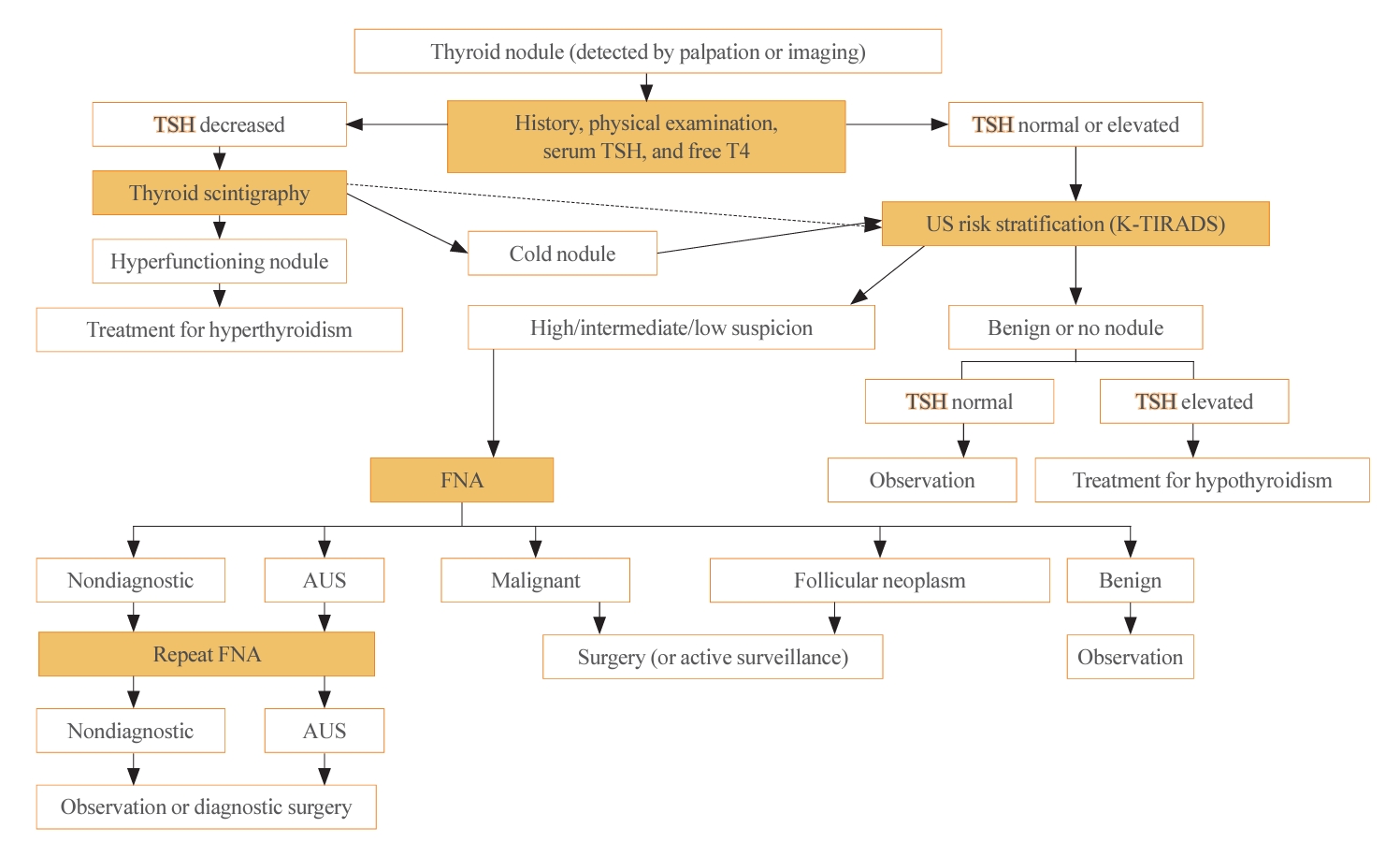
- A Narrative Review of the 2023 Korean Thyroid Association Management Guideline for Patients with Thyroid Nodules
- Eun Kyung Lee, Young Joo Park, Chan Kwon Jung, Dong Gyu Na
- Endocrinol Metab. 2024;39(1):61-72. Published online February 14, 2024
- DOI: https://doi.org/10.3803/EnM.2024.1938
- 23,974 View
- 835 Download
- 22 Web of Science
- 31 Crossref
-
Abstract
PDFPubReader ePub
- The 2023 Korean Thyroid Association (KTA) Management Guideline for Patients with Thyroid Nodules constitute an update of the 2016 KTA guideline for thyroid nodules and cancers that focuses specifically on nodules. The 2023 guideline aim to offer updated guidance based on new evidence that reflects the changes in clinical practice since the 2016 KTA guideline. To update the 2023 guideline, a comprehensive literature search was conducted from January 2022 to May 2022. The literature search included studies, reviews, and other evidence involving human subjects that were published in English in MEDLINE (PubMed), Embase, and other relevant databases. Additional significant clinical trials and research studies published up to April 2023 were also reviewed. The limitations of the current evidence are discussed, and suggestions for areas in need of further research are identified. The purpose of this review is to provide a summary of the 2023 KTA guideline for the management of thyroid nodules released in May 2023 and to give a balanced insight with comparison of recent guidelines from other societies.
-
Citations
Citations to this article as recorded by- Long-Term Surveillance for Benign Thyroid Nodules
Manuela Macera, Rossella Melcarne, Giorgio Grani
Endocrine Practice.2026; 32(1): 77. CrossRef - Ultrasonographic Features in Recognition of Malignant Thyroid Nodule with Fine Needle Aspiration Cytology as the Gold Standard
Abdul Samad, Naveed Khan Kakar, Aisha Shahid Mughal, Shazia Shabbir
Pakistan Journal of Health Sciences.2026; : 33. CrossRef - Integrative multi-omics refines the molecular subtypes of thyroid cancers and enhances cancer-progression prediction: a retrospective cohort study
Yoo Hyung Kim, Joseph Wang, Jae-Kyung Won, Youngsoo Kim, Sun Wook Cho, Dohyun Han, Young Joo Park
International Journal of Surgery.2026; 112(5): 11987. CrossRef - Elderly age and male gender as risk factors for Non Diagnostic cytology at thyroid fine needle aspiration: results of a large cytological series
Laura Croce, Spyridon Chytiris, Marsida Teliti, Isabella Chiardi, Francesca Coperchini, Linda Loretta Businaro, Flavia Magri, Tshering Dorji, Mario Rotondi
Endocrine.2026;[Epub] CrossRef - Diagnostic Performance of Five Societies’ Ultrasound Risk Stratification Systems for Thyroid Malignancy According to Nodule Size: A Comparison Using a Standardized Ultrasound Lexicon
Dong Gyu Na, Byeong-Joo Noh, Won Jun Kim, Jin Yub Kim, Ha Young Kim, Jong Cheol Lee, Myoung Sook Shim, Yong Jin Song, Kwang Hyun Yoon, Wooyul Paik
Thyroid®.2026; 36(4): 408. CrossRef - Risk Stratification Tools for Thyroid Cancer: A Systematic Review of Models Combining Ultrasound, Cytology, and Clinical Risk Factors
Emma Watts, Zakariya Sattar, Kristien Boelaert, Neil Sharma
Thyroid®.2026;[Epub] CrossRef - Impact of Health Behaviors on Cardiovascular Risk in Thyroid Cancer Survivors according to Metastasis: A Nationwide Cohort Study
Jeongmin Lee, Jaekyung Lee, Joonseon Park, Kwangsoon Kim, Ja Seong Bae, Kyung-Do Han, Dong-Jun Lim
Endocrinology and Metabolism.2026;[Epub] CrossRef - Comparison of thyroid-specific quality of life after thermal ablation vs. thyroid lobectomy for benign thyroid nodules
Yan Li, Shengnan Huo, Ying Wei, Zhenlong Zhao, Lili Peng, Jie Wu, ShiLiang Cao, Na Yu, Wenjia Cai, Song Li, Shuqi Li, Ming-an Yu
BMC Endocrine Disorders.2026;[Epub] CrossRef - Integrating Digital Ki-67 Labeling Index and K-TIRADS for Malignancy Risk Stratification in Thyroid Core Needle Biopsies
Yujin Cha, Sue Youn Kim, Chankyung Kim, Ja Seong Bae, Dong-Jun Lim, So-Lyung Jung, Chan Kwon Jung
Cancers.2026; 18(14): 2260. CrossRef - Ablation of Benign Thyroid Nodules: Indian Society of Vascular and Interventional Radiology Consensus Statement
Sanchita Gupta, Stanzin Spalkit, Chinmay P. Nagesh, Vikas HP, Gaurav Pawar, Navin M. Mulimani, Shakthi Parvathi, Pratik Bangde, Basavaraj Biradar, Tom George, Swish Kumar Singh, Jenny Gandhi, Devasenathipathy Kandasamy, Meenu Bagarhatta, Santosh B. Patil,
Journal of Clinical Interventional Radiology ISVIR.2026;[Epub] CrossRef - Prediction of Central Lymph Node Metastasis in Papillary Thyroid Microcarcinoma Using a Deep Learning Radiomics Model Based on SAM3 Automatic Segmentation of Ultrasound Images: A Multicenter Cohort Study
Jun Song, Yuan Zhang, Xiachuan Qin, Xiaoling Liu, Fanding He
Academic Radiology.2026;[Epub] CrossRef - Current Perspectives on Thyroid Nodule Evaluation: Integrating Cytomorphology, Ultrasound Risk Stratification, and Molecular Testing
Marc P. Pusztaszeri, Zubair W. Baloch
Modern Pathology.2026; 39(10): 101039. CrossRef - Recomendaciones de la Sociedad Española de Endocrinología y Nutrición (SEEN) sobre «qué no hacer» en la práctica clínica
Juan José Díez, Emma Anda, Irene Bretón, Cintia González-Blanco, María Miguélez, Ana Zugasti, Alberto Fernández
Endocrinología, Diabetes y Nutrición.2025; 72(3): 101531. CrossRef - Association Between Metabolic Dysfunction-Associated Steatotic Liver Disease and Thyroid Cancer
Sang Yi Moon, Minkook Son, Jung-Hwan Cho, Hye In Kim, Ji Min Han, Ji Cheol Bae, Sunghwan Suh
Thyroid®.2025; 35(1): 79. CrossRef - Comparison of core-needle biopsy and repeat fine-needle aspiration biopsy for thyroid nodules with initially inconclusive findings: a systematic review, diagnostic accuracy meta-analysis, and meta-regression
Hendra Zufry, Timotius Ivan Hariyanto
Journal of the American Society of Cytopathology.2025; 14(3): 159. CrossRef - Recommendations of the Spanish Society of Endocrinology and Nutrition (SEEN) on “what not to do” in clinical practice
Juan José Díez, Emma Anda, Irene Bretón, Cintia González-Blanco, María Miguélez, Ana Zugasti, Alberto Fernández
Endocrinología, Diabetes y Nutrición (English ed.).2025; 72(3): 101531. CrossRef - Enhancing recurrent laryngeal nerve localization during transoral endoscopic thyroid surgery using augmented reality: a proof-of-concept study
Moon Young Oh, Yeonjin Choi, Taesoo Jang, Eun Kyung Choe, Hyoun-Joong Kong, Young Jun Chai
Annals of Surgical Treatment and Research.2025; 108(3): 135. CrossRef - Surgical Extent of Low-to-Intermediate Thyroid Cancer: Molecular Testing and Clinical Decision-Making
Jae Won Chang
International Journal of Thyroidology.2025; 18(1): 19. CrossRef - Systematic review and meta-analysis of diagnostic accuracy of one-step nucleic acid amplification for lymph node metastases of papillary thyroid carcinoma
Maria Magdalena Llompart-Coll, Paula Domínguez-Garijo, Martí Manyalich-Blasi, Gemma Domènech-Gómez, Iria Perales-Galan, David Saavedra-Pérez, Maria Teresa Rodrigo, Sergi Vidal-Sicart, Miguel Pera-Roman, Oscar Vidal-Pérez
Langenbeck's Archives of Surgery.2025;[Epub] CrossRef - Diagnosis and Evaluation of Aggressiveness Using Circulating Plasma miRNAs in Papillary Thyroid Microcarcinoma
Jiwon Jang, Ji Min Kim, Sung-Chan Shin, Yong-il Cheon, Bo Hyun Kim, Mijin Kim, Sang Soo Kim, Byung-Joo Lee
Cancers.2025; 17(13): 2079. CrossRef - Ultrasound-Guided Microwave Ablation for Autonomous Hyperfunctioning Thyroid Nodule in a Child
Meiye Li, Xin Li, Hongxia Zhang, Jingyu Chen, Zhenzhen Zhao, Jun Zhang, Xiangru Kong
Indian Journal of Pediatrics.2025; 92(10): 1101. CrossRef - Sorveglianza attiva nei noduli tiroidei: pro e contro
Giulia Brigante, Gloria Agrimonti, Nicolò Bacchi, Francesco Costantino, Roberta Sueri, Vincenzo Rochira, Manuela Simoni
L'Endocrinologo.2025; 26(5): 623. CrossRef - Comparative evaluation of two automated immunoassays for serum thyroglobulin quantification
Kyoung Ho Roh, Hyunyong Hwang
Kosin Medical Journal.2025; 40(3): 213. CrossRef - Prospective differentiation of difficult-to-diagnose thyroid nodules using shear wave elastography
Luying Gao, Xuehua Xi, Yuxin Jiang, Qiong Gao, Jiajia Tang, Xiao Yang, Shenling Zhu, Ruina Zhao, Xingjian Lai, Bo Zhang
Journal of Cancer Research and Therapeutics.2025; 21(6): 1115. CrossRef - 2023 Update of the Korean Thyroid Association Guidelines for the Management of Thyroid Nodules
Eun Kyung Lee, Young Joo Park
Clinical Thyroidology®.2024; 36(4): 153. CrossRef - Systemic therapy for differentiated thyroid cancer with distant metastasis
Eun Kyung Lee
Journal of the Korean Medical Association.2024; 67(7): 484. CrossRef - Educational exchange in thyroid core needle biopsy diagnosis: enhancing pathological interpretation through guideline integration and peer learning
Agnes Stephanie Harahap, Chan Kwon Jung
Journal of Pathology and Translational Medicine.2024; 58(5): 205. CrossRef - Standardized Ultrasound Evaluation for Active Surveillance of Low-Risk Thyroid Microcarcinoma in Adults: 2024 Korean Society of Thyroid Radiology Consensus Statement
Ji Ye Lee, Min Kyoung Lee, Hyun Kyung Lim, Chang Yoon Lee, Jin Yong Sung, Jung Hyun Yoon, Soo Yeon Han, Jung Hee Shin, Ji-hoon Kim, So Lyung Jung, Sae Rom Chung, Jung Hwan Baek, Dong Gyu Na
Korean Journal of Radiology.2024; 25(11): 942. CrossRef - Thermal ablation for Bethesda III and IV thyroid nodules: current diagnosis and management
Wen-Hui Chan, Pi-Ling Chiang, An-Ni Lin, Yen-Hsiang Chang, Wei-Che Lin
Ultrasonography.2024; 43(6): 395. CrossRef - Cytologic hallmarks and differential diagnosis of papillary thyroid carcinoma subtypes
Agnes Stephanie Harahap, Chan Kwon Jung
Journal of Pathology and Translational Medicine.2024; 58(6): 265. CrossRef - Standardized Ultrasound Evaluation for Active Surveillance of Low-Risk Thyroid Microcarcinoma in Adults: 2024 Korean Society of Thyroid Radiology Consensus Statement
Ji Ye Lee, Min Kyoung Lee, Hyun Kyung Lim, Chang Yoon Lee, Jin Yong Sung, Jung Hyun Yoon, Soo Yeon Hahn, Jung Hee Shin, Ji-hoon Kim, So Lyung Jung, Sae Rom Chung, Jung Hwan Baek, Dong Gyu Na
Journal of the Korean Society of Radiology.2024; 85(6): 1060. CrossRef
- Long-Term Surveillance for Benign Thyroid Nodules
- Thyroid
- Novel and Advanced Ultrasound Techniques for Thyroid Thermal Ablation
- Wai-Kin Chan, Jui-Hung Sun, Miaw-Jene Liou, Chia-Jung Hsu, Yu-Ling Lu, Wei-Yu Chou, Yan-Rong Li, Feng-Hsuan Liu
- Endocrinol Metab. 2024;39(1):40-46. Published online February 13, 2024
- DOI: https://doi.org/10.3803/EnM.2024.1917
- 12,443 View
- 429 Download
- 13 Web of Science
- 13 Crossref
-
Abstract
PDFPubReader ePub
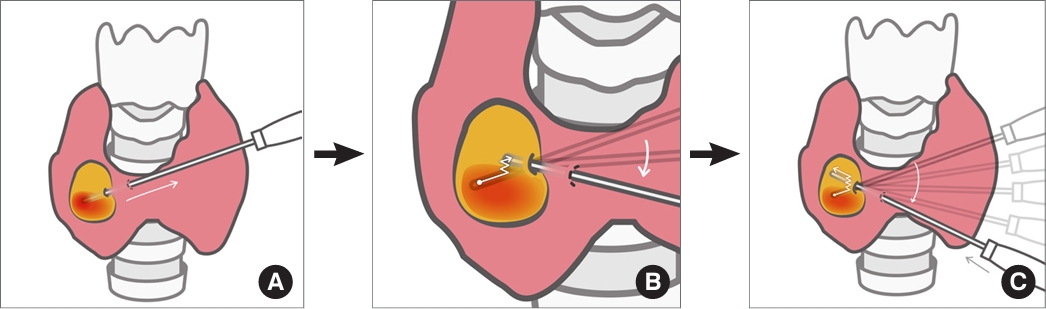
- Thyroid radiofrequency ablation and microwave ablation are widely adopted minimally invasive treatments for diverse thyroid conditions worldwide. Fundamental skills such as the trans-isthmic approach and the moving shot technique are crucial for performing thyroid ablation, and advanced techniques, including hydrodissection and vascular ablation, improve safety and efficacy and reduce complications. Given the learning curve associated with ultrasound-guided therapeutic procedures, operators need training and experience. While training models exist, limited attention has been given to ultrasound maneuvers in ablation needle manipulation. This article introduces two essential maneuvers, the zigzag moving technique and the alienate maneuver, while also reviewing the latest ultrasound techniques in thyroid ablation, contributing valuable insights into this evolving field.
-
Citations
Citations to this article as recorded by- A cost-effective porcine training model for thermal ablation of thyroid nodules and subsequent transoral endoscopic thyroidectomy
Lei Min, Yujing Weng, Weichun Chen, Debiao Chen, Qing Ai, Jiang Jiang, Zhiheng Huang
Minimally Invasive Therapy & Allied Technologies.2026; 35(1): 79. CrossRef - Factors associated with early complete resolution after radiofrequency ablation for low-risk papillary thyroid microcarcinoma: a dual-center retrospective study
Yuxuan Qiu, Yina Zhang, Jingqi Zhu, Yun Gong, Lu Yin, Pin Fan, Lian Zhang, Lingyun Bao, Jianhua Fang, Jun Lou, Chenke Xu
European Radiology.2026; 36(7): 5277. CrossRef - Controlled minimally invasive surgical interventions for the treatment of patients with thyroid carcinoma
David D. Dolidze, Zurab A. Bagatelia, Suren G. Laboyan, Arshak V. Vardanyan, Konstantin S. Titov, Ivan N. Lebedinsky, Georgi Genadi Melkonyan, Dmitriy V. Matveev, Nodar N. Gogitidze, Andrei Y. Lukin, Armen R. Oganyan, David G. Gogolashvili, Anastasia V. B
Journal of Experimental and Clinical Surgery.2026; 19(1): 45. CrossRef - Expression of serum inflammatory factors and vascular endothelial growth factor and volume reduction rate in thyroid nodules treated with ultrasound-guided radiofrequency ablation
Hui Yang, Mei Liu, Yadong Zhou, Yali He, Huijuan Jin
Journal of Medical Biochemistry.2026; 45(10): 2206. CrossRef - North American Society for Interventional Thyroidology Statement on Directed Ablative Therapy for the Management of Low Risk Papillary Thyroid Carcinoma
Chelsey K. Baldwin, Kaitlyn M. Frazier, Jennifer H. Kuo, Julia E. Noel, Jonathon O. Russell, Victoria E. Banuchi
Endocrine Practice.2026; 32(10): 1531. CrossRef - Volumetric outcomes of ultrasound-guided microwave ablation for benign thyroid nodules: A single-centre retrospective cohort study
İsmail Engin, Ali H. Emirkadı, Zafer Ü. Coşkun
Ultrasound.2026;[Epub] CrossRef - Advances in Ultrasound-Targeted Microbubble Destruction (UTMD) for Breast Cancer Therapy
Yunfeng Wu, Yuxi Liu, Han Wu, Mengying Tong, Linyao Du, Shuangsong Ren, Ying Che
International Journal of Nanomedicine.2025; Volume 20: 1425. CrossRef - Diagnostic accuracy of ultrasound in hyperthyroidism: A comprehensive review of recent studies
Dawei Wang, Chao Xie, Xuena Zheng, Min Li
Journal of Radiation Research and Applied Sciences.2025; 18(2): 101370. CrossRef - Current evidence and strategies for preventing tumor recurrence following thermal ablation of papillary thyroid carcinoma
Ru Li, Luyang Yang, Ming Xu, Baofeng Wu, Qinhao Liu, Qin An, Yuchen Sun, Yi Zhang, Yunfeng Liu
Cancer Imaging.2025;[Epub] CrossRef - Ablación de nódulos tiroideos: revisión de la literatura
Alex Wash Franulic
Revista Médica Clínica Las Condes.2025; 36(4): 267. CrossRef - Thermal ablation for papillary thyroid microcarcinoma in the isthmus: a systematic review and meta-analysis
Yuqi Hao, Kun Liao, Ling Zeng, Lili Feng
Endocrine Connections.2025;[Epub] CrossRef - Current role of interventional radiology in thyroid nodules
Onur Taydas, Erbil Arik, Omer Faruk Sevinc, Ahmet Burak Kara, Mustafa Ozdemir, Hasret Cengiz, Zulfu Bayhan, Mehmet Halil Ozturk
Frontiers in Endocrinology.2024;[Epub] CrossRef - Recurrent laryngeal nerve monitoring by flexible laryngoscopy during thyroid radiofrequency ablation in the awake patient
Marsida Teliti, Antonio Occhini, Rodolfo Fonte, Laura Croce, Benedetto Calì, Federica Antonella Ripepi, Andrea Carbone, Mario Rotondi, Spyridon Chytiris
Frontiers in Endocrinology.2024;[Epub] CrossRef
- A cost-effective porcine training model for thermal ablation of thyroid nodules and subsequent transoral endoscopic thyroidectomy
Original Articles
- Thyroid
- The Diagnostic Role of Repeated Biopsy of Thyroid Nodules with Atypia of Undetermined Significance with Architectural Atypia on Core-Needle Biopsy
- Hye Hyeon Moon, Sae Rom Chung, Young Jun Choi, Tae-Yon Sung, Dong Eun Song, Tae Yong Kim, Jeong Hyun Lee, Jung Hwan Baek
- Endocrinol Metab. 2024;39(2):300-309. Published online January 3, 2024
- DOI: https://doi.org/10.3803/EnM.2023.1818
- 8,013 View
- 125 Download
- 3 Web of Science
- 1 Crossref
-
Abstract
PDFSupplementary MaterialPubReader ePub
- Background
We aimed to evaluate the utility of repeat biopsy of thyroid nodules classified as atypia of undetermined significance with architectural atypia (IIIB) on core-needle biopsy (CNB).
Methods
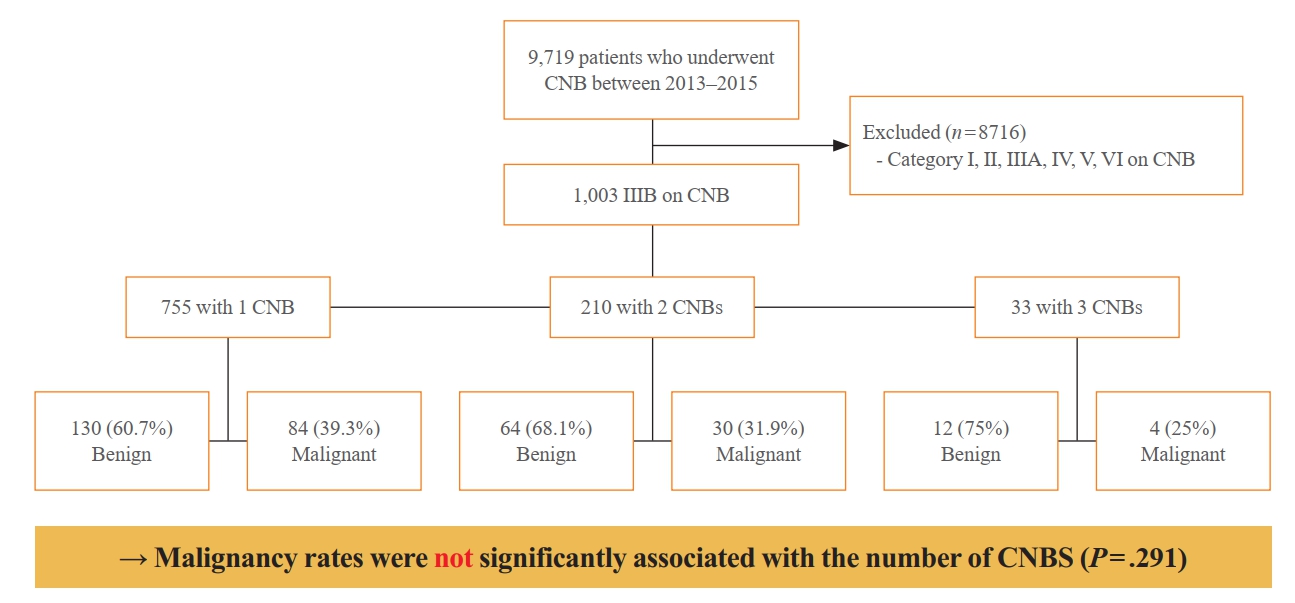
This retrospective study evaluated patients with thyroid nodules categorized as IIIB on CNB between 2013 and 2015. Demographic characteristics, subsequent biopsy results, and ultrasound (US) images were evaluated. The malignancy rates of nodules according to number of CNBs and the number of IIIB diagnoses was compared. Demographic and US features were evaluated to determine factors predictive of malignancy.
Results
Of 1,003 IIIB nodules on CNB, the final diagnosis was determined for 328 (32.7%) nodules, with 121 of them confirmed as malignant, resulting in a malignancy rate of 36.9% (95% confidence interval, 31.7% to 42.1%). Repeat CNB was performed in 248 nodules (24.7%), with 75 (30.2%), 131 (52.8%), 13 (5.2%), 26 (10.5%), one (0.4%), and two (0.8%) reclassified into categories II, IIIB, IIIA, IV, V, and VI, respectively. Malignancy rates were not significantly affected by the number of CNBs (P=0.291) or the number of IIIB diagnoses (P=0.473). None of the nodules confirmed as category II on repeat CNB was malignant. US features significantly associated with malignancy (P<0.003) included solid composition, irregular margins, microcalcifications, and high suspicion on the US risk stratification system.
Conclusion
Repeat biopsy of nodules diagnosed with IIIB on CNB did not increase the detection of malignancy but can potentially reduce unnecessary surgery. Repeat biopsy should be performed selectively, with US features guiding the choice between repeat biopsy and diagnostic surgery. -
Citations
Citations to this article as recorded by- Integrating Digital Ki-67 Labeling Index and K-TIRADS for Malignancy Risk Stratification in Thyroid Core Needle Biopsies
Yujin Cha, Sue Youn Kim, Chankyung Kim, Ja Seong Bae, Dong-Jun Lim, So-Lyung Jung, Chan Kwon Jung
Cancers.2026; 18(14): 2260. CrossRef
- Integrating Digital Ki-67 Labeling Index and K-TIRADS for Malignancy Risk Stratification in Thyroid Core Needle Biopsies
- Thyroid
Thyroid Cancer Screening - Diagnostic Performance of Ultrasound-Based Risk Stratification Systems for Thyroid Nodules: A Systematic Review and Meta-Analysis
- Leehi Joo, Min Kyoung Lee, Ji Ye Lee, Eun Ju Ha, Dong Gyu Na
- Endocrinol Metab. 2023;38(1):117-128. Published online February 27, 2023
- DOI: https://doi.org/10.3803/EnM.2023.1670

- 14,130 View
- 308 Download
- 18 Web of Science
- 22 Crossref
-
Abstract
PDFPubReader ePub
- Background
This study investigated the diagnostic performance of biopsy criteria in four society ultrasonography risk stratification systems (RSSs) for thyroid nodules, including the 2021 Korean (K)-Thyroid Imaging Reporting and Data System (TIRADS).
Methods
The Ovid-MEDLINE, Embase, Cochrane, and KoreaMed databases were searched and a manual search was conducted to identify original articles investigating the diagnostic performance of biopsy criteria for thyroid nodules (≥1 cm) in four widely used society RSSs.
Results
Eleven articles were included. The pooled sensitivity and specificity were 82% (95% confidence interval [CI], 74% to 87%) and 60% (95% CI, 52% to 67%) for the American College of Radiology (ACR)-TIRADS, 89% (95% CI, 85% to 93%) and 34% (95% CI, 26% to 42%) for the American Thyroid Association (ATA) system, 88% (95% CI, 81% to 92%) and 42% (95% CI, 22% to 67%) for the European (EU)-TIRADS, and 96% (95% CI, 94% to 97%) and 21% (95% CI, 17% to 25%) for the 2016 K-TIRADS. The sensitivity and specificity were 76% (95% CI, 74% to 79%) and 50% (95% CI, 49% to 52%) for the 2021 K-TIRADS1.5 (1.5-cm size cut-off for intermediate-suspicion nodules). The pooled unnecessary biopsy rates of the ACR-TIRADS, ATA system, EU-TIRADS, and 2016 K-TIRADS were 41% (95% CI, 32% to 49%), 65% (95% CI, 56% to 74%), 68% (95% CI, 60% to 75%), and 79% (95% CI, 74% to 83%), respectively. The unnecessary biopsy rate was 50% (95% CI, 47% to 53%) for the 2021 K-TIRADS1.5.
Conclusion
The unnecessary biopsy rate of the 2021 K-TIRADS1.5 was substantially lower than that of the 2016 K-TIRADS and comparable to that of the ACR-TIRADS. The 2021 K-TIRADS may help reduce potential harm due to unnecessary biopsies. -
Citations
Citations to this article as recorded by- Precision medicine in thyroid nodules: current strategies, challenges, and future directions
Marcio J. Concepción-Zavaleta, Jenyfer M. Fuentes-Mendoza, Cristian A. Rojas-Hipólito, Daniela Sánchez-Mejía, Mariana A. López-Torres, Luis Concepción-Urteaga, Cristian D. Armas, José Paz-Ibarra
Hormones.2026; 25(2): 649. CrossRef - The value of a nomogram model combining ultrasonic features and blood inflammatory indicators in differentiating benign and malignant thyroid nodules
Jierui Guo, Chunhua Ma, Yinhong Lan, Xiehong Chen
Medicine.2026; 105(21): e49007. CrossRef - Diagnostic capabilities of a malignancy risk stratification system in ultrasound examination of focal thyroid lesions
L. A. Timofeeva, T. N. Makarova, A. O. Yumanov, S. S. Alekseev
Medical alphabet.2026; (13): 51. CrossRef - THE IMPACT OF STANDARDIZATION IN ULTRASOUND DIAGNOSTICS AND THE UNIFICATION OF TI-RADS ON THE JUSTIFICATION FOR REFERRING THYROID NODULES FOR FINE-NEEDLE ASPIRATION BIOPSY
Natalia I. Zinchenko
Clinical and Preventive Medicine.2026; (4): 15. CrossRef - Validation of a thyroid malignancy risk calculator in a Portuguese cohort
Beatriz Tavares da Silva, Liliana Fonseca, Cláudia Freitas, André Carvalho
Endocrine.2026;[Epub] CrossRef - Enhancing diagnostic accuracy of thyroid nodules: integrating self-learning and artificial intelligence in clinical training
Daham Kim, Yoon-a Hwang, Youngsook Kim, Hye Sun Lee, Eunjung Lee, Hyunju Lee, Jung Hyun Yoon, Vivian Youngjean Park, Miribi Rho, Jiyoung Yoon, Si Eun Lee, Jin Young Kwak
Endocrine.2025; 88(3): 766. CrossRef - Interobserver agreement between artificial intelligence models in the thyroid imaging and reporting data system (TIRADS) assessment of thyroid nodules
Andrea Leoncini, Pierpaolo Trimboli
Endocrine.2025; 89(1): 197. CrossRef - A comparative study of Chinese and ACR-TIRADS diagnostic accuracy in small thyroid nodule risk evaluation
Rasha Nadeem Ahmed, Maysaloon Shaman Saeed, Nazar M. T. Jawhar, Mohamed Tarek El-Diasty, Noha Yahia Ebaid, Mostafa Mohamad Assy
Egyptian Journal of Radiology and Nuclear Medicine.2025;[Epub] CrossRef - Risk Stratification of Thyroid Nodules 10 mm in Diameter or Less: Strength and Pitfalls of the Ultrasonographic Assessment From a Cross‐Sectional Study
Giuseppe Lisco, Anna De Tullio, Vito Angelo Giagulli, Giuseppina Renzulli, Vincenzo Triggiani, Suraiya Saleem
International Journal of Endocrinology.2025;[Epub] CrossRef - Ultrasound Risk Stratification of Autonomously Functioning Thyroid Nodules: Cine Loop Video Sequences Versus Static Image Captures
Larissa Rosenbaum, Martin Freesmeyer, Tabea Nikola Schmidt, Christian Kühnel, Falk Gühne, Philipp Seifert
Diagnostics.2025; 15(19): 2525. CrossRef - Interobserver Agreement Among Thyroid Ultrasound Operators in Defining Thyroid Nodules as Subcapsular
Pierpaolo Trimboli, Enrico Papini, Jörg Bojunga, Chiara Camponovo, Maurilio Deandrea, Antonio Giangregorio, Lauro Gianola, Giorgio Grani, Rinaldo Guglielmi, Andrea Frasoldati, Fabian Pitoia, Gilles Russ, Cosimo Durante, Andrea Leoncini
Thyroid®.2025; 35(10): 1198. CrossRef - Analysis of FNAC indication in thyroid nodules assessed as low risk according to various TIRADSs
Pierpaolo Trimboli, Petra Makovac, Amos Colombo, Lorenzo Ruinelli, Chiara Dobrinja, Lorenzo Scappaticcio, Andrea Leoncini
European Thyroid Journal.2025;[Epub] CrossRef - Accuracy of ultrasound in predicting thyroid malignancy: a comparative analysis of the ACR TI-RADS and ATA risk stratification systems
Shaza Samargandy, Aliaa H. Ghoneim
Archives of Endocrinology and Metabolism.2024;[Epub] CrossRef - Korean Thyroid Association Management Guidelines for Patients with Thyroid Nodules 2024
Young Joo Park, Eun Kyung Lee, Young Shin Song, Su Hwan Kang, Bon Seok Koo, Sun Wook Kim, Dong Gyu Na, Seung-Kuk Baek, So Won Oh, Min Kyoung Lee, Sang-Woo Lee, Young Ah Lee, Yong Sang Lee, Ji Ye Lee, Dong-Jun Lim, Leehi Joo, Yuh-Seog Jung, Chan Kwon Jung,
International Journal of Thyroidology.2024; 17(1): 208. CrossRef - Individual Ultrasonographic Characteristics of Thyroid Nodules and Their Cytopathological Correlation to Determine Malignancy Risk
Miguel Ángel Castilla Villanueva, Dania Guadalupe Solis Cano, Ana Amador Martínez, Marco Antonio Téliz Meneses, Jesús Baquera-Heredia, Cesar Eduardo Vallin Orozco, Mónica Loya Ceballos
Cureus.2024;[Epub] CrossRef - Improving the diagnostic performance of inexperienced readers for thyroid nodules through digital self-learning and artificial intelligence assistance
Si Eun Lee, Hye Jung Kim, Hae Kyoung Jung, Jin Hyang Jung, Jae-Han Jeon, Jin Hee Lee, Hanpyo Hong, Eun Jung Lee, Daham Kim, Jin Young Kwak
Frontiers in Endocrinology.2024;[Epub] CrossRef - Systemic therapy for differentiated thyroid cancer with distant metastasis
Eun Kyung Lee
Journal of the Korean Medical Association.2024; 67(7): 484. CrossRef - To Screen or Not to Screen?
Do Joon Park
Endocrinology and Metabolism.2023; 38(1): 69. CrossRef - The 2017 United States Preventive Services Task Force Recommendation for Thyroid Cancer Screening Is No Longer the Gold Standard
Ka Hee Yi
Endocrinology and Metabolism.2023; 38(1): 72. CrossRef - Thyroid Cancer Screening: How to Maximize Its Benefits and Minimize Its Harms
Jung Hwan Baek
Endocrinology and Metabolism.2023; 38(1): 75. CrossRef - 2023 Korean Thyroid Association Management Guidelines for Patients with Thyroid Nodules
Young Joo Park, Eun Kyung Lee, Young Shin Song, Soo Hwan Kang, Bon Seok Koo, Sun Wook Kim, Dong Gyu Na, Seung-Kuk Baek, So Won Oh, Min Kyoung Lee, Sang-Woo Lee, Young Ah Lee, Yong Sang Lee, Ji Ye Lee, Dong-Jun Lim, Leehi Joo, Yuh-Seog Jung, Chan Kwon Jung
International Journal of Thyroidology.2023; 16(1): 1. CrossRef - Evaluation of the Appropriateness of Thyroid Fine-Needle Aspiration
Lairce Cristina Ribeiro Brito, Iara Beatriz De Carvalho Botêlho, Lanna Matos Silva Fernandes, Nayze Lucena Sangreman Aldeman, Uziel Nunes Silva
International Journal for Innovation Education and Research.2023; 11(6): 8. CrossRef
- Precision medicine in thyroid nodules: current strategies, challenges, and future directions
- Thyroid
Thyroid Cancer Screening - A Comprehensive Assessment of the Harms of Fine-Needle Aspiration Biopsy for Thyroid Nodules: A Systematic Review
- Ji Yong Park, Wonsuk Choi, A Ram Hong, Jee Hee Yoon, Hee Kyung Kim, Ho-Cheol Kang
- Endocrinol Metab. 2023;38(1):104-116. Published online February 27, 2023
- DOI: https://doi.org/10.3803/EnM.2023.1669
- 27,993 View
- 354 Download
- 23 Web of Science
- 32 Crossref
-
Abstract
PDFSupplementary MaterialPubReader ePub
- Background
There have concerns related with the potential harms of fine-needle aspiration biopsy (FNAB). We aimed to summarize the clinical complications and evaluate the safety of FNAB.
Methods
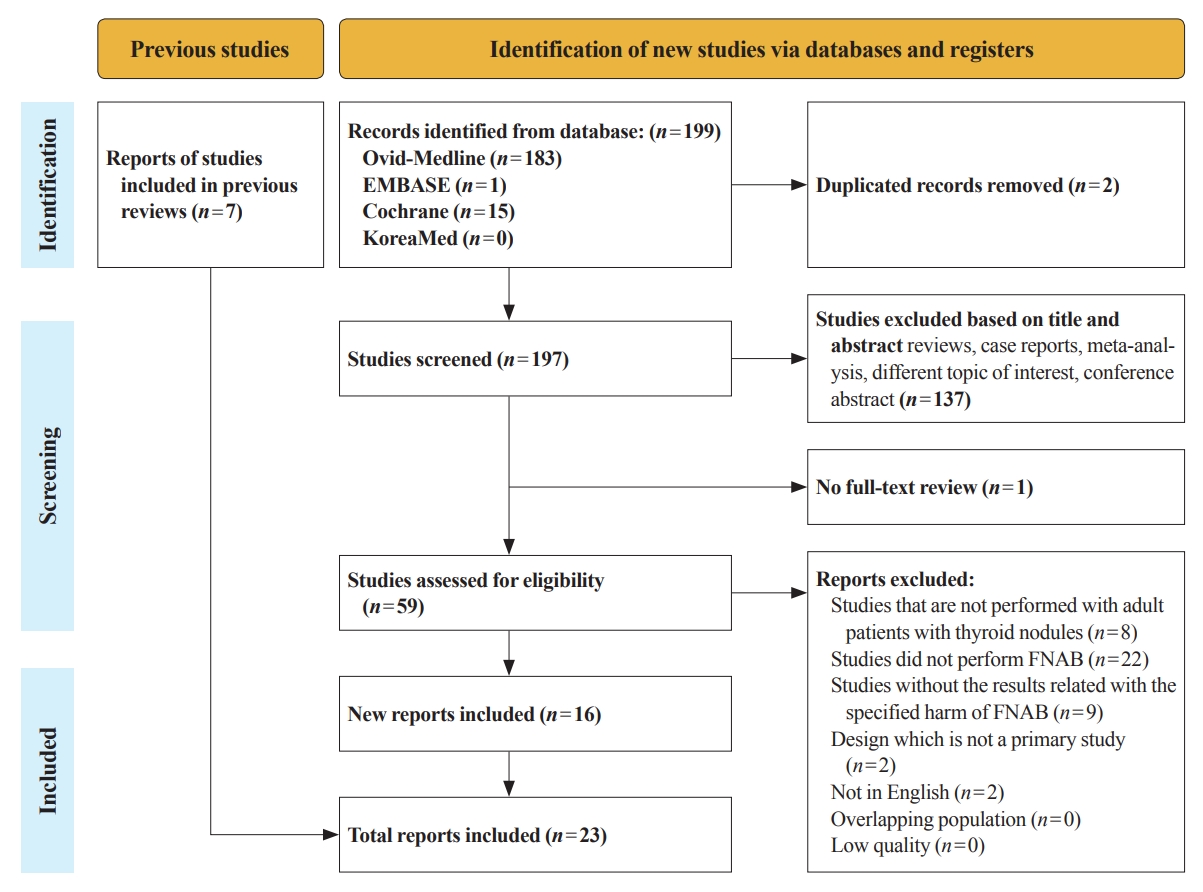
Studies related with the harms of FNAB were searched on MEDLINE, Embase, Cochrane library, and KoreaMed from 2012 to 2022. Also, studies reviewed in the previous systematic reviews were evaluated. Included clinical complications were postprocedural pain, bleeding events, neurological symptoms, tracheal puncture, infections, post-FNAB thyrotoxicosis, and needle tract implantation of thyroid cancers.
Results
Twenty-three cohort studies were included in this review. Nine studies which were related with FNAB-related pain showed that most of the subjects had no or mild discomfort. The 0% to 6.4% of the patients had hematoma or hemorrhage after FNAB, according to 15 studies. Vasovagal reaction, vocal cord palsy, and tracheal puncture have rarely described in the included studies. Needle tract implantation of thyroid malignancies was described in three studies reporting 0.02% to 0.19% of the incidence rate.
Conclusion
FNAB is considered to be a safe diagnostic procedure with rare complications, which are mainly minor events. Thorough assessement of the patients’ medical condition when deciding to perform FNABs would be advisable to lower potential complications. -
Citations
Citations to this article as recorded by- Life-Threatening Neck Hematoma After Fine-Needle Aspiration of a Thyroid Nodule in a Patient With End-Stage Renal Disease
Hesham Yasin, Shivani Khetani, Hooman Oktaei
AACE Endocrinology and Diabetes.2026; 13(3): 384. CrossRef - Intrathyroidal Hematoma, Biphasic Thyroid Dysfunction, and Permanent Hypothyroidism After Fine Needle Aspiration Biopsy
Mohammad Jay, Rebecca B.K. Wong, Cristina Goens, Jeannette Goguen
AACE Endocrinology and Diabetes.2026; 13(4): 566. CrossRef - Korean Thyroid Association Guidelines on the Management of Differentiated Thyroid Cancers; Part II. Follow-up Surveillance after Initial Treatment 2026
Eun Kyung Lee, Seung Heon Kang, Bon Seok Koo, Mijin Kim, Min Joo Kim, Bo Hyun Kim, Ji Won Kim, Dong Gyu Na, Sohyun Park, Ji-In Bang, Kyorim Back, Youngduk Seo, Young-Ik Son, Young Shin Song, Dong Yeob Shin, Jong-Hyuk Ahn, Hwa Young Ahn, So Won Oh, Ho-Ryun
International Journal of Thyroidology.2026; 19(1): 1. CrossRef - Diagnosis and Management of Thyroid Dysfunction in Postpartum Women: A Narrative Review
Neha, Zeeshan Ansari, Preeti Kamal, Priyanka Sonker, Nisha Sharma, Anuradha Kalani, Prakash Chandra Gupta
Current Women s Health Reviews.2026;[Epub] CrossRef - Research Progress of Hyperthyroidism Complicated with Thyroid Cancer
扬 李
Advances in Clinical Medicine.2026; 16(06): 1917. CrossRef - Efficacy and safety of ultrasound-guided microwave ablation therapy for
benign and malignant thyroid nodules of different sizes based on real-world
evidence
L. Zhang, Y. Liu, P. Zhang, Y. Zhang, M. Xie, X. Zhang, H. Li, Y. Duan
International Journal of Radiation Research.2026; 24(1): 143. CrossRef - Risk-adapted trajectory selection for ultrasound-guided thyroid fine-needle aspiration biopsy: a multicenter study of in-plane and out-of-plane approaches
Xiubin Tang, Wenjin Lin, Youhai Wu, Ming Chen, Xiao Yang
Frontiers in Endocrinology.2026;[Epub] CrossRef - Current Status and Evolution of Fine-Needle Aspiration Cytology in the Head and Neck Region
Yuki Kawamura, Tsuyoshi Kojima, Ryusuke Hori
Practica Oto-Rhino-Laryngologica.2026; 119(8): 485. CrossRef - Pediatric lingual ectopic thyroid: two contrasting cases and a narrative literature review
Zifeng Shi, Chengpin Tao
Frontiers in Pediatrics.2026;[Epub] CrossRef - The Effect of Video-Assisted Informed Consent Before Thyroid Fine-Needle Aspiration Biopsy on Anxiety and Patient Experience in Patients with Suspected Malignancy: A Randomized Controlled Study
Yavuz Selim Kahraman, Muhammet Raşit Aydin, İsmail Özer, Fuldem Mutlu, Onur Taydaş, Adem Şentürk
Online Türk Sağlık Bilimleri Dergisi.2026; 11(3): 320. CrossRef - Korean Thyroid Association Guidelines on the Management of Differentiated Thyroid Cancers, Part II: Follow-up Surveillance after Initial Treatment 2026
Eun Kyung Lee, Seung Heon Kang, Bon Seok Koo, Mijin Kim, Min Joo Kim, Bo Hyun Kim, Ji Won Kim, Dong Gyu Na, Sohyun Park, Ji-In Bang, Kyorim Back, Youngduk Seo, Young-Ik Son, Young Shin Song, Dong Yeob Shin, Jong-hyuk Ahn, Hwa Young Ahn, So Won Oh, Ho-Ryun
Endocrinology and Metabolism.2026; 41(4): 493. CrossRef - Application of Liquid‐Based Cytology Using the ThinPrep System to Thyroid Fine‐Needle Aspiration Samples
Vargas‐Castellanos Elizabeth, Arenas Avila Lina Alejandra, Rocha Franky
Current Protocols.2026;[Epub] CrossRef - Ethics of Elective Whole‐Body Magnetic Resonance Imaging With Head and Neck Findings
Tony Chung, Shiven Sharma, Eric M. Genden, Jacob M. Appel
Otolaryngology–Head and Neck Surgery.2025; 172(4): 1480. CrossRef - Office-Based Lymph Node Biopsy
Michael Chaney, Tyler Anderson, Saad Shebrain
Surgical Clinics of North America.2025; 105(4): 763. CrossRef - Botulinum neurotoxin therapy in dystonic head flexion: Anterior injection approaches to the longus colli and longus capitis muscles
Lucy Hicklin, Winnie Yeung
Toxicon.2025; 262: 108401. CrossRef - Thyroid function test profile in patients who have thyroid nodule and its correlation with ultrasound TIRAD scoring system and cytological results
Sama Atta Gitti, Saman Sarko Baha Al-den
Scientific Reports.2025;[Epub] CrossRef - Needle aspiration technique as a supportive tool for clinical diagnosis of anorectal atresia in calves
Ahmed Abdelrahiem Sadek, Kamal Hussein
BMC Veterinary Research.2025;[Epub] CrossRef - Evaluating Liquid Biopsy for Circulating Tumor DNA (ctDNA) Detection as a Complementary Diagnostic Tool in Thyroid Cancer Among Ecuadorian Women
Santiago Cadena-Ullauri, Viviana A. Ruiz-Pozo, Elius Paz-Cruz, Rafael Tamayo-Trujillo, Patricia Guevara-Ramírez, Oscar Jaramillo-Calvas, Cristhian García, Mikaela García, Ana Pérez, Maritza Ochoa-Castro, Fausto Zaruma-Torres, Favian Bayas-Morejón, Lenín G
International Journal of Molecular Sciences.2025; 26(14): 6987. CrossRef - Resolution-Adaptive Binning Enhances Machine Learning Modeling by Interbatch and Multiplatform Orbitrap-Based Shotgun Mass Spectrometry Data Integration
Hiu-Lok Ngan, Jialing Zhang, Kenneth Kin-Leung Kwan, Jacinth Wing-Sum Cheu, Li Zhong, Yike Guo, Xian Yang, Carmen Chak-Lui Wong, Hong Yan, Zongwei Cai
Analytical Chemistry.2025; 97(48): 26877. CrossRef - Organizational models of "one-stop" clinics for thyroid disease: A review of processes, performance indicators, and outcomes from the literature
Marko Milić, Šćepan Sinanović, Dejan Kostić, Milena Ratković
Medicinski glasnik Specijalne bolnice za bolesti štitaste žlezde i bolesti metabolizma.2025; 30(99): 51. CrossRef - Minimally invasive and non-invasive treatment of benign thyroid nodules
Radoslav Pejin, Tijana Icin, Ivana Bajkin, Nikolina Vukovic, Teodor Grbic, Stefan Dragicevic
Medicinski pregled.2025; 78(9-12): 265. CrossRef - A Narrative Review of the 2023 Korean Thyroid Association Management Guideline for Patients with Thyroid Nodules
Eun Kyung Lee, Young Joo Park, Chan Kwon Jung, Dong Gyu Na
Endocrinology and Metabolism.2024; 39(1): 61. CrossRef - Fine-needle aspiration cytology for neck lesions in patients with antithrombotic/anticoagulant medications: systematic review and meta-analysis
Dongbin Ahn, Ji Hye Kwak, Gill Joon Lee, Jin Ho Sohn
European Radiology.2024; 34(10): 6843. CrossRef - 2023 Update of the Korean Thyroid Association Guidelines for the Management of Thyroid Nodules
Eun Kyung Lee, Young Joo Park
Clinical Thyroidology®.2024; 36(4): 153. CrossRef - Korean Thyroid Association Guidelines on the Management of Differentiated Thyroid Cancers; Part II. Follow-up Surveillance after Initial Treatment 2024
Mijin Kim, Ji-In Bang, Ho-Cheol Kang, Sun Wook Kim, Dong Gyu Na, Young Joo Park, Youngduk Seo, Young Shin Song, So Won Oh, Sang-Woo Lee, Eun Kyung Lee, Ji Ye Lee, Dong-Jun Lim, Ari Chong, Yun Jae Chung, Chae Moon Hong, Min Kyoung Lee, Bo Hyun Kim
International Journal of Thyroidology.2024; 17(1): 115. CrossRef - Needle size for thyroid fine needle aspiration cytology. A single institution experience
Pasquale Cianci, Rocco Tumolo, Ivana Conversano, Damiano Travaglia, Giuseppe Trigiante, Giuliano Lantone, Vincenzo Lizzi, Miriam Cappiello, Marco Montagna, Fabio Pio Curci, Enrico Restini
Frontiers in Surgery.2024;[Epub] CrossRef - Important Role of Ultrasonography Immediately After Fine-Needle Aspiration Biopsy of Thyroid Nodules to Detect Acute Transient Thyroid Swelling
Kouichi Yoshimoto, Shinya Satoh, Hisakazu Shindo, Kento Katsuyama, Daisuke Tatsushima, Takashi Fukuda, Seigo Tachibana, Yusuke Mori, Hiroshi Takahashi, Yuji Nagayama, Hiroyuki Yamashita
Cureus.2024;[Epub] CrossRef - Assessing the feasibility of ChatGPT-4o and Claude 3-Opus in thyroid nodule classification based on ultrasound images
Ziman Chen, Nonhlanhla Chambara, Chaoqun Wu, Xina Lo, Shirley Yuk Wah Liu, Simon Takadiyi Gunda, Xinyang Han, Jingguo Qu, Fei Chen, Michael Tin Cheung Ying
Endocrine.2024; 87(3): 1041. CrossRef - To Screen or Not to Screen?
Do Joon Park
Endocrinology and Metabolism.2023; 38(1): 69. CrossRef - Thyroid Cancer Screening: How to Maximize Its Benefits and Minimize Its Harms
Jung Hwan Baek
Endocrinology and Metabolism.2023; 38(1): 75. CrossRef - Evaluation of the Appropriateness of Thyroid Fine-Needle Aspiration
Lairce Cristina Ribeiro Brito, Iara Beatriz De Carvalho Botêlho, Lanna Matos Silva Fernandes, Nayze Lucena Sangreman Aldeman, Uziel Nunes Silva
International Journal for Innovation Education and Research.2023; 11(6): 8. CrossRef - A Retrospective Analysis of Ultrasound-Guided Fine-Needle Aspiration Biopsy for Thyroid Diseases Indicating Ciliated Columnar Epithelium
Yoshiyuki SAITO, Wataru KITAGAWA, Ryohei KATOH, Takashi AMANO, Ai MATSUI, Yoko KUGA, Chie MASAKI, Junko AKAISHI, Ritsuko OKAMURA, Akifumi SUZUKI, Kenichi MATSUZU, Mitsuji NAGAHAMA, Kiminori SUGINO, Koichi ITO
Nihon Rinsho Geka Gakkai Zasshi (Journal of Japan Surgical Association).2023; 84(12): 1835. CrossRef
- Life-Threatening Neck Hematoma After Fine-Needle Aspiration of a Thyroid Nodule in a Patient With End-Stage Renal Disease
Review Article
- Thyroid
- Update from the 2022 World Health Organization Classification of Thyroid Tumors: A Standardized Diagnostic Approach
- Chan Kwon Jung, Andrey Bychkov, Kennichi Kakudo
- Endocrinol Metab. 2022;37(5):703-718. Published online October 4, 2022
- DOI: https://doi.org/10.3803/EnM.2022.1553
- 75,957 View
- 4,573 Download
- 224 Web of Science
- 246 Crossref
-
Abstract
PDFPubReader ePub
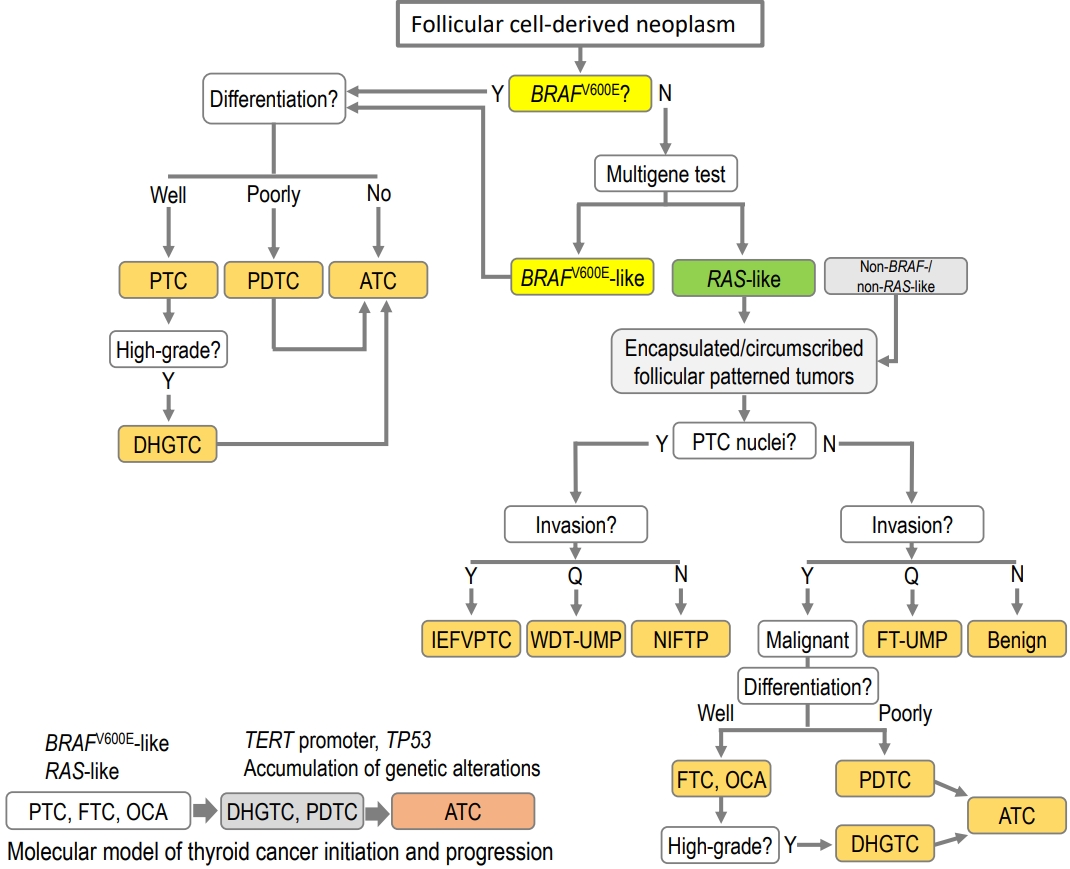
- The fifth edition of the World Health Organization (WHO) histologic classification of thyroid neoplasms released in 2022 includes newly recognized tumor types, subtypes, and a grading system. Follicular cell-derived neoplasms are categorized into three families (classes): benign tumors, low-risk neoplasms, and malignant neoplasms. The terms “follicular nodular disease” and “differentiated high-grade thyroid carcinoma” are introduced to account for multifocal hyperplastic/neoplastic lesions and differentiated thyroid carcinomas with high-grade features, respectively. The term “Hürthle cells” is replaced with “oncocytic cells.” Invasive encapsulated follicular and cribriform morular variants of papillary thyroid carcinoma (PTC) are now redefined as distinct tumor types, given their different genetic alterations and clinicopathologic characteristics from other PTC subtypes. The term “variant” to describe a subclass of tumor has been replaced with the term “subtype.” Instead, the term “variant” is reserved to describe genetic alterations. A histologic grading system based on the mitotic count, necrosis, and/or the Ki67 index is used to identify high-grade follicular-cell derived carcinomas and medullary thyroid carcinomas. The 2022 WHO classification introduces the following new categories: “salivary gland-type carcinomas of the thyroid” and “thyroid tumors of uncertain histogenesis.” This review summarizes the major changes in the 2022 WHO classification and their clinical relevance.
-
Citations
Citations to this article as recorded by- Prognostic Significance of Solid Subtype of Papillary Thyroid Carcinoma: Analysis of 63 Patients
Andre Ywata de Carvalho, Felipe D' Almeida Costa, Jose Guilherme Vartanian, Luiz Paulo Kowalski
Head & Neck.2026; 48(1): 5. CrossRef - Hyalinizing trabecular tumor of the thyroid: A comprehensive review of clinicopathological features, diagnostic dilemmas, and emerging molecular insights
Yinghe Huang, Shanshan Liu, Yilei Wen
Annals of Diagnostic Pathology.2026; 80: 152539. CrossRef - Nomogram for predicting overall and cancer-specific survival in patients with postoperative follicular thyroid cancer
Xin Liu, Suidan Chen, Cangui Wu
Brazilian Journal of Otorhinolaryngology.2026; 92(1): 101719. CrossRef - Synchronous Papillary and Oncocytic Thyroid Carcinomas: An Unusual Occurrence
Manjit Kaur Rana, Ankita Soni, Gargi Kapatia, Vikasdeep Gupta
Indian Journal of Otolaryngology and Head & Neck Surgery.2026; 78(3): 1716. CrossRef - Short-term outcomes in radiofrequency ablation for the primary treatment of T1N0M0 papillary thyroid carcinomas
Rachel Liou, Lauren Slattery, Yinin Hu, Eric J. Kuo, Catherine McManus, James A. Lee, Jennifer H. Kuo
The American Journal of Surgery.2026; 253: 116702. CrossRef - Lithium Therapy–Associated Thyroid Alterations Mimicking Thyroid Malignancy: A Diagnostic Pitfall
Irene Y. Chen, Adel K. El-Naggar
International Journal of Surgical Pathology.2026; 34(3): 812. CrossRef - Prognostic Factors Affecting Iodine-131 Treatment Efficacy in Patients With Differentiated Thyroid Carcinoma: A Risk-Stratified Analysis
Jinhao Li, Huixia Geng, Junbo Nan, Fangfang Mao, Luoping Zhai, Wanchun Zhang
Nutrition and Cancer.2026; 78(2): 181. CrossRef - Clinical value of clinicopathological, ultrasonographic features and fibroblast activation protein in evaluating the radioiodine treatment efficacy in papillary thyroid carcinoma
Dongyue Chen, Li Zhu, Xue Li, Dan Wang, Yang Li, Xiankai Meng, Jian Tan, Danyang Sun, Zhaowei Meng
Annals of Nuclear Medicine.2026; 40(4): 365. CrossRef - Neoplasia Folicular Não Invasiva com Núcleos de Tipo Papilar em Struma Ovarii
Sara Sardinha Abrantes, Cláudia Lopes, Vanessa Santos, Teresa Diniz Costa, Ana Sofia Osório, Catarina Machado, Joaquim Tinoco, Lucília Gonçalves
Acta Médica Portuguesa.2026; 39(1): 77. CrossRef - Machine learning prediction of thyroid cancer recurrence for early screening and clinical decision pathways: a retrospective cohort study
Guobin Hu, Bin Huang, Li Cai, Yue Zhang, Ying Zhang, Yuyang Liu, Ganxun Wu
Discover Oncology.2026;[Epub] CrossRef - Chromophobe thyroid carcinoma: a distinct entity associated with TSC gene alterations
Agnes S. Harahap, Marc P. Pusztaszeri, Rayan Rammal, William D. Foulkes, Yuri E. Nikiforov, Jason K. Wasserman, Raja R. Seethala
Virchows Archiv.2026; 488(4): 735. CrossRef - Comment on “The lymph node yield in the initial lateral neck dissection predicts recurrence in the lateral neck of papillary thyroid carcinoma: a revision surgery cohort study”
YiRong Chen, Shanyan Hong, Yongqiang Chen
International Journal of Surgery.2026; 112(4): 10788. CrossRef - Trop2-Targeted [18F]AlF-RESCA-RT4 ImmunoPET/CT in Guiding Clinical Surgeries of Thyroid Cancers: A Proof-of-Concept Study
Xinlu Yin, Wenzhi Jia, Le Xu, Wenjie Zheng, Yiqing Gao, Linglin Tang, You Zhang, Qianyun Wu, Dongsheng Xu, Shuxian An, Weijun Wei, Jianjun Liu, Qinyi Zhou, Jialin Feng, Jun Chen
Molecular Pharmaceutics.2026; 23(3): 1696. CrossRef - Coexistence of Hyalinizing Trabecular Tumor and Papillary Thyroid Carcinoma: A Diagnostic Challenge
Mubashirah S. Charolia, Alka Rani, Aisha Hassan Memon, Shayan Anwar, Saira Fatima
AACE Endocrinology and Diabetes.2026; 13(3): 388. CrossRef - Integrating Robotic Bilateral Axillo-Breast Approach Thyroidectomy with Molecular Diagnostics and Artificial Intelligence in Thyroid Cancer Care
Qiang Deng, Xiaoping Men, Duo Jin, Yuzhuo Bai
Biomolecules & Therapeutics.2026; 34(1): 45. CrossRef - Anaplastic Thyroid Carcinoma and High-Grade Tall Cell Papillary Thyroid Carcinoma: Case Report of a Rare Association
Catalin-Bogdan Satala, Alina-Mihaela Gurau, Gabriela Patrichi, Daniela Mihalache
Reports.2026; 9(1): 56. CrossRef - Assessment of an innovative synthetic matrix for enhanced cell preservation: evaluating its clinical utility and impact on diagnostic precision in thyroid fine-needle aspiration cytology
Diana-Raluca Streinu, Octavian Constantin Neagoe, Andreea Bena, Dana-Liana Stoian
BMC Endocrine Disorders.2026;[Epub] CrossRef - Influence of the tumor microenvironment on genetic mutations in thyroid carcinoma
Lingyan Zhou, Shujian Xu, Yuwen Song, Dongqing Jiang, Shihong Chen, Avaniyapuram Kannan Murugan
PLOS One.2026; 21(2): e0341123. CrossRef - Paradigm Transformation of Precision Management of Thyroid Cancer
樱 袁
Advances in Clinical Medicine.2026; 16(02): 2361. CrossRef - De-escalation strategies in the management of differentiated thyroid cancer
Mubeen Hussein Arawker, Fitrat Habibullah, Shantanu Baral, Lijun Fu, Ning Sun, Hongting Li, Xinguang Qiu
Endocrine.2026;[Epub] CrossRef - Immune cell–related gene signatures for diagnostic and prognostic stratification in thyroid cancer using machine learning analysis
Kun Fang, Zhifang Zhang, Meng Luo, Xudong Niu
Discover Oncology.2026;[Epub] CrossRef - Data-driven thresholds for tumor size and nodal involvement in oncocytic thyroid carcinoma: A population-based analysis
Milanie Milan, Samantha M. Thomas, Christina V. Lindsay, Todd W. Frieze, Randall P. Scheri, Hadiza S. Kazaure
The American Journal of Surgery.2026; 255: 116874. CrossRef - Integrative multi-omics refines the molecular subtypes of thyroid cancers and enhances cancer-progression prediction: a retrospective cohort study
Yoo Hyung Kim, Joseph Wang, Jae-Kyung Won, Youngsoo Kim, Sun Wook Cho, Dohyun Han, Young Joo Park
International Journal of Surgery.2026; 112(5): 11987. CrossRef - Solid Subtype of Papillary Thyroid Carcinoma: A Case Series Highlighting Aggressive Features
Rafael Castellanos Bueno, Gabriela Almeyda Carreño, Diana Carolina Vergara Arenas, Laura Yibeth Esteban Badillo, Ernesto García Ayala
Clinical Case Reports.2026;[Epub] CrossRef - Survival outcomes, metastatic patterns, and local invasion in oncocytic papillary thyroid carcinomas and oncocytic carcinomas: A retrospective cohort study
Yuhui Liu, Yutang Miao, Yanqing Zheng, Wenrui Wang, Shuang Ma, Xue Yang
European Archives of Oto-Rhino-Laryngology.2026; 283(7): 4597. CrossRef - Gut microbe Terrisporobacter promotes papillary thyroid carcinoma progression by upregulating the NTRK1 oncogene and fostering an immunosuppressive tumor microenvironment
Jia Li, Jie Shen, Dongyan Lu, Enci Ding, Lijuan Wei
Frontiers in Immunology.2026;[Epub] CrossRef - Treatment outcomes of stereotactic radiosurgery for thyroid cancer spine metastases—systematic review
Muhammad Izhar, Yusuke S. Hori, Ziyad Ahmad, Ahed H. Kattaa, David J. Park, Steven D. Chang
Neurosurgical Review.2026;[Epub] CrossRef - Utilizing the transformer mechanism to predict cervical lymph node metastasis in patients with papillary thyroid carcinoma
Huiting Chen, Fangqiu Ruan, Li Zhu, Yong Zhuang, Xiaojian Ye, Xinxiu Liu, Jinshu Zeng, Carmelo Caldarella
PLOS One.2026; 21(4): e0345937. CrossRef - Interpretable patient-voting deep learning-enhanced Raman spectroscopy of serum for breast Cancer detection
Yannan Chen, Jian Sun, Chenxi Dong, Ying Chen, Bing Pei, Changyu Wu
Spectrochimica Acta Part A: Molecular and Biomolecular Spectroscopy.2026; 358: 127853. CrossRef - A differentiated thyroid carcinoma-specific graded prognostic assessment for brain metastases: derivation in a 10,306-patient cohort and external validation
Hamza A. Salim, Sarimar Agosto, Heba Al Qudah, Kim Learned, Mark Zafereo, Jennifer Wang, Mimi I. Hu, Ahmed Msherghi, Naifa Busaidy, F. Eymen Ucisik, Sarah Hamidi, Hussein Tawbi, Rami W. Eldaya, Jing Li, Max Wintermark, Maria E. Cabanillas
Journal of Neuro-Oncology.2026;[Epub] CrossRef - Case Report: The clear cell variant of papillary thyroid carcinoma: a clinicopathologic study of four cases with emphasis on RET gene fusions
Li Xu, Bin Luo, Qianwen Wang, Wen Liu, Xiaokang Ke, Jingping Yuan
Frontiers in Oncology.2026;[Epub] CrossRef - A review of spontaneous bone metastases in domestic and laboratory animals
Shiyu Yuan, Nathan K. Hoggard, Evan T. Keller, Brad M. Matz, Shi Wei, Timothy M. Fan, Blake E. Hildreth, Thomas J. Rosol
Journal of Bone Oncology.2026; 58: 100762. CrossRef - UCHL5 suppresses thyroid carcinoma progression via ZRANB1 stabilization and ferroptosis regulation
Wenxia Xiao, Yu Ding, Xuesuo Wu, Fenglian Que, Baozhi Wang, Shanshan Hong, Fenghua Zhang
Cancer Biology & Therapy.2026;[Epub] CrossRef - Diagnostic Accuracy of the Thyroid Imaging Reporting and Data System (TI-RADS) and the Bethesda System: Correlation With Final Histopathology
Haneen Alboosta, Noora Fuad Ali, Reem Althawadi, Reem AlBuainain, Ahmed J Isa, Ahmed A Alkazaz, Zahraa Radhi, Israa Abualainain, Ahmed AlSharakhat, Hamza Muneer
Cureus.2026;[Epub] CrossRef - Management of Medullary Thyroid Carcinoma: Integrating World Health Organization Grading and Molecular Targets for Precision Therapy
M.H. Arawker, F. Habibullah, Y. Zhang, L. Fu, F.-H. Ji, N. Sun, H. Li, S. Baral, X. Qiu
Clinical Oncology.2026; 55: 104171. CrossRef - Molecular Testing in Indeterminate Thyroid Nodules: Genomic Landscape, Diagnostic Performance, and Integrated Risk-Stratified Management
Sayaka Tanaka, Naomi Kitayama, Kyouko Kawamoto, Tomoko Wakasa, Yanhua Bai, Kennichi Kakudo
Cancers.2026; 18(10): 1661. CrossRef - Molecular Determinants of Thyroid Cancer Progression: Thyroid Hormone Signaling, the BRAF/MAPK Pathway, and Emerging miRNA Biomarkers
Marina Lasa, Constanza Contreras-Jurado
Biomedicines.2026; 14(5): 967. CrossRef - Multimodal Ultrasound Integration Pathways and Paradigm Innovations in Precision Diagnosis and Treatment of Thyroid Cancer
Ming Zhang, Xueyan Wang, Yucheng Deng, Kui Tang
Academic Radiology.2026; 33(9): 3888. CrossRef - Interrupted time series analysis of a digital nursing decision support system for postoperative lymphorrhea prevention in thyroid cancer: A single-center retrospective study
Xiu Du, Mei Duan, Yu Yang
Medicine.2026; 105(23): e48932. CrossRef - High Rates of Synchronous Oncocytic Neoplasms and Papillary Thyroid Carcinomas: Are We Missing Something?
Connor V. Haynes, Forest S. Mahoney, Justus Gabriel, Cambia Rome, Courtney E. Gibson, Jennifer Ogilvie, Alexander Ladenheim, Adriana G. Ramirez
Journal of Surgical Research.2026; 324: 261. CrossRef - Primary salivary gland neuroendocrine carcinoma with multidisciplinary insights
Y. Han, Y. Zhang, X. Zhang, A. Chen
International Journal of Oral and Maxillofacial Surgery.2026;[Epub] CrossRef - Das medulläre Schilddrüsenkarzinom in der S3-Leitlinie Schilddrüsenkarzinom
Michael Zimny
Angewandte Nuklearmedizin.2026; 49(02): 134. CrossRef - Collision Tumor of the Thyroid: Coexistence of Medullary and Papillary Microcarcinoma – A Rare Diagnostic and Therapeutic Challenge
Girish Mishra, Ruju Brijeshbhai Vadaviya, Akashkumar Ramani
Journal of Head & Neck Physicians and Surgeons.2026; 14(1): 108. CrossRef - Thyroid Nodules with a Cytological Diagnosis of Follicular Neoplasm (Bethesda IV): Exploring Approaches to Risk Stratification
Boris M. Shifman, Nadezhda M. Platonova, Fatima M. Abdulkhabirova, Ekaterina V. Bondarenko, Liliya S. Urusova, Tatyana V. Soldatova, Alina A. Matrosova, Marina V. Utkina, Sergey V. Popov, Ekaterina A. Troshina
Acta Cytologica.2026; : 1. CrossRef - Clinicopathological, proliferative, molecular, and prognostic characteristics of differentiated high-grade thyroid carcinoma: a multicenter retrospective study
Wenwen Cui, Lihang Xing, Zhenzhen Li, Xinjun Li, Junzhi Li
Frontiers in Oncology.2026;[Epub] CrossRef - Portable Multispectral Optoelectronic System for Thyroid Cancer Detection
Edmilson Roberto Braga, Roberto Márcio Braga Júnior, Mauro Sérgio Braga, Janete Maria Cerutti, Walter Jaimes Salcedo
Sensors.2026; 26(14): 4448. CrossRef - Malignancy Risk Within Hyperfunctioning Thyroid Nodules: Clinicopathologic Features and Diagnostic Implications
Pang-Jui Huang, Shun-Yu Chi, Shun-Chen Huang, Yen-Hsiang Chang, Chen-Kai Chou
Diagnostics.2026; 16(14): 2249. CrossRef - APC alterations in papillary thyroid carcinoma: molecular mechanisms, clinical implications, and future perspective
Azin Soltani, Farideh Razi, Alireza Abdollahi
Journal of Diabetes & Metabolic Disorders.2026;[Epub] CrossRef - P53 loss and BRAF V600E mutation suggest potentially divergent pathways to aggressiveness in high grade differentiated thyroid carcinoma
Jiaojiao Cui, Cui Li, Xiaofeng Liu, Jingwen Duan
Discover Oncology.2026;[Epub] CrossRef - Clinical significance of B-Raf proto-oncogene, rat sarcoma virus oncogene homolog, and telomerase reverse transcriptase mutations in risk stratification and management of thyroid nodules: A large-scale cohort study
Huang Chen, Jinxi Di, Yiru Niu, Chengxiang Gong, Qiye He, Ruiying Jiang, Lichao Jiang, Qixing Huang, Rui Yang, Honglei Zhang, Jinping Zhang, Meng Yang, Bo Zhang, Dingrong Zhong, Yun Niu
Cytojournal.2026; 23: 49. CrossRef - MAPK pathway inhibitors enhance radioiodine sensitivity in anaplastic thyroid carcinoma through promoting NIS expression and ARF4-mediated NIS membrane transport
Junfang Wang, Zhenzhen Zeng, Shasha Xu, Xiaoxian Wang, Keliu Wu, Yongguang Chang, Guanzheng Wang, Baoping Liu, Ruihua Wang, Xingmin Han
Scientific Reports.2026;[Epub] CrossRef - Interobserver variation among cytopathologists in the evaluation of oncocytic cell‐predominant thyroid FNA cytology: A validation study of 173 cases with surgical follow‐up and correlation with molecular testing
Tarik M. Elsheikh, Erika E. Doxtader, Marko Golusin, Juan Xing, James F. Bena, Lame Balikani
Cancer Cytopathology.2026;[Epub] CrossRef - Prevalence and predictors of malignancy in Bethesda III and IV thyroid nodules undergoing surgery
Anna Krzentowska, Aleksander Józef Konturek, Filip Gołkowski, Anna Merklinger-Gruchała, Marcin Barczyński
Frontiers in Endocrinology.2026;[Epub] CrossRef - Comprehensive Review of Extracellular Vesicles in Thyroid Cancer: From Methodological Approaches to Biological Functions and Clinical Applications
Sonja Šelemetjev, Tijana Išić Denčić, Ninoslav Mitić
International Journal of Molecular Sciences.2026; 27(16): 7337. CrossRef - Value of TERT promoter mutations for early outcomes in papillary thyroid cancer
Min Jhi Kim, Daham Kim, Hye Sun Lee, Se Hee Park, Eun Jin Kim, Jin Kyong Kim, Sang-Wook Kang, Jandee Lee, Jong Ju Jeong, Woong Youn Chung, Kee-Hyun Nam
Endocrine-Related Cancer.2026;[Epub] CrossRef - Non‐Oncocytic Thyroid Follicular Neoplasm: Cytological Atypia and Development of a Score for Malignancy Risk Stratification
Boris M. Shifman, Nadezhda M. Platonova, Fatima M. Abdulkhabirova, Ekaterina V. Bondarenko, Anastasia M. Lapshina, Liliya S. Urusova, Georgii S. Razmakhaev, Tatyana N. Kamneva, Ekaterina A. Troshina
Diagnostic Cytopathology.2026;[Epub] CrossRef - High-grade follicular cell-derived thyroid carcinomas (PDTC/DHGTC): standardized histologic criteria and a practical diagnostic algorithm
D. V. Bulanov, A. V. Fesenko, M. D. Makeev
Сибирский научный медицинский журнал.2026; 46(4): 12. CrossRef - Immune checkpoints and immunoregulation in metabolic diseases and cancers: pathological mechanisms and therapeutic potential
Minmin Xiang, Shuang Liu, Desheng Xiao, Yongguang Tao
Signal Transduction and Targeted Therapy.2026;[Epub] CrossRef - Time to euthyroidism and its predictors among thyrotoxicosis patients on antithyroid drugs at tertiary hospitals, Western Oromia, Ethiopia: a retrospective cohort study
Bokasa Negeri, Emiru Merdassa, Meseret Belete Fite, Tesfaye Shibiru, Firomsa Bekele
Thyroid Research.2026;[Epub] CrossRef - Sclerosing Mucoepidermoid Carcinoma with Eosinophilia of the Thyroid with High-Grade Transformation
Natália Santos Barcelos, Hyago Portela Figueiredo, Alexandre Andrade Sousa, Beatriz Fuga Rossi Teixeira, Patrícia Carlos Caldeira
Revista Brasileira de Cancerologia.2026;[Epub] CrossRef - Phenotype-driven cascade screening in a Syrian family with clinically consistent multiple endocrine neoplasia type 2A
Munawar Hraib, Mona Alturun, Taim Al Kheder, Faozat Alonainy
JCEM Case Reports.2026;[Epub] CrossRef - TP53/p53 alterations in thyroid cancer: Dedifferentiation, radioiodine refractoriness and risk stratification
Yang Shi, Jiapeng Huang, Wenwu Dong, Chengzhou Lv, Yujian Guan, Pai Liu, Guoan Zhao, Zeyu Li, Ping Zhang, Hao Zhang
Critical Reviews in Oncology/Hematology.2026; 227: 105601. CrossRef - Application of ultrasound-based thyroid imaging reporting and data system for assessing thyroid nodules with suspected malignancy
Y. Wu, D. Liu, Y. Zhou, X. Xin, A. Guo
International Journal of Radiation Research.2026; 24(3): 789. CrossRef - Conventional sonographic phenotype of thyroid oncocytic neoplasms: a pathology-confirmed comparative study
Chuanyang Li, Tingyu Zhu, Xiaojuan Zheng, Zhuomin Chen, Chao Zhu, Yiying Li
Journal of Ultrasound.2026;[Epub] CrossRef - Environmental chemical burden in differentiated thyroid cancer
Joshua D. Preston, Yongliang Liang, Thomas Szabo Yamashita, Sami Teeny, Jaclyn Weinberg, William J. Crandall, Zachery R. Jarrell, Xin Hu, Susan A. Safley, Jennifer M. Robertson, ViLinh Tran, Anee S. Jackson, Snehal G. Patel, Logan D. Glosser, Collin J. We
Environment International.2026; 216: 110535. CrossRef - Artificial Intelligence-Assisted ACR TI-RADS Assessment of Thyroid Nodules: Potential for Reducing Unnecessary Biopsies in a Prospective Single-Center Study
Rojda Kotan, Bahri Evren
Tomography.2026; 12(10): 144. CrossRef - Label-Free Microscopic Hyperspectral Imaging for Papillary Thyroid Carcinoma Photodiagnosis Using Patient-Level Spectral-Spatial Deep Learning
Qingying Sun, Feifei Meng, Guangxi Shi, Wenshi Tian, Xulei Wang, Jiazheng Yan, Zhe Ma
Photodiagnosis and Photodynamic Therapy.2026; : 105674. CrossRef - Locoregional Control and Toxicity of Neck Radiation with Field Reduction in Advanced Differentiated Thyroid Carcinoma: A Retrospective Cohort Study
Justin Choi, Shuai Wang, Eric J. Sherman, Edward Christopher Dee, Zhigang Zhang, Achraf Shamseddine, Yao Yu, Jennifer Ma, Nadeem Riaz, Sean McBride, Zeinab Abou Yehia, Alan L. Ho, Lara Dunn, Winston Wong, R. Michael Tuttle, James A. Fagin, Mona Sabra, Ste
Thyroid®.2026;[Epub] CrossRef - Dihydroartemisinin Inhibits Epithelial–Mesenchymal Transition Progression in Medullary Thyroid Carcinoma Through the Hippo Signaling Pathway Regulated by Interleukin-6
Ruicong Li, Xinyu Zhang, Yanan Ge, Zhen Zhao, Liangliang Feng, Xiaoming Li
Cancer Biotherapy and Radiopharmaceuticals.2025; 40(2): 139. CrossRef - PET/CT imaging of differentiated and medullary thyroid carcinoma using the novel SSTR-targeting peptide [18F]SiTATE – first clinical experiences
Sophie C. Kunte, Vera Wenter, Johannes Toms, Simon Lindner, Marcus Unterrainer, Friederike Eilsberger, Klaus Jurkschat, Carmen Wängler, Björn Wängler, Ralf Schirrmacher, Maximilian W. Tiling, Gabriel T. Sheikh, Dirk Mehrens, Matthias Brendel, Johannes Rüb
European Journal of Nuclear Medicine and Molecular Imaging.2025; 52(3): 900. CrossRef - Unifocal Conventional Papillary Thyroid Carcinoma with Coexisting Caseating Granulomatous Inflammation in India
Umasankary Calaisselvane, Banushree Chandrasekhar Srinivasamurthy, Mima Maychet B. Sangma, M. Shyamala Gowri
Indian Journal of Otolaryngology and Head & Neck Surgery.2025; 77(1): 477. CrossRef - Exploring the application of FNA-Tg for the diagnosis of cervical lymph node metastasis in PTC
Tingting Liu, Lin Deng, Hongming Lin, Ruohan Su, Zhiqing Lin, Hu Zhao, Sheng Huang
European Journal of Surgical Oncology.2025; 51(2): 109489. CrossRef - Aggressive primary salivary gland-type carcinoma of the thyroid: a case report
J. Chen, J. Zhang, K. Sun, T. Liu
International Journal of Oral and Maxillofacial Surgery.2025; 54(4): 308. CrossRef - Prognosis of invasive encapsulated follicular variant and classical papillary thyroid carcinoma: a propensity score-matched study using the SEER database
Shuai Jin, Lang Xie, Gongyou Zhang, Lei Liu, Kaide Xia, Hongzhou Liu, Haiwang Zhang, Peng Li
Scientific Reports.2025;[Epub] CrossRef - Correlation of SALL1 with CEUS parameters and immune escape in thyroid carcinoma
Xia Li, Shuang Xu, Liuwei Hao, Xiaoning Zhou
Biomedical Journal.2025; 48(5): 100829. CrossRef - Comparison of clinicopathological characteristics and prognosis between primary squamous cell carcinoma of the thyroid and squamous cell carcinoma combined with papillary thyroid carcinoma
Wanyun Yan, Huiying Chen, Xiaoyu Lin, Ruifa Zhou, Feng Zhao, Jiping Su
Frontiers in Endocrinology.2025;[Epub] CrossRef - The role of the hypothalamic–pituitary–thyroid axis in thyroid cancer
Laura Abaandou, Raisa Ghosh, Joanna Klubo-Gwiezdzinska
The Lancet Diabetes & Endocrinology.2025; 13(4): 333. CrossRef - Assessing the Rise in Papillary Thyroid Cancer Incidence: A 38-Year Australian Study Investigating WHO Classification Influence
Steven Weller, Cordia Chu, Alfred King-yin Lam
Journal of Epidemiology and Global Health.2025;[Epub] CrossRef - Advanced anaplastic thyroid carcinoma with positive expression of PD-L1 response to immune checkpoint inhibitors: A case report
Shanmin Fan, Yang Yuan, Yanfang Su, Die Sang
SAGE Open Medical Case Reports.2025;[Epub] CrossRef - Ultrasound and histopathological assessment of benign, borderline, and malignant thyroid tumors in pediatric patients: an illustrative review and literature overview
Dominika Januś, Monika Kujdowicz, Aleksandra Kiszka-Wiłkojć, Konrad Kaleta, Anna Taczanowska-Niemczuk, Jan Radliński, Kamil Możdżeń, Zuzanna Nowak, Wojciech Górecki, Jerzy B. Starzyk
Frontiers in Endocrinology.2025;[Epub] CrossRef - Adherence to Mediterranean diet and prevalence of differentiated thyroid cancer: a single-center Unit of Thyroid Surgery experience in a Southern-Italy cohort
Alessandro MONACO, Ludovica VERDE, Marcello FILOGRANA PIGNATELLI, Annamaria DOCIMO, Sonia FERRANDES, Luigi BARREA, Francesco CALISTI, Giovanni COZZOLINO, Giovanna MUSCOGIURI, Giovanni DOCIMO
Minerva Endocrinology.2025;[Epub] CrossRef - Advanced pathological subtype classification of thyroid cancer using efficientNetB0
Hongpeng Guo, Junjie Zhang, You Li, Xinghe Pan, Chenglin Sun
Diagnostic Pathology.2025;[Epub] CrossRef - Human Relevance of Pharmaceutical Drug‐Induced Thyroid Tumors in Rats, Labeling Implications, and Carcinogenicity Study Requirements
B. D. Hollingshead, Z. A. Radi
Journal of Applied Toxicology.2025; 45(8): 1426. CrossRef - Update follikuläres Schilddrüsenkarzinom – Was ist für Chirurg*innen relevant?
Nicolas Schlegel
Die Chirurgie.2025; 96(7): 544. CrossRef - Carcinoma tiroideo compacto - folicular no funcional en paciente canino de 7 años. Caso clínico
Carmen Angélica Yanzaguano-Romero, Andrés Santiago Aguilar Caivinagua, Edy Paul Castillo-Hidalgo
Revista Científica de la Facultad de Ciencias Veterinarias.2025; 35(1): 9. CrossRef - Systems biology approach delineates critical pathways associated with papillary thyroid cancer: a multi-omics data analysis
Febby Payva, Santhy K. S., Remya James, Amrisa Pavithra E, Venketesh Sivaramakrishnan
Thyroid Research.2025;[Epub] CrossRef - PESI-MS combined with AI to build a prediction model for lymph node metastasis of papillary thyroid cancer
Qixin Huang, Zhenhe Chen, Lingyu Zhao, Lichao Jiang, Ye Wang, Qianqian Feng, Yajuan Lei, Xiaodong Li, Dingrong Zhong
Pathology - Research and Practice.2025; 270: 155952. CrossRef - Warburg effect in malign thyroid tissue evidenced using FTIR spectroscopy
Adriana Martinez-Cuazitl, Monica Maribel Mata-Miranda, Edgar Hernandez-Abarca, Christian Andrei Becerril-Galeana, Francisco Garibay-Gonzalez, Luis Eduardo Delgado-Gonzalez, Izanami Tamaniz-Marcos, Juan Salvador Garcia-Hernandez, Gustavo Jesus Vazquez-Zapi
Spectrochimica Acta Part A: Molecular and Biomolecular Spectroscopy.2025; 339: 126281. CrossRef - Identification of Specific Biomarkers for Anaplastic Thyroid Carcinoma Through Spatial Transcriptomic and Immunohistochemical Profiling
Faridul Haq, Andrey Bychkov, Ozgur Mete, Sora Jeon, Chan Kwon Jung
Endocrine Pathology.2025;[Epub] CrossRef - Concurrent papillary thyroid carcinoma and incidental cervical lymph node indolent B cell non-Hodgkin lymphoma: clinicopathological features, outcomes, and potential relationships
Yanhui Zhang, Yanyan Song, Runfen Cheng, Qiongli Zhai
World Journal of Surgical Oncology.2025;[Epub] CrossRef - Clinical factors influencing postoperative drainage volume in papillary thyroid carcinoma: A retrospective analysis
Yunchao Xin, Lihang Yang, Qi Xie, Dong Li, Zedong Tian, Yanping Li, Xiaoling Shang
Current Problems in Surgery.2025; 68: 101776. CrossRef - DICER1 Mutation-Associated Follicular Thyroid Tumor With Bizarre and Pleomorphic Nuclei
Mai Thy Tran, Hunter L Monroe, John A Ozolek, Reima El Naili
Cureus.2025;[Epub] CrossRef - Multifaceted investigations of PSMB8 provides insights into prognostic prediction and immunological target in thyroid carcinoma
Yulou Luo, Yinghui Ye, Yilina Saibaidoula, Yuting Zhang, Yan Chen, Aldrin V. Gomes
PLOS One.2025; 20(5): e0323013. CrossRef - MENTAL HEALTH AND ATHLETIC LONGEVITY: PSYCHOLOGICAL STRATEGIES FOR RETURNING TO ELITE SPORTS – A CASE STUDY OF A VETERAN JUDO AND SAMBO ATHLETE
Ольга Черепєхіна, Володимир Рудченко
Молодий вчений.2025; (2 (133)): 40. CrossRef - Diagnostic yield of fine needle aspiration with simultaneous core needle biopsy for thyroid nodules
Mohammad Ali Hasannia, Ramin Pourghorban, Hoda Asefi, Amir Aria, Elham Nazar, Hojat Ebrahiminik, Alireza Mohamadian
Journal of Pathology and Translational Medicine.2025; 59(3): 180. CrossRef - Lessons learned from the first 2 years of experience with thyroid core needle biopsy at an Indonesian national referral hospital
Agnes Stephanie Harahap, Maria Francisca Ham, Retno Asti Werdhani, Erwin Danil Julian, Rafi Ilmansyah, Chloe Indira Arfelita Mangunkusumso, Tri Juli Edi Tarigan
Journal of Pathology and Translational Medicine.2025; 59(3): 149. CrossRef - Risk Stratification for Thyroid Malignancies in Chronic Lymphocytic Thyroiditis
Anna Krzentowska, Aleksander Konturek, Filip Gołkowski, Anna Merklinger-Gruchała, Marcin Barczyński
Cancers.2025; 17(12): 1964. CrossRef - Predictive Value of LncRNA LINC01184 in Papillary Thyroid Cancer Development and Prognosis and Its Regulatory Effect on Cellular Processes
Yi Sun, Wanping Hu, Jianyuan Huang, Zhi Liu
Endocrine Research.2025; 50(3): 148. CrossRef - Real-world treatment outcomes and clinicopathologic and molecular determinants of response to first-line lenvatinib in patients with advanced follicular cell-derived thyroid cancer
Kara M. Ruicci, Yangqing Deng, Tian Xiao, Antoine Eskander, David Goldstein, Ozgur Mete, Aruz Mesci, Jelena Lukovic, Monika K. Krzyzanowska, Carly C. Barron, Lucy X. Ma
BJC Reports.2025;[Epub] CrossRef - Papillary Thyroid Microcarcinoma in Thyroid Surgical Practice: Incidental vs. Non-Incidental: A Ten-Year Comparative Study
Amani A. Bashir, Mohamed M. El-Zaheri, Ahmad A. Bashir, Luma Fayyad, Aiman H. Obed, Dima Alkam, Abdalla Y. Bashir
Cancers.2025; 17(12): 2029. CrossRef - P4HA2 promotes the progression of papillary thyroid cancer by enhancing degradation of IκBα to activate NF-κB signaling pathway
Ruowen Li, Mingjian Zhao, Min Sun, Yongkang Wu, Chengxu Miao, Liu Fangyu, Mengting Wu, Xiaojia Shi, Jinghui Lu, Xuetian Yue
Cancer Cell International.2025;[Epub] CrossRef - The Initial Risk Stratification System for Differentiated Thyroid Cancer: Key Updates in the 2024 Korean Thyroid Association Guideline
Shinje Moon, Young Shin Song, Kyong Yeun Jung, Eun Kyung Lee, Jeongmin Lee, Dong-Jun Lim, Chan Kwon Jung, Young Joo Park
Endocrinology and Metabolism.2025; 40(3): 357. CrossRef - Regulatory mechanisms of PFKFB2 in glycolysis and tumor metabolism: implications for cancer therapy
Qiuwen Lou, Jie Chang, Yi Pan, Yuzhuo Gong, Wenxia Xu, Minfeng Tong, Lude Wang, Fengfeng Jiang
Carcinogenesis.2025;[Epub] CrossRef - Size-Specific Predictors for Malignancy Risk in Follicular Thyroid Neoplasms: Machine Learning Analysis
Xin Li, Wen-yu Yang, Fan Zhang, Rui Shan, Fang Mei, Shi-Bing Song, Bang-Kai Sun, Jing Chen, Run-ze Hu, Yang Yang, Yi-hang Yang, Jing-yao Liu, Chun-Hui Yuan, Zheng Liu
JMIR Cancer.2025; 11: e73069. CrossRef - PET Imaging of Thyroid-Stimulating Hormone Receptor (TSHR) in Oncocytic Thyroid Carcinoma for Monitoring TSHR CAR T-Cell Therapy Response
Wenhui Fu, Ephraim E. Parent, Justyna J. Gleba, Joshua A. Knight, Saad J. Kenderian, John A. Copland, Hancheng Cai
Bioconjugate Chemistry.2025; 36(8): 1744. CrossRef - Evaluating Liquid Biopsy for Circulating Tumor DNA (ctDNA) Detection as a Complementary Diagnostic Tool in Thyroid Cancer Among Ecuadorian Women
Santiago Cadena-Ullauri, Viviana A. Ruiz-Pozo, Elius Paz-Cruz, Rafael Tamayo-Trujillo, Patricia Guevara-Ramírez, Oscar Jaramillo-Calvas, Cristhian García, Mikaela García, Ana Pérez, Maritza Ochoa-Castro, Fausto Zaruma-Torres, Favian Bayas-Morejón, Lenín G
International Journal of Molecular Sciences.2025; 26(14): 6987. CrossRef - Total Thyroidectomy vs. Lobectomy in Papillary Thyroid Microcarcinoma: A Contested Gold Standard
Enrico Battistella, Luca Pomba, Riccardo Toniato, Andrea Piotto, Antonio Toniato
Journal of Personalized Medicine.2025; 15(7): 324. CrossRef - Specific genomic alterations and aggressive clinical features of sporadic thyroid carcinomas in children and adolescents: findings from an in-house cohort study
Gongxun Tan, Yuguo Wang, Guoliang Zhang, Xian Wang, Yongzhen Ren, Qian Gu, Feiju Xu, Zhenwei Mao, Chunhe Shi, Hui Wang, Ting Wu, Xi Wei, Tengxu Zhang, Xiuying Li, Ying Xu, Shengsheng Ou, Xinping Wu, Gaolei Jia, Xiaoqin Qian
Frontiers in Endocrinology.2025;[Epub] CrossRef - Warthin-like variant of papillary thyroid carcinoma: a rare case report
Rafif E Mattar, Osama Almubadel, Areej Bokhari
Journal of Surgical Case Reports.2025;[Epub] CrossRef - Challenges of the 5th Edition of the WHO Classification of Thyroid Tumours
Paula Soares, Miguel Melo, Antónia Póvoa, José Manuel Cameselle-Teijeiro, Manuel Sobrinho-Simões
Endocrinology Insights.2025; 20(2): 92. CrossRef - Risk factors for lateral neck lymph node metastasis in papillary thyroid ultra micro carcinoma with implications for active surveillance
Hyeung Kyoo Kim, Ho Jung Jeong, Jin Seok Lee, Soo Young Kim, Yong Sang Lee, Hang-Seok Chang
Scientific Reports.2025;[Epub] CrossRef - Preoperative serum lipids as novel predictors for concomitant thyroid carcinoma in Graves’ disease
Xingxing Gao, Mi Liu, Yijun Wu
PeerJ.2025; 13: e19915. CrossRef - Papillary Thyroid Carcinoma and Its Hormonal Effects in Women Following Surgical Removal
Sophia Salazar, Eric G Yang, Vindhya N Reddy, Savithri-Chandana Veluri
Cureus.2025;[Epub] CrossRef - Prognostic significance of BRAF V600E and TERT promoter mutations in radioiodine resistance and recurrence of differentiated thyroid cancer
Le Thi Tuyet Nhung, Nghiem Xuan Hoan, Dao Phuong Giang, Dang Trung Dung, Nguyen Thi Phuong, Ngo Thi Minh Hanh, Le Van Khanh, Ngo Thu Hang, Le Ngoc Ha, Hoang Van Tong
Medicine.2025; 104(38): e44540. CrossRef - Epidemiology of thyroid cancer in Asia in 2020 and its projection to 2040
Seyed Ehsan Mousavi, Negin Abiri Jahromi, Kimia Motlagh Asghari, Seyed Aria Nejadghaderi
BMC Public Health.2025;[Epub] CrossRef - Computational study for the identification of phytochemical from Acacia hydaspica as potent inhibitor for addressing KRAS-related non-small cell lung cancer: Perspectives on ligand-based drug discovery
Md Noor Rabbi, Md. Reaz Morshed
In Silico Research in Biomedicine.2025; 1: 100080. CrossRef - Genetic variations in amino acid metabolism-related genes are associated with risk of papillary thyroid carcinoma: a case-control study
Hongjing Meng, Zhifu Xiao, Qiang Wang, Dewei Li, Zhuyan Li
BMC Endocrine Disorders.2025;[Epub] CrossRef - Peptide Receptor Radionuclide Therapy with Lu-177-DOTATATE and Monitoring with Somatostatin Receptor PET/CT in Patients with Advanced Differentiated Thyroid Carcinoma
Sophie Carina Kunte, Vera U. Wenter, Adrien Holzgreve, Gabriel T. Sheikh, Liam Widjaja, Franz Josef Gildehaus, Simon Lindner, Ralf Schirrmacher, Christine Spitzweg, Christoph J. Auernhammer, Rudolf A. Werner, Mathias J. Zacherl
Molecular Imaging and Biology.2025; 27(6): 954. CrossRef - Chemoradiotherapy as a pivotal therapeutic modality for inoperable intrathymic thyroid carcinoma: A case report and literature review
Xiaotong Huang, Bo Li, Mingjin Xu, Yanchen Gong, Hui Feng, Xiaojun Wang, Xintong Wang, Ye Tan
Medicine.2025; 104(40): e44836. CrossRef - Prognostic significance of GPR132 in papillary thyroid carcinoma: insights from integrated machine learning and its role in regulating TPC-1 cell growth
Jinghua Gao, Zihan Cai, Shoupeng Ding, Lanxin Ma, Jian Han, Yi-Yi Luo, Xueli Yang, Liqin Zhou, Wen Mei, Xiangfang Li, Lin Meng, Heng Luo
Discover Oncology.2025;[Epub] CrossRef - Mediterranean Diet Adherence and One-Year Metabolic Changes in Patients with Papillary Thyroid Cancer: An Observational Study
Jinyoung Shin, Seok-Jae Heo, Yae-Ji Lee, Sang-Wook Kang, Yu-Jin Kwon, Ji-Won Lee
Nutrients.2025; 17(21): 3420. CrossRef - Case Report: A rare case of mixed medullary-papillary thyroid carcinoma with mixed lymph node metastasis
De-shi Yang, Jing He
Frontiers in Oncology.2025;[Epub] CrossRef - CRISPR/Cas9-mediated deletion of MADD induces cell cycle arrest and apoptosis in anaplastic thyroid cancer cells
Velavan Bakthavachalam, Mark A. Sanborn, Manikannan Mathayan, Satyajeet S. Salunkhe, Jason M. Wood, Mark Maienschein-Cline, Suman Setty, Basirudeen Syed Ahamed Kabeer, Jalees Rehman, Bellur S. Prabhakar
Scientific Reports.2025;[Epub] CrossRef - Das follikuläre Schilddrüsenkarzinom – eine diagnostische Herausforderung
Nicolas Schlegel
InFo Hämatologie + Onkologie.2025; 28(11): 16. CrossRef - The Utility of Cabozantinib in the Therapy of Endocrine Tumours
Eleni Armeni, Tu-Vinh Luong, Ashley Grossman
Endocrine Pathology.2025;[Epub] CrossRef - Molecular Differences in Invasive Encapsulated Follicular Variant of Papillary Thyroid Carcinoma (IEFVPTC) and Infiltrative Follicular Variant of Papillary Thyroid Carcinoma (IFVPTC): The Role of Extracellular Matrix
Rebecca Sparavelli, Riccardo Giannini, Laura Boldrini, Beatrice Fuochi, Agnese Proietti, Francesca Signorini, Liborio Torregrossa, Gabriele Materazzi, Clara Ugolini
Biomolecules.2025; 15(12): 1666. CrossRef - Diagnostic Challenges, Prognostic Assessment, and Treatment Strategies in High-Grade Differentiated Thyroid Carcinoma
Chan Kwon Jung, Agnes Stephanie Harahap
Endocrinology and Metabolism.2025; 40(6): 830. CrossRef - Prolonged Survival of Anaplastic Thyroid Carcinoma: A Case Report and Literature Review
Dereje G. Andargie, Chernet T. Mengistie, Biruk T. Mengistie, Solomon Hunegnaw, Anduamalak Bazezew, Kristin Long, Raj Petersson
Clinical Case Reports.2025;[Epub] CrossRef - Multimodal spectrum of approach in poorly differentiated thyroid carcinoma (an updated analysis)
Mihai Costachescu, Nina Ionovici , Dana Cristina Terzea , Florina Vasilescu , Lucian-George Eftimie , Alexandra-Ioana Trandafir , Ana-Maria Gheorghe , Oana-Claudia Sima , Claudiu Nistor , Mara Carsote
Romanian Journal of Morphology and Embryology.2025; 66(3): 431. CrossRef - Molecular predictive biomarker testing in advanced thyroid cancer – a European consensus
Aleš Ryška, Jaume Capdevila, Matthias S Dettmer, Rossella Elisei, Dagmar Führer, Julien Hadoux, Barbara Jarząb, Laura D Locati, Kate Newbold, Giovanni Tallini, Silvia Uccella, Lori Wirth, Ravinder Singh, Iris M Simon, Pilar Camacho, Laura Fugazzola
European Thyroid Journal.2025;[Epub] CrossRef - Minimal or absent tumor desmoplasia predicts lower recurrence risk in papillary thyroid carcinoma
Tommaso Piticchio, Eliana Piombino, Francesco Galeano, Salvatore Volpe, Antonio Prinzi, Ignazio Barca, Andrea Tumminia, Pasqualino Malandrino, Dario Tumino, Marco Russo, Rosario Le Moli, Sium Wolde Sellasie, Francesco Pallotti, Pierpaolo Trimboli, Giovann
European Thyroid Journal.2025;[Epub] CrossRef -
BRAF
V600E and TERT promoter mutations and their impact on recurrent papillary thyroid carcinoma progression
Nguyen Thi Nhung, Van Dong Hoang, Zhanna Mussazhanova, Hirokazu Kurohama, Le Ngoc Ha, Katsuya Matsuda, Van Phu Thang Nguyen, Ngo Thi Minh Hanh, Thi Ngoc Anh Nguyen, Masahiro Nakashima
Endocrine Connections.2025;[Epub] CrossRef - Rising incidence of follicular thyroid carcinoma and oncocytic carcinoma of the thyroid in Australia
Steven Weller, Cordia Chu, Alfred King-Yin Lam
Endocrine-Related Cancer.2025;[Epub] CrossRef - Tumeurs de la thyroïde : nouveautés de la classification OMS 2022
Serge Guyétant, Myriam Decaussin Petrucci, Emmanuelle Leteurtre
Annales de Pathologie.2024; 44(1): 5. CrossRef - Diagnostic Performance of [18F]TFB PET/CT Compared with Therapeutic Activity [131I]Iodine SPECT/CT and [18F]FDG PET/CT in Recurrent Differentiated Thyroid Carcinoma
David Ventura, Matthias Dittmann, Florian Büther, Michael Schäfers, Kambiz Rahbar, Daniel Hescheler, Michael Claesener, Philipp Schindler, Burkhard Riemann, Robert Seifert, Wolfgang Roll
Journal of Nuclear Medicine.2024; 65(2): 192. CrossRef - Canine follicular cell and medullary thyroid carcinomas: Immunohistochemical characterization
Jana Jankovic, Eve Tièche, Martina Dettwiler, Kerstin Hahn, Stephanie Scheemaeker, Martin Kessler, Sylvie Daminet, Sven Rottenberg, Miguel Campos
Veterinary Pathology.2024; 61(4): 524. CrossRef - Clinicopathological features of differentiated thyroid carcinoma as predictors of the effects of radioactive iodine therapy
Wen Liu, Beibei Jiang, Jingli Xue, Ruijing Liu, Yuqing Wei, Peifeng Li
Annals of Diagnostic Pathology.2024; 69: 152243. CrossRef - Management of aggressive variants of papillary thyroid cancer
Ying Ki Lee, Aleix Rovira, Paul V. Carroll, Ricard Simo
Current Opinion in Otolaryngology & Head & Neck Surgery.2024; 32(2): 125. CrossRef - Artificial Intelligence Detected the Relationship Between Nuclear Morphological Features and Molecular Abnormalities of Papillary Thyroid Carcinoma
Toui Nishikawa, Ibu Matsuzaki, Ayata Takahashi, Iwamoto Ryuta, Fidele Yambayamba Musangile, Kanako Sagan, Mizuki Nishikawa, Yurina Mikasa, Yuichi Takahashi, Fumiyoshi Kojima, Shin-ichi Murata
Endocrine Pathology.2024; 35(1): 40. CrossRef - Review of the 2023 World Congress on Thyroid Cancer (WCTC 2023, London): is there light at the end of the tunnel for patients with neglected cancer?
S.M. Cherenko
INTERNATIONAL JOURNAL OF ENDOCRINOLOGY (Ukraine).2024; 19(8): 609. CrossRef - Molecular Alterations and Comprehensive Clinical Management of Oncocytic Thyroid Carcinoma
Lindsay A. Bischoff, Ian Ganly, Laura Fugazzola, Erin Buczek, William C. Faquin, Bryan R. Haugen, Bryan McIver, Caitlin P. McMullen, Kate Newbold, Daniel J. Rocke, Marika D. Russell, Mabel Ryder, Peter M. Sadow, Eric Sherman, Maisie Shindo, David C. Shonk
JAMA Otolaryngology–Head & Neck Surgery.2024; 150(3): 265. CrossRef - Malignancy in a Solitary Thyroid Nodule: A Retrospective Histopathological Evaluation
Hassan Alzahrani
International Journal of General Medicine.2024; Volume 17: 135. CrossRef - Pathologie thyroïdienne. Actualités et problèmes pratiques. Introduction
Serge Guyétant
Annales de Pathologie.2024; 44(2): 90. CrossRef - Diagnostic implication of thyroid spherules for cytological diagnosis of thyroid nodules
Heeseung Sohn, Kennichi Kakudo, Chan Kwon Jung
Cytopathology.2024; 35(3): 383. CrossRef - Aggressive Primary Thyroid Mucoepidermoid Carcinoma with Extensive Pulmonary Involvement
Marius Mitrache, Dana Terzea, Anca Sirbu, Simona Fica
Biomedicines.2024; 12(2): 285. CrossRef - Unravelling the role of long non-coding RNAs in modulating the Hedgehog pathway in cancer
Shailendra Singh Chandel, Anurag Mishra, Gaurav Dubey, Ravindra Pal Singh, Mithilesh Singh, Mohit Agarwal, Himmat Singh Chawra, Neelima Kukreti
Pathology - Research and Practice.2024; 254: 155156. CrossRef - Hürthle cell (Oncocytic) carcinoma – Is hemithyroidectomy enough?
Taylor O. Julsrud, Trenton R. Foster, Robert A. Vierkant, Melanie L. Lyden, Travis J. McKenzie, Mabel Ryder, Benzon M. Dy
Surgical Oncology Insight.2024; 1(1): 100010. CrossRef - Échographie des carcinomes thyroïdiens différenciés de souche folliculaire
P.Y. Marcy, M. Tassart, J.G. Marchand, J. Sanglier, A. Bizeau, E. Ghanassia
Journal d'imagerie diagnostique et interventionnelle.2024; 7(2): 54. CrossRef - Differentiating BRAF V600E- and RAS-like alterations in encapsulated follicular patterned tumors through histologic features: a validation study
Chankyung Kim, Shipra Agarwal, Andrey Bychkov, Jen-Fan Hang, Agnes Stephanie Harahap, Mitsuyoshi Hirokawa, Kennichi Kakudo, Somboon Keelawat, Chih-Yi Liu, Zhiyan Liu, Truong Phan-Xuan Nguyen, Chanchal Rana, Huy Gia Vuong, Yun Zhu, Chan Kwon Jung
Virchows Archiv.2024; 484(4): 645. CrossRef - Cas no5. High-grade Tall cell papillary carcinoma
Myriam Decaussin-Petrucci
Annales de Pathologie.2024; 44(2): 114. CrossRef - Primary Squamous Cell Carcinoma of the Thyroid Has a Molecular Genetic Profile Distinct From That of Anaplastic Thyroid Carcinoma
Meihua Ye, Zhenying Guo, Jingjing Xu, Yanling Jin, Xianglei He, Minghua Ge
American Journal of Surgical Pathology.2024; 48(8): 1024. CrossRef - Current and future of immunotherapy for thyroid cancer based on bibliometrics and clinical trials
Ke Wang, Ying Zhang, Yang Xing, Hong Wang, Minghua He, Rui Guo
Discover Oncology.2024;[Epub] CrossRef - Cas no6. Anaplastic thyroid carcinoma, epidermoid subtype
Myriam Decaussin-Petrucci
Annales de Pathologie.2024; 44(2): 120. CrossRef - Papillary Thyroid Carcinoma With Lymphoepithelial Features and Lacking Association With Epstein-Barr Virus (EBV): A Rare Case
Ahmed Bendari, Saroja Devi Geetha, Reham Al-Refai, Xuelin Zhong, Sunder Sham, Manju Harshan
Cureus.2024;[Epub] CrossRef - Clinical and morphological features and unsolved issues in diagnosis of aggressive forms of papillary thyroid carcinoma
Denis V. Korotovsky, Sergey V. Sergiiko, Sergey A. Lukyanov
Perm Medical Journal.2024; 41(1): 90. CrossRef - Finding possible diagnostic markers for differentiating benign and malignant thyroid tumors on example investigate of rheological properties
I. Javakhishvili, T. Sanikidze, K. Mardaleishvili, N. Momtselidze, T. Urdulashvili, M. Mantskava, L. Prantl, F. Jung
Clinical Hemorheology and Microcirculation.2024; 87(4): 515. CrossRef - Unraveling the Significance of DGCR8 and miRNAs in Thyroid Carcinoma
Lia Rodrigues, Arnaud Da Cruz Paula, Paula Soares, João Vinagre
Cells.2024; 13(7): 561. CrossRef - Management of Poorly Differentiated Thyroid Cancer and Differentiated High-Grade Thyroid Carcinoma
Iram S. Alam, Kepal N. Patel
Surgical Clinics of North America.2024; 104(4): 751. CrossRef - What’s new in thyroid pathology 2024: updates from the new WHO classification and bethesda system
Andrey Bychkov, Chan Kwon Jung
Journal of Pathology and Translational Medicine.2024; 58(2): 98. CrossRef - Ultrasound–Histopathological Presentation of Thyroid and Ovary Lesions in Adolescent Patients with DICER1 Syndrome: Case Reports and Literature Overview
Dominika Januś, Monika Kujdowicz, Konrad Kaleta, Kamil Możdżeń, Jan Radliński, Anna Taczanowska-Niemczuk, Aleksandra Kiszka-Wiłkojć, Marcin Maślanka, Wojciech Górecki, Jerzy B. Starzyk
Children.2024; 11(4): 403. CrossRef - Surgical treatment of solid variant of papillary thyroid carcinoma: Fifteen-year experience of a tertiary center
Katarina Tausanović, Marina Stojanović, Milan Jovanović, Boban Stepanović, Jovan Ilić, Sara Ivaniš, Vladan Živaljević
Medicinska istrazivanja.2024; 57(1): 121. CrossRef - Critical appraisal of the WHO 2022 classification of thyroid cancer
Mithraa Devi Sekar, Debasis Gochhait, Sadishkumar Kamalanathan
Thyroid Research and Practice.2024;[Epub] CrossRef - Patterns in the Reporting of Aggressive Histologic Subtypes in Papillary Thyroid Cancer
Yeon J. Lee, Caitlin E. Egan, Jacques A. Greenberg, Teagan Marshall, Abhinay Tumati, Brendan M. Finnerty, Toni Beninato, Rasa Zarnegar, Thomas J. Fahey, Minerva A. Romero Arenas
Journal of Surgical Research.2024; 298: 325. CrossRef - An individualized protein-based prognostic model to stratify pediatric patients with papillary thyroid carcinoma
Zhihong Wang, He Wang, Yan Zhou, Lu Li, Mengge Lyu, Chunlong Wu, Tianen He, Lingling Tan, Yi Zhu, Tiannan Guo, Hongkun Wu, Hao Zhang, Yaoting Sun
Nature Communications.2024;[Epub] CrossRef - Clinical and Paraclinical Considerations Regarding ki67’s Role in the Management of Differentiated Thyroid Carcinoma—A Literature Review
Claudiu Peștean, Alexandru Pavel, Doina Piciu
Medicina.2024; 60(5): 769. CrossRef - Can the analysis of chromatin texture and nuclear fractal dimensions serve as effective means to distinguish non-invasive follicular thyroid neoplasm with papillary-like nuclear features from other malignancies with follicular pattern in the thyroid?: a s
Geet Bhuyan, Anjumoni Rabha
Ultrastructural Pathology.2024; 48(4): 310. CrossRef - A Comprehensive Review and Insights into the New Entity of Differentiated High-Grade Thyroid Carcinoma
Agnes Stephanie Harahap, Regina Stefani Roren, Shofiyya Imtiyaz
Current Oncology.2024; 31(6): 3311. CrossRef - Predictive Factors of Radioactive Iodine Therapy Refractoriness in Patients with Differentiated Thyroid Carcinoma
Majdouline Bel Lakhdar, Ayat Mouaden, Mourad Zekri, Dounia Alami, Hamza Zarouf, Imad Ghfir, Hasnae Guerrouj
World Journal of Nuclear Medicine.2024; 23(03): 185. CrossRef - Korean Thyroid Association Guidelines on the Management of Differentiated Thyroid Cancers; Part I. Initial Management of Differentiated Thyroid Cancers - Chapter 4. Pathological Diagnosis and Staging after Thyroidectomy 2024
Su-Jin Shin, Hee Young Na, Ho-Cheol Kang, Sun Wook Kim, Dong Gyu Na, Young Joo Park, Young Shin Song, Eun Kyung Lee, Dong-Jun Lim, Yun Jae Chung, Chan Kwon Jung
International Journal of Thyroidology.2024; 17(1): 61. CrossRef - Management of Parapharyngeal Metastatic Medullary Thyroid Carcinoma Via a Combined Trans-Cervical and Trans-Oral Robotic Approach
Clémentine Hyvrard, Florent Couineau, Tiffany Rigal, Serena Louerat, Stéphane Hans, Robin Baudouin
Annals of Otology, Rhinology & Laryngology.2024; 133(9): 823. CrossRef - Eggshell Calcifications at Thyroid Ultrasound: A Sample-focused Analysis of Cytological Findings and Post-thyroidectomy Pathological Correlates
Florentina Ioniţă Radu, Ana M. Gheorghe , Oana C. Sima , Mara Carsote , Claudiu Nistor
Romanian Journal of Military Medicine.2024; 127(6): 428. CrossRef - Biomarkers in Thyroid Cancer: Emerging Opportunities from Non-Coding RNAs and Mitochondrial Space
Patricio Cabané, Claudio Correa, Ignacio Bode, Rodrigo Aguilar, Alvaro A. Elorza
International Journal of Molecular Sciences.2024; 25(12): 6719. CrossRef - Estrogen-related receptor alpha promotes thyroid tumor cell survival via a tumor subtype-specific regulation of target gene networks
Wenjing Chen, Young Shin Song, Han Sai Lee, Chien-Wei Lin, Junguee Lee, Yea Eun Kang, Seon-Kyu Kim, Seon-Young Kim, Young Joo Park, Jong-In Park
Oncogene.2024; 43(31): 2431. CrossRef - Utilizing Immunoglobulin G4 Immunohistochemistry for Risk Stratification in Patients with Papillary Thyroid Carcinoma Associated with Hashimoto Thyroiditis
Faridul Haq, Gyeongsin Park, Sora Jeon, Mitsuyoshi Hirokawa, Chan Kwon Jung
Endocrinology and Metabolism.2024; 39(3): 468. CrossRef - The Role of SPECT/CT and PET/CT Hybrid Imaging in the Management of Ectopic Thyroid Carcinoma—A Systematic Review
Claudiu Peștean, Alexandru Pavel, Doina Piciu
Diagnostics.2024; 14(13): 1369. CrossRef - Long-term survival outcomes of systemic therapy in patients with isolated and mixed medullary thyroid cancer
Manal S. Fawzy, Aziza Ali Alenezi, Baraah T. Abu AlSel, Eman A. Toraih
Heliyon.2024; 10(13): e33654. CrossRef - Radioactive iodine therapy for thyroid cancer coexisting with Hashimoto’s thyroiditis: a systematic review and meta-analysis
Xiang-Yi Chen, Yang Tan, Dawei Wang, Zhi-Xiao Wei
British Journal of Radiology.2024; 97(1160): 1423. CrossRef - Advances in clinical research on ultrasound-guided radiofrequency ablation for papillary thyroid microcarcinoma
Hua Xu, Jin-yan Yang, Xing Zhao, Zhe Ma
Frontiers in Oncology.2024;[Epub] CrossRef - Proteomics profile in encapsulated follicular patterned thyroid neoplasms
Truong Phan-Xuan Nguyen, Sittiruk Roytrakul, Supranee Buranapraditkun, Shanop Shuangshoti, Nakarin Kitkumthorn, Somboon Keelawat
Scientific Reports.2024;[Epub] CrossRef - Understanding the factors of wearable devices among the patients with thyroid cancer: A modified UTAUT2 model
LingLi Song, BinXian Li, HaiBo Wu, CuiCui Wu, XueQi Zhang, Zhiyuan Yu
PLOS ONE.2024; 19(7): e0305944. CrossRef - Warthin like papillary thyroid carcinoma: A rare case report
Anjali Goyal, Riya Shah, Monali Halpati, Kinjal Damor, Prahari Nayankumar Updhyaya
IP Journal of Diagnostic Pathology and Oncology.2024; 9(2): 134. CrossRef - Simultaneous occurrence of papillary thyroid carcinoma, medullary thyroid carcinoma, and lymphoma: A case report
Zengfang Hao, Hanjing Cui, Yuehong Li, Wenxin Wu, Yuan Wang, Haijun Dan, Lei Lou, Hengshu Wang, Pengxin Zhao
Medicine.2024; 103(33): e39363. CrossRef - Emerging Strategies in Thyroid Cancer Immunotherapy: A Comprehensive Systematic Review and Meta-Analysis of Clinical Outcomes
Daniel Alejandro Estrella Cornejo, Meylin Yalitza Carriel Alvarado, Norma Susana Chávez Villagómez, Alberto Dario Díaz Parra, María Fernanda Navas Espinosa
Salud, Ciencia y Tecnología.2024; 4: 1241. CrossRef - Advances in the Diagnosis and Treatment of Follicular Thyroid Carcinoma: A Comprehensive Review
Vasundara Gopalan, Swati G Deshpande, Anup A Zade, Darshana Tote, Rahul Rajendran, Shubham Durge, Abhilasha Bhargava
Cureus.2024;[Epub] CrossRef - WHO 2022 updates on follicular cell and c-cell derived thyroid neoplasm
Parth Goswami, Tarang Patel, Rushang Dave, Gyanendra Singh, Anurag Singh, Tushar Kalonia
Journal of Medicine and Life.2024; 17(1): 15. CrossRef - Oncocytic Noninvasive Follicular Thyroid Neoplasm with Papillary-Like Nuclear Features: A Case Report
Kaveripakam Ajay Joseph, Sana Ahuja, Sufian Zaheer
Indian Journal of Surgical Oncology.2024; 15(S4): 606. CrossRef - Enhancing diagnostic precision in thyroid nodule assessment: evaluating the efficacy of a novel cell preservation technique in fine-needle aspiration cytology
Diana-Raluca Streinu, Octavian Constantin Neagoe, Andreea Borlea, Ion Icma, Mihnea Derban, Dana Stoian
Frontiers in Endocrinology.2024;[Epub] CrossRef - Prognosis of Poorly Differentiated Thyroid Carcinoma: A Systematic Review and Meta-Analysis
Ji Young Kim, Jae Kyung Myung, Soyun Kim, Kyung Tae, Yun Young Choi, Soo Jin Lee
Endocrinology and Metabolism.2024; 39(4): 590. CrossRef - Comparing therapeutic outcomes: radioactive iodine therapy versus non-radioactive iodine therapy in differentiated thyroid cancer
Robert Aurelian Tiucă, Oana Mirela Tiucă, Raluca Monica Pop, Ionela Maria Paşcanu
Frontiers in Endocrinology.2024;[Epub] CrossRef - Solitär fibröser Tumor in einem follikulären Adenom der Schilddrüse
Sarah Theurer, Simon Schimmack, Hideo A. Baba
Die Pathologie.2024; 45(6): 404. CrossRef - Educational exchange in thyroid core needle biopsy diagnosis: enhancing pathological interpretation through guideline integration and peer learning
Agnes Stephanie Harahap, Chan Kwon Jung
Journal of Pathology and Translational Medicine.2024; 58(5): 205. CrossRef - Neoadjuvant Treatment in Locally Advanced Thyroid Carcinoma
Víctor Navas Moreno, Fernando Sebastián Valles, Marcos Lahera Vargas, Berta Hernández Marín, Elena Carrillo López, Mónica Marazuela, José Luis Muñoz de Nova
Journal of Clinical Medicine.2024; 13(19): 5769. CrossRef - SEOM-GETNE-TTCC Clinical guideline thyroid cancer (2023)
Teresa Alonso-Gordoa, Paula Jimenez-Fonseca, Javier Martinez-Trufero, Miguel Navarro, Ignacio Porras, Jordi Rubió-Casadevall, Marta Arregui Valles, Neus Basté, Jorge Hernando, Lara Iglesias Docampo
Clinical and Translational Oncology.2024; 26(11): 2902. CrossRef - CYTOLOGICAL DIAGNOSTICS OF THYROID DISEASES: BASIC PRINCIPLES AND FEATURES OF APPLICATION IN MODERN CONDITIONS
V. I. Vovk
Ukrainian Journal of Laboratory Medicine.2024;[Epub] CrossRef - Coexisting Medullary and Papillary Thyroid Carcinomas: A Case of Dual Neoplasia With a High Risk of Misdiagnosis
Santiago Sierra Castillo, Maria A Henao Rincón, David Aristizabal Colorado, David Alexander Vernaza Trujillo, Alin Abreu Lomba
Cureus.2024;[Epub] CrossRef - Complexities in diagnosis and treatment of medullary thyroid cancer. Clinical observation
E. V. Frolova, N. N. Naumova, E. V. Salautin, E. A. Volodina
Bulletin of the Medical Institute "REAVIZ" (REHABILITATION, DOCTOR AND HEALTH).2024; 14(4): 99. CrossRef - Nomogram predicts cervical lymph node metastasis of pathological subtypes of papillary thyroid carcinoma
Ziyu Luo, Wenhan Li, Binliang Huo, Jianhui Li
Langenbeck's Archives of Surgery.2024;[Epub] CrossRef - High-grade encapsulated follicular cell thyroid carcinomas
A.Yu. Abrosimov, A.A. Kuryshev
Russian Journal of Archive of Pathology.2024; 86(5): 60. CrossRef - Nouveautés en pathologie thyroïdienne : classification OMS 2022, système Bethesda 2023, biologie moléculaire et testing moléculaire
Mohamed Amine Bani, Sophie Moog, Voichita Suciu, Livia Lamartina, Abir Al Ghuzlan
Bulletin du Cancer.2024; 111(10): 10S5. CrossRef - Histopathological Analysis of Thyroid Nodules with Taller-Than-Wide Shape in Adults
Xi-Yue Yang, Li-Fang Huang, Yue-Jian Han, Xiao-Xin Cen, Zong-Xin Tao
International Journal of General Medicine.2024; Volume 17: 5123. CrossRef - The role of elastography in determining the risk of malignant thyroid nodules in children
Aleksandra Kiszka-Wiłkojć, Anna Taczanowska-Niemczuk, Dominika Januś, Marcin Maślanka, Joanna Godlewska, Monika Kujdowicz, Michał Wiłkojć, Wojciech Górecki
Frontiers in Endocrinology.2024;[Epub] CrossRef - Cytologic hallmarks and differential diagnosis of papillary thyroid carcinoma subtypes
Agnes Stephanie Harahap, Chan Kwon Jung
Journal of Pathology and Translational Medicine.2024; 58(6): 265. CrossRef - Impact of Intraoperative Nanocarbon Staining and parathyroid autotransplantation on parathyroid injury and recovery in adult thyroidectomy: a retrospective cohort study
Chen Chen, Xiaole Wang, Gang Liu, Yi Huang
BMC Surgery.2024;[Epub] CrossRef - Папиллярный рак щитовидной железы с фиброматозоподобной стромой
Д. А. Матвеева , Д. Н. Дербугов , А. Ю. Абросимов , В. Н. Гриневич
Oncopathology.2024;[Epub] CrossRef - Progress in the application of radiolabeled FAPI in advanced differentiated thyroid cancer
Min Wang, Huajun Liu, Jiayu Zhang, Bin Wu, Chunyin Zhang
Clinical and Translational Imaging.2024; 13(1): 1. CrossRef - Ultrasound Findings of Diffuse Sclerosing Subtype of Papillary Thyroid Carcinoma
In Ho Park, Young Sik Choi
Clinical Ultrasound.2024; 9(2): 58. CrossRef - Risk Factors for Malignancy of Thyroid Nodules in Patients Undergoing Thyroid Resection
Anna Krzentowska, Filip Gołkowski, Elżbieta Broniatowska, Aleksander Konturek, Marcin Barczyński
Journal of Clinical Medicine.2024; 13(24): 7559. CrossRef - The Prognostic Significance of Transient Receptor Potential Canonical 1 and Its Association with Vascular Endothelial Growth Factor Receptor 2 in Papillary Thyroid Carcinoma Patients
Mengshi Chen, Bo Liu, Zhaoming Ding, Ruinan Sheng, Jiewu Zhang
The Tohoku Journal of Experimental Medicine.2024; 264(3): 141. CrossRef - COL4A2 enhances thyroid cancer cell proliferation through the AKT pathway
LIANG HE, WEI HAN, KAI YUE, XUDONG WANG
Oncology Research.2024; 32(9): 1467. CrossRef - Sclerosing Mucoepidermoid Cancer: A Unique Entity
Ashima Mittal, Christina Dimech, Farhad Hasan, Gayatri Jaiswal
Open Journal of Endocrine and Metabolic Diseases.2024; 14(05): 107. CrossRef - Update on C-Cell Neuroendocrine Neoplasm: Prognostic and Predictive Histopathologic and Molecular Features of Medullary Thyroid Carcinoma
Chan Kwon Jung, Shipra Agarwal, Jen-Fan Hang, Dong-Jun Lim, Andrey Bychkov, Ozgur Mete
Endocrine Pathology.2023; 34(1): 1. CrossRef - The 5th edition of WHO classification of tumors of endocrine organs: changes in the diagnosis of follicular-derived thyroid carcinoma
Fulvio Basolo, Elisabetta Macerola, Anello Marcello Poma, Liborio Torregrossa
Endocrine.2023; 80(3): 470. CrossRef - Preoperative Risk Stratification of Follicular-patterned Thyroid Lesions on Core Needle Biopsy by Histologic Subtyping and RAS Variant-specific Immunohistochemistry
Meejeong Kim, Sora Jeon, Chan Kwon Jung
Endocrine Pathology.2023; 34(2): 247. CrossRef - Ultrasound evolution of parenchymal changes in the thyroid gland with autoimmune thyroiditis in children prior to the development of papillary thyroid carcinoma – a follow-up study
Dominika Januś, Monika Kujdowicz, Małgorzata Wójcik, Anna Taczanowska-Niemczuk, Aleksandra Kiszka-Wiłkojć, Wojciech Górecki, Jerzy B. Starzyk
Frontiers in Endocrinology.2023;[Epub] CrossRef - Papillary thyroid carcinoma with aggressive fused follicular and solid growth pattern: A unique histological subtype with high‐grade malignancy?
Shin‐ichi Murata, Ibu Matsuzaki, Mitsuo Kishimoto, Naomi Katsuki, Toshinori Onishi, Mitsuyoshi Hirokawa, Fumiyoshi Kojima
Pathology International.2023; 73(5): 207. CrossRef - Multi-Omics and Management of Follicular Carcinoma of the Thyroid
Thifhelimbilu Emmanuel Luvhengo, Ifongo Bombil, Arian Mokhtari, Maeyane Stephens Moeng, Demetra Demetriou, Claire Sanders, Zodwa Dlamini
Biomedicines.2023; 11(4): 1217. CrossRef - Molecular Genetics of Diffuse Sclerosing Papillary Thyroid Cancer
Meshael Alswailem, Balgees Alghamdi, Anwar Alotaibi, Abeer Aljomiah, Hindi Al-Hindi, Avaniyapuram Kannan Murugan, Mohamed Abouelhoda, Yufei Shi, Ali S Alzahrani
The Journal of Clinical Endocrinology & Metabolism.2023; 108(9): e704. CrossRef - Multifunctional Phase-Transition Nanoparticles for Effective Targeted Sonodynamic-Gene Therapy Against Thyroid Papillary Carcinoma
Shihui Guan, Dengke Teng, Hui Wang, Qimeihui Wang, Xi Zhen, Guoqing Sui, Yang Wang, Lingyu Zhu, Yuanqiang Lin, Dan Jiao, Feng Guo
International Journal of Nanomedicine.2023; Volume 18: 2275. CrossRef - Utilizing Dynamic Risk Stratification in Patients With Tall Cell Variant Papillary Thyroid Cancer
David Zimmer, Gilman Plitt, Brandon Prendes, Jamie Ku, Natalie Silver, Eric Lamarre, Emrullah Yilmaz, Jessica Geiger, Christian Nasr, Lea El Hage, Mario Skugor, Shauna Cambpell, Shlomo Koyfman, Jacob Miller, Neil Woody, Katherine Heiden, Nikhil Joshi, Tar
The Laryngoscope.2023; 133(9): 2430. CrossRef - Ultrasound, laboratory and histopathological insights in diagnosing papillary thyroid carcinoma in a paediatric population: a single centre follow-up study between 2000-2022
Dominika Januś, Małgorzata Wójcik, Anna Taczanowska-Niemczuk, Aleksandra Kiszka-Wiłkojć, Monika Kujdowicz, Małgorzata Czogała, Wojciech Górecki, Jerzy B. Starzyk
Frontiers in Endocrinology.2023;[Epub] CrossRef - Medullary Thyroid Carcinoma: A Single Institute Experience
Sonal Trivedi, T. Salahuddin, Mohamed Taher Mithi, Priyank Rathod, Arpit Bandi, Shashank J. Pandya, Mohit Sharma, Shailesh Patel, Vikas Warikoo, Ketul Puj, Abhijeet Salunkhe, Keval Patel, Shivam Pandya
Indian Journal of Otolaryngology and Head & Neck Surgery.2023; 75(4): 2884. CrossRef - FNAC (Fine needle aspiration cytology) and histopathological correlation and reclassification of thyroid neoplasm in accordance with WHO classification 2022
Fareeda Joshi, Shreya Hegde
Indian Journal of Pathology and Oncology.2023; 10(2): 132. CrossRef - Papillary thyroid carcinoma associated with non‑functioning parathyroid carcinoma with Warthin's tumor of the parotid gland: A case report and brief literature review
Ari Abdullah, Aras Qaradakhy, Yadgar Saeed, Abdulwahid Salih, Seema Karim, Osama Ali, Shko Hassan, Shalaw Nasraldeen, Shvan Mohammed, Fahmi Kakamad
Medicine International.2023;[Epub] CrossRef - Warthin-like papillary thyroid carcinoma: a case report and comprehensive review of the literature
Abdel Mouhaymen Missaoui, Fatma Hamza, Wafa Belabed, Manel Mellouli, Mohamed Maaloul, Slim Charfi, Issam Jardak, Tahya Sellami-Boudawara, Nabila Rekik, Mohamed Abid
Frontiers in Endocrinology.2023;[Epub] CrossRef - Reevaluating diagnostic categories and associated malignancy risks in thyroid core needle biopsy
Chan Kwon Jung
Journal of Pathology and Translational Medicine.2023; 57(4): 208. CrossRef - Cancer Predisposition Syndromes and Thyroid Cancer: Keys for a Short Two-Way Street
Ioana Balinisteanu, Monica-Cristina Panzaru, Lavinia Caba, Maria-Christina Ungureanu, Andreea Florea, Ana Maria Grigore, Eusebiu Vlad Gorduza
Biomedicines.2023; 11(8): 2143. CrossRef - Deep learning prediction model for central lymph node metastasis in papillary thyroid microcarcinoma based on cytology
Wenhao Ren, Yanli Zhu, Qian Wang, Yuntao Song, Zhihui Fan, Yanhua Bai, Dongmei Lin
Cancer Science.2023; 114(10): 4114. CrossRef - Cytology and Histology of Thyroid Nodules: Exploring Novel Insights in the Molecular Era for Enhanced Patient Management
Beatrix Cochand-Priollet, Zahra Maleki
Current Oncology.2023; 30(8): 7753. CrossRef - Agrin is a novel oncogenic protein in thyroid cancer
Anna Adamiok‑Ostrowska, Małgorzata Grzanka, Barbara Czarnocka
Oncology Letters.2023;[Epub] CrossRef - Analysis of Pathological Features of Thyroid Carcinoma in the Western Yunnan
身吾 王
Advances in Clinical Medicine.2023; 13(10): 15820. CrossRef - Insight of novel biomarkers for papillary thyroid carcinoma through multiomics
Wei Liu, Junkan Zhu, Zhen Wu, Yongxiang Yin, Qiao Wu, Yiming Wu, Jiaojiao Zheng, Cong Wang, Hongyan Chen, Talal Jamil Qazi, Jun Wu, Yuqing Zhang, Houbao Liu, Jingmin Yang, Daru Lu, Xumin Zhang, Zhilong Ai
Frontiers in Oncology.2023;[Epub] CrossRef - Identification of NIFTP-Specific mRNA Markers for Reliable Molecular Diagnosis of Thyroid Tumors
So-Yeon Lee, Jong-Lyul Park, Kwangsoon Kim, Ja Seong Bae, Jae-Yoon Kim, Seon-Young Kim, Chan Kwon Jung
Endocrine Pathology.2023; 34(3): 311. CrossRef - Somatostatin Receptor Type 2 and Thyroid-Stimulating Hormone Receptor Expression in Oncocytic Thyroid Neoplasms: Implications for Prognosis and Treatment
Andrea Gillis, Rui Zheng-Pywell, Chandler McLeod, Dezhi Wang, John M. Ness, Rachael Guenter, Jason Whitt, Tomas A. Prolla, Herbert Chen, Manuel Lora Gonzalez, Bart Rose, Ricardo V. Lloyd, Renata Jaskula-Sztul, Diana Lin
Modern Pathology.2023; 36(12): 100332. CrossRef - Comparison of Treatment and Prognosis Between Follicular Variant
Papillary Thyroid Carcinoma and Classical Papillary Thyroid
Carcinoma
Bing Zhang, Wenming Wu, Jinjing Liu, Zhou Liang, Liang Zong
Hormone and Metabolic Research.2023; 55(12): 855. CrossRef - Sentinel lymph node mapping: current applications and future perspectives in thyroid carcinoma
Isabella Merante Boschin, Loris Bertazza, Carla Scaroni, Caterina Mian, Maria Rosa Pelizzo
Frontiers in Medicine.2023;[Epub] CrossRef - Utility of the Growth Differentiation Factor-15 in the Differential Diagnosis of Follicular-Patterned Lesions of the Thyroid on Cytopathologic and Histopathologic Samples
Prasanna V Perumal, Neelaiah Siddaraju, Sunil K Saxena, Soundravally Rajendiran, Ramachandra V Bhat
Cureus.2023;[Epub] CrossRef - Investigation of pre‐operative demographic, biochemical, sonographic and cytopathological findings in low‐risk thyroid neoplasms
Muzaffer Serdar Deniz, Didem Özdemir, Narin Nasıroğlu İmga, Hüsniye Başer, Fatma Neslihan Çuhacı Seyrek, Ayşegül Aksoy Altınboğa, Oya Topaloğlu, Reyhan Ersoy, Bekir Çakır
Clinical Endocrinology.2023; 99(5): 502. CrossRef - Applications of machine and deep learning to thyroid cytology and histopathology: a review
Greg Slabaugh, Luis Beltran, Hasan Rizvi, Panos Deloukas, Eirini Marouli
Frontiers in Oncology.2023;[Epub] CrossRef - The Asian Thyroid Working Group, from 2017 to 2023
Kennichi Kakudo, Chan Kwon Jung, Zhiyan Liu, Mitsuyoshi Hirokawa, Andrey Bychkov, Huy Gia Vuong, Somboon Keelawat, Radhika Srinivasan, Jen-Fan Hang, Chiung-Ru Lai
Journal of Pathology and Translational Medicine.2023; 57(6): 289. CrossRef - Anaplastic thyroid cancer: Pathogenesis, prognostic factors and genetic landscape (Review)
Abdul-Mohsen Alhejaily, Omar Alhuzim, Yazeed Alwelaie
Molecular and Clinical Oncology.2023;[Epub] CrossRef - Simultaneous Occurrence of Medullary Thyroid Carcinoma and Papillary Thyroid Carcinoma: A Case Series with Literature Review
Poupak Fallahi, Armando Patrizio, Giulio Stoppini, Giusy Elia, Francesca Ragusa, Sabrina Rosaria Paparo, Eugenia Balestri, Valeria Mazzi, Chiara Botrini, Gilda Varricchi, Salvatore Ulisse, Marco Ghionzoli, Alessandro Antonelli, Silvia Martina Ferrari
Current Oncology.2023; 30(12): 10237. CrossRef - Construction and validation of a nomogram for predicting cervical lymph node metastasis in diffuse sclerosing variant of papillary thyroid carcinoma
Xunyi Lin, Jiaxing Huo, Huan Zhang, Hang Su, Fenghua Zhang
Langenbeck's Archives of Surgery.2023;[Epub] CrossRef - A 16-Year Single-Center Series of Trachea Resections for Locally Advanced Thyroid Carcinoma
Julia I. Staubitz-Vernazza, Sina Schwind, Oana Lozan, Thomas J. Musholt
Cancers.2023; 16(1): 163. CrossRef - Reprogramming of Cellular Metabolism and Its Therapeutic Applications in Thyroid Cancer
Yuji Nagayama, Koichiro Hamada
Metabolites.2022; 12(12): 1214. CrossRef - Developments to improve outcomes in thyroid surgery
Thomas J. Musholt
Innovative Surgical Sciences.2022; 7(3-4): 77. CrossRef - The relationship of the clinicopathological characteristics and treatment results of post-Chornobyl papillary thyroid microcarcinomas with the latency period and radiation exposure
Tetiana Bogdanova, Serhii Chernyshov, Liudmyla Zurnadzhy, Tatiana I. Rogounovitch, Norisato Mitsutake, Mykola Tronko, Masahiro Ito, Michael Bolgov, Sergii Masiuk, Shunichi Yamashita, Vladimir A. Saenko
Frontiers in Endocrinology.2022;[Epub] CrossRef
- Prognostic Significance of Solid Subtype of Papillary Thyroid Carcinoma: Analysis of 63 Patients
Original Articles
- Thyroid
- Diagnostic Performance of Thyroid Core Needle Biopsy Using the Revised Reporting System: Comparison with Fine Needle Aspiration Cytology
- Kwangsoon Kim, Ja Seong Bae, Jeong Soo Kim, So Lyung Jung, Chan Kwon Jung
- Endocrinol Metab. 2022;37(1):159-169. Published online February 28, 2022
- DOI: https://doi.org/10.3803/EnM.2021.1299

- 10,407 View
- 231 Download
- 21 Web of Science
- 23 Crossref
-
Abstract
PDFSupplementary MaterialPubReader ePub
- Background
We aim to validate the diagnostic performance of thyroid core needle biopsy (CNB) for diagnosing malignancy in clinical settings to align with the changes made in recently updated thyroid CNB guidelines.
Methods
We retrospectively analyzed 1,381 thyroid CNB and 2,223 fine needle aspiration (FNA) samples. The FNA and CNB slides were interpreted according to the Bethesda System for Reporting Thyroid Cytopathology and updated practice guidelines for thyroid CNB, respectively.
Results
Compared to FNA, CNB showed lower rates of inconclusive results: categories I (2.8% vs. 11.2%) and III (1.2% vs. 6.2%), and higher rates of categories II (60.9% vs. 50.4%) and IV (17.5% vs. 2.0%). The upper and lower bounds of the risk of malignancy (ROM) for category IV of CNB were 43.2% and 26.6%, respectively. The CNB subcategory IVb with nuclear atypia had a higher ROM than the subcategory without nuclear atypia (40%–62% vs. 23%–36%). In histologically confirmed cases, there was no significant difference in the diagnostic performance between CNB and FNA for malignancy. However, neoplastic diseases were more frequently detected by CNB than by FNA (88.8% vs. 77.6%, P=0.046). In category IV, there was no difference in unnecessary surgery rate between CNB and FNA (4.7% vs. 6.9%, P=0.6361).
Conclusion
Thyroid CNB decreased the rate of inconclusive results and showed a higher category IV diagnostic rate than FNA. The revised guidelines for thyroid CNB proved to be an excellent reporting system for assessing thyroid nodules. -
Citations
Citations to this article as recorded by- Integrating Digital Ki-67 Labeling Index and K-TIRADS for Malignancy Risk Stratification in Thyroid Core Needle Biopsies
Yujin Cha, Sue Youn Kim, Chankyung Kim, Ja Seong Bae, Dong-Jun Lim, So-Lyung Jung, Chan Kwon Jung
Cancers.2026; 18(14): 2260. CrossRef - Risk-adapted trajectory selection for ultrasound-guided thyroid fine-needle aspiration biopsy: a multicenter study of in-plane and out-of-plane approaches
Xiubin Tang, Wenjin Lin, Youhai Wu, Ming Chen, Xiao Yang
Frontiers in Endocrinology.2026;[Epub] CrossRef - Diagnostic Accuracy of Elastography Combined with TI-RADS for Differentiating Benign and Malignant Thyroid Nodules: A Systematic Review and Meta-Analysis
Noraiz Ali, Mahrukh Latif, Muhammad Zubair, Farheen Fatima, Esha Saleem, Muhammad Ishaq Khan
Journal of Diagnostic Medical Sonography.2026;[Epub] CrossRef - Cytology fine-needle aspiration and surgical pathology core needle biopsy reporting: blurred lines or battle lines?
Paul A. VanderLaan
Journal of the American Society of Cytopathology.2025; 14(1): 1. CrossRef - PESI-MS combined with AI to build a prediction model for lymph node metastasis of papillary thyroid cancer
Qixin Huang, Zhenhe Chen, Lingyu Zhao, Lichao Jiang, Ye Wang, Qianqian Feng, Yajuan Lei, Xiaodong Li, Dingrong Zhong
Pathology - Research and Practice.2025; 270: 155952. CrossRef - Superior Diagnostic Yield of Core Needle Biopsy Over Fine Needle Aspiration in Diagnosing Follicular-Patterned Neoplasms: A Multicenter Study Focusing on Bethesda IV Results
Leehi Joo, Jung Hwan Baek, Jungbok Lee, Dong Eun Song, Sae Rom Chung, Young Jun Choi, Jeong Hyun Lee
Korean Journal of Radiology.2025; 26(6): 604. CrossRef - Lessons learned from the first 2 years of experience with thyroid core needle biopsy at an Indonesian national referral hospital
Agnes Stephanie Harahap, Maria Francisca Ham, Retno Asti Werdhani, Erwin Danil Julian, Rafi Ilmansyah, Chloe Indira Arfelita Mangunkusumso, Tri Juli Edi Tarigan
Journal of Pathology and Translational Medicine.2025; 59(3): 149. CrossRef - Risk Stratification of Thyroid Nodules Diagnosed as Follicular Neoplasm on Core Needle Biopsy
Byeong-Joo Noh, Won Jun Kim, Jin Yub Kim, Ha Young Kim, Jong Cheol Lee, Myoung Sook Shim, Yong Jin Song, Kwang Hyun Yoon, In-Hye Jung, Hyo Sang Lee, Wooyul Paik, Dong Gyu Na
Endocrinology and Metabolism.2025; 40(4): 610. CrossRef - The Effects of Immunocytochemistry on Diagnostic Accuracy in Thyroid Fine Needle Aspiration Cytology: A Retrospective Study
Ali Mızrak, Cansu Benli Işık, Esen Gül Uzuner, Saime Gül Barut
Clinical and Experimental Health Sciences.2025; 15(3): 531. CrossRef - Malignancy risk in AUS thyroid lesions: comparison between FNA and CNB with implications for NIFTP diagnosis
Yeseul Kim, Jae Ho Shin, You-Na Sung, Dawon Park, Harim Oh, Hyo Seon Ryu, Kyeong Jin Kim, Hyun Joo Kim, Sin Gon Kim, Hoon Yub Kim, Kwang Yoon Jung, Seung-Kuk Baek, Sangjeong Ahn
Frontiers in Endocrinology.2025;[Epub] CrossRef - Examining the impact of several factors including COVID‐19 on thyroid fine‐needle aspiration biopsy
Muzaffer Serdar Deniz, Merve Dindar
Diagnostic Cytopathology.2024; 52(1): 42. CrossRef - Consensus SFE-AFCE-SFMN 2022 sur la prise en charge des nodules thyroïdiens : intérêt et place de la cytologie thyroïdienne
Myriam Decaussin-Petrucci, Beatrix Cochand Priollet, Emannuelle Leteurtre, Frédérique Albarel, Françoise Borson-Chazot
Annales de Pathologie.2024; 44(1): 20. CrossRef - A comparative analysis of core needle biopsy and repeat fine needle aspiration in patients with inconclusive initial cytology of thyroid nodules
Xuejiao Su, Can Yue, Wanting Yang, Buyun Ma
Frontiers in Endocrinology.2024;[Epub] CrossRef - The Diagnostic Role of Repeated Biopsy of Thyroid Nodules with Atypia of Undetermined Significance with Architectural Atypia on Core-Needle Biopsy
Hye Hyeon Moon, Sae Rom Chung, Young Jun Choi, Tae-Yon Sung, Dong Eun Song, Tae Yong Kim, Jeong Hyun Lee, Jung Hwan Baek
Endocrinology and Metabolism.2024; 39(2): 300. CrossRef - Korean Thyroid Association Management Guidelines for Patients with Thyroid Nodules 2024
Young Joo Park, Eun Kyung Lee, Young Shin Song, Su Hwan Kang, Bon Seok Koo, Sun Wook Kim, Dong Gyu Na, Seung-Kuk Baek, So Won Oh, Min Kyoung Lee, Sang-Woo Lee, Young Ah Lee, Yong Sang Lee, Ji Ye Lee, Dong-Jun Lim, Leehi Joo, Yuh-Seog Jung, Chan Kwon Jung,
International Journal of Thyroidology.2024; 17(1): 208. CrossRef - Korean Thyroid Association Guidelines on the Management of Differentiated Thyroid Cancers; Part I. Initial Management of Differentiated Thyroid Cancers - Chapter 2. Surgical Management of Thyroid Cancer 2024
Yoon Young Cho, Cho Rok Lee, Ho-Cheol Kang, Bon Seok Koo, Hyungju Kwon, Sun Wook Kim, Won Woong Kim, Jung-Han Kim, Dong Gyu Na, Young Joo Park, Kyorim Back, Young Shin Song, Seung Hoon Woo, Ho-Ryun Won, Chang Hwan Ryu, Jee Hee Yoon, Min Kyoung Lee, Eun Ky
International Journal of Thyroidology.2024; 17(1): 30. CrossRef - Long-term efficacy of lobectomy for stage T1 papillary thyroid carcinoma with varying degrees of lymph node metastasis
Chao Qin, Sijia Cai, Yanyu Qi, Meilin Liu, Weibo Xu, Min Yin, Haitao Tang, Qinghai Ji, Tian Liao, Yu Wang
Frontiers in Endocrinology.2024;[Epub] CrossRef - Current role of interventional radiology in thyroid nodules
Onur Taydas, Erbil Arik, Omer Faruk Sevinc, Ahmet Burak Kara, Mustafa Ozdemir, Hasret Cengiz, Zulfu Bayhan, Mehmet Halil Ozturk
Frontiers in Endocrinology.2024;[Epub] CrossRef - A simplified four-tier classification for thyroid core needle biopsy
M. Paja, J. L. Del Cura, R. Zabala, I. Korta, Mª T. Gutiérrez, A. Expósito, A. Ugalde
Journal of Endocrinological Investigation.2024; 48(4): 895. CrossRef - Preoperative Risk Stratification of Follicular-patterned Thyroid Lesions on Core Needle Biopsy by Histologic Subtyping and RAS Variant-specific Immunohistochemistry
Meejeong Kim, Sora Jeon, Chan Kwon Jung
Endocrine Pathology.2023; 34(2): 247. CrossRef - 2023 Korean Thyroid Association Management Guidelines for Patients with Thyroid Nodules
Young Joo Park, Eun Kyung Lee, Young Shin Song, Soo Hwan Kang, Bon Seok Koo, Sun Wook Kim, Dong Gyu Na, Seung-Kuk Baek, So Won Oh, Min Kyoung Lee, Sang-Woo Lee, Young Ah Lee, Yong Sang Lee, Ji Ye Lee, Dong-Jun Lim, Leehi Joo, Yuh-Seog Jung, Chan Kwon Jung
International Journal of Thyroidology.2023; 16(1): 1. CrossRef - Reevaluating diagnostic categories and associated malignancy risks in thyroid core needle biopsy
Chan Kwon Jung
Journal of Pathology and Translational Medicine.2023; 57(4): 208. CrossRef - A Matched-Pair Analysis of Nuclear Morphologic Features Between Core Needle Biopsy and Surgical Specimen in Thyroid Tumors Using a Deep Learning Model
Faridul Haq, Andrey Bychkov, Chan Kwon Jung
Endocrine Pathology.2022; 33(4): 472. CrossRef
- Integrating Digital Ki-67 Labeling Index and K-TIRADS for Malignancy Risk Stratification in Thyroid Core Needle Biopsies
- Thyroid
- Comparison of Korean vs. American Thyroid Imaging Reporting and Data System in Malignancy Risk Assessment of Indeterminate Thyroid Nodules
- Sunyoung Kang, Seul Ki Kwon, Hoon Sung Choi, Min Joo Kim, Young Joo Park, Do Joon Park, Sun Wook Cho
- Endocrinol Metab. 2021;36(5):1111-1120. Published online October 21, 2021
- DOI: https://doi.org/10.3803/EnM.2021.1208

- 9,681 View
- 162 Download
- 12 Web of Science
- 13 Crossref
-
Abstract
PDFSupplementary MaterialPubReader ePub
- Background
The management of cytologically indeterminate thyroid nodules is challenging for clinicians. This study aimed to compare the diagnostic performance of the Korean Thyroid Imaging Reporting and Data Systems (K-TIRADS) with that of the American College of Radiology (ACR)-TIRADS for predicting the malignancy risk of indeterminate thyroid nodules.
Methods
Thyroid nodules diagnosed by fine-needle aspiration (FNA) followed by surgery or core needle biopsy at a single referral hospital were enrolled.
Results
Among 200 thyroid nodules, 78 (39.0%) nodules were classified as indeterminate by FNA (Bethesda category III, IV, and V), and 114 (57.0%) nodules were finally diagnosed as malignancy by surgery or core needle biopsy. The area under the curve (AUC) was higher for FNA than for either TIRADS system in all nodules, while all three methods showed similar AUCs for indeterminate nodules. However, for Bethesda category III nodules, applying K-TIRADS 5 significantly increased the risk of malignancy compared to a cytological examination alone (50.0% vs. 26.5%, P=0.028), whereas applying ACR-TIRADS did not lead to a change.
Conclusion
K-TIRADS and ACR-TIRADS showed similar diagnostic performance in assessing indeterminate thyroid nodules, and K-TIRADS had beneficial effects for malignancy prediction in Bethesda category III nodules. -
Citations
Citations to this article as recorded by- Ultrasound characteristics of medullary thyroid carcinoma and prognostic significance
Li Wang, Yuzhe Wang, Xueqing Wei, Xi Wei
Ultrasound.2026;[Epub] CrossRef - Artificial intelligence-assisted risk stratification of thyroid nodules with atypia of undetermined significance
Jinyoung Kim, Jeongmin Lee, Jeonghoon Ha, Ohjoon Kwon, Ki-Hyun Baek, Chang Myeon Song, Hyeon A Lee, Hyemi Kwon, Inyoung Youn, Mi-ri Kwon, Dong-Jun Lim
European Thyroid Journal.2026;[Epub] CrossRef - Integrating Digital Ki-67 Labeling Index and K-TIRADS for Malignancy Risk Stratification in Thyroid Core Needle Biopsies
Yujin Cha, Sue Youn Kim, Chankyung Kim, Ja Seong Bae, Dong-Jun Lim, So-Lyung Jung, Chan Kwon Jung
Cancers.2026; 18(14): 2260. CrossRef - Artificial Intelligence-Assisted ACR TI-RADS Assessment of Thyroid Nodules: Potential for Reducing Unnecessary Biopsies in a Prospective Single-Center Study
Rojda Kotan, Bahri Evren
Tomography.2026; 12(10): 144. CrossRef - Is the nodule location a predictive risk factor for cancer in AUS/FLUS thyroid nodules? A retrospective cohort study
Saad M. Alqahtani, Bassam A. Altalhi, Yousef S. Alalawi, Saif S. Al-Sobhi
Asian Journal of Surgery.2024; 47(6): 2574. CrossRef - Correlation between Ultrasound TI-RADS and Bethesda FNAC Scoring in Thyroid Lesions: A Retrospective Analysis
Smriti Mathur, Amit Chail, Amit K. Das, Seerat Pal, Ranjit S. Lahel
Medical Journal of Dr. D.Y. Patil Vidyapeeth.2024; 17(3): 533. CrossRef - Diagnostic Performance of Various Ultrasound Risk Stratification Systems for Benign and Malignant Thyroid Nodules: A Meta-Analysis
Ji-Sun Kim, Byung Guk Kim, Gulnaz Stybayeva, Se Hwan Hwang
Cancers.2023; 15(2): 424. CrossRef - The impact of thyroid imaging reporting and data system on the management of Bethesda III thyroid nodules
Saad M. Alqahtani, Saif S. Al-Sobhi, Mohammed A. Alturiqy, Riyadh I. Alsalloum, Hindi N. Al-Hindi
Journal of Taibah University Medical Sciences.2023; 18(3): 506. CrossRef - Diagnostic Performance of Six Ultrasound Risk Stratification Systems for Thyroid Nodules: A Systematic Review and Network Meta-Analysis
Do Hyun Kim, Sung Won Kim, Mohammed Abdullah Basurrah, Jueun Lee, Se Hwan Hwang
American Journal of Roentgenology.2023; 220(6): 791. CrossRef - Diagnostic efficiency among Eu-/C-/ACR-TIRADS and S-Detect for thyroid nodules: a systematic review and network meta-analysis
Longtao Yang, Cong Li, Zhe Chen, Shaqi He, Zhiyuan Wang, Jun Liu
Frontiers in Endocrinology.2023;[Epub] CrossRef - Comparison of diagnostic performance of two ultrasound risk stratification systems for thyroid nodules: a systematic review and meta-analysis
Yun Jin Kang, Hee Sun Ahn, Gulnaz Stybayeva, Ju Eun Lee, Se Hwan Hwang
La radiologia medica.2023; 128(11): 1407. CrossRef - Diagnostic Performance of ACR and Kwak TI-RADS for Benign and Malignant Thyroid Nodules: An Update Systematic Review and Meta-Analysis
Yun Jin Kang, Gulnaz Stybayeya, Ju Eun Lee, Se Hwan Hwang
Cancers.2022; 14(23): 5961. CrossRef - Comparison of Thyroid Imaging Reporting and Data Systems in Malignancy Risk Stratification of Indeterminate Thyroid Nodules
Bo Hyun Kim
Endocrinology and Metabolism.2021; 36(5): 974. CrossRef
- Ultrasound characteristics of medullary thyroid carcinoma and prognostic significance
- Clinical Study
- Efficacy of Ethanol Ablation for Benign Thyroid Cysts and Predominantly Cystic Nodules: A Systematic Review and Meta-Analysis
- Cheng-Chun Yang, Yung Hsu, Jyun-Yan Liou
- Endocrinol Metab. 2021;36(1):81-95. Published online February 24, 2021
- DOI: https://doi.org/10.3803/EnM.2020.833

- 15,716 View
- 315 Download
- 32 Web of Science
- 38 Crossref
-
Abstract
PDFSupplementary MaterialPubReader ePub
- Background
Ultrasound-guided minimally invasive procedures are widely used to treat thyroid diseases. The objective of this study was to assess the efficacy and safety of ethanol ablation (EA) in comparison with other non-surgical options in the treatment of benign thyroid cystic nodules.
Methods
We conducted a systematic search of studies on EA for thyroid cystic nodules, mainly in the Ovid-MEDLINE and Embase, Web of Science, and Cochrane databases. The standardized mean difference (SMD) of the volume reduction ratio (VRR) after EA versus other non-surgical treatments comprised the primary outcome, whereas the odds ratio (OR) of therapeutic success rates between the two groups comprised the secondary outcome.
Results
The meta-analysis included 19 studies (four randomized controlled trials and 15 non-randomized studies) with 1,514 participants. The cumulative VRR of EA was 83.908% (95% confidence interval [CI], 79.358% to 88.457%). EA had a significantly higher pooled VRR (SMD, 0.381; 95% CI, 0.028 to 0.734; P=0.030), but not a significantly higher pooled therapeutic success rate (OR, 0.867; 95% CI, 0.132 to 5.689; P=0.880), than other forms of non-surgical management including radiofrequency ablation (RFA), polidocanol sclerotherapy, and simple aspiration with or without saline flush. However, the VRR and therapeutic success rate were not significantly different between EA and RFA. Major complications were recorded only in six patients (0.53%) with self-limiting dysphonia.
Conclusion
The role of EA as the first-line treatment for benign thyroid cysts and predominantly cystic nodules is supported by its high effectiveness and good safety profile compared to other currently available non-surgical options. -
Citations
Citations to this article as recorded by- Quality of Life After Ethanol Ablation of Thyroid Nodules: A 1-Year Follow-Up Study
Lorenzo Scappaticcio, Nicole Di Martino, Rita Matrone, Pamela Ferrazzano, Michela Di Nuzzo, Alessandra Volatile, Giovanni Cozzolino, Carla Carbone, Miriam Longo, Maria Ida Maiorino, Giovanni Docimo, Pierpaolo Trimboli, Giuseppe Bellastella, Katherine Espo
Endocrine Practice.2026; 32(2): 149. CrossRef - Comparison of microwave ablation versus lauromacrogol injection ablation for 50–75% cystic thyroid nodules: a two-center retrospective study
Jiayan Bao, Wenbo Ding, Zheng Zhang, Yanwei Chen, Shuangshuang Zhao, Yun Cai, Wenjun Li, Jiwen Qian, Feng Zhao, Baoding Chen
Frontiers in Endocrinology.2026;[Epub] CrossRef - Post-procedural Thyroid Cyst Infection Following Aspiration and Polidocanol Sclerotherapy: A Case Report
Sigfrido Miracle López, Marco-Antonio Alvarez-Arrazola
Cureus.2026;[Epub] CrossRef - North American Society for Interventional Thyroidology Statement on Directed Ablative Therapy for the Management of Benign Non-functional Thyroid Nodules
Vaninder Kaur Dhillon, John Woody Sistrunk, David T. Hughes, Toni Beninato, Sumedha Chablani, Ralph P. Tufano, Chelsey K. Baldwin
Endocrine Practice.2026; 32(10): 1522. CrossRef - Efficacy of thyroid cyst sclerotherapy with polidocanol
Ziga Mercun, Laura Martinjak, Edvard Pirnat, Simona Gaberscek, Katja Zaletel, Katica Bajuk Studen
Radiology and Oncology.2026; 60(2): 282. CrossRef - Ethanol ablation of cystic thyroid nodules: institutional experience with one year follow-up
Lorenzo Scappaticcio, Nicole Di Martino, Pamela Ferrazzano, Miriam Longo, Luca Marinelli, Giovanni Docimo, Maria Ida Maiorino, Giuseppe Bellastella, Salvatore Cappabianca, Katherine Esposito
La radiologia medica.2026; 131(7): 1228. CrossRef - Ablation of cystic thyroid nodules with or without the injection of ethanol prior to aspiration: a one-year follow-up study
Lorenzo Scappaticcio, Nicole Di Martino, Pamela Ferrazzano, Silvia Angelino, Michela Di Nuzzo, Miriam Longo, Alessandro Monaco, Giovanni Docimo, Maria Ida Maiorino, Katherine Esposito, Giuseppe Bellastella
Updates in Surgery.2026;[Epub] CrossRef - EndoBridge 2025: pearls and highlights
Bulent Okan Yildiz, Mirco Armenti, Maria Luisa Brandi, John Carey, Tobias Carling, Andreea Ciudin, Ketan Dhatariya, Athanasios Fountas, Gema Frühbeck, Dimitrios Goulis, Maria Grammatikopoulou, Mark Gurnell, Gary D. Hammer, Angelica Lindén Hirschberg, Susa
Hormones.2026;[Epub] CrossRef - Efficacy Comparison and Prognostic Factor Analysis of Ultrasound‐Guided Microwave Ablation Alone Versus Combined with Lauromacrogol Sclerotherapy for Mixed Cystic‐Solid Thyroid Nodules
Jie Wang, Qingmin Fan, Xiaofeng Wu, Ting Lu, Junchen Yan, Xiaojing Wan, Fenglin Dong
Journal of Ultrasound in Medicine.2026;[Epub] CrossRef - Clinical outcomes of medical therapy, EUS-guided ethanol ablation, and surgical resection in insulinoma: a clinical epidemiology study
Jin-Ying Lu, Fan Chou, Tsu-Yao Cheng, Fang-Yu Wen, Yu-Wen Tien, Ting-Chun Kuo, Chin-Chen Chang, Wan-Chen Wu, Wei-Yi Chiu, Shyang-Rong Shih, Pei-Lung Chen, Chih-Yuan Wang, Hsiu-Po Wang, Fu-Chang Hu
Frontiers in Endocrinology.2026;[Epub] CrossRef - Percutaneous ethanol injection for thyroid nodules
David Lee, Alex Tessnow
Operative Techniques in Otolaryngology-Head and Neck Surgery.2026;[Epub] CrossRef - Ultrasound-guided percutaneous polidocanol ablation for symptomatic benign cystic and predominantly cystic thyroid nodules: a prospective evaluation of safety and efficacy
Wael Maher Mohamed Abd El Khalek, Mohamed Osama Mohammad Kamel Abdelmawla, Sameh Mohamed Abdelwahab, Mai Shaaban Abd El-Galil
Egyptian Journal of Radiology and Nuclear Medicine.2026;[Epub] CrossRef - Treatment of nodular goiter with compression of the neck organs in a step-by-step manner: sclerotherapy, radiofrequency ablation
G. T. Gumerova, A. F. Fazlieva, S. P. Klimets, N. S. Suleymanova, A. I. Ishbulatova, I. V. Asfandiyarova, A. D. Neryakhin, V. A. Makariin, A. A. Uspenskaya
Endocrine Surgery.2025; 18(4): 39. CrossRef - Diagnostic accuracy of ultrasound in hyperthyroidism: A comprehensive review of recent studies
Dawei Wang, Chao Xie, Xuena Zheng, Min Li
Journal of Radiation Research and Applied Sciences.2025; 18(2): 101370. CrossRef - Ultrasound (US)-guided ethanol ablation for cystic thyroid nodules: a comparison of the ethanol retention and aspiration techniques
Amr Muhammad Abdo Salem, Mohamed El-Gharib Abou-Elmaaty, Mona Mohamed Abdelsalam Besibes, Mohamed Gamal Abdelmoteleb, Allam El-Sayed Allam
Egyptian Journal of Radiology and Nuclear Medicine.2025;[Epub] CrossRef - Does one session suffice? Evaluation of single-session ethanol ablation for thyroid cysts of varying sizes
Wei-Shin Yu, Pin-Hsien Lai, Hsiang-Lin Lee, Yu-Hsun Wang, Chun-Lang Su, Yu-Shen Lee, Kai-Lun Cheng
The American Journal of Surgery.2025; 248: 116519. CrossRef - The First 100 Patients to Undergo Elective Ethanol Ablation of Thyroid Cysts in the East of Scotland
Rosa Bock, Iain J. Nixon, Craig Hurnauth, David Summers, Helen Reid
Clinical Otolaryngology.2025; 50(6): 1035. CrossRef - Complications after thermal ablation for thyroid nodules across countries
Shuang Wu, Yantao Cai, Xiaoyu Liu, Chenfang Zhu
Frontiers in Endocrinology.2025;[Epub] CrossRef - Interventional Radiology in Diagnosis and Treatment of Endocrine Diseases
Ömer Faruk Topaloğlu, Onur Taydaş
Türk Radyoloji Seminerleri.2025;[Epub] CrossRef - Ultrasound-guided ethanol ablation versus the Sistrunk operation as a primary treatment for thyroglossal duct cysts
Dongbin Ahn, Ji Hye Kwak, Gil Joon Lee, Jin Ho Sohn
Ultrasonography.2024; 43(1): 25. CrossRef - The Comparison of Efficacy and Safety between Radiofrequency Ablation Alone and Ethanol Ablation Followed by Radiofrequency Ablation in the Treatment of Mixed Cystic and Solid Thyroid Nodule
Min Gang Jo, Min Kyoung Lee, Jae Ho Shin, Min Guk Seo, So Lyung Jung
Journal of the Korean Society of Radiology.2024; 85(3): 618. CrossRef - Prevalence and Management of Complications of Percutaneous Ethanol Injection for Cystic Thyroid Nodules: A Systematic Review of Literature and Meta-analysis
Lorenzo Scappaticcio, Pamela Ferrazzano, Nicole Di Martino, Roberto Negro, Maurilio Deandrea, Maria Ida Maiorino, Paola Caruso, Michela Di Nuzzo, Miriam Longo, Giovanni Docimo, Giampaolo Papi, Pierpaolo Trimboli, Katherine Esposito, Giuseppe Bellastella
Thyroid®.2024; 34(9): 1068. CrossRef - Current role of interventional radiology in thyroid nodules
Onur Taydas, Erbil Arik, Omer Faruk Sevinc, Ahmet Burak Kara, Mustafa Ozdemir, Hasret Cengiz, Zulfu Bayhan, Mehmet Halil Ozturk
Frontiers in Endocrinology.2024;[Epub] CrossRef - Ethanol Ablation Is a Safe Treatment Option for Cystic and Predominantly Cystic Thyroid Nodules
Iram Hussain
Clinical Thyroidology®.2024; 36(11): 412. CrossRef - Percutaneous Ethanol Sclerotherapy for Head-and-Neck Lymphatic Malformation: A Systematic Review and Case Report
Xin Ler Pang, Stephanie He Shengjie, Man Hon Tang, Joel Lau Wen Liang, Wei Keat Cheah, Yi-Xiu Chua, Hui Seong Teh, Si Zhao Tang
Journal of Endocrine Surgery.2024; 24(4): 119. CrossRef - Ultrasound-Guided Ethanol Ablation for Thyroglossal Duct Cyst: A Review of Technical Issues and Potential as a New Standard Treatment
Dongbin Ahn
Journal of Clinical Medicine.2023; 12(17): 5445. CrossRef - Ultrasound‐Guided Ethanol Ablation as a Primary Treatment for Thyroglossal Duct Cyst: Feasibility, Characteristics, and Outcomes
Dongbin Ahn, Ji Hye Kwak, Gil Joon Lee, Jin Ho Sohn
Otolaryngology–Head and Neck Surgery.2023; 168(6): 1381. CrossRef - Ultraschallgeführte lokalablative Verfahren zur Behandlung von Schilddrüsenläsionen
Johannes-Paul Richter, Carl-Philip Richter, Daniel Gröner
Angewandte Nuklearmedizin.2023; 46(02): 169. CrossRef - A Case of Thyroid Abscess Following Ethanol Ablation for Benign Thyroid Nodule
Heungrae Cho, Dongbin Ahn, Ji Hye Kwak, Gil Joon Lee
Korean Journal of Otorhinolaryngology-Head and Neck Surgery.2023; 66(9): 624. CrossRef - Sclerotherapy with a Viscum Album Extract for the Two Patients with Cystic Thyroid Nodule
Jae Ha Lee, Seung Won Lee, Ki Nam Park
International Journal of Thyroidology.2023; 16(1): 139. CrossRef - Percutaneous ethanol injection in thyroid nodular pathology and metastatic cervical adenopathies: A systematic review, meta-analysis and economic evaluation
Beatriz León-Salas, Aránzazu Hernández-Yumar, Diego Infante-Ventura, Aythami de Armas Castellano, Yadira González Hernández, Renata Linertová, Teresa Téllez Santana, Pedro de Pablos-Velasco, María M. Trujillo-Martín
Endocrinología, Diabetes y Nutrición.2023; 70(9): 572. CrossRef - Ultraschallgeführte lokalablative Verfahren zur Behandlung von Schilddrüsenläsionen
Johannes-Paul Richter, Carl-Philip Richter, Daniel Gröner
Laryngo-Rhino-Otologie.2023; 102(12): 916. CrossRef - Percutaneous ethanol injection in thyroid nodular pathology and metastatic cervical adenopathies: A systematic review, meta-analysis and economic evaluation
Beatriz León-Salas, Aránzazu Hernández-Yumar, Diego Infante-Ventura, Aythami de Armas Castellano, Yadira González Hernández, Renata Linertová, Teresa Téllez Santana, Pedro de Pablos-Velasco, María M. Trujillo-Martín
Endocrinología, Diabetes y Nutrición (English ed.).2023; 70(9): 572. CrossRef - Safety and Efficacy of Ultrasound-Guided Radiofrequency Ablation for Benign Nonfunctional Thyroid Nodules in Children: A Retrospective Study of 62 Patients with Over Four Years of Follow-Up
Liwen Li, Xinguang Qiu
Thyroid®.2022; 32(5): 525. CrossRef - Ethanol ablation for the treatment of benign thyroid nodules
Gabrielle K. Steinl, Latoya A. Stewart, Catherine McManus, James A. Lee, Jennifer H. Kuo
The American Journal of Surgery.2022; 224(1): 408. CrossRef - Minimally-invasive treatments for benign thyroid nodules: recommendations for information to patients and referring physicians by the Italian Minimally-Invasive Treatments of the Thyroid group
Giovanni Mauri, Stella Bernardi, Andrea Palermo, Roberto Cesareo, Enrico Papini, Luigi Solbiati, Daniele Barbaro, Salvatore Monti, Maurilio Deandrea, Laura Fugazzola, Giovanni Gambelunghe, Roberto Negro, Stefano Spiezia, Fulvio Stacul, Luca Maria Sconfien
Endocrine.2022; 76(1): 1. CrossRef - Image-Guided Percutaneous Ablation for Primary and Metastatic Tumors
Arian Mansur, Tushar Garg, Apurva Shrigiriwar, Vahid Etezadi, Christos Georgiades, Peiman Habibollahi, Timothy C. Huber, Juan C. Camacho, Sherif G. Nour, Alan Alper Sag, John David Prologo, Nariman Nezami
Diagnostics.2022; 12(6): 1300. CrossRef - Approach to FNA of Thyroid Gland Cysts
Esther Diana Rossi, Pietro Tralongo, Vincenzo Fiorentino, Mariangela Curatolo, Carmine Bruno, Carmen De Crea, Marco Raffaelli, Alfredo Pontecorvi, Luigi Maria Larocca
Advances in Anatomic Pathology.2022; 29(6): 358. CrossRef
- Quality of Life After Ethanol Ablation of Thyroid Nodules: A 1-Year Follow-Up Study
- Clinical Study
- Effectiveness of Injecting Cold 5% Dextrose into Patients with Nerve Damage Symptoms during Thyroid Radiofrequency Ablation
- Min Kyoung Lee, Jung Hwan Baek, Sae Rom Chung, Young Jun Choi, Yu-Mi Lee, Tae Yong Kim, Jeong Hyun Lee
- Endocrinol Metab. 2020;35(2):407-415. Published online June 24, 2020
- DOI: https://doi.org/10.3803/EnM.2020.35.2.407

- 12,086 View
- 178 Download
- 26 Web of Science
- 31 Crossref
-
Abstract
PDFPubReader ePub
- Background
Although radiofrequency ablation (RFA) is a safe treatment for thyroid tumors, nerve damage is a frequent complication. A previous retrospective study suggested that an injection of cold 5% dextrose in water (5% DW) can reduce nerve damage during RFA. This study validated the efficacy of injecting cold 5% DW for management of nerve damage during RFA.
Methods
Between November 2017 and December 2018, 242 patients underwent 291 RFA sessions for treatment of benign thyroid nodules or recurrent thyroid cancers. Using a standardized technique, cold (0°C to 4°C) 5% DW was immediately injected around the damaged nerve into patients with any symptoms suggesting nerve damage. The incidence of nerve damage, the volume of 5% DW injected, symptom recovery time and the incidence of permanent nerve damage were evaluated.
Results
Nineteen patients experienced nerve damage symptoms related to 21 RFA sessions, including 17 patients during 19 sessions and two patients on the day after two sessions. Patients with nerve damage symptoms detected during RFA were treated by injection of a mean 41 mL (range, 3 to 260) cold 5% DW, but the two patients who experienced symptoms the next day did not receive cold 5% DW injections. Immediate recovery was observed after 15 RFA sessions in 14 patients. No patient experienced permanent nerve damage.
Conclusion
Injection of cold 5% DW is effective in managing nerve damage during RFA of thyroid lesions. -
Citations
Citations to this article as recorded by- Vocal Fold Immobility After Radiofrequency Ablation of Thyroid Nodules: A Survey of Laryngologists and an Algorithm for Periprocedural Voice Assessment
Vaninder Kaur Dhillon, Catherine Fiona Sinclair
Head & Neck.2026; 48(3): 821. CrossRef - International expert consensus on thermal ablation for benign thyroid nodules (2025 Edition)
Shi-Liang Cao, Shu-Rong Wang, Ji-Hoon Kim, Gregory W. Randolph, Song-Yuan Yu, Giovanni Mauri, Wei-Che Lin, Gang Dong, Kai-Lun Cheng, Bülent Çekiç, Song-Song Wu, Ingo Janssen, Hossam A. Ghazi, Jian-Qin Guo, Gerardo Amabile, Carlos N. Lehn, Jun-Feng He, Raf
International Journal of Surgery.2026; 112(5): 11038. CrossRef - Direct Ice Packing for Voice Changes During Thyroid Radiofrequency Ablation: A Retrospective Case Series
Mei-Chen Yeh, Wei-Shin Yu, Hsiang-Lin Lee, Yu-Shen Lee, Kai-Lun Cheng, Osamu Isozaki
Case Reports in Endocrinology.2026;[Epub] CrossRef - Radiofrequency Ablation for Primary Thyroid Cancer
Iram Hussain
Endocrine Practice.2026;[Epub] CrossRef - Recommandations sur la prévention et la prise en charge des complications des thermoablations des nodules thyroïdiens
P.-Y. Marcy, A. Dohan, H. Sharara, G. Russ, P.-Y. Marcy, P. Papadopoulos, N. Villard, F. Ridouani, A. Muller, A. Dohan, A. Varoquaux, M. Sapoval, A. Lesnik, C. Aubé, J. Frandon, M. Tassart, F. Benoudiba, C. Lions, J.-P. Beregi
Journal d'imagerie diagnostique et interventionnelle.2026; 9(4): 182. CrossRef - Efficacy and safety of microwave ablation employing sodium hyaluronate hydrodissection for treating thyroid nodules
Shuangshuang Zhao, Jiayan Bao, Xincai Wu, Zheng Zhang, Yanwei Chen, Yun Cai, Wenjun Li, Jiwen Qian, Xin Zhang, Baoding Chen
Asian Journal of Surgery.2026;[Epub] CrossRef - Radiofrequency Ablation for Benign Thyroid Nodules: Updates for
Otolaryngologists
Hanaro Park, Minju Lee
Journal of Clinical Otolaryngology Head and Neck Surgery.2026; 37(2): 31. CrossRef - Nerve Injury During Thyroid Radiofrequency Ablation: Mechanisms, Prevention, and Practical Management
Hunjong Lim, Jung Hwan Baek
Korean Journal of Radiology.2026; 27(10): 973. CrossRef - Thyroid Radiofrequency Ablation‐Thermal Effects on Recurrent Laryngeal Nerve Using Continuous Intraoperative Neuromonitoring Animal Model
Tzu‐Yen Huang, Shih‐Wei Wang, Hsin‐Yi Tseng, Gregory W. Randolph, Gianlorenzo Dionigi, Yi‐Chu Lin, Cheng‐Hsun Chuang, I‐Cheng Lu, Chih‐Hung Lin, Leong‐Perng Chan, Feng‐Yu Chiang, Che‐Wei Wu
Otolaryngology–Head and Neck Surgery.2025; 172(1): 63. CrossRef - Radiofrequency Ablation for Recurrent Thyroid Cancers: 2025 Korean Society of Thyroid Radiology Guideline
Eun Ju Ha, Min Kyoung Lee, Jung Hwan Baek, Hyun Kyung Lim, Hye Shin Ahn, Seon Mi Baek, Yoon Jung Choi, Sae Rom Chung, Ji-hoon Kim, Jae Ho Shin, Ji Ye Lee, Min Ji Hong, Hyun Jin Kim, Leehi Joo, Soo Yeon Hahn, So Lyung Jung, Chang Yoon Lee, Jeong Hyun Lee,
Korean Journal of Radiology.2025; 26(1): 10. CrossRef - Complications in chemical and thermal ablation of parathyroid lesions: a systematic review and meta-analysis
So Yeong Jeong, Se Jin Cho, Jung Hwan Baek
European Radiology.2025; 35(12): 7738. CrossRef - Long-Term Outcomes of Radiofrequency Ablation in Patients with Low-Risk Papillary Thyroid Microcarcinoma
Hunjong Lim, Min Joo Kim
Endocrinology and Metabolism.2025; 40(3): 385. CrossRef - Which Intraoperative Monitoring Method More Accurately Predicts Voice Change After Thyroid Nodule Ablation: Transcutaneous Laryngeal Ultrasonography Versus Subjective Voice Assessment
Xiaomin Guo, Bowen Zheng, Jinfen Wang, Tao Wu, Tinghui Yin, Yufan Lian, Lei Tan, Yanping Ma, Rui Guo, Yuting He, Jie Ren
Ultrasound in Medicine & Biology.2025; 51(10): 1846. CrossRef - Scholarly Dialogue on Risk to the Recurrent Laryngeal Nerve with Thermal Ablation Procedures: A Reflection on Empirical Practices
Marika Russell, Che-Wei Wu, Tzu-Yen Huang, R. Michael Tuttle, Peter A. Kopp, Jung Hwan Baek, Lisa A. Orloff, Julia Noel, Joseph Scharpf, Peter Angelos, Kyung Tae, Jeong Seon Park, Elizabeth Cottrill, Victoria Banuchi, MaryBeth Cunnane, Maurilio Deandrea,
Thyroid®.2025; 35(11): 1221. CrossRef - The Role of Radiofrequency Ablation in Benign and Malignant Thyroid Nodules
Meghal Shah, Catherine McManus
Surgical Clinics of North America.2024; 104(4): 779. CrossRef - Recurrent laryngeal nerve monitoring by flexible laryngoscopy during thyroid radiofrequency ablation in the awake patient
Marsida Teliti, Antonio Occhini, Rodolfo Fonte, Laura Croce, Benedetto Calì, Federica Antonella Ripepi, Andrea Carbone, Mario Rotondi, Spyridon Chytiris
Frontiers in Endocrinology.2024;[Epub] CrossRef - Long-term clinical outcomes of thermal ablation for benign thyroid nodules and unresolved issues: a comprehensive systematic review
So Yeong Jeong, Jung Hwan Baek
La radiologia medica.2024; 130(1): 111. CrossRef - Clinical and Economic Evaluation of Ultrasound-Guided Radiofrequency Ablation vs. Parathyroidectomy for Patients with Primary Hyperparathyroidism: A Cohort Study
Hui-hui Chai, Zhan-jing Dai, Bai Xu, Qiao-hong Hu, Hong-feng He, Ying Xin, Wen-wen Yue, Cheng-zhong Peng
Academic Radiology.2023; 30(11): 2647. CrossRef - Efficacy of single-session radiofrequency ablation (RFA) in rendering euthyroidism for persistent/relapsed Graves’ disease, a pilot study
Man Him Matrix Fung, Brian Hung Hin Lang
European Radiology.2023; 33(9): 6534. CrossRef - Radiofrequency Ablation of Cervical Thyroid Cancer Metastases—Experience of Endocrinology Practices in the United States
Shahzad Ahmad, Jules Aljammal, Ian Orozco, Sheharyar Raashid, Fizza Zulfiqar, Sean P Nikravan, Iram Hussain
Journal of the Endocrine Society.2023;[Epub] CrossRef - Radiofrequency ablation of benign thyroid nodules: the value of anterolateral hydrodissection
So Yeong Jeong, Jung Hwan Baek, Sae Rom Chung, Young Jun Choi, Ki-Wook Chung, Tae Yong Kim, Jeong Hyun Lee
Ultrasonography.2023; 42(3): 432. CrossRef - Effective and Safe Application of Radiofrequency Ablation for Benign Thyroid Nodules
Jin Yong Sung
Journal of the Korean Society of Radiology.2023; 84(5): 985. CrossRef - Assessment of thyroid-specific quality of life in patients with benign symptomatic thyroid nodules treated with radiofrequency or ethanol ablation: a prospective multicenter study
So Yeong Jeong, Eun Ju Ha, Jung Hwan Baek, Tae Yong Kim, Yu-Mi Lee, Jeong Hyun Lee, Jeonghun Lee
Ultrasonography.2022; 41(1): 204. CrossRef - Management of Recurrent Laryngeal Nerve Injury During Radiofrequency Ablation of Thyroid Nodules
Jules Aljammal, Iram Hussain, Shahzad Ahmad
AACE Clinical Case Reports.2022; 8(2): 102. CrossRef - Thermal Ablation for the Management of Papillary Thyroid Microcarcinoma in the Era of Active Surveillance and Hemithyroidectomy
Sae Rom Chung, Jung Hwan Baek, Young Jun Choi, Jeong Hyun Lee
Current Oncology Reports.2022; 24(8): 1045. CrossRef - Improving Voice Outcomes after Thyroid Surgery and Ultrasound-Guided Ablation Procedures
Pia Pace-Asciak, Jon O. Russell, Ralph P. Tufano
Frontiers in Surgery.2022;[Epub] CrossRef - Using Intra‐Operative Laryngeal Ultrasonography as a Real‐Time Tool in Assessing Vocal Cord Function During Radiofrequency Ablation of the Thyroid Gland
Matrix Man Him Fung, Brian Hung Hin Lang
World Journal of Surgery.2022; 46(9): 2206. CrossRef - Long-term outcome of microwave ablation for benign thyroid nodules: Over 48-month follow-up study
Jia-Rui Du, Wen-Hui Li, Cheng-Hai Quan, Hui Wang, Deng-Ke Teng
Frontiers in Endocrinology.2022;[Epub] CrossRef - Continuous neuromonitoring during radiofrequency ablation of benign thyroid nodules provides objective evidence of laryngeal nerve safety
Catherine F. Sinclair, Maria J. Téllez, Roberto Peláez-Cruz, Alba Díaz-Baamonde, Sedat Ulkatan
The American Journal of Surgery.2021; 222(2): 354. CrossRef - Future Considerations and Directions for Thermal Ablative Technologies
Jonathon Russell, Catherine F. Sinclair
Current Otorhinolaryngology Reports.2021; 9(2): 210. CrossRef - Continuous, Large-Volume Hydrodissection to Protect Delicate Structures around the Thyroid throughout the Radiofrequency Ablation Procedure
Yanping Ma, Tao Wu, Zhicheng Yao, Bowen Zheng, Lei Tan, Ge Tong, Yufan Lian, Jung Hwan Baek, Jie Ren
European Thyroid Journal.2021; 10(6): 495. CrossRef
- Vocal Fold Immobility After Radiofrequency Ablation of Thyroid Nodules: A Survey of Laryngologists and an Algorithm for Periprocedural Voice Assessment
- Clinical Study
- Revisiting Rupture of Benign Thyroid Nodules after Radiofrequency Ablation: Various Types and Imaging Features
- Sae Rom Chung, Jung Hwan Baek, Jin Yong Sung, Ji Hwa Ryu, So Lyung Jung
- Endocrinol Metab. 2019;34(4):415-421. Published online December 23, 2019
- DOI: https://doi.org/10.3803/EnM.2019.34.4.415
- 13,761 View
- 138 Download
- 33 Web of Science
- 36 Crossref
-
Abstract
PDFPubReader ePub
Background To evaluate the imaging features, clinical manifestations, and prognosis of patients with thyroid nodule rupture after radiofrequency ablation (RFA).
Methods The records of 12 patients who experienced thyroid nodule rupture after RFA at four Korean thyroid centers between March 2010 and July 2017 were retrospectively reviewed. Clinical data evaluated included baseline patient characteristics, treatment methods, initial presenting symptoms, imaging features, treatment, and prognosis.
Results The most common symptoms of post-RFA nodule rupture were sudden neck bulging and pain. Based on imaging features, the localization of nodule rupture was classified into three types: anterior, posterolateral, and medial types. The anterior type is the most often, followed by posterolateral and medial type. Eight patients recovered completely after conservative treatment. Four patients who did not improve with conservative management required invasive procedures, including incision and drainage or aspiration.
Conclusion Thyroid nodule rupture after RFA can be classified into three types based on its localization: anterior, posterolateral, and medial types. Because majority of thyroid nodule ruptures after RFA can be managed conservatively, familiarity with these imaging features is essential in avoiding unnecessary imaging workup or invasive procedures.
-
Citations
Citations to this article as recorded by- Complications of minimally invasive treatments of benign thyroid nodules: preventive andmanaging strategies: A systematic review
Giovanni Mauri, Lorenzo Monfardini, Pierluigi Glielmo, Antonio Galluzzo, Pierre Yves Marcy, Robert M. Eisele, Michael Douek, Auh Whan Park, Wei-Che Lin, Edouard Ghanassia, Gilles Russ, Daniele Maiettini, Juan Pablo Dueñas, Stefano Spiezia, Giovanni Antone
La radiologia medica.2026; 131(8): 1369. CrossRef - Radiofrequency Ablation for Benign Thyroid Nodules: Updates for
Otolaryngologists
Hanaro Park, Minju Lee
Journal of Clinical Otolaryngology Head and Neck Surgery.2026; 37(2): 31. CrossRef - The Use of Directed Ablative Techniques for Autonomously Functioning Thyroid Nodules: A Statement From the North American Society for Interventional Thyroidology
Catherine McManus, Michael L. Douek, Sophie Y. Dream, Claire E. Graves, Lowell R. Schmeltz, Catherine Sinclair, Marius Stan, Maria Papaleontiou
Endocrine Practice.2026;[Epub] CrossRef - Thyroid nodule rupture after thermal ablation for benign thyroid nodules: incidence, risk factors, and clinical management
Yu-tong Liu, Ying Wei, Zhen-Long Zhao, Jie Wu, Shi-Liang Cao, Na Yu, Yan Li, Li-Li Peng, Ming-an Yu
International Journal of Hyperthermia.2025;[Epub] CrossRef - Clinical study on the relationship between the incidence of complications and tumour size after thermal ablation of benign thyroid nodules
Han-xiao Zhao, Ying Wei, Zhen-long Zhao, Li-li Peng, Yan Li, Jie Wu, Shi-liang Cao, Na Yu, Ming-an Yu
International Journal of Hyperthermia.2025;[Epub] CrossRef - Ablation therapies for thyroid nodules and parathyroid adenomas: What we should know?
Tümay Bekci, Uluhan Eryürük
CERASUS JOURNAL OF MEDICINE.2025; 2(1): 1. CrossRef - Chinese guidelines for ultrasound-guided thermal ablation of thyroid nodules (2024 edition)
Zhi-Yu Han, Jian-Ping Dou, Lin Zheng, Min Xu, Jie Ren, Hui Wang, Shu-Rong Wang, Wei-Wei Zhan, Jian-Qiao Zhou, Shu-Hang Xu, Wen Cheng, Man Lu, Dong Xu, Jie Yu, Fei Jing, Ming-an Yu, Song-Yuan Yu, Zhi-Gang Cheng, Cheng-Zhong Peng, Ying Che, Wei-de Dai, Zu-B
International Journal of Surgery.2025; 111(2): 1699. CrossRef - Risk factors and prevention strategies for complications following thyroid radiofrequency ablation: A review
Junli Qiao, Shuyan Li, Zhanbin Cui, Lili Zhang, Mingqiang Han
Medicine.2025; 104(34): e44039. CrossRef - Assessing the efficacy of thyroid nodule radiofrequency ablation using patient-reported outcome measures
Ege Akgun, Gustavo Romero-Velez, Eren Berber
Surgery.2024; 175(3): 654. CrossRef - The Comparison of Efficacy and Safety between Radiofrequency Ablation Alone and Ethanol Ablation Followed by Radiofrequency Ablation in the Treatment of Mixed Cystic and Solid Thyroid Nodule
Min Gang Jo, Min Kyoung Lee, Jae Ho Shin, Min Guk Seo, So Lyung Jung
Journal of the Korean Society of Radiology.2024; 85(3): 618. CrossRef - Cutaneous fistula formation after thyroid nodule rupture: A rare complication after radiofrequency ablation
Amanda J. Bastien, Luv Amin, Jeffrey Moses, Wendy Sacks, Allen S. Ho
Head & Neck.2024;[Epub] CrossRef - Brazilian Consensus on the Application of Thermal Ablation for Treatment of Thyroid Nodules: A Task Force Statement by the Brazilian Society of Interventional Radiology and Endovascular Surgery (SOBRICE), Brazilian Society of Head and Neck Surgery (SBCCP)
Gustavo Philippi de los Santos, Marco Aurélio Vamondes Kulcsar, Fabio de Aquino Capelli, Jose Higino Steck, Klecius Leite Fernandes, Cleo Otaviano Mesa, Joaquim Mauricio da Motta-Leal-Filho, Rafael Selbach Scheffel, Fernanda Vaisman, Guilherme Lopes Pinhe
Archives of Endocrinology and Metabolism.2024;[Epub] CrossRef - Thyroid nodule rupture after radiofrequency ablation: case report and literature review
Tatiana Ferraro, Sameeha Sajid, Steven P. Hodak, Chelsey K. Baldwin
Frontiers in Endocrinology.2024;[Epub] CrossRef - Thyroid Nodule Rupture Following Radiofrequency Ablation for Benign Thyroid Nodules
Joaquin Austerlitz, Daljit Singh Mann, Julia E. Noel, Lisa A. Orloff
JAMA Otolaryngology–Head & Neck Surgery.2024; 150(8): 651. CrossRef - Microwave versus Radiofrequency Ablation in Treating Predominantly Solid Benign Thyroid Nodules: A Randomized Controlled Trial
Sitong Chen, Jianping Dou, Yuancheng Cang, Ying Che, Gang Dong, Chunlai Zhang, Dong Xu, Qinxian Long, Jie Yu, Ping Liang
Radiology.2024;[Epub] CrossRef - Radiofrequency Ablation for Benign Thyroid Nodules: Radiology In Training
Ningcheng Li, Timothy C. Huber
Radiology.2023; 306(1): 54. CrossRef - A Case of Thyroid Abscess Following Ethanol Ablation for Benign Thyroid Nodule
Heungrae Cho, Dongbin Ahn, Ji Hye Kwak, Gil Joon Lee
Korean Journal of Otorhinolaryngology-Head and Neck Surgery.2023; 66(9): 624. CrossRef - Radiofrequency Ablation for Benign Thyroid Nodules
Julia E Noel, Catherine F Sinclair
The Journal of Clinical Endocrinology & Metabolism.2023; 109(1): e12. CrossRef - 2022 Taiwan clinical multicenter expert consensus and recommendations for thyroid radiofrequency ablation
Wei-Che Lin, Wen-Chieh Chen, Pei-Wen Wang, Yi-Chia Chan, Yen-Hsiang Chang, Harn-Shen Chen, Szu-Tah Chen, Wei-Chih Chen, Kai-Lun Cheng, Shun-Yu Chi, Pi-Ling Chiang, Chen-Kai Chou, Feng-Fu Chou, Shun-Chen Huang, Feng-Hsuan Liu, Sheng-Dean Luo, Fen-Yu Tseng,
Ultrasonography.2023; 42(3): 357. CrossRef - Effective and Safe Application of Radiofrequency Ablation for Benign Thyroid Nodules
Jin Yong Sung
Journal of the Korean Society of Radiology.2023; 84(5): 985. CrossRef - General Principles for the Safe Performance, Training, and Adoption of Ablation Techniques for Benign Thyroid Nodules: An American Thyroid Association Statement
Catherine F. Sinclair, Jung Hwan Baek, Kathleen E. Hands, Steven P. Hodak, Timothy C. Huber, Iram Hussain, Brian Hung-Hin Lang, Julia E. Noel, Maria Papaleontiou, Kepal N. Patel, Gilles Russ, Jonathon Russell, Stefano Spiezia, Jennifer H. Kuo
Thyroid®.2023; 33(10): 1150. CrossRef - Échographie de la thyroïde
H. Monpeyssen, J. Tramalloni
EMC - Endocrinologie - Nutrition.2023; 34(2): 1. CrossRef - Radiofrequency ablation and thyroid cancer: review of the current literature
Haris Muhammad, Aniqa Tehreem, Jonathon O. Russell
American Journal of Otolaryngology.2022; 43(1): 103204. CrossRef - Microwave Ablation Vs Traditional Thyroidectomy for Benign Thyroid Nodules: A Prospective, Non-Randomized Cohort Study
Shaokun Li, Mingfeng Yang, Haipeng Guo, Muyuan Liu, Shaowei Xu, Hanwei Peng
Academic Radiology.2022; 29(6): 871. CrossRef - Radiofrequency ablation and related ultrasound‐guided ablation technologies for treatment of benign and malignant thyroid disease: An international multidisciplinary consensus statement of the American Head and Neck Society Endocrine Surgery Section with
Lisa A. Orloff, Julia E. Noel, Brendan C. Stack, Marika D. Russell, Peter Angelos, Jung Hwan Baek, Kevin T. Brumund, Feng‐Yu Chiang, Mary Beth Cunnane, Louise Davies, Andrea Frasoldati, Anne Y. Feng, Laszlo Hegedüs, Ayaka J. Iwata, Emad Kandil, Jennifer K
Head & Neck.2022; 44(3): 633. CrossRef - Thyroid Nodule Radiofrequency Ablation: Complications and Clinical Follow Up
James Y. Lim, Jennifer H. Kuo
Techniques in Vascular and Interventional Radiology.2022; 25(2): 100824. CrossRef - Minimally-invasive treatments for benign thyroid nodules: recommendations for information to patients and referring physicians by the Italian Minimally-Invasive Treatments of the Thyroid group
Giovanni Mauri, Stella Bernardi, Andrea Palermo, Roberto Cesareo, Enrico Papini, Luigi Solbiati, Daniele Barbaro, Salvatore Monti, Maurilio Deandrea, Laura Fugazzola, Giovanni Gambelunghe, Roberto Negro, Stefano Spiezia, Fulvio Stacul, Luca Maria Sconfien
Endocrine.2022; 76(1): 1. CrossRef - American Association of Clinical Endocrinology Disease State Clinical Review: The Clinical Utility of Minimally Invasive Interventional Procedures in the Management of Benign and Malignant Thyroid Lesions
Sina Jasim, Kepal N. Patel, Gregory Randolph, Stephanie Adams, Roberto Cesareo, Edward Condon, Tara Henrichsen, Malak Itani, Maria Papaleontiou, Leonardo Rangel, John Schmitz, Marius N. Stan
Endocrine Practice.2022; 28(4): 433. CrossRef - Radiofrequency Ablation of Benign and Malignant Thyroid Nodules
Patrick J. Navin, Scott M. Thompson, Anil N. Kurup, Robert A. Lee, Matthew R. Callstrom, M. Regina Castro, Marius N. Stan, Brian T. Welch, John J. Schmitz
RadioGraphics.2022; 42(6): 1812. CrossRef - SFE-AFCE-SFMN 2022 consensus on the management of thyroid nodules: Thermal ablation
Adrien Ben Hamou, Edouard Ghanassia, Arnaud Muller, Miriam Ladsous, Nunzia Cinzia Paladino, Laurent Brunaud, Laurence Leenhardt, Gilles Russ
Annales d'Endocrinologie.2022; 83(6): 423. CrossRef - Complications of RFA for Thyroid Nodules: Prevention and Management
Rahul K. Sharma, Jennifer H Kuo
Current Otorhinolaryngology Reports.2021; 9(1): 79. CrossRef - Ultrasonographic characteristics of thyroid nodule rupture after microwave ablation
Peng Tian, Wenyan Du, Xiaoxi Liu, Yiwen Ding, Zekai Zhang, Jing Li, Yanzhen Wang
Medicine.2021; 100(9): e25070. CrossRef - Symptomatic aseptic necrosis of benign thyroid lesions after microwave ablation: risk factors and clinical significance
Jian-ping Dou, Jie Yu, Zhi-gang Cheng, Fang-yi Liu, Xiao-ling Yu, Qi-di Hou, Fang Liu, Zhi-yu Han, Ping Liang
International Journal of Hyperthermia.2021; 38(1): 815. CrossRef - The Importance of Nodule Size in the Management of Ruptured Thyroid Nodule After Radiofrequency Ablation: A Retrospective Study and Literature Review
Wen-Chieh Chen, Sheng-Dean Luo, Wei-Chih Chen, Chen-Kai Chou, Yen-Hsiang Chang, Kai-Lun Cheng, Wei-Che Lin
Frontiers in Endocrinology.2021;[Epub] CrossRef - Long-Term Follow-Up of Single-Fiber Multiple Low-Intensity Energy Laser Ablation Technique of Benign Thyroid Nodules
Mattia Squarcia, Mireia Mora, Gloria Aranda, Enrique Carrero, Daniel Martínez, Ramona Jerez, Ricard Valero, Joan Berenguer, Irene Halperin, Felicia A. Hanzu
Frontiers in Oncology.2021;[Epub] CrossRef - Effectiveness of Injecting Cold 5% Dextrose into Patients with Nerve Damage Symptoms during Thyroid Radiofrequency Ablation
Min Kyoung Lee, Jung Hwan Baek, Sae Rom Chung, Young Jun Choi, Yu-Mi Lee, Tae Yong Kim, Jeong Hyun Lee
Endocrinology and Metabolism.2020; 35(2): 407. CrossRef
- Complications of minimally invasive treatments of benign thyroid nodules: preventive andmanaging strategies: A systematic review
- A Clinical Analysis of 2,500 Cases of Thyroid Nodules in the Korean People.
- Chong Suk Lee
- J Korean Endocr Soc. 1996;11(4):418-430. Published online November 7, 2019
- 1,981 View
- 21 Download
-
Abstract
PDF
- Background
Thyroid nodules are one of the most clinical problems encounted by physieian. Palpation, radianuclide imaging, and sonography do not deterrnine whether a thyroid nodule is benign and malignant. So, the purpose of this study is to investigate how many thyroid cancer consist in thyroid nodule by using the fine needle aspiration(FNA) technique. Methods: With a disposable #23 gauge needle attached to 5rnl disposable plastic syringe was inserted at the thyroid nodules of the patients after rectinilinear thyroid scanning or ultrasono- graphy. All cells aspirated from the thyroid nodules were smeared on the 3 slide glasses and then, 2 slide glasses were immersed in 95% ethanol for Papanicolaou staining and one slide was air dried m room temperature for Giemsa staining. After complete staining the cytologic diagnosis of all slide glasses were reviewed by general light mi~eroscope. Results: Approximately, three-quarters(73.0%) of thyroid nodules aspirated by FNA were diagnosed as benign or inflammatory nodules, rnalignant neoplasia including follicular neoplasia 12.5%, and indeterminate cases 14.5% of thyroid nodules. Conclusion: Fine needle aspiration(FNA) has become the diagnostic procedure of choiee in the evaluation of the nodular thyroid disease because of its easiness, safety, cost effectiveness, and high diagnostic accuracy. Malignant neopleasia including follicular neopleasia were found 12.5% of thyroid nodules in Korean, aspirated by FNA which was same category in prevalence rate compared to known abroad results(8~20%).
- The Diagnostic Value of Ultrasound-Guided Fine Needle Aspiration Cytology in the Thyroid Nodules.
- Yang Hun Koo, Sung Jun Hong, Hwi Choi, Hark Rim, Young Sik Choi, Yo Han Park, Kyung Seung Oh, Hee Kyung Chang
- J Korean Endocr Soc. 1996;11(4):391-400. Published online November 7, 2019
- 2,140 View
- 27 Download
-
Abstract
PDF
- Background
Thyroid nodule is a common disease of thymid gland. The incidence of malignant nodule is about 3%, so most of thyroid nodules are benign. Because most thyroid nodule morbidity is related to cancerous lesions, early detection of malignant nodule is important. However, some of these nodules are srnall sized or deep seated which were not detected by physieal exarnination but by ultrasonography incidentally. In these cases the diagnostic approach is difficult with conventional methods but it is easy with ultrasound-guided fine needle aspiration (FNA). However, the role of ultrasound-guided FNA on the thyroid nodules has been poorly evaluated, so we tried to assess the diagnostic value of high resolution ultrasound-guided FNA in the thyroid nodules. Methods: We examined the medical records retrospectively of all patients who were engaged in high resolution ultrasonography(ATL Ultramark-9, 10 MHz linear transducer) due to thyroid nodules and/or other thyroid abnormalities from September, 1995 to March, 1996. Ultrasound- guided FNA was performed in 137 patients with palpable or nonpalpable(small sized or deep seated) nodules which were detected by high resolution ultrasonography. Results: The mean age of the patients was 45 and most of them were middle aged. Male to female ratio was 1:8.1. Malignant nodules were frequent in patients over 30 yus of age. Of 137 patients 43 were involutional change, 45 hyperplasia, 12 Hashimotos thyroiditis, 12 follicular neoplasm, ll papillary carcinoma, 1 Hurthle cell tumor, 1 medullary carcinoma, and 12 inadequate specimen. In 22 cases thyroid nodules were not detected by physical examinatian but by ultrasonography and in 31 cases additional thyroid nodules were detected by ultrasonography. In the nature of thyroid nodules, 99 cases were solid, 16 cystic, 22 mixed. Malignant nodule were more frequent in the solid nodule, but thete was no significant difference between each group. The size of masses was categorized into four groups. Thirty-one cases measured less than 1cm, 63 between 1cm and 1.9cm, 29 between 2cm to 2.9cm, and 14 over 3cm. The malignant nodule was not palpable in 3 cases and the smallest was 0.7cm in diameter. Most of malignant lesions were between 1cm and 2.9cm, but the difference of incidence rate of rnalignant nodules between each group was not significant. The incidence rate of malignancy was 8.8% in solitary nodule and 8.7% in multiple nodules. Twenty-three cases including 12 malignancies diagnosed by FNA underwent operation. Of those 13 were papillary earcinoma, 1 follicular carcinoma, 1 medullary carcinoma. Upon the correlation of ultrasound-guided FNA cytology with pathologic diagnosis, the sensitivity of ultrasound-guided FNA cytology in differentiating benign and malignant nodule was 80.0%, the specificity 100% and overall diagnostic accuracy was 86.1%. The obtainability of adequate cytologic specimen by ultrasound-guided FNA was 91%. No complication except pain was noted during this study. Conclusion: High resolution ultrasound-guided FNA cytology in the thyroid nodules may be useful in the diagnosis of thyroid cancer especially in the nodules which were small sized or deep seated and also useful in early detection of recurrence of thyroid cancer.
- Diagnostic Value of Thallium-201 Scan in The Thyroid Nodule.
- Jeong Sik Moon, Kee Hyeon Kim, Chul Sung Park, Jae Haak Lee, Gyeong Heon Jeong, Sun Ho Kim, Jung Kyu Lim, Chin Duk Huh, Hyeng Suk Cho, Jang Shin Son
- J Korean Endocr Soc. 1996;11(2):175-181. Published online November 7, 2019
- 2,265 View
- 27 Download
-
Abstract
PDF
- To investigate diagnostic value of Thallium 201(T1-201) thymid scan in differentiating malignant nodule from benign, 135 patients with thyroid nodule were evaluated with Tl-201 thyroid scan, fine needle aspiration(FNA), clinical characteristics and laboratory data. Each had histological diagnosis after thyroidectomy. Tl-201 scan had a sensitivity of 67.3% and a specificity of 66.3% and FNA had sermitivity of 46.9% and specificity of 100% in predicting malignancy. As the size of thyroid nodule and age of patient incteases, diagnostic value of 11-201 thyroid scan was improved. In the thyroid nodules larger then 3cm, sensitivity, specificity and negative predictive value were 100%, 70% and 100%, reqectively. By cornbining Tl-201 throid scan and FNA, sensitivity had 91.8%. From the data we conclude that Tl-201 thyroid scan is valuable with adjuvant diagnostic method in differentiating malignant fmm benign thyroid nodule and treatment planning.
Case Reports
- A Case of Autonomously Functioning Thyroid Nodule Treated with Percutaneous.
- Min Ho Shin, Chun Hee Koo, Young Ju Park, Jeong Yim Lee, Tae Yong Park, Eun Sil Kim, Jong Soon Kim, Seung Soo Han
- J Korean Endocr Soc. 1994;9(3):258-264. Published online November 6, 2019
- 2,376 View
- 29 Download
-
Abstract
PDF
- Autonomously functioning thyroid nodules(AFTNs) are so named because they presumably are independent of TSH for growth and function. In general, surgery and radioactive iodine are effective therapies but reluctant to use because of complications such as hypothyroidism or cosmetic problems.Percutaneous ethanol injection therapy(PEIT) under sonographic guidance has recently been introduced as alternative therapy. But its adverse effects such as severe local pain, subcutaneous hematoma or palsy of the recurrent nerve are not negligible, therefore sufficient skill is required.In this case, the levothyroxine therapy in reducing the size of colloid thyroid nodules was not apparent within three months. Therefore we selected another sclerosing therapeutic method such as percutaneous tetracycline injection(PTI) and followed up thyroid function test, thyroid scan, ultrasonographical size and volume of nodule. The results were as follows: 1) With 0.5-0.8 cc tetracycline injection for three times, the volume of nodule was reduced after PTI; About 2.3 X 1.7 X 0.7 cm sized nodule was reduced to about 1.3 X 1.0 X 0.5 cm sized nodule. 2) There were significant improvements of TFT(subclinical hyperthyroidism to euthyroidism) and thyroid scan(solitary hot nodule to completely ablated AFTN) during 9 months follow-up after PTI as compared with the base line study. In conclusion, we experienced good results in a 22-year-old woman suffered from AFTN treated with PTI and think that PTI could be the effective, safe, simple, well tolerable procedure in the treatment of AFTN.
- A Case of Anterior Cervical Lipoma Mimicking Thyroid Nodule.
- Yong Keol Yoo, Dong Seok Lee, Chul Hun Jung, Ock Chan Lee, Ho Jung Kim, In Soon Kim, You Hern Ahn, Mok Hyun Kim, On Koo Cho
- J Korean Endocr Soc. 1994;9(1):32-34. Published online November 6, 2019
- 2,709 View
- 39 Download
-
Abstract
PDF
- Lipomas are among the most common of all benign neoplasma and occur more frequently over the back, between the shoulders, and on the back of the neck. They are usually subcutaneous in origin, and characteristically multilobulated masses of fatty tissue that vary from small nodules to large masses weighing several kilograms.A mass in the anterior part of the neck may be initially thought to be thyroid nodules and then other cervical masses should be considered. Ultrasonographic examination of benign lipoma demonstrates solid and echogenic mass and may differentiate nonthyroid from thyroid masses. When lipoma is clinically suspected, the use of CTs can establish the correct diagnosis without the use of thyroid hormone suppression or the need for urgent surgery.We experienced a case of anterior cervical mass in a 51-year-old male patient presenting a non-tender and soft mass rapidly growing for recent several months and moved with swollowing, and diagnosed his case as benign lipoma using ultrasonography, computed tomographic scan, and fine niddle asperation biopsy and therefore when we encounter patients with anterior neck mass, we should consider benign lipoma mimicking thyroid nodule.
Original Article
- Clinical Study
- Comparison of Natural Course between Thyroid Cancer Nodules and Thyroid Benign Nodules
- Kyun-Jin Yun, Jeonghoon Ha, Min-Hee Kim, Ye Young Seo, Mee Kyoung Kim, Hyuk-Sang Kwon, Ki-Ho Song, Moo Il Kang, Ki-Hyun Baek
- Endocrinol Metab. 2019;34(2):195-202. Published online June 24, 2019
- DOI: https://doi.org/10.3803/EnM.2019.34.2.195
- 11,909 View
- 81 Download
- 10 Web of Science
- 10 Crossref
-
Abstract
PDFPubReader ePub
Background The natural course of thyroid cancer nodules and benign nodules is different. This study was to compare the changes in size between thyroid cancer nodules and thyroid benign nodules. The risk factors associated with the changes of thyroid cancer nodules were assessed.
Methods This study contains retrospective observational and prospective analysis. A total of 113 patients with 120 nodules were recruited in the cancer group, and 116 patients with 119 nodules were enrolled in the benign group. Thyroid ultrasonography was performed at least two times at more than 1-year interval.
Results The mean follow-up durations were 29.5±18.8 months (cancer group) and 31.9±15.8 months (benign group) (
P =0.32). The maximum diameter change in length was 0.36±0.97 mm/year in the cancer group and –0.04±0.77 mm/year in the benign group (P <0.01). The volume was significantly increased in the cancer group compared with the benign group (0.06±0.18 mL/year vs. 0.004±0.05 mL/year, respectively,P <0.01; 26.9%±57.9%/year vs. 1.7%±26.0%/year,P <0.01). Initial maximum diameter (β=0.02,P <0.01) and initial volume (β=0.13,P <0.01) were significantly associated with volume change (mL)/year. Initial maximum standardized uptake value did not predict the nodule growth.Conclusion It is suggested that thyroid cancer nodules progress rapidly compared with benign nodules. Initial size and volume of nodule were independent risk factors for cancer nodule growth.
-
Citations
Citations to this article as recorded by- Long-Term Surveillance for Benign Thyroid Nodules
Manuela Macera, Rossella Melcarne, Giorgio Grani
Endocrine Practice.2026; 32(1): 77. CrossRef - Analysis of the association between water iodine concentration and TyG-BMI index with thyroid diseases: a cross-sectional study in Shandong province, China
Chun-Hu Li, Meng Zhao, Tong Zhao, Yu-Hang Liu, Zong-Yu Yue, Zhe-Xu Zhang, Xiang-Kun Zeng, Dian-Jun Sun, Peng Liu
Frontiers in Nutrition.2026;[Epub] CrossRef - RAS-Mutated Cytologically Indeterminate Thyroid Nodules: Prevalence of Malignancy and Behavior Under Active Surveillance
Hannah J. Sfreddo, Elizabeth S. Koh, Karena Zhao, Christina E. Swartzwelder, Brian R. Untch, Jennifer L. Marti, Benjamin R. Roman, Jared Dublin, Ronald S. Wang, Rong Xia, Jean-Marc Cohen, Bin Xu, Ronald Ghossein, Babak Givi, Jay O. Boyle, R. Michael Tuttl
Thyroid®.2024;[Epub] CrossRef - Ultrasound for the assessment of thyroid nodules: an overview for non-radiologists
Conor Hamill, Peter Ellis, Philip C Johnston
British Journal of Hospital Medicine.2022; 83(7): 1. CrossRef - Цитологічно підтверджений вузловий зоб у членів Українсько-Американського когортного дослідження: дескриптивний аналіз результатів обстеження за 1998- 2015 роки
M.D. Tronko, L.S. Strafun, H.M. Terekhova, H.A. Zamotayeva, I.P. Pasteur
Endokrynologia.2022; 27(1): 5. CrossRef - A Computational Study on the Role of Parameters for Identification of Thyroid Nodules by Infrared Images (and Comparison with Real Data)
José R. González, Charbel Damião, Maira Moran, Cristina A. Pantaleão, Rubens A. Cruz, Giovanna A. Balarini, Aura Conci
Sensors.2021; 21(13): 4459. CrossRef - Ultrasound in active surveillance for low-risk papillary thyroid cancer: imaging considerations in case selection and disease surveillance
Sangeet Ghai, Ciara O’Brien, David P. Goldstein, Anna M. Sawka, Lorne Rotstein, Dale Brown, John de Almeida, Patrick Gullane, Ralph Gilbert, Douglas Chepeha, Jonathan Irish, Jesse Pasternak, Shereen Ezzat, James P. Brierley, Richard W. Tsang, Eric Monteir
Insights into Imaging.2021;[Epub] CrossRef - Association between various thyroid gland diseases, TSH values and thyroid cancer: a case–control study
Leif Schiffmann, Karel Kostev, Matthias Kalder
Journal of Cancer Research and Clinical Oncology.2020; 146(11): 2989. CrossRef - Combination of peroxisome proliferator–activated receptor gamma and retinoid X receptor agonists induces sodium/iodide symporter expression and inhibits cell growth of human thyroid cancer cells
Jui-Yu Chen, Jane-Jen Wang, Hsin-Chen Lee, Chin-Wen Chi, Chen-Hsen Lee, Yi-Chiung Hsu
Journal of the Chinese Medical Association.2020; 83(10): 923. CrossRef - Growth rates of malignant and benign thyroid nodules in an ultrasound follow-up study: a retrospective cohort study
Michael Cordes, Theresa Ida Götz, Karen Horstrup, Torsten Kuwert, Christian Schmidkonz
BMC Cancer.2019;[Epub] CrossRef
- Long-Term Surveillance for Benign Thyroid Nodules
Review Article
- Thyroid
- Long-Term Outcomes Following Thermal Ablation of Benign Thyroid Nodules as an Alternative to Surgery: The Importance of Controlling Regrowth
- Jung Suk Sim, Jung Hwan Baek
- Endocrinol Metab. 2019;34(2):117-123. Published online June 24, 2019
- DOI: https://doi.org/10.3803/EnM.2019.34.2.117
- 19,829 View
- 198 Download
- 73 Web of Science
- 78 Crossref
-
Abstract
PDFPubReader ePub
Thermal ablation (TA) procedures, such as radiofrequency ablation and laser ablation, are used for the treatment of benign thyroid nodules. Short-term studies (<2 years) have demonstrated that TA is an effective and safe procedure to improve cosmetic or symptomatic problems. However, studies including a longer follow-up period show that treated thyroid nodules can increase in size after 2 to 3 years. Several studies suggest that this results from regrowth at the undertreated nodule margins. Here, we review current data on regrowth after TA and describe factors related to it and possible approaches to prevent it.
-
Citations
Citations to this article as recorded by- Early volume reduction slope as a novel predictor of long-term outcomes following microwave ablation of benign thyroid nodules: a machine learning-enhanced prediction model
XueJing Zhang, MingFeng Mao, Xin Jia Liu, Ling Lin
Journal of Ultrasound.2026; 29(3): 563. CrossRef - Radiofrequency Ablation for Benign Thyroid Nodules: Updates for
Otolaryngologists
Hanaro Park, Minju Lee
Journal of Clinical Otolaryngology Head and Neck Surgery.2026; 37(2): 31. CrossRef - Morphologic, Immunohistochemical, and Molecular Features of Laser-Ablated Thyroid Nodules: Diagnostic Pitfalls and Differential Diagnosis with Thyroid Carcinoma
Pietro Tralongo, Fernanda Russotto, Valeria Zuccalà, Vincenzo Fiorentino, Marina Gloria Micali, Mariausilia Franchina, Ludovica Pepe, Walter Giordano, Gabriele Ricciardi, Mariagiovanna Ballato, Emanuela Germanà, Emilia Magliolo, Serenella Ristagno, Esther
International Journal of Molecular Sciences.2026; 27(13): 5880. CrossRef - Microwave ablation of benign thyroid nodules: Two-year follow-up of thyroid function
Milena Brkić, Tade Popović, Radoslav Gajanin, Eugen Marić, Irma Ovačina, Zoran Dakić
Respiratio.2026; 16(1-2): 162. CrossRef - Multimodal Assessment of Tissue Response After Thyroid Radiofrequency Ablation: Clinical, Imaging, Histopathological and Molecular Insights
Domenico Parmeggiani, Gerardo Amabile, Alessio Cece, Sergio Surfaro, Giancarlo Moccia, Francesco Miele, Pasquale Luongo, Manuela Miccio, Rossella Sperlongano, Agostino Fernicola, Paola Della Monica, Federica Colapietra, Marina Di Domenico, Eduardo Clery,
Journal of Clinical Medicine.2026; 15(15): 6031. CrossRef - Thermal Ablation for Autonomously Functioning Thyroid Nodules: A Prospective Comparison of Radiofrequency and Microwave Ablation
Andrew B. Thornton, Eric J. Kuo, Catherine McManus, James A. Lee, Jennifer H. Kuo
Endocrine Practice.2026;[Epub] CrossRef - Surgery After Thermal Ablation of Thyroid Nodules: A Systematic Review of Surgical Risk, Strategy and Pathological Findings
Francesco Brucchi, Federica Poli, Beatrice Sperotto, Carla Colombo, Laura Fugazzola, Gianlorenzo Dionigi
Head & Neck.2026;[Epub] CrossRef - Radiofrequency versus microwave ablation for non-functioning benign thyroid nodules: a single-institution comparative cohort study
A. Thornton, I. Comens, E. J. Kuo, J. A. Lee, C. McManus, J. H. Kuo
Endocrine.2026;[Epub] CrossRef - Chinese guidelines for ultrasound-guided thermal ablation of thyroid nodules (2024 edition)
Zhi-Yu Han, Jian-Ping Dou, Lin Zheng, Min Xu, Jie Ren, Hui Wang, Shu-Rong Wang, Wei-Wei Zhan, Jian-Qiao Zhou, Shu-Hang Xu, Wen Cheng, Man Lu, Dong Xu, Jie Yu, Fei Jing, Ming-an Yu, Song-Yuan Yu, Zhi-Gang Cheng, Cheng-Zhong Peng, Ying Che, Wei-de Dai, Zu-B
International Journal of Surgery.2025; 111(2): 1699. CrossRef - Five-year Follow-up of Ultrasound-Guided Thermal Ablation for T1N0M0 Papillary Thyroid Carcinoma: a Systematic Review and Meta-analysis
Jing Li, Chaoyi Qi, Siyuan Zhen
Academic Radiology.2025; 32(11): 6653. CrossRef - Long-term efficacy of ultrasound-guided radiofrequency and microwave ablation for benign thyroid nodules and a nomogram to predict the regrowth
Yujiang Li, Lin Yan, Huacheng Yu, Na Pang, Liu Liu, Xiaoqiu Chu, Mingan Yu, Mingbo Zhang, Ying Che, Yukun Luo, Shuhang Xu
International Journal of Hyperthermia.2025;[Epub] CrossRef - Thermal Ablation as a Non-Surgical Alternative for Thyroid Nodules: A Review of Current Evidence
Andreas Antzoulas, Vasiliki Garantzioti, George S. Papadopoulos, Apostolos Panagopoulos, Vasileios Leivaditis, Dimitrios Litsas, Platon M. Dimopoulos, Levan Tchabashvili, Elias Liolis, Konstantinos Tasios, Panagiotis Leventis, Nikolaos Kornaros, Francesk
Medicina.2025; 61(11): 1910. CrossRef - From ablation to operation: Unraveling the surgical outcomes and complications of thyroidectomy after radiofrequency ablation
Mohammad Hussein, Eman Toraih, Peter P. Issa, Mahmoud Omar, Mohamed Aboueisha, Yusef Buti, Chad P. Issa, Aaron L. Albuck, Katherine Cironi, Abdallah S. Attia, Alexandra C. LaForteza, Mohamed Shama, Emad Kandil
Surgery.2024; 175(1): 146. CrossRef - Radiofrequency Ablation for Benign Nodules and for Cancer, Too?
Jonathon O. Russell, Kaitlyn M. Frazier
Otolaryngologic Clinics of North America.2024; 57(1): 83. CrossRef - Clinical Outcomes of Thermal Ablation Re-Treatment of Benign Thyroid Nodules: A Multicenter Study from the Italian Minimally Invasive Treatments of the Thyroid Group
Stella Bernardi, Valentina Rosolen, Fabio Barbone, Stefano Borgato, Maurilio Deandrea, Pierpaolo De Feo, Laura Fugazzola, Giovanni Gambelunghe, Roberto Negro, Salvatore Oleandri, Giampaolo Papi, Enrico Papini, Francesca Retta, Ruth Rossetto, Daniela Sanso
Thyroid®.2024; 34(3): 360. CrossRef - An anthropomorphic thyroid phantom for ultrasound‐guided radiofrequency ablation of nodules
Tim Boers, Wyger Brink, Leonardo Bianchi, Paola Saccomandi, Johan van Hespen, Germen Wennemars, Sicco Braak, Michel Versluis, Srirang Manohar
Medical Physics.2024; 51(2): 826. CrossRef - The safety and efficacy of radiofrequency ablation in benign pediatric thyroid disease in the US: An initial case series
Grace S. Kim, Hilary Seeley, Julia Noel, Iram Ahmad, Kara Meister
Laryngoscope Investigative Otolaryngology.2024;[Epub] CrossRef - Comparison of the Therapeutic Efficacy and Technical Outcomes between Conventional Fixed Electrodes and Adjustable Electrodes in the Radiofrequency Ablation of Benign Thyroid Nodules
Jae Ho Shin, Minkook Seo, Min Kyoung Lee, So Lyung Jung
Korean Journal of Radiology.2024; 25(2): 199. CrossRef - Comparison of efficacy and safety of different minimally invasive therapies for thyroid nodules: A network meta-analysis
Wei Yuan, Liju Di, Xiaoxin Yu, Jian Li
Endocrine.2024; 85(3): 979. CrossRef - Assessing the relative effectiveness of various ultrasound-guided ablation techniques for treating benign thyroid nodules: A systematic review and network meta-analysis
Xiangmei Sun, Jiaojiao Chen, Yan Zou, Jiahao Lei, Weizong Liu
Medicine.2024; 103(18): e38014. CrossRef - Diagnosing and management of thyroid nodules and goiter – current perspectives
Katica Bajuk Studen, Bartosz Domagała, Simona Gaberšček, Katja Zaletel, Alicja Hubalewska-Dydejczyk
Endocrine.2024; 87(1): 39. CrossRef - Efficacy of echolaser smart interface-guided laser ablation in volume reduction of symptomatic benign thyroid nodules
Iftikhar Malik, Janeil Mitchell, Johnson Thomas
Frontiers in Endocrinology.2024;[Epub] CrossRef - Radio Frequency Ablation of Enlarged Thyroid Nodules: A Case Report
Sabina N Muminiy , Tarek Harhash, Aakash Soni, Aron Yunatanov, Mark Mordukhay, Nathaniel Mavash, Stella Ilyayeva, Benjamin Ilyaev
Cureus.2024;[Epub] CrossRef - If the price is right: Cost-effectiveness of radiofrequency ablation versus thyroidectomy in the treatment of benign thyroid nodules
Eric J. Kuo, Aaron Oh, Yinin Hu, Catherine M. McManus, James A. Lee, Jennifer H. Kuo
Surgery.2023; 173(1): 201. CrossRef - Development and validation of a nomogram model for predicting residue of partially cystic thyroid nodules after ultrasound-guided ethanol and thermal ablation
Di Li, Xiaoer Zhang, Yutong Zhang, Tongyi Huang, Rui Zhang, Wenwen Zhou, Xiaoyan Xie, Ming Xu
Frontiers in Endocrinology.2023;[Epub] CrossRef - Image-guided Thermal Ablation as a Promising Approach to Both Nontoxic and Toxic Autonomously Functioning Thyroid Nodules
Long Wang, Peiqing Wang, Zhijiang Chen, Yinghe Lin, Yingshan Liu, Rong Peng, Jinlian Li, Wenfeng Luo, Jian Kuang
Academic Radiology.2023; 30(11): 2636. CrossRef - Analysis and prediction of regrowth in benign thyroid nodules undergoing radiofrequency ablation: a retrospective study with a 5-year follow-up
Yi Li, Wen Li, Bo Jiang, Jiahang Zhao, Yan Zhang, Yukun Luo
European Radiology.2023; 33(8): 5615. CrossRef - Ultrasound (US)-Guided Ablation of Thyroid Nodules
Byung Seup Kim
Journal of Surgical Ultrasound.2023; 10(1): 14. CrossRef - Minimally Invasive Ablative Treatments for Benign Thyroid Nodules: Current Evidence and Future Directions
Enrico Papini, Laszlo Hegedüs
Thyroid®.2023; 33(8): 890. CrossRef - Ultrasound imaging in thyroid nodule diagnosis, therapy, and follow‐up: Current status and future trends
Tim Boers, Sicco J. Braak, Nicole E. T. Rikken, Michel Versluis, Srirang Manohar
Journal of Clinical Ultrasound.2023; 51(6): 1087. CrossRef - Radiofrequency ablation of benign thyroid nodules: the value of anterolateral hydrodissection
So Yeong Jeong, Jung Hwan Baek, Sae Rom Chung, Young Jun Choi, Ki-Wook Chung, Tae Yong Kim, Jeong Hyun Lee
Ultrasonography.2023; 42(3): 432. CrossRef - Radiofrequency Ablation for Benign Thyroid Nodules
Julia E Noel, Catherine F Sinclair
The Journal of Clinical Endocrinology & Metabolism.2023; 109(1): e12. CrossRef - High-security automatic path planning of radiofrequency ablation for liver tumors
Jing Li, Huayu Gao, Nanyan Shen, Di Wu, Lanyun Feng, Peng Hu
Computer Methods and Programs in Biomedicine.2023; 242: 107769. CrossRef - General Principles for the Safe Performance, Training, and Adoption of Ablation Techniques for Benign Thyroid Nodules: An American Thyroid Association Statement
Catherine F. Sinclair, Jung Hwan Baek, Kathleen E. Hands, Steven P. Hodak, Timothy C. Huber, Iram Hussain, Brian Hung-Hin Lang, Julia E. Noel, Maria Papaleontiou, Kepal N. Patel, Gilles Russ, Jonathon Russell, Stefano Spiezia, Jennifer H. Kuo
Thyroid®.2023; 33(10): 1150. CrossRef - Clinical Approach for Thyroid Radiofrequency Ablation
Jung Suk Sim
Journal of the Korean Society of Radiology.2023; 84(5): 1017. CrossRef - Contrast-enhanced ultrasound is a reliable and reproducible assessment of necrotic ablated volume after radiofrequency ablation for benign thyroid nodules: a retrospective study
Lin Yan, XinYang Li, Jing Xiao, YingYing Li, Yaqiong Zhu, Hongying He, Yukun Luo
International Journal of Hyperthermia.2022; 39(1): 40. CrossRef - Nonsurgical Management of Thyroid Nodules: The Role of Ablative Therapies
Marius N Stan, Maria Papaleontiou, John J Schmitz, M Regina Castro
The Journal of Clinical Endocrinology & Metabolism.2022; 107(5): 1417. CrossRef - Safety and Efficacy of Ultrasound-Guided Radiofrequency Ablation for Benign Nonfunctional Thyroid Nodules in Children: A Retrospective Study of 62 Patients with Over Four Years of Follow-Up
Liwen Li, Xinguang Qiu
Thyroid®.2022; 32(5): 525. CrossRef - A Nomogram to Predict Regrowth After Ultrasound-Guided Radiofrequency Ablation for Benign Thyroid Nodules
Lin Yan, Mingbo Zhang, Xinyang Li, YingYing Li, Yukun Luo
Frontiers in Endocrinology.2022;[Epub] CrossRef - Radiofrequency Ablation of Solid, Non-Functional Thyroid Nodules
Michael Douek
Techniques in Vascular and Interventional Radiology.2022; 25(2): 100821. CrossRef - American Association of Clinical Endocrinology Disease State Clinical Review: The Clinical Utility of Minimally Invasive Interventional Procedures in the Management of Benign and Malignant Thyroid Lesions
Sina Jasim, Kepal N. Patel, Gregory Randolph, Stephanie Adams, Roberto Cesareo, Edward Condon, Tara Henrichsen, Malak Itani, Maria Papaleontiou, Leonardo Rangel, John Schmitz, Marius N. Stan
Endocrine Practice.2022; 28(4): 433. CrossRef - The Use of Radiofrequency Ablation for Benign Thyroid Nodules
Rachel Liou, Catherine McManus, Jennifer Kuo
VideoEndocrinology™.2022;[Epub] CrossRef - A novel parallel overlapping mode for complete ablation of large benign thyroid nodules in a single-session radiofrequency ablation
Tao Wu, Bowen Zheng, Lei Tan, Tinghui Yin, Yufan Lian, Shicheng Xu, Jin Ye, Jie Ren
Frontiers in Endocrinology.2022;[Epub] CrossRef - Efficacy and safety of thermal ablation for autonomously functioning thyroid nodules: a systematic review and meta-analysis
Hyun Jin Kim, Se Jin Cho, Jung Hwan Baek, Chong Hyun Suh
European Radiology.2021; 31(2): 605. CrossRef - Letter: Twelve-Month Volume Reduction Ratio Predicts Regrowth and Time to Regrowth in Thyroid Nodules Submitted to Laser Ablation: A 5-Year Follow-Up Retrospective Study
Jung Suk Sim
Korean Journal of Radiology.2021; 22(2): 291. CrossRef - How to Monitor and Manage Nodule Regrowth after Thermal Ablation of Benign Thyroid Nodules
Sang Ik Park, Jung Hwan Baek
Korean Journal of Radiology.2021; 22(2): 293. CrossRef - Non-enhanced ultrasound is not a satisfactory modality for measuring necrotic ablated volume after radiofrequency ablation of benign thyroid nodules: a comparison with contrast-enhanced ultrasound
Lin Yan, Yukun Luo, Jing Xiao, Lin Lin
European Radiology.2021; 31(5): 3226. CrossRef - The Adoption of Ultrasound-guided Radiofrequency Ablation of Thyroid Nodules in the United States
Jennifer H. Kuo, James A. Lee
Annals of Surgery.2021; 273(1): e10. CrossRef - Radiofrequency ablation of benign thyroid nodules: recommendations from the Asian Conference on Tumor Ablation Task Force
Eun Ju Ha, Jung Hwan Baek, Ying Che, Yi-Hong Chou, Nobuhiro Fukunari, Ji-hoon Kim, Wei-Che Lin, Le Thi My, Dong Gyu Na, Lawrence Han Hwee Quek, Ming-Hsun Wu, Koichiro Yamakado, Jianhua Zhou
Ultrasonography.2021; 40(1): 75. CrossRef - Thermal Treatment Options for Benign Thyroid Nodules—The Role of Radio-Frequency Ablation and Laser Therapy
Erivelto Volpi
Clinical Thyroidology.2021; 33(1): 17. CrossRef - Residual vital ratio predicts 5-year volume reduction and retreatment after radiofrequency ablation of benign thyroid nodules but not regrowth
Stella Bernardi, Fabiola Giudici, Giacomo Colombin, Marco Cavallaro, Fulvio Stacul, Bruno Fabris
International Journal of Hyperthermia.2021; 38(1): 111. CrossRef - Radiofrequency ablation versus reoperation for benign thyroid nodules that developed after previous thyroid surgery
Lin Yan, Cuiai Deng, Qing Song, Nan Li, Ling Ren, HongYing He, Wen Li, Mingbo Zhang, Yukun Luo
International Journal of Hyperthermia.2021; 38(1): 176. CrossRef - Letter to the Editor Regarding “Minimally Invasive Treatment for Benign Parathyroid Lesions: Treatment Efficacy and Safety Based on Nodule Characteristics”
Jung Suk Sim
Korean Journal of Radiology.2021; 22(5): 861. CrossRef - Unresolved Clinical Issues in Thermal Ablation of Benign Thyroid Nodules: Regrowth at Long-Term Follow-Up
Jung Suk Sim, Jung Hwan Baek
Korean Journal of Radiology.2021; 22(8): 1436. CrossRef - Current Status and Challenges of US-Guided Radiofrequency Ablation of Thyroid Nodules in the Long Term: A Systematic Review
Stella Bernardi, Andrea Palermo, Rosario Francesco Grasso, Bruno Fabris, Fulvio Stacul, Roberto Cesareo
Cancers.2021; 13(11): 2746. CrossRef - Long-Term Outcomes of Radiofrequency Ablation for Treatment of Cystic Warthin Tumors versus Solid Warthin Tumors
Chih-Hung Cha, Sheng-Dean Luo, Pi-Ling Chiang, Wei-Chih Chen, Yu-Cheng Tung, Yan-Ye Su, Wei-Che Lin
International Journal of Environmental Research and Public Health.2021; 18(12): 6640. CrossRef - Comparison of Thermal Ablation and Surgery for Low-Risk Papillary Thyroid Microcarcinoma: A Systematic Review and Meta-Analysis
Hyun Jin Kim, Se Jin Cho, Jung Hwan Baek
Korean Journal of Radiology.2021; 22(10): 1730. CrossRef - Long-Term Outcomes of Thermal Ablation for Benign Thyroid Nodules: The Issue of Regrowth
Jung Suk Sim, Jung Hwan Baek, Rosaria Meccariello
International Journal of Endocrinology.2021; 2021: 1. CrossRef - Matrix 3D ultrasound-assisted thyroid nodule volume estimation and radiofrequency ablation: a phantom study
T. Boers, S. J. Braak, M. Versluis, S. Manohar
European Radiology Experimental.2021;[Epub] CrossRef - Ultrasound-Guided Thermal Ablation of Bethesda IV Thyroid Nodules: A Pilot Study
Xinyang Li, Yu Lan, Nan Li, Lin Yan, Jing Xiao, Mingbo Zhang, Yukun Luo
Frontiers in Endocrinology.2021;[Epub] CrossRef - Radiofrequency Ablation of Benign Thyroid Nodules
Eun Ju Ha, Jung Hwan Baek, Ying Che, Yi-Hong Chou, Nobuhiro Fukunari, Ji-Hoon Kim, Wei-Che Lin, Le Thi My, Dong Gyu Na, Lawrence Han Hwee Quek, Ming-Hsun Wu, Koichiro Yamakado, Jianhua Zhou
Journal of Medical Ultrasound.2021; 29(2): 77. CrossRef - Percutaneous Microwave Ablation for Benign, Symptomatic Thyroid Nodules: Wave of the Future?
Alaina D. Geary, Frederick Thurston Drake
World Journal of Surgery.2020; 44(7): 2280. CrossRef - Radiofrequency Ablation Systemization
Leonardo Guimarães Rangel, Erivelto Martinho Volpi, Jose Higino Steck, Jonathon O. Russell, Ralph P. Tufano
VideoEndocrinology.2020;[Epub] CrossRef - Twelve-Month Volume Reduction Ratio Predicts Regrowth and Time to Regrowth in Thyroid Nodules Submitted to Laser Ablation: A 5-Year Follow-Up Retrospective Study
Roberto Negro, Gabriele Greco, Maurilio Deandrea, Matteo Rucco, Pierpaolo Trimboli
Korean Journal of Radiology.2020; 21(6): 764. CrossRef - Long-Term Results of Thermal Ablation of Benign Thyroid Nodules: A Systematic Review and Meta-Analysis
Se Jin Cho, Jung Hwan Baek, Sae Rom Chung, Young Jun Choi, Jeong Hyun Lee
Endocrinology and Metabolism.2020; 35(2): 339. CrossRef - Effectiveness of Injecting Cold 5% Dextrose into Patients with Nerve Damage Symptoms during Thyroid Radiofrequency Ablation
Min Kyoung Lee, Jung Hwan Baek, Sae Rom Chung, Young Jun Choi, Yu-Mi Lee, Tae Yong Kim, Jeong Hyun Lee
Endocrinology and Metabolism.2020; 35(2): 407. CrossRef - Vital volume increase versus clinical evaluation as the indication of additional radiofrequency ablation for benign thyroid nodule: a single center retrospective study
Lin Yan, Yukun Luo, Mingbo Zhang, Jing Xiao
International Journal of Hyperthermia.2020; 37(1): 777. CrossRef - Five-Year Results of Radiofrequency and Laser Ablation of Benign Thyroid Nodules: A Multicenter Study from the Italian Minimally Invasive Treatments of the Thyroid Group
Stella Bernardi, Fabiola Giudici, Roberto Cesareo, Giovanni Antonelli, Marco Cavallaro, Maurilio Deandrea, Massimo Giusti, Alberto Mormile, Roberto Negro, Andrea Palermo, Enrico Papini, Valerio Pasqualini, Bruno Raggiunti, Duccio Rossi, Luca Maria Sconfie
Thyroid®.2020; 30(12): 1759. CrossRef - A practical pretreatment planning method of multiple puncturing for thermal ablation surgery
Jing Li, Yuanqi Xu, Nanyan Shen, Lanyun Feng, Zhuang Ran, Zongqian Deng
Biocybernetics and Biomedical Engineering.2020; 40(4): 1469. CrossRef - Radiofrequency for benign and malign thyroid lesions
Leonardo Rangel, Leonardo M. Volpi, Elaine Stabenow, Jose Higino Steck, Erivelto Volpi, Jonathon O. Russell, Ralph P. Tufano
World Journal of Otorhinolaryngology - Head and Neck Surgery.2020; 6(3): 188. CrossRef - Residual vital ratio: predicting regrowth after radiofrequency ablation for benign thyroid nodules
Lin Yan, Yukun Luo, Fang Xie, Mingbo Zhang, Jing Xiao
International Journal of Hyperthermia.2020; 37(1): 1139. CrossRef - Thermal Ablation of Benign Thyroid Nodules and Papillary Thyroid Microcarcinoma
Xiao-Wan Bo, Feng Lu, Hui-Xiong Xu, Li-Ping Sun, Kun Zhang
Frontiers in Oncology.2020;[Epub] CrossRef - Inter-observer reliability in ultrasound measurement of benign thyroid nodules in the follow-up of radiofrequency ablation: a retrospective study
Lin Yan, Yukun Luo, Qing Song, Nan Li, Jing Xiao, Ying Zhang, Yaqiong Zhu
International Journal of Hyperthermia.2020; 37(1): 1336. CrossRef - CT-based quantitative evaluation of the efficacy after radiofrequency ablation in patients with benign thyroid nodules
Yangsean Choi, So-Lyung Jung, Jinhee Jang, Na-Young Shin, Kook-Jin Ahn, Bum-soo Kim
International Journal of Hyperthermia.2020; 37(1): 742. CrossRef - 2020 European Thyroid Association Clinical Practice Guideline for the Use of Image-Guided Ablation in Benign Thyroid Nodules
Enrico Papini, Hervé Monpeyssen, Andrea Frasoldati, Laszlo Hegedüs
European Thyroid Journal.2020; 9(4): 172. CrossRef - Efficacy of Percutaneous Thermal Ablation of Papillary Thyroid Carcinoma
Ettore Caruso, Ettore Gagliano, Gianlorenzo Dionigi
Journal of Endocrine Surgery.2019; 19(4): 154. CrossRef - Response: Long-Term Outcomes Following Thermal Ablation of Benign Thyroid Nodules as an Alternative to Surgery: The Importance of Controlling Regrowth (Endocrinol Metab 2019;34:117–23, Jung Suk Sim et al.)
Jung Suk Sim, Jung Hwan Baek
Endocrinology and Metabolism.2019; 34(3): 325. CrossRef - Letter: Long-Term Outcomes Following Thermal Ablation of Benign Thyroid Nodules as an Alternative to Surgery: The Importance of Controlling Regrowth (Endocrinol Metab 2019;34:117-23, Jung Suk Sim et al.)
Tae Yong Kim
Endocrinology and Metabolism.2019; 34(3): 323. CrossRef
- Early volume reduction slope as a novel predictor of long-term outcomes following microwave ablation of benign thyroid nodules: a machine learning-enhanced prediction model
Original Articles
- Clinical Study
- Does Radiofrequency Ablation Induce Neoplastic Changes in Benign Thyroid Nodules: A Preliminary Study
- Su Min Ha, Jun Young Shin, Jung Hwan Baek, Dong Eun Song, Sae Rom Chung, Young Jun Choi, Jeong Hyun Lee
- Endocrinol Metab. 2019;34(2):169-178. Published online May 15, 2019
- DOI: https://doi.org/10.3803/EnM.2019.34.2.169
- 11,321 View
- 107 Download
- 34 Web of Science
- 34 Crossref
-
Abstract
PDFSupplementary MaterialPubReader ePub
Background To evaluate the clinical feasibility of radiofrequency ablation (RFA) of benign thyroid nodules along with cytomorphological alteration, and any malignant transformation through biopsy.
Methods The data were retrospectively collected between April 2008 and June 2013 and core needle biopsy (CNB) was performed on 16 benign thyroid nodules previously treated using RFA. The parameters of the patients were compared, between the time of enrollment and the last follow-up examination, using linear mixed model statistical analysis.
Results No atypical cells or neoplastic transformation were detected in the undertreated peripheral portion of treated benign nodules on the CNB specimen. RFA altered neither the thyroid capsule nor the thyroid tissue adjacent to the treated area. On histopathological examinations, we observed 81.2% acellular hyalinization, which was the most common finding. After a mean follow-up period of over 5 years, the mean volume of thyroid nodule had decreased to 6.4±4.2 mL, with a reduction rate of 81.3%±5.8% (
P <0.0001).Conclusion RFA is a technically feasible treatment method for benign thyroid nodules, with no carcinogenic effect or tissue damage of the normal thyroid tissue adjacent to the RFA-treated zone.
-
Citations
Citations to this article as recorded by- High-grade Thyroid Cancer Diagnosed After Radiofrequency Ablation Therapy With Multiple Benign Biopsies
Mayumi Endo, Isaye Barton, Nicole Zern, James Y Lim, Tracy S Tylee, Mara Y Roth
JCEM Case Reports.2026;[Epub] CrossRef - Nuove frontiere nella gestione della patologia nodulare tiroidea a citologia indeterminata: l’ablazione con radiofrequenza (RFA) nei noduli tiroidei Bethesda III
Jacopo Maria Arnone, Simona Censi, Caterina Mian
L'Endocrinologo.2026; 27(1): 107. CrossRef - Fibrosis‐Driven Surgical Risk After Thyroid Nodule Ablation: Quantitative Clinicopathological Determinants of Complications in Post‐Ablative Thyroidectomy—A Retrospective Cohort Study
Daqi Zhang, Alvino Boero, Giacomo Gazzano, Andrea Satta, Laura Fugazzola, Carla Colombo, Francesco Brucchi, Gianlorenzo Dionigi
World Journal of Surgery.2026; 50(4): 914. CrossRef - Surgery After Thermal Ablation of Thyroid Nodules: A Systematic Review of Surgical Risk, Strategy and Pathological Findings
Francesco Brucchi, Federica Poli, Beatrice Sperotto, Carla Colombo, Laura Fugazzola, Gianlorenzo Dionigi
Head & Neck.2026;[Epub] CrossRef - Thermal Ablation for Papillary Thyroid Carcinoma
Lin Yan, Yingying Li, XinYang Li, Jing Xiao, Haoyu Jing, Zhen Yang, Miao Li, Qing Song, Shurong Wang, Ying Che, Yukun Luo
JAMA Otolaryngology–Head & Neck Surgery.2025; 151(1): 9. CrossRef - Radiofrequency Ablation of Benign Thyroid Nodules: 10-Year Follow-Up Results From a Single Center
Jae Ho Shin, Minkook Seo, Min Kyoung Lee, So Lyung Jung
Korean Journal of Radiology.2025; 26(2): 193. CrossRef - Cytological Alterations of Benign Thyroid Nodules Following Radiofrequency Ablation
Emad Kandil, Mohammad H. Hussein, Kavin Sugumar, Milee Patel, Marika Russell, Gregory Randolph, Eman A. Toraih
The Laryngoscope.2025; 135(7): 2638. CrossRef - Anaplastic and poorly differentiated thyroid carcinomas at intervention sites: implications of track seeding and the importance of follow-up monitoring– report of two cases
Jungirl Seok, Yoo Hyung Kim, Jae-Kyung Won, Yul Hwangbo, Seog Yun Park, Junsun Ryu
European Archives of Oto-Rhino-Laryngology.2025; 282(6): 3357. CrossRef - Cytomorphological changes in thyroid nodules induced by radiofrequency ablation therapy: Emphasis on recurrent papillary thyroid carcinoma
Uiju Cho, So Lyung Jung, Chan Kwon Jung
Annals of Diagnostic Pathology.2025; 77: 152479. CrossRef - Early Results of Radiofrequency Ablation for Treating Molecular Negative Bethesda III Thyroid Nodules
Katherine Jackson, Jillian McCabe, Stacey Stern, Ariela Edri, Melanie Goldfarb
Journal of the American College of Surgeons.2025; 241(1): 48. CrossRef - Long-term efficacy of ultrasound-guided radiofrequency and microwave ablation for benign thyroid nodules and a nomogram to predict the regrowth
Yujiang Li, Lin Yan, Huacheng Yu, Na Pang, Liu Liu, Xiaoqiu Chu, Mingan Yu, Mingbo Zhang, Ying Che, Yukun Luo, Shuhang Xu
International Journal of Hyperthermia.2025;[Epub] CrossRef - Comparison Between Radiofrequency Ablation and Microwave Ablation in the Treatment for Benign Thyroid Nodules: a Meta-analysis
Jing Wu, Junguo Liu, Li Liu
Indian Journal of Surgery.2024; 86(S1): 53. CrossRef - Comparison of the Therapeutic Efficacy and Technical Outcomes between Conventional Fixed Electrodes and Adjustable Electrodes in the Radiofrequency Ablation of Benign Thyroid Nodules
Jae Ho Shin, Minkook Seo, Min Kyoung Lee, So Lyung Jung
Korean Journal of Radiology.2024; 25(2): 199. CrossRef - Brazilian Consensus on the Application of Thermal Ablation for Treatment of Thyroid Nodules: A Task Force Statement by the Brazilian Society of Interventional Radiology and Endovascular Surgery (SOBRICE), Brazilian Society of Head and Neck Surgery (SBCCP)
Gustavo Philippi de los Santos, Marco Aurélio Vamondes Kulcsar, Fabio de Aquino Capelli, Jose Higino Steck, Klecius Leite Fernandes, Cleo Otaviano Mesa, Joaquim Mauricio da Motta-Leal-Filho, Rafael Selbach Scheffel, Fernanda Vaisman, Guilherme Lopes Pinhe
Archives of Endocrinology and Metabolism.2024;[Epub] CrossRef - Long-term outcomes of radiofrequency ablation for intrathoracic goiter up to 5 years: evaluated by computed tomography/magnetic resonance imaging and ultrasound
Yu-Hsin Wang, Pi-Ling Chiang, An-Ni Lin, Cheng-Kang Wang, Chih-Ying Lee, Chen-Kai Chou, Yen-Hsiang Chang, Shun-Yu Chi, Sheng-Dean Luo, Wei-Che Lin
International Journal of Hyperthermia.2024;[Epub] CrossRef - Thermal ablation for Bethesda III and IV thyroid nodules: current diagnosis and management
Wen-Hui Chan, Pi-Ling Chiang, An-Ni Lin, Yen-Hsiang Chang, Wei-Che Lin
Ultrasonography.2024; 43(6): 395. CrossRef - Surgical and Pathological Challenges in Thyroidectomy after Thermal Ablation of Thyroid Nodules
Ting-Chun Kuo, Kuen-Yuan Chen, Hsiang-Wei Hu, Jie-Yang Jhuang, Ming-Tsan Lin, Chin-Hao Chang, Ming-Hsun Wu
Thyroid®.2024; 34(12): 1503. CrossRef - Thermoablation of thyroid nodules reveals excellent results with low morbidity
Robert M. Eisele, Philipp R. Scherber, Monika Schlüter, Thorsten Drews, Matthias Glanemann, Gereon Gäbelein
Technology and Health Care.2022; 30(3): 683. CrossRef - Radiofrequency ablation and related ultrasound‐guided ablation technologies for treatment of benign and malignant thyroid disease: An international multidisciplinary consensus statement of the American Head and Neck Society Endocrine Surgery Section with
Lisa A. Orloff, Julia E. Noel, Brendan C. Stack, Marika D. Russell, Peter Angelos, Jung Hwan Baek, Kevin T. Brumund, Feng‐Yu Chiang, Mary Beth Cunnane, Louise Davies, Andrea Frasoldati, Anne Y. Feng, Laszlo Hegedüs, Ayaka J. Iwata, Emad Kandil, Jennifer K
Head & Neck.2022; 44(3): 633. CrossRef - Thyroid Nodule Radiofrequency Ablation: Complications and Clinical Follow Up
James Y. Lim, Jennifer H. Kuo
Techniques in Vascular and Interventional Radiology.2022; 25(2): 100824. CrossRef - American Association of Clinical Endocrinology Disease State Clinical Review: The Clinical Utility of Minimally Invasive Interventional Procedures in the Management of Benign and Malignant Thyroid Lesions
Sina Jasim, Kepal N. Patel, Gregory Randolph, Stephanie Adams, Roberto Cesareo, Edward Condon, Tara Henrichsen, Malak Itani, Maria Papaleontiou, Leonardo Rangel, John Schmitz, Marius N. Stan
Endocrine Practice.2022; 28(4): 433. CrossRef - Efficacy of radiofrequency and laser thermal ablation in solving thyroid nodule-related symptoms and cosmetic concerns. A systematic review and meta-analysis
Roberto Cesareo, Silvia Egiddi, Anda M. Naciu, Gaia Tabacco, Andrea Leoncini, Nicola Napoli, Andrea Palermo, Pierpaolo Trimboli
Reviews in Endocrine and Metabolic Disorders.2022; 23(5): 1051. CrossRef - Comparison of ultrasound-guided radiofrequency ablation versus thyroid lobectomy for T1bN0M0 papillary thyroid carcinoma
Lin Yan, Xinyang Li, Yingying Li, Jing Xiao, Mingbo Zhang, Yukun Luo
European Radiology.2022; 33(1): 730. CrossRef - A systematic review and meta-analysis comparing tumor progression and complications between radiofrequency ablation and thyroidectomy for papillary thyroid carcinoma
Yuan-dong Sun, Hao Zhang, Hai-tao Zhu, Chun-xue Wu, Miao-ling Chen, Jian-jun Han
Frontiers in Oncology.2022;[Epub] CrossRef - RFA and benign thyroid nodules: Review of the current literature
Haris Muhammad, Prasanna Santhanam, Jonathon O. Russell, Jennifer H. Kuo
Laryngoscope Investigative Otolaryngology.2021; 6(1): 155. CrossRef - Radiofrequency ablation and thyroid nodules: updated systematic review
Haris Muhammad, Prasanna Santhanam, Jonathon O. Russell
Endocrine.2021; 72(3): 619. CrossRef - Complications of RFA for Thyroid Nodules: Prevention and Management
Rahul K. Sharma, Jennifer H Kuo
Current Otorhinolaryngology Reports.2021; 9(1): 79. CrossRef - Long-Term Results of Ultrasound-Guided Radiofrequency Ablation of Benign Thyroid Nodules: State of the Art and Future Perspectives—A Systematic Review
Hervé Monpeyssen, Ahmad Alamri, Adrien Ben Hamou
Frontiers in Endocrinology.2021;[Epub] CrossRef - Long-Term Outcomes of Thermal Ablation for Benign Thyroid Nodules: The Issue of Regrowth
Jung Suk Sim, Jung Hwan Baek, Rosaria Meccariello
International Journal of Endocrinology.2021; 2021: 1. CrossRef - Ultrasound-Guided Radiofrequency Ablation Versus Thyroid Lobectomy for Low-Risk Papillary Thyroid Microcarcinoma: A Propensity-Matched Cohort Study of 884 Patients
Lin Yan, Mingbo Zhang, Qing Song, Yukun Luo
Thyroid®.2021; 31(11): 1662. CrossRef - Clinical Effects of Microwave Ablation in the Treatment of Low-Risk Papillary Thyroid Microcarcinomas and Related Histopathological Changes
Chenya Lu, Xingjia Li, Xiaoqiu Chu, Ruiping Li, Jie Li, Jianhua Wang, Yalin Wang, Yang Xu, Guofang Chen, Shuhang Xu, Chao Liu
Frontiers in Endocrinology.2021;[Epub] CrossRef - Ultrasound-Guided Thermal Ablation of Thyroid Nodules: Technicalities Progress and Clinical Applications, Especially in Malignant Thyroid Nodules
Enock Adjei Agyekum, Jian-hua Fu, Fei-Ju Xu, Yong-Zhen Ren, Debora Akortia, Qing Chen, Xiao-Qin Qian, Yuguo Wang, Xian Wang
Frontiers in Oncology.2021;[Epub] CrossRef - 2020 European Thyroid Association Clinical Practice Guideline for the Use of Image-Guided Ablation in Benign Thyroid Nodules
Enrico Papini, Hervé Monpeyssen, Andrea Frasoldati, Laszlo Hegedüs
European Thyroid Journal.2020; 9(4): 172. CrossRef - Response: Long-Term Outcomes Following Thermal Ablation of Benign Thyroid Nodules as an Alternative to Surgery: The Importance of Controlling Regrowth (Endocrinol Metab 2019;34:117–23, Jung Suk Sim et al.)
Jung Suk Sim, Jung Hwan Baek
Endocrinology and Metabolism.2019; 34(3): 325. CrossRef
- High-grade Thyroid Cancer Diagnosed After Radiofrequency Ablation Therapy With Multiple Benign Biopsies
- Thyroid
- Procalcitonin as Marker of Recurrent Medullary Thyroid Carcinoma: A Systematic Review and Meta-Analysis
- Pierpaolo Trimboli, Luca Giovanella
- Endocrinol Metab. 2018;33(2):204-210. Published online June 21, 2018
- DOI: https://doi.org/10.3803/EnM.2018.33.2.204
- 10,637 View
- 81 Download
- 15 Web of Science
- 20 Crossref
-
Abstract
PDFSupplementary MaterialPubReader ePub
Background Calcitonin measurement is pivotal in the management of medullary thyroid carcinoma (MTC), but several pitfalls can affect its reliability. Other potential markers have been proposed, and procalcitonin (ProCT) has been reported as promising. The present study was undertaken to summarize the published data and provide more robust estimates on the reliability of ProCT as marker in the management of patients with MTC.
Methods The systematic review was conducted according to the Preferred Reporting Items for Systematic Reviews and Meta-Analyses (PRISMA) guidelines. The sources comprised studies published through May 2018. Original articles that reported series of MTC patients undergone ProCT during postoperative follow-up were searched. A random-effects model was used for statistical pooling of the data. The
I 2 index was used to quantify the consistency among the studies. The Egger test evaluated the possible presence of significant publication bias. Quality assessment of the studies was performed according to Quality Assessment of Diagnostic Accuracy Studies 2 (QUADAS-2).Results According to inclusion and exclusion criteria five papers, reporting 296 MTC patients undergone ProCT evaluation, were finally selected. The number of MTC with recurrence was 140. The pooled sensitivity of ProCT in detecting recurrence was 96% (95% confidence interval [CI], 92% to 99%), with neither heterogeneity (
I 2=0%) nor publication bias (Egger test, 3.16;P =0.99). The pooled specificity was 96% (95% CI, 87% to 100%) with mild heterogeneity (I 2=66.6%), while Egger test was not calculable.Conclusion The present meta-analysis provides evidence that ProCT is reliable to manage MTC patients during their postoperative follow-up.
-
Citations
Citations to this article as recorded by- Persistent hyperprocalcitoninemia as the initial diagnostic clue to sporadic medullary thyroid carcinoma
Aysun Şeker
European Journal of Case Reports in Internal Medicine.2026;[Epub] CrossRef - Persistent elevation of procalcitonin following resolution of presumed community-acquired pneumonia revealing sporadic medullary thyroid carcinoma
Shin Yee Tang, Shaikh Abdul Matin Mattar
Archive of Clinical Cases.2026; 13(3): 87. CrossRef - Thyroid cancer quality of care indicators: A scoping review
Kimia Ameri, Michelle Kwon, Akie Watanabe, Sam M. Wiseman
The American Journal of Surgery.2025; 243: 116223. CrossRef - Insulinoma with Hyperprocalcitoninemia and Hypercalcitoninemia Showing Coexpression of Insulin and Calcitonin in Its Tumor Cells
Tomoko Kaketaka, Ikuo Mineo, Yu Kimura, Naohiko Ito, Yukiyoshi Okauchi, Hiromi Tamura, Shiro Adachi, Hiromi Iwahashi
Internal Medicine.2024; 63(10): 1415. CrossRef - Diagnostic Performance of Preoperative Calcitonin and Procalcitonin Tests for Differential Diagnosis of Medullary Thyroid Cancer
Il Youb Jeong, Hyeok Jun Yun, Seok-Mo Kim, Yongjung Park
Diagnostics.2024; 14(16): 1809. CrossRef - Febrility in malignant disease
Štefan Sotak
Vnitřní lékařství.2024; 70(8): 508. CrossRef - Recent Advances in the Diagnostics and Management of Medullary Thyroid Carcinoma: Emphasis on Biomarkers and Thyroidectomy in Neuroendocrine Neoplasms
Michał Miciak, Krzysztof Jurkiewicz
Archive of International Journal of Cancer and Allied Science.2024; 4(1): 17. CrossRef - Elevated procalcitonin levels can occur in bacterial infections and also in medullary thyroid carcinoma
Fatih Kaya, Tarek Alsafdi
European Journal of Case Reports in Internal Medicine.2024;[Epub] CrossRef - [111In]In-CP04 as a novel cholecystokinin-2 receptor ligand with theranostic potential in patients with progressive or metastatic medullary thyroid cancer: final results of a GRAN-T-MTC Phase I clinical trial
Luka Lezaic, Paola Anna Erba, Clemens Decristoforo, Katja Zaletel, Renata Mikolajczak, Helmut Maecke, Theodosia Maina, Mark Konijnenberg, Petra Kolenc, Malgorzata Trofimiuk-Müldner, Elwira Przybylik-Mazurek, Irene Virgolini, Marion de Jong, Alide C Fröber
European Journal of Nuclear Medicine and Molecular Imaging.2023; 50(3): 892. CrossRef - Diagnostic tests for medullary thyroid carcinoma: an umbrella review
Pierpaolo Trimboli, Caterina Mian, Arnoldo Piccardo, Giorgio Treglia
Endocrine.2023; 81(2): 183. CrossRef - Advances in Diagnostics and Therapy of Medullary Thyroid Carcinoma (MTC)– A Mini-Review
Michał Miciak, Krzysztof Jurkiewicz
Clinical Cancer Investigation Journal.2023; 12(5): 1. CrossRef - Role of Polypeptide Inflammatory Biomarkers in the Diagnosis and Monitoring of COVID-19
Aparajita Sen, Arti Nigam, Meenakshi Vachher
International Journal of Peptide Research and Therapeutics.2022;[Epub] CrossRef - A pregnancy-specific reference interval for procalcitonin
Samuel Dockree, Jennifer Brook, Tim James, Brian Shine, Manu Vatish
Clinica Chimica Acta.2021; 513: 13. CrossRef - Clinical performance of calcitonin and procalcitonin Elecsys® immunoassays in patients with medullary thyroid carcinoma
Luca Giovanella, Martina Fontana, Franco Keller, Frederik A. Verburg, Luca Ceriani
Clinical Chemistry and Laboratory Medicine (CCLM).2021; 59(4): 743. CrossRef - Correlation between preoperative ultrasonic features of medullary thyroid carcinoma and postoperative recurrence
Qiaodan Zhu, Dong Xu
BMC Cancer.2021;[Epub] CrossRef - Calcitonin and complementary biomarkers in the diagnosis of hereditary medullary thyroid carcinoma in children and adolescents
Felix Eckelt, Roland Pfaeffle, Wieland Kiess, Juergen Kratzsch
Journal of Pediatric Endocrinology and Metabolism.2021; 34(12): 1491. CrossRef - Medullary thyroid carcinoma: recent advances in identification, treatment, and prognosis
Marisa A. Bartz-Kurycki, Omowunmi E. Oluwo, Lilah F. Morris-Wiseman
Therapeutic Advances in Endocrinology and Metabolism.2021;[Epub] CrossRef - Diagnostic Challenges of Medullary Thyroid Carcinoma
Robert D. Leimbach, Thanh D. Hoang, Mohamed K.M. Shakir
Oncology.2021; 99(7): 422. CrossRef - The Diagnostic and Antibiotic Reference Values of Procalcitonin for Intracranial Infection After Craniotomy
Lei Zhu, Lun Dong, Yuping Li, Guangyu Lu, Hengzhu Zhang, Xingdong Wang, Xiaoguang Liu, Zhenfei Teng, Boming Xia, Peng Zhang
World Neurosurgery.2019; 126: e1. CrossRef - Triennial Report ofEndocrinology and Metabolism, 2015 to 2017
Eun-Jung Rhee, Hey Yeon Jang, Won-Young Lee
Endocrinology and Metabolism.2018; 33(2): 195. CrossRef
- Persistent hyperprocalcitoninemia as the initial diagnostic clue to sporadic medullary thyroid carcinoma
- Thyroid
- A Comparison of Ultrasound-Guided Fine Needle Aspiration versus Core Needle Biopsy for Thyroid Nodules: Pain, Tolerability, and Complications
- Eun Ji Jeong, Sae Rom Chung, Jung Hwan Baek, Young Jun Choi, Jae Kyun Kim, Jeong Hyun Lee
- Endocrinol Metab. 2018;33(1):114-120. Published online March 21, 2018
- DOI: https://doi.org/10.3803/EnM.2018.33.1.114
- 13,728 View
- 89 Download
- 27 Web of Science
- 27 Crossref
-
Abstract
PDFPubReader ePub
Background To compare pain, tolerability, and complications associated with fine needle aspiration (FNA) versus core needle biopsy (CNB).
Methods FNAs were performed using 23-gauge needles and CNBs were performed using 18-gauge double-action spring-activated needles in 100 patients for each procedure. Patients were asked to record a pain score using a 10-cm visual analog scale and procedure tolerability. Complications and number of biopsies were recorded.
Results The median pain scores were similar for the FNA and CNB approaches during and 20 minutes after the biopsy procedures (3.7 vs. 3.6,
P =0.454; 0.9 vs. 1.1,P =0.296, respectively). The procedure was tolerable in all 100 FNA patients and in 97 CNB patients (P =0.246). The mean number of biopsies was fewer in the CNB group (1.4 vs. 1.2,P =0.002). By subgroup analysis (staff vs. non-staff), no significant difference was detected in any parameter. There were no major complications in either group, but three patients who underwent CNB had minor complications (P =0.246).Conclusion FNA and CNB show no significant differences for diagnosing thyroid nodules in terms of pain, tolerability, or complications.
-
Citations
Citations to this article as recorded by- Fine‐Needle Aspiration Versus Core Needle Biopsy for Malignant Cervical Lymphadenopathy: A Meta‐Analysis and Systematic Review
Sacha Moufarrej, Kavenpreet S. Bal, Alexander Rivero, Miranda L. Weintraub, Thomas L. Haupt, Kevin H. Wang
OTO Open.2026;[Epub] CrossRef - Advantages of thyroid core needle biopsy: an emerging selective first-line biopsy modality
Jae Ho Shin, Yeseul Kim, Min Kyoung Lee, Jung Hwan Baek, So Lyung Jung
Ultrasonography.2026; 45(3): 205. CrossRef - Risk-adapted trajectory selection for ultrasound-guided thyroid fine-needle aspiration biopsy: a multicenter study of in-plane and out-of-plane approaches
Xiubin Tang, Wenjin Lin, Youhai Wu, Ming Chen, Xiao Yang
Frontiers in Endocrinology.2026;[Epub] CrossRef - Diagnostic adequacy of thyroid fine needle aspiration biopsy: a comparative analysis by age and gender
Erkan Bilgin, Ahmet Bayrak
Journal of Health Sciences and Medicine.2025; 8(5): 754. CrossRef - A comparative analysis of core needle biopsy and repeat fine needle aspiration in patients with inconclusive initial cytology of thyroid nodules
Xuejiao Su, Can Yue, Wanting Yang, Buyun Ma
Frontiers in Endocrinology.2024;[Epub] CrossRef - Assessing Adequacy: A Meta-Analysis of Rapid Onsite Evaluation of Thyroid Nodules
Peter P. Issa, Christina McCarthy, Mohammad Hussein, Aaron L. Albuck, Essam Emad, Mohamed Shama, Krzysztof Moroz, Eman Toraih, Emad Kandil
Journal of Surgical Research.2024; 296: 523. CrossRef - Reliability of Thyroid Imaging Reporting and Data Systems' Scoring in the Evaluation of Thyroid Nodules
Zeynep Ergenç, Hasan Ergenç, Erkan Aksoy, Özlem Karaca Ocak, Kerim Güzel, Feyzi Gökosmanoğlu
Experimental and Applied Medical Science.2024; 5(3): 150. CrossRef - Histology-based and cytology-based needle sampling for targeted next-generation sequencing in the indeterminate thyroid tumors
Chun-Nan Chen, Tsung-Lin Yang
European Archives of Oto-Rhino-Laryngology.2023; 280(8): 3773. CrossRef - Preoperative evaluation of thyroid nodules – Diagnosis and management strategies
Tapoi Dana Antonia, Lambrescu Ioana Maria, Gheorghisan-Galateanu Ancuta-Augustina
Pathology - Research and Practice.2023; 246: 154516. CrossRef - Keloid Development After Fine Needle Aspiration of the Thyroid: A Rare Case and Review of Management Strategies
Shaniah S Holder, Alaerebo S Malvan-iyalla, Sara Arfan, Vimal Basani, Frederick Tiesenga
Cureus.2023;[Epub] CrossRef - Utilidad de la biopsia con aguja gruesa ecoguiada en nódulos tiroideos con punción aspirativa con aguja fina no diagnóstica
R. Cortázar-García, M.D. Martín-Escalante, L. Robles-Cabeza, C. Martínez-Santos
Radiología.2022; 64(3): 195. CrossRef - Thyroid diagnostic modalities (fine needle aspiration and core needle biopsy) with histology correlation: a tertiary centre experience
Sona J Appukutty, Anna Paterson, Nishant S Patel, Adam Duckworth, James Chan, Maria O'Donovan, Alison J Marker
Journal of Clinical Pathology.2022; 75(9): 620. CrossRef - Diagnostic performance of core needle biopsy for nodal recurrences in patients with head and neck squamous cell carcinoma
Ta-Hsuan Lo, Cheng-Ping Wang, Chun-Nan Chen, Tsung-Lin Yang, Pei-Jen Lou, Jenq-Yuh Ko, Yih-Leong Chang, Tseng-Cheng Chen
Scientific Reports.2022;[Epub] CrossRef - The efficacy of incorporating ultrasound-guided core biopsy into the clinical workflow of indeterminate thyroid tumors
Chun-Nan Chen, Min-Shu Hsieh, Yi-Hsuan Lee, Tsung-Lin Yang
Journal of the Formosan Medical Association.2022; 121(10): 2012. CrossRef - A Literature Review of Factors Associated With Pain From Fine Needle Aspiration Biopsy of Thyroid Nodules
Tao Liu, Manisha Tilak, Sara Awad, Joshua Lakoff
Endocrine Practice.2022; 28(6): 628. CrossRef - Usefulness of ultrasound-guided core biopsy in thyroid nodules with inconclusive fine-needle aspiration biopsy findings
R. Cortázar-García, M.D. Martín-Escalante, L. Robles-Cabeza, C. Martínez-Santos
Radiología (English Edition).2022; 64(3): 195. CrossRef - Permanent vocal fold paralysis after ultrasound-guided core needle biopsy of thyroid nodule
Kathrin Zimmerman, Matthew Hoffman, Amalee Smith, C. Blake Simpson
Otolaryngology Case Reports.2022; 24: 100455. CrossRef - Interobserver variability in ultrasound assessment of thyroid nodules
Jaber Alyami, Fahad F. Almutairi, Sultan Aldoassary, Amani Albeshry, Ali Almontashri, Mazen Abounassif, Majed Alamri
Medicine.2022; 101(41): e31106. CrossRef - Usage and Diagnostic Yield of Fine-Needle Aspiration Cytology and Core Needle Biopsy in Thyroid Nodules: A Systematic Review and Meta-Analysis of Literature Published by Korean Authors
Soon-Hyun Ahn
Clinical and Experimental Otorhinolaryngology.2021; 14(1): 116. CrossRef - Hydrodissection: A Novel Approach for Safe Core Needle Biopsy of Small High-Risk Subcapsular Thyroid Nodules
Hojat Ebrahiminik, Hossein Chegeni, Javad Jalili, Rambod Salouti, Hadi Rokni, Afshin Mohammadi, Ali Mosaddegh Khah, Seyed Mohammad Tavangar, Zahra Ebrahiminik
CardioVascular and Interventional Radiology.2021; 44(10): 1651. CrossRef - A Blinded Randomized Trial Comparing 2 Needle Gauges for Fine‐Needle Biopsy of Thyroid Nodules
Christopher M. Shumrick, Jonathan C. Simmonds, Lorna L. Ogden, Cindi A. Snowden, Jagdish K. Dhingra
OTO Open.2021;[Epub] CrossRef - Application of biomarkers in the diagnosis of uncertain samples of core needle biopsy of thyroid nodules
Yan Xiong, Xin Li, Li Liang, Dong Li, Limin Yan, Xueying Li, Jiting Di, Ting Li
Virchows Archiv.2021; 479(5): 961. CrossRef - Diagnostic Efficacy and Safety of Core Needle Biopsy as a First-Line Diagnostic Method for Thyroid Nodules: A Prospective Cohort Study
Min Ji Hong, Dong Gyu Na, Hunkyung Lee
Thyroid®.2020; 30(8): 1141. CrossRef - Comparison Between Fine Needle Aspiration and Core Needle Biopsy for the Diagnosis of Thyroid Nodules: Effective Indications According to US Findings
Soo Yeon Hahn, Jung Hee Shin, Young Lyun Oh, Ko Woon Park, Yaeji Lim
Scientific Reports.2020;[Epub] CrossRef - 2019 Practice guidelines for thyroid core needle biopsy: a report of the Clinical Practice Guidelines Development Committee of the Korean Thyroid Association
Chan Kwon Jung, Jung Hwan Baek, Dong Gyu Na, Young Lyun Oh, Ka Hee Yi, Ho-Cheol Kang
Journal of Pathology and Translational Medicine.2020; 54(1): 64. CrossRef - Pathological diagnosis of thyroid nodules based on core needle biopsies: comparative study between core needle biopsies and resected specimens in 578 cases
Yan Xiong, Limin Yan, Lin Nong, Yalin Zheng, Ting Li
Diagnostic Pathology.2019;[Epub] CrossRef - The Significance of Having an Excellent Patient's Comfort with Thyroid Core Needle Biopsy
Pierpaolo Trimboli, Luca Giovanella
Endocrinology and Metabolism.2018; 33(1): 53. CrossRef
- Fine‐Needle Aspiration Versus Core Needle Biopsy for Malignant Cervical Lymphadenopathy: A Meta‐Analysis and Systematic Review
Review Article
- Recent Advances in Core Needle Biopsy for Thyroid Nodules
- Chan Kwon Jung, Jung Hwan Baek
- Endocrinol Metab. 2017;32(4):407-412. Published online December 14, 2017
- DOI: https://doi.org/10.3803/EnM.2017.32.4.407
- 13,286 View
- 133 Download
- 36 Web of Science
- 34 Crossref
-
Abstract
PDFPubReader
Core needle biopsy (CNB) was introduced as an alternative diagnostic tool to fine-needle aspiration (FNA), and is increasingly being used in the preoperative assessment of thyroid nodules. CNB provides a definitive diagnosis in most cases, but it sometimes may be inconclusive. CNB has the advantage of enabling a histologic examination in relation to the surrounding thyroid tissue, immunohistochemistry, and molecular testing that can provide a more accurate assessment than FNA in selected cases. Nevertheless, CNB should be performed only by experienced experts in thyroid interventions to prevent complications because CNB needles are larger in caliber than FNA needles. As recent evidence has accumulated, and with improvements in the technique and devices for thyroid CNB, the Korean Society of Thyroid Radiology released its 2016 thyroid CNB guidelines and the Korean Endocrine Pathology Thyroid Core Needle Biopsy Study Group published a consensus statement on the pathology reporting system for thyroid CNB in 2015. This review presents the current consensus and recommendations regarding thyroid CNB, focusing on indications, complications, and pathologic classification and reporting.
-
Citations
Citations to this article as recorded by- Advantages of thyroid core needle biopsy: an emerging selective first-line biopsy modality
Jae Ho Shin, Yeseul Kim, Min Kyoung Lee, Jung Hwan Baek, So Lyung Jung
Ultrasonography.2026; 45(3): 205. CrossRef - Diagnostic Performance and Operator Workload of Core Needle Biopsy Versus Fine-Needle Aspiration for Superficial Lymph Nodes: A Prospective, Paired Comparative Study
Qinxian Zhao, Qiong Meng, Zhen Wang
Academic Radiology.2026; 33(8): 3425. CrossRef - Clinicopathological Correlation of Core-Needle Biopsy in Thyroid Nodule Assessment: Insights from a Tertiary Care Center
Neha Nigam, Rishabh Sahai, Anil Singh, Anjali Mishra, Sabaretnam Mayilvaganan, Ojas Gupta, Prabhakar Mishra, Nirbhay Kumar, Amit Rastogi
Journal of Cytology.2026; 43(4): 235. CrossRef - Lessons learned from the first 2 years of experience with thyroid core needle biopsy at an Indonesian national referral hospital
Agnes Stephanie Harahap, Maria Francisca Ham, Retno Asti Werdhani, Erwin Danil Julian, Rafi Ilmansyah, Chloe Indira Arfelita Mangunkusumso, Tri Juli Edi Tarigan
Journal of Pathology and Translational Medicine.2025; 59(3): 149. CrossRef - Ultrasound-guided thyroid fine-needle aspiration and concurrent core needle biopsy: A comparative study with practical clinical scenarios
Gabrielle E Bailey, Javad Azadi, Jonathon O Russell, Béatrix Cochand-Priollet, Zahra Maleki
American Journal of Clinical Pathology.2025; 164(3): 500. CrossRef - Diagnostic performance of the ACR TI-RADS classification in identifying and excluding thyroid malignancy: a multi-correlative retrospective study in a South African tertiary hospital
Neelam Bagratee, Tanusha Sewchuran
Egyptian Journal of Radiology and Nuclear Medicine.2025;[Epub] CrossRef - Diagnosing and management of thyroid nodules and goiter – current perspectives
Katica Bajuk Studen, Bartosz Domagała, Simona Gaberšček, Katja Zaletel, Alicja Hubalewska-Dydejczyk
Endocrine.2024; 87(1): 39. CrossRef - Parenchymal microcalcifications in the thyroid gland: Clinical significance and management strategy
Younghee Yim, Hye Sun Park, Jung Hwan Baek, Hyunju Yoo, Jin Yong Sung
Medicine.2023; 102(32): e34636. CrossRef - Strategies for Safe and Effective Core Needle Biopsy of Thyroid Nodules with Macrocalcification
Jae Ho Shin
International Journal of Thyroidology.2023; 16(2): 195. CrossRef - The histopathologic checkpoints for thyroid core needle biopsy compared with resection sections
Tugce Kiran, Beril Guler
Polish Journal of Pathology.2023; 73(4): 310. CrossRef - Utilidad de la biopsia con aguja gruesa ecoguiada en nódulos tiroideos con punción aspirativa con aguja fina no diagnóstica
R. Cortázar-García, M.D. Martín-Escalante, L. Robles-Cabeza, C. Martínez-Santos
Radiología.2022; 64(3): 195. CrossRef - Usefulness of ultrasound-guided core biopsy in thyroid nodules with inconclusive fine-needle aspiration biopsy findings
R. Cortázar-García, M.D. Martín-Escalante, L. Robles-Cabeza, C. Martínez-Santos
Radiología (English Edition).2022; 64(3): 195. CrossRef - Effectiveness of core needle biopsy in the diagnosis of thyroid lymphoma and anaplastic thyroid carcinoma: A systematic review and meta-analysis
Vincent Vander Poorten, Nathan Goedseels, Asterios Triantafyllou, Alvaro Sanabria, Paul M. Clement, Oded Cohen, Pawel Golusinski, Orlando Guntinas-Lichius, Cesare Piazza, Gregory W. Randolph, Alessandra Rinaldo, Ohad Ronen, Maria E. Cabanillas, Ashok R. S
Frontiers in Endocrinology.2022;[Epub] CrossRef - A Matched-Pair Analysis of Nuclear Morphologic Features Between Core Needle Biopsy and Surgical Specimen in Thyroid Tumors Using a Deep Learning Model
Faridul Haq, Andrey Bychkov, Chan Kwon Jung
Endocrine Pathology.2022; 33(4): 472. CrossRef - Intraoperative Assessment of High-Risk Thyroid Nodules Based on Electrical Impedance Measurements: A Feasibility Study
Jalil Beheshti Firoozabadi, Reihane Mahdavi, Khosro Shamsi, Hossein Ataee, Abdollah Shafiee, Hojat Ebrahiminik, Hossein Chegini, Parisa Hoseinpour, Afshin Moradi, Narges Yousefpour, Faeze Aghaei, Ali Fardoost, Alireza Ghelichli, Hadi Mokhtari Dowlatabad,
Diagnostics.2022; 12(12): 2950. CrossRef - Assessing the diagnostic performance of thyroid biopsy with recommendations for appropriate interpretation
Su Min Ha, Jung Hwan Baek, Dong Gyu Na, Chan-Kwon Jung, Chong Hyun Suh, Young Kee Shong, Tae Yon Sung, Dong Eun Song, Jeong Hyun Lee
Ultrasonography.2021; 40(2): 228. CrossRef - Update on the Evaluation of Thyroid Nodules
Victor J. Bernet, Ana-Maria Chindris
Journal of Nuclear Medicine.2021; 62(Supplement): 13S. CrossRef - Poorly Differentiated Thyroid Carcinoma: Single Centre Experience and Review of the Literature
Maria Bellini, Marco Biffoni, Renato Patrone, Maria Borcea, Maria Costanzo, Tiziana Garritano, Rossella Melcarne, Rosa Menditto, Alessio Metere, Chiara Scorziello, Marco Summa, Luca Ventrone, Vito D’Andrea, Laura Giacomelli
Journal of Clinical Medicine.2021; 10(22): 5258. CrossRef - Laser Ablation Versus Radiofrequency Ablation for Benign Non-Functioning Thyroid Nodules: Six-Month Results of a Randomized, Parallel, Open-Label, Trial (LARA Trial)
Roberto Cesareo, Claudio Maurizio Pacella, Valerio Pasqualini, Giuseppe Campagna, Mario Iozzino, Andrea Gallo, Angelo Lauria Pantano, Roberto Cianni, Claudio Pedone, Paolo Pozzilli, Chiara Taffon, Anna Crescenzi, Silvia Manfrini, Andrea Palermo
Thyroid®.2020; 30(6): 847. CrossRef - 2019 Practice guidelines for thyroid core needle biopsy: a report of the Clinical Practice Guidelines Development Committee of the Korean Thyroid Association
Chan Kwon Jung, Jung Hwan Baek, Dong Gyu Na, Young Lyun Oh, Ka Hee Yi, Ho-Cheol Kang
Journal of Pathology and Translational Medicine.2020; 54(1): 64. CrossRef - Morphological and Molecular Assessment in Thyroid Cytology Using Cell-Capturing Scaffolds
Stefania Scarpino, Silvia Taccogna, Giuseppina Pepe, Enrico Papini, Martina D’Angelo, Federica Cascone, Daniele Nicoletti, Rinaldo Guglielmi, Andrea Palermo, Marcella Trombetta, Alberto Rainer, Chiara Taffon, Anna Crescenzi
Hormone and Metabolic Research.2020; 52(11): 803. CrossRef - European Thyroid Association Survey on Use of Minimally Invasive Techniques for Thyroid Nodules
Laszlo Hegedüs, Andrea Frasoldati, Roberto Negro, Enrico Papini
European Thyroid Journal.2020; 9(4): 194. CrossRef - Malignancy risk of initially benign thyroid nodules: validation with various Thyroid Imaging Reporting and Data System guidelines
Su Min Ha, Jung Hwan Baek, Young Jun Choi, Sae Rom Chung, Tae Yon Sung, Tae Yong Kim, Jeong Hyun Lee
European Radiology.2019; 29(1): 133. CrossRef - Tumor Volume Doubling Time in Active Surveillance of Papillary Thyroid Carcinoma
Hye-Seon Oh, Hyemi Kwon, Eyun Song, Min Ji Jeon, Tae Yong Kim, Jeong Hyun Lee, Won Bae Kim, Young Kee Shong, Ki-Wook Chung, Jung Hwan Baek, Won Gu Kim
Thyroid®.2019; 29(5): 642. CrossRef - Risk of Malignancy According to the Sub-classification of Atypia of Undetermined Significance and Suspicious Follicular Neoplasm Categories in Thyroid Core Needle Biopsies
Sae Rom Chung, Jung Hwan Baek, Jeong Hyun Lee, Yu-Mi Lee, Tae-Yon Sung, Ki-Wook Chung, Suck Joon Hong, Min Ji Jeon, Tae Yong Kim, Young Kee Shong, Won Bae Kim, Won Gu Kim, Dong Eun Song
Endocrine Pathology.2019; 30(2): 146. CrossRef - Does Radiofrequency Ablation Induce Neoplastic Changes in Benign Thyroid Nodules: A Preliminary Study
Su Min Ha, Jun Young Shin, Jung Hwan Baek, Dong Eun Song, Sae Rom Chung, Young Jun Choi, Jeong Hyun Lee
Endocrinology and Metabolism.2019; 34(2): 169. CrossRef - Response: Long-Term Outcomes Following Thermal Ablation of Benign Thyroid Nodules as an Alternative to Surgery: The Importance of Controlling Regrowth (Endocrinol Metab 2019;34:117–23, Jung Suk Sim et al.)
Jung Suk Sim, Jung Hwan Baek
Endocrinology and Metabolism.2019; 34(3): 325. CrossRef - A Study on Head and Neck Malignant Lymphoma Diagnosed by Core Needle Biopsy
Keisuke Yamamoto, Tsuyoshi Okuni, Makoto Kurose, Akira Yorozu, Kizuku Owada, Ryoto Yajima, Ayumi Takahashi, Kazufumi Obata, Atsushi Kondo, Kenichi Takano
Practica Oto-Rhino-Laryngologica.2019; 112(9): 609. CrossRef - The Role of Core Needle Biopsy for the Evaluation of Thyroid Nodules with Suspicious Ultrasound Features
Sae Rom Chung, Jung Hwan Baek, Young Jun Choi, Tae-Yon Sung, Dong Eun Song, Tae Yong Kim, Jeong Hyun Lee
Korean Journal of Radiology.2019; 20(1): 158. CrossRef - Safety and Efficacy of Radiofrequency Ablation for Nonfunctioning Benign Thyroid Nodules in Children and Adolescents in 14 Patients over a 10-Year Period
Min Ji Hong, Jin Yong Sung, Jung Hwan Baek, Mi Su Je, Dong Whan Choi, Hyunju Yoo, Sae Jeong Yang, Sang Yu Nam, Eun Young Yoo
Journal of Vascular and Interventional Radiology.2019; 30(6): 900. CrossRef - Reliability of core needle biopsy as a second-line procedure in thyroid nodules with an indeterminate fine-needle aspiration report: a systematic review and meta-analysis
Pierpaolo Trimboli, Luca Giovanella
Ultrasonography.2018; 37(2): 121. CrossRef - The Significance of Having an Excellent Patient's Comfort with Thyroid Core Needle Biopsy
Pierpaolo Trimboli, Luca Giovanella
Endocrinology and Metabolism.2018; 33(1): 53. CrossRef - Ultrasonographic Echogenicity and Histopathologic Correlation of Thyroid Nodules in Core Needle Biopsy Specimens
Ji-hoon Kim, Dong Gyu Na, Hunkyung Lee
Korean Journal of Radiology.2018; 19(4): 673. CrossRef - A Comparison of Ultrasound-Guided Fine Needle Aspiration versus Core Needle Biopsy for Thyroid Nodules: Pain, Tolerability, and Complications
Eun Ji Jeong, Sae Rom Chung, Jung Hwan Baek, Young Jun Choi, Jae Kyun Kim, Jeong Hyun Lee
Endocrinology and Metabolism.2018; 33(1): 114. CrossRef
- Advantages of thyroid core needle biopsy: an emerging selective first-line biopsy modality
Original Articles
- Risk of Malignancy in Thyroid Nodules 4 cm or Larger
- Uchechukwu C. Megwalu
- Endocrinol Metab. 2017;32(1):77-82. Published online February 6, 2017
- DOI: https://doi.org/10.3803/EnM.2017.32.1.77
- 17,160 View
- 89 Download
- 24 Web of Science
- 27 Crossref
-
Abstract
PDFPubReader
Background Several authors have questioned the accuracy of fine-needle aspiration cytology (FNAC) in large nodules. Some surgeons recommend thyroidectomy for nodules ≥4 cm even in the setting of benign FNAC, due to increased risk of malignancy and increased false negative rates in large thyroid nodules. The goal of our study was to evaluate if thyroid nodule size is associated with risk of malignancy, and to evaluate the false negative rate of FNAC for thyroid nodules ≥4 cm in our patient population.
Methods This is a retrospective study of 85 patients with 101 thyroid nodules, who underwent thyroidectomy for thyroid nodules measuring ≥4 cm.
Results The overall risk of malignancy in nodules ≥4 cm was 9.9%. Nodule size was not associated with risk of malignancy (odds ratio, 1.02) after adjusting for nodule consistency, age, and sex (
P =0.6). The false negative rate for FNAC was 0%.Conclusion Nodule size was not associated with risk of malignancy in nodules ≥4 cm in our patient population. FNAC had a false negative rate of 0. Patients with thyroid nodules ≥4 cm and benign cytology should not automatically undergo thyroidectomy.
-
Citations
Citations to this article as recorded by- Approach to Thyroid Nodule in Elderly: Current State-of-the-Art Review
Subhankar Chatterjee, Animesh Maiti
Bangladesh Journal of Endocrinology and Metabolism.2026; 5(1): 18. CrossRef - Malignancy Risk and Diagnostic Accuracy of Fine-Needle Aspiration in Thyroid Nodules ≥4 cm: A Retrospective Analysis of Incidental Cancer
Niranjna Swaminathan, Angel J. Laboy, Azeem Izhar, Sanjana Balachandra, Chandler McLeod, Andrea Gillis, Jessica Fazendin, Brenessa Lindeman, Herbert Chen
The American Surgeon™.2026; 92(6): 1813. CrossRef - Correlation Between Thyroid Nodule Size and Risk of Thyroid Cancer: A Retrospective Cohort Study at a Tertiary Care Center
Osama Zeidan, Talal Sarhan, Zeid Alkhairi, Omar Abusedera, Qaswar Sudani, Hasan Kadhem, Jenan Obaid, Alexandra E. Butler
Diagnostics.2026; 16(10): 1505. CrossRef - Predictors of Malignancy and False‐Negative Risk in Large (≥ 3 cm) Thyroid Nodules: Insights From a Single‐Centre Thyroidectomy Cohort
Ömer Komaç, Elif Bilgili, Merve Yetişken, Deniz Çetin, Nesibe Kahraman Çetin, Ogün Aydoğan, Göksel Tuzcu, İmran Kurt Ömürlü, Mustafa Ünübol, Mustafa Gökhan Ünsal, Engin Güney
Clinical Endocrinology.2026;[Epub] CrossRef - Comparative accuracy of fine-needle aspiration cytology between larger and smaller size thyroid nodules
Saad Samargandy, Yousef Zaki Khedher, Shaza Ahmed Samargandy, Ghaida Ahmed Alzahrani, Hesham Tariq Nahhas, Mohammed Abdulrahman Alshaikh, Khalid Abdulaziz Alzahrani, Samah Saharti
Cytojournal.2025; 22: 44. CrossRef - Thyroid cancer in West Java: It’s not all papillary and pretty
Kiki Akhmad Rizki, Rantapina Kurniasari, Monty Priosadewo, Maman Abdurrahman, Raden Yohana Azhar, Dodi Lumban Gaol, Rupita Sari Endangena Sitanggang, Zuldi Erdiansyah, Prapanca Nugraha, Arrayyan Muhammad, Etis Primastari
Cancer Epidemiology.2025; 97: 102869. CrossRef - Thyroid nodule size and risk of malignancy: a systematic review
Aine Cotter, Marcel Jinih
Discover Oncology.2025;[Epub] CrossRef - The Utility of ACR TI-RADS in Predicting False-Negative Fine Needle Aspiration for Thyroid Cancer
Katrina L. Dimaano, Valerie A. Dib, Taylor Parnall, Audrey Covington, Amy H. Kaji, Patrick Choi, Kathryn T. Chen
The American Surgeon™.2024; 90(6): 1156. CrossRef - The Effect of Thyroid Nodule Size and Characteristics on the Accuracy of Fine-Needle Aspiration Biopsy and the Risk of Malignancy
Mehmet Alperen Avcı, Can Akgün, Mustafa Gün, Selim Tamam, Meltem Türk
Hitit Medical Journal.2024; 6(3): 321. CrossRef - Correlation between ultrasonographic and cytologic features of thyroid nodules: a single-center cross-sectional study
Imane Ziani, Anouar Jamal, Imane Assarrar, Ikram Karabila, Siham Rouf, Hanane Latrech
Journal of Medicine and Life.2024; 17(6): 593. CrossRef - The necessity of fine-needle aspiration biopsy in surgical decision-making for thyroid nodules larger than 3 cm
Serkan Erkan, Hakan Yabanoğlu, Tevfik Avci, Ramazan Gündoğdu, Murat Kuş, Murathan Erkent, Caner İncekaş
Medicine.2024; 103(51): e40373. CrossRef - Effect of thyroid nodule size on cytology reliability and incidence of malignancy: A large cohort of 1205 patients from a single center
Muhammed Erkam Sencar, Murat Calapkulu, Hayri Bostan, Davut Sakiz, Sema Hepsen, Muhammed Kizilgul, Ilknur Ozturk Unsal, Ozgur Ozcelik, Emre Arslan, Bekir Ucan, Cem Azili, Mustafa Ozbek, Erman Cakal
Annales d'Endocrinologie.2023; 84(2): 238. CrossRef - Accuracy of fine‐needle aspiration cytopathology to differentiate malignant and benign thyroid nodules with ≥4 cm diameter: A retrospective study
Houra Rastegar, Ashkan Torshizian, Mohammad Ali Yaghoubi, Nastaran Khoshhal, Mehdi Asadi, Negar Morovatdar, Masoud Mohebbi
Diagnostic Cytopathology.2023; 51(4): 263. CrossRef - Risk of malignancy and diagnostic accuracy of fine-needle aspiration biopsy in thyroid nodules with diameters greater than 4 centimeters
Rafaela N. Barcelos, Cléber P. Camacho, Maria da Conceição de O. C. Mamone, Elza S. Ikejiri, Felipe A. B. Vanderlei, Ji H. Yang, Rosália P. Padovani, Leandro A. L. Martins, Rosa Paula M. Biscolla, Danielle Macellaro, Susan C. Lindsey, Rui M. B. Maciel, Jo
Archives of Endocrinology and Metabolism.2023;[Epub] CrossRef - Concordance of the ACR TI-RADS Classification With Bethesda Scoring and Histopathology Risk Stratification of Thyroid Nodules
Elaine Y. F. Huang, Nern Hoong Kao, Snow Yunni Lin, Isabelle J. H. Jang, Kimberley Liqin Kiong, Anna See, Nanda Venkatanarasimha, Kristen Alexa Lee, Chwee Ming Lim
JAMA Network Open.2023; 6(9): e2331612. CrossRef - Probable impact of environmental radiation on thyroid swellings in areas of Eastern Hyderabad and Nalgonda
Namit Kant Singh, Neemu Hage, Shailaja Prabhala, Balaji Ramamourthy, Sushmitha Nagaraju, Krishna Medha Kappagantu
The Egyptian Journal of Otolaryngology.2023;[Epub] CrossRef - Predictive Value of a Genomic Classifier in Indeterminate Thyroid Nodules Based on Nodule Size
Jared C. Dublin, Michael Papazian, Elcin Zan, Thaira Oweity, Wei Sun, Adam Jacobson, Kepal Patel, Tamar C. Brandler, Babak Givi
JAMA Otolaryngology–Head & Neck Surgery.2022; 148(1): 53. CrossRef - Navigating the Debate on Managing Large (≥4 cm) Thyroid Nodules
Samantha N. Steinmetz-Wood, Amanda G. Kennedy, Bradley J. Tompkins, Matthew P. Gilbert, Claudio Casella
International Journal of Endocrinology.2022; 2022: 1. CrossRef - Clinicopathologic features of thyroid nodules with PTEN mutations on preoperative testing
Jacob A Quaytman, Yuri E Nikiforov, Marina N Nikiforova, Elena Morariu
Endocrine-Related Cancer.2022; 29(9): 513. CrossRef - The risk of thyroid carcinoma in multinodular goiter compared to solitary thyroid nodules: A retrospective analysis of 600 patients
Khaled Y. Ajarma, Ashraf F. Al-Faouri, Maysoon K. Al Ruhaibeh, Feras A. Almbaidien, Rima T. Nserat, Abdallah O. Al-Shawabkeh, Khaldon K. Al-Sarihin, Yousef A. Al-Harazi, Haitham S. Rbihat, Mohammad E. Aljbour
Medical Journal Armed Forces India.2020; 76(1): 23. CrossRef - A Study to Evaluate the Size of Thyroid Nodules as an Indicator for Malignancy
Ajay Kumar Jha, Ajit Kumar Sinha
Academia Journal of Surgery.2020; 3(1): 16. CrossRef - Thyroid nodules over 4 cm do not have higher malignancy or benign cytology false-negative rates
Muhammed Kizilgul, Rupendra Shrestha, Angela Radulescu, Maria R. Evasovich, Lynn A. Burmeister
Endocrine.2019; 66(2): 249. CrossRef - Clinical and Ultrasound Thyroid Nodule Characteristics and Their Association with Cytological and Histopathological Outcomes: A Retrospective Multicenter Study in High-Resolution Thyroid Nodule Clinics
María Molina-Vega, Carlos Antonio Rodríguez-Pérez, Ana Isabel Álvarez-Mancha, Gloria Baena-Nieto, María Riestra, Victoria Alcázar, Ana Reyes Romero-Lluch, Juan C. Galofré, José C. Fernández-García
Journal of Clinical Medicine.2019; 8(12): 2172. CrossRef - The influence of thyroid nodule size on the diagnostic efficacy and accuracy of ultrasound guided fine‐needle aspiration cytology
Berna İmge Aydoğan, Mustafa Şahin, Koray Ceyhan, Olgun Deniz, Özgür Demir, Rifat Emral, Vedia Tonyukuk Gedik, Ali Rıza Uysal, Demet Çorapçıoğlu
Diagnostic Cytopathology.2019; 47(7): 682. CrossRef - Update on Thyroid Nodule Management
Alan A Parsa, Hossein Gharib
US Endocrinology.2019; 15(1): 32. CrossRef - Large Cytologically Benign Thyroid Nodules Do Not Have High Rates of Malignancy or False-Negative Rates and Clinical Observation Should be Considered: A Meta-Analysis
Nicole A. Cipriani, Michael G. White, Peter Angelos, Raymon H. Grogan
Thyroid®.2018; 28(12): 1595. CrossRef - Hemoptisis aislada en una paciente no fumadora
A. Hidalgo Rodríguez, C.A. Fignani Molina, I. Alfonso Zamora, J.C. Aguirre Rodríguez, M. Mene Llorente
SEMERGEN - Medicina de Familia.2017; 43(8): e65. CrossRef
- Approach to Thyroid Nodule in Elderly: Current State-of-the-Art Review
- Clinical Study
- Molecular Diagnosis Using Residual Liquid-Based Cytology Materials for Patients with Nondiagnostic or Indeterminate Thyroid Nodules
- Hyemi Kwon, Won Gu Kim, Markus Eszlinger, Ralf Paschke, Dong Eun Song, Mijin Kim, Suyeon Park, Min Ji Jeon, Tae Yong Kim, Young Kee Shong, Won Bae Kim
- Endocrinol Metab. 2016;31(4):586-591. Published online November 4, 2016
- DOI: https://doi.org/10.3803/EnM.2016.31.4.586
- 9,298 View
- 62 Download
- 11 Web of Science
- 12 Crossref
-
Abstract
PDFPubReader
Background Molecular analysis for common somatic mutations in thyroid cancer can improve diagnostic accuracy of fine-needle aspiration cytology (FNAC) in the nondiagnostic or indeterminate category of thyroid nodules. In this study, we evaluated the feasibility of molecular diagnosis from residual liquid-based cytology (LBC) material after cytological diagnosis.
Methods This prospective study enrolled 53 patients with thyroid nodules diagnosed as nondiagnostic, atypia of undetermined significance (AUS), or follicular lesion of undetermined significance (FLUS) after FNAC. DNAs and RNAs were isolated from residual LBC materials.
BRAF V600E andRAS point mutations,PAX8 /peroxisome proliferator-activated receptor γ (PPARγ ),RET/PTC1 , andRET/PTC3 rearrangements were evaluated by real-time polymerase chain reaction and pyrosequencing.Results All DNAs from 53 residual LBC samples could be analysed and point mutations were detected in 10 samples (19%). In 17 AUS nodules, seven samples (41%) had point mutations including
BRAF (n =4),NRAS (n =2), andKRAS (n =1). In 20 FLUS nodules, three samples (15%) hadNRAS point mutations. RNA from only one FLUS nodule could be analysed for rearrangements and there was no abnormality.Conclusion Molecular analysis for
BRAF andRAS mutations was feasible in residual LBC materials and might be useful for diagnosis of indeterminate thyroid nodules.-
Citations
Citations to this article as recorded by- Kras Gene Analysis Using Liquid-Based Cytology Specimens Predicts Therapeutic Responses and Prognosis in Patients with Pancreatic Cancer
Masahiro Itonaga, Reiko Ashida, Shin-Ichi Murata, Yasunobu Yamashita, Keiichi Hatamaru, Takashi Tamura, Yuki Kawaji, Yuudai Kayama, Tomoya Emori, Manabu Kawai, Hiroki Yamaue, Ibu Matsuzaki, Hirokazu Nagai, Yuichi Kinoshita, Ke Wan, Toshio Shimokawa, Masay
Cancers.2022; 14(3): 551. CrossRef - From Traditional Histology to Next-Generation Pathology: A Review of The Workflow for the Characterisation and Molecular Profiling of Non-Small Cell Lung Cancer Samples
EMJ Oncology.2020;[Epub] CrossRef - Preanalytic variables in quality and quantity of nucleic acids extracted from FNA specimens of thyroid gland nodules collected in CytoLyt: Cellularity and storage time
Jonas J. Heymann, Lorene M. Yoxtheimer, Hyeon Jin Park, Evan M. Fernandez, Kirk E. Facey, Susan A. Alperstein, Hung V. Tran, Inji Baek, Theresa Scognamiglio, Hanna Rennert, Momin T. Siddiqui, Wei Song
Cancer Cytopathology.2020; 128(9): 656. CrossRef - Diagnostic accuracy of molecular testing with three molecular markers on thyroid fine‐needle aspiration cytology with abnormal category
Hatice Seneldir, Gozde Kir, Tuce Soylemez, Rabia B. Girgin, Nurver Ozbay, Filiz Ozen, Handan Ankarali, Gurhan Bas, Orhan Alimoglu
Diagnostic Cytopathology.2020; 48(6): 507. CrossRef - Small but powerful: the promising role of small specimens for biomarker testing
Qiong Gan, Sinchita Roy-Chowdhuri
Journal of the American Society of Cytopathology.2020; 9(5): 450. CrossRef - Centrifuged supernatants from FNA provide a liquid biopsy option for clinical next‐generation sequencing of thyroid nodules
Wenrui Ye, Brette Hannigan, Stephanie Zalles, Meenakshi Mehrotra, Bedia A. Barkoh, Michelle D. Williams, Maria E. Cabanillas, Beth Edeiken‐Monroe, Peter Hu, Dzifa Duose, Ignacio I. Wistuba, L. Jeffrey Medeiros, John Stewart, Rajyalakshmi Luthra, Sinchita
Cancer Cytopathology.2019; 127(3): 146. CrossRef - Molecular testing of residual cytology samples: Rethink, reclaim, repurpose
Sinchita Roy‐Chowdhuri
Cancer Cytopathology.2019; 127(1): 15. CrossRef - K-ras mutation analysis of residual liquid-based cytology specimens from endoscopic ultrasound-guided fine needle aspiration improves cell block diagnosis of pancreatic ductal adenocarcinoma
Yoko Sekita-Hatakeyama, Takeshi Nishikawa, Mao Takeuchi, Kouhei Morita, Maiko Takeda, Kinta Hatakeyama, Tokiko Nakai, Tomoko Uchiyama, Hiroe Itami, Tomomi Fujii, Akira Mitoro, Masayuki Sho, Chiho Ohbayashi, Giancarlo Troncone
PLOS ONE.2018; 13(3): e0193692. CrossRef - Comparison of Immunohistochemistry and Direct Sanger Sequencing for Detection of theBRAFV600EMutation in Thyroid Neoplasm
Hye-Seon Oh, Hyemi Kwon, Suyeon Park, Mijin Kim, Min Ji Jeon, Tae Yong Kim, Young Kee Shong, Won Bae Kim, Jene Choi, Won Gu Kim, Dong Eun Song
Endocrinology and Metabolism.2018; 33(1): 62. CrossRef - Next-Generation Sequencing Identifies Gene Mutations That Are Predictive of Malignancy in Residual Needle Rinses Collected From Fine-Needle Aspirations of Thyroid Nodules
Maren Y. Fuller, Dina Mody, April Hull, Kristi Pepper, Heather Hendrickson, Randall Olsen
Archives of Pathology & Laboratory Medicine.2018; 142(2): 178. CrossRef - Articles inEndocrinology and Metabolismin 2016
Won-Young Lee
Endocrinology and Metabolism.2017; 32(1): 62. CrossRef - Loss of c-KIT expression in thyroid cancer cells
Sara Franceschi, Francesca Lessi, Federica Panebianco, Elena Tantillo, Marco La Ferla, Michele Menicagli, Paolo Aretini, Alessandro Apollo, Antonio Giuseppe Naccarato, Ivo Marchetti, Chiara Maria Mazzanti, Aamir Ahmad
PLOS ONE.2017; 12(3): e0173913. CrossRef
- Kras Gene Analysis Using Liquid-Based Cytology Specimens Predicts Therapeutic Responses and Prognosis in Patients with Pancreatic Cancer
Review Article
- Thyroid
- The Revised 2016 Korean Thyroid Association Guidelines for Thyroid Nodules and Cancers: Differences from the 2015 American Thyroid Association Guidelines
- Ka Hee Yi
- Endocrinol Metab. 2016;31(3):373-378. Published online September 26, 2016
- DOI: https://doi.org/10.3803/EnM.2016.31.3.373
- 24,798 View
- 249 Download
- 100 Web of Science
- 98 Crossref
-
Abstract
PDFPubReader
Increased detection of thyroid nodules using high-resolution ultrasonography has resulted in a world-wide increase in the incidence of differentiated thyroid cancer (DTC). Despite the steep increase in its incidence, the age-standardized mortality rate of thyroid cancer has remained stable, which leads toward a trend of more conservative treatment. The latest American Thyroid Association (ATA) guidelines for thyroid nodules and thyroid cancer revised in 2015 suggested that fine needle aspiration biopsy should be performed for thyroid nodules larger than 1 cm and lobectomy might be sufficient for 1 to 4 cm intrathyroidal DTC. In addition, active surveillance instead of immediate surgical treatment was also recommended as a treatment option for papillary thyroid microcarcinoma based on the results of a few observational studies from Japan. The Korean Thyroid Association (KTA) has organized a task force team to develop revised guidelines for thyroid nodules and DTC after an extensive review of articles and intense discussion on whether we should accept the changes in the 2015 ATA guidelines. This paper introduces and discusses the updated major issues and differences in the ATA and the KTA guidelines.
-
Citations
Citations to this article as recorded by- Unravelling the rise in thyroid cancer incidence and addressing overdiagnosis
Debbie W. Chen, Megan R. Haymart
Nature Reviews Endocrinology.2026; 22(1): 10. CrossRef - Thyroglobulin Cutoffs after Total Thyroidectomy Without Radioiodine in Low- to Intermediate-Risk Thyroid Cancer: A Multicenter Cohort Study
Mijin Kim, Eun Kyung Lee, Kyeong Jin Kim, Soo Myoung Shin, Jinsun Jang, Je Yoon Shin, Meihua Jin, Ja Seong Bae, Kwangsoon Kim, Won Gu Kim, Min Ji Jeon, Seung Heon Kang, Hee Kyung Kim, Jee Hee Yoon, Yea Eun Kang, Hwa Young Ahn, Young Joo Park, Bo Hyun Kim
Thyroid®.2026; 36(1): 46. CrossRef - Ecological analysis of the association between dietary factors and thyroid carcinoma incidence based on GBD 2021 data
Keyu CHEN, Yanting DUAN, Jiajie XU
Journal of Zhejiang University (Medical Sciences).2026; 55(6): 540. CrossRef - Clinical and molecular genetic analysis of cytologically uncertain thyroid nodules in patients with thyroid disease
Jindrich Lukas, Barbora Hintnausova, Vlasta Sykorova, Martin Syrucek, Marek Maly, David Lukas, Jaroslava Duskova
Biomedical Papers.2025; 169(1): 26. CrossRef - Survival outcomes of locoregionally advanced papillary thyroid carcinoma
Yazeed M. Qadadha, Sophia M. Colevas Sovinski, Aaron M. Wieland, Gregory K. Hartig, Tiffany A. Glazer, Timothy M. McCulloch
International Journal of Otorhinolaryngology and Head and Neck Surgery.2025; 11(4): 356. CrossRef - Fabrication of serum-based SERS-tailored 3D structures for thyroid cancer diagnosis
Sunwoo Park, Yeongsu Jo, Sung-Jo Kim, Thanh Mien Nguyen, Min Jin Lee, Ji Hyun Bae, Hyung Woo Lee, Dongwon Yi, Jin-Woo Oh
Scientific Reports.2025;[Epub] CrossRef - Risk Stratification of Thyroid Nodules 10 mm in Diameter or Less: Strength and Pitfalls of the Ultrasonographic Assessment From a Cross‐Sectional Study
Giuseppe Lisco, Anna De Tullio, Vito Angelo Giagulli, Giuseppina Renzulli, Vincenzo Triggiani, Suraiya Saleem
International Journal of Endocrinology.2025;[Epub] CrossRef - Intraoperative visualization of central zone lymph nodes after hemithyroidectomy in patients with papillary thyroid carcinoma
E.V. Ryabchenko
Pirogov Russian Journal of Surgery.2025; (10): 47. CrossRef - Intraoperative pathologic evaluation of central compartment lymph nodes in patients undergoing lobectomy for unilateral papillary thyroid carcinoma
Hye Lim Bae, Jong-hyuk Ahn, JungHak Kwak, Hyun Soo Kim, Sang Gab Yoon, Jin Wook Yi, Su-jin Kim, Kyu Eun Lee
Asian Journal of Surgery.2024; 47(1): 360. CrossRef - Global scientific trends on thyroid disease in early 21st century: a bibliometric and visualized analysis
Mingyuan Song, Wei Sun, Qi Liu, Zhongqing Wang, Hao Zhang
Frontiers in Endocrinology.2024;[Epub] CrossRef - A Narrative Review of the 2023 Korean Thyroid Association Management Guideline for Patients with Thyroid Nodules
Eun Kyung Lee, Young Joo Park, Chan Kwon Jung, Dong Gyu Na
Endocrinology and Metabolism.2024; 39(1): 61. CrossRef - Lowering Barriers to Health Risk Assessments in Promoting Personalized Health Management
Hayoung Park, Se Young Jung, Min Kyu Han, Yeonhoon Jang, Yeo Rae Moon, Taewook Kim, Soo-Yong Shin, Hee Hwang
Journal of Personalized Medicine.2024; 14(3): 316. CrossRef - Clinicopathological Features and Molecular Signatures of Lateral Neck Lymph Node Metastasis in Papillary Thyroid Microcarcinoma
Jinsun Lim, Han Sai Lee, Jin-Hyung Heo, Young Shin Song
Endocrinology and Metabolism.2024; 39(2): 324. CrossRef - Korean Thyroid Association Guidelines on the Management of Differentiated Thyroid Cancers; Overview and Summary 2024
Young Joo Park, Eun Kyung Lee, Young Shin Song, Bon Seok Koo, Hyungju Kwon, Keunyoung Kim, Mijin Kim, Bo Hyun Kim, Won Gu Kim, Won Bae Kim, Won Woong Kim, Jung-Han Kim, Hee Kyung Kim, Hee Young Na, Shin Je Moon, Jung-Eun Moon, Sohyun Park, Jun-Ook Park, J
International Journal of Thyroidology.2024; 17(1): 1. CrossRef - Korean Thyroid Association Management Guidelines for Patients with Thyroid Nodules 2024
Young Joo Park, Eun Kyung Lee, Young Shin Song, Su Hwan Kang, Bon Seok Koo, Sun Wook Kim, Dong Gyu Na, Seung-Kuk Baek, So Won Oh, Min Kyoung Lee, Sang-Woo Lee, Young Ah Lee, Yong Sang Lee, Ji Ye Lee, Dong-Jun Lim, Leehi Joo, Yuh-Seog Jung, Chan Kwon Jung,
International Journal of Thyroidology.2024; 17(1): 208. CrossRef - Diagnostic Accuracy of Preoperative Radiologic Findings in Papillary Thyroid Microcarcinoma: Discrepancies with the Postoperative Pathologic Diagnosis and Implications for Clinical Outcomes
Ying Li, Seul Ki Kwon, Hoonsung Choi, Yoo Hyung Kim, Sunyoung Kang, Kyeong Cheon Jung, Jae-Kyung Won, Do Joon Park, Young Joo Park, Sun Wook Cho
Endocrinology and Metabolism.2024; 39(3): 450. CrossRef - Impact of a simple informative leaflet on Brazilian doctors' attitudes towards active surveillance of thyroid microcarcinomas
Fernanda Barbosa Duarte, Fernanda Nascimento Faro, Laura Sterian Ward, Adriano Namo Cury, Carolina Ferraz, Rosália do Prado Padovani
Heliyon.2024; 10(17): e37300. CrossRef - Standard operating procedure (SOP) for cervical ultrasound cine loop video sequences in the follow-up of differentiated thyroid carcinoma (DTC)
Marc-Patrick Sopuschek, Martin Freesmeyer, Thomas Winkens, Christian Kühnel, Manuela Petersen, Falk Gühne, Anke Werner, Philipp Seifert
Endocrine.2024; 87(2): 635. CrossRef - Small Multi-Gene DNA Panel Can Aid in Reducing the Surgical Resection Rate and Predicting the Malignancy Risk of Thyroid Nodules
Moon Young Oh, Hye-Mi Choi, Jinsun Jang, Heejun Son, Seung Shin Park, Minchul Song, Yoo Hyung Kim, Sun Wook Cho, Young Jun Chai, Woosung Chung, Young Joo Park
Endocrinology and Metabolism.2024; 39(5): 777. CrossRef - Prognostic Utility of Tumor Stage versus American Thyroid Association Risk Class in Thyroid Cancer
Arash Abiri, Jonathan Pang, Karthik R. Prasad, Khodayar Goshtasbi, Edward C. Kuan, William B. Armstrong, Yarah M. Haidar, Tjoson Tjoa
The Laryngoscope.2023; 133(1): 205. CrossRef - Active surveillance for PTMC warranted for the UK population?
Pavithran Maniam, Noah Harding, Lucy Li, Richard Adamson, Ashley Hay, Ian Nixon
Clinical Otolaryngology.2023; 48(1): 88. CrossRef - Cost-effectiveness of active surveillance versus early surgery for thyroid micropapillary carcinoma based on diagnostic and treatment norms in China
Min Lai, Miao Miao Zhang, Qing Qing Qin, Yu An, Yan Ting Li, Wen Zhen Yuan
Frontiers in Endocrinology.2023;[Epub] CrossRef - Biopsy strategies for intermediate and high suspicion thyroid nodules with macrocalcifications
Sungmok Kim, Jae Ho Shin, Yon Kwon Ihn
Current Medical Research and Opinion.2023; 39(2): 179. CrossRef - Active surveillance versus immediate surgery: A comparison of clinical and quality of life outcomes among patients with highly suspicious thyroid nodules 1 cm or smaller in China
Chunhao Liu, Hao Zhao, Yu Xia, Yue Cao, Liyang Zhang, Ya Zhao, Luying Gao, Ruifeng Liu, Yuewu Liu, Hongfeng Liu, Zhilan Meng, Shuzhou Liu, Ying Lu, Xiaoyi Li
European Journal of Surgical Oncology.2023; 49(9): 106917. CrossRef - SThy-Net: a feature fusion-enhanced dense-branched modules network for small thyroid nodule classification from ultrasound images
Abdulrhman H. Al-Jebrni, Saba Ghazanfar Ali, Huating Li, Xiao Lin, Ping Li, Younhyun Jung, Jinman Kim, David Dagan Feng, Bin Sheng, Lixin Jiang, Jing Du
The Visual Computer.2023; 39(8): 3675. CrossRef - Response to Letter to the Editor on Surgical Outcomes in Patients With Low-Risk Papillary Thyroid Microcarcinoma From MAeSTro Study: Immediate Operation Versus Delayed Operation Following Active Surveillance: A Multicenter Prospective Cohort Study
Hyeonuk Hwang, June Young Choi, Jae Hoon Moon, Eun Kyung Lee, Young Joo Park, Su-jin Kim, Yuh-Seog Jung
Annals of Surgery Open.2023; 4(3): e311. CrossRef - The Association of Pregnancy with Disease Progression in Patients Previously Treated for Differentiated Thyroid Cancer: A Propensity Score-Matched Retrospective Cohort Study
Xin Li, Wu-Cai Xiao, Fang Mei, Rui Shan, Shi-Bing Song, Bang-Kai Sun, He-Ling Bao, Jing Chen, Chun-Hui Yuan, Zheng Liu
Journal of Women's Health.2023; 32(11): 1174. CrossRef - Mortality rate and causes of death in papillary thyroid microcarcinoma
Jung Heo, Hyun Jin Ryu, Hyunju Park, Tae Hyuk Kim, Sun Wook Kim, Young Lyun Oh, Jae Hoon Chung
Endocrine.2023; 83(3): 671. CrossRef - Surgical Outcomes in Patients With Low-risk Papillary Thyroid Microcarcinoma From MAeSTro Study
Hyeonuk Hwang, June Young Choi, Hyeong Won Yu, Jae Hoon Moon, Ji-hoon Kim, Eun Kyung Lee, Yeo Koon Kim, Chang Yoon Lee, Sun Wook Cho, Eun-Jae Chung, Chang Hwan Ryu, Junsun Ryu, Ka Hee Yi, Do Joon Park, Kyu Eun Lee, Young Joo Park, Su-jin Kim, Yuh-Seog Jun
Annals of Surgery.2023; 278(5): e1087. CrossRef - US Predictors of Papillary Thyroid Microcarcinoma Progression at Active Surveillance
Ji Ye Lee, Ji-hoon Kim, Yeo Koon Kim, Chang Yoon Lee, Eun Kyung Lee, Jae Hoon Moon, Hoon Sung Choi, Hwangbo Yul, Sun Wook Cho, Su-jin Kim, Kyu Eun Lee, Do Joon Park, Young Joo Park
Radiology.2023;[Epub] CrossRef - Bilaterality as a Risk Factor for Recurrence in Papillary Thyroid Carcinoma
Hyeji Kim, Hyungju Kwon
Cancers.2023; 15(22): 5414. CrossRef - Thyroid Papillary Microcarcinoma - Carcinoma with Clinically Benign Behaviour
Hitesh R Singhavi, Manish Mair, Burhanuddin Qayyumi, Arjun Singh, Pankaj Chaturvedi
Journal of Head & Neck Physicians and Surgeons.2023; 11(2): 95. CrossRef - Trends in Diagnosis of Noninvasive Follicular Thyroid Neoplasm With Papillarylike Nuclear Features and Total Thyroidectomies for Patients With Papillary Thyroid Neoplasms
Lisa Caulley, Antoine Eskander, Weining Yang, Edel Auh, Lydia Cairncross, Nancy L. Cho, Bahar Golbon, Subramania Iyer, Jeffrey C. Liu, Paul J. Lee, Brenessa Lindeman, Charles Meltzer, Nicole Molin, Alessandra Moore, Julia Noel, Halie Nozolino, Jesse Paste
JAMA Otolaryngology–Head & Neck Surgery.2022; 148(2): 99. CrossRef - What's in a Name? A Cost-Effectiveness Analysis of the Noninvasive Follicular Thyroid Neoplasm with Papillary-Like Nuclear Features' Nomenclature Revision
Vikas Mehta, Ankita Naraparaju, David Liao, Louise Davies, Bryan R. Haugen, Peter A. Kopp, Susan J. Mandel, Yuri E. Nikiforov, Douglas S. Ross, Jennifer J. Shin, R. Michael Tuttle, Gregory W. Randolph
Thyroid®.2022; 32(4): 421. CrossRef - Clinical management of low-risk papillary thyroid microcarcinoma
Chie MASAKI, Kiminori SUGINO, Koichi ITO
Minerva Endocrinology.2022;[Epub] CrossRef - Can Active Surveillance Management be Developed for Patients With Low-Risk Papillary Thyroid Microcarcinoma? A Preliminary Investigation in a Chinese Population
Wen Liu, Weihan Cao, Zhizhong Dong, Ruochuan Cheng
Endocrine Practice.2022; 28(4): 391. CrossRef - Assessment of Radiofrequency Ablation for Papillary Microcarcinoma of the Thyroid
Sam P. J. van Dijk, Hannelore I. Coerts, Sabrina T. G. Gunput, Evert F. S. van Velsen, Marco Medici, Adriaan Moelker, Robin P. Peeters, Cornelis Verhoef, Tessa M. van Ginhoven
JAMA Otolaryngology–Head & Neck Surgery.2022; 148(4): 317. CrossRef - The Future of Thyroid Nodule Risk Stratification
Nydia Burgos, Naykky Singh Ospina, Jennifer A. Sipos
Endocrinology and Metabolism Clinics of North America.2022; 51(2): 305. CrossRef - Complication Rates of Total Thyroidectomy vs Hemithyroidectomy for Treatment of Papillary Thyroid Microcarcinoma
Vivian Hsiao, Tyler J. Light, Abdullah A. Adil, Michael Tao, Alexander S. Chiu, Mary Hitchcock, Natalia Arroyo, Sara Fernandes-Taylor, David O. Francis
JAMA Otolaryngology–Head & Neck Surgery.2022; 148(6): 531. CrossRef - Malignancy risk stratification of thyroid nodules smaller than 10 mm with ACR-TIRADS, K-TIRADS, and ATA-2015 guidelines: a prospective study
Mehrdad Nabahati, Zoleika Moazezi
Egyptian Journal of Radiology and Nuclear Medicine.2022;[Epub] CrossRef - Thyroglobulin-Based Risk Factor Repositioning for Determining Radioactive Iodine Activity in Patients with Papillary Thyroid Carcinoma: a Multicenter Retrospective Cohort Study
Subin Jeon, Seong Young Kwon, Sang-Woo Lee, Sang Kyun Bae
Nuclear Medicine and Molecular Imaging.2022; 56(4): 173. CrossRef - Quality of Life of Survivors of Thyroid Cancer Is Not Inferior to That in Subjects without Cancer: Long-Term after Over 5 Years
Jeongmin Lee, Youn-Ju Lee, Dong-Jun Lim, Jung-Min Lee, Sang-Ah Chang, Min-Hee Kim
Endocrinology and Metabolism.2022; 37(4): 664. CrossRef - Residual, regrowth, and new growth of radiofrequency ablation for benign thyroid nodules of different volumes: two-year follow-up results
Meng-Hsiang Chen, Wei-Che Lin, Sheng-Dean Luo, Pi-Ling Chiang, Yueh-Sheng Chen, Wei-Chih Chen, An-Ni Lin, Cheng-Kang Wang, Jung-Hwan Baek, Hsiu-Ling Chen
International Journal of Hyperthermia.2022; 39(1): 1172. CrossRef - Progression of Low-Risk Papillary Thyroid Microcarcinoma During Active Surveillance: Interim Analysis of a Multicenter Prospective Cohort Study of Active Surveillance on Papillary Thyroid Microcarcinoma in Korea
Eun Kyung Lee, Jae Hoon Moon, Yul Hwangbo, Chang Hwan Ryu, Sun Wook Cho, June Young Choi, Eun-Jae Chung, Woo-Jin Jeong, Yuh-Seog Jung, Junsun Ryu, Su-jin Kim, Min Joo Kim, Yeo Koon Kim, Chang Yoon Lee, Ji Ye Lee, Hyeong Won Yu, Jeong Hun Hah, Kyu Eun Lee,
Thyroid®.2022; 32(11): 1328. CrossRef - Recent Changes in the Incidence of Thyroid Cancer in Korea between 2005 and 2018: Analysis of Korean National Data
Yun Mi Choi, Jiwoo Lee, Mi Kyung Kwak, Min Ji Jeon, Tae Yong Kim, Eun-Gyoung Hong, Won Bae Kim, Won Gu Kim
Endocrinology and Metabolism.2022; 37(5): 791. CrossRef - Strain Versus 2D Shear-Wave Elastography Parameters—Which Score Better in Predicting Thyroid Cancer?
Andreea Borlea, Ioan Sporea, Alexandru Popa, Mihnea Derban, Laura Taban, Dana Stoian
Applied Sciences.2022; 12(21): 11147. CrossRef - Estimating the risk of completion total thyroidectomy using real-world data to guide initial surgical decision-making for patients with clinical low-risk papillary thyroid carcinoma
Wen Liu, Xiangxiang Zhan, Zhizhong Dong, Yanjun Su, Jianming Zhang, Jun Qian, Yunhai Ma, Chang Diao, Ruochuan Cheng
Holistic Integrative Oncology.2022;[Epub] CrossRef - Rigorous radiofrequency ablation can completely treat low-risk small papillary thyroid carcinoma without affecting subsequent surgical management
Xinyang Li, Jie Li, Zhi Qiao, Lin Yan, Jing Xiao, Yingying Li, Mingbo Zhang, Yukun Luo
European Radiology.2022; 33(6): 4189. CrossRef - Whirling technique for thyroid fine needle aspiration biopsy: a preliminary study of effectiveness and safety
Jae Ho Shin, Seung Wan Han, Hyang Lim Lee, Yon Kwon Ihn
Ultrasonography.2021; 40(1): 147. CrossRef - Value of dual-phase, contrast-enhanced CT combined with ultrasound for the diagnosis of metastasis to central lymph nodes in patients with papillary thyroid cancer
Ying Liu, Sheng Li, Cuiju Yan, Caiyun He, Miao Yun, Min Liu, Jianhua Zhou, Longzhong Liu
Clinical Imaging.2021; 75: 5. CrossRef - Clinical outcomes of T4a papillary thyroid cancer with recurrent laryngeal nerve involvement: a retrospective analysis
Han-Seul Na, Hyun-Keun Kwon, Sung-Chan Shin, Yong-Il Cheon, Myeonggu Seo, Jin-Choon Lee, Eui-Suk Sung, Minhyung Lee, In-Joo Kim, Bo Hyun Kim, Byung-Joo Lee
Scientific Reports.2021;[Epub] CrossRef - Protocol for a Korean Multicenter Prospective Cohort Study of Active Surveillance or Surgery (KoMPASS) in Papillary Thyroid Microcarcinoma
Min Ji Jeon, Yea Eun Kang, Jae Hoon Moon, Dong Jun Lim, Chang Yoon Lee, Yong Sang Lee, Sun Wook Kim, Min-Hee Kim, Bo Hyun Kim, Ho-Cheol Kang, Minho Shong, Sun Wook Cho, Won Bae Kim
Endocrinology and Metabolism.2021; 36(2): 359. CrossRef - Thyroid nodules in childhood‐onset Hashimoto's thyroiditis: Frequency, risk factors, follow‐up course and genetic alterations of thyroid cancer
Yun Jeong Lee, Yeon Jin Cho, You Joung Heo, Eun‐Jae Chung, Young Hun Choi, Jong‐Il Kim, Young Joo Park, Choong Ho Shin, Young Ah Lee
Clinical Endocrinology.2021; 95(4): 638. CrossRef - Clinical implications of age and excellent response to therapy in patients with high‐risk differentiated thyroid carcinoma
Meihua Jin, Jonghwa Ahn, Yu‐Mi Lee, Tae‐Yon Sung, Dong Eun Song, Tae Yong Kim, Ki‐Wook Chung, Jin‐Sook Ryu, Won Bae Kim, Young Kee Shong, Min Ji Jeon, Won Gu Kim
Clinical Endocrinology.2021; 95(6): 882. CrossRef - Ecografía clínica de la glándula tiroides y del cuello
Pepa Bertrán Culla, David Teixidó Gimeno, Pere Guirado Vila
FMC - Formación Médica Continuada en Atención Primaria.2021; 28(7): 390. CrossRef - Active Surveillance as an Effective Management Option for Low-Risk Papillary Thyroid Microcarcinoma
Min Ji Jeon, Won Gu Kim, Tae Yong Kim, Young Kee Shong, Won Bae Kim
Endocrinology and Metabolism.2021; 36(4): 717. CrossRef - Clinical Effects of Microwave Ablation in the Treatment of Low-Risk Papillary Thyroid Microcarcinomas and Related Histopathological Changes
Chenya Lu, Xingjia Li, Xiaoqiu Chu, Ruiping Li, Jie Li, Jianhua Wang, Yalin Wang, Yang Xu, Guofang Chen, Shuhang Xu, Chao Liu
Frontiers in Endocrinology.2021;[Epub] CrossRef - Optimization of follow-up in patients with papillary thyroid cancer who show no evidence of disease 9–12 months after treatment
Fabian Nordell, Ghadir Hallal, Pernilla Asp, Martin Almquist
BJS Open.2021;[Epub] CrossRef - The most reliable time point for intact parathyroid hormone measurement to predict hypoparathyroidism after total thyroidectomy with central neck dissection to treat papillary thyroid carcinoma: a prospective cohort study
Jae Won Chang, Ki Wan Park, Seung-Nam Jung, Lihua Liu, Sung Min Kim, Bon Seok Koo
European Archives of Oto-Rhino-Laryngology.2020; 277(2): 549. CrossRef - Time Trends for Prostate Cancer Incidence from 2003 to 2013 in South Korea: An Age-Period-Cohort Analysis
Hyun Young Lee, Do Kyoung Kim, Seung Whan Doo, Won Jae Yang, Yun Seob Song, Bora Lee, Jae Heon Kim
Cancer Research and Treatment.2020; 52(1): 301. CrossRef - Clinical behavior and outcome of papillary T1 thyroid cancers: South Korea vs. Turkey vs. Colombia in a cohort study analyzing oncological outcomes
Murat Ozdemir, Yong-Sang Lee, Ozer Makay, Juan Pablo Dueñas, Bulent Yazici, Aysegul Akgun, Gokhan Icoz, Mahir Akyildiz, Soo Young Kim, Seok-Mo Kim, Hojin Chang, Hang-Seok Chang, Cheong Soo Park
Asian Journal of Surgery.2020; 43(8): 795. CrossRef - Radioiodine ablation in thyroid cancer patients: renal function and external radiation dose rate at discharge according to patient preparation
Yeon-Hee Han, Hwan-Jeong Jeong, Myung-Hee Sohn, Sun Y. Lee, Seok T. Lim
The Quarterly Journal of Nuclear Medicine and Molecular Imaging.2020;[Epub] CrossRef - Effect of the location and size of thyroid nodules on the diagnostic performance of ultrasound elastography: A retrospective analysis
Xinxin Xie, Yongqiang Yu
Clinics.2020; 75: e1720. CrossRef Fine-Needle Aspiration of Subcentimeter Thyroid Nodules in the Real-World Management
Chaiho Jeong, Hyunsam Kim, Jeongmin Lee, Jeonghoon Ha, Min-Hee Kim, Moo Il Kang, Dong-Jun Lim
Cancer Management and Research.2020; Volume 12: 7611. CrossRef- Continuing controversy regarding individualized surgical decision-making for patients with 1–4 cm low-risk differentiated thyroid carcinoma: A systematic review
Wen Liu, Xuejing Yan, Ruochuan Cheng
European Journal of Surgical Oncology.2020; 46(12): 2174. CrossRef - Clinical Implication of World Health Organization Classification in Patients with Follicular Thyroid Carcinoma in South Korea: A Multicenter Cohort Study
Meihua Jin, Eun Sook Kim, Bo Hyun Kim, Hee Kyung Kim, Hyon-Seung Yi, Min Ji Jeon, Tae Yong Kim, Ho-Cheol Kang, Won Bae Kim, Young Kee Shong, Mijin Kim, Won Gu Kim
Endocrinology and Metabolism.2020; 35(3): 618. CrossRef - Clinical Outcomes of N1b Papillary Thyroid Cancer Patients Treated with Two Different Doses of Radioiodine Ablation Therapy
Meihua Jin, Jonghwa Ahn, Yu-Mi Lee, Tae-Yon Sung, Won Gu Kim, Tae Yong Kim, Jin-Sook Ryu, Won Bae Kim, Young Kee Shong, Min Ji Jeon
Endocrinology and Metabolism.2020; 35(3): 602. CrossRef - A Propensity Score‐matched Comparison Study of Surgical Outcomes in Patients with Differentiated Thyroid Cancer After Robotic Versus Open Total Thyroidectomy
Dong Sik Bae, Do Hoon Koo
World Journal of Surgery.2019; 43(2): 540. CrossRef - Diagnostic value of cytology, thyroglobulin, and combination of them in fine-needle aspiration of metastatic lymph nodes in patients with differentiated thyroid cancer
Yixin Xu, Dapeng Wu, Wenting Wu, Jian Jiang, Cheng Xi, Nianyuan Ye, Yibo Wang, Xuezhong Xu
Medicine.2019; 98(45): e17859. CrossRef - Investigation of blood groups in benign thyroid diseases in Turkey
Murat Dağdeviren, İhsan Ateş, Burak Furkan Demir, Emine Ergün, Canan Yıldız, Mustafa Altay
Endocrine Journal.2019; 66(11): 1001. CrossRef - Tumor Volume Doubling Time in Active Surveillance of Papillary Thyroid Carcinoma
Hye-Seon Oh, Hyemi Kwon, Eyun Song, Min Ji Jeon, Tae Yong Kim, Jeong Hyun Lee, Won Bae Kim, Young Kee Shong, Ki-Wook Chung, Jung Hwan Baek, Won Gu Kim
Thyroid®.2019; 29(5): 642. CrossRef - Tumor doubling time predicts response to sorafenib in radioactive iodine-refractory differentiated thyroid cancer
Min Joo Kim, Seok-Mo Kim, Eun Kyung Lee, Yul Hwangbo, You Jin Lee, Sun Wook Cho, Do Joon Park, Yumi Lee, Young Joo Park
Endocrine Journal.2019; 66(7): 597. CrossRef - Total thyroidectomy's association with survival in papillary thyroid cancers and the high proportion of total thyroidectomy in low-risk patients: Analysis of Korean nationwide data
Hyun-Soo Zhang, Eun-Kyung Lee, Yuh-Seog Jung, Byung-Ho Nam, Kyu-Won Jung, Hyun-Joo Kong, Young-Joo Won, Boyoung Park
Surgery.2019; 165(3): 629. CrossRef - Individualized Follow-Up Strategy for Patients with an Indeterminate Response to Initial Therapy for Papillary Thyroid Carcinoma
Hye-Seon Oh, Jong Hwa Ahn, Eyun Song, Ji Min Han, Won Gu Kim, Tae Yong Kim, Won Bae Kim, Young Kee Shong, Min Ji Jeon
Thyroid.2019; 29(2): 209. CrossRef - Differentiated Thyroid Cancer and Radioactive Iodine: Past, Present and Future
Jaetae Lee, Il Jo
International Journal of Thyroidology.2019; 12(2): 71. CrossRef - Diagnostic performance of HMGA2 gene expression for differentiation of malignant thyroid nodules: A systematic review and meta‐analysis
Bo Hyun Kim, Seong Jang Kim, Mijin Kim, Sang‐Woo Lee, Shin Young Jeong, Kyoungjune Pak, Keunyoung Kim, In Joo Kim
Clinical Endocrinology.2018; 89(6): 856. CrossRef - Ultrasound risk evaluation of thyroid nodules that are “unspecified” in the 2015 American Thyroid Association management guidelines
Luying Gao, Xuehua Xi, Juanjuan Wang, Xiao Yang, Ying Wang, Shenling Zhu, Xingjian Lai, Xiaoyan Zhang, Ruina Zhao, Bo Zhang
Medicine.2018; 97(52): e13914. CrossRef - Refining the eighth edition AJCC TNM classification and prognostic groups for papillary thyroid cancer with lateral nodal metastasis
Hye In Kim, Kyunga Kim, So Young Park, Jun-Ho Choe, Jung-Han Kim, Jee Soo Kim, Young Lyun Oh, Soo Yeon Hahn, Jung Hee Shin, Hyeon Seon Ahn, Sun Wook Kim, Tae Hyuk Kim, Jae Hoon Chung
Oral Oncology.2018; 78: 80. CrossRef - Thyroid cancer surgery guidelines in an era of de-escalation
K.J. Kovatch, C.W. Hoban, A.G. Shuman
European Journal of Surgical Oncology.2018; 44(3): 297. CrossRef - Changes in Serum Thyroglobulin Levels After Lobectomy in Patients with Low-Risk Papillary Thyroid Cancer
Suyeon Park, Min Ji Jeon, Hye-Seon Oh, Yu-Mi Lee, Tae-Yon Sung, Minkyu Han, Ji Min Han, Tae Yong Kim, Ki-Wook Chung, Won Bae Kim, Young Kee Shong, Won Gu Kim
Thyroid®.2018; 28(8): 997. CrossRef - Study Protocol of Multicenter Prospective Cohort Study of Active Surveillance on Papillary Thyroid Microcarcinoma (MAeSTro)
Jae Hoon Moon, Ji-hoon Kim, Eun Kyung Lee, Kyu Eun Lee, Sung Hye Kong, Yeo Koon Kim, Woo-jin Jung, Chang Yoon Lee, Roh-Eul Yoo, Yul Hwangbo, Young Shin Song, Min Joo Kim, Sun Wook Cho, Su-jin Kim, Eun Jae Jung, June Young Choi, Chang Hwan Ryu, You Jin Lee
Endocrinology and Metabolism.2018; 33(2): 278. CrossRef - Low-Dose Radioactive Iodine Ablation Is Sufficient in Patients With Small Papillary Thyroid Cancer Having Minor Extrathyroidal Extension and Central Lymph Node Metastasis (T3 N1a): Reply
Minjung Seo, Yon Seon Kim, Jong Cheol Lee, Myung Woul Han, Eun Sook Kim, Kyung Bin Kim, Seol Hoon Park
Clinical Nuclear Medicine.2018; 43(8): 635. CrossRef - Diagnosis and treatment of low-risk papillary thyroid microcarcinoma
Jae Hoon Moon, Young Joo Park
Journal of the Korean Medical Association.2018; 61(4): 232. CrossRef - Efficacy of a Home-Based Exercise Program After Thyroidectomy for Thyroid Cancer Patients
Kyunghee Kim, Mee Ock Gu, Jung Hwa Jung, Jong Ryeal Hahm, Soo Kyoung Kim, Jin Hyun Kim, Seung Hoon Woo
Thyroid.2018; 28(2): 236. CrossRef - Genome-Wide Association Study Reveals Distinct Genetic Susceptibility of Thyroid Nodules From Thyroid Cancer
Yul Hwangbo, Eun Kyung Lee, Ho-Young Son, Sun-Wha Im, Soo-Jung Kwak, Ji Won Yoon, Min Joo Kim, Jeongseon Kim, Hoon Sung Choi, Chang Hwan Ryu, You Jin Lee, Jong-Il Kim, Nam H Cho, Young Joo Park
The Journal of Clinical Endocrinology & Metabolism.2018; 103(12): 4384. CrossRef - Active Surveillance of Low-Risk Papillary Thyroid Microcarcinoma: A Multi-Center Cohort Study in Korea
Hye-Seon Oh, Jeonghoon Ha, Hye In Kim, Tae Hyuk Kim, Won Gu Kim, Dong-Jun Lim, Tae Yong Kim, Sun Wook Kim, Won Bae Kim, Young Kee Shong, Jae Hoon Chung, Jung Hwan Baek
Thyroid®.2018; 28(12): 1587. CrossRef - Ultrasound criteria for risk stratification of thyroid nodules in the previously iodine deficient area of Austria - a single centre, retrospective analysis
Christina Tugendsam, Veronika Petz, Wolfgang Buchinger, Brigitta Schmoll-Hauer, Iris Pia Schenk, Karin Rudolph, Michael Krebs, Georg Zettinig
Thyroid Research.2018;[Epub] CrossRef - Practical Initial Risk Stratification Based on Lymph Node Metastases in Pediatric and Adolescent Differentiated Thyroid Cancer
Min Ji Jeon, Young Nam Kim, Tae-Yong Sung, Suck Joon Hong, Yoon Young Cho, Tae Yong Kim, Young Kee Shong, Won Bae Kim, Sun Wook Kim, Jae Hoon Chung, Tae Hyuk Kim, Won Gu Kim
Thyroid.2018; 28(2): 193. CrossRef - Current Radiological Approach in Thyroid Nodules
Duzgun Yildirim, Deniz Alis, Sabri Sirolu, Cesur Samanci, Fethi Emre Ustabasioglu, Bulent Colakoglu
Journal of Cancer Therapy.2017; 08(05): 423. CrossRef - A new paradigm in low-risk papillary microcarcinoma: active surveillance
Alex González Bóssolo, Michelle Mangual Garcia, Paula Jeffs González, Miosotis Garcia, Guillermo Villarmarzo, Jose Hernán Martinez
Endocrinology, Diabetes & Metabolism Case Reports.2017;[Epub] CrossRef - Serial Neck Ultrasonographic Evaluation of Changes in Papillary Thyroid Carcinoma During Pregnancy
Hye-Seon Oh, Won Gu Kim, Suyeon Park, Mijin Kim, Hyemi Kwon, Min Ji Jeon, Jeong Hyun Lee, Jung Hwan Baek, Dong Eun Song, Tae Yong Kim, Young Kee Shong, Won Bae Kim
Thyroid.2017; 27(6): 773. CrossRef - Restratification of survival prognosis of N1b papillary thyroid cancer by lateral lymph node ratio and largest lymph node size
Hye In Kim, Tae Hyuk Kim, Jun‐Ho Choe, Jung‐Han Kim, Jee Soo Kim, Young Lyun Oh, Soo Yeon Hahn, Jung Hee Shin, Hye Won Jang, Young Nam Kim, Hosu Kim, Hyeon Seon Ahn, Kyunga Kim, Sun Wook Kim, Jae Hoon Chung
Cancer Medicine.2017; 6(10): 2244. CrossRef - Comparison on Fine Needle Aspiration Cytology (FNAC) and Thyroid Ultrasonography in Management of Thyroid Nodules
Sandini A Gunaratne
International Clinical Pathology Journal.2017;[Epub] CrossRef - Current Practices of Thyroid Fine-Needle Aspiration in Asia: A Missing Voice
Andrey Bychkov, Kennichi Kakudo, SoonWon Hong
Journal of Pathology and Translational Medicine.2017; 51(6): 517. CrossRef - Clinical outcomes after delayed thyroid surgery in patients with papillary thyroid microcarcinoma
Min Ji Jeon, Won Gu Kim, Hyemi Kwon, Mijin Kim, Suyeon Park, Hye-Seon Oh, Minkyu Han, Tae-Yon Sung, Ki-Wook Chung, Suck Joon Hong, Tae Yong Kim, Young Kee Shong, Won Bae Kim
European Journal of Endocrinology.2017; 177(1): 25. CrossRef - Articles inEndocrinology and Metabolismin 2016
Won-Young Lee
Endocrinology and Metabolism.2017; 32(1): 62. CrossRef - The Impact of Thyroid Nodule Size and Fine-Needle Aspiration Biopsy Result on the Risk of Malignancy in the Patients Who Underwent Thyroidectomy
Hwibin Im, Yu-Young Park, Jae-Gu Cho, Seung-Kuk Baek, Soon-Young Kwon, Kwang-Yoon Jung, Jeong-Soo Woo
Korean Journal of Otorhinolaryngology-Head and Neck Surgery.2017; 60(6): 308. CrossRef - Active Surveillance of Papillary Thyroid Microcarcinoma: A Mini-Review from Korea
Tae Yong Kim, Young Kee Shong
Endocrinology and Metabolism.2017; 32(4): 399. CrossRef
- Unravelling the rise in thyroid cancer incidence and addressing overdiagnosis
Original Articles
- Thyroid
- The Validity of Ultrasonography-Guided Fine Needle Aspiration Biopsy in Thyroid Nodules 4 cm or Larger Depends on Ultrasonography Characteristics
- Jin Hwa Kim, Na Kyung Kim, Young Lyun Oh, Hye Jeong Kim, Sang Yong Kim, Jae Hoon Chung, Sun Wook Kim
- Endocrinol Metab. 2014;29(4):545-552. Published online December 29, 2014
- DOI: https://doi.org/10.3803/EnM.2014.29.4.545
- 8,194 View
- 36 Download
- 9 Web of Science
- 11 Crossref
-
Abstract
PDFPubReader
Background The objective of this study was to evaluate the validity of fine needle aspiration biopsy (FNAB) according to ultrasonography (US) characteristics in thyroid nodules 4 cm and larger.
Methods We retrospectively reviewed the cases of 263 patients who underwent thyroid surgery for thyroid nodules larger than 4 cm between January 2001 and December 2010.
Results The sensitivity of US-FNAB was significantly higher in nodules with calcifications (micro- or macro-) than those without (97.9% vs. 87.%
P <0.05). The accuracy of US-FNAB was higher in large thyroid nodules with US features suspicious of malignancy, such as a solid component, ill-defined margin, hypoechogenicity or marked hypoechogenicity, or any calcifications (micro- or macro-) compared to thyroid nodules with none of these features. Furthermore, the accuracy improved as the number of these features increased. The overall false negative rate (FNR) was 11.9%. The FNR of thyroid nodules that appeared benign on US, such as mixed nodules (7.7%) or nodules without calcification (9.8%), trended toward being lower than that of solid nodules (17.9%) or nodules with any microcalcification or macrocalcification (33.3%). In nodules without suspicious features of malignancy, the FNR of US-FNAB was 0% (0/15).Conclusion We suggest individualized strategies for large thyroid nodules according to US features. Patients with benign FNAB can be followed in the absence of any malignant features in US. However, if patients exhibit any suspicious features, potential false negative results of FNAB should be kept in mind and surgery may be considered.
-
Citations
Citations to this article as recorded by- Challenging the 4 cm Rule: Nodule Size Does not Predict the Risk of Occult Malignancy in Cytologically Benign Thyroid Nodules
Burak Altunpak, Hüsnü Aydın, Fevzi Cebi, Sezer Bulut, Alpen Gümüşoğlu, Deniz Güzey
Bakirkoy Tip Dergisi / Medical Journal of Bakirkoy.2026; : 64. CrossRef - The Effect of Thyroid Nodule Size and Characteristics on the Accuracy of Fine-Needle Aspiration Biopsy and the Risk of Malignancy
Mehmet Alperen Avcı, Can Akgün, Mustafa Gün, Selim Tamam, Meltem Türk
Hitit Medical Journal.2024; 6(3): 321. CrossRef - Risk of malignancy and diagnostic accuracy of fine-needle aspiration biopsy in thyroid nodules with diameters greater than 4 centimeters
Rafaela N. Barcelos, Cléber P. Camacho, Maria da Conceição de O. C. Mamone, Elza S. Ikejiri, Felipe A. B. Vanderlei, Ji H. Yang, Rosália P. Padovani, Leandro A. L. Martins, Rosa Paula M. Biscolla, Danielle Macellaro, Susan C. Lindsey, Rui M. B. Maciel, Jo
Archives of Endocrinology and Metabolism.2023;[Epub] CrossRef - The comparison of accuracy of ultrasonographic features versus ultrasound-guided fine-needle aspiration cytology in diagnosis of malignant thyroid nodules
Mehrdad Nabahati, Zoleika Moazezi, Soude Fartookzadeh, Rahele Mehraeen, Naser Ghaemian, Majid Sharbatdaran
Journal of Ultrasound.2019; 22(3): 315. CrossRef - False negative rate of fine‐needle aspiration in thyroid nodules: impact of nodule size and ultrasound pattern
Hye Shin Ahn, Dong Gyu Na, Jung Hwan Baek, Jin Yong Sung, Ji‐Hoon Kim
Head & Neck.2019; 41(4): 967. CrossRef - Thyroid nodules over 4 cm do not have higher malignancy or benign cytology false-negative rates
Muhammed Kizilgul, Rupendra Shrestha, Angela Radulescu, Maria R. Evasovich, Lynn A. Burmeister
Endocrine.2019; 66(2): 249. CrossRef - Large Cytologically Benign Thyroid Nodules Do Not Have High Rates of Malignancy or False-Negative Rates and Clinical Observation Should be Considered: A Meta-Analysis
Nicole A. Cipriani, Michael G. White, Peter Angelos, Raymon H. Grogan
Thyroid®.2018; 28(12): 1595. CrossRef - Risk of Malignancy in Thyroid Nodules 4 cm or Larger
Uchechukwu C. Megwalu
Endocrinology and Metabolism.2017; 32(1): 77. CrossRef - Usefulness of NRAS codon 61 mutation analysis and core needle biopsy for the diagnosis of thyroid nodules previously diagnosed as atypia of undetermined significance
Eun Kyung Jang, Won Gu Kim, Eui Young Kim, Hyemi Kwon, Yun Mi Choi, Min Ji Jeon, Jung Hwan Baek, Jeong Hyun Lee, Tae Yong Kim, Young Kee Shong, Jene Choi, Dong Eun Song, Won Bae Kim
Endocrine.2016; 52(2): 305. CrossRef - Association between neck ultrasonographic findings and clinico‐pathological features in the follicular variant of papillary thyroid carcinoma
Eun Kyung Jang, Won Gu Kim, Yun Mi Choi, Min Ji Jeon, Hyemi Kwon, Jung Hwan Baek, Jeong Hyun Lee, Tae Yong Kim, Young Kee Shong, Dong Eun Song, Won Bae Kim
Clinical Endocrinology.2015; 83(6): 968. CrossRef - Articles in 'Endocrinology and Metabolism' in 2014
Won-Young Lee
Endocrinology and Metabolism.2015; 30(1): 47. CrossRef
- Challenging the 4 cm Rule: Nodule Size Does not Predict the Risk of Occult Malignancy in Cytologically Benign Thyroid Nodules
- Thyroid
- Clinicopathological, Biochemical, and Sonographic Features of Thyroid Nodule Predictive of Malignancy among Adult Filipino Patients in a Tertiary Hospital in the Philippines
- Edwin Jadulco Cañete, Cherrie Mae Sison-Peña, Cecilia Alegado Jimeno
- Endocrinol Metab. 2014;29(4):489-497. Published online December 29, 2014
- DOI: https://doi.org/10.3803/EnM.2014.29.4.489
- 9,872 View
- 60 Download
- 15 Web of Science
- 9 Crossref
-
Abstract
PDFPubReader
Background Thyroid nodules may harbor cancer in 5% to 15% of cases. Specific clinical and sonographic features predictive of malignancy have been investigated in various populations, but due to differences in epidemiology, risk factors and iodine nutrition status, these predictors may not be valid in the Philippines. This study determined the clinicopathological, biochemical, and sonographic features of thyroid nodules predictive of malignancy among adult Filipino patients at the University of the Philippines-Philippine General Hospital (UP-PGH).
Methods We reviewed the medical records of Filipino patients ≥19 years of age who underwent thyroid surgery in UP-PGH from 2008 to 2011.
Results A total of 837 of 1,670 patients (50.1%) were enrolled in the study, which included 417 benign and 420 malignant tumors. The mean age at diagnosis was 38±11 years, with female predominance. Multiple logistic regression analysis showed that the presence of a hard or firm nodule (odds ratio [OR], 58.8,
P <0.001; OR, 12.8,P <0.001), presence of microcalcifications (OR, 11.1;P <0.001), irregular margins on ultrasound (OR, 4.5;P <0.001), and absence of associated symptoms (OR, 2.3;P <0.002) increased significantly the likelihood of thyroid malignancy.Conclusion Similar to international data, the absence of associated symptoms, firm to hard thyroid nodules, and the presence of microcalcifications and irregular margins were significant predictors of thyroid malignancy.
-
Citations
Citations to this article as recorded by- Sociodemographic and clinical predictors of malignancy in thyroid nodules: a systematic review and meta-analysis
Vanessa Neto, Catarina Leitão, Cláudia Martins, Margarida Fardilha, Maria Teresa Herdeiro, Alexandra Nunes
Frontiers in Endocrinology.2026;[Epub] CrossRef - Detection of Thyroid Nodule Prevalence and Associated Risk Factors in Southwest China: A Study of 45,023 Individuals Undergoing Physical Examinations
Yi Liang, Xiaohong Li, Fang Wang, Zongting Yan, Yuhuan Sang, Yuan Yuan, Yun Qin, Xuefei Zhang, Mei Ju
Diabetes, Metabolic Syndrome and Obesity.2023; Volume 16: 1697. CrossRef - Diagnostic performance of the EU TI‐RADS and ACR TI‐RADS scoring systems in predicting thyroid malignancy
Hiba‐Allah Chatti, Ibtissem Oueslati, Aymen Azaiez, Jihen Marrakchi, Seif Boukriba, Habiba Mizouni, Slim Haouet, Ghazi Besbes, Meriem Yazidi, Melika Chihaoui
Endocrinology, Diabetes & Metabolism.2023;[Epub] CrossRef - Behaviour and epidemiology of differentiated thyroid cancer among filipinos in and outside the Philippines: Comparison between Qatar, Canada and Philippines
Mohamed Said Ghali, Walid El Ansari, Abdelrahman Abdelaal, Mohamed S. Al Hassan
Annals of Medicine and Surgery.2022; 81: 104202. CrossRef - Association Between Thyroid Nodules and Volume and Metabolic Syndrome in an Iodine-Adequate Area: A Large Community-Based Population Study
Yue Su, Yan-ling Zhang, Meng Zhao, Hai-qing Zhang, Xu Zhang, Qing-bo Guan, Chun-xiao Yu, Shan-shan Shao, Jin Xu
Metabolic Syndrome and Related Disorders.2019; 17(4): 217. CrossRef - Accuracy of ultrasonography-guided fine needle aspiration cytology and significance of non-diagnostic cytology in the preoperative detection of thyroid malignancy
JSL Chieng, CH Lee, AA Karandikar , JPN Goh, SSS Tan
Singapore Medical Journal.2019; 60(4): 193. CrossRef - Thyroid Fine-Needle Aspiration Practice in the Philippines
Agustina D. Abelardo
Journal of Pathology and Translational Medicine.2017; 51(6): 555. CrossRef - RETRACTED: An Epidemiological Study of Risk Factors of Thyroid Nodule and Goiter in Chinese Women
Lei Zheng, Wenhua Yan, Yue Kong, Ping Liang, Yiming Mu
International Journal of Environmental Research and Public Health.2015; 12(9): 11608. CrossRef - Articles in 'Endocrinology and Metabolism' in 2014
Won-Young Lee
Endocrinology and Metabolism.2015; 30(1): 47. CrossRef
- Sociodemographic and clinical predictors of malignancy in thyroid nodules: a systematic review and meta-analysis
Case Report
- Thyroid
- Delayed Surgery for Parathyroid Adenoma Misdiagnosed as a Thyroid Nodule and Treated with Radiofrequency Ablation
- Ho-Su Kim, Bong Hoi Choi, Jung Rang Park, Jong Ryeal Hahm, Jung Hwa Jung, Soo Kyoung Kim, Sungsu Kim, Kyong-Young Kim, Soon Il Chung, Tae Sik Jung
- Endocrinol Metab. 2013;28(3):231-235. Published online September 13, 2013
- DOI: https://doi.org/10.3803/EnM.2013.28.3.231
- 10,862 View
- 46 Download
- 13 Crossref
-
Abstract
PDFPubReader
Primary hyperparathyroidism occurs as a result of isolated parathyroid adenoma in 80% to 85% of all cases. A 99mtechnetium (99mTc) sestamibi scan or neck ultrasonography is used to localize the neoplasm prior to surgical intervention. A 53-year-old female was referred for the exclusion of metabolic bone disease. She presented with low back pain that had persisted for the past 6 months and elevated serum alkaline phosphatase (1,253 IU/L). Four years previously, she had been diagnosed at a local hospital with a 2.3-cm thyroid nodule, which was determined to be pathologically benign. Radiofrequency ablation was performed at the same hospital because the nodule was still growing during the follow-up period 2 years before the visit to our hospital, and the procedure was unsuccessful in reducing the size of the nodule. The results of the laboratory tests in our hospital were as follows: serum calcium, 14.6 mg/dL; phosphorus, 3.5 mg/dL; and intact parathyroid hormone (iPTH), 1,911 pg/mL. Neck ultrasonography and 99mTc sestamibi scan detected a 5-cm parathyroid neoplasm in the left lower lobe of the patient's thyroid; left parathyroidectomy was performed. This case indicated that thyroid ultrasonographers and pathologists need to be experienced enough to differentiate a parathyroid neoplasm from a thyroid nodule; 99mTc sestamibi scan, serum calcium, and iPTH levels can help to establish the diagnosis of parathyroid neoplasm.
-
Citations
Citations to this article as recorded by- Giant mixed solid cystic parathyroid adenoma – Diagnostic and surgical challenges
Hanifa Akhtar, Ruuzeno Kuotsu, Sankappa P. Sinhasan, Md Jamil, Neizekhotuo Brian Shunyu, Pakesh Baishya, DebKumar Boruah, Nisha Kumari
Surgery Case Reports.2026; 7: 100150. CrossRef - Construction of a nomogram predictive model for thermal ablation efficacy in benign thyroid nodules based on multimodal ultrasound and serological markers
Mengyao Zhao, Zeyang Dong, Jie Chen, Yuke Zhao, Xixi Sun, Bin Huang, Nan Cao
International Journal of Hyperthermia.2026;[Epub] CrossRef - A Multi-Branch Feature Fusion Transformer Network and Its Application in Neck Ultrasound Detection
Qing Guo, Jie Yang, Ming-an Yu, Xiaoyu Yang, Ying Wei, Zhenlong Zhao, Huaqing Wang
IEEE Transactions on Computational Biology and Bioinformatics.2026; 23(4): 1574. CrossRef - Complications after radiofrequency ablation of hyperparathyroidism secondary to chronic kidney disease
Li-Ping Lin, Miao Lin, Song-Song Wu, Wei-hua Liu, Li Zhang, Yi-ping Ruan, Mei-zhu Gao, Fu-Yuan Hong
Renal Failure.2023;[Epub] CrossRef - Risk factors influencing cure of ultrasound-guided microwave ablation for primary hyperparathyroidism
Fangyi Liu, Li Zang, Yang Liu, Xiaoling Yu, Zhigang Cheng, Zhiyu Han, Jie Yu, Ping Liang
International Journal of Hyperthermia.2022; 39(1): 258. CrossRef - Efficacy and safety of radiofrequency ablation versus parathyroidectomy for secondary hyperparathyroidism in dialysis patients: a single-center retrospective study
Mian Ren, Danna Zheng, Juan Wu, Yueming Liu, Chengzhong Peng, Wei Shen, Bo Lin
Scientific Reports.2022;[Epub] CrossRef - Radiofrequency Ablation of Parathyroid Adenoma: A Novel Treatment Option for Primary Hyperparathyroidism
Iram Hussain, Shahzad Ahmad, Jules Aljammal
AACE Clinical Case Reports.2021; 7(3): 195. CrossRef - Efficacy of Ultrasound-guided Radiofrequency Ablation of Parathyroid Hyperplasia: Single Session vs. Two-Session for Effect on Hypocalcemia
Zeng Zeng, Cheng-Zhong Peng, Ji-Bin Liu, Yi-Wen Li, Hong-Feng He, Qiao-Hong Hu, Bo Lin, Xiao-Gang Shen
Scientific Reports.2020;[Epub] CrossRef - Efficacy and safety of microwave ablation for ectopic secondary hyperparathyroidism: a feasibility study
Xin Li, Ying Wei, Hongzeng Shao, Lili Peng, Chao An, Ming-An Yu
International Journal of Hyperthermia.2019; 36(1): 646. CrossRef - US-guided Microwave Ablation of Hyperplastic Parathyroid Glands: Safety and Efficacy in Patients with End-Stage Renal Disease—A Pilot Study
Li Zhuo, Li-li Peng, Yu-mei Zhang, Zhi-hong Xu, Gu-ming Zou, Xin Wang, Wen-ge Li, Ming-de Lu, Ming-an Yu
Radiology.2017; 282(2): 576. CrossRef - Safety and efficiency of microwave ablation for recurrent and persistent secondary hyperparathyroidism after parathyroidectomy: A retrospective pilot study
Ming-An Yu, Li Yao, Ling Zhang, Lili Peng, Li Zhuo, Yumei Zhang, Wenge Li, Ming-De Lv
International Journal of Hyperthermia.2016; 32(2): 180. CrossRef - A nonfunctioning parathyroid carcinoma misdiagnosed as a follicular thyroid nodule
Filomena Cetani, Gianluca Frustaci, Liborio Torregrossa, Silvia Magno, Fulvio Basolo, Alberto Campomori, Paolo Miccoli, Claudio Marcocci
World Journal of Surgical Oncology.2015;[Epub] CrossRef - Brief Review of Articles in 'Endocrinology and Metabolism' in 2013
Won-Young Lee
Endocrinology and Metabolism.2014; 29(3): 251. CrossRef
- Giant mixed solid cystic parathyroid adenoma – Diagnostic and surgical challenges
Review Article
- Thyroid
- Indications for Fine Needle Aspiration in Thyroid Nodules
- Jin Young Kwak
- Endocrinol Metab. 2013;28(2):81-85. Published online June 18, 2013
- DOI: https://doi.org/10.3803/EnM.2013.28.2.81
- 20,049 View
- 90 Download
- 24 Web of Science
- 24 Crossref
-
Abstract
PDFPubReader
Thyroid nodules are a common clinical problem with the widespread use of ultrasonography. Fine needle aspiration (FNA) is the mainstay for diagnosing a thyroid malignancy. There have been several guidelines on when to perform FNA in thyroid nodules. This review is based on several published recommendations and helps physicians easily understand the factors favoring FNA.
-
Citations
Citations to this article as recorded by- Simultaneous quadruple pathology in the thyroid gland: A case report with literature review
Ari M. Abdullah, Rawa M. Ali, Abdulwahid M. Salih, Aras J. Qaradakhy, Hardi M. Dhahir, Aso S. Muhialdeen, Shko H. Hassan, Shaho F. Ahmed, Imad J. Habibullah, Fahmi H. Kakamand
Radiology Case Reports.2025; 20(8): 4047. CrossRef - Thyroid nodule size and risk of malignancy: a systematic review
Aine Cotter, Marcel Jinih
Discover Oncology.2025;[Epub] CrossRef - Combining CEUS and ultrasound parameters in thyroid nodule and cancer diagnosis: a TIRADS-based evaluation
Andreea Borlea, Luciana Moisa-Luca, Alina Popescu, Felix Bende, Dana Stoian
Frontiers in Endocrinology.2024;[Epub] CrossRef - Individual risk factors for recurrence after hemithyroidectomy and thyroidectomy in patients with papillary thyroid microcarcinoma in the presence of autoimmune thyroiditis
E.V. Ryabchenko
P.A. Herzen Journal of Oncology.2023; 12(3): 20. CrossRef - Diagnostic Accuracy of Five Different Classification Systems for Thyroid Nodules: A Prospective, Comparative Study
Umut Percem Orhan Soylemez, Nesrin Gunduz
Journal of Ultrasound in Medicine.2022; 41(5): 1125. CrossRef - Occult Thyroid Carcinoma: A Report of a Rare Case
一丹 张
Advances in Clinical Medicine.2022; 12(03): 2249. CrossRef - Assessing Detection Accuracy of Computerized Sonographic Features and Computer-Assisted Reading Performance in Differentiating Thyroid Cancers
Hao-Chih Tai, Kuen-Yuan Chen, Ming-Hsun Wu, King-Jen Chang, Chiung-Nien Chen, Argon Chen
Biomedicines.2022; 10(7): 1513. CrossRef - Retrospective comparison of individual risk factors hemithyroidectomy and thyroidectomy in patients with papillary carcinoma of the thyroid gland in combination with autoimmune thyroiditis
E. V. Ryabchenko
Head and neck tumors (HNT).2022; 12(4): 71. CrossRef - Hydrodissection: A Novel Approach for Safe Core Needle Biopsy of Small High-Risk Subcapsular Thyroid Nodules
Hojat Ebrahiminik, Hossein Chegeni, Javad Jalili, Rambod Salouti, Hadi Rokni, Afshin Mohammadi, Ali Mosaddegh Khah, Seyed Mohammad Tavangar, Zahra Ebrahiminik
CardioVascular and Interventional Radiology.2021; 44(10): 1651. CrossRef - TI-RADS Diagnostic Performance: Which Algorithm Is Superior and How Elastography and 4D Vascularity Improve the Malignancy Risk Assessment
Andreea Borlea, Florin Borcan, Ioan Sporea, Cristina Dehelean, Romeo Negrea, Laura Cotoi, Dana Stoian
Diagnostics.2020; 10(4): 180. CrossRef - Thyroid Dysfunction and Cytological Patterns among Patients Requested for Thyroid Function Test in an Endemic Goiter Area of Gondar, North West Ethiopia
Daniel Asmelash, Kumlgn Tesfa, Belete Biadgo
International Journal of Endocrinology.2019; 2019: 1. CrossRef - Thyroid cancer detection rate and associated risk factors in patients with thyroid nodules classified as Bethesda category III
Magdalena Mileva, Bojana Stoilovska, Anamarija Jovanovska, Ana Ugrinska, Gordana Petrushevska, Slavica Kostadinova-Kunovska, Daniela Miladinova, Venjamin Majstorov
Radiology and Oncology.2018; 52(4): 370. CrossRef - Preoperative clinicopathological characteristics of patients with solitary encapsulated follicular variants of papillary thyroid carcinomas
Hyemi Kwon, Min Ji Jeon, Jong Ho Yoon, Suck Joon Hong, Jeong Hyun Lee, Tae Yong Kim, Young Kee Shong, Won Bae Kim, Won Gu Kim, Dong Eun Song
Journal of Surgical Oncology.2017; 116(6): 746. CrossRef - A comparison of lobectomy and total thyroidectomy in patients with papillary thyroid microcarcinoma: a retrospective individual risk factor-matched cohort study
Hyemi Kwon, Min Ji Jeon, Won Gu Kim, Suyeon Park, Mijin Kim, Dong Eun Song, Tae-Yon Sung, Jong Ho Yoon, Suck Joon Hong, Tae Yong Kim, Young Kee Shong, Won Bae Kim
European Journal of Endocrinology.2017; 176(4): 371. CrossRef - Impact of Reclassification on Thyroid Nodules with Architectural Atypia: From Non-Invasive Encapsulated Follicular Variant Papillary Thyroid Carcinomas to Non-Invasive Follicular Thyroid Neoplasm with Papillary-Like Nuclear Features
Min Ji Jeon, Dong Eun Song, Chan Kwon Jung, Won Gu Kim, Hyemi Kwon, Yu-Mi Lee, Tae-Yon Sung, Jong Ho Yoon, Ki-Wook Chung, Suck Joon Hong, Jung Hwan Baek, Jeong Hyun Lee, Tae Yong Kim, Young Kee Shong, Won Bae Kim, Rafael Rosell
PLOS ONE.2016; 11(12): e0167756. CrossRef - Usefulness of NRAS codon 61 mutation analysis and core needle biopsy for the diagnosis of thyroid nodules previously diagnosed as atypia of undetermined significance
Eun Kyung Jang, Won Gu Kim, Eui Young Kim, Hyemi Kwon, Yun Mi Choi, Min Ji Jeon, Jung Hwan Baek, Jeong Hyun Lee, Tae Yong Kim, Young Kee Shong, Jene Choi, Dong Eun Song, Won Bae Kim
Endocrine.2016; 52(2): 305. CrossRef - Features Predictive of Distant Metastasis in Papillary Thyroid Microcarcinomas
Min Ji Jeon, Won Gu Kim, Yun Mi Choi, Hyemi Kwon, Yu-Mi Lee, Tae-Yon Sung, Jong Ho Yoon, Ki-Wook Chung, Suck Joon Hong, Tae Yong Kim, Young Kee Shong, Dong Eun Song, Won Bae Kim
Thyroid®.2016; 26(1): 161. CrossRef - Correlation of Thyroid Imaging Reporting and Data System [TI-RADS] and fine needle aspiration: experience in 1,000 nodules
Antonio Rahal Junior, Priscila Mina Falsarella, Rafael Dahmer Rocha, João Paulo Bacellar Costa Lima, Matheus Jorge Iani, Fábio Augusto Cardillo Vieira, Marcos Roberto Gomes de Queiroz, Jairo Tabacow Hidal, Miguel José Francisco Neto, Rodrigo Gobbo Garcia,
Einstein (São Paulo).2016; 14(2): 119. CrossRef - Thyroid nodule ultrasound: technical advances and future horizons
Andrew S. McQueen, Kunwar S. S. Bhatia
Insights into Imaging.2015; 6(2): 173. CrossRef - Lowered cutoff of lymph node fine-needle aspiration thyroglobulin in thyroid cancer patients with serum anti-thyroglobulin antibody
Kwanhoon Jo, Min-Hee Kim, Yejee Lim, So-Lyung Jung, Ja-Seong Bae, Chan-Kwon Jung, Moo-Il Kang, Bong-Yun Cha, Dong-Jun Lim
European Journal of Endocrinology.2015; 173(4): 489. CrossRef - Association between neck ultrasonographic findings and clinico‐pathological features in the follicular variant of papillary thyroid carcinoma
Eun Kyung Jang, Won Gu Kim, Yun Mi Choi, Min Ji Jeon, Hyemi Kwon, Jung Hwan Baek, Jeong Hyun Lee, Tae Yong Kim, Young Kee Shong, Dong Eun Song, Won Bae Kim
Clinical Endocrinology.2015; 83(6): 968. CrossRef - Solitary Skin Metastasis of Papillary Thyroid Carcinoma
Hyemi Kwon, Hyojung Kim, Sojung Park, Dong Eun Song, Won Gu Kim, Tae Yong Kim, Young Kee Shong, Won Bae Kim
Endocrinology and Metabolism.2014; 29(4): 579. CrossRef - Brief Review of Articles in 'Endocrinology and Metabolism' in 2013
Won-Young Lee
Endocrinology and Metabolism.2014; 29(3): 251. CrossRef - NRAS Codon 61 Mutation Is Associated with Distant Metastasis in Patients with Follicular Thyroid Carcinoma
Eun Kyung Jang, Dong Eun Song, So Young Sim, Hyemi Kwon, Yun Mi Choi, Min Ji Jeon, Ji Min Han, Won Gu Kim, Tae Yong Kim, Young Kee Shong, Won Bae Kim
Thyroid.2014; 24(8): 1275. CrossRef
- Simultaneous quadruple pathology in the thyroid gland: A case report with literature review
Original Article
- Thyroid
- Natural Course of Cytologically Benign Thyroid Nodules: Observation of Ultrasonographic Changes
- Dong Jun Lim, Jee Young Kim, Ki Hyun Baek, Mee Kyoung Kim, Woo Chan Park, Jong Min Lee, Moo Il Kang, Bong Yun Cha
- Endocrinol Metab. 2013;28(2):110-118. Published online June 18, 2013
- DOI: https://doi.org/10.3803/EnM.2013.28.2.110
- 11,350 View
- 54 Download
- 19 Web of Science
- 24 Crossref
-
Abstract
PDFPubReader
Background The natural course of cytologically benign thyroid nodules remains unclear. The aim of this study was to evaluate whether ultrasonographic (US) changes are associated with changes in nodule volume during follow-up.
Methods We retrospectively reviewed over 4 years of clinical records of patients with benign thyroid nodules as confirmed by fine needle aspiration (FNA). In total, 186 patients with 202 benign thyroid nodules were included for study. We assessed for changes in nodule volume and examined the cystic portion of the nodule as well as four US features (echogenicity, margin, calcification pattern, and shape).
Results During follow-up (mean, 21.7±10.7 months) and using 50% as a cutoff value, nodule volumes increased in 11.8%, exhibited no change in 79.9%, and decreased in 8.3% of patients. Proportion of nodules demonstrating at least one US change was 20.8% (42/202). The most common US changes (in descending order of frequency) were cystic change, margin change, and calcification pattern change. Nodule shape and echogenicity rarely changed. Increased nodule volume was not significantly associated with any US features or with the number of FNAs but was associated with younger age at time of diagnosis.
Conclusion Although a portion of thyroid nodules confirmed as benign showed US changes or volume changes during the follow-up period, these findings may only represent the natural course of benign nodules. Frequent follow-up with US might be needed for only a small number of cases with suspicious US findings.
-
Citations
Citations to this article as recorded by- Risk Stratification and Long-Term Outcome of Benign Thyroid Nodules – An 11-Year Cohort Study
Sapir Pinhas, Jonathan Cohen, Raviv Allon, Nadav Ben-David, Noam Koch, David Kiderman, Elchanan Zloczower, Taiba Zornitzki, Moshe Yehuda, Yonatan Lahav, Oded Cohen
Endocrine Practice.2025; 31(10): 1304. CrossRef - Follow-up of benign thyroid nodules confirmed by ultrasound-guided core needle biopsy after inconclusive cytology on fine-needle aspiration biopsy
Yoon Ji Hwang, Hye Ryoung Koo, Jeong Seon Park
Ultrasonography.2023; 42(1): 121. CrossRef - Clinical Characteristics, Diagnostic Approach and Outcome of Thyroid Incidental Findings vs. Clinically Overt Thyroid Nodules: An Observational Single-Centre Study
Tom Jansen, Nike Stikkelbroeck, Annenienke van de Ven, Ilse van Engen-van Grunsven, Marcel Janssen, Han Bonenkamp, Martin Gotthardt, Romana T. Netea-Maier
Cancers.2023; 15(8): 2350. CrossRef - Association between various thyroid gland diseases, TSH values and thyroid cancer: a case–control study
Leif Schiffmann, Karel Kostev, Matthias Kalder
Journal of Cancer Research and Clinical Oncology.2020; 146(11): 2989. CrossRef - TI-RADS und andere sonografische Klassifikationssysteme für Schilddrüsenknoten
Julian M. M. Rogasch, Christoph Wetz, Winfried Brenner
Onkologie up2date.2020; 2(03): 223. CrossRef - TI-RADS und andere sonografische Klassifikationssysteme für Schilddrüsenknoten
Julian M.M. Rogasch, Christoph Wetz, Winfried Brenner
Radiopraxis.2020; 13(01): E1. CrossRef - Changes of Nodular Size and Its Risk Factors in Iodine-Sufficient Area: a Retrospective Cohort Analysis of 7753 Thyroid Nodules
Hwa Young Ahn, Kyung Won Kim, Hoon Sung Choi, Jae Hoon Moon, Ka Hee Yi, Min Kyung Hyun, Min Joo Kang, Jung Im Shim, Ja Youn Lee, Do Joon Park, Young Joo Park
International Journal of Thyroidology.2020; 13(2): 118. CrossRef - Comparison of Natural Course between Thyroid Cancer Nodules and Thyroid Benign Nodules
Kyun-Jin Yun, Jeonghoon Ha, Min-Hee Kim, Ye Young Seo, Mee Kyoung Kim, Hyuk-Sang Kwon, Ki-Ho Song, Moo Il Kang, Ki-Hyun Baek
Endocrinology and Metabolism.2019; 34(2): 195. CrossRef - Risk factors for hypothyroidism in euthyroid thyroid nodule patients with lymphocytic thyroiditis on fine needle aspiration cytology
Jeong-Min Lee, Jeonghoon Ha, Kwanhoon Jo, Yejee Lim, Min-Hee Kim, Chan-Kwan Jung, So-Lyung Jung, Moo-Il Kang, Bong-Yun Cha, Dong-Jun Lim
The Korean Journal of Internal Medicine.2019; 34(6): 1287. CrossRef - Evaluation of the natural course of thyroid nodules in patients with acromegaly
Sema Ciftci Dogansen, Artur Salmaslioglu, Gulsah Yenidunya Yalin, Seher Tanrikulu, Sema Yarman
Pituitary.2019; 22(1): 29. CrossRef - TI-RADS und andere sonografische Klassifikationssystemefür Schilddrüsenknoten
Julian M.M. Rogasch, Christoph Wetz, Winfried Brenner
Der Nuklearmediziner.2019; 42(03): 206. CrossRef - Molecular profiling of thyroid nodule fine-needle aspiration cytology
Markus Eszlinger, Lorraine Lau, Sana Ghaznavi, Christopher Symonds, Shamir P. Chandarana, Moosa Khalil, Ralf Paschke
Nature Reviews Endocrinology.2017; 13(7): 415. CrossRef - Diagnostic accuracy of thyroid nodule growth to predict malignancy in thyroid nodules with benign cytology: systematic review and meta‐analysis
Naykky Singh Ospina, Spyridoula Maraka, Ana Espinosa DeYcaza, Derek O'Keeffe, Juan P. Brito, Michael R. Gionfriddo, M. Regina Castro, John C. Morris, Patricia Erwin, Victor M. Montori
Clinical Endocrinology.2016; 85(1): 122. CrossRef - Rapid thyroid nodule growth is not a marker for well-differentiated thyroid cancer
Claudius Falch, Steffen Axt, Bettina Scuffi, Alfred Koenigsrainer, Andreas Kirschniak, Sven Muller
World Journal of Surgical Oncology.2015;[Epub] CrossRef - Predicting the Size of Benign Thyroid Nodules and Analysis of Associated Factors That Affect Nodule Size
Seok Ho Seo, Tae Hyun Kim, Soon Ho Kim, Seung Hyun Lee, Jong Taek Kim, Dae Won Park, Dong Chul Lee
Chonnam Medical Journal.2015; 51(2): 97. CrossRef - Thyroid ultrasound findings in a follow-up survey of children from three Japanese prefectures: Aomori, Yamanashi and Nagasaki
Naomi Hayashida, Misa Imaizumi, Hiroki Shimura, Fumihiko Furuya, Noriyuki Okubo, Yasushi Asari, Takeshi Nigawara, Sanae Midorikawa, Kazuhiko Kotani, Shigeyuki Nakaji, Akira Ohtsuru, Takashi Akamizu, Masafumi Kitaoka, Shinichi Suzuki, Nobuyuki Taniguchi, S
Scientific Reports.2015;[Epub] CrossRef - Brief Review of Articles in 'Endocrinology and Metabolism' in 2013
Won-Young Lee
Endocrinology and Metabolism.2014; 29(3): 251. CrossRef - Natural Course of Cytologically Diagnosed Benign Thyroid Nodules
Eun-Kyung Kim
Journal of Korean Thyroid Association.2014; 7(2): 136. CrossRef - Ruling in or ruling out thyroid malignancy by molecular diagnostics of thyroid nodules
Markus Eszlinger, László Hegedüs, Ralf Paschke
Best Practice & Research Clinical Endocrinology & Metabolism.2014; 28(4): 545. CrossRef - Insufficient Experience in Thyroid Fine-Needle Aspiration Leads to Misdiagnosis of Thyroid Cancer
Jung Il Son, Sang Youl Rhee, Jeong-taek Woo, Won Seo Park, Jong Kyu Byun, Yu-Jin Kim, Ja Min Byun, Sang Ouk Chin, Suk Chon, Seungjoon Oh, Sung Woon Kim, Young Seol Kim
Endocrinology and Metabolism.2014; 29(3): 293. CrossRef - Clinical Outcomes in Patients with Non-Diagnostic Thyroid Fine Needle Aspiration Cytology: Usefulness of the Thyroid Core Needle Biopsy
Sung Hak Lee, Min Hee Kim, Ja Seong Bae, Dong Jun Lim, So Lyung Jung, Chan Kwon Jung
Annals of Surgical Oncology.2014; 21(6): 1870. CrossRef - Letter: Natural Course of Cytologically Benign Thyroid Nodules: Observation of Ultrasonographic Changes (Endocrinol Metab 2013;28:110-8, Dong Jun Lim et al.)
Sun Wook Cho
Endocrinology and Metabolism.2013; 28(3): 241. CrossRef - Natural Course of Benign Thyroid Nodules
Kyung Won Kim
Endocrinology and Metabolism.2013; 28(2): 94. CrossRef - Response: Natural Course of Cytologically Benign Thyroid Nodules: Observation of Ultrasonographic Changes (Endocrinol Metab 2013;28:110-8, Dong Jun Lim et al.)
Dong Jun Lim, Ki Hyun Baek
Endocrinology and Metabolism.2013; 28(3): 243. CrossRef
- Risk Stratification and Long-Term Outcome of Benign Thyroid Nodules – An 11-Year Cohort Study
Case Report
- Papillary Thyroid Carcinoma Manifesting as an Autonomously Functioning Thyroid Nodule.
- Ji Hyun Kim, Gyeong Jae Na, Ki Won Kim, Hee Ja Ko, Sung Wan Jeon, Yeo Joo Kim, Sang Jin Kim, Hyeun Duk Jo, Chang Jin Kim
- Endocrinol Metab. 2012;27(1):59-62. Published online March 1, 2012
- DOI: https://doi.org/10.3803/EnM.2012.27.1.59
- 68,401 View
- 36 Download
- 3 Crossref
-
Abstract
PDF
- Hyperfunctioning thyroid carcinoma is very rare. Hence, radionuclide imaging of thyroid hot nodules usually suggests a benign tumor, and less than 4% of cases have been reported as malignant. We would like to present a case of a hyperfunctioning papillary thyroid carcinoma that was initially treated with radioactive iodine. A 58-year-old woman was referred to our hospital for palpable thyroid nodule and a 5-kg weight loss within 6 months. Thyroid function test revealed thyrotoxicosis, and thyroid autoantibodies were absent. 99mTc thyroid scintigraphy showed a 2 x 2 cm-sized hyperactive hot nodule at the left lobe. Despite radioactive iodine treatment with a dose of 10 mCi 131I, thyroid function did not improve. Fine needle aspiration revealed papillary thyroid cancer. The patient underwent total thyroidectomy. Although clinical features and thyroid scans suggest a benign nodule, the possibility of malignancy should not be ruled out. Malignant thyroid hot nodules are rare; however, its possibility should be taken into account. Therefore, we suggest that ruling out malignancy by existing diagnostic guidelines can misdiagnose even a typical case with benign features. As thyroid nodule detection is getting sensitive and accurate, we present this case to discuss whether additional diagnostic approaches would be necessary for thyroid nodules.
-
Citations
Citations to this article as recorded by- Ultrasonographic Characteristics of the Hyperfunctioning Thyroid Nodule and Predictive Factors for Thyroid Stimulating Hormone Suppression
Won Sang Yoo, Hoon Sung Choi
International Journal of Thyroidology.2019; 12(1): 35. CrossRef - Papillary Thyroid Carcinoma Presented as a Hot Nodule with Hyperthyroidism
Sung Hye Kong, Seo Young Lee, Ye Seul Yang, Jae Hoon Moon
International Journal of Thyroidology.2016; 9(1): 47. CrossRef - Follicular variant of papillary thyroid carcinoma: an unusual cause of thyrotoxicosis
David Owen Rees, Victoria Angharad Anthony, Keston Jones, Jeffrey W Stephens
BMJ Case Reports.2015; 2015: bcr2014207091. CrossRef
- Ultrasonographic Characteristics of the Hyperfunctioning Thyroid Nodule and Predictive Factors for Thyroid Stimulating Hormone Suppression
Original Articles
- Association between Serum Thyroid Stimulating Hormone Level and Papillary Thyroid Microcarcinoma in Korean Euthyroid Patients.
- Hyun Sook Kim, Seung Joon Lee, Jung Kyu Park, Chang Ho Jo, Ho Sang Shon, Eui Dal Jung
- Endocrinol Metab. 2011;26(4):297-302. Published online December 1, 2011
- DOI: https://doi.org/10.3803/EnM.2011.26.4.297
- 4,024 View
- 26 Download
- 4 Crossref
-
Abstract
PDF
- BACKGROUND
Thyroid cancer is a common disease and its prevalence is increasing. Recent reports have shown that an elevated thyrotropin (thyroid stimulating hormone, TSH) level is associated with thyroid cancer risk. However, the association between TSH level and thyroid cancer risk is not yet known for euthyroid patients diagnosed with papillary thyroid microcarcinoma (PTMC). METHODS: Our study included 425 patients who underwent thyroid surgery and were diagnosed with PTMC between 2008 and 2009. Control group patients were diagnosed with benign nodules < or = 1 cm in size by US-guided fine needle aspiration. Nodules with one or more suspected malignant-ultrasonographic feature(s) were excluded from this study. Patients who were not euthyroid or who took thyroid medication were also excluded. RESULTS: The mean age of all patients was 48.5 +/- 11.0 years and 88.8% were women. The mean age of those with PTMC was significantly lower than that of the control group. The mean TSH level was 1.78 +/- 0.93 mIU/L, and the mean free T4 level was 15.96 +/- 2.32 pmol/L. There was no difference in TSH level between the PTMC and control groups (1.77 +/- 0.93 mIU/L vs. 1.79 +/- 0.91 mIU/L, P = 0.829). After adjusting for age, TSH level was not correlated with tumor size (r = 0.02, P = 0.678) in the PTMC group. Moreover, the TSH level did not differ between patients with stage I and stage III-IV carcinoma (stage I, 1.77 +/- 0.95 mIU/L; stage III-IV, 1.79 +/- 0.87 mIU/L; P = 0.856). CONCLUSION: TSH levels are not elevated in euthyroid PTMC patients. Thus, further evaluation is needed before serum TSH can be used as a tumor marker for small nodules < or = 1 cm in size in euthyroid patients. -
Citations
Citations to this article as recorded by- Could Thyroid-Stimulating Hormone Levels Predict Malignancy in Thyroid Nodules with Indeterminate Cytology? Relation between Thyroid-Stimulating Hormone Levels and Malignant Histology in Thyroid Nodules in the Indeterminate 2023 The Bethesda System for Re
Mariana Mourão, Sofia Guerreiro, Nuno Manso, Isabel Loureiro, Rosário Eusébio, Sule Canberk, Hugo Pinto Marques
Endocrinology Insights.2025; 20(3): 128. CrossRef - Effectiveness and Safety of Very-Low-Dose Rosuvastatin–Ezetimibe Therapy in Korean Patients with Dyslipidaemia: A Multicentre Prospective Observational Study
Ji Woong Roh, Moon-hwa Park, Ji-won Son, SungA Bae
Clinical Drug Investigation.2025; 45(10): 803. CrossRef - Which is the best predictor of thyroid cancer: thyrotropin, thyroglobulin or their ratio?
Pinar Yazici, Mehmet Mihmanli, Emre Bozkurt, Feyza Yener Ozturk, Mehmet Uludag
Hormones.2016; 15(2): 256. CrossRef - Evaluation of serum thyroid‐stimulating hormone as indicator for fine‐needle aspiration in patients with thyroid nodules
Ji Soo Choi, Chung Mo Nam, Eun‐Kyung Kim, Hee Jung Moon, Kyung Hwa Han, Jin Young Kwak
Head & Neck.2015; 37(4): 498. CrossRef
- Could Thyroid-Stimulating Hormone Levels Predict Malignancy in Thyroid Nodules with Indeterminate Cytology? Relation between Thyroid-Stimulating Hormone Levels and Malignant Histology in Thyroid Nodules in the Indeterminate 2023 The Bethesda System for Re
- Prevalence of Thyroid Nodules Detected by Ultrasonography in Adults for Health Check-Ups and Analysis of Fine Needle Aspiration Cytology.
- Won Jun Kim, Joo Hyong Kim, Dong Won Park, Chang Beom Lee, Yong Soo Park, Dong Sum Kim, Woong Hwan Choi, Tae Wha Kim, You Hern Ahn
- J Korean Endocr Soc. 2008;23(6):413-419. Published online December 1, 2008
- DOI: https://doi.org/10.3803/jkes.2008.23.6.413
- 4,952 View
- 37 Download
- 9 Crossref
-
Abstract
PDF
- BACKGROUND
The purpose of this study was to assess the prevalence of thyroid nodules in healthy adults without a history of thyroid disease and the results of fine needle aspiration cytology (FNAC). METHODS: We retrospectively studied 4,832 adults (2,427 women, 2,405 men) over the age of 20 who had visited our health care center from January, 2005, to March, 2008. Subjects with previous thyroid disease were excluded. All were screened by thyroid ultrasonography and FNAC was performed on large or potentially malignant nodules. RESULTS: Thyroid nodules were present in 686 women (28.3%) and 396 men (16.5%), with a female predominance (odds ratio = 1.47, 95% CI = 1.35~1.60). The prevalence of a thyroid nodule was significantly correlated with age in both women and men (P < 0.001). Multinodularity also increased according to age in both groups. Ninety patients were tested with conventional FNAC and 195 underwent ultrasonography-guided FNAC. The rate of inadequate cytology by ultrasonographic guidance was lower than by freehand methods, and the total rate of malignant cytology per patient was 17.9%. Ultrasonographic characteristics that significantly correlated with histologically-confirmed papillary carcinoma included a solid component, hypoechogenecity, irregular margin, and the presence of microcalcification or macrocalcification. CONCLUSION: The prevalence of thyroid nodules detected by ultrasonography was 28.3% in healthy women and 16.5% in healthy men population. The prevalence and multinodularity was significantly correlated with age in both groups. It's useful to examine thyroid by ultrasonography because of detecting more nodules, providing guidance of FNAC, achieving more adequate sampling and not missing small malignant nodules. -
Citations
Citations to this article as recorded by- The Prevalence of Thyroid Nodules and the Morphological Analysis of Malignant Nodules on Ultrasonography
An Hyun, Ji Tae-jeong, Lee Hyo-young, Im In-chul
Journal of Radiological Science and Technology.2019; 42(3): 201. CrossRef - Ultrasonographic Characteristics of the Hyperfunctioning Thyroid Nodule and Predictive Factors for Thyroid Stimulating Hormone Suppression
Won Sang Yoo, Hoon Sung Choi
International Journal of Thyroidology.2019; 12(1): 35. CrossRef - Prevalence and Annual Incidence of Thyroid Disease in Korea from 2006 to 2015: A Nationwide Population-Based Cohort Study
Hyemi Kwon, Jin-hyung Jung, Kyung-Do Han, Yong-Gyu Park, Jung-Hwan Cho, Da Young Lee, Ji Min Han, Se Eun Park, Eun-Jung Rhee, Won-Young Lee
Endocrinology and Metabolism.2018; 33(2): 260. CrossRef - Prevalence of thyroid nodules and their associated clinical parameters: a large-scale, multicenter-based health checkup study
Jae Hoon Moon, Min Kyung Hyun, Ja Youn Lee, Jung Im Shim, Tae Hyuk Kim, Hoon Sung Choi, Hwa Young Ahn, Kyung Won Kim, Do Joon Park, Young Joo Park, Ka Hee Yi
The Korean Journal of Internal Medicine.2018; 33(4): 753. CrossRef - Analysis of Fine Needle Aspiration Results of Thyroid Nodules in Ultrasonography
Jong-Gil Kwak, Jae-Bok Han, Jong-Nam Song, Il-Bong Moon, Nam-Gil Choi
The Journal of the Korea Contents Association.2016; 16(5): 290. CrossRef - Clinical Characteristics and Incidence of Thyroid Nodule in the Male Population for Health Check-up
Yeon Jin Jeon, Young Teag Koh, Seung Jong Oh, Min Young Koo
Korean Journal of Endocrine Surgery.2015; 15(4): 93. CrossRef - Clinical Characteristics and Incidence of Thyroid Nodule in the Male Population for Health Check-up
Yeon Jin Jeon, Young Teag Koh, Seung Jong Oh, Min Young Koo
Korean Journal of Endocrine Surgery.2015; 15(4): 93. CrossRef - Management of Thyroid Nodules and Cancers Arising in the Elderly
Eunyoung Kim, June Young Choi, Kyu Eun Lee
Journal of Korean Thyroid Association.2012; 5(2): 99. CrossRef - Screening of Thyroid Cancer and Management of Thyroid Incidentaloma
Jung Jin Cho
Korean Journal of Family Medicine.2010; 31(2): 87. CrossRef
- The Prevalence of Thyroid Nodules and the Morphological Analysis of Malignant Nodules on Ultrasonography
Case Report
- A Case of Hyalinizing Trabecular Tumor of the Thyroid Gland Misdiagnosed as Medullary Carcinoma at Cytologic Examination.
- Jae Joon Han, Yun Jung Lee, Moon Chan Choi, Mikwang Kwon, Suk Chon, Juhie Lee
- J Korean Endocr Soc. 2008;23(5):327-331. Published online October 1, 2008
- DOI: https://doi.org/10.3803/jkes.2008.23.5.327
- 3,117 View
- 22 Download
- 1 Crossref
-
Abstract
PDF
- A hyalinizing trabecular tumor (HTT) is a rare benign thyroid tumor that can present as a solitary thyroid nodule, a prominent nodule in a multinodular goiter, or as an incidental finding within a thyroidectomy specimen. The clinical importance of this entity is that it is frequently misdiagnosed as papillary carcinoma or medullary carcinoma on fine-needle aspiration cytology or histopathologic examination. The cytology of HTT is characterized by hypercellularity, nuclear grooves, nuclear pseudoinclusions, and powdery chromatin of the tumor cells, which is frequently seen in papillary carcinomas. The histologic findings of the tumor show polygonal and spindle cells arranged in a trabecular growth pattern with the presence of a variable hyalinized stroma. Calcitonin and other neuroendocrine markers can be used to differentiate HTT from medullary carcinoma. MIB-1, galectin-3, or other cytokeratin markers help to exclude papillary carcinoma. We report a patient with a thyroid tumor misdiagnosed as a medullary carcinoma on fine-needle aspiration and finally diagnosed as HTT after total thyroidectomy and immunohistochemical examination.
-
Citations
Citations to this article as recorded by- Clinical features and outcomes of thyroid hyalinizing trabecular tumors: An 11‑year experience at a tertiary referral hospital
Hye Lim, Hye-Bin Jang, Kyung-Hwa Lee, Ji Lee, Tae Yoon
Experimental and Therapeutic Medicine.2025; 30(1): 1. CrossRef
- Clinical features and outcomes of thyroid hyalinizing trabecular tumors: An 11‑year experience at a tertiary referral hospital
Original Articles
- Prevalence of Thyroid Nodules Detected by Ultrasonography in Adult Men Attending Health Check-ups.
- Jung Hyun Kim, Sang Jun Park, Sang Eok Kim, Kwang Hee Lee, Il Kwon Cho, Sun Ik Jang, Jin Kwan Lee, Keum Soo Seo, Hyuck Po Kwon, Sung Chang Chung
- J Korean Endocr Soc. 2007;22(2):112-117. Published online April 1, 2007
- DOI: https://doi.org/10.3803/jkes.2007.22.2.112
- 4,729 View
- 38 Download
- 9 Crossref
-
Abstract
PDF
- BACKGROUND
Thyroid nodules are a common disease in clinical practice. The prevalence of thyroid nodules has recently been increased by according to the development of thyroid ultrasonography. Thyroid nodules are more commonly found in women, but the potential for malignant nodules is much higher in men. So, we aimed to focus on the prevalence of thyroid nodules in the adult male population. METHODS: We studied men over the age of 30 who visited our health care center for routine health check-ups from January, 2005 to December, 2005. After excluding the patients with previous thyroid disorders, 1081 men were selected to undergo thyroid ultrasonography for detecting the presence of thyroid nodules. If nodules were found, then their size and numbers were recorded. These data were then correlated with the age of the patients. If needed, ultrasound-guided fine needle aspiration was performed. RESULTS: Among the 1,081 subjects, thyroid nodules were detected in 152 (14.1%) with its prevalence increasing with the increasing age of the patients (age 30 to 49: 12.3%, over 50: 17.2%, P = 0.026). Among these study subjects, nodules larger than 5 mm in size were detected in 99 patients and fine needle aspirations were performed on 53 of these patients. Six patients were diagnosed with papillary carcinoma. CONCLUSION: The prevalence of thyroid nodules in the male population was 14.1%, with an increasing prevalence in the over 50 age group. -
Citations
Citations to this article as recorded by- The Prevalence of Thyroid Nodules and the Morphological Analysis of Malignant Nodules on Ultrasonography
An Hyun, Ji Tae-jeong, Lee Hyo-young, Im In-chul
Journal of Radiological Science and Technology.2019; 42(3): 201. CrossRef - Prevalence of thyroid nodules and their associated clinical parameters: a large-scale, multicenter-based health checkup study
Jae Hoon Moon, Min Kyung Hyun, Ja Youn Lee, Jung Im Shim, Tae Hyuk Kim, Hoon Sung Choi, Hwa Young Ahn, Kyung Won Kim, Do Joon Park, Young Joo Park, Ka Hee Yi
The Korean Journal of Internal Medicine.2018; 33(4): 753. CrossRef - Prevalence and Annual Incidence of Thyroid Disease in Korea from 2006 to 2015: A Nationwide Population-Based Cohort Study
Hyemi Kwon, Jin-hyung Jung, Kyung-Do Han, Yong-Gyu Park, Jung-Hwan Cho, Da Young Lee, Ji Min Han, Se Eun Park, Eun-Jung Rhee, Won-Young Lee
Endocrinology and Metabolism.2018; 33(2): 260. CrossRef - Clinical Characteristics and Incidence of Thyroid Nodule in the Male Population for Health Check-up
Yeon Jin Jeon, Young Teag Koh, Seung Jong Oh, Min Young Koo
Korean Journal of Endocrine Surgery.2015; 15(4): 93. CrossRef - An Iodine Database for Common Korean Foods and the Association between Iodine Intake and Thyroid Disease in Korean Adults
Mi-Rhan Han, Dal Lae Ju, Young Joo Park, Hee-Young Paik, YoonJu Song
International Journal of Thyroidology.2015; 8(2): 170. CrossRef - Clinical Characteristics and Incidence of Thyroid Nodule in the Male Population for Health Check-up
Yeon Jin Jeon, Young Teag Koh, Seung Jong Oh, Min Young Koo
Korean Journal of Endocrine Surgery.2015; 15(4): 93. CrossRef - Screening of Thyroid Cancer and Management of Thyroid Incidentaloma
Jung Jin Cho
Korean Journal of Family Medicine.2010; 31(2): 87. CrossRef - Prevalence of Thyroid Nodules Detected by Ultrasonography in Adults for Health Check-Ups and Analysis of Fine Needle Aspiration Cytology
Won Jun Kim, Joo Hyong Kim, Dong Won Park, Chang Beom Lee, Yong Soo Park, Dong Sum Kim, Woong Hwan Choi, Tae Wha Kim, You Hern Ahn
Journal of Korean Endocrine Society.2008; 23(6): 413. CrossRef - Prevalence of Thyroid Nodules Detected by Ultrasonography in Adults for Health Check-up and Analysis of Fine Needle Aspiration Cytology
Jae Hoon Chung
Journal of Korean Endocrine Society.2008; 23(6): 391. CrossRef
- The Prevalence of Thyroid Nodules and the Morphological Analysis of Malignant Nodules on Ultrasonography
- Galectin-3 and Thyroid Peroxidase Expression in Thyroid Nodules.
- Gyu Hwan Bae, Hyun Dae Yoon, Jong Yup Bae, Ho Sang Son, Eui Dal Jung, Sung Pyo Hong, Myung Hwan Kim, Sun Ah Lee, Hyun Sook Kim, Sun Young Ahn
- J Korean Endocr Soc. 2007;22(2):105-111. Published online April 1, 2007
- DOI: https://doi.org/10.3803/jkes.2007.22.2.105
- 3,711 View
- 22 Download
- 2 Crossref
-
Abstract
PDF
- BACKGROUND
The accurate diagnosis of a thyroid nodule is important in deciding a patient's treatment plan and for predicting the prognosis. The histopathological diagnosis of resected specimens are largely positively accomplished, but the consistency of the diagnosis is low when the specimen shows a small carcinomatous cytological feature or the nodule does not express papillary proliferation. Therefore, the need for supplementary diagnostic measures is increased. Herein, the expressions of galectin-3 and thyroid peroxidase (TPO) of resected specimens were investigated using immunohistochemical staining, and their potential for contributing to an accurate diagnosis studied. METHODS: The specimens included 195 resected thyroid nodules obtained from 179 patients having undergone thyroid surgery. Immunohistochemical staining for two useful antibodies, galectin-3 and TPO, were performed, and the expressions of these two antibodies investigated with regard to the histological diagnosis. RESULTS: The sensitivity, specificity, and positive and negative predictive values of galectin-3 and TPO for detecting papillary carcinomas were all 100%, but these values were low for other forms of carcinoma. CONCLUSION: Our data showed the diagnosis of thyroid nodules, using immunohistochemical staining for galectin-3 and TPO, was very useful for detecting thyroid papillary carcinoma, but insufficiently sensitive for follicular carcinoma. Immunohistochemical staining for TPO is also useful for distinguishing cases when a false positive result for galectin-3 is obtained. -
Citations
Citations to this article as recorded by- Immunohistochemical Expression of CXC Chemokine Receptor 4 and Galectin-3 in Follicular Tumors of Thyroid
Ji Eun Park, Bu Kyung Kim, Sangeon Gwoo, Yo-Han Park, Young Sik Choi, Young Ok Kim
Journal of Korean Thyroid Association.2012; 5(1): 45. CrossRef - The Significance of Immunohistochemical Staining in Thyroid Nodule: TPO and Galectin-3
G Gong
Journal of Korean Endocrine Society.2007; 22(2): 95. CrossRef
- Immunohistochemical Expression of CXC Chemokine Receptor 4 and Galectin-3 in Follicular Tumors of Thyroid
- Prevalence of Ultrasonographically-Detected Thyroid Nodules in Adults without Previous History of Thyroid Disease.
- Ji Hye Suk, Tae Yong Kim, Mi Kyung Kim, Won Bae Kim, Hong Kyu Kim, Seong Hoon Jeon, Young Kee Shong
- J Korean Endocr Soc. 2006;21(5):389-393. Published online October 1, 2006
- DOI: https://doi.org/10.3803/jkes.2006.21.5.389
- 4,169 View
- 29 Download
- 11 Crossref
-
Abstract
PDF
- BACKGROUND
The prevalence of palpable thyroid nodules in the general population is about 5%, and is 3~5 times higher in women than in men. However, much higher prevalence, up to 50%, was reported from autopsy data. Recently, the use of high resolution ultrasonography for routine check-up has resulted in much more detection of non-palpable thyroid nodules. We studied the prevalence of thyroid nodules in healthy adults without history of thyroid disease, and compared the prevalence in relation to palpability, age and gender. METHODS: The prevalence of thyroid nodules was studied in adults aged from 20 to 79 years who had visited the health promotion center at Asan Medical Center, Seoul, Korea, from Jan 2002 to Dec 2003. Subjects with previous thyroid disease were excluded. 7,440 subjects (6,168 female, 1,272 men) were included in this study. Thyroid palpation was performed and followed by ultrasonography using a 12-MHz real-time scanner. RESULTS: Thyroid nodules were detected in 3,040 of the 7,440 subjects (41%). Palpable nodules were present in 213 (3%), and non-palpable, but ultrasonographically detected thyroid nodules were present in 2,827 (38%). Thyroid nodules were present in 2,602 women (42.2%) and 370 men (29%). Among them, 159 women (2.6%) and 54 men (4.2%) had palpable thyroid nodules and 2,443 women (39.6%) and 316 men (24.8%) had non-palpable but ultrasonographically detected nodules. A significant linear trend was found between age and the prevalence of thyroid nodules. CONCLUSIONS: The prevalence of ultrasonographically detected thyroid nodules in adults with no previous history of thyroid disease was 41%. The prevalence of palpable nodules and non-palpable, but ultrasonographically detected nodules were 3% and 38%, respectively. Thyroid nodules were detected in 42.2% of women and 29% of men, showing that thyroid nodules are very common in healthy adults, even in men. -
Citations
Citations to this article as recorded by- The Prevalence of Thyroid Nodules and the Morphological Analysis of Malignant Nodules on Ultrasonography
An Hyun, Ji Tae-jeong, Lee Hyo-young, Im In-chul
Journal of Radiological Science and Technology.2019; 42(3): 201. CrossRef - Prevalence of thyroid nodules and their associated clinical parameters: a large-scale, multicenter-based health checkup study
Jae Hoon Moon, Min Kyung Hyun, Ja Youn Lee, Jung Im Shim, Tae Hyuk Kim, Hoon Sung Choi, Hwa Young Ahn, Kyung Won Kim, Do Joon Park, Young Joo Park, Ka Hee Yi
The Korean Journal of Internal Medicine.2018; 33(4): 753. CrossRef - Prevalence and Annual Incidence of Thyroid Disease in Korea from 2006 to 2015: A Nationwide Population-Based Cohort Study
Hyemi Kwon, Jin-hyung Jung, Kyung-Do Han, Yong-Gyu Park, Jung-Hwan Cho, Da Young Lee, Ji Min Han, Se Eun Park, Eun-Jung Rhee, Won-Young Lee
Endocrinology and Metabolism.2018; 33(2): 260. CrossRef - An Iodine Database for Common Korean Foods and the Association between Iodine Intake and Thyroid Disease in Korean Adults
Mi-Rhan Han, Dal Lae Ju, Young Joo Park, Hee-Young Paik, YoonJu Song
International Journal of Thyroidology.2015; 8(2): 170. CrossRef - Management of Thyroid Nodules and Cancers Arising in the Elderly
Eunyoung Kim, June Young Choi, Kyu Eun Lee
Journal of Korean Thyroid Association.2012; 5(2): 99. CrossRef - Screening of Thyroid Cancer and Management of Thyroid Incidentaloma
Jung Jin Cho
Korean Journal of Family Medicine.2010; 31(2): 87. CrossRef - Postoperative Findings of the Cytological Diagnosis of Follicular Neoplasm or Hürthle Cell Neoplasm and the Risk of Malignancy
Ji Hye Yim, Eui Young Kim, Won Gu Kim, Tae Yong Kim, Gyungyup Gong, Suck Joon Hong, Won Bae Kim, Young Kee Shong
Endocrinology and Metabolism.2010; 25(4): 316. CrossRef - Prevalence of Thyroid Nodules Detected by Ultrasonography in Adults for Health Check-up and Analysis of Fine Needle Aspiration Cytology
Jae Hoon Chung
Journal of Korean Endocrine Society.2008; 23(6): 391. CrossRef - Prevalence of Thyroid Nodules Detected by Ultrasonography in Adults for Health Check-Ups and Analysis of Fine Needle Aspiration Cytology
Won Jun Kim, Joo Hyong Kim, Dong Won Park, Chang Beom Lee, Yong Soo Park, Dong Sum Kim, Woong Hwan Choi, Tae Wha Kim, You Hern Ahn
Journal of Korean Endocrine Society.2008; 23(6): 413. CrossRef - Trends Analysis of Characteristics of Thyroid Cancer Patients in One Medical Center
Seung Hun Lee, Tae Yong Kim, Jin-Sook Ryu, Gyungyub Gong, Won Bae Kim, Seong Chul Kim, Suck Joon Hong, Young Kee Shong
Journal of Korean Endocrine Society.2008; 23(1): 35. CrossRef - Prevalence of Thyroid Nodules Detected by Ultrasonography in Adult Men Attending Health Check-ups
Jung Hyun Kim, Sang Jun Park, Sang Eok Kim, Kwang Hee Lee, Il Kwon Cho, Sun Ik Jang, Jin Kwan Lee, Keum Soo Seo, Hyuck Po Kwon, Sung Chang Chung
Journal of Korean Endocrine Society.2007; 22(2): 112. CrossRef
- The Prevalence of Thyroid Nodules and the Morphological Analysis of Malignant Nodules on Ultrasonography
- The Adequacy of Ultrasound-Guided Fine Needle Aspiration in Thyroid Nodules.
- Hyo Jin Lee, So Young Rha, Ki Hyun Kwon, Jun Chul Lee, Koon Soon Kim, Young Suk Jo, Bon Jeong Ku, Minho Shong, Young Kun Kim, Heung Kyu Ro
- J Korean Endocr Soc. 2005;20(2):154-159. Published online April 1, 2005
- DOI: https://doi.org/10.3803/jkes.2005.20.2.154
- 3,555 View
- 18 Download
- 1 Crossref
-
Abstract
PDF
- BACKGROUND
Fine needle aspiration(FNA) is an accurate and safe method for the diagnosis of thyroid nodules. One of the limitations of FNA is the variable rate of unsatisfactory specimens, especially in small sized, deep seated or complex cystic nodules. To overcome this problem, ultrasound-guided FNA(US-FNA) has been widely used. In this study, the adequacy of cytologic specimens by US-FNA was compared with that of conventional palpation-guided FNA(P-FNA). METHODS: The medical records of all patients who were engaged in FNA due to thyroid nodules at Chungnam National University Hospital from January 2003 to July 2004 were retrospectively examined. The US-FNA and P-FNA were performed in 114 and 185 patients, respectively. RESULTS: Comparison of the adequacy of the two techniques in providing sufficient material for the cytologic diagnosis showed that specimens in 24(13.0%) and 6(5.3%) patients collected by P-FNA and US-FNA, respectively, were unsatisfactory(P=0.031). A total of 23 patients underwent thyroid surgery due to strong suspicion of malignancy at cytologic finding and/or on clinical judgement. Seventeen patients belonged to the P-FNA group and 6 patients to the US-FNA group. In the P-FNA group, a histologic diagnosis revealed two false-negative cytologic findings, but no false-negative findings were found in the US-FNA group. CONCLUSION: Compared with P-FNA, US-FNA may reduce the possibility of unsatisfactory cytologic specimens and the rate of false-negative diagnosis, and may improve the diagnostic accuracy in investigating thyroid nodules -
Citations
Citations to this article as recorded by- Prevalence of Thyroid Nodules Detected by Ultrasonography in Adults for Health Check-up and Analysis of Fine Needle Aspiration Cytology
Jae Hoon Chung
Journal of Korean Endocrine Society.2008; 23(6): 391. CrossRef
- Prevalence of Thyroid Nodules Detected by Ultrasonography in Adults for Health Check-up and Analysis of Fine Needle Aspiration Cytology
- Relationship between The Expressions of Sodium/Iodide Symporter and The Findings of Thallium-201 Scan in Thyroid Nodules.
- Joon Hyop An, Min Ah Na, Sang Soo Kim, Ok Nyu Kong, Ju Won Seok, Chang Hun Lee, Chang Won Lee, In Joo Kim, Yong Ki Kim
- J Korean Endocr Soc. 2004;19(2):165-174. Published online April 1, 2004
- 1,940 View
- 16 Download
-
Abstract
PDF
- BACKGROUND
The sodium/iodide symporter (NIS) has an important role in the diagnosis and treatment of well differentiated thyroid carcinoma. The relationship between the uptake of thallium- 201 scan (201Tl scan) and the expression of sodium/iodide symporter (hNIS) was studied in thyroid nodules. METHODS: Patients that had undergone operations for thyroid nodules, and who received a 201Tl scan before their operations, were investigated. Anti-NIS antibodies were used to analyze the presence and distribution of the hNIS protein by immunohistochemical staining of their thyroid tissues. RESULTS: Forty-four patients (papillary carcinoma; 18, follicular adenoma; 11, adenomatous goiter; 14, nonspecific thyroiditis; 1) 30 with no immunoreactivity and 14 with a positive reaction to the anti-NIS antibody, were included. The NIS negative patients (12/30) had no 201Tl uptake, but all others were positive on 201Tl scan, and the NIS-positive patients (13/14) had positive 201Tl uptake, with 1 negative on 201Tl scan, with significant difference (p=0.035). Of the 18 patients with a papillary thyroid carcinoma, the NIS negative patients (2/10) had no 201Tl uptake and the others were positive on 201Tl scan, but without significant difference. NIS positive patients (1/8) with a papillary thyroid carcinoma had no 201Tl uptake, and the others were positive on 201Tl scan, but without significant difference. Whether the results of NIS staining and 201Tl scan were positive or not did not affect the responses of radioactive iodine therapy in our study. CONCLUSION: These results suggest that thallium-201 uptake may be correlated with hNIS expression in thyroid nodules
Case Report
- A Case of Acute Suppurative Thyroiditis as a Complication of Acupuncture in Patient with a Benign Thyroid Nodule.
- Tae Yong Kim, Han Mo Yang, Jae Kyung Hwang, Young Min Cho, Young Joo Park, Do Joon Park, Seong Yeon Kim, Hong Kyu Lee, Bo Youn Cho
- J Korean Endocr Soc. 2002;17(4):576-582. Published online August 1, 2002
- 2,591 View
- 28 Download
-
Abstract
PDF
- Acute suppurative thyroiditis is an uncommon disease, and usually affects patients with preexisting thyroid gland pathology. Penetrating injury could provide an acquired channel for the infection to spread into the relatively infection-resistant thyroid gland. We describe the first case of acute suppurative thyroiditis, as a complication of acupuncture, in a patient with a benign thyroid nodule. A 54-year-old male received acupuncture on his neck for the treatment of a previously diagnosed thyroid nodule. Four days after the acupuncture, the patient was admitted due to severe pain of the anterior neck and odynophagia. Fever and tenderness over the thyroid gland were observed. Burkholderia cepacia was isolated from a culture dish of aspirate of the thyroid gland. A neck computed tomography scan showed an abscess in the thyroid gland. Antibiotic treatment, and repeated drainage of the abscess, ameliorated the symptoms of infection. Two weeks after admission, the patient was discharged without sequela. Acupuncture should be considered as a kind of penetrating injury, which may induce acute suppurative thyroiditis.
Original Articles
- Prevalence of Thyroid Nodules detected by Ultrasonography in Womens Attending Health Check-Ups.
- Chang Hoon Yim, Han Jin Oh, Ho Yeon Chung, Ki Ok Han, Hak Chul Jang, Hyun Ku Yoon, In Kwon Han, Byoung Hee Han, Kyung Sang Lee, Byung Jae Cho
- J Korean Endocr Soc. 2002;17(2):183-188. Published online April 1, 2002
- 2,081 View
- 27 Download
-
Abstract
PDF
- BACKGROUND
Thyroid nodules are commonly found in clinical practice, and the recent development of thyroid ultrasonography has allowed for the detection of small nodules previously undetectable by routine palpations. Since previous studies on thyroid ultrasonography have been focused on patients with known thyroid disorders, we aimed to determine the prevalence of thyroid nodules in a female population. METHODS: We studied women in the age range 30 to 70 years visiting the health promotion center at Samsung Cheil Hospital for routine health check-ups. After excluding patients with previous thyroid disorders, 1300 women where selected to undergo thyroid ultrasonography for the detection of the presence of thyroid nodules. If nodules were found, their size and numbers were recorded, and these data correlated with the patients age. RESULTS: Of the 1300 subjects, thyroid nodules were detected in 490 (37.7%) with their prevalence (p=0.009), and that of multinodularity of thyroid nodules (p=0.001), increasing with the increasing age of the patients (Age 30 to 39: 30.8%, 40 to 49: 37.0%, 50 to 59: 41.5% and 60 to 69: 65.2%). Among these study subjects, nodules larger than 15 mm in size were detected in 29 and after performing fine needle aspirations on 18 nodules, 17 were found to be benign, with 1 papillary carcinoma, which required a total thyroidectomy. CONCLUSION: The prevalence of thyroid nodules in our female study population was 37.7%, with their prevalence, and that of multinodularity of thyroid nodules, increasing with increased age.
- Percutaneous Ethanol Injection in Autonomous Functioning Thyroid Nodules and Complex Cysts: Five Years' Experience.
- Seong Jin Lee, Jung Hee Han, Ha Young Kim, Jong Chul Won, Sang Wook Kim, Ho Kyu Lee, Il Min Ahn
- J Korean Endocr Soc. 2002;17(1):57-68. Published online February 1, 2002
- 2,013 View
- 17 Download
-
Abstract
PDF
- BACKGROUND
Percutaneous ethanol injection therapy (PEI) performed with ultrasonography guidance has recently been used in cases of autonomous functioning thyroid nodules (AFTN) and benign complex cysts. We performed this study to analyze the effects of PEI on AFTN and benign complex cysts. METHEODS: From September 1995 to September 2000, we performed PEI on 456 outpatients (47 men and 409 women, mean age 42.4+/-11.8 years) with AFTN or benign complex cysts. All cases were subjected to fine needle aspirations (FNA) by ultrasonography-guidance if necessary. FNA was performed at least twice with results of colloid nodule in cases of complex cysts. For AFTN, cases with FNA results of follicular neoplasm were also included. After PEI on AFTN, patients were classified into three response groups: complete response as judged by our new criteria (CR, normalization of TSH and free T4, disappearance of hot nodule on thyroid scan) along with the old criteria of previous studies (normalization of TSH and free T4, recovery of suppressed extranodular tissue on thyroid scan), partial response (PR, normalized free T4 but suppressed TSH, persistent hot nodule despite recovery in suppressed extranodular tissue) and no response (no change of hot nodule). Complex cysts were classified into three groups in accordance with volume reduction after PEI: complete response (CR, above 90% of volume reduction), partial response (PR, 50~89%) and no response (below 50%). RESULTS: Overall pre-treatment volumes were 15.3+/-12.1 mL and post-treatment volumes were 2.8+/-2.9 mL, with 66.4+/-19.9% of volume reductions in AFTN and complex cysts. Volume reductions were 71.5+/-18.0% in AFTN, and 66.1+/-15.0% in complex cysts. In 24 cases of AFTN, responses satisfying the previous criteria were 14 (58.3%) of CR, 6 (25.0%) of PR, and 4 (16.7%) of no response. However, by the new criteria there were 1 (4.2%) of CR, 10 (41.6%) of PR, and 13 (54.2%) of no response. In 432 cases of complex cysts, CR was observed in 82 (19.0%), PR in 261 (60.4%) and no response in 89 (20.6%). The volume reductions in complex cysts with pre-treatment volume larger than 15 mL were higher than those of groups with smaller volumes (p<0.001). Pre-treatment volumes were not correlated with post-treatment volumes, nor with volume reductions. Volume reductions were not correlated with the amounts of injected ethanol. Mild and transient complications were observed in 41 cases (9.0%) during PEI, consisting of transient neck pain (n=36, 7.9%), transient unilateral vocal cord palsy (n=3, 0.7%), intracavitary hemorrhage (n=1, 0.2%), and transient hypotension (n=1, 0.2%). CONCLUSION: Our data suggest that the efficacy of PEI on AFTN is temporary and does not usually induce long-term complete remissions. In complex cysts, however, PEI may have potential as an additive treatment modality to thyroid hormone suppressive therapy
- Usefulness of Thallium-201 Scintigraphy for Differentiating Benign and Malignant Thyroid Nodules in Inconclusive Cases with Fine Needle Aspiration.
- Young Sil Lee, Chang Won Lee, Mi Hwa Jang, Ju Won Seok, Seok Man Son, Seok Dong Yoo, In Joo Kim, Yong Ki Kim
- J Korean Endocr Soc. 2001;16(4-5):447-456. Published online October 1, 2001
- 1,849 View
- 21 Download
-
Abstract
PDF
- BACKGROUND
Although fine needle aspiration(FNA) is recognized as the most accurate procedure in the differential diagnosis of thyroid nodules, about 20~30% of nodules remain inconclusive in FNA. Therefore, we assessed the usefulness of Thallium-201 scintigraphy in differentiating benign from malignant thyroid nodules in patients with inconclusive diagnosis by FNA. METHODS: We studied 43 patients with inconclusive diagnosis(29 of follicular neoplasm, 11 of cystic change and 3 of inadequate) by FNA, with the results being confirmed histopathologically by operation. Thallium-201 scintigraphy was performed at 15 minutes(early scan) and 2-3 hours(late scan) after the intravenous administration of 37 MBq of thallium-201. Malignant nodules were defined by the retention of Thallium-201 on delayed images. RESULTS: In the 43 patients with inconclusive FNA diagnosis, Thallium-201 scan had a sensitivity of 75.0%, specificity of 62.9% and accuracy of 65.1%. The positive and negative predictive values were 31.6% and 91.7%, respectively. In the 29 patients with follicular neoplasm by FNA, Thallium-201 scan had a sensitivity of 83.3%, specificity of 60.9% and accuracy of 65.5%. The positive and negative predictive values were 35.7% and 93.3%, respectively. CONCLUSION: In particular, Thallium-201 scintigraphy demonstrated a high negative predictive value, Therefore, for patients with inconclusive FNA findings, Thallium-201 scintigraphy might be useful in differentiating between benign and malignant thyroid nodules, and has the potential to reduce the rate of unnecessary operations in benign nodules.
- Effectiveness of Percutaneous Ethanol Injection in Benign Cold Thyroid Nodules: Five Years' Experience.
- Seong Jin Lee, Jung Hee Han, Ha Young Kim, Jong Chul Won, Sang Wook Kim, Ho Kyu Lee, Il Min Ahn
- J Korean Endocr Soc. 2001;16(2):210-220. Published online April 1, 2001
- 1,886 View
- 17 Download
-
Abstract
PDF
- BACKGROUND
Percutaneous ethanol injection therapy (PEI) which is performed with the guidance of ultrasonography has recently been used in patient who had benign cold thyroid nodules. We performed this study to analyze the long-term effects of PEI on benign cold thyroid nodules. METHOD: From September 1995 to September 2000, we treated 198 outpatients (12 men and 186 women, who had a mean age of 40.8 years, with a range of 15-71) who had benign cold thyroid nodules at the Asan Medical Center. The PEI was performed on 141 patients who had solitary nodules (SN) and on 57 patients who had prominent nodules or Questionable or typing error? multiple nodules (MN). All patients had fine needle aspirations (FNAs) at least twice which resulted in a diagnosis of the presence of a colloid nodule. Thyroid hormone was given to all patients along with TSH measurements. The thyroid hormone dose was titrated to correspond to TSH level of a low normal range. These patients were followed up for mean period of 37.6 months (range 18-60). Patients who were treated with PEI were classified into three groups according to their volume reduction: a complete response (CR, which was above 90% in volume reduction), a partial response (PR, which was a 50-89%) reduction and No Response (which was below 50% or an increased size) groups. RESULTS: The overall pre-treatment volumes of the nodules were 15.7+/-19.8 mL. The overall post-treatment volumes were 2.4+/-2.6 mL and consisted of volume reductions of 70.1+/-17.1%. The results of PEI for all of the patients were: a complete reduction (CR) in 34 cases (17.2%), a partial reduction (PR) in 142 cases (71.7%) and No Response in 22 patients (11.1%). In 141 patients in the SN group, in which there was a mean follow-up duration of 36.7+/-11.2 months, the volume reductions were 68.3+/-18.8%. CR was observed in 20 patients (14.2%), PR in 103 (73.0%) and No Response in 18 (12.8%). In twenty-two of the SN patients (22/141, 15.6%) we were able to discontinue the thyroid hormone suppressive therapy because those nodules had markedly decreased in volume after PEI without any further increase of nodule size during the follow-up period. In 57 patients in the MN group, over a mean follow-up durations of 37.1+/-11.4 months, the volume reductions were 74.3+/-12.1%. CR was observed in 14 patients (24.6%), PR in 39 (68.4%) and No Response occurred in 4 (7.0%). During the follow-up period after PEI, further volume reductions were observed for 36 months after thyroid hormone suppressive therapy in the Response Group. Differences in volume reductions between the SN and MN groups were not statistically significant but the volume reductions in patients who had a pre-treatment volume larger than 15 mL were higher than those in the smaller group (p<0.001). In the cases of the SN and MN groups, volume reductions did not correlate with either the amount of injected ethanol or the pre-treatment volumes, but the pre-treatment volumes correlated with post-treatment volumes in the patients who had SN (p<0.001, r=0.411) and MN (p<0.001, r=0.729). We observed mild, but transient complications in 32 patients (16.2%) during PEI which included a transient neck pain (n=27, 13.6%), a transient unilateral vocal cord palsy (n=4, 2.0%), and an abscess formation (n=1, 0.5%) which was cured. CONCLUSION: These results suggest that PEI is a feasible adjunctive therapy to use in thyroid hormone suppressive therapy for benign cold thyroid nodules
- Percutaneous Ethanol Injection in Benigh Thyroid Nodules.
- Hong Kyu Kim, Il Min Ahn, Eun Joo Lee, Jin Yub Kim, Mi Heon Lee, Sung Jin Lee, Ho Kyu Lee
- J Korean Endocr Soc. 1998;13(3):373-383. Published online January 1, 2001
- 2,052 View
- 18 Download
-
Abstract
PDF
- BACKGROUND
Percutaneous ethanol injection(PEI) performed in guidance of ultrasonography has been used in cases of thyroid cyst and autonomous functiong thyroid nodule(AFTN). We performed this study to determine the feasibility of PEI on the various type of benign cold nodules(solid, pure cyst, complex cyst) and AFTN. METHOD: Ninety patients(age 41+12 years; 83 women and 7 men) with hot and cold nodule were included in this study. All cases were subjected to FNAB, and sono-guided in cases of complex cyst, at least twice with results of colloid nodule. T4 suppression treatment was done for cold solid nodules for at least 6 months and cases which had partial response(50% or more volume reduction but no further volume decrease on T4 suppression) were included in this study. After PEI, we classified AFTN into three different response groups; complete response (normali- zation of TFT and thyroid scan finding), partial response(normalized freeT4 but suppressed TSH or persistently suppressed scan), or failure group. Each subtypes(solid, pure cyst, complex cyst) of cold nodules were also classified into three groups in accordance with volume reduction; complete response(above 90% of volume reduction), partial response(50-90%), and failure(below 50% or increase in size) group. RESULTS: Overall responses rate of PEI for benign thyroid nodule were complete; 70(78%), partial; 18(20%), and failure; 2(2%). In 27 cold solid nodules, complete response was observed in 23(85%) and partial response in 4(15%). In 11 pure cysts, complete response was observed in 7(64%), partial response in 3(27%), and 1 case(9%) of failure was lost after 1 trial of PEI. In 45 cases of complex cyst, complete response was observed in 36(80%), partial response in 8 (18%), and 1 case(2%) of failure was subjected to operation with pathology report of Hiirthle cell adenoma. In 7 cases of AFTN, complete response was observed in 4(57%) and partial response in 3(43%). We observed complications during PEI therapy such as transient neck pain(n=10), transient unilateral vocal cord palsy(n=l), and intracavitary hemorrhage(n=2), transient hypotension during ethanol injection(n 1). CONCLUSION: Our data suggest that efficacy of PEI(57%) in AFTN is inferior to conventional therapies like surgery and radioiodine, but still can be an alternative therapeutic modality in selected cases. In cold nodules, especially of solid type and complex cyst, PEI may have feasibility as a therapeutic modality in restricted cases. Further studies of prolonged follow-up for the possibility of neglecting occult malignancy are warranted.
- Prevalence Thyroid Cancer in Patients with Cold Thyroid Nodules in Relation to Sex, Age, And Multinodularity.
- Won Bae Kim, Hyun Kyung Chung, Chang Hoon Yim, Do Joon Park, Sung Yeon Kim, Bo Yeon Cho, Hong Gyu Lee
- J Korean Endocr Soc. 1998;13(3):366-372. Published online January 1, 2001
- 2,861 View
- 27 Download
-
Abstract
PDF
- BACKGROUND
We evaluated the prevalence of thyroid cancer in patients with cold thyroid nodules and the impact of sex, age, hardness of nodule, and multinodularity as factors able to predict the probability of malignancy in patients with nodular thyroid diseases. METHODS: We examined a 728 patients who visited Seoul National University Hospital with one or more cold thyroid nodules between Jan. 1996 and Dec. 1997. After clinical evaluations including medical history, physical examinations(size, hardness and multiplicity of nodule), fine needle aspiration biopsies and cytologic examinations were carried out. RESULTS: Among the 728 cases, 76 cases(10.4%) were diagnosed as cancer and 602 cases (82.6%) were diagnosed as benign nodule. The prevalence of cancer was significantly lower in female patients with cold nodules(9.4%, 62/662) than in males(17.5%, 11/63)(p=0.041). Age was an important factor in both sexes. The proportion of nodules that were malignant was lower in patients of 20-60 years old(8,9%, 56/632) than patients younger than 20 years old(1S.1%, 2/11) or older than 60 years old(18.3%, 15/82)(p=0.019). The prevalence of cancer was significantly higher in hard nodules(36.3%, 41/113) than firm(5.2%, 30/574) or soft nodules(5.3%, 2/38)(p= 0.001). There was no size difference between malignant(25.2 +- 13.7mm) and benign nodules(25.3 +- 8.9mm)(p=0.9425). The prevalence of thyroid cancer in solitary nodule(10.6%, 63/593) was not different from that in multiple nodules(7.6%, 10/132)(p=0.293). CONCLUSION: Our data suggest that thyroid nodules of the patients who are younger than 20 years old or older than 60 years old, male, as well as hard nodule require more careful evaluation for the risk of thyroid malignancies.
 First
 Prev


