
 KES
KES
Search
- Page Path
- HOME > Search
Original Articles
- Diabetes, Obesity and Metabolism
- The Leg Fat to Total Fat Ratio Is Associated with Lower Risks of Non-Alcoholic Fatty Liver Disease and Less Severe Hepatic Fibrosis: Results from Nationwide Surveys (KNHANES 2008–2011)
- Hyun Min Kim, Yong-ho Lee
- Endocrinol Metab. 2021;36(6):1232-1242. Published online November 23, 2021
- DOI: https://doi.org/10.3803/EnM.2021.1087
- 3,856 View
- 131 Download
- 3 Web of Science
- 2 Crossref
-
 Abstract
 PDF
PDF Supplementary Material
 PubReader
  ePub
ePub - Background
The prevalence of non-alcoholic fatty liver disease (NAFLD) has rapidly increased worldwide. The aim of this study was to investigate whether there is an independent relationship between regional fat distribution, especially leg fat mass, and the presence of NAFLD using nationally representative data in Korea.
Methods
This cross-sectional study analyzed data from 14,502 participants in the Korea National Health and Nutrition Examination Survey 2008 to 2011. Total fat mass, leg fat mass, and appendicular skeletal muscle mass were measured by dual-energy X-ray absorptiometry. Validated NAFLD prediction models and scoring systems for hepatic fibrosis were used.
Results
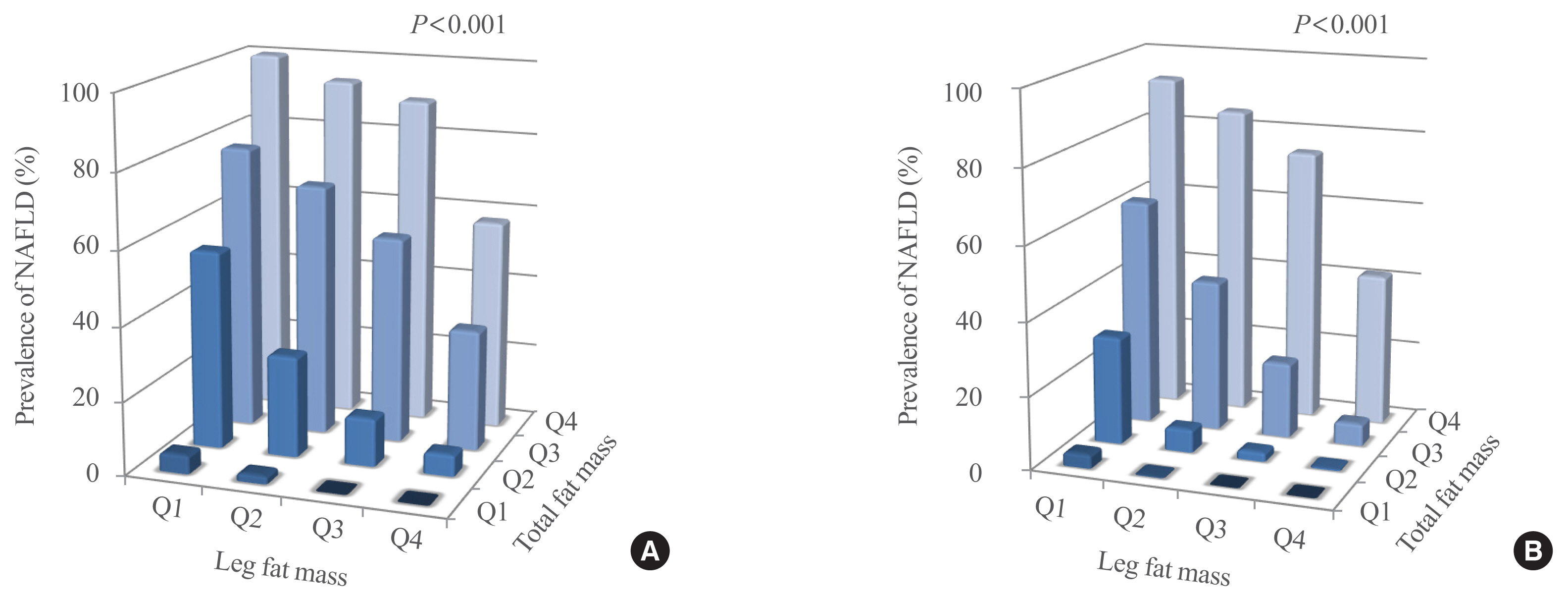
The leg fat to total fat (LF/TF) ratio showed a negative relationship with many factors, including body mass index, waist circumference, blood pressure, fasting blood glucose, and liver enzyme levels. When the LF/TF ratio and indices of hepatic steatosis were stratified by quartiles, the LF/TF ratio showed a negative correlation with the scoring systems that were used. The LF/TF ratio showed better accuracy in predicting NAFLD than total fat mass or leg fat mass alone. After adjusting for various traditional and lifestyle factors, a low LF/TF ratio remained a risk factor for NAFLD. Among NAFLD subjects, the LF/TF ratio showed a negative relationship with hepatic fibrosis.
Conclusion
A lower LF/TF ratio was markedly associated with a higher risk of hepatic steatosis and advanced hepatic fibrosis using various predictive models in a Korean population. Therefore, the LF/TF ratio could be a useful anthropometric parameter to predict NAFLD or advanced hepatic fibrosis. -
Citations
Citations to this article as recorded by
- A greater ratio of thigh subcutaneous fat to abdominal fat is associated with protection against non-alcoholic fatty liver disease
Yebei Liang, Peizhu Chen, Siyu Chen, Dan Liu, Fusong Jiang, Zhijun Zhu, Keqing Dong, Li Wei, Xuhong Hou
JHEP Reports.2023; 5(7): 100730. CrossRef - Association between Alcohol Consumption and Metabolic Dysfunction-Associated Steatotic Liver Disease Based on Alcohol Flushing Response in Men: The Korea National Health and Nutrition Examination Survey 2019–2021
Dae Eon Kang, Si Nae Oh
Nutrients.2023; 15(18): 3901. CrossRef
- A greater ratio of thigh subcutaneous fat to abdominal fat is associated with protection against non-alcoholic fatty liver disease

- Clinical Study
- Effect of Lactobacillus sakei, a Probiotic Derived from Kimchi, on Body Fat in Koreans with Obesity: A Randomized Controlled Study
- Soo Lim, Ji Hye Moon, Chol Min Shin, Dahye Jeong, Bongjoon Kim
- Endocrinol Metab. 2020;35(2):425-434. Published online June 24, 2020
- DOI: https://doi.org/10.3803/EnM.2020.35.2.425
- 8,698 View
- 261 Download
- 30 Web of Science
- 34 Crossref
-
Abstract
PDFPubReader ePub
- Background
The increased prevalence of obesity has led to increases in the prevalence of chronic diseases worldwide. There is interest whether probiotics have an effect on obesity, but the effectiveness and safety of only a few probiotics for the treatment of obesity have been reported. The purpose of this study was to investigate whether ingestion of Lactobacillus sakei (CJLS03) derived from kimchi causes weight loss in people with obesity.
Methods
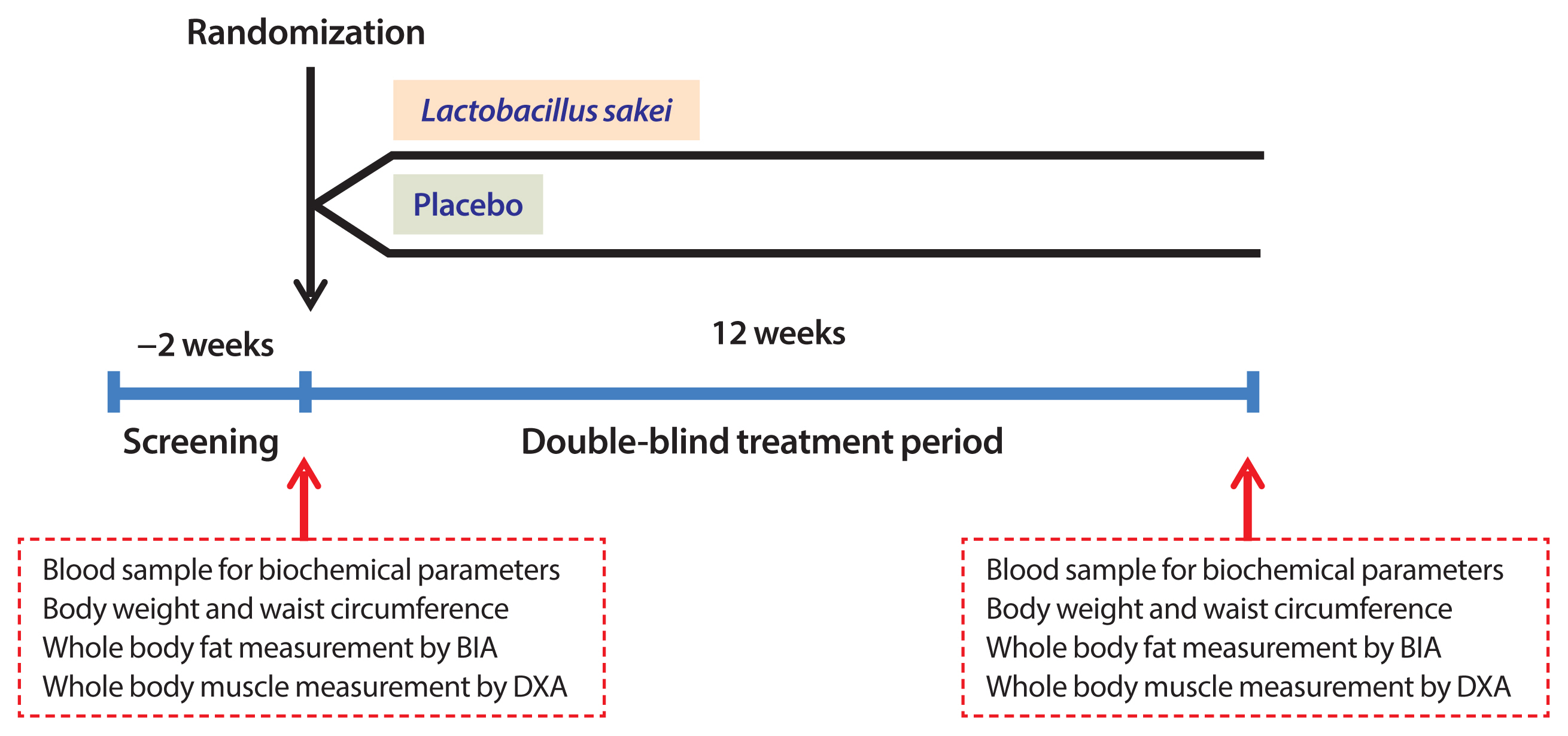
This randomized, double-blind, placebo-controlled, clinical trial involved 114 adults with a body mass index (BMI) ≥25 kg/m2 who were assigned randomly to a CJLS03 or placebo group. The groups received two allocations of either 5×10⁹ colony-forming units of CJLS03/allocation or the equivalent vehicle for 12 weeks. Demographic and biochemical parameters, and body composition including fat and muscle mass were measured at baseline and after 12 weeks. Changes in body fat, weight, and waist circumference were compared between the two treatment groups. Adverse events were monitored during study period.
Results
Body fat mass decreased by 0.2 kg in the CJLS03 group and increased by 0.6 kg in the placebo group (0.8 kg difference, P=0.018). After the 12 weeks, waist circumference was 0.8 cm smaller in the CJLS03 group than in the placebo group (P=0.013). BMI and body weight did not change after the 12 weeks. Adverse events were mild and did not differ between the two groups.
Conclusion
These data suggest that L. sakei (CJLS03) might help people with obesity reduce body fat mass without serious side effects (ClinicalTrials.gov: NCT03248414). -
Citations
Citations to this article as recorded by-
Latilactobacillus sakei
: a candidate probiotic with a key role in food fermentations and health promotion
Leilei Yu, Ying Chen, Hui Duan, Nanzhen Qiao, Gang Wang, Jianxin Zhao, Qixiao Zhai, Fengwei Tian, Wei Chen
Critical Reviews in Food Science and Nutrition.2024; 64(4): 978. CrossRef - Beneficial effects of the probiotics and synbiotics supplementation on anthropometric indices and body composition in adults: A systematic review and meta‐analysis
Saeede Saadati, Kaveh Naseri, Omid Asbaghi, Mohsen Yousefi, Elnaz Golalipour, Barbora de Courten
Obesity Reviews.2024;[Epub] CrossRef - Spore-forming probiotics Weizmannia coagulans isolated from human breast milk improves on the flavor development using micro-cheese platform
Hyejin Choi, Daye Mun, Sangdon Ryu, Min-Jin Kwak, Bum-Keun Kim, Dong-Jun Park, Do-Youn Jeong, Wonseo Park, Sangnam Oh, Younghoon Kim
Food Bioscience.2024; 57: 103550. CrossRef - Latilactobacillus sakei as a starter culture to ferment pepper fruits
Emma Mani-López, Nelly Ramírez-Corona, Aurelio López-Malo
Food and Humanity.2024; 2: 100233. CrossRef - Association between kimchi consumption and obesity based on BMI and abdominal obesity in Korean adults: a cross-sectional analysis of the Health Examinees study
Hyein Jung, Ye-Rang Yun, Sung Wook Hong, Sangah Shin
BMJ Open.2024; 14(2): e076650. CrossRef - Adjunctive administration of parabiotic Lactobacillus sakei CVL-001 ameliorates drug-induced toxicity and pulmonary inflammation during antibiotic treatment for tuberculosis
Hagyu Kim, Eun-Jung Song, Eunsol Choi, Kee Woong Kwon, Jong-Hwan Park, Sung Jae Shin
International Immunopharmacology.2024; 132: 111937. CrossRef - Anti-obesogenic effects of plant natural products: A focus on Korean traditional foods
Gitishree Das, Luis Alfonso Jiménez Ortega, Sandra Gonçalves, J. Basilio Heredia, Maria de Lourdes Gomes Pereira, Anabela Romano, Han-Seung Shin, Jayanta Kumar Patra
Trends in Food Science & Technology.2024; 148: 104470. CrossRef - The effect of probiotic and synbiotic supplementation on lipid parameters among patients with cardiometabolic risk factors: a systematic review and meta-analysis of clinical trials
Zeinab Ghorbani, Asma Kazemi, Theda U.P. Bartolomaeus, Fahimeh Martami, Morvarid Noormohammadi, Arsalan Salari, Ulrike Löber, Heydar Ali Balou, Sofia K. Forslund, Marjan Mahdavi-Roshan
Cardiovascular Research.2023; 119(4): 933. CrossRef - Impact of probiotics on muscle mass, muscle strength and lean mass: a systematic review and meta‐analysis of randomized controlled trials
Konstantinos Prokopidis, Panagiotis Giannos, Richard Kirwan, Theocharis Ispoglou, Francesco Galli, Oliver C. Witard, Konstantinos K. Triantafyllidis, Konstantinos S. Kechagias, Jordi Morwani‐Mangnani, Andrea Ticinesi, Masoud Isanejad
Journal of Cachexia, Sarcopenia and Muscle.2023; 14(1): 30. CrossRef - Anti-obesity potential of heat-killed Lactiplantibacillus plantarum K8 in 3T3-L1 cells and high-fat diet mice
Kyoung Ok Jang, Jung Seo Choi, Kyeong Hun Choi, Seongjae Kim, Hangeun Kim, Dae Kyun Chung
Heliyon.2023; 9(1): e12926. CrossRef - Effect of Lactobacillus plantarum LMT1-48 on Body Fat in Overweight Subjects: A Randomized, Double-Blind, Placebo-Controlled Trial
Minji Sohn, Hyeyoung Jung, Woo Shun Lee, Tai Hoon Kim, Soo Lim
Diabetes & Metabolism Journal.2023; 47(1): 92. CrossRef - Effect of kimchi intake on body weight of general community dwellers: a prospective cohort study
Li-Juan Tan, Ye-Rang Yun, Sung Wook Hong, Sangah Shin
Food & Function.2023; 14(4): 2162. CrossRef - Effects of Probiotics on Intermediate Cardiovascular Outcomes in Patients with Overweight or Obesity: A Systematic Review and Meta-Analysis
Frank Mayta-Tovalino, Carlos Diaz-Arocutipa, Alejandro Piscoya, Adrian V. Hernandez
Journal of Clinical Medicine.2023; 12(7): 2554. CrossRef - Effects of kimchi on human health: a scoping review of randomized controlled trials
Eunhye Song, Lin Ang, Hye Won Lee, Myung-Sunny Kim, You Jin Kim, Daija Jang, Myeong Soo Lee
Journal of Ethnic Foods.2023;[Epub] CrossRef - Randomized controlled trials reporting the effects of probiotics in individuals with overweight and obesity: A critical review of the interventions and body adiposity parameters
Marcella Rodrigues Guedes, Karine Scanci da Silva Pontes, Maria Inês Barreto Silva, Mario Fritsch Neves, Márcia Regina Simas Torres Klein
Clinical Nutrition.2023; 42(6): 835. CrossRef - Roles of the gut microbiome in weight management
Rachel N. Carmody, Jordan E. Bisanz
Nature Reviews Microbiology.2023; 21(8): 535. CrossRef - Does gut microbiota affect the success of weight loss? Evidence and speculation
Małgorzata Moszak, Marta Pelczyńska, Agnieszka Wesołek, Dominika Stenclik, Paweł Bogdański
Nutrition.2023; 116: 112111. CrossRef - Certain Fermented Foods and Their Possible Health Effects with a Focus on Bioactive Compounds and Microorganisms
Gülsüm Deveci, Elif Çelik, Duygu Ağagündüz, Elena Bartkiene, João Miguel F. Rocha, Fatih Özogul
Fermentation.2023; 9(11): 923. CrossRef - The gut microbiome in the fight against obesity: The potential of dietary factors
Jamil Ahmad, Imran Khan, Gokhan Zengin, Mohamad Fawzi Mahomoodally
The FASEB Journal.2023;[Epub] CrossRef - Effect of Continuous Ingestion of Bifidobacteria and Inulin on Reducing Body Fat: A Randomized, Double-Blind, Placebo-Controlled, Parallel-Group Comparison Study
Yuhei Baba, Yasuo Saito, Mei Kadowaki, Naoki Azuma, Daisuke Tsuge
Nutrients.2023; 15(24): 5025. CrossRef - A Review of the Health Benefits of Kimchi Functional Compounds and Metabolites
Hyun Ju Kim, Min Sung Kwon, Hyelyeon Hwang, Ha-Sun Choi, WooJe Lee, Sang-Pil Choi, Haeun Jo, Sung Wook Hong
Microbiology and Biotechnology Letters.2023; 51(4): 353. CrossRef - Efficacy and Safety of Lactobacillus plantarum K50 on Lipids in Koreans With Obesity: A Randomized, Double-Blind Controlled Clinical Trial
Minji Sohn, Ga Yoon Na, Jaeryang Chu, Hyunchae Joung, Byung-Kook Kim, Soo Lim
Frontiers in Endocrinology.2022;[Epub] CrossRef - Changes in systolic blood pressure, postprandial glucose, and gut microbial composition following mango consumption in individuals with overweight and obesity
Justine Keathley, Michèle Kearney, Véronique Garneau, Juan de Toro-Martín, Thibault V. Varin, Geneviève Pilon, Patrick Couture, André Marette, Marie-Claude Vohl, Charles Couillard
Applied Physiology, Nutrition, and Metabolism.2022; 47(5): 565. CrossRef - Host—microbial interactions in metabolic diseases: from diet to immunity
Ju-Hyung Lee, Joo-Hong Park
Journal of Microbiology.2022; 60(6): 561. CrossRef - Effect of MED-02 Containing Two Probiotic Strains, Limosilactobacillus fermentum MG4231 and MG4244, on Body Fat Reduction in Overweight or Obese Subjects: A Randomized, Multicenter, Double-Blind, Placebo-Controlled Study
Young Gyu Cho, Yun Jun Yang, Yeong Sook Yoon, Eon Sook Lee, Jun Hyung Lee, Yulah Jeong, Chang Ho Kang
Nutrients.2022; 14(17): 3583. CrossRef - Evaluation of metabolic activities and probiotic characteristics of two Latilactobacillus sakei strains isolated from pastırma
Emine Dincer, Merih Kivanc
World Journal of Microbiology and Biotechnology.2022;[Epub] CrossRef - Correlation between autochthonous microbial communities and flavor profiles during the fermentation of mustard green paocai (Brassica juncea Coss.), a typical industrial-scaled salted fermented vegetable
Dongdong Wang, Gong Chen, Yao Tang, Jiayi Li, Runqiu Huang, Meizuo Ye, Jianying Ming, Yalong Wu, Fei Xu, Xingyue Lai, Qisheng Zhang, Wenxue Zhang
LWT.2022; 172: 114212. CrossRef - Therapeutic and Improving Function of Lactobacilli in the Prevention and Treatment of Cardiovascular-Related Diseases: A Novel Perspective From Gut Microbiota
Xin Zhao, Xinqin Zhong, Xiao Liu, Xiaoying Wang, Xiumei Gao
Frontiers in Nutrition.2021;[Epub] CrossRef - Don’t Worry, Heavy Moms; Just Eat Your Broccoli (or Kimchi)!
Sun-Kyung Lee
Molecules and Cells.2021; 44(6): 422. CrossRef - Effects of probiotics on body adiposity and cardiovascular risk markers in individuals with overweight and obesity: A systematic review and meta-analysis of randomized controlled trials
Karine Scanci da Silva Pontes, Marcella Rodrigues Guedes, Michelle Rabello da Cunha, Samanta de Souza Mattos, Maria Inês Barreto Silva, Mario Fritsch Neves, Bianca Cristina Antunes Alves Marques, Márcia Regina Simas Torres Klein
Clinical Nutrition.2021; 40(8): 4915. CrossRef - Health-Promoting Constituents and Selected Quality Parameters of Different Types of Kimchi: Fermented Plant Products
Anna Korus, Emilia Bernaś, Jarosław Korus, Eduard Hernández
International Journal of Food Science.2021; 2021: 1. CrossRef - Effects of Probiotics and Synbiotics on Weight Loss in Subjects with Overweight or Obesity: A Systematic Review
Valentina Álvarez-Arraño, Sandra Martín-Peláez
Nutrients.2021; 13(10): 3627. CrossRef - ADJUVANT AND BENEFICIAL PROBIOTIC THERAPY FOR WOMEN HEALTH
Igori Balta, Eugenia Butucel, Valentyn Mohylyuk
Romanian Archives of Microbiology and Immunology.2021; 80(2): 151. CrossRef - Nrf2-interacting nutrients and COVID-19: time for research to develop adaptation strategies
Jean Bousquet, Jean-Paul Cristol, Wienczyslawa Czarlewski, Josep M. Anto, Adrian Martineau, Tari Haahtela, Susana C. Fonseca, Guido Iaccarino, Hubert Blain, Alessandro Fiocchi, G. Walter Canonica, Joao A. Fonseca, Alain Vidal, Hak-Jong Choi, Hyun Ju Kim,
Clinical and Translational Allergy.2020;[Epub] CrossRef
-
Latilactobacillus sakei
: a candidate probiotic with a key role in food fermentations and health promotion
- Relationship between Adiponectin, Leptin and Body Fat in Men with Hypogonadism Before and After Testosterone Treatment.
- Sang Wan Kim, Joon Ku Kang, Do Joon Park, Chan Soo Shin, Kyung Soo Park, Seong Yeon Kim, Bo Youn Cho, Hong Kyu Lee
- J Korean Endocr Soc. 2004;19(5):473-484. Published online October 1, 2004
- 1,116 View
- 19 Download
-
Abstract
PDF
- BACKGROUND
Testosterone replacement therapy in men with hypogonadism improves sexual function, decreases body fat, and increases the mass and function of lean muscle. These beneficial effects of testosterone replacement therapy are accompanied by slight lowering of the high density lipoprotein (HDL) cholesterol levels, increase in the hematocrit/hemoglobin ratio and size of the prostate gland. It is presently unknown whether the effect of testosterone on body fat could also reduce the risk of atherosclerotic disease associated with obesity. We investigated the relationship between body fat and blood leptin and adiponectin levels to elucidate the effect of testosterone on body fat metabolism, as well as the effect of testosterone on lipid and bone metabolism. METHODS: We selected 28 men, who were hypogonadal (mean serum testosterone+/-SD, 22.3+/-35.3 ng/dL) due to an organic disease, and them with oral testosterone (testosterone undecanoate) for 12 months. We measured the body composition, serum leptin, plasma adiponectin, biochemical bone markers, bone mineral density, prostate-specific antigen, and serum lipids before and 3, 6 and 12 months after treatment. We analyzed the relationship between body fat and blood leptin and adiponectin levels. RESULTS: The mean serum testosterone concentration reached the subnormal range after 6 months of treatment, which remained for the duration of treatment. The fat mass decreased and muscle mass increased, not within the first 6 months, but principally within 12 months (p<0.05). Although the decrease in the serum leptin level was not statistically significant, there were positive correlations between the leptin level and fat mass before and after 6 months of treatment (p<0.05). The plasma adiponectin did not increase or correlate with body fat parameters. The bone mineral densities of the lumbar spine (L2-L4) and femoral neck did not increased, but the serum osteocalcin and urine N-telopeptide were significantly decreased (p<0.05 and <0.01, respectively). The HDL-cholesterol decreased, principally within the first 6 months (p<0.01), but the total and LDL cholesterols, and the triglycerides remained unchanged during the course of treatment. There was also no change in prostate-specific antigen. CONCLUSION: Twelve months of oral testosterone replacement in men with hypogonadism improved body composition and bone metabolism, but demonstrated subnormal serum testosterone levels, had no effect on the leptin and adiponectin levels and decrease in HDL-cholesterol levels. It will be necessary to examine the long-term effects of testosterone replacement on the incidence of cardiovascular events as well as cardiovascular risk factors in men with hypogonadism
- Effects of B3-adrenergic Receptor Gene Mutation on the Body Fat Distribution and Weight Loss in Obese Subjects.
- Sung Kil Lim, Young Duk Song, Hyun Chul Lee, Kap Bum Huh, Kyung Rae Kim, Seok Won Park, Seok Joo Kwon, Eun Young Cho, Jong Ho Lee
- J Korean Endocr Soc. 1998;13(4):590-600. Published online January 1, 2001
- 1,092 View
- 19 Download
-
Abstract
PDF
- BACKGROUND
Recently, missense mutation of the B3-adrenergic receptor gene has been shown to be associated with early onset of type 2 diabetes, abdominal obesity and an increased capacity to gain weight. This study was performed to investigate the effects of Trp64Arg mutation in the B3-adrenergic receptor gene on body fat distribution and weight loss in obese subjects. METHODS: Determination of the B3-adrenergic receptor gene mutation with restriction enzyme digestion method, anthropometry, various biochemical studies, including oral glucose tolerance test were performed in 99 obese and 35 control subjects. Body fat distributions were also evaluated by computerized tomography before and after weight-reduction program. RESULTS: I) There were no differences in the frequencies of Trp64Arg mutation in the B3-adrenergic receptor gene between obese and control subjects (15.2 vs 12.9 %). 2) The obese subjects with Trp64Arg mutation had higher waist to hip circumference ratio(WHR) (0.93 +/- 0.05 vs 0.87 +/- 0.04, p<0.001), visceral fat area (115.0 +/- 25.9 vs 86.4 +/- 41.4 cm, p=0.01), but decreased plasma free fatty acid (618.0 +/- 163.1 vs 817.5 +/- 248.2 pEq/L, p=0.001), and triglyceride level (118.7 +/- 36.2 vs 158.4 +/- 105.8 mg/dL, p=0.015) than those without mutation. 3) The obese subjects with Trp64Arg mutation had smaller decreases in weight (-3.4 vs -5.1 kg, p<0.001), body fat content (-2.1 vs -3.8 %, p<0.001), WHR (-0.01 vs -0.03, p=0.025), and abdominal fat masses (total, subcutaneous, and visceral fat) after weight-reduction program than those without mutation. CONCLUSION: Trp64Arg mutation in the B3-adrenergic receptor gene might be one of genetic loci contributing to central obesity and a predictor of difficulty in losing weight in obese subjects.
 First
First Prev
Prev


