

Skip Navigation
Skip to contents

Endocrinol Metab : Endocrinology and Metabolism

clarivate
OPEN ACCESS
SEARCH
Search

Search

Page Path
HOME > Search
2 "Sleep"
Filter
Filter
Article type
Keywords
Publication year
Authors
Original Articles
Hypothalamus and pituitary gland
Obstructive Sleep Apnea Screening and Effects of Surgery in Acromegaly: A Prospective Study
Jaeyoung Cho, Jung Hee Kim, Yong Hwy Kim, Jinwoo Lee
Endocrinol Metab. 2024;39(4):641-652.   Published online June 26, 2024
DOI: https://doi.org/10.3803/EnM.2024.1933
  • 8,016 View
  • 109 Download
  • 8 Web of Science
  • 9 Crossref
AbstractAbstract PDFSupplementary MaterialPubReader   ePub   
Background
To identify a screening tool for obstructive sleep apnea (OSA) and evaluate the effects of endoscopic transsphenoidal surgery on improving OSA in patients with acromegaly.
Methods
We prospectively enrolled adults with acromegaly scheduled for endoscopic transsphenoidal surgery. All measurements were conducted when participants were admitted for a baseline work-up for acromegaly before surgery and surveillance approximately 3 to 6 months after surgery. Respiratory event index (REI) was used as a surrogate for apnea-hypopnea index (Trial Registration: NCT03526016).
Results
Of the 35 patients with acromegaly (median age, 47 years; 40% men; median body mass index, 24.4 kg/m2), 24 (68.6%) had OSA (REI ≥5/hour), 15 (42.9%) had moderate-to-severe OSA (REI ≥15/hour). At baseline, serum insulin-like growth factor 1 (IGF-1) levels were positively correlated with the REI (ρ=0.53, P=0.001). The sensitivity and negative predictive value of a Snoring, Tiredness, Observed apnea, high blood Pressure-Body mass index, age, Neck circumference, and Gender (STOP-Bang) score ≥ 3 were 93.3% and 87.5%, respectively, detecting moderate-to-severe OSA. Biochemical acromegaly remission was achieved in 32 (91.4%) patients. The median difference in the REI was –9.5/hour (95% confidence interval, –13.3 to –5.3). Half of the 24 patients diagnosed with OSA preoperatively had REI <5/hour postoperatively. In a linear mixed-effects model, changes in the REI across surgery were related to changes in IGF-1 levels.
Conclusion
The STOP-Bang questionnaire is a reliable tool for OSA among patients with acromegaly. Improvement in OSA severity after surgery is related to decreased IGF-1 levels.

Citations

Citations to this article as recorded by  
  • Change in apnea hypopnea index and sleep quality following treatment in acromegaly
    Kavita Kadian, Ravi Gupta, Rajnish Arora, Kalyani Sridharan
    Endocrine Research.2026; 51(1): 27.     CrossRef
  • Correlation between obstructive sleep apnea and pituitary function in pituitary adenomas patients
    Zitong Wang, Qi Li, Junjie Zhao, Hai Yu, Jiayi Du, Tingqin Huang, Yushan Xie, Zine Cao, Chendi Lu, Xinru Lv, Simin Zhu, Yanuo Zhou, Wei Hou, Yani Feng, Haiqin Liu, Xiaoyong Ren, Yewen Shi
    Respiratory Medicine.2026; 252: 108660.     CrossRef
  • Acromegaly and cardiovascular disease: mechanisms, clinical impact, and evolving management
    Marta Araujo-Castro, Pedro Marques, Luis Miguel Cardoso, Eider Pascual-Corrales, Julie Refardt, Sebastian J C M M Neggers, José María Jiménez Cassinello, Mónica Marazuela, Manel Puig-Domingo, Betina Biagetti
    Endocrine Reviews.2026;[Epub]     CrossRef
  • Consensus on acromegaly complications: an update
    Andrea Giustina, Luigi di Filippo, Maria Fleseriu, Rosario Pivonello, Stephan Petersenn, John Wass, Susan L. Samson, Alberto M. Pereira, Raúl M. Luque, Betina Biagetti, Maria Chiara Zatelli, Ken K Y Ho, Cesar L. Boguszewski, Aart Jan van der Lely, Mark Gu
    Pituitary.2026;[Epub]     CrossRef
  • Acromegaly complications: an update
    Andrea Giustina, Maria Fleseriu
    The Journal of Clinical Endocrinology & Metabolism.2026; 111(Supplement): S51.     CrossRef
  • Acromegaly Discovered After Head Trauma: Multivessel Coronary Disease and Postoperative Meningitis Complicating a Pituitary Macroadenoma
    Sean Rockwell, Jaxon S Boley, Nicholas Pulido, Mohammad Safa, Lila S Chertman
    Cureus.2026;[Epub]     CrossRef
  • Long-Term Prognosis and Systemic Impact of Acromegaly: Analyses Utilizing Korean National Health Insurance Data
    Sangmo Hong, Kyungdo Han, Cheol-Young Park
    Endocrinology and Metabolism.2025; 40(1): 1.     CrossRef
  • Mechanisms associated with obstructive sleep apnea in achondroplasia
    G. Dave Singh
    Journal of Clinical Sleep Medicine.2025; 21(9): 1649.     CrossRef
  • How Different Treatments for Acromegaly Modulate Sleep Quality: A Psychometric Study
    Gaspare Alfì, Danilo Menicucci, Dalì Antonia Ciampa, Vito Di Giura, Giulia Marconcini, Claudio Urbani, Fausto Bogazzi, Angelo Gemignani
    Endocrines.2024; 5(3): 408.     CrossRef
Close layer
Diabetes, Obesity and Metabolism
Sleep Duration and the Risk of Type 2 Diabetes: A Community-Based Cohort Study with a 16-Year Follow-up
Da Young Lee, Inha Jung, So Young Park, Ji Hee Yu, Ji A Seo, Kyeong Jin Kim, Nam Hoon Kim, Hye Jin Yoo, Sin Gon Kim, Kyung Mook Choi, Sei Hyun Baik, Seung Ku Lee, Chol Shin, Nan Hee Kim
Endocrinol Metab. 2023;38(1):146-155.   Published online February 6, 2023
DOI: https://doi.org/10.3803/EnM.2022.1582
  • 14,820 View
  • 364 Download
  • 18 Web of Science
  • 23 Crossref
AbstractAbstract PDFPubReader   ePub   
Background
We aimed to investigate the moderating effects of obesity, age, and sex on the association between sleep duration and the development of diabetes in Asians.
Methods
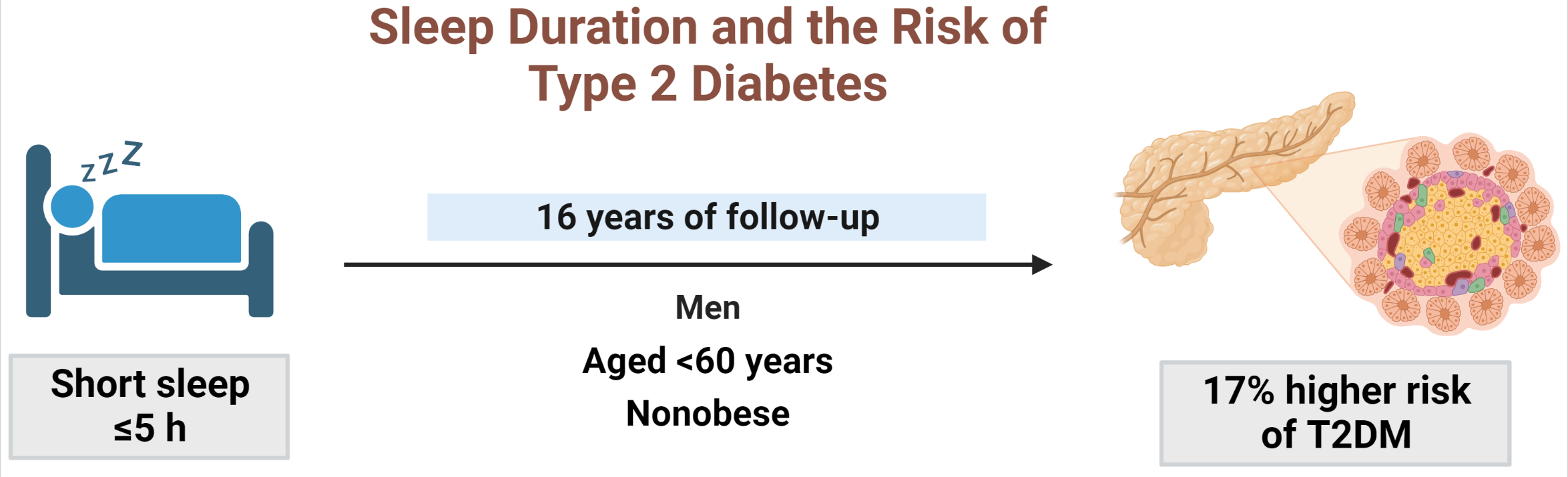
We analyzed data from a cohort of the Korean Genome and Epidemiology Study conducted from 2001 to 2020. After excluding shift workers and those with diabetes at baseline, 7,407 participants were stratified into three groups according to sleep duration: ≤5 hours/night, >5 to 7 hours/night (reference), and >7 hours/night. The Cox proportional hazards analyses were used to calculate the hazard ratios (HRs) and 95% confidence intervals (CIs) for incident type 2 diabetes mellitus (T2DM). Subgroup analyses were performed according to obesity, age, and sex.
Results
During 16 years of follow-up, 2,024 cases of T2DM were identified. Individuals who slept ≤5 h/night had a higher risk of incident diabetes than the reference group (HR, 1.17; 95% CI, 1.02 to 1.33). The subgroup analysis observed a valid interaction with sleep duration only for obesity. A higher risk of T2DM was observed in the ≤5 hours/night group in non-obese individuals, men, and those aged <60 years, and in the >7 hours/night group in obese individuals (HRs were 1.34 [95% CI, 1.11 to 1.61], 1.22 [95% CI, 1 to 1.49], and 1.18 [95% CI, 1.01 to 1.39], respectively).
Conclusion
This study confirmed the effect of sleep deprivation on the risk of T2DM throughout the 16-year follow-up period. This impact was confined to non-obese or young individuals and men. We observed a significant interaction between sleep duration and obesity.

Citations

Citations to this article as recorded by  
  • Glucose homeostasis during recurrent periods of sleep restriction and recovery in healthy young adults
    Yuki Y Y Cheung, Torance Y L Tan, Tiffany B Koa, Chin Meng Khoo, June C Lo
    SLEEPJ.2026;[Epub]     CrossRef
  • Mobile Phone Addiction and Sleep Quality Among Children and Adolescents: Unraveling the Health Consequences
    Ghizal Fatima, Vani Shukla, Aminat Magomedova, Rasul Magomedov
    Cureus.2026;[Epub]     CrossRef
  • Association of daytime circadian-aligned activity with glycemic control in type 2 diabetes: Insights from continuous glucose monitoring and wearable data
    Da Young Lee, Jung-Been Lee, Inha Jung, So Young Park, Ji Hee Yu, Ji A Seo, Heon-Jeong Lee, Nan Hee Kim
    Metabolism.2026; 179: 156570.     CrossRef
  • The Role of Circadian Rhythm Dysregulation, Abnormal Sleep Patterns, and Sleep Disorders on the Development of Diabetes
    Hulya Merie, Bashair M. Mussa, Salah Abusnana
    Clocks & Sleep.2026; 8(2): 22.     CrossRef
  • Body-weight-specific and shared metabolomic responses to acute sleep loss in young adults
    Linnéa Good, Luiz Eduardo Mateus Brandão, Lieve Thecla van Egmond, Payam Emami Khoonsari, Ida Erngren, Henrik Carlsson, Robert Fredriksson, Kim Kultima, Christian Benedict, Jonathan Cedernaes
    Journal of Translational Medicine.2026;[Epub]     CrossRef
  • Association Between Sleep Duration and Glycemic Levels in Adults With Prediabetes: A Population-based Study
    Zhongqing Mou, Yan Zhou, Zaiquan Dong
    Canadian Journal of Diabetes.2026;[Epub]     CrossRef
  • Sleep features and the risk of type 2 diabetes mellitus: a systematic review and meta-analysis
    Hongyi Liu, Hui Zhu, Qinkang Lu, Wen Ye, Tao Huang, Yuqiong Li, Bingqi Li, Yingxin Wu, Penghao Wang, Tao Chen, Jin Xu, Lindan Ji
    Annals of Medicine.2025;[Epub]     CrossRef
  • The potential impact of habitual sleep quality on glycaemic control and inflammation: A study on geriatric patients recently diagnosed with type 2 diabetes mellitus (T2DM)
    Nadia Hussain, Amal Hussain Ibrahim Al Haddad, Saima Abbass, Zina Alfahl
    Sleep Medicine: X.2025; 9: 100139.     CrossRef
  • The link between sleep duration and stroke risk
    Yu Cheng, Yuchuan Ding, Ahmed Elmadhoun, Xunming Ji, Xiaokun Geng
    Brain Circulation.2025; 11(1): 1.     CrossRef
  • Association between obstructive sleep apnea risk and atherosclerosis: A nationwide cross-sectional study in the Korean population
    Il Rae Park, Yong Geun Chung, Seung Min Chung, Jun Sung Moon, Ji Sung Yoon, Kyu Chang Won, Qian Wu
    PLOS One.2025; 20(5): e0322897.     CrossRef
  • Case Report on the Improvement of Uncontrolled Blood Glucose with Shihogayonggolmoryo-tang, Yeonggyechulgam-tang, and Korean Medicine Complex Therapy
    Nahyun Cho, Chul-woo Ahn, Hyungsun Jun, Hyun-jong Jung, Dasol Park, Jungtae Leem
    The Journal of Internal Korean Medicine.2025; 46(3): 511.     CrossRef
  • The relationship between sleep patterns and the risk of edentulism: evidence from the CHARLS
    Hong-Yu Zhao, Peng-Lu Jia, Ping Ma, Wu-Long Jin, Hua-Jiao Yu
    Postgraduate Medical Journal.2025; 102(1203): 48.     CrossRef
  • Impact of Technological Advances on Type 2 Diabetes and Its Effect on Mental Health: A Perspective
    Varun Damle, Ankit Halder, Tanvi Damle
    Annals of Indian Psychiatry.2025;[Epub]     CrossRef
  • Reinterpreting Yangsaeng in Physiology on Korean Medicine for Geriatric Care: A Personalized Self-Care Model for Future Medicine
    Su Jin Lee, Young-Kyu Kwon
    Journal of Physiology & Pathology in Korean Medicine.2025; 39(6): 271.     CrossRef
  • Attention to Innate Circadian Rhythm and the Impact of Its Disruption on Diabetes
    Da Young Lee, Inha Jung, So Young Park, Ji Hee Yu, Ji A Seo, Kyeong Jin Kim, Nam Hoon Kim, Hye Jin Yoo, Sin Gon Kim, Kyung Mook Choi, Sei Hyun Baik, Nan Hee Kim
    Diabetes & Metabolism Journal.2024; 48(1): 37.     CrossRef
  • Role of Sleep and Sleep Disorders in Cardiometabolic Risk: a Review and Update
    Shaden O. Qasrawi, Ahmed S. BaHammam
    Current Sleep Medicine Reports.2024; 10(1): 34.     CrossRef
  • Evaluating reliability in wearable devices for sleep staging
    Vera Birrer, Mohamed Elgendi, Olivier Lambercy, Carlo Menon
    npj Digital Medicine.2024;[Epub]     CrossRef
  • Replication Study of Genome Wide Association Study of Sleep Duration in Korean Association Resources Cohort
    Seok-Ho Cho, Seon-Ah Kim, Hyun-Seok Jin, Hong Sung Kim
    Biomedical Science Letters.2024; 30(2): 86.     CrossRef
  • Insights into optimal BMI from the GlasVEGAS study
    Chun-Kwan O, Juliana C. N. Chan
    Nature Metabolism.2024; 6(8): 1435.     CrossRef
  • Mechanisms, consequences and role of interventions for sleep deprivation: Focus on mild cognitive impairment and Alzheimer’s disease in elderly
    Upasana Mukherjee, Ujala Sehar, Malcolm Brownell, P. Hemachandra Reddy
    Ageing Research Reviews.2024; 100: 102457.     CrossRef
  • The Relationship Between the Risk of Type 2 Diabetes and Insomnia Severity and Sleep Duration in Academicians
    Tuğba Bilgehan, Esra Çalık Var
    Sağlık Bilimleri Üniversitesi Hemşirelik Dergisi.2024; 6(3): 203.     CrossRef
  • All That Glitters Is Not Gold: The Same Sleep Time, but Different Diabetogenic Outcomes
    Bohye Kim, Obin Kwon
    Endocrinology and Metabolism.2023; 38(1): 78.     CrossRef
  • The Link Between Sleeping and Type 2 Diabetes: A Systematic Review
    Ali Darraj
    Cureus.2023;[Epub]     CrossRef
Close layer

Endocrinol Metab : Endocrinology and Metabolism
TOP