Parathyroid hormone (PTH) and fibroblast growth factor 23 (FGF23) each play a central role in the pathogenesis of chronic kidney disease (CKD)-mineral and bone disorder. Levels of both hormones increase progressively in advanced CKD and can lead to damage in multiple organs. Secondary hyperparathyroidism (SHPT), characterized by parathyroid hyperplasia with increased PTH secretion, is associated with fractures and mortality. Emerging evidence suggests that these associations may be partially explained by PTH-induced browning of adipose tissue and increased energy expenditure. Observational studies suggest a survival benefit of PTHlowering therapy, and a recent study comparing parathyroidectomy and calcimimetics further suggests the importance of intensive PTH control. The mechanisms underlying the regulation of FGF23 secretion by osteocytes in response to phosphate load have been unclear, but recent experimental studies have identified glycerol-3-phosphate, a byproduct of glycolysis released by the kidney, as a key regulator of FGF23 production. Elevated FGF23 levels have been shown to be associated with mortality, and experimental data suggest off-target adverse effects of FGF23. However, the causal role of FGF23 in adverse outcomes in CKD patients remains to be established. Further studies are needed to determine whether intensive SHPT control improves clinical outcomes and whether treatment targeting FGF23 can improve patient outcomes.
Citations
Citations to this article as recorded by
Heterogeneous regulation of fibroblast growth factor 23 in acute kidney injury, chronic kidney disease, and polycystic kidney disease: mechanisms, diagnostic utility, and clinical implications Xiaohua Hu, Bo Yang, Haimin Chen, Min Min, Nanmei Liu, Cheng Xue Frontiers in Molecular Biosciences.2026;[Epub] CrossRef
Endocrine disorders linked to chronic kidney disease: Mechanisms and clinical implications Marcio J Concepción-Zavaleta, Jenyfer M Fuentes-Mendoza, Elida P López-Ramírez, Jesús A Martínez-García, Luis A Concepción-Urteaga, José Paz-Ibarra World Journal of Nephrology.2026;[Epub] CrossRef
Diabetes progression and its association with fracture risk in type 2 diabetes Bongsung Kim, Kyu-Na Lee, Kyungdo Han, Mee Kyoung Kim Osteoporosis International.2026;[Epub] CrossRef
Pre-Parathyroidectomy PTH as an Integrated Biomarker of Glandular Remodeling and Skeletal Turnover in Secondary Hyperparathyroidism Min-Tser Liao, Chia-Chao Wu, Yi-Chou Hou, Kuo-Wang Tsai, Li-Jane Shih, Kuo-Cheng Lu, Chien-Lin Lu International Journal of Molecular Sciences.2026; 27(11): 5094. CrossRef
Allopurinol has no effect on calcitriol or other CKD-MBD biomarkers: a randomized double-blind study Tiago E Costa, Julia C Lauar, Mariana L R Innecchi, Luiza Karla R P Araujo, Venceslau A Coelho, Luciene M dos Reis, Rosa M A Moysés, Rosilene M Elias Journal of the Endocrine Society.2026;[Epub] CrossRef
Combination therapy with nutritional vitamin D and calcimimetics in secondary hyperparathyroidism: a mechanism-based approach to restoring PTH regulation Chien-Lin Lu, Yi-Chou Hou, Chia-Chao Wu, Te-Chao Fang, Cai-Mei Zheng, Kuo-Cheng Lu Frontiers in Nutrition.2026;[Epub] CrossRef
Fracture prevention in osteoporosis and nephrolithiasis: maintaining the balance of mineral metabolism O.I. Nishkumai, O.B. Iaremenko, V.E. Kondratiuk, Mike K.S. Chan, M.B. Dzhus, I.V. Rudenko, A.B. Bezrodnyi TRAUMA.2026; 27(3): 233. CrossRef
Safety, tolerability, pharmacokinetics, and pharmacodynamics of oral JMKX003002 in Chinese healthy participants: a randomized, double-blind, placebo-controlled, single- and multiple-ascending dose, and food-effect phase I clinical trial Guoying Cao, Xiaomeng Mao, Xiaojie Wu, Nanyang Li, Haijing Yang, Jingjing Wang, Jicheng Yu, Jingqiu Hu, Lingli Zhang, Jingyun Chen, Jing Zhang Annals of Medicine.2026;[Epub] CrossRef
Association Between Serum Parathyroid Hormone Levels and Femoral Bone Mineral Density in Patients with Chronic Kidney Disease Stage 3 Laura Montaño-Azor, Petra Cantón Guerrero, María Ángeles Jiménez Sánchez, María José Jiménez Moral, Raquel María García-Sáez, María Encarnación Rodríguez-Ortiz, Mariano Rodríguez, Victoria Pendón-Ruiz de Mier, Esperanza Romero-Rodríguez Journal of Clinical Medicine.2026; 15(14): 5519. CrossRef
Gene expression and hormonal signaling in osteoporosis: from molecular mechanisms to clinical breakthroughs Gurinderdeep Singh, Ronald Darwin, Krishna Chandra Panda, Shaikh Amir Afzal, Shashwat Katiyar, Ram C. Dhakar, Sangeetha Mani Journal of Biomaterials Science, Polymer Edition.2025; 36(10): 1466. CrossRef
Correlation linking fibroblast growth factor 23 in circulation (FGF-23) and serum aldosterone levels in different stages of chronic kidney disease Amira Hassan Elsaid Dohuim, Medhat Abd El Megeid Ghazy, Nahla Abdel Aziz Nosair, Amr Khalifa Hussien The Egyptian Journal of Internal Medicine.2025;[Epub] CrossRef
Effects of Blood Flow Restriction Training and Possible Applications in Chronic Kidney Disease: A Narrative Review Shen Liu, Zhuo Wang, Jia-fu Tang, Yong-long Yang, Wei-xiu Ji, Da-qi Xu Current Physical Medicine and Rehabilitation Reports.2025;[Epub] CrossRef
Correlation Between Fibroblast Growth Factor 23 and Biochemical Parameters in Hemodialysis Patients With End-Stage Renal Disease Barat Yusubov, Mirkhalig Javadov, Khanbaba Huseynov, Muradali Bakhshiyev Cureus.2025;[Epub] CrossRef
Serum FGF-23 and Vitamin D Deficiency as Predictors of Metabolic Syndrome in Chronic Kidney Disease
Pakistan Journal of Medicine and Dentistry.2025; : 334. CrossRef
Efficacy of Different Doses of Sodium in the Dialysis Fluid on the Levels of Calcium, Phosphorus and Parathyroid Hormone in Patients Undergoing Chronic Hemodialysis Asieh Aref, Ladan Mirzaei, Ali Ghorbani, Samaneh Tirom, Elham Farhadi Nephro-Urology Monthly.2025;[Epub] CrossRef
Skeletal Health in Youth with Type 2 Diabetes Hanine AlArab, Anna Zenno, Melinda Pierce Current Osteoporosis Reports.2025;[Epub] CrossRef
Capture the superior anti-osteoporotic innovative multi-component complex from Ligustri Lucidi Fructus based on Component Recombination strategy Jun Jiang, Baixiu Zhao, Yuwen Ma, Yichen Zeng, Yusong Zeng, Jin Fang, Wenjiao Kang, Tong Chen Phytomedicine.2025; 146: 157116. CrossRef
Serum Calcium as a Determinant of Fibroblast Growth Factor 23 Levels in Patients With Primary Hyperparathyroidism and Graves’ Disease Hiroyuki Yamashita, Yusuke Mori, Yasuo Imanishi, Hisakazu Shindo, Daisuke Tatsushima, Seigo Tachibana, Takashi Fukuda, Hiroshi Takahashi, Yuji Nagayama, Shinya Satoh Cureus.2025;[Epub] CrossRef
Immune mechanisms in chronic kidney disease-mineral and bone disorder: current insights and therapeutic implications Bin Xu, Rui Ma, Yuqiang Wu, Chi Liu, Xiangrong Song Frontiers in Medicine.2025;[Epub] CrossRef
Treatment outcomes and determinants of combined hemodialysis-hemoperfusion therapy in chronic glomerulonephritis Xiaotong Yuan American Journal of Translational Research.2025; 17(11): 8612. CrossRef
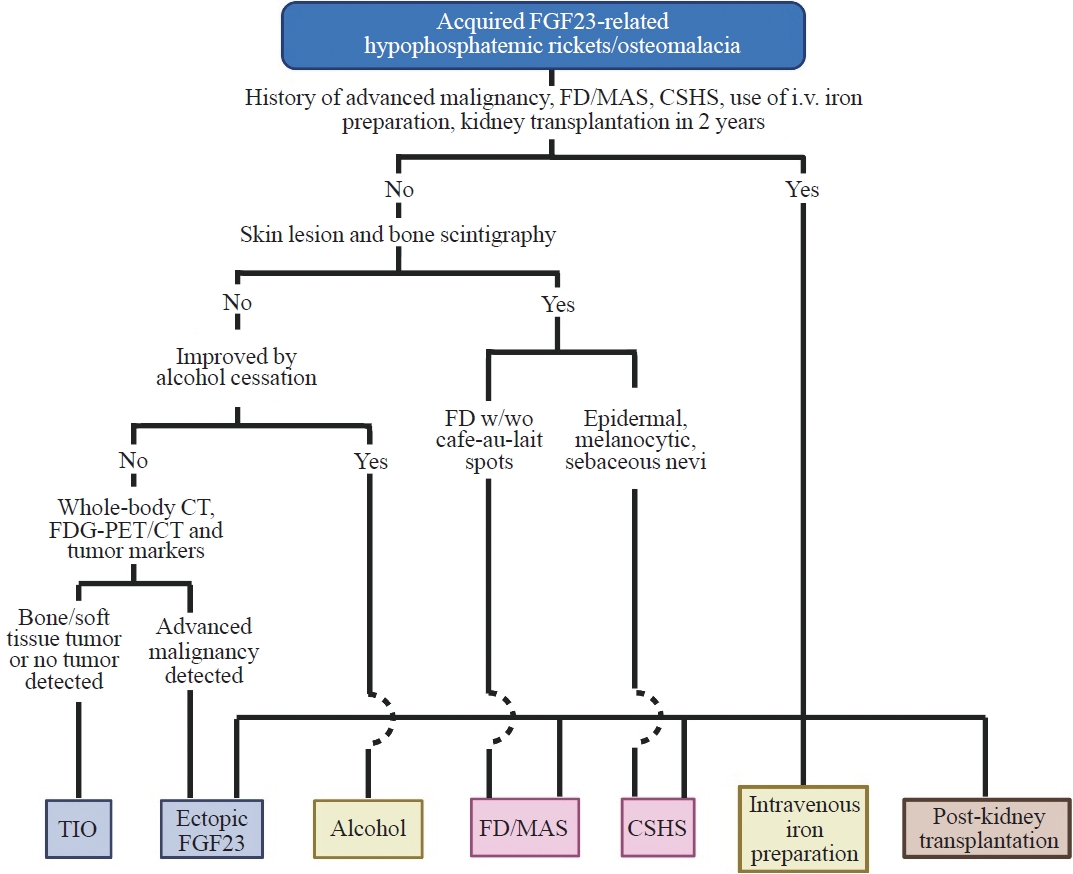
Fibroblast growth factor 23 (FGF23) is a pivotal humoral factor for the regulation of serum phosphate levels and was first identified in patients with autosomal dominant hypophosphatemic rickets and tumor-induced osteomalacia (TIO), the most common form of acquired FGF23-related hypophosphatemic rickets/osteomalacia (FGF23rHR). After the identification of FGF23, many other inherited and acquired forms of FGF23rHR were reported. In this review article, the detailed features of each acquired FGF23rHR are discussed, including TIO, ectopic FGF23 syndrome with malignancy, fibrous dysplasia/McCune-Albright syndrome, Schimmelpenning-Feuerstein-Mims syndrome/cutaneous skeletal hypophosphatemia syndrome, intravenous iron preparation-induced FGF23rHR, alcohol consumption-induced FGF23rHR, and post-kidney transplantation hypophosphatemia. Then, an approach for the differential diagnosis and therapeutic options for each disorder are concisely introduced. Currently, the majority of endocrinologists might only consider TIO when encountering patients with acquired FGF23rHR; an adequate differential diagnosis can reduce medical costs and invasive procedures such as positron emission tomography/computed tomography and venous sampling to identify FGF23-producing tumors. Furthermore, some acquired FGF23rHRs, such as intravenous iron preparation/alcohol consumption-induced FGF23rHR, require only cessation of drugs or alcohol to achieve full recovery from osteomalacia.
Citations
Citations to this article as recorded by
Surgical management strategies and clinical outcomes of cutaneous skeletal hypophosphatemia syndrome: a case series Yi Qiao, Jin Dai, Ting Zhuang, Yicong Liu, Xiuzhi Ren Frontiers in Pediatrics.2026;[Epub] CrossRef
Adefovir dipivoxil-induced hypophosphatemic osteomalacia and osteoporosis: a case report and literature review Wenshu Yu, Chunxia Deng, Shangyu Chen, Hui Jiang, Jiaqin Jiang Frontiers in Endocrinology.2026;[Epub] CrossRef
Oral manifestations of X-linked hypophosphatemic rickets: diagnostic and therapeutic strategies from the perspective of systemic homeostatic imbalance Yunfan Cai, Yue Feng, Baize Zhang, Jingrui Kang, Ling Li, Xiang Li, Zhiting Li, Shengquan Cheng, Xin Sun, Yujiang Chen, Tao Ye, Li’an Wu, Kaiyan Wang, Lina Niu Oral Science and Homeostatic Medicine.2026;[Epub] CrossRef
Hypophosphatemic osteomalacia caused by diffuse tenosynovial giant cell tumor misdiagnosed as spondyloarthritis: a case report Yazhen Su, Xingxing Zhao, Ruihong Hou, Dan Ma, Ke Xu, Liyun Zhang Frontiers in Endocrinology.2026;[Epub] CrossRef
Paraneoplastic endocrine syndromes: a contemporary overview Juan Eduardo Quiroz-Aldave, Jacsel Suarez-Rojas, Elman Rolando Gamarra-Osorio, Katia Rivera-Fabián, María Del Carmen Durand-Vásquez, Luis Alberto Concepción-Urteaga, José Paz-Ibarra, Marcio José Concepción-Zavaleta Expert Review of Endocrinology & Metabolism.2025; 20(1): 51. CrossRef
Excess fibroblast growth factor 23 in alcoholic osteomalacia is derived from the bone Naoko Hidaka, Yuko Oyama, Minae Koga, Naoki Kondo, Yoichi Yasunaga, Taketoshi Shimakura, Noriaki Yamamoto, Hideaki E Takahashi, Yoichi Iwafuchi, So Watanabe, Soichiro Kimura, Yoshitomo Hoshino, Hajime Kato, Yuka Kinoshita, Hiroshi Kobayashi, Takeyuki Tana JBMR Plus.2025;[Epub] CrossRef
X-linked hypophosphatemia and tumor-induced osteomalacia: a narrative review and expert opinion on the diagnostic and therapeutic challenges in the era of burosumab Maria Luisa Brandi, Cristina Eller Vainicher, Danilo Fintini, Andrea Giusti, Andrea Magnolato, Salvatore Minisola, Sandro Giannini Orphanet Journal of Rare Diseases.2025;[Epub] CrossRef
Acquired hypophosphatemic osteomalacia: case series from a Peruvian referral center (1999–2023) José Paz-Ibarra, Sofía Sáenz-Bustamante, Manuel Inostroza-Fernández, Paola Sifuentes Hermenegildo, Liliana Ancajima Lescano, Marcio Concepción-Zavaleta, Alejandro Román-González, Alfredo Adolfo Reza-Albarrán Archives of Osteoporosis.2024;[Epub] CrossRef
Tumor-induced osteomalacia (TIO), a paraneoplastic disease, is characterized by hypophosphatemia, and caused by renal phosphate wasting inappropriately, normal or decreased 1, 25(OH)2D3 production, and defective calcification of cartilage and bone. Because the removal of the responsible tumor normalizes phosphate metabolism, unidentified humoral phosphaturic factors (phosphatonin) are believed to be responsible for this syndrome. These factors include fibroblast growth factor (FGF)-23, secreted frizzled-related protein-4 and matrix extracellular phosphoglycoprotein. However, no case of TIO producing FGF-23 has been clearly reported in Korea. Herein, a case of TIO producing FGF-23 in a 45-year-old woman is reported. The patient presented with a large tumor on her buttock, with severe bone and muscle pain. A histological examination of the tumor revealed a mixed connective tissue tumor, consisting of deposition of calcified materials and surrounding primitive spindle cells, with prominent vascularity. Whether FGF-23 is a secreted factor, as well as its levels of expression in tumors were investigated. An immunohistochemical study showed the tumor cells to be FGF-23 positive. Furthermore, the levels of serum FGF-23 were extremely high and an RT-PCR analysis, using total RNA from the tumor, revealed the abundant expression of FGF-23 mRNA. After removal of the tumor, all the biochemical and hormonal abnormalities disappeared, with marked symptomatic improvement.
Citations
Citations to this article as recorded by
Change in Patient's Ages Who Took an Adenoidectomy for 30 Years Eun Jung Lee, Ji Hoon Kim, Hye Jin Hwang, Min Ki Kim, Min Seok Kang, Kyung-Su Kim Journal of Rhinology.2017; 24(1): 8. CrossRef
Dietary assessment according to frequency of food consumed away from home among children and adolescents: Based on the 2010~2012 Korea National Health and Nutrition Examination Survey Yong-Suk Kwon, Wan-Soo Hong, Seyoung Ju Journal of Nutrition and Health.2016; 49(6): 471. CrossRef
Dyslipidemia in Children and Adolescents: When and How to Diagnose and Treat? Jung Min Yoon Pediatric Gastroenterology, Hepatology & Nutrition.2014; 17(2): 85. CrossRef
Length and Volume of Morphologically Normal Kidneys in Korean Children: Ultrasound Measurement and Estimation Using Body Size Jun-Hwee Kim, Myung-Joon Kim, Sok Hwan Lim, Jieun Kim, Mi-Jung Lee Korean Journal of Radiology.2013; 14(4): 677. CrossRef
Factors Influencing Obesity among Adolescent: Analysis of 2011 Korean Youth Risk Behavior Survey Young-Ju Jee, Young-Hae Kim The Korean Journal of Obesity.2013; 22(1): 39. CrossRef
A Case of Nutritional Osteomalacia in Young Adult Male Choong-Kyun Noh, Min-Jeong Lee, Bu Kyung Kim, Yoon-Sok Chung Journal of Bone Metabolism.2013; 20(1): 51. CrossRef
The Relationship between High Energy/Low Nutrient Food Consumption and Obesity among Korean Children and Adolescents Gyu Jin Heo, So-Young Nam, Soo-Kyung Lee, Sang-Jin Chung, Ji hyun Yoon Korean Journal of Community Nutrition.2012; 17(2): 226. CrossRef
Changes in Prevalence of Obesity and Underweight among Korean Children and Adolescents: 1998-2008 Ki Eun Kim, Shin Hye Kim, Sangshin Park, Young-Ho Khang, Mi Jung Park The Korean Journal of Obesity.2012; 21(4): 228. CrossRef
A new age-based formula for estimating weight of Korean children Jungho Park, Young Ho Kwak, Do Kyun Kim, Jae Yun Jung, Jin Hee Lee, Hye Young Jang, Hahn Bom Kim, Ki Jeong Hong Resuscitation.2012; 83(9): 1129. CrossRef
Lipid Profiles and Prevalence of Dyslipidemia in Korean Adolescents Shin Hye Kim, Byung Chul Ahn, Hyojee Joung, Mi Jung Park Endocrinology and Metabolism.2012; 27(3): 208. CrossRef
Trends in obesity among Korean children using four different criteria Young-Ho Khang, Mi Jung Park International Journal of Pediatric Obesity.2011; 6(3-4): 206. CrossRef
Usefulness of the Waist Circumference-to-Height Ratio in Screening for Obesity in Korean Children and Adolescents Joo Hyun Gil, Mi Na Lee, Hye Ah Lee, Hyesook Park, Jeong Wan Seo Korean Journal of Pediatric Gastroenterology and Nutrition.2010; 13(2): 180. CrossRef