
 KES

Search
- Page Path
- HOME > Search
Original Articles
- Diabetes, obesity and metabolism
- TAZ WW Domain-Mediated Regulation of Gluconeogenesis and Tumorigenesis in Hepatocellular Carcinoma through Interaction with the Glucocorticoid Receptor
- Hongxiang Huang, Jinhong Chen, Xingyu Tao, Peiyuan Zhong, Yanqiu Meng, Sujuan Peng, Wanying Luo, Zhiyong He, Shuai Luo, Xie Zhu, Zhihui Lu, Li Chen, Yangyang Liu
- Endocrinol Metab. 2026;41(2):267-287. Published online February 10, 2026
- DOI: https://doi.org/10.3803/EnM.2025.2471

- 2,932 View
- 49 Download
- 1 Web of Science
-
 Abstract
 PDF
 Supplementary Material
 PubReader
 ePub
- Background
Hepatocellular carcinoma (HCC) is a leading cause of cancer mortality, characterized by poor prognosis due to its high proliferative and invasive potential. Tumor metabolic reprogramming, particularly involving glucose metabolism, is essential for tumor survival. This study investigates the role of the Hippo pathway effector transcriptional co-activator with PDZ-binding motif (TAZ) in regulating gluconeogenesis and promoting tumorigenesis in HCC.
Methods
TAZ expression in HCC was analyzed using The Cancer Genome Atlas data and validated in clinical samples and cell lines. TAZ was overexpressed or silenced in HCC cell lines to evaluate its effects on cell proliferation, apoptosis, migration, and invasion. The expression and prognostic relevance of the gluconeogenesis-related genes phosphoenolpyruvate carboxykinase 1 (PCK1) and glucose-6-phosphatase (G6PC) were examined, along with their correlation with TAZ expression. Tumor growth was assessed in nude mice. Interactions between TAZ and the glucocorticoid receptor (GR) were investigated using co-immunoprecipitation, immunofluorescence, and chromatin immunoprecipitation assays.
Results
TAZ was significantly upregulated in HCC tissues and cell lines. TAZ overexpression enhanced proliferation, reduced apoptosis, and promoted migration and invasion. In contrast, PCK1 and G6PC were downregulated in HCC and showed a negative correlation with TAZ expression.
Conclusion
TAZ modulates gluconeogenesis and accelerates tumor growth, whereas its knockdown attenuates tumor progression. TAZ interacts with GR, suppressing its transcriptional activity on gluconeogenic gene promoters.

- Diabetes, obesity and metabolism
Big Data Articles (National Health Insurance Service Database) - Impact of Glucose Metabolism Status on the Association between Apolipoprotein A-I and Ischemic Risk in Patients with Coronary Artery Disease: A Large-Sample Cohort Study
- Kailun Yan, Jiawen Li, Kexin Zhang, Menglu Liu, Pei Zhu, Xiaofang Tang, Deshan Yuan, Yuejin Yang, Runlin Gao, Jinqing Yuan, Xueyan Zhao
- Endocrinol Metab. 2025;40(6):904-915. Published online November 7, 2025
- DOI: https://doi.org/10.3803/EnM.2025.2407

- 2,321 View
- 50 Download
-
Abstract
PDFSupplementary MaterialPubReader ePub
- Background
Apolipoprotein A-I (ApoA-I) is a key cardioprotective lipoprotein. Nevertheless, it remains unclear how ApoA-I relates to ischemic risk across glucose metabolism statuses in patients with coronary artery disease (CAD). This study investigated whether glucose metabolism status influences the association between ApoA-I and ischemic risk in CAD patients.
Methods
This cohort study included 10,724 consecutive CAD patients undergoing percutaneous coronary intervention, who were classified into diabetes mellitus (DM), pre-DM, and normal glucose regulation (NGR) groups. The primary clinical endpoint was major adverse cardiac and cerebrovascular event (MACCE), defined as a composite of all-cause death, myocardial infarction, revascularization, and stroke.
Results
Of the 10,232 patients ultimately included, 2,139 (20.9%) experienced MACCE over 5 years. A significant interaction was observed between ApoA-I levels and glucose metabolism status (P for interaction=0.041). In the DM group, an L-shaped association between ApoA-I and MACCE was found, with lower ApoA-I levels linked to a higher risk of MACCE (P for non-linearity= 0.044). Multivariate Cox regression analysis showed that patients in the lowest quintile of ApoA-I had a 1.327-fold increased risk of MACCE compared to those at the lowest risk (hazard ratio, 1.327; 95% confidence interval, 1.097 to 1.604). However, no significant association was observed in the pre-DM or NGR groups (both P>0.05).
Conclusion
This large-scale, 5-year follow-up study is the first to demonstrate that lower ApoA-I levels are associated with increased MACCE risk in CAD patients with DM, highlighting the potential value of ApoA-I in risk stratification and as a therapeutic target.
Review Article
- Diabetes, obesity and metabolism
- Regulation of Energy and Glucose Homeostasis by the Nucleus of the Solitary Tract and the Area Postrema
- Kyla Bruce, Ameth N. Garrido, Song-Yang Zhang, Tony K.T. Lam
- Endocrinol Metab. 2024;39(4):559-568. Published online August 1, 2024
- DOI: https://doi.org/10.3803/EnM.2024.2025

- 11,908 View
- 285 Download
- 10 Web of Science
- 12 Crossref
-
Abstract
PDFPubReader ePub
- The central nervous system regulates feeding, weight and glucose homeostasis in rodents and humans, but the site-specific mechanisms remain unclear. The dorsal vagal complex in the brainstem that contains the nucleus of the solitary tract (NTS) and area postrema (AP) emerges as a regulatory center that impacts energy and glucose balance by monitoring hormonal and nutrient changes. However, the specific mechanistic metabolic roles of the NTS and AP remain elusive. This mini-review highlights methods to study their distinct roles and recent findings on their metabolic differences and similarities of growth differentiation factor 15 (GDF15) action and glucose sensing in the NTS and AP. In summary, future research aims to characterize hormonal and glucose sensing mechanisms in the AP and/or NTS carries potential to unveil novel targets that lower weight and glucose levels in obesity and diabetes.
-
Citations
Citations to this article as recorded by
- Region-Specific Adult Neural Stem Cell Niches of the Mediobasal Hypothalamus and Medulla Oblongata
Eriko Furube, Rena Fujii, Yuri Nambu, Daishi Hiratsuka, Ryoichi Yoshimura, Seiji Miyata
Stem Cell Reviews and Reports.2026; 22(1): 222. CrossRef - Adipocyte-derived extracellular vesicles are key regulators of central leptin sensitivity and energy homeostasis
Jin Wang, Xuhong Zhang, Ye Zhu, Haixiang Sun, Xuetao Chen, Zhicong Zhao, Nina Zhang, Chenyu Zhang, Liang Li, Yan Bi
Cell Metabolism.2026; 38(1): 82. CrossRef - Pharmacological administration of FGF21 reverses obesity through a parabrachial-projecting neuron population in the hindbrain
Yunfan Lin, Kristin E. Claflin, Iltan Aklan, Donald A. Morgan, Andrew I. Sullivan, Michael C. Rudolph, Kamal Rahmouni, Matthew J. Potthoff
Cell Reports.2026; 45(4): 117093. CrossRef - Astrocytes in systemic regulation of blood glucose and the development of type 2 diabetes
Zhen Wen, Peng Bai, Li Du, Qianru Zhao, Mengliu Yang, Jialin Shan, Xiang Hu, Jie Min, Kangli Qiu, Yunfei Liao, Tianshu Zeng, Nan Zhang
Frontiers in Cellular Neuroscience.2026;[Epub] CrossRef - Therapeutic access points: The roles of circumventricular organs in drug delivery and metabolic regulation
Ines Martinez‐Corral, Nicholas Monaco, Daniel I. Brierley, Monica Imbernon
British Journal of Pharmacology.2026;[Epub] CrossRef - Brain circadian clocks timing the 24h rhythms of behavior
Jorge Mendoza
npj Biological Timing and Sleep.2025;[Epub] CrossRef - Hypothalamus and brainstem circuits in the regulation of glucose homeostasis
Zitian Lin, Yunxin Xuan, Yingshi Zhang, Qirui Zhou, Weiwei Qiu
American Journal of Physiology-Endocrinology and Metabolism.2025; 328(4): E588. CrossRef - Global Clock Coordination by the Brain Clock in the Suprachiasmatic Nucleus Through Relay and Amplification of Diffusible and Neural Signaling
Rae Silver, Yifan Yao, Jihwan Myung
European Journal of Neuroscience.2025;[Epub] CrossRef - The brainstem BBSome regulates glucose homeostasis and lean mass in a state-dependent manner
Connor Laule, Deng-Fu Guo, Yuying Zhao, Paul A. Williams, Donald A. Morgan, Younes Rouabhi, Miriam McDonough, Trevor Butler, Jon Resch, Kamal Rahmouni
Molecular Metabolism.2025; 100: 102222. CrossRef - Regional adiposity shapes brain and cognition in adults
Die Zhang, Yingji Fu, Chenye Shen, Chaoqiang Liu, Nanguang Chen, Hua Cao, Kui Kai Lau, Anqi Qiu
Nature Mental Health.2025; 3(10): 1168. CrossRef - Central and peripheral neural circuits regulating glucose homeostasis
Diego Espinoza, Finn Seibold, Sarah Stanley
npj Biomedical Innovations.2025;[Epub] CrossRef - Relevance of GDF15 as a biomarker for clinical outcomes after bariatric surgery
Paula Urones, Paula Juiz-Valiña, Elena Outeiriño-Blanco, María Jesús García-Brao, Vanesa Balboa-Barreiro, Fernando Cordido, Susana Sangiao-Alvarellos
Journal of Endocrinology.2025;[Epub] CrossRef
- Region-Specific Adult Neural Stem Cell Niches of the Mediobasal Hypothalamus and Medulla Oblongata
Namgok Lecture 2023
- Diabetes, obesity and metabolism
- Hypothalamic AMP-Activated Protein Kinase as a Whole-Body Energy Sensor and Regulator
- Se Hee Min, Do Kyeong Song, Chan Hee Lee, Eun Roh, Min-Seon Kim
- Endocrinol Metab. 2024;39(1):1-11. Published online February 14, 2024
- DOI: https://doi.org/10.3803/EnM.2024.1922
- 18,727 View
- 263 Download
- 17 Web of Science
- 20 Crossref
-
Abstract
PDFPubReader ePub
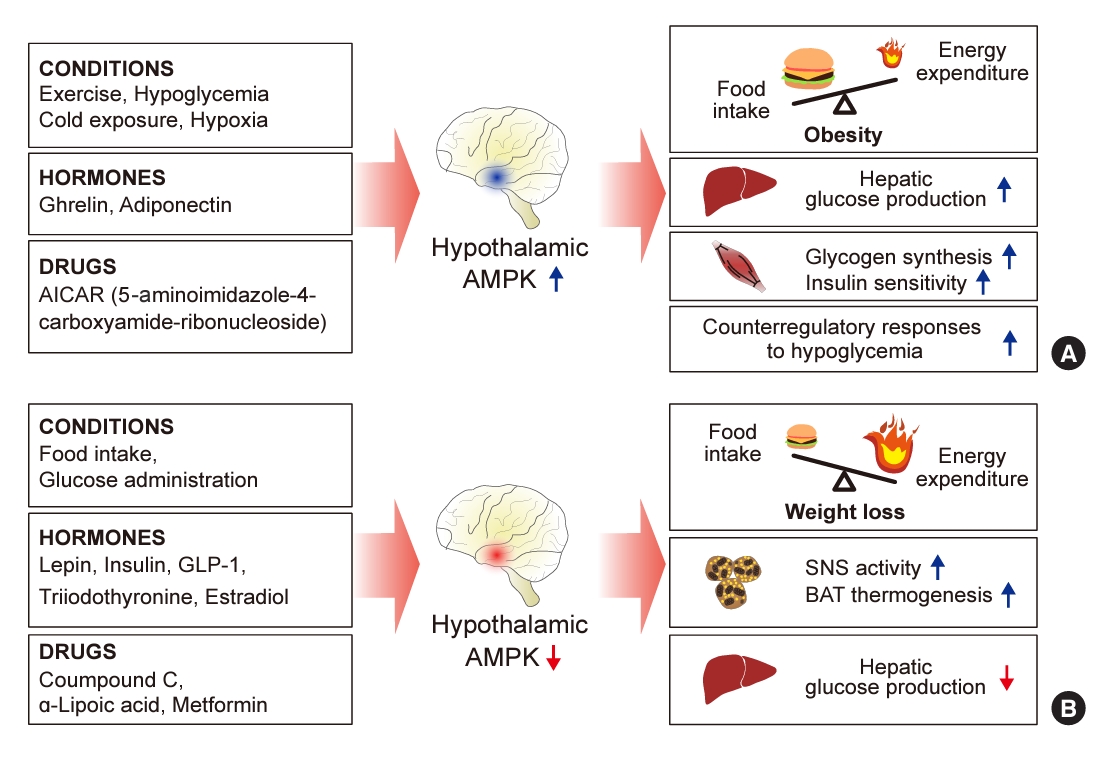
- 5´-Adenosine monophosphate (AMP)-activated protein kinase (AMPK), a cellular energy sensor, is an essential enzyme that helps cells maintain stable energy levels during metabolic stress. The hypothalamus is pivotal in regulating energy balance within the body. Certain neurons in the hypothalamus are sensitive to fluctuations in food availability and energy stores, triggering adaptive responses to preserve systemic energy equilibrium. AMPK, expressed in these hypothalamic neurons, is instrumental in these regulatory processes. Hypothalamic AMPK activity is modulated by key metabolic hormones. Anorexigenic hormones, including leptin, insulin, and glucagon-like peptide 1, suppress hypothalamic AMPK activity, whereas the hunger hormone ghrelin activates it. These hormonal influences on hypothalamic AMPK activity are central to their roles in controlling food consumption and energy expenditure. Additionally, hypothalamic AMPK activity responds to variations in glucose concentrations. It becomes active during hypoglycemia but is deactivated when glucose is introduced directly into the hypothalamus. These shifts in AMPK activity within hypothalamic neurons are critical for maintaining glucose balance. Considering the vital function of hypothalamic AMPK in the regulation of overall energy and glucose balance, developing chemical agents that target the hypothalamus to modulate AMPK activity presents a promising therapeutic approach for metabolic conditions such as obesity and type 2 diabetes mellitus.
-
Citations
Citations to this article as recorded by- Cross-Talk Between Signaling and Transcriptional Networks Regulating Thermogenesis—Insights into Canonical and Non-Canonical Regulatory Pathways
Klaudia Simka-Lampa
International Journal of Molecular Sciences.2026; 27(2): 754. CrossRef - From intestinal messenger to next-generation therapeutics: A review on mechanisms and prospects of host metabolic regulation mediated by P9, a secreted protein from Akkermansia muciniphila
Zhiming Long, Jiaxuan Li, Fengmei Zhu, Xiaojing Liu, Jiefang Zhou, Jun Li, Wentao Xu
International Journal of Biological Macromolecules.2026; 353: 151199. CrossRef - Alterations of Growth Performance, Blood Parameters, and Antioxidant Function of Brown Adipose Tissue in Mice Exposed to Cold
Xuekai Zhang, Xiao Jin, Zhipeng Han, Min Jiang, Binlin Shi
Antioxidants.2026; 15(4): 476. CrossRef - Lactylation: Unlocking the regulatory code of exercise-mediated anti-aging
Xin Li, Kang-cheng Fan, Gui-yan Sun, Zhuo Wang
Ageing Research Reviews.2026; 118: 103143. CrossRef - Reprogramming metabolic dysfunction in diabetes: The emerging role of taurine from molecular mechanisms to clinical translation
Shrushti Ambade, Siddhi S. Sandekar, Radheshyam T. Lohiya, Swati N. Lade, Diksha S. Undirwade, Milind J. Umekar, Sushil S. Burle, Aarti S. Zanwar
Obesity Medicine.2026; 61: 100713. CrossRef - Mitochondrial Signaling and Stress Responses, Key Regulators of Aging and Longevity
Yi Sheng, Zachary Markovich, Sung Min Han, Rui Xiao
BioEssays.2026;[Epub] CrossRef - Rewiring nutrition: Chemical insights into the physiological and microbiological roles of food's microconstituents
Mohammad Nazrul Islam Bhuiyan
Food Biomacromolecules.2026; 3(3): 444. CrossRef - Metformin as a promising therapeutic option for reducing substance withdrawal syndromes: A narrative review
Soha Azadi, Maysam Fadaei-Kenarsary, Keivan Sahebi, Maryam Baneshi, Amir Tajbakhsh, Hossein Niknahad, Manica Negahdaripour
Biomedicine & Pharmacotherapy.2026; 200: 119553. CrossRef - Exercise attenuates cisplatin-induced anorexia-cachexia via modulation of hypothalamic inflammation and orexigenic signaling
Se Hwan Park, Jeong Rim Ko, Chang Shin Yoon, Nam Mi Park, Maria Victoria Faith V. Garcia, Hyung Kyu Kim, Jin Han
European Journal of Applied Physiology.2026; 126(8): 4639. CrossRef - Targeting neuropeptide Y receptors for obesity management: Mechanistic insights, pharmacological advances, and translational challenges
Kalyani R. Thombre, Krishna R. Gupta, Milind J. Umekar
Obesity Medicine.2026; 63: 100739. CrossRef - Decoding the PI3K/Akt/mTOR-AMPK signalling nexus: molecular crosstalk, metabolic reprogramming and therapeutic targeting in human disease
Josef Yakin, Faruk Alam, Jose Fernando G. Elpa
Journal of Immunoassay and Immunochemistry.2026; : 1. CrossRef - Mangiferin monosodium salt attenuates metabolic and alcohol-associated liver disease via a novel insight into cuproptosis and improving gut microbiota
Qingqing Zhang, Chongzheng Pang, Lehua Chen, Ruikai Yan, Xue Yu, Baohua Chen, Baoku Li, Chengyan Zhou
Toxicology and Applied Pharmacology.2026; 516: 118035. CrossRef - Neurobiological mechanisms of nicotine's effects on feeding and body weight
Ying Li, Jian Mao, Guobi Chai, Ruimao Zheng, Xingyu Liu, Jianping Xie
Neuroscience & Biobehavioral Reviews.2025; 169: 106021. CrossRef - Thermogenesis and Energy Metabolism in Brown Adipose Tissue in Animals Experiencing Cold Stress
Xuekai Zhang, Jin Xiao, Min Jiang, Clive J. C. Phillips, Binlin Shi
International Journal of Molecular Sciences.2025; 26(7): 3233. CrossRef - Gestational saccharin consumption disrupts gut-brain axis glucose homeostasis control in adolescent offspring rats in a sex-dependent manner
Beatriz Pacheco-Sánchez, Sonia Melgar-Locatelli, Raquel López-Merchán, María José Benítez-Marín, Marta Blasco-Alonso, Ernesto González-Mesa, Rubén Tovar, Pablo Rubio, Juan Suárez, Carlos Sanjuan, Fernando Rodríguez de Fonseca, Francisco Alén, Marialuisa d
Biology of Sex Differences.2025;[Epub] CrossRef - Molecular aspects of metformin’s anti-aging properties for muscle function and longevity in Drosophila melanogaster
Milind Umekar, Mohammad Qutub, Tanvi Premchandani, Amol Tatode, Jayshree Taksansde, Priyanka Singanwad, Mayur Kale, Mithun Maniyar, Ujban Md Hussain
Precision Medication.2025; 2(4): 100051. CrossRef - Paraventricular nucleus–locus coeruleus VGlut2 neural circuit regulates energy metabolism in mice
Haodong Liu, Penghui Li, Mingyang Yu, Xin Zhang, Hefeng Zhu, Yang He, Zelin Zhang, Xiaolong Li, Bingkun Teng, Jiaxin Fan, Wenchao Yang, Junzhe Yin, Qinqin Hao, Guifang Cao, Haijun Li, Shuying Liu, Yongqiang Li, Junguang Ren, Yujie Chen, Chenguang Du
Cell Death & Disease.2025;[Epub] CrossRef - CL316,243 and skeletal muscle metabolism: role of sex and estrogen receptor beta
Alan Maloney, Jinseok Lee, Eric D Queathem, Kylie A Schaller, Shahad Buckhary, Dennis B Lubahn, Rudy J Valentine, Victoria J Vieira-Potter
Journal of Endocrinology.2025;[Epub] CrossRef - Differential Efficacy of Weight Loss Interventions in Patients with Versus Without Diabetes
Federico Losada-Díaz, Santiago Lizarazo-Bocanegra, Juan J. Perdomo-Lugo, Sebastián A. Gutiérrez-Romero, Isabella Correa-Osio, Carlos O. Mendivil
Diabetes Therapy.2024; 15(11): 2279. CrossRef - Glucagon-like peptide-1 receptor: mechanisms and advances in therapy
Zhikai Zheng, Yao Zong, Yiyang Ma, Yucheng Tian, Yidan Pang, Changqing Zhang, Junjie Gao
Signal Transduction and Targeted Therapy.2024;[Epub] CrossRef
- Cross-Talk Between Signaling and Transcriptional Networks Regulating Thermogenesis—Insights into Canonical and Non-Canonical Regulatory Pathways
Review Article
- Diabetes, Obesity and Metabolism
- Roles of Protein Arginine Methyltransferases in the Control of Glucose Metabolism
- Hye-Sook Han, Dahee Choi, Seri Choi, Seung-Hoi Koo
- Endocrinol Metab. 2014;29(4):435-440. Published online December 29, 2014
- DOI: https://doi.org/10.3803/EnM.2014.29.4.435
- 10,332 View
- 76 Download
- 26 Web of Science
- 25 Crossref
-
Abstract
PDFPubReader
Glucose homeostasis is tightly controlled by the regulation of glucose production in the liver and glucose uptake into peripheral tissues, such as skeletal muscle and adipose tissue. Under prolonged fasting, hepatic gluconeogenesis is mainly responsible for glucose production in the liver, which is essential for tissues, organs, and cells, such as skeletal muscle, the brain, and red blood cells. Hepatic gluconeogenesis is controlled in part by the concerted actions of transcriptional regulators. Fasting signals are relayed by various intracellular enzymes, such as kinases, phosphatases, acetyltransferases, and deacetylases, which affect the transcriptional activity of transcription factors and transcriptional coactivators for gluconeogenic genes. Protein arginine methyltransferases (PRMTs) were recently added to the list of enzymes that are critical for regulating transcription in hepatic gluconeogenesis. In this review, we briefly discuss general aspects of PRMTs in the control of transcription. More specifically, we summarize the roles of four PRMTs: PRMT1, PRMT 4, PRMT 5, and PRMT 6, in the control of hepatic gluconeogenesis through specific regulation of FoxO1- and CREB-dependent transcriptional events.
-
Citations
Citations to this article as recorded by- Protein arginine methyltransferases as metabolic regulators: many roles beyond cancer
Fan Wang, Fan Yao, Fan Ye, Bin Zhang, Zhihao Jia, Xiaobo Sun
Science China Life Sciences.2026;[Epub] CrossRef -
Dysregulated m
6
A via compensatory arginine methylation primes premalignancy in metabolic dysfunction–associated steatotic liver disease
Geun-Woo D. Kim, Dahee Choi, Soo-Young Kim, Haengdueng Jeong, Geon Kang, So Jung Eom, Sangkyeong Eom, Jinyoung Park, Hye-Sook Lee, Insook Yang, Je Kyung Sung, Ki Taek Nam, Young Nyun Park, Sung Wook Chi, Seung-Hoi Koo
Science Advances.2026;[Epub] CrossRef - Protein Arginine Methyltransferase 1: A Multi-Purpose Player in the Development of Cancer and Metabolic Disease
Daphne de Korte, Menno Hoekstra
Biomolecules.2025; 15(2): 185. CrossRef - PRMT1 in Health and Disease: Emerging Perspectives From Molecular Mechanisms to Therapeutic Strategies
Yanqun Luo, Ying Gao, Xiaoliang Deng, Lei Wang, Tao Wu
MedComm.2025;[Epub] CrossRef - Regulation of hepatic lipogenesis by asymmetric arginine methylation
Hye-Sook Han, Byeong Hun Choi, Seo Young Jang, Seri Choi, Geum-Sook Hwang, Seung-Hoi Koo
Metabolism.2024; 157: 155938. CrossRef - Protein Arginine Methyltransferases: Emerging Targets in Cardiovascular and Metabolic Disease
Yan Zhang, Shibo Wei, Eun-Ju Jin, Yunju Jo, Chang-Myung Oh, Gyu-Un Bae, Jong-Sun Kang, Dongryeol Ryu
Diabetes & Metabolism Journal.2024; 48(4): 487. CrossRef - Anoikis resistance and immune escape mediated by Epstein-Barr virus-encoded latent membrane protein 1-induced stabilization of PGC-1α promotes invasion and metastasis of nasopharyngeal carcinoma
Chaoliang Liao, Min Li, Xue Chen, Chenpeng Tang, Jing Quan, Ann M. Bode, Ya Cao, Xiangjian Luo
Journal of Experimental & Clinical Cancer Research.2023;[Epub] CrossRef - An Overview of Epigenetics in Obesity: The Role of Lifestyle and Therapeutic Interventions
Abeer M. Mahmoud
International Journal of Molecular Sciences.2022; 23(3): 1341. CrossRef - Protein Arginine Methyltransferase (PRMT) Inhibitors—AMI-1 and SAH Are Effective in Attenuating Rhabdomyosarcoma Growth and Proliferation in Cell Cultures
Joanna Janisiak, Patrycja Kopytko, Marta Tkacz, Dorota Rogińska, Magdalena Perużyńska, Bogusław Machaliński, Andrzej Pawlik, Maciej Tarnowski
International Journal of Molecular Sciences.2021; 22(15): 8023. CrossRef - Depletion ofPrmt1in Adipocytes Impairs Glucose Homeostasis in Diet-Induced Obesity
Seri Choi, Dahee Choi, Yun-Kyung Lee, Seung Hyun Ahn, Je Kyung Seong, Sung Wook Chi, Tae Jung Oh, Sung Hee Choi, Seung-Hoi Koo
Diabetes.2021; 70(8): 1664. CrossRef - Structure, Activity and Function of the Protein Arginine Methyltransferase 6
Somlee Gupta, Rajashekar Varma Kadumuri, Anjali Kumari Singh, Sreenivas Chavali, Arunkumar Dhayalan
Life.2021; 11(9): 951. CrossRef - Dysregulacja poziomu metylotransferaz argininy w patogenezie chorób nowotworowych
Joanna Janisiak, Patrycja Kopytko, Maciej Tarnowski
Postępy Higieny i Medycyny Doświadczalnej.2021; 75(1): 272. CrossRef - Non-Histone Arginine Methylation by Protein Arginine Methyltransferases
Ayad A. Al-Hamashi, Krystal Diaz, Rong Huang
Current Protein & Peptide Science.2020; 21(7): 699. CrossRef - Posttranslational regulation of PGC‐1α and its implication in cancer metabolism
Xiangjian Luo, Chaoliang Liao, Jing Quan, Can Cheng, Xu Zhao, Ann M. Bode, Ya Cao
International Journal of Cancer.2019; 145(6): 1475. CrossRef - PRMT1 suppresses ATF4-mediated endoplasmic reticulum response in cardiomyocytes
Myong-Ho Jeong, Hyeon-Ju Jeong, Byeong-Yun Ahn, Jung-Hoon Pyun, Ilmin Kwon, Hana Cho, Jong-Sun Kang
Cell Death & Disease.2019;[Epub] CrossRef - Synthesis of SAM‐Adenosine Conjugates for the Study of m6A‐RNA Methyltransferases
Colette Atdjian, Laura Iannazzo, Emmanuelle Braud, Mélanie Ethève‐Quelquejeu
European Journal of Organic Chemistry.2018; 2018(32): 4411. CrossRef - Chemical probes targeting epigenetic proteins: Applications beyond oncology
Suzanne Ackloo, Peter J. Brown, Susanne Müller
Epigenetics.2017; 12(5): 378. CrossRef - Development of Potent Type I Protein Arginine Methyltransferase (PRMT) Inhibitors of Leukemia Cell Proliferation
Chen Wang, Hao Jiang, Jia Jin, Yiqian Xie, Zhifeng Chen, Hao Zhang, Fulin Lian, Yu-Chih Liu, Chenhua Zhang, Hong Ding, Shijie Chen, Naixia Zhang, Yuanyuan Zhang, Hualiang Jiang, Kaixian Chen, Fei Ye, Zhiyi Yao, Cheng Luo
Journal of Medicinal Chemistry.2017; 60(21): 8888. CrossRef - Sensitive determination of glucose in Dulbecco's modified Eagle medium by high‐performance liquid chromatography with 1‐phenyl‐3‐methyl‐5‐pyrazolone derivatization: application to gluconeogenesis studies
Zhaoli Ling, Ping Xu, Zeyu Zhong, Fan Wang, Nan Shu, Ji Zhang, Xiange Tang, Li Liu, Xiaodong Liu
Biomedical Chromatography.2016; 30(4): 601. CrossRef - Biochemistry and regulation of the protein arginine methyltransferases (PRMTs)
Yalemi Morales, Tamar Cáceres, Kyle May, Joan M. Hevel
Archives of Biochemistry and Biophysics.2016; 590: 138. CrossRef - Are epigenetic drugs for diabetes and obesity at our door step?
Andrix O. Arguelles, Sunitha Meruvu, John D. Bowman, Mahua Choudhury
Drug Discovery Today.2016; 21(3): 499. CrossRef - Expression of epigenetic machinery genes is sensitive to maternal obesity and weight loss in relation to fetal growth in mice
Polina E. Panchenko, Sarah Voisin, Mélanie Jouin, Luc Jouneau, Audrey Prézelin, Simon Lecoutre, Christophe Breton, Hélène Jammes, Claudine Junien, Anne Gabory
Clinical Epigenetics.2016;[Epub] CrossRef - Vasculoprotective Effects of 3-Hydroxybenzaldehyde against VSMCs Proliferation and ECs Inflammation
Byung Soo Kong, Soo Jung Im, Yang Jong Lee, Yoon Hee Cho, Yu Ri Do, Jung Woo Byun, Cheol Ryong Ku, Eun Jig Lee, Maria Cristina Vinci
PLOS ONE.2016; 11(3): e0149394. CrossRef - Articles in 'Endocrinology and Metabolism' in 2014
Won-Young Lee
Endocrinology and Metabolism.2015; 30(1): 47. CrossRef - Icariin regulates PRMT/ADMA/DDAH pathway to improve endothelial function
Hong-Bo Xiao, Zi-Kui Liu, Xiang-Yang Lu, Chun-Na Deng, Zhi-Feng Luo
Pharmacological Reports.2015; 67(6): 1147. CrossRef
- Protein arginine methyltransferases as metabolic regulators: many roles beyond cancer
Original Article
- The Effects of Growth Hormone Tretment on Body Composition and Glucose Metabolism in Adult Hypophysectomized Rats.
- Kwan Woo Lee, Hyun Chul Lee, Kap Bum Huh, Yoon Sok Chung, Deok Bae Park, Yup Kang, Hyeon Man Kim, Seoung Oh Yang
- J Korean Endocr Soc. 1997;12(1):53-60. Published online January 1, 2001
- 2,236 View
- 22 Download
-
Abstract
PDF
- BACKGROUND
It is well known that growth hormone (GH) stimulates animal growth, but studies on metabolic effects of growth hormone have recently been increasing. The purpose of this study was to clarify the effects of growth hormone treatment on body composition and glucose metabolism in hypophysectomized growth hormone-deficient rats. METHODS: The 20-week-old rnale Sprague-Dawley rats were hypophysectomized and replaced with cortisol and thyroxine for 8 weeks, then administered with recombinant human growth hormone for 2 weeks. Group 1 consisted of intact controls (n 15), while group 2 consisted of hypophysectomized controls (n 12), and group three consisted of those with GH treatment (n 13). The body weights, body composition, blood glucose levels, plasma insulin-like growth factor-I (IGF-I) levels, euglycemic hyperinsulinemic clamp test, and glycogen synthase activities in gastrocnemius muscle were measured before and after growth hormone treatment. RESULTS: Plasma IGF-I levels in GH-treated group increased to intact control group levels after 2 weeks of GH treatment. There were significant changes in body composition after the treatment (fat mass significantly decreased and lean body mass significantly increased). There were no changes in glucose metabolism in peripheral tissue after 2 weeks of GH treatment. CONCLUSION: Human GH treatment (4 IU/kg/day) in adult hypophysectomized GH-deficient rats changed the body composition, but did not alter the glucose metabolism in peripheral tissue.
 First
 Prev


